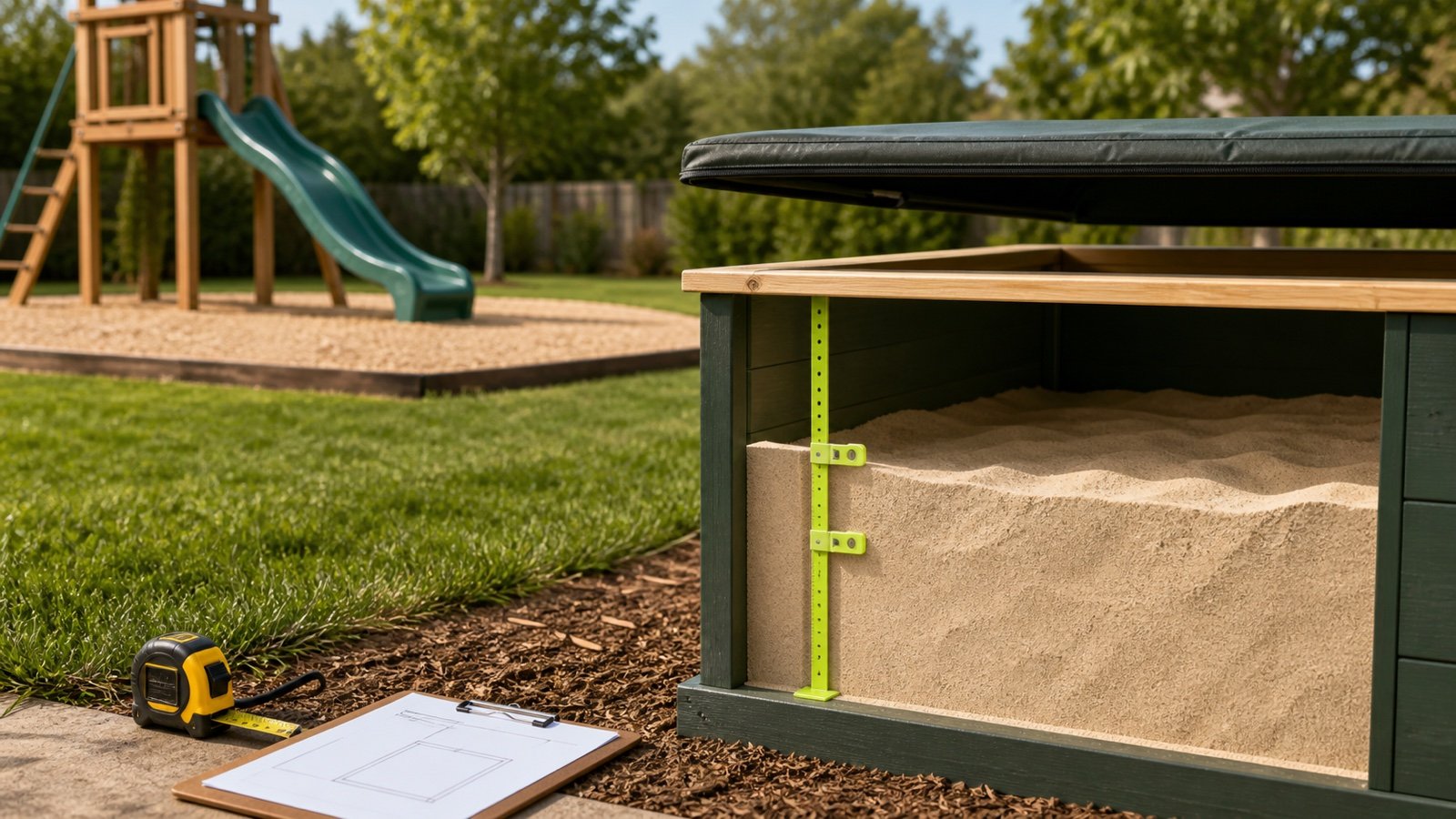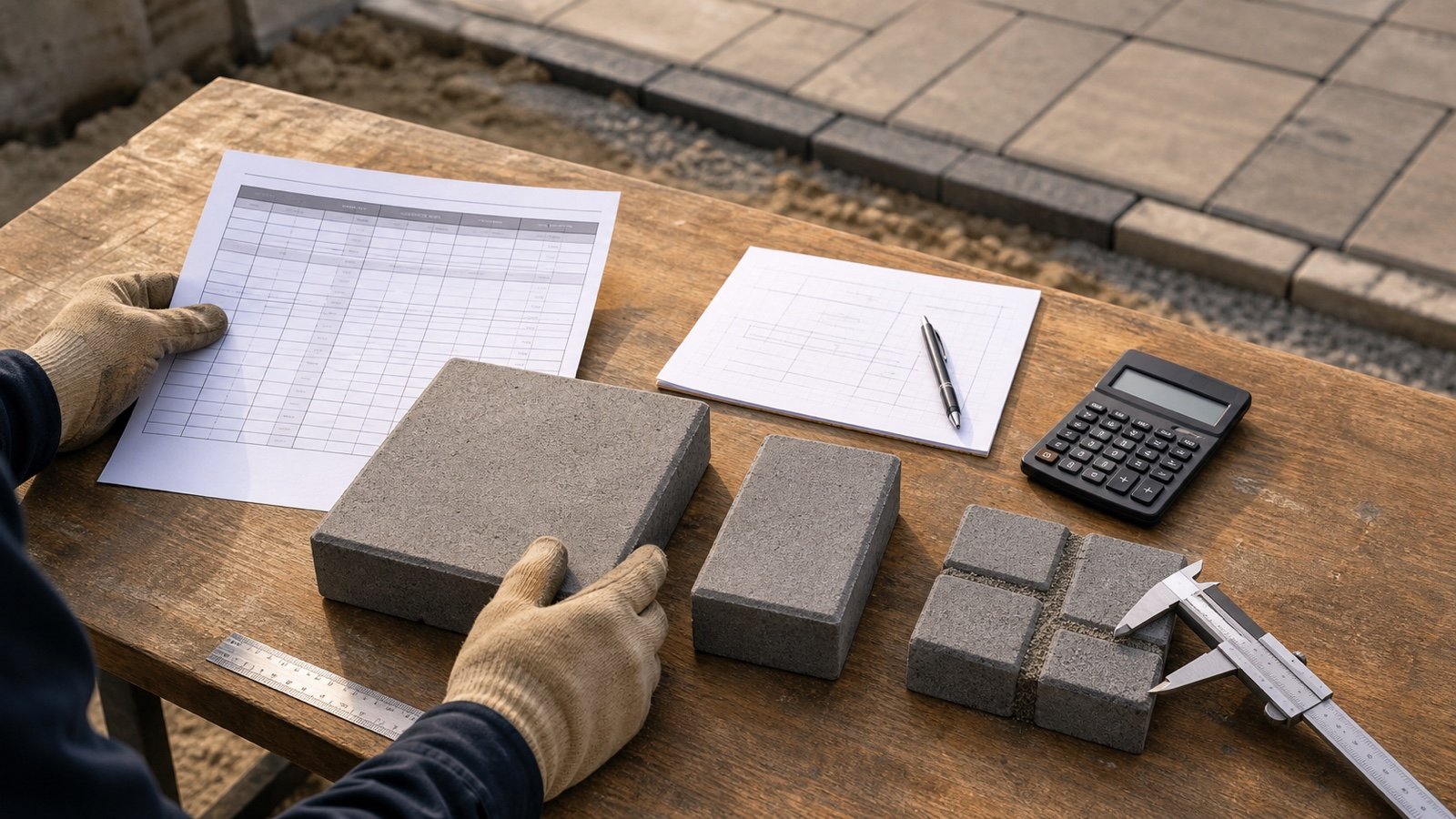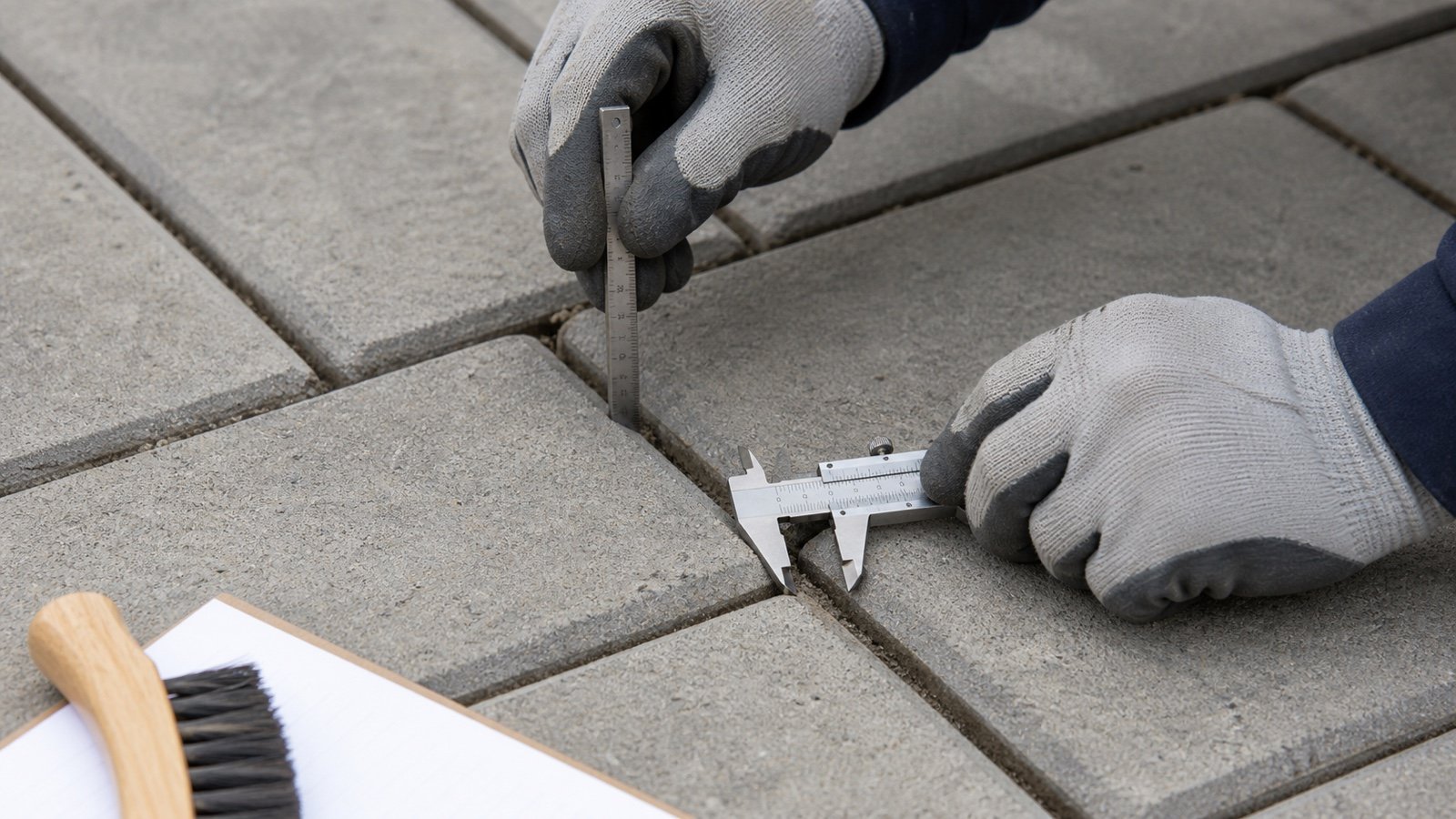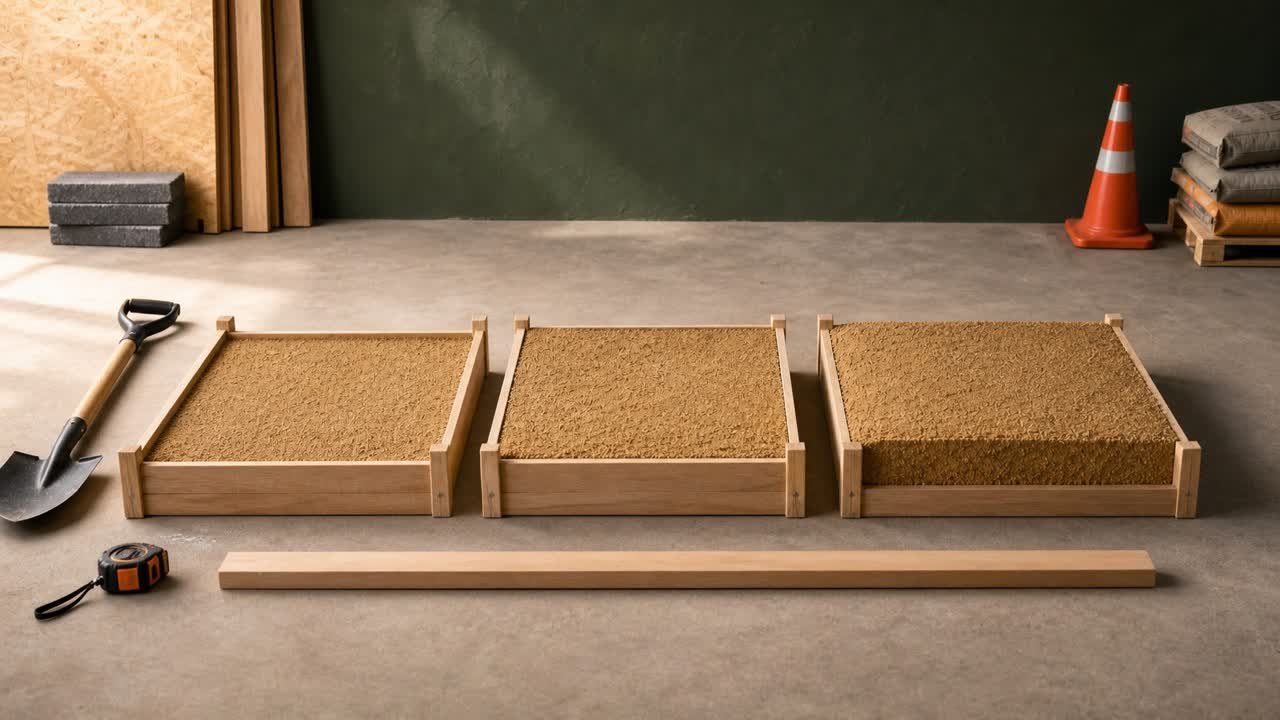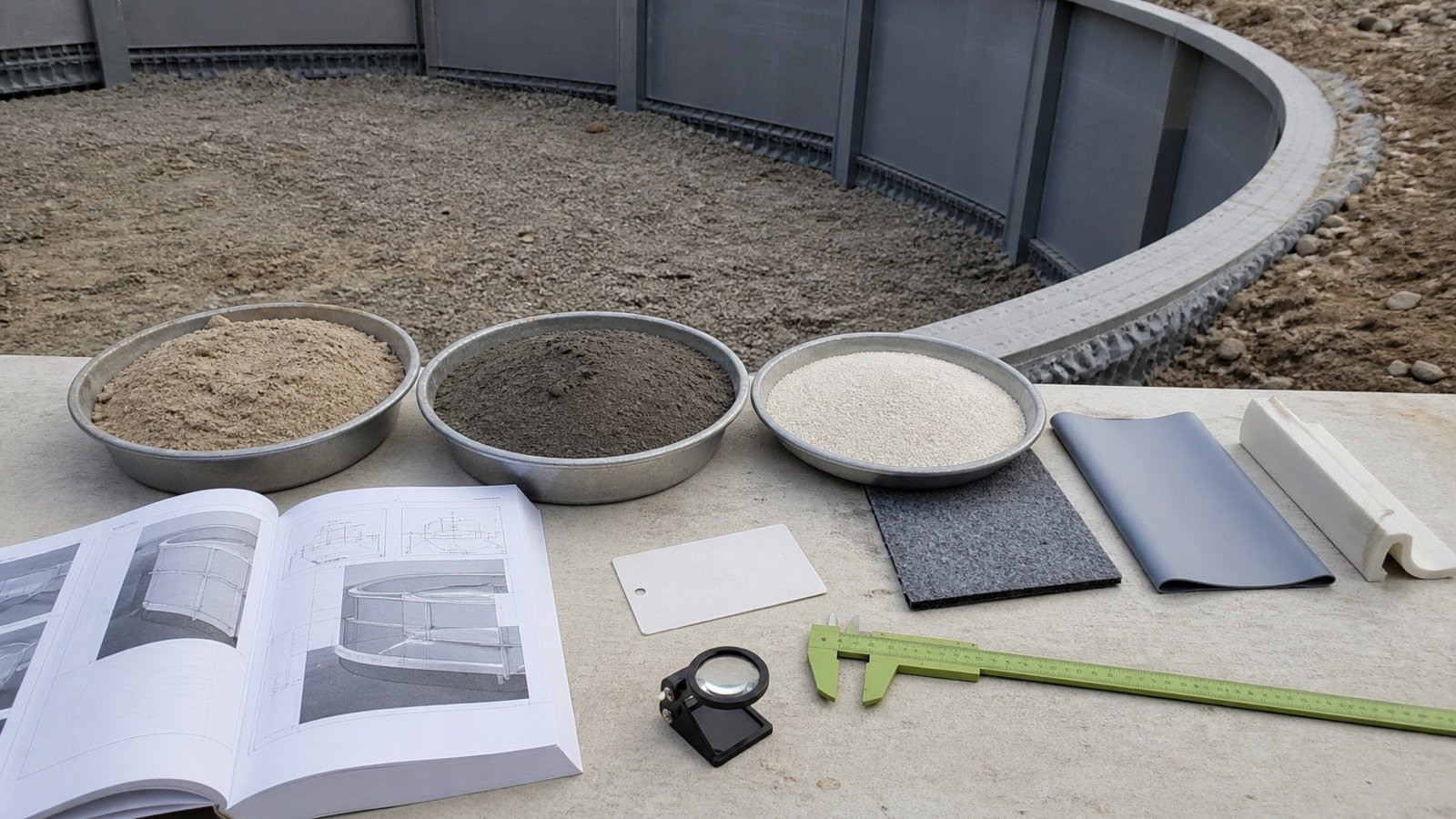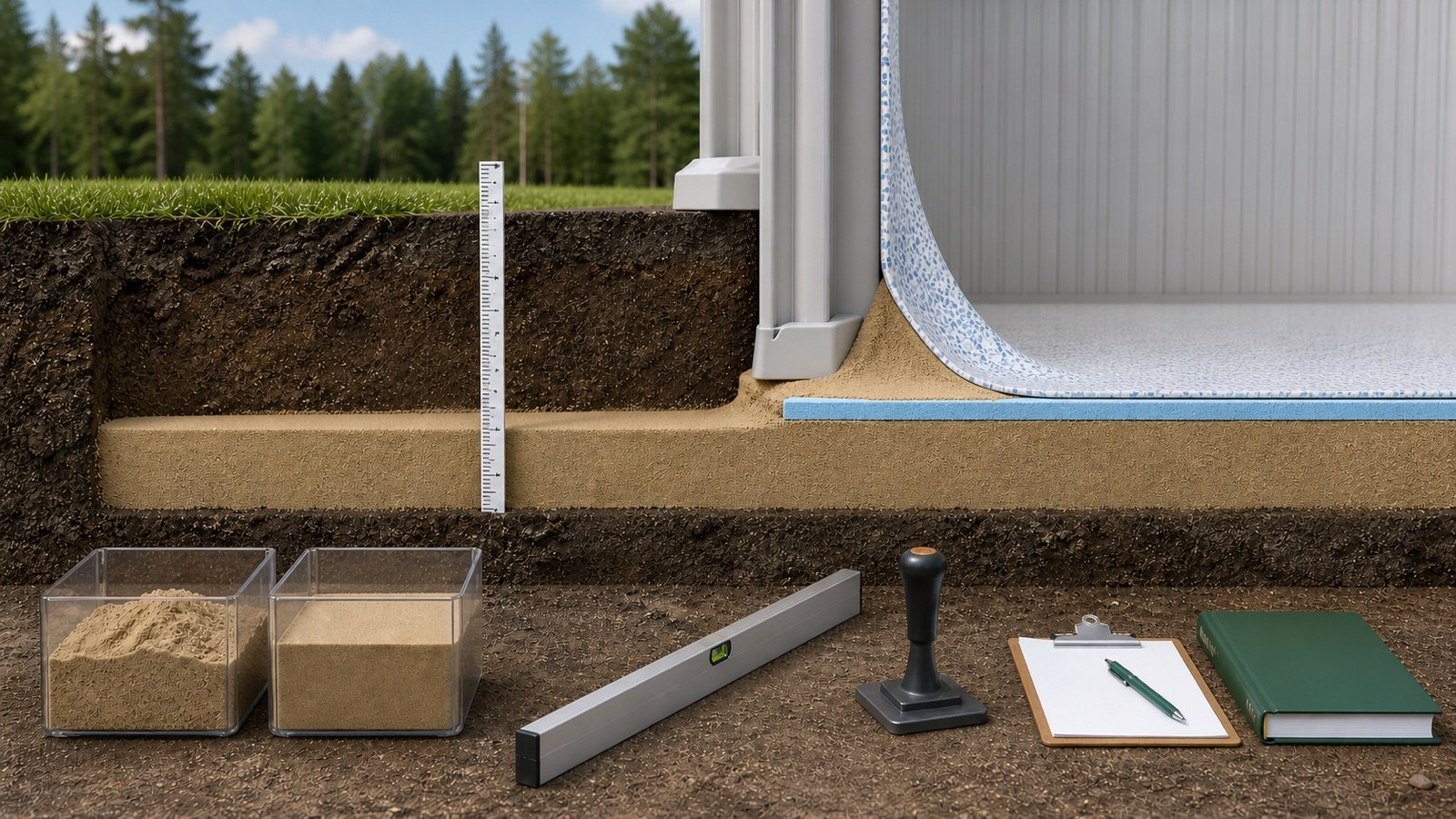
A pool-base depth must come from the current instructions for the exact pool or liner system. A general 2 in figure may match one manual and conflict with another system that uses a different material, compacted thickness or no sand layer.
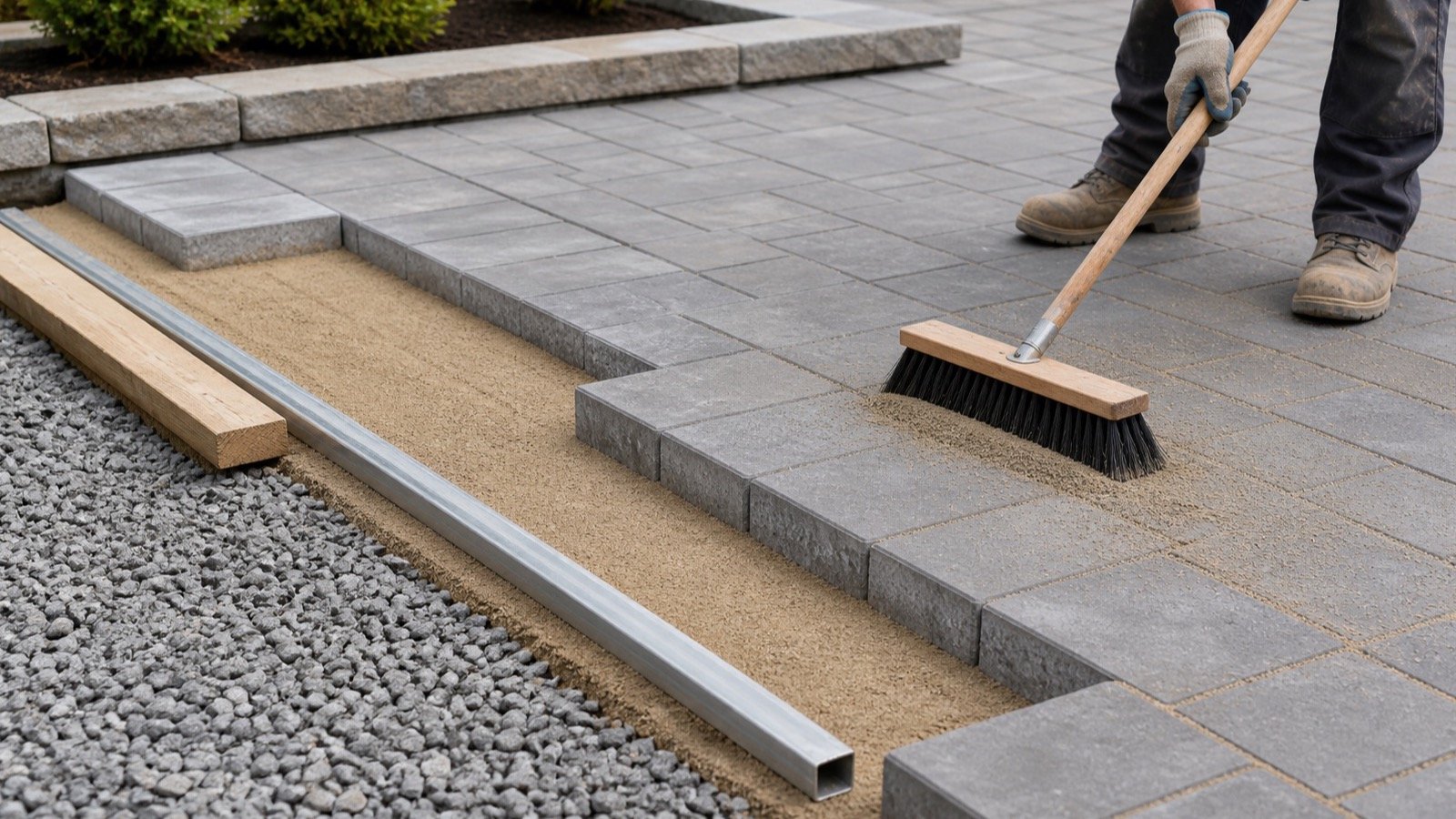
Record the finished uniform layer that sits under the pool floor. Keep loose placement thickness, wall cove, site leveling, support trenches and pool-pad thickness on separate lines before calculating a quantity.
How deep should sand be under an above-ground pool?
Use the depth and material stated by the exact pool manual. The live documents reviewed for this guide range from a 5 cm (2 in) sand layer to a 2 to 3 in compacted aggregate detail, while one Bestway frame-pool manual says sand must not create a level base.
No average of those instructions produces a safe universal depth. Match the manufacturer, model, size, manual revision, material, footprint and finished material state before entering depth in the Pool Base Sand Calculator.
Write the manual title and page beside the depth. If the exact instructions cannot be found or conflict with supplied components, stop the quantity decision and contact the manufacturer or responsible installer.
Why do pool-base depth instructions differ?
Pool walls, rails, legs, supports, liners and approved foundation materials differ by system. A flexible frame pool on prepared ground does not use the same foundation detail as a steel-wall oval pool with channels, blocks and A-frames.
The instruction can also describe a different material state. One manual may state the loose thickness before compaction, while another states the finished layer under the liner. Treat those as separate measurements.
| Document | Stated condition | Calculator-depth treatment |
|---|---|---|
| Bestway S-S-004972 | Firm, flat site; sand must not create a level base | Do not invent a sand depth for this system |
| ABGAL liner instruction | 5 cm (2 in) sand over the floor, plus a separate cove | Use 5 cm only when the exact pool and liner instructions accept that detail |
| Radiant Metric Oval R8 | Recommends 2 to 3 in of clean washed masonry sand or suitable base; its later schedule produces a 2 in floor layer and separate cove | Use the controlling system-specific finished floor value and keep the cove separate |
| CARVIN Equinox Round | Compaction sand or fine rock dust; 4 to 5 in loose at the perimeter becomes no more than 2 to 3 in after compaction | Record both states and use the accepted finished uniform layer for geometric volume |
These examples show variation; they do not offer a menu from which to choose a preferred depth. The exact pool instructions and accepted installation detail govern the work.
Does 2 inches work under every above-ground pool?
Two inches appears in several pool and liner documents, but it is not a universal rule. Bestway S-S-004972 gives no 2 in sand layer and prohibits sand as a leveling method for the named frame pools.
Radiant R8 uses 2 in as the floor result in one oval-system sand schedule. ABGAL uses 5 cm in its liner process. The same nominal value can still have different materials, boundaries, compaction instructions and cove requirements.
Which depth belongs in the calculator?
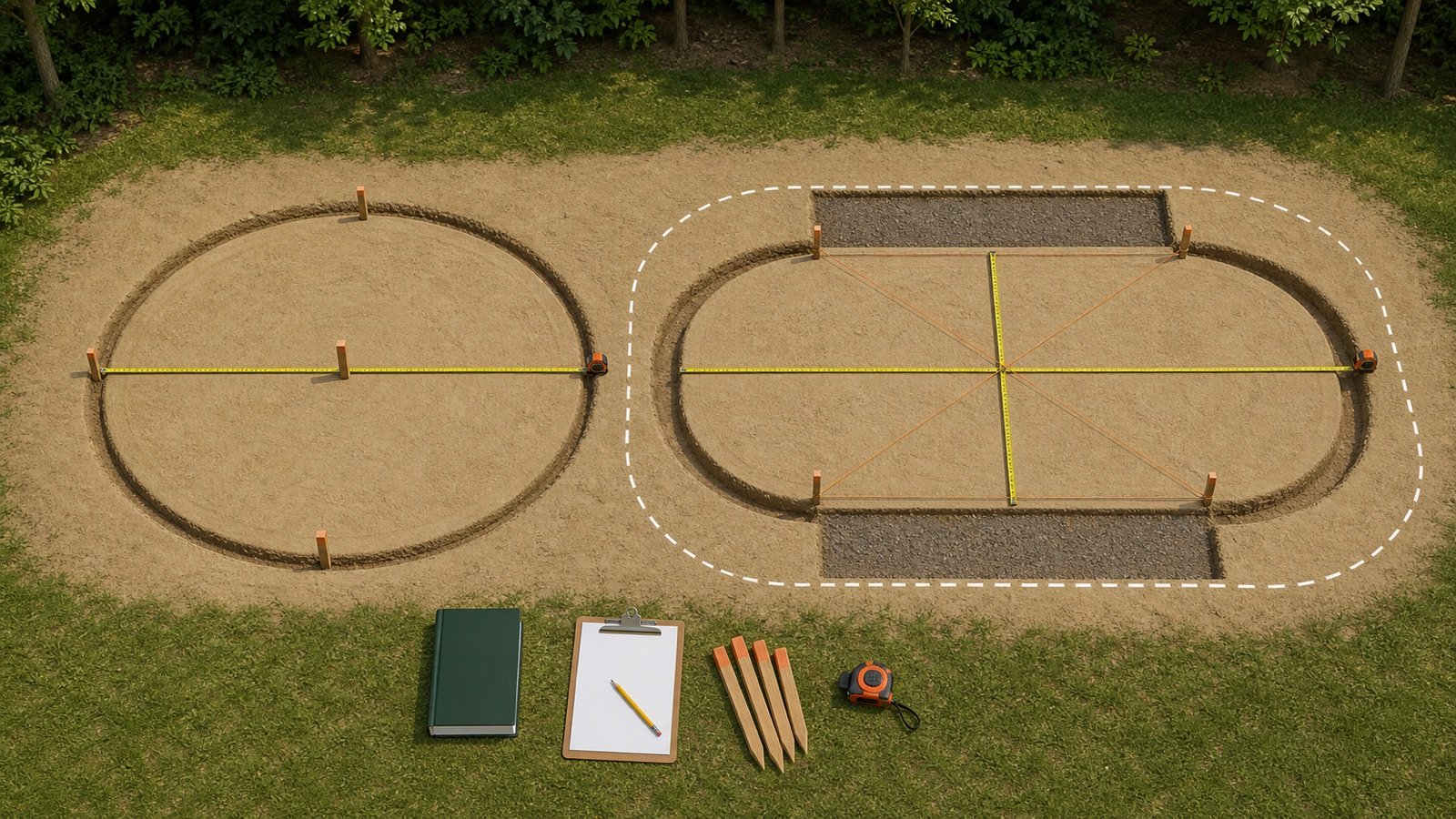
Enter the accepted finished thickness of one uniform flat-base layer. The footprint and depth must refer to the same layer and same boundary.
- Identify the exact manufacturer, model, size and supplied foundation components.
- Find the current installation manual and any liner or base-product instructions.
- Mark whether the document permits sand, stone dust, another base or prepared ground with no sand.
- Separate loose placement thickness from the finished compacted thickness.
- Separate the flat floor from the cove, wall track, supports, blocks and trenches.
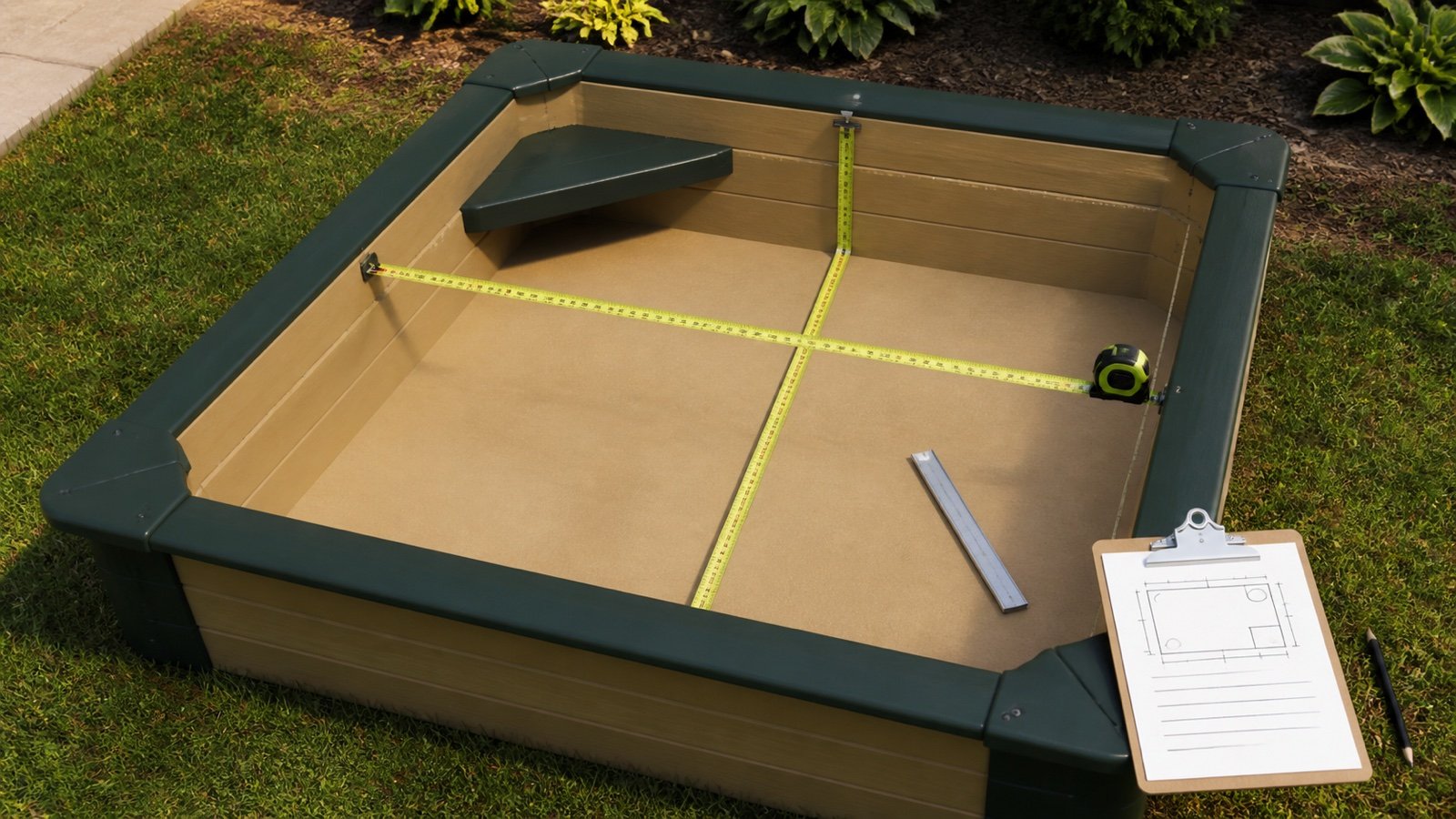
- Confirm the approved footprint using the pool-base measurement guide.
- Enter the finished uniform depth and record its source beside the result.
A stated material quantity can provide a reasonableness check when it covers the same floor and cove detail. Do not reverse-engineer one uniform depth from a combined sand schedule unless the manual separates those volumes.
How are loose and compacted thickness different?
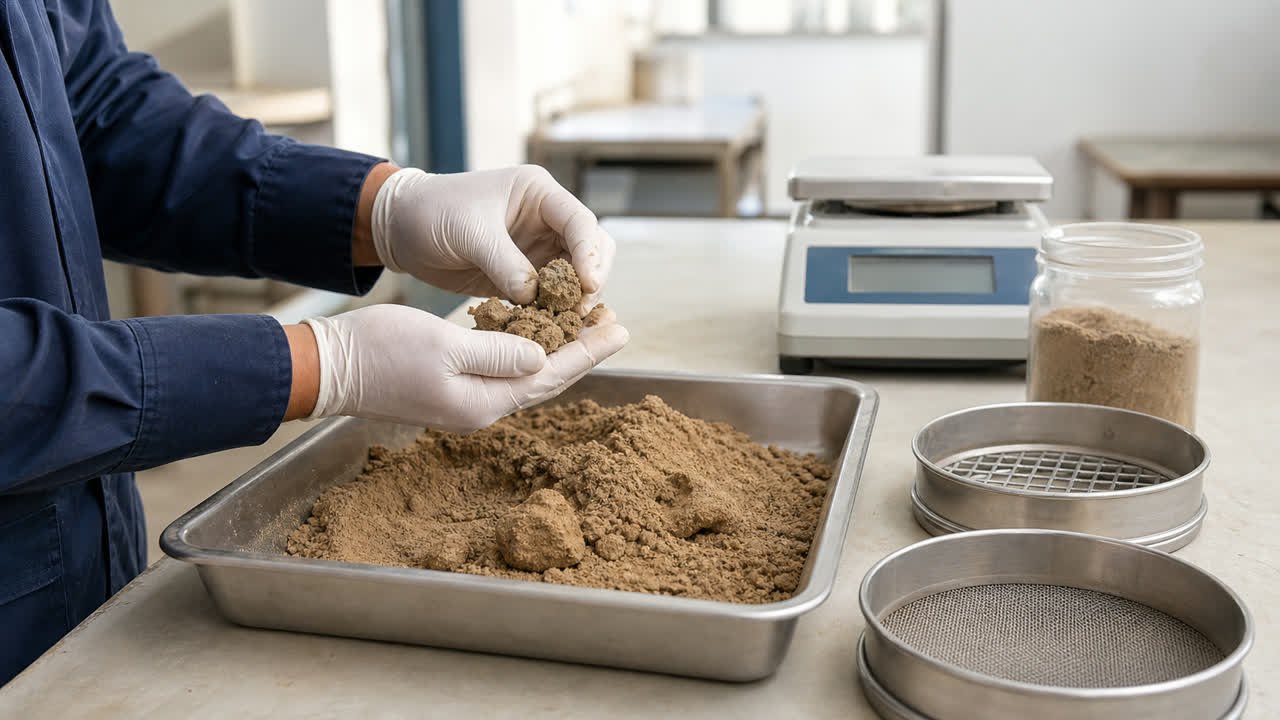
Loose thickness describes material before the stated compaction process. Finished compacted thickness describes the layer after placement and compaction. The change depends on the product, moisture, grading and procedure.
CARVIN's cited guide gives a clear system example: it calls for 4 to 5 in of uncompacted aggregate around the pool line and says the compacted result should be no more than 2 to 3 in. Entering 5 in as the finished depth would describe the wrong state.
| Record | Meaning | Quantity use |
|---|---|---|
| Loose placement thickness | Layer before the named compaction process | Supports placement planning only when the manual or test defines it |
| Finished compacted thickness | Accepted layer after compaction | Use for geometric finished-layer volume |
| Supplier loose volume | Selling or delivered condition | Convert from finished volume only with a documented yield or density basis |
| Handling allowance | Named loss or tolerance | Add after preserving the measured layer |
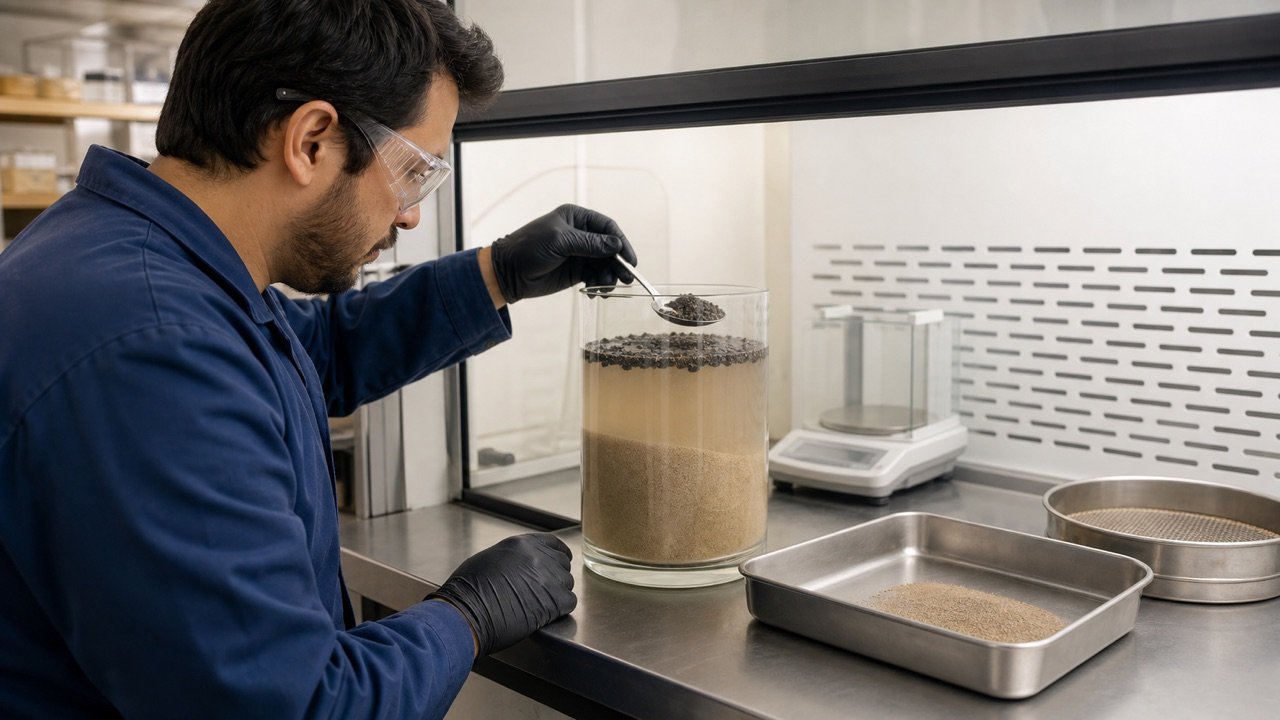
A fixed compaction percentage from another sand cannot bridge these records. Use manufacturer instructions, a project test section, supplier evidence or another accepted source for the actual conversion.
Can sand level a sloping pool site?
Do not convert a site slope into an average sand depth. Bestway S-S-004972 says the ground must be dug out where needed instead of using sand to create a level base.
CARVIN's Equinox guide also tells installers to remove the high side rather than add sand or soil to the low side. It limits level difference for that system and requires a solid, draining site.
A flat-layer calculator cannot design earthwork, retaining, drainage or support on fill. Follow the exact manual and obtain qualified site guidance where slope, weak soil, water or frost conditions affect the foundation.
Is cove height part of the flat sand depth?
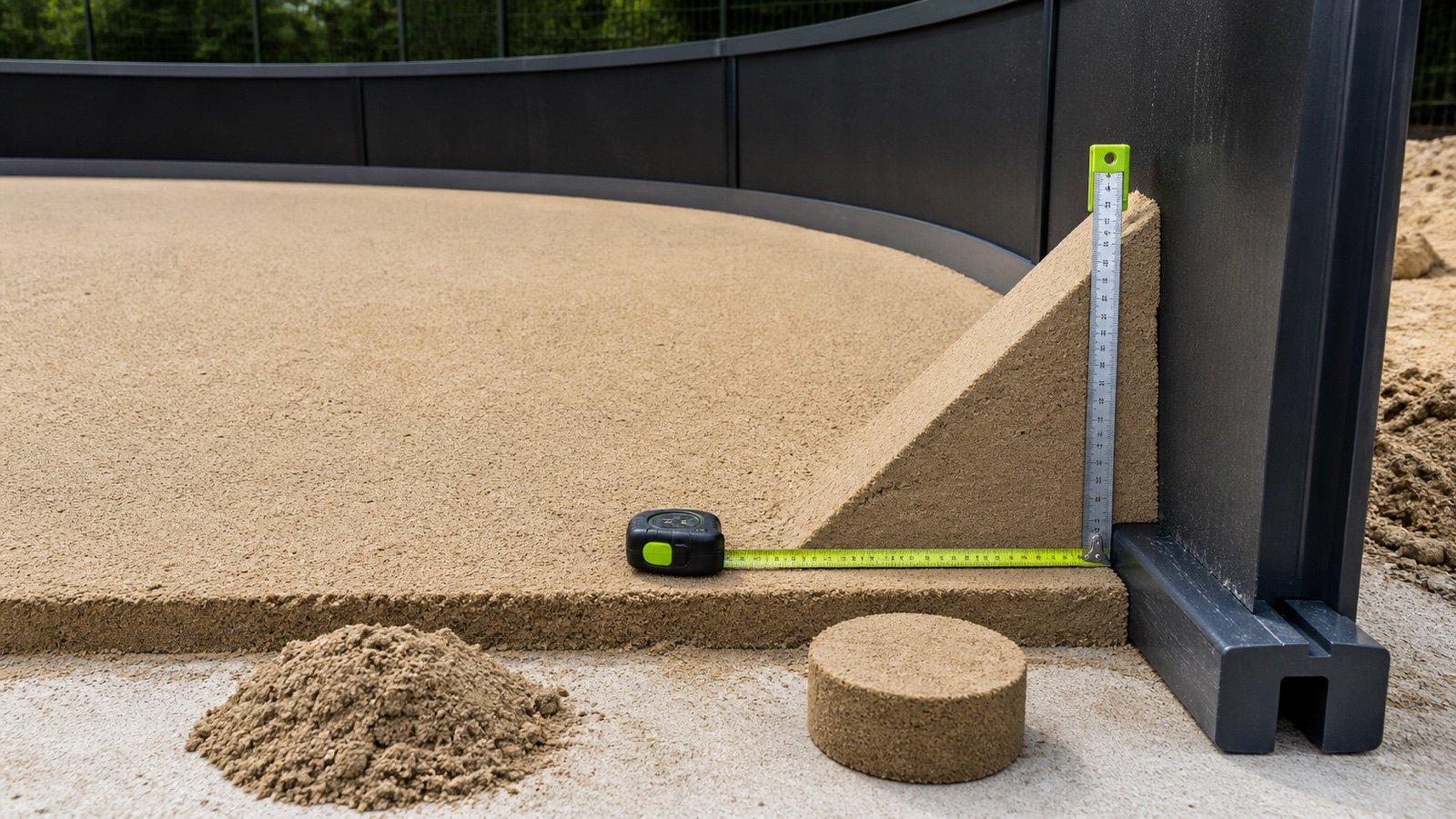
The cove is a separate perimeter shape at the wall and floor. Do not spread its height across the full pool area or add it as a fixed number of inches to the flat layer.
Radiant R8 states that its prescribed sand amount provides a 2 in pool floor and a 4 in cove, then describes a 3 to 4 in formed cove. ABGAL states a 5 cm floor layer and a separate cove at least 15 cm high. Each dimension applies to a different geometry.
A preformed cove or another permitted material also changes the sand quantity. The calculator excludes cove volume because the cross-section, perimeter and approved product need their own record.
Does a pool pad replace the sand layer?
A pad changes the liner-protection assembly only when the exact pool, liner and pad instructions permit it. Its presence does not prove that the stated foundation layer can be removed, reduced or changed.
ABGAL allows a ground sheet above or below the sand in its named liner process. That detail does not transfer to another pool. Record pad product, thickness, position and compatibility separately from the base material.
How much does a half-inch depth change affect quantity?
Depth changes volume in direct proportion when the footprint stays fixed. A half-inch can add a meaningful delivery quantity across a large round pool.
A 24 ft round footprint covers 452.3893 ft². The table holds that area constant and changes only the example depth.
| Example depth | Volume | Cubic yards |
|---|---|---|
| 1.5 in | 56.5487 ft³ | 2.0944 yd³ |
| 2 in | 75.3982 ft³ | 2.7925 yd³ |
| 2.5 in | 94.2478 ft³ | 3.4907 yd³ |
| 3 in | 113.0973 ft³ | 4.1888 yd³ |
Each additional 0.5 in adds 18.8496 ft³, or 0.6981 yd³, to this footprint. The table checks input sensitivity and does not recommend any listed depth.
Metric depth check
A 7.3 m round footprint covers 41.8539 m². At 50 mm, its uniform-layer volume is 2.0927 m³. At 75 mm, the result is 3.1390 m³.
Keep millimetres and centimetres out of a metre-based formula until they are converted. The calculator handles that conversion while preserving the entered source value.
How should finished depth be checked before the liner is installed?
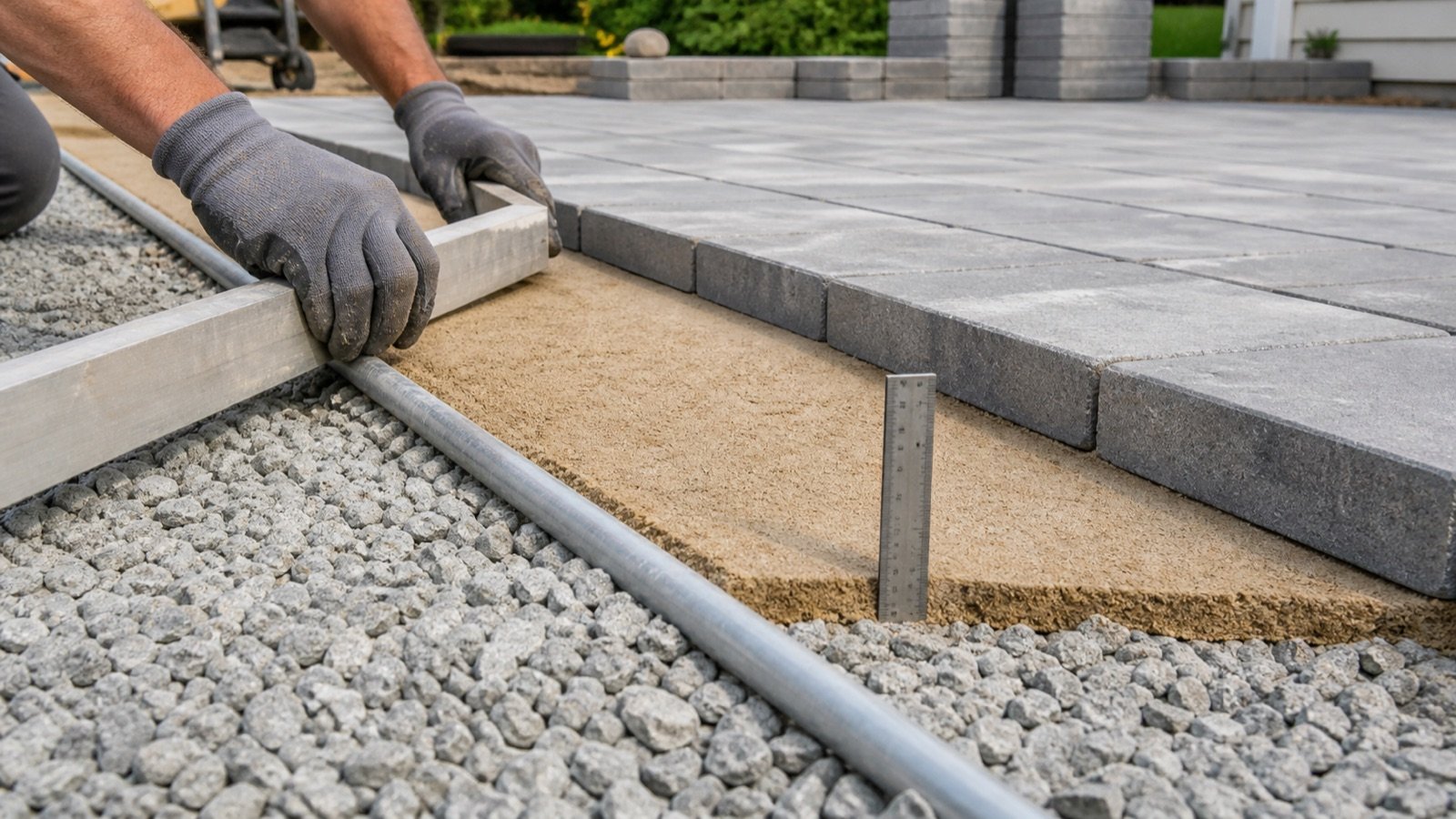
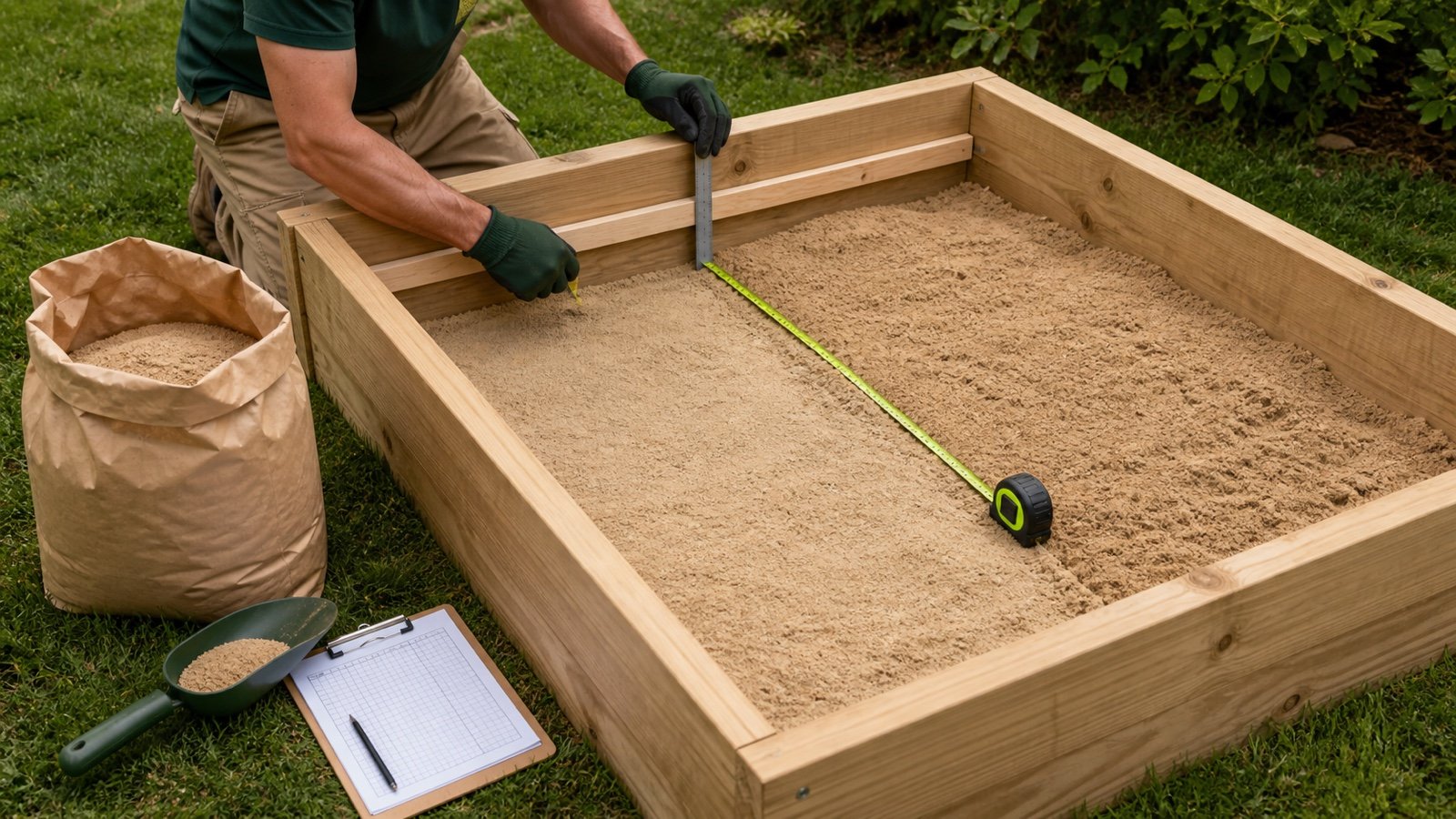
Use the benchmark, grid, straightedge and measurement procedure stated by the pool instructions. Record readings before the liner hides the base and before water makes correction unsafe.
- Confirm the supporting ground meets the specified level and compaction condition.
- Mark the flat-base boundary and the separate cove or support zones.
- Place and compact the permitted material under the stated process.
- Take depth readings at a planned grid or the control points named in the manual.
- Record low, high and target values instead of replacing them with one average.
- Correct out-of-tolerance areas under the approved method, then recheck level and smoothness.
- Photograph the completed record before the liner or pad covers it.
CARVIN's cited guide checks floor flatness on a grid and requires a separate level tolerance for its system. ABGAL tells installers to smooth, compact and remove marks from its stated sand floor. Apply each procedure only inside its document scope.
What changes for an existing pool or liner replacement?
Do not assume that the old layer still has its design depth or remains suitable. Migration, settlement, contamination, washout and previous repairs can change the surface and material state.
Identify the pool and liner instructions, then use an approved inspection and repair process. Keep retained material, removed material and new replacement quantity on separate records. Never enter or disturb a filled, unstable or partly supported pool to measure the base.
Myth versus project record
| Common claim | Project record needed |
|---|---|
| Every pool needs 2 in of sand | Exact model manual, permitted material and finished depth |
| More sand gives better protection | Maximum or target thickness, compaction method and foundation detail |
| Sand can fill the low side | Approved earthwork and leveling method |
| The cove is included in the flat depth | Separate cove material, cross-section and perimeter |
| A pool pad replaces the foundation | Compatibility and layer sequence from all controlling instructions |
| Loose and compacted inches are interchangeable | Named material states and accepted conversion or procedure |
What should the depth record contain?
- Pool manufacturer, model, size, product code and supplied components.
- Manual title, revision, page, drawing and retrieval date.
- Permitted base material and product source.
- Flat footprint and link to the measurement sketch.
- Loose placement depth, compaction method and finished depth.
- Grid readings, level readings, tolerance and correction record.
- Separate cove, blocks, supports, trenches, pad and ground preparation.
- Measured volume, allowance reason, supplier conversion and order increment.
- Preparer, checker, photographs and unresolved site questions.
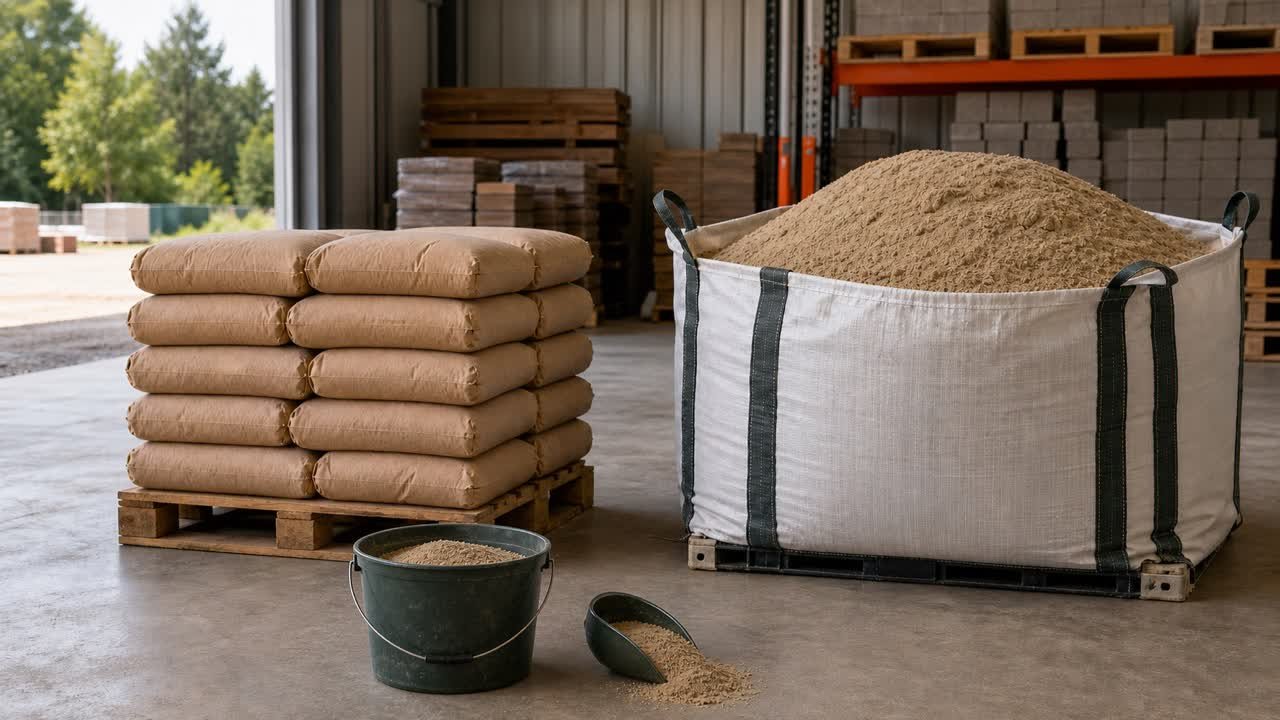
Use the Sand Bags vs Bulk guide after the finished volume and product are accepted. Return to the Sand Material Planning hub for published calculators, charts and material guides.
Safety, permit and installation limits
Confirm permits, barriers, drainage, electrical requirements and utility-location rules before excavation. United States readers can use 811 Before You Dig to find the applicable state contact.
This page does not approve a foundation, specify earthwork, certify soil, design drainage, set compaction equipment or replace the pool manual. Stop work when the ground, excavation, pool structure or electrical condition is unsafe.
The calculation methodology explains unit and fixture checks. Report a depth, formula or source issue through the corrections route.
Sources and source scope
- Radiant Metric Oval Installation Manual R8: one oval system's suitable-base range, 2 in finished floor example, separate cove, support layout and sand schedule.
- Bestway Pool Manual S-S-004972: one frame-pool family's flat and firm site requirements and prohibition on using sand to create a level base.
- CARVIN Equinox Round Above Ground Pool User's Guide: one round system's permitted aggregate, loose and compacted thickness example, leveling method and cove detail.
- ABGAL Above Ground Pool Liner Installation: one liner maker's 5 cm floor layer, separate cove and surface-preparation steps.
- NIST Handbook 44 (2026), Appendix C: exact area and volume unit relationships used in the fixtures.
- 811 Before You Dig: United States utility-location contacts and state-specific notice records.
Source scope: manufacturer and liner documents govern only their named systems. NIST supports unit relationships, and 811 Before You Dig supports the U.S. locate handoff. The current instructions for the exact pool and liner, approved project documents, permits, local rules, site conditions and responsible qualified people control the installation.
Review note: Saleem Sial owns the research and editorial record. Live source retrieval, PDF extraction, manufacturer comparison, volume fixtures, editorial review, build validation, link crawl, schema review and rendered QA form the internal publication gate. Waseem Sial, External Reviewer and Engineer, is listed for ongoing external review; no completed external-review date is claimed.