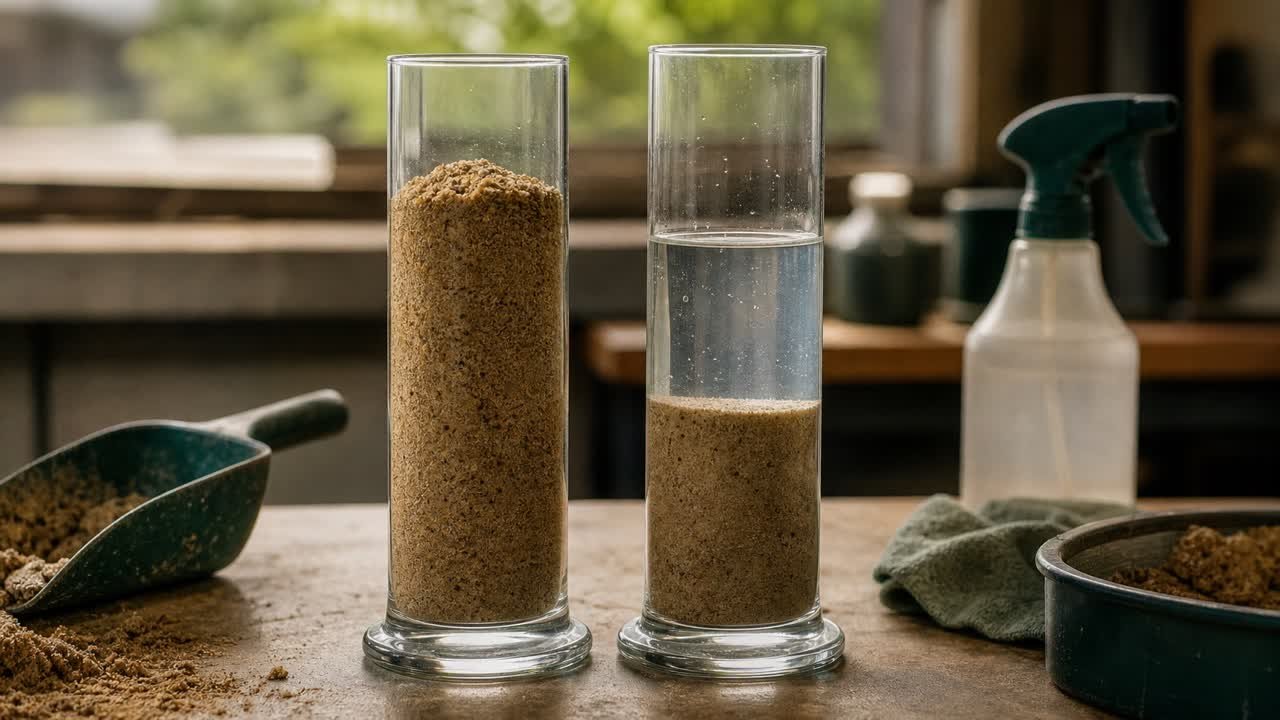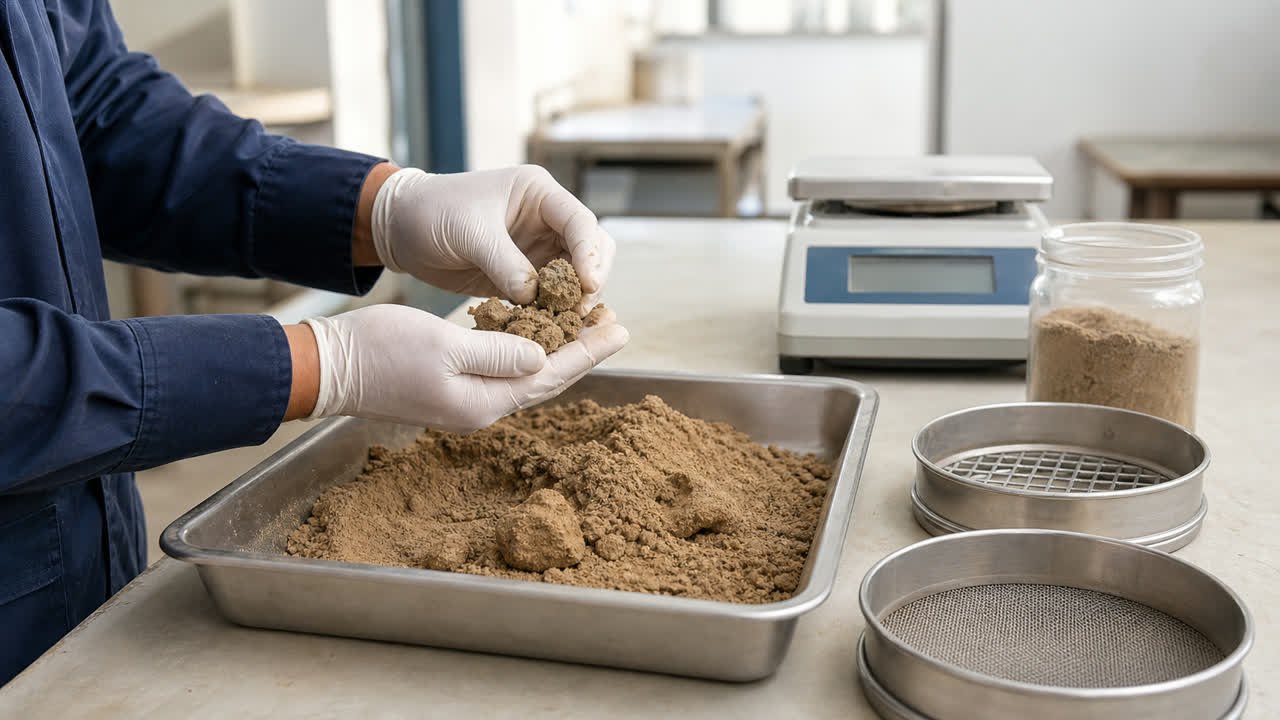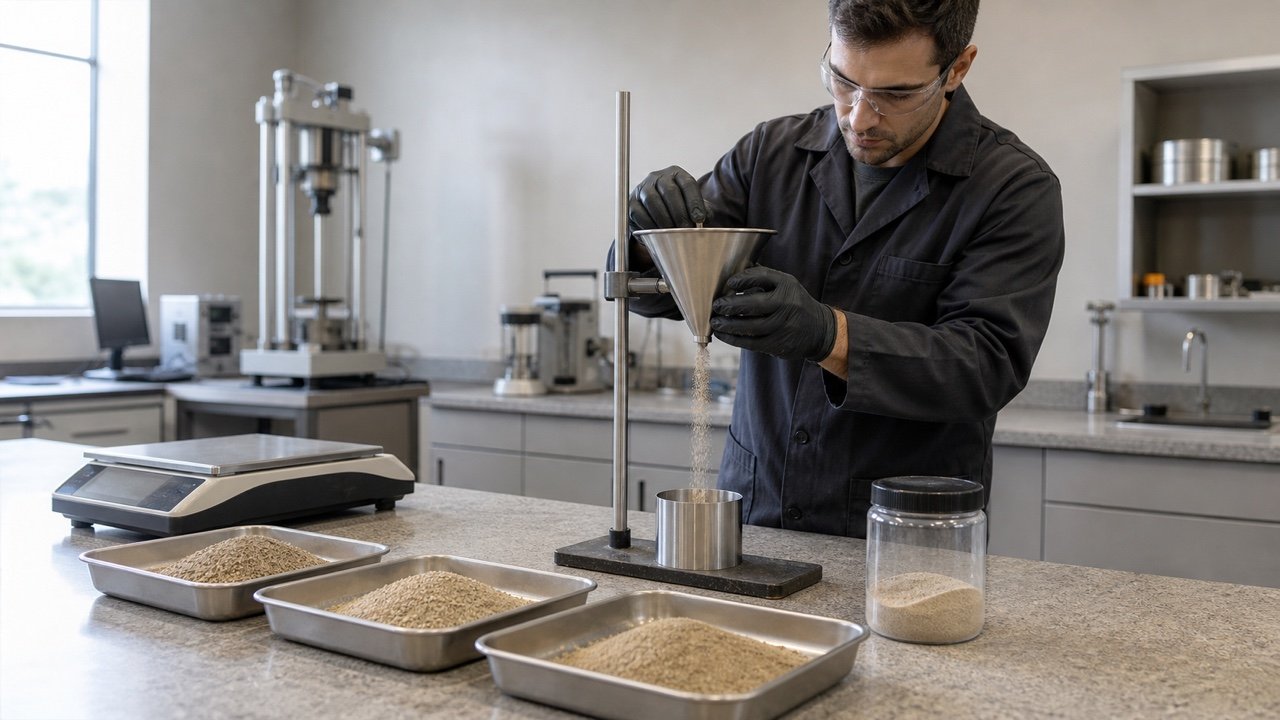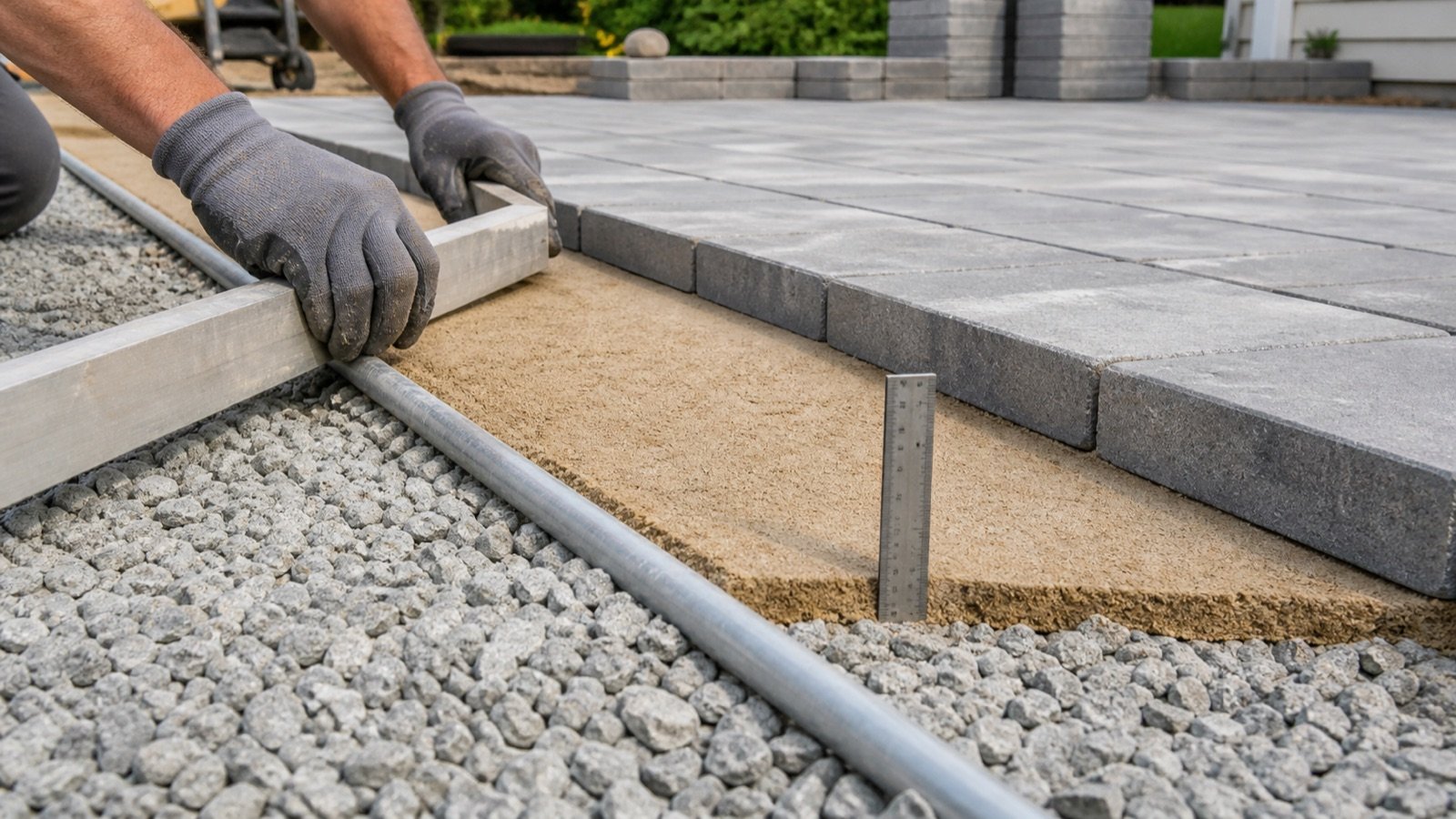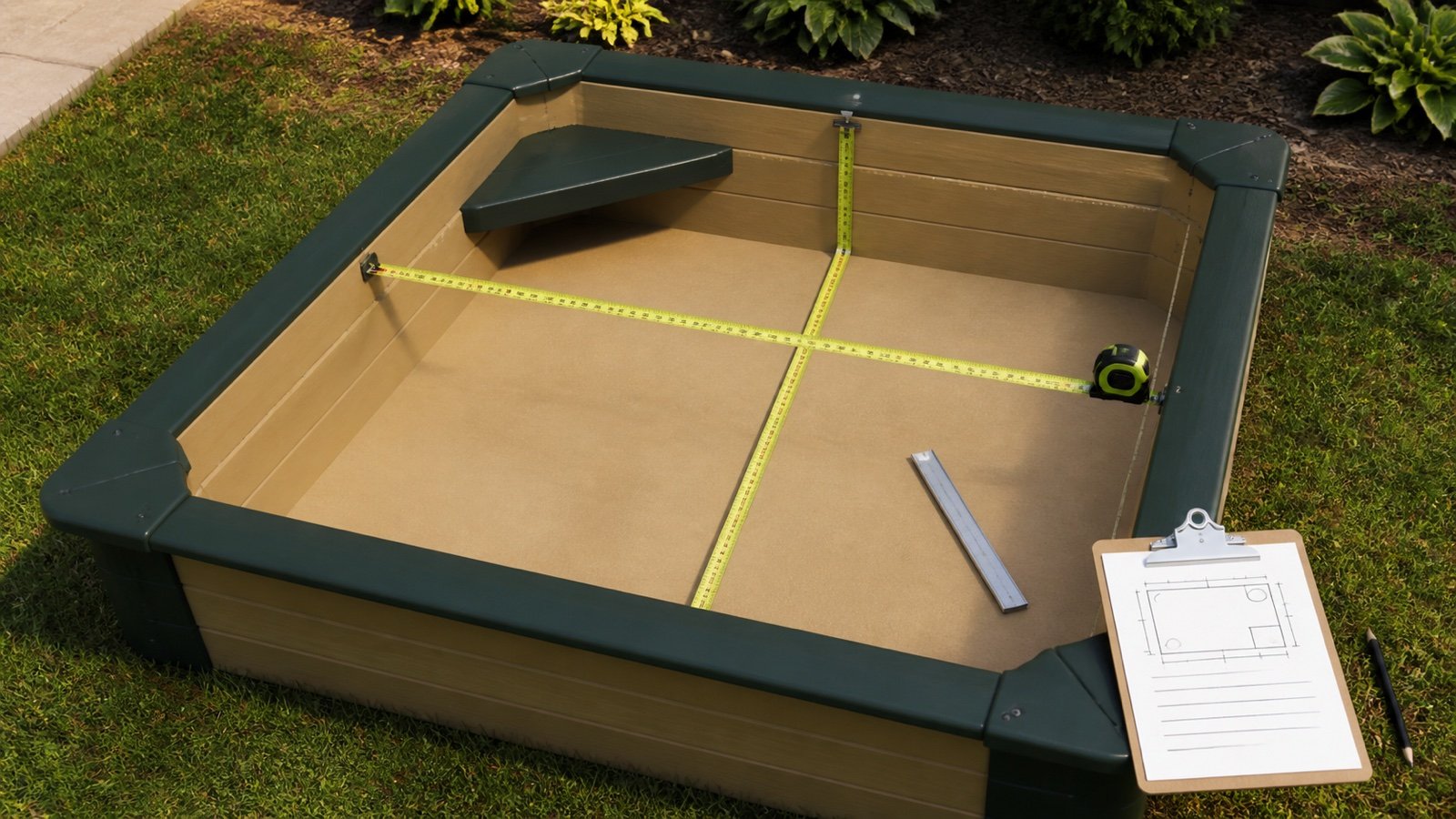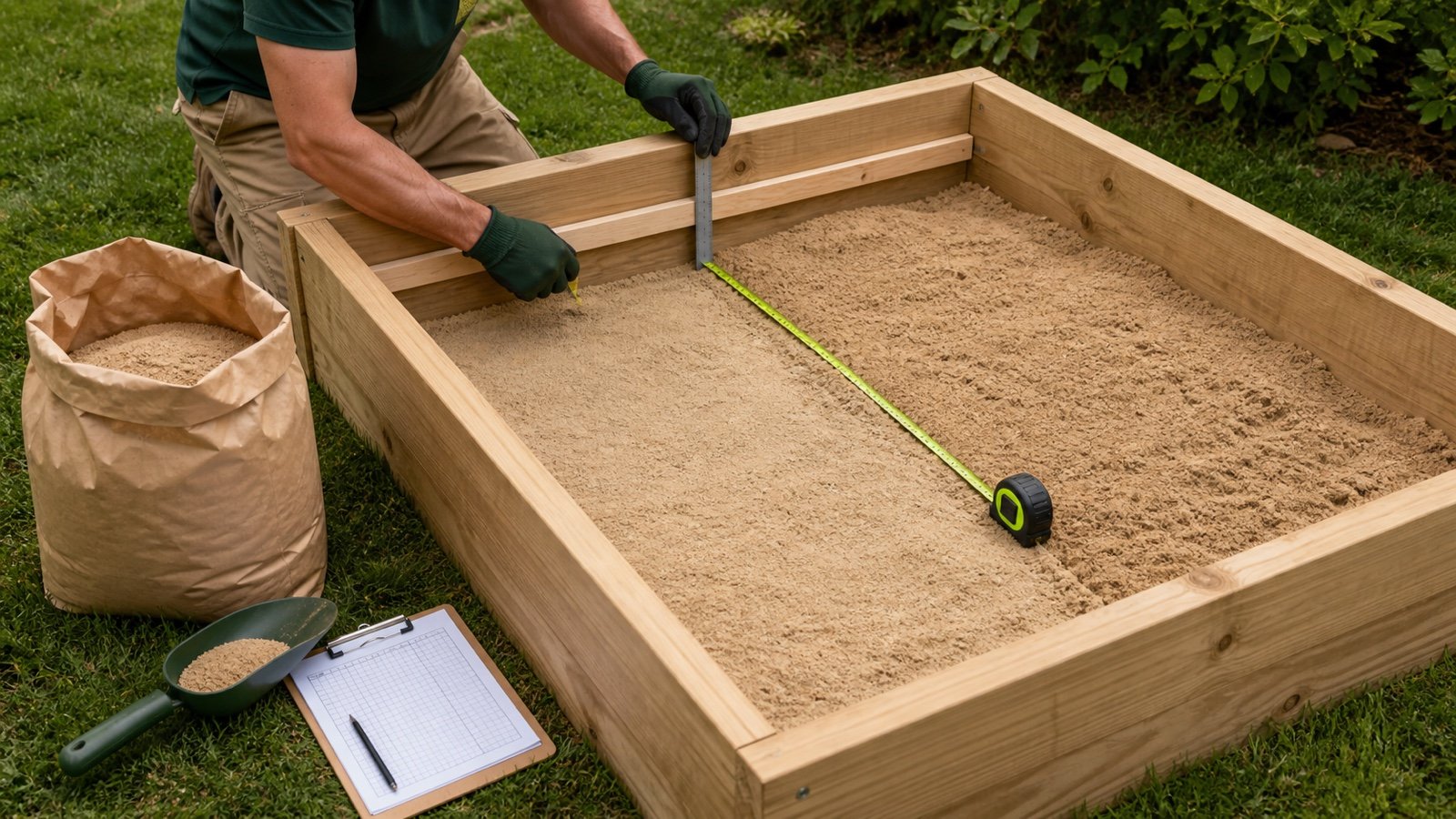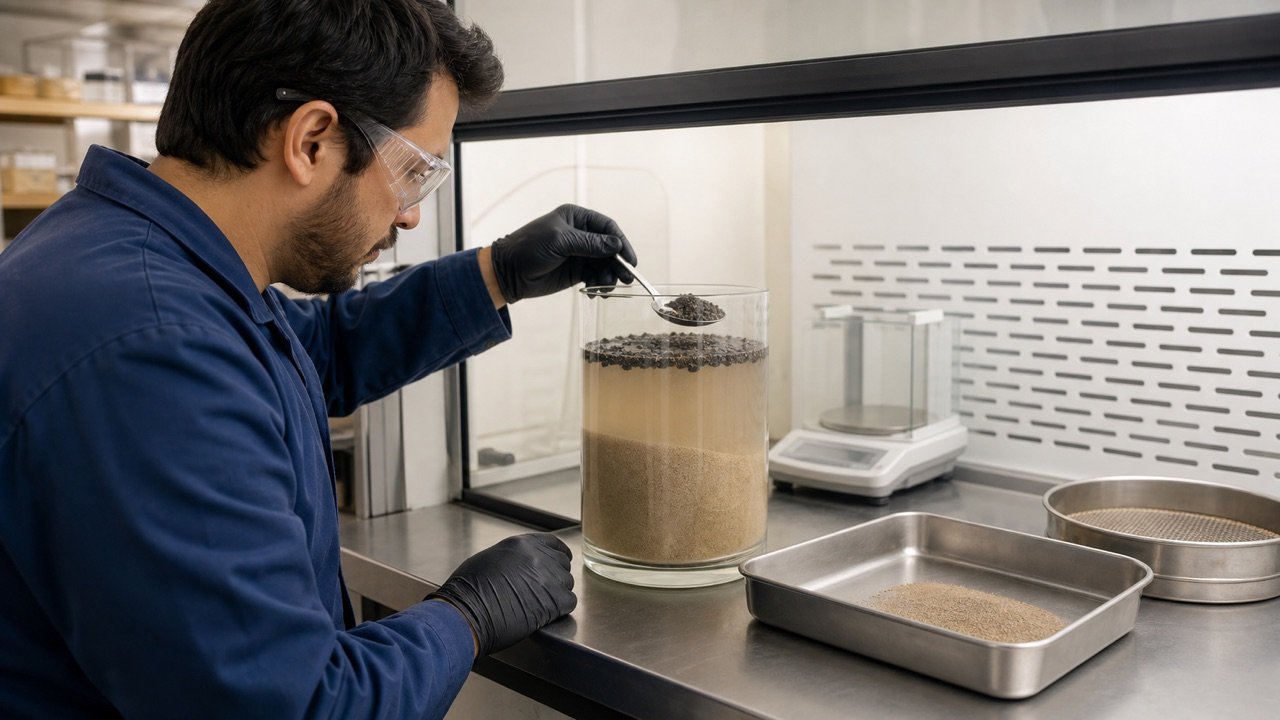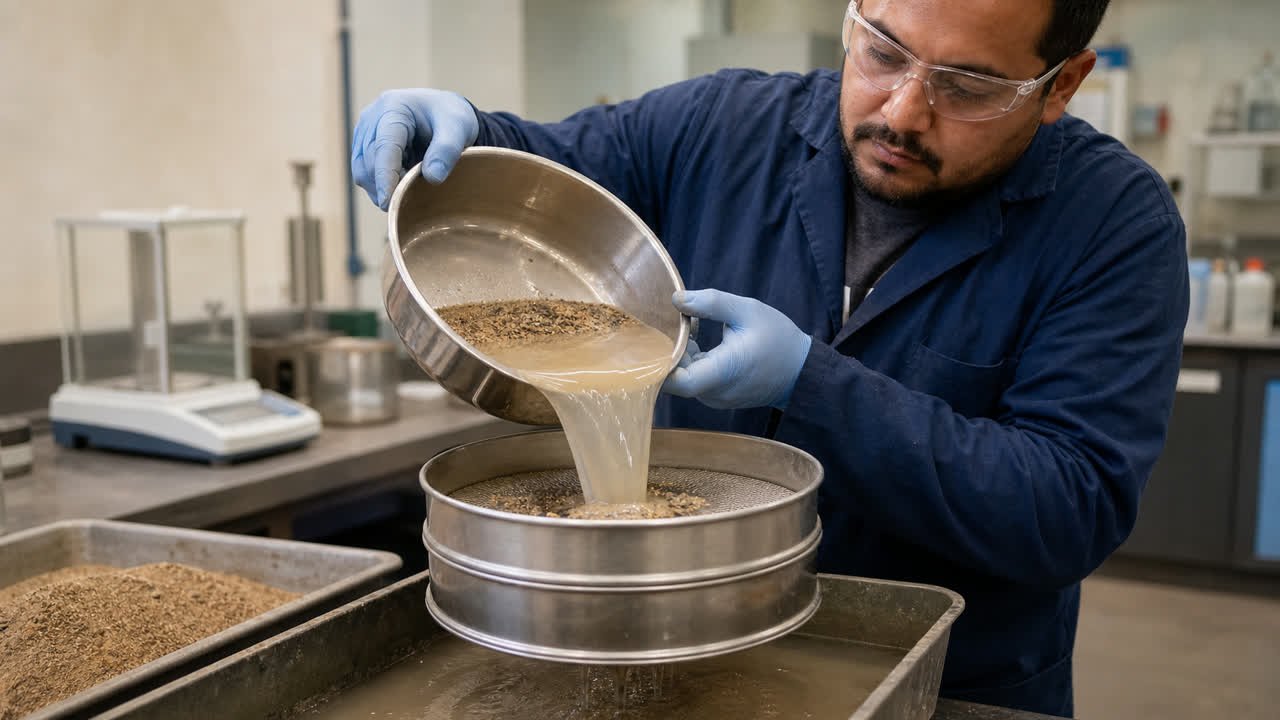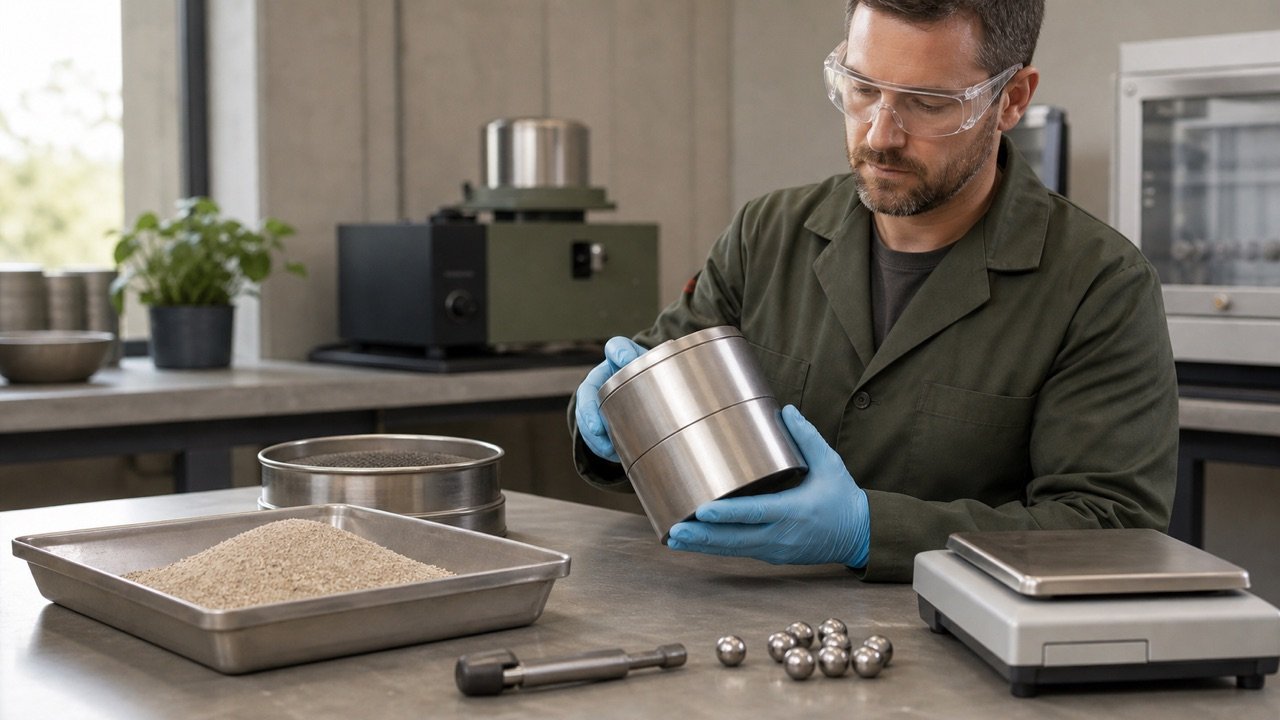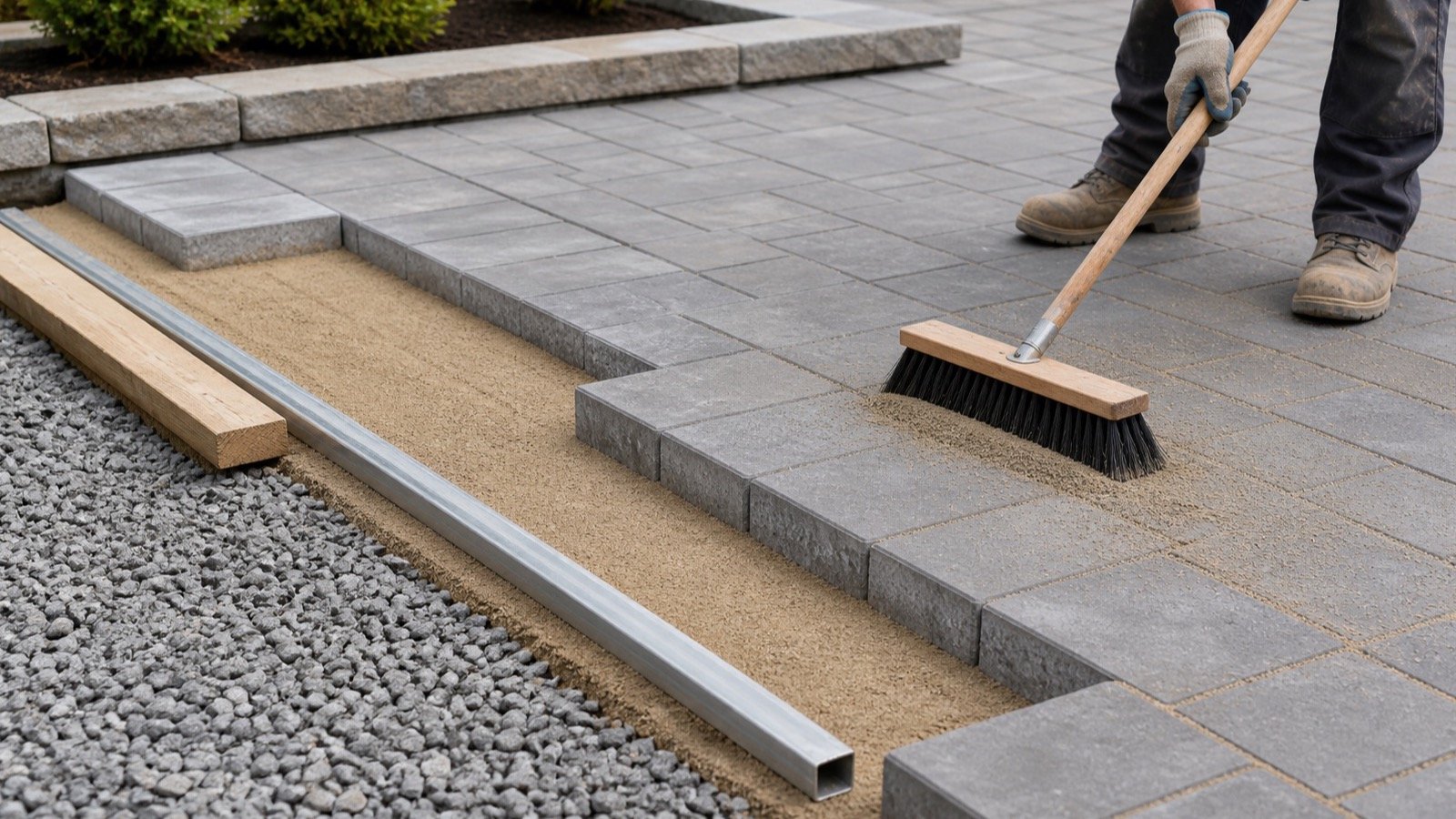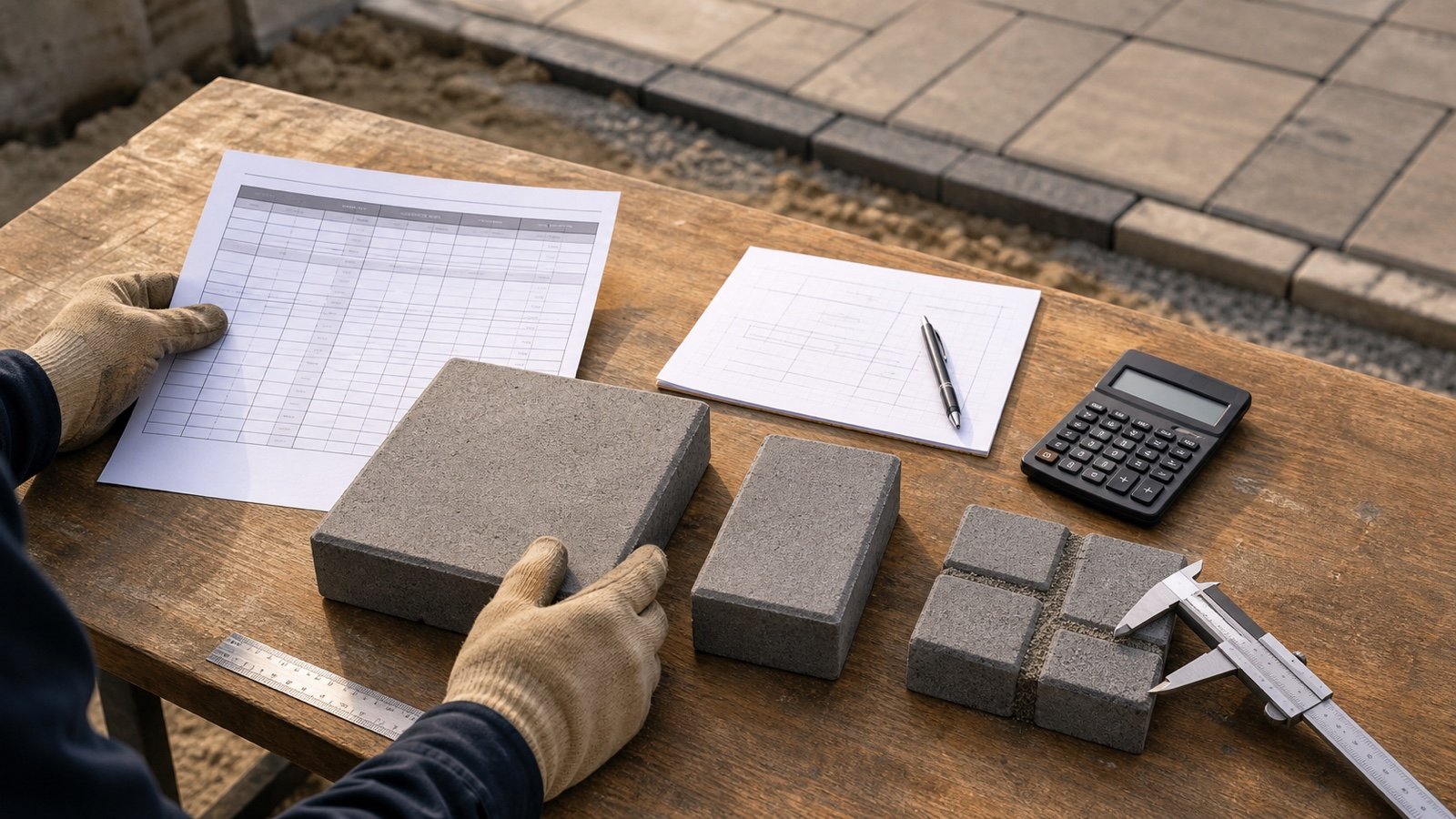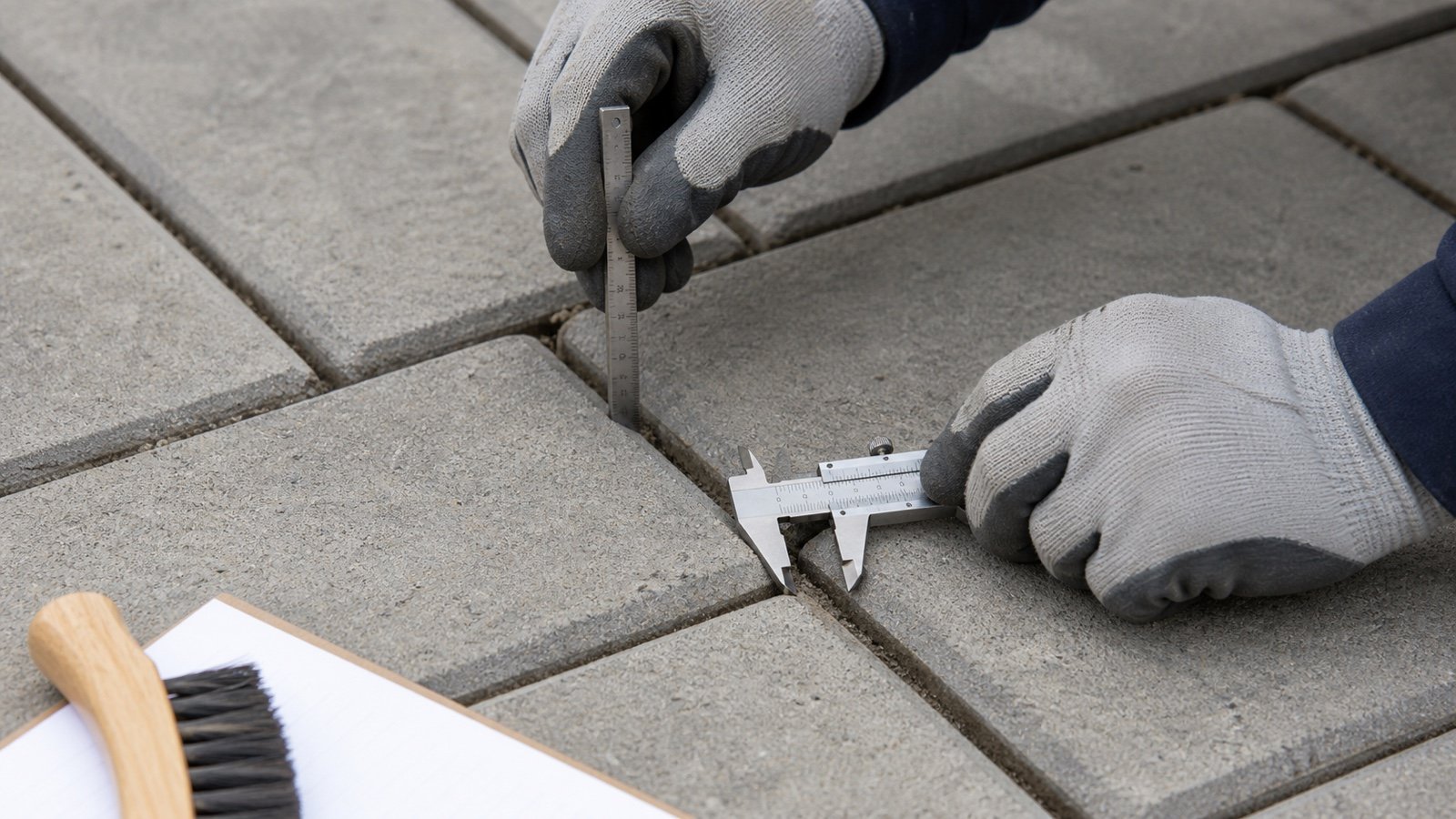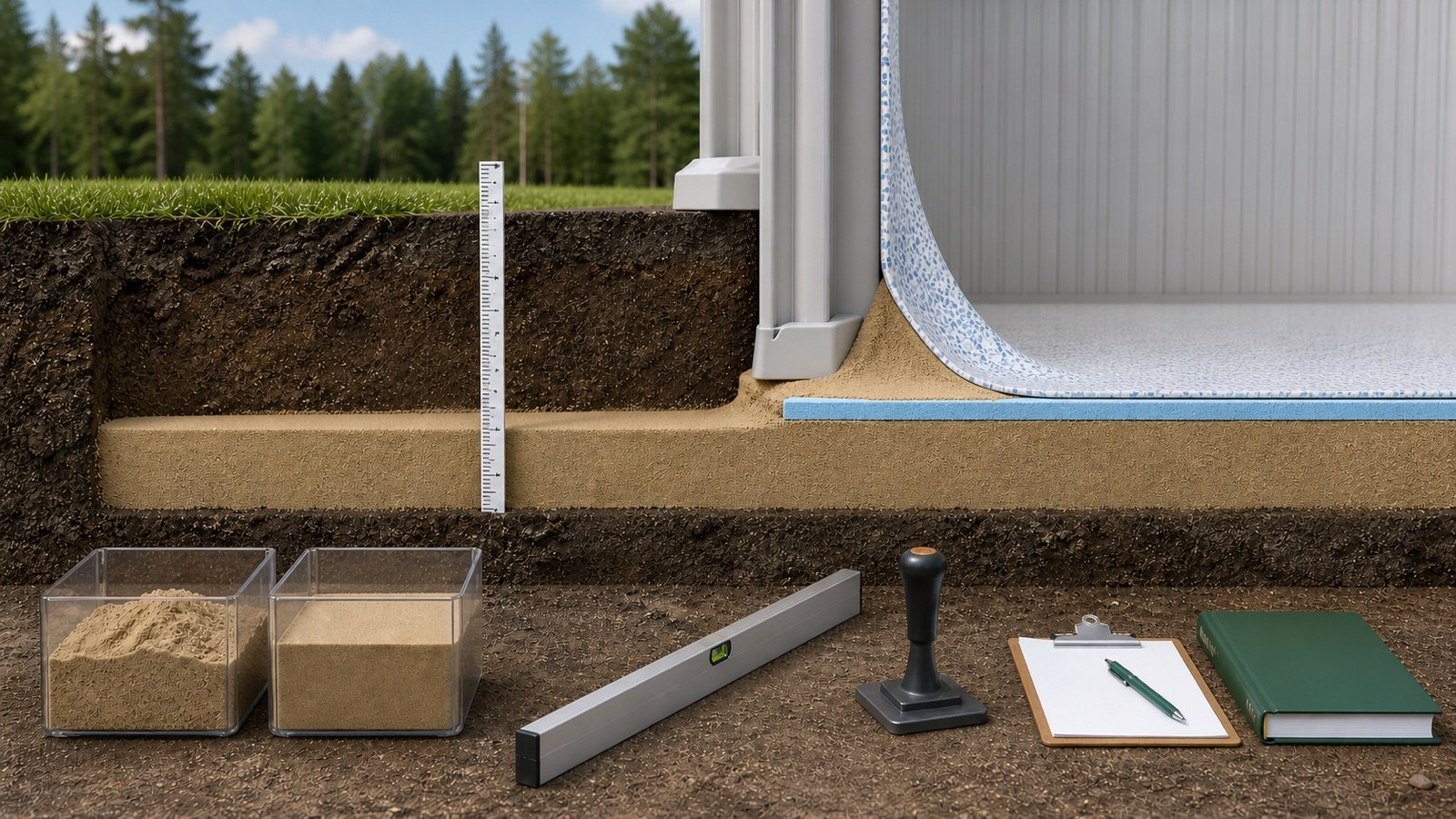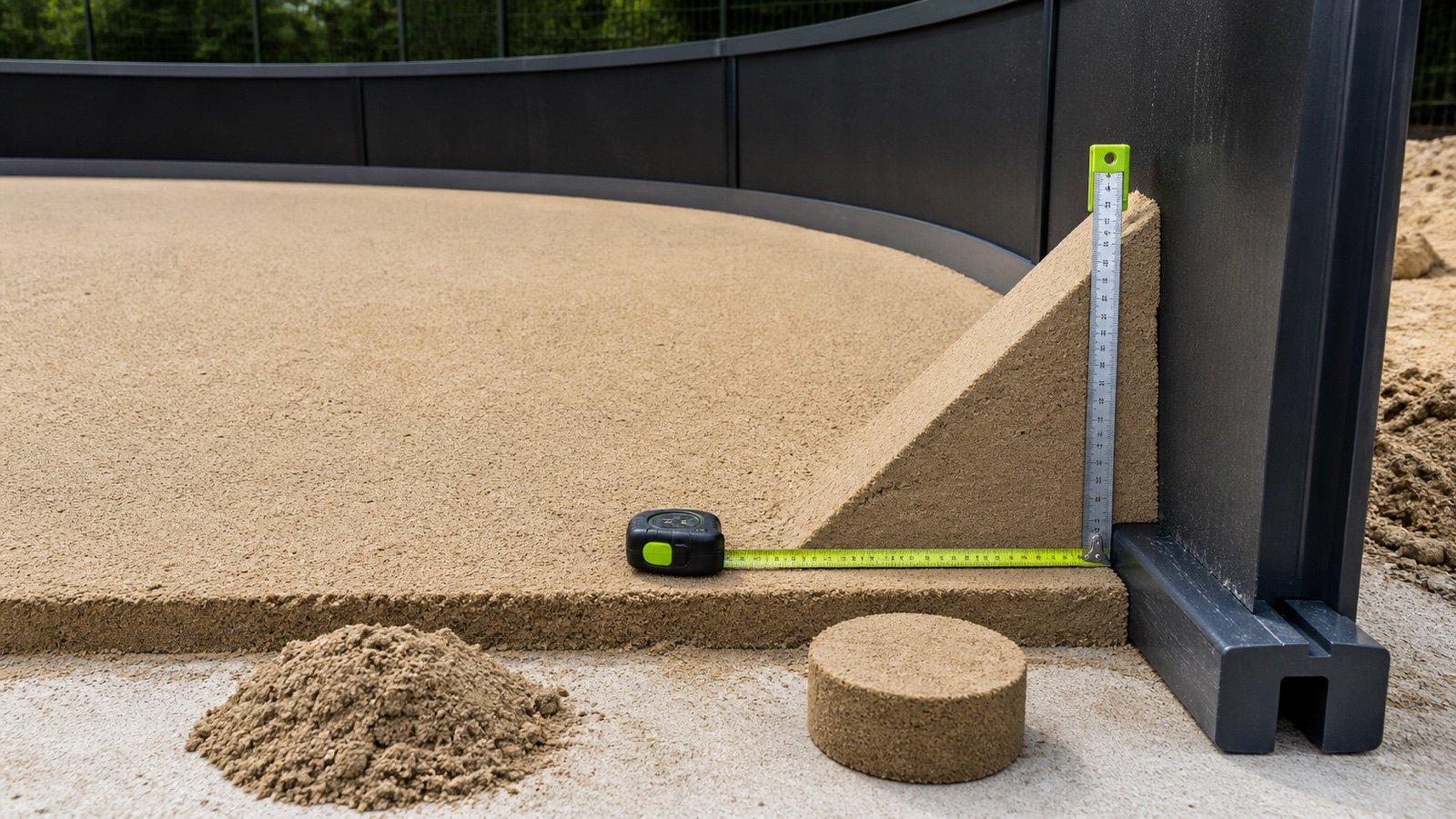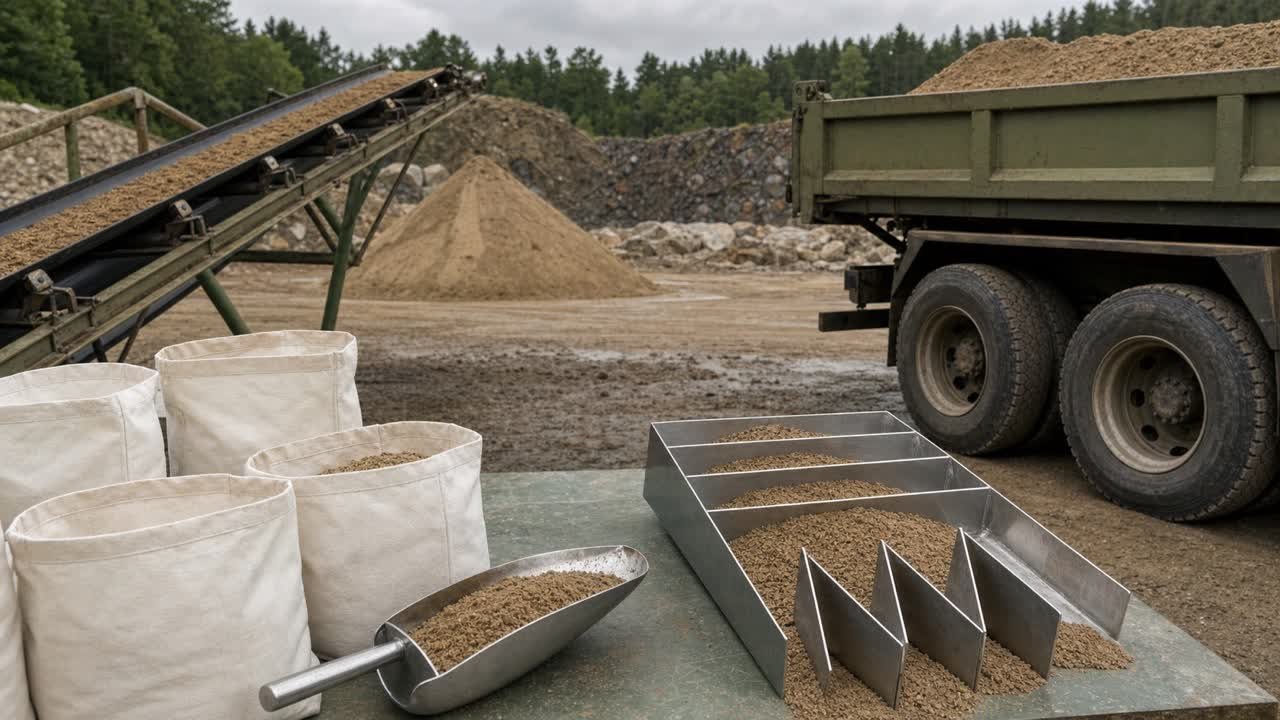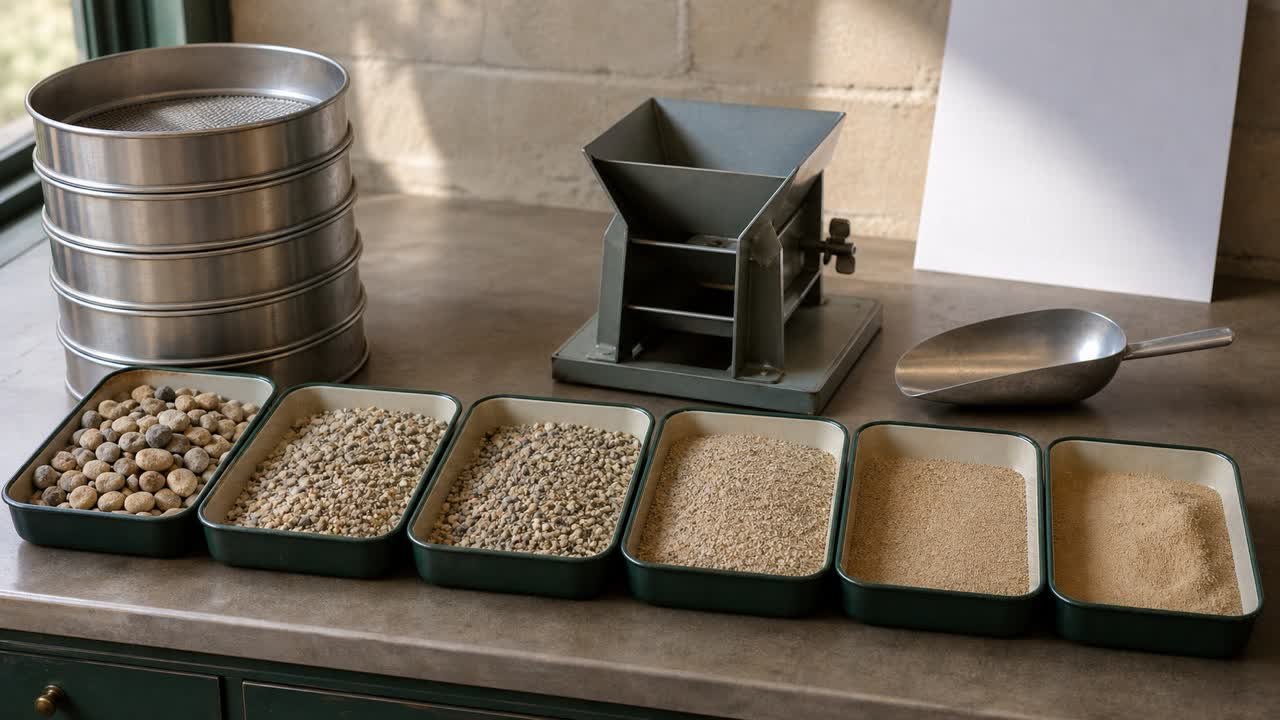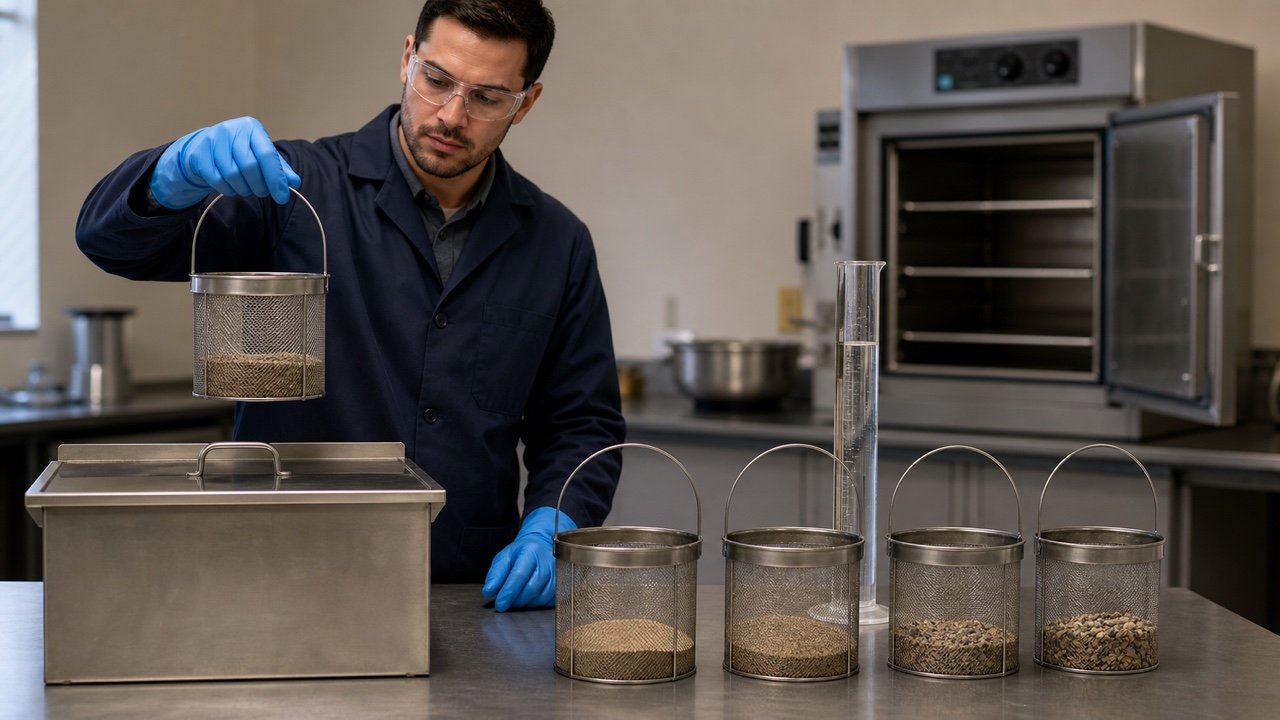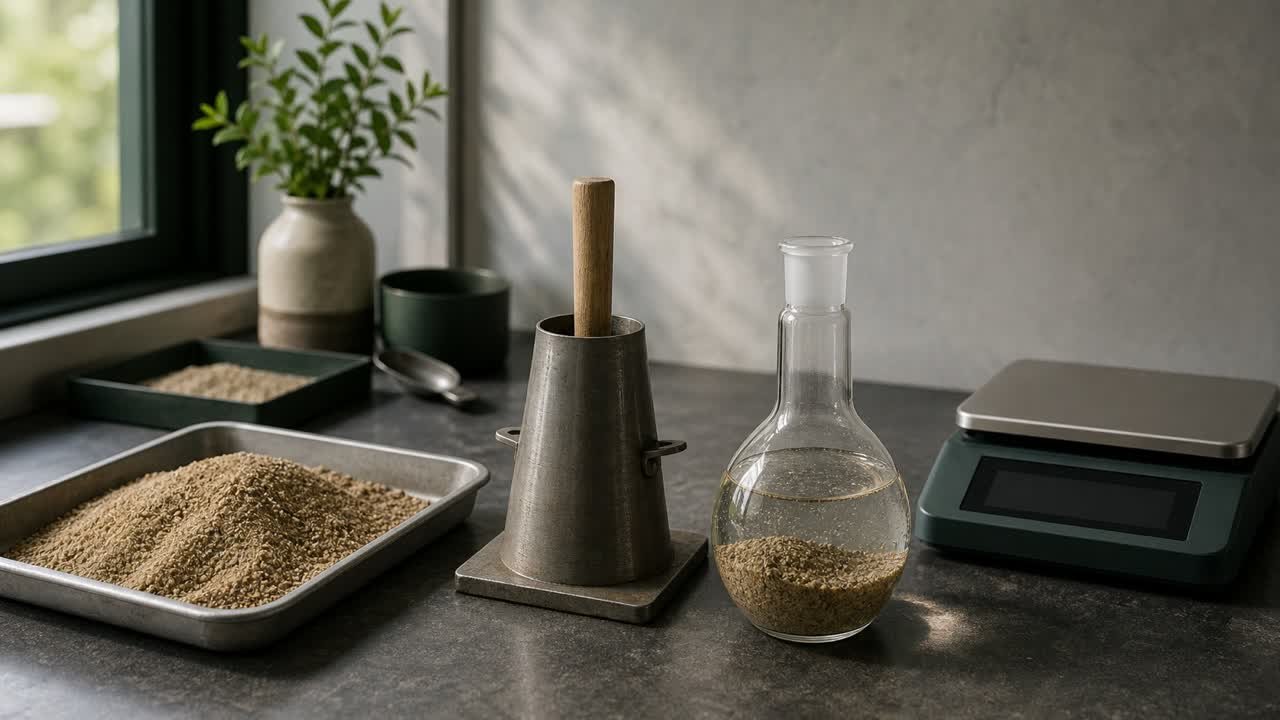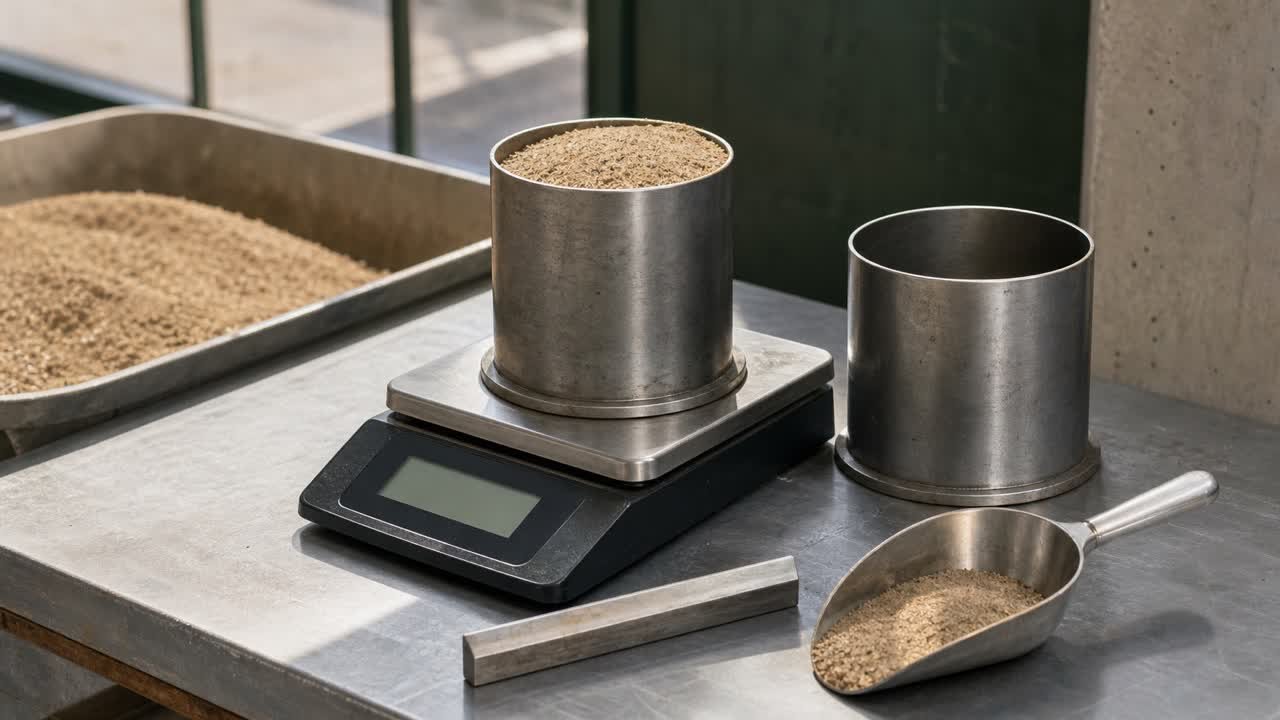
A sand bulk-density record starts with a calibrated container, its empty mass, and its filled mass under a stated method. The calculation is short. The packing state, moisture condition, sample identity, and repeat results determine whether the number can support a later quantity estimate.
This guide calculates dry loose or compacted sand density and the traditional unit-weight result. It also shows how to calculate interparticle voids when you have a compatible measured bulk oven-dry specific gravity.
How do you calculate sand bulk density from a container test?
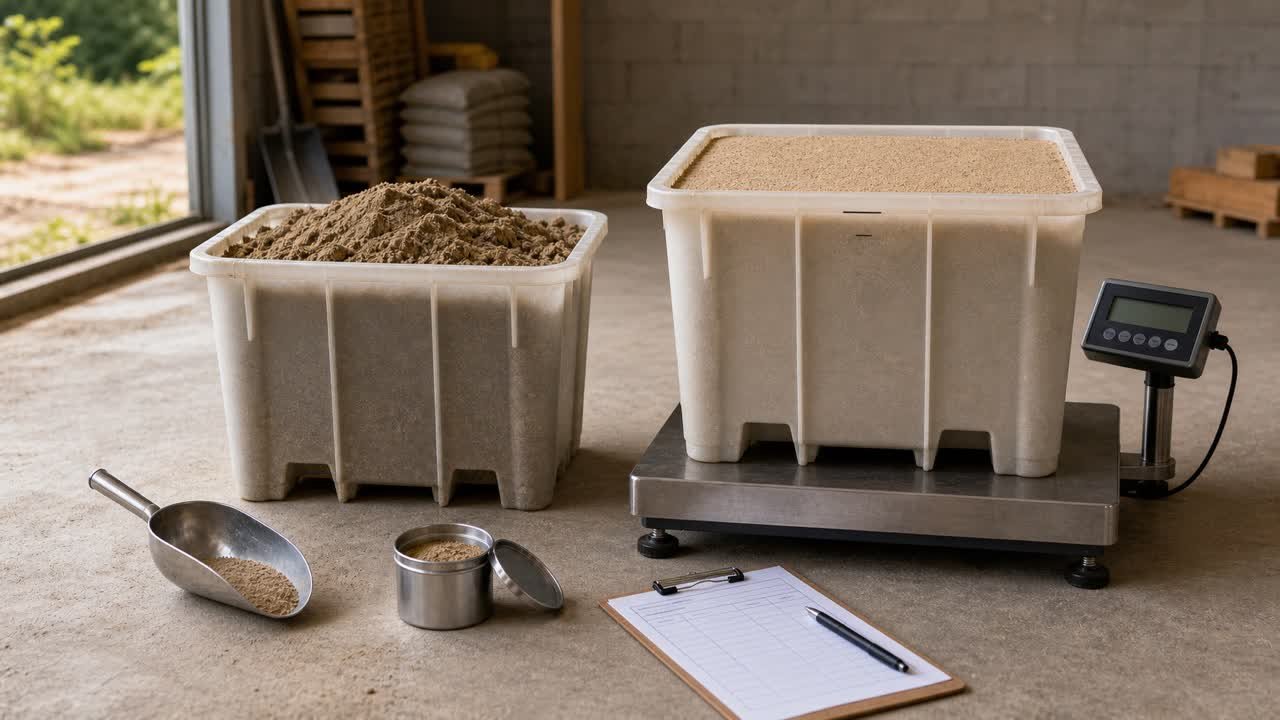
Subtract the empty-container mass from the filled-container mass. Divide the net sand mass by the calibrated internal volume of the measure.
Net sand mass = filled measure mass - empty measure mass
Bulk density = net sand mass ÷ calibrated measure volume
Use kilograms and cubic metres for kg/m³, or pounds and cubic feet for lb/ft³. Keep both measurements in one unit system. ASTM C29/C29M-23 uses “unit weight” as the traditional name and notes that the measured property is more correctly mass per unit volume or density.
Record dry loose, dry rodded, dry jigged, moist loose, or the exact condition required by the governing method. A density without its packing and moisture state cannot support a checked conversion.
Which measurements belong in the record?
The result needs enough information for another person to repeat the arithmetic and understand the sample boundary. A single density copied from a table does not identify the sand delivered to a project.
| Record | What to enter | Check |
|---|---|---|
| Material identity | Product, source, lot or stockpile, sample ID, and date | Match the test portion to the stated material |
| Moisture state | Oven-dry, air-dry, as-received, or another defined condition | Do not label a wet mass as a dry-method result |
| Filling method | Loose, rodded, jigged, tapped, or the governing procedure | Keep unlike packing methods separate |
| Empty measure mass | Clean measure tare in the selected mass unit | Confirm the balance zero and container identity |
| Filled measure mass | Measure plus struck-off sand | Filled mass must exceed tare |
| Calibrated volume | Internal volume under the required calibration | Use the calibration record, not an assumed label |
| Repeat results | Each filled mass, net mass, and density | Apply the governing repeatability rule before averaging |
The Sand Sampling guide explains how the field sample stays connected to a stated lot and location before a test portion reaches the measure.
What is the difference between loose and rodded bulk density?
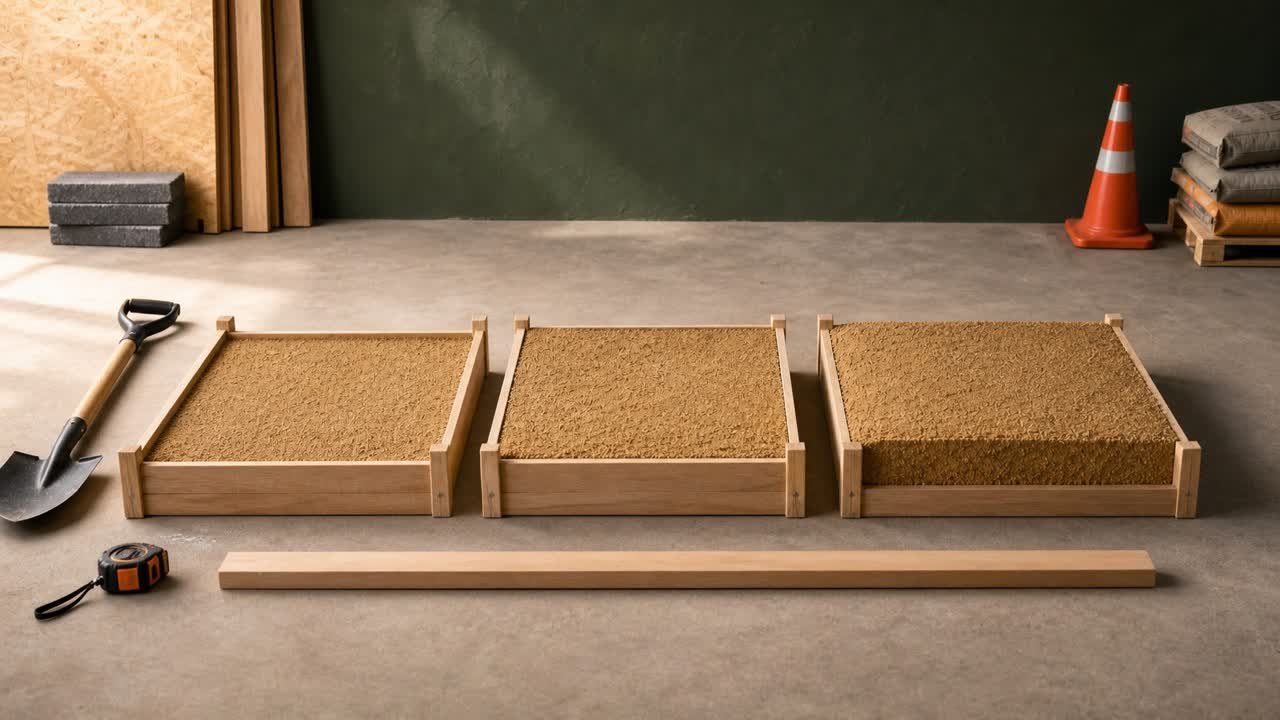
A loose method fills the measure with limited disturbance under the stated procedure. A rodded method applies a defined compaction sequence. Rodding can rearrange particles and reduce interparticle space, so the same sand can return a higher mass in the same container.
Use the method named by the specification, laboratory procedure, mix-design process, or purchasing agreement. Do not choose the higher or lower result after seeing which number fits an estimate.
| State | Measured boundary | What it does not prove |
|---|---|---|
| Dry loose container | Dry sand placed and struck off under a defined loose method | Density of a damp stockpile or settled delivery |
| Dry rodded container | Dry sand compacted in a measure under a stated rodding method | Field compaction, strength, or accepted in-place density |
| As-received container | Sand with its current water and packing condition | Oven-dry bulk density |
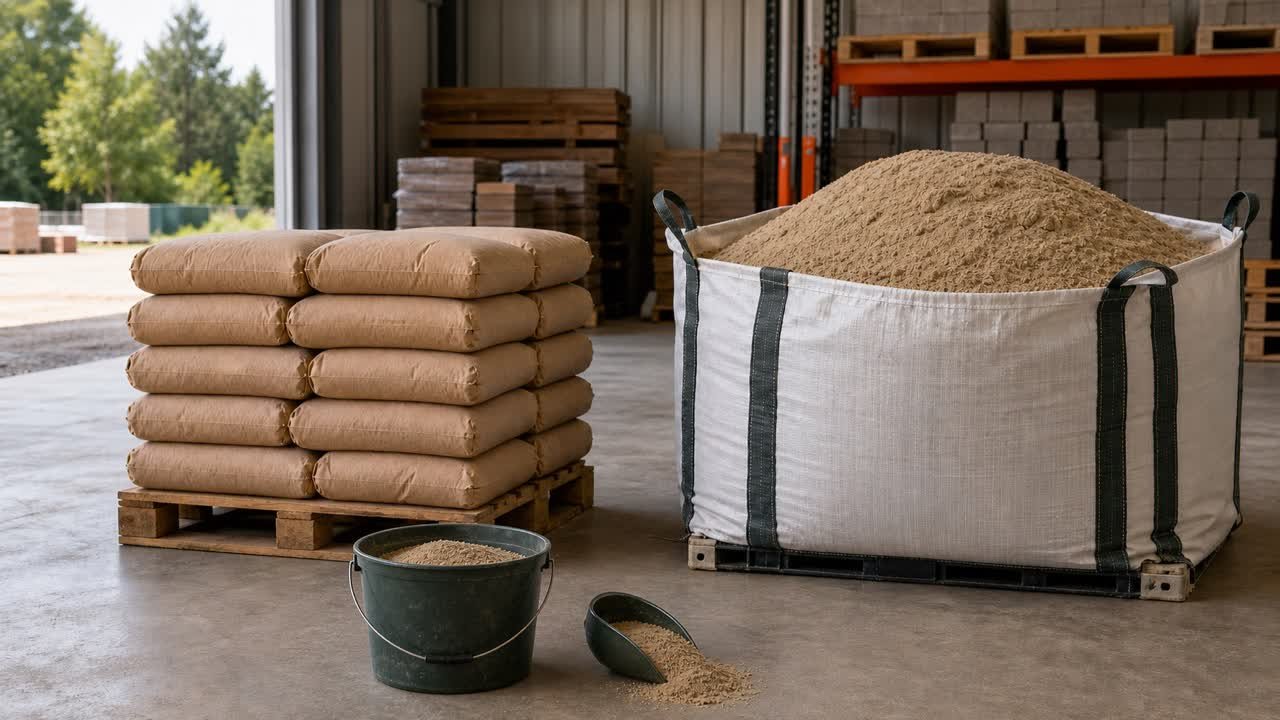
| Stockpile or haul unit | A larger volume with its own loading, segregation, moisture, and settlement | The packing achieved in a laboratory measure |
| Compacted project layer | Placed material under the project's geometry and acceptance method | A value produced by rodding a small container |
Why does the measure need calibration?
A dented, worn, or nominally labelled container can have a volume different from the value used in the formula. The governing method sets the apparatus and calibration procedure.
California Test 212 calibrates its measure with water at a measured temperature, determines the net water weight, and calculates a factor from the applicable water unit weight. It then multiplies that factor by the average net aggregate weight. A method that reports the calibrated volume directly reaches the same mass-per-volume relationship.
Calibrated volume = net calibration-water mass ÷ water density at the measured temperature
Follow the complete procedure named by the project. Do not replace its temperature table, balance tolerance, container requirement, or calibration interval with a rounded assumption from this guide.
Worked metric example with 3 loose determinations
A calibrated measure has a volume of 0.003000 m³ and an empty mass of 4.280 kg. Three dry loose fills give the following masses.
| Run | Filled mass | Net sand mass | Bulk density |
|---|---|---|---|
| 1 | 9.116 kg | 9.116 - 4.280 = 4.836 kg | 1,612.000 kg/m³ |
| 2 | 9.104 kg | 9.104 - 4.280 = 4.824 kg | 1,608.000 kg/m³ |
| 3 | 9.122 kg | 9.122 - 4.280 = 4.842 kg | 1,614.000 kg/m³ |
| Average | (4.836 + 4.824 + 4.842) ÷ 3 = 4.834 kg | 1,611.333 kg/m³ | |
The net-mass range is 4.842 - 4.824 = 0.018 kg. Relative to the 4.834 kg average, the spread is 0.372%. California Test 212 requires 3 determinations that do not differ by more than 1%, so these illustrative runs satisfy that cited check.
A separate rodded fill of the same 0.003000 m³ measure weighs 9.590 kg including the container:
Rodded bulk density = (9.590 - 4.280) ÷ 0.003000 = 1,770.000 kg/m³
The 158.667 kg/m³ difference belongs to these stated measurements. It does not establish a universal loose-to-rodded factor for other sand.
How do you calculate void content from bulk density?
Use the measured bulk density with a compatible bulk oven-dry specific gravity for the same sand. Match the water-density value and units to the governing method.
Voids (%) = 100 × [(GOD × water density) - bulk density] ÷ (GOD × water density)
In this equation, GOD is dimensionless. Water density and sand bulk density must use the same mass-per-volume unit. The void result describes spaces between aggregate particles under the measured packing state. It does not include the permeable or impermeable pores inside each particle.
The Sand Specific Gravity and Absorption guide shows how a fine-aggregate bulk OD specific gravity is calculated from the required pycnometer masses. Use the accepted result from the method that governs the project instead of inserting a generic 2.65.
Metric void calculation
Assume the same sand has a measured bulk OD specific gravity of 2.641. The example uses a compatible water density of 998.2 kg/m³.
| State | Substitution | Voids |
|---|---|---|
| Dry loose | 100 × [(2.641 × 998.2) - 1,611.333] ÷ (2.641 × 998.2) | 38.878% |
| Dry rodded | 100 × [(2.641 × 998.2) - 1,770.000] ÷ (2.641 × 998.2) | 32.859% |
Rodding placed more dry sand mass in the fixed container, so the calculated interparticle void percentage fell. These values check arithmetic. The governing specification decides reporting precision, test acceptance, and whether the result has a project use.
Worked inch-pound example
A measure has a calibrated volume of 0.0625 ft³. It weighs 11.20 lb empty and 17.35 lb after the stated dry loose fill.
- Net sand mass: 17.35 - 11.20 = 6.15 lb.
- Traditional unit weight: 6.15 ÷ 0.0625 = 98.4 lb/ft³.
- NIST conversion: 98.4 × 16.01846 = 1,576.216 kg/m³.
For an independent void fixture, use a measured bulk OD specific gravity of 2.65 and a rounded 62.3 lb/ft³ water value consistent with the 62.301 lb/ft³ value listed by California Test 212 at 70°F:
Voids = 100 × [(2.65 × 62.3) - 98.4] ÷ (2.65 × 62.3) = 40.398%
Use the water value and precision required by the governing method. Do not mix 62.3 lb/ft³ with a sand density expressed in kg/m³.
How should repeat results be checked and rounded?
Review individual masses before calculating the reported average. A large spread can point to a filling, strike-off, segregation, balance, tare, container, or transcription problem.
- Calculate each net mass from the same verified tare.
- Calculate each density with the same calibrated volume.
- Compare the repeats under the governing method's rule.
- Investigate a failed set instead of deleting the inconvenient result.
- Average the accepted unrounded values.
- Round the final reported result at the required precision.
Do not average loose and rodded runs. Do not combine dry and moist runs. A later result from a different container calibration, product source, gradation, or test method belongs to a separate record.
Can a container density be used for a stockpile or truckload?
Use it only when the commercial or project process accepts the same material state and measurement basis. ASTM C29/C29M-23 states that the relationship between compaction in a hauling unit or stockpile and the compaction achieved in the test method is unknown. It also notes that stockpiled and hauled aggregate usually contains absorbed and surface moisture, while the ASTM method determines bulk density on a dry basis.
| Question | Proceed when | Stop and obtain better evidence when |
|---|---|---|
| Is it the same product? | Source, product code, gradation, and lot basis match | The supplier changed source, blend, or process |
| Is the state compatible? | Dry/moist condition and packing basis are stated and accepted | A dry loose test is being used for a damp settled load without adjustment |
| Is the selling unit clear? | The quote states mass, volume, package yield, or another legal unit | “Truckload” or “bucket” has no documented quantity boundary |
| Does the agreement accept the value? | The supplier, specification, or responsible project process supports it | The density came from a generic web table |
| Can delivery be checked? | A scale ticket or accepted volume record closes the order | Nominal vehicle capacity is the only evidence |
A container test can support a controlled mass-volume relationship. It does not certify the load carried by a truck or the volume occupied by a field stockpile.
How do moisture and bulking change the result?
Surface water adds mass, while moisture films can also change the loose volume occupied by fine aggregate. Record moisture and packing state instead of treating the effects as one fixed correction.
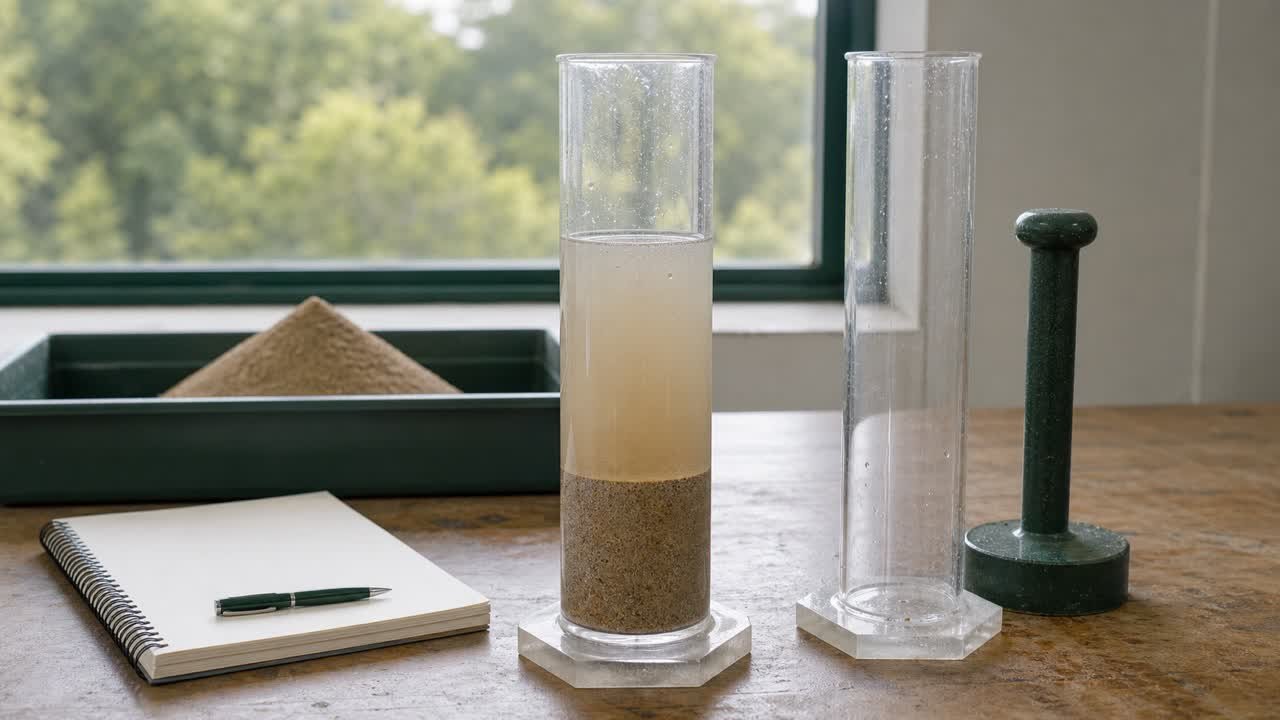
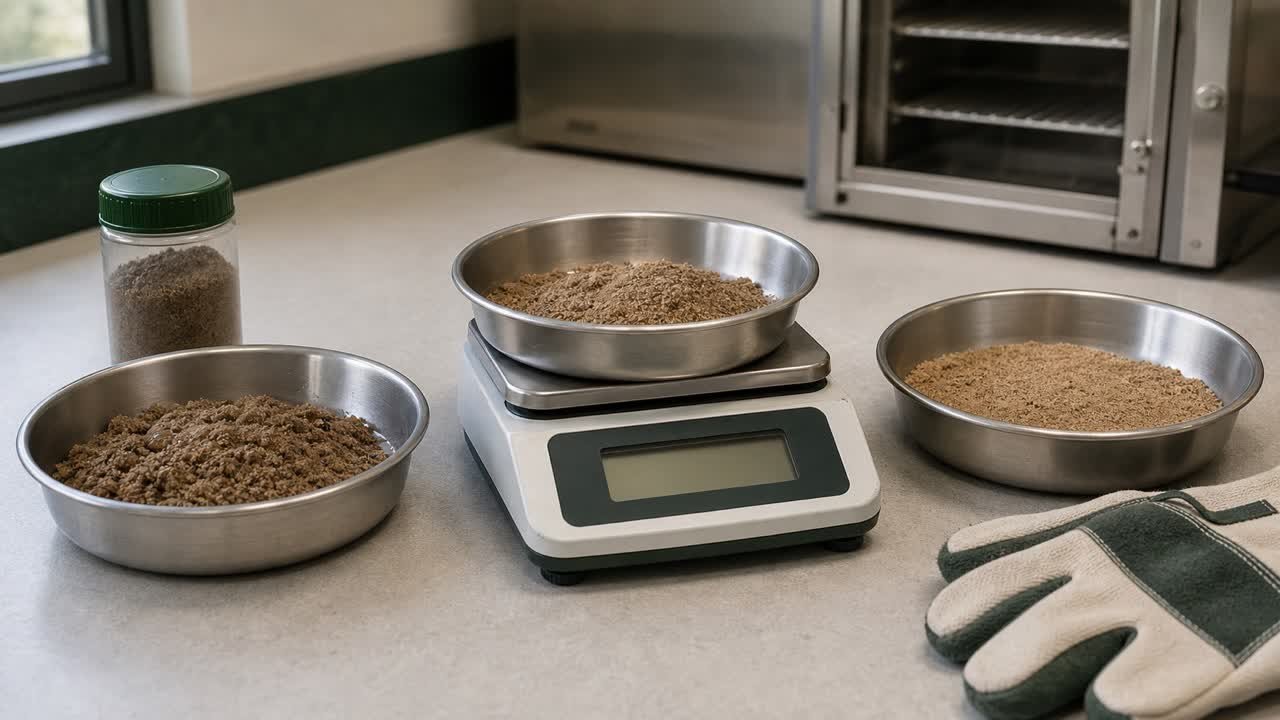
The Sand Moisture Content guide calculates total evaporable moisture from wet and dry masses. The Bulking of Sand guide measures the loose-volume change from a representative damp sample. Neither result can be replaced by the bulk-density number on this page.
If a supplier sells wet sand by mass, the scale ticket includes the water carried in the delivered material. If a project needs dry aggregate mass, use a representative moisture result and the approved adjustment method. Keep that calculation separate from container density.
Is bulk density the same as specific gravity or field dry density?
Each term uses a different boundary or comparison. Selecting the wrong one can turn a volume-to-mass estimate into a particle-volume calculation or a field-compaction claim.
| Term | Meaning | Typical use |
|---|---|---|
| Bulk density | Sand mass divided by total occupied bulk volume, including spaces between particles | Container test, concrete proportioning input, or supported mass-volume conversion |
| Traditional unit weight | Weight per volume terminology used by the cited aggregate methods | Inch-pound aggregate records, often reported as lb/ft³ |
| Bulk OD specific gravity | Aggregate-particle relative density on the oven-dry basis defined by its method | Absolute-volume and void calculations |
| Particle density | Mass related to particle volume under the stated particle-density definition | Material characterization, not loose stockpile weight |
| Field dry density | Dry mass divided by the in-place total volume tested in the field | Earthwork or layer compaction under a separate field method |
Rodded bulk density does not certify field relative compaction. A laboratory measure and an in-place layer use different boundaries, procedures, and acceptance records.
How do you use a measured density in a sand quantity estimate?
Calculate the project volume first. Then multiply that volume by a density supported for the selected product and planning state.
Estimated sand mass = measured project volume × supported bulk density
Assume a separate layer calculation produces 6.40 m³ and the approved planning record uses the illustrative dry loose density of 1,611.333 kg/m³:
6.40 × 1,611.333 = 10,312.531 kg
This value is about 10.313 metric tonnes before any documented state adjustment or supplier rounding. The calculation remains conditional on the density basis. It does not predict the wet delivered mass or authorize a 10.313 t vehicle load.
Enter the accepted product density in the Sand Calculator after measuring area and required depth. The Sand Weight Chart provides conversion equations and a supplier-density worksheet without assigning one universal value.
Common sand bulk-density mistakes
- Dividing the filled measure mass by volume without subtracting the container tare.
- Using nominal container capacity when the governing method requires a calibrated volume.
- Leaving loose, rodded, tapped, or jigged state off the result.
- Averaging loose and compacted measurements.
- Reporting a moist sample as dry bulk density.
- Inserting a generic specific gravity to certify void content.
- Combining kg/m³ with an lb/ft³ water value in the void equation.
- Rounding each repeat before calculating the average.
- Deleting a repeat that fails without investigating the test record.
- Using particle specific gravity as the sand bulk density.
- Treating rodded container density as proof of field compaction.
- Assuming a dry container value reproduces a damp stockpile or truckload.
What should the final test record contain?
- Project, supplier, source, product, sample ID, lot or stockpile, and sampling date.
- Governing test method, edition, project modification, and filling procedure.
- Sample moisture condition and preparation record.
- Measure ID, calibrated volume or factor, and calibration date.
- Balance ID and required check status.
- Empty mass and every filled mass.
- Individual net masses, densities, spread check, accepted average, and reporting precision.
- Measured bulk OD specific gravity source and water convention when voids are calculated.
- Deviations, retests, rejected determinations, and reason.
- Technician, checker, date, and intended use of the result.
Safety and method limits
Use the complete governing method, laboratory safety procedure, product safety information, and required controls. Keep the measure on a stable work surface and use handling equipment suited to the sample and container mass.
Sand and aggregate can contain crystalline silica. OSHA's construction silica requirements apply to covered occupational tasks and set exposure-control duties. The employer and the applicable laboratory or site plan select controls for the actual task. This calculation guide does not choose ventilation, respiratory protection, housekeeping, lifting, or disposal procedures.
The page checks arithmetic and record boundaries. It does not replace an accredited laboratory, test standard, specification, mix design, field-density method, purchasing agreement, or professional acceptance decision.
Sources and source scope
- ASTM C29/C29M-23: current public scope, loose and compacted bulk-density states, traditional unit-weight terminology, dry basis, void calculation scope, uses, and stockpile or hauling-unit limitation.
- California Test 212, Method of Test for Unit Weight of Aggregate: calibrated measure, tare, loose and rodded procedures, repeated determinations, average net mass, unit-weight calculation, and the cited temperature-based water value within that method.
- NIST Guide to the SI, Appendix B.8: pound-per-cubic-foot to kilogram-per-cubic-metre conversion.
- OSHA respirable crystalline silica information: U.S. construction exposure-control scope.
Scope: the sources support the stated terms, equations, examples, method boundaries, and unit conversion. They do not provide one universal sand density, a supplier quantity, a field-compaction result, or acceptance for a specific project. The governing method, specification, source records, responsible laboratory or project personnel, and current commercial documents control those decisions.
Use the measured value with the Sand Calculator, review volume-to-weight planning in the Sand Weight Chart, or return to the Sand Material Planning hub.