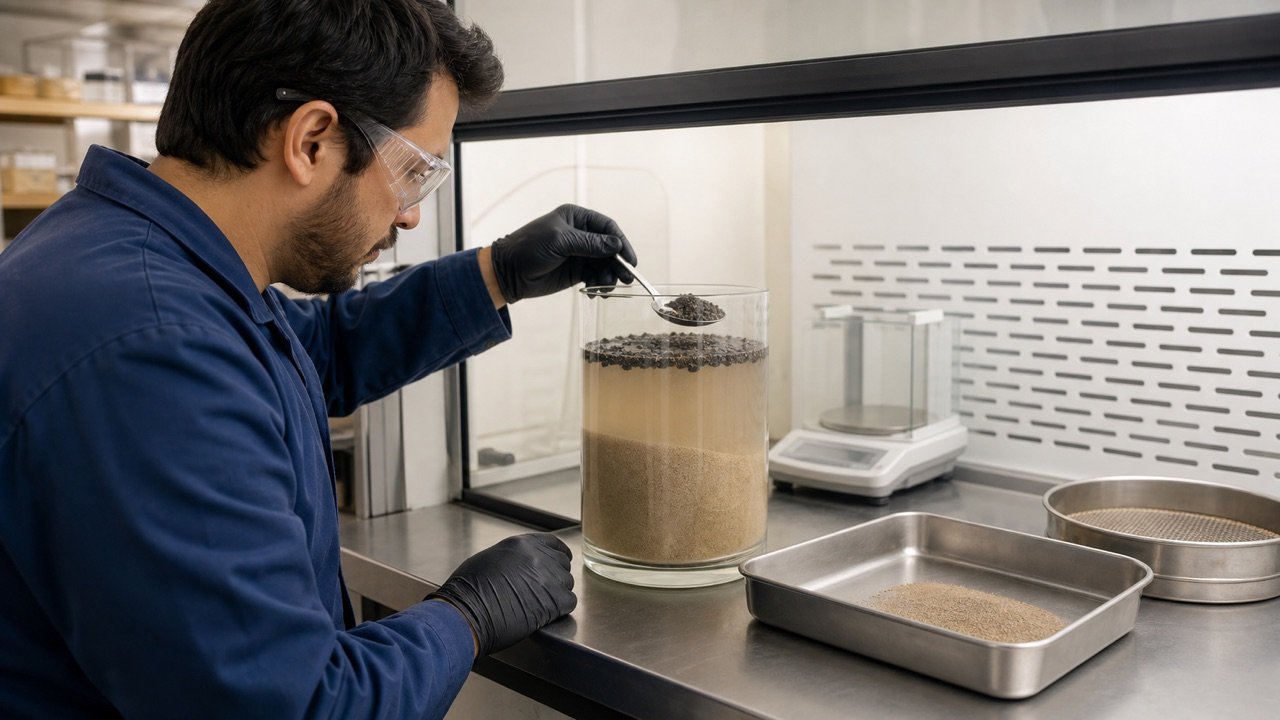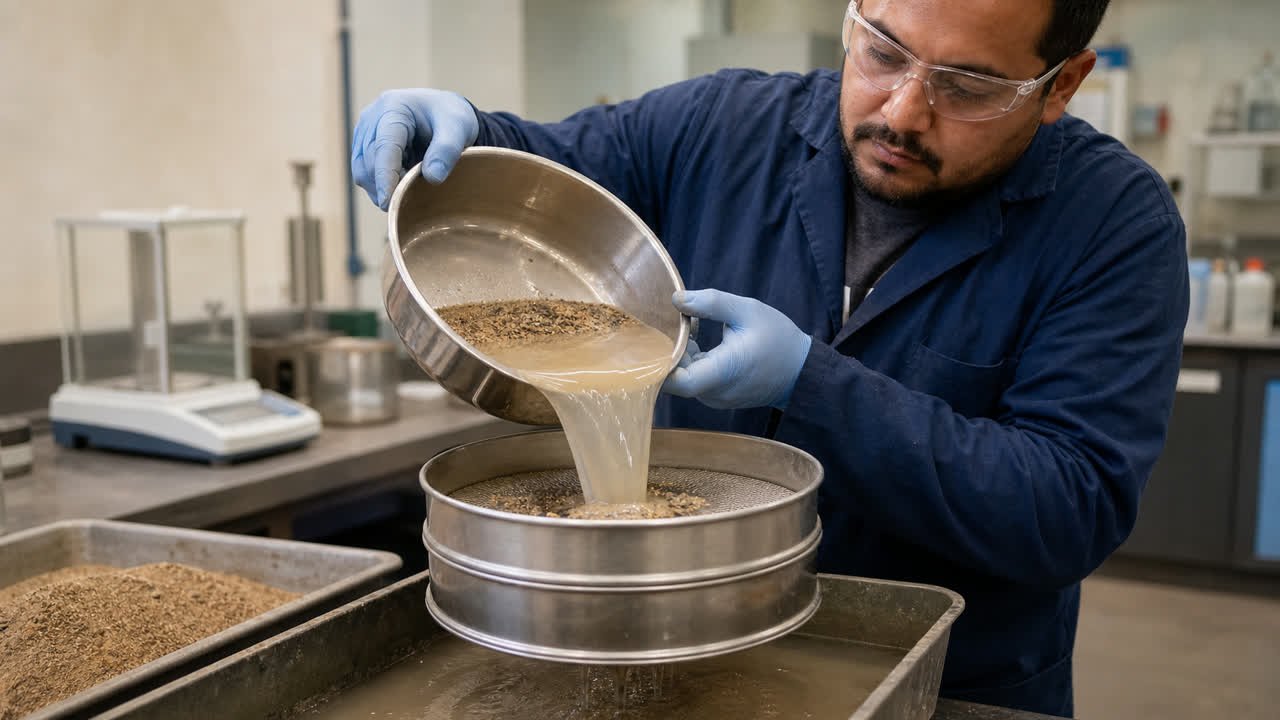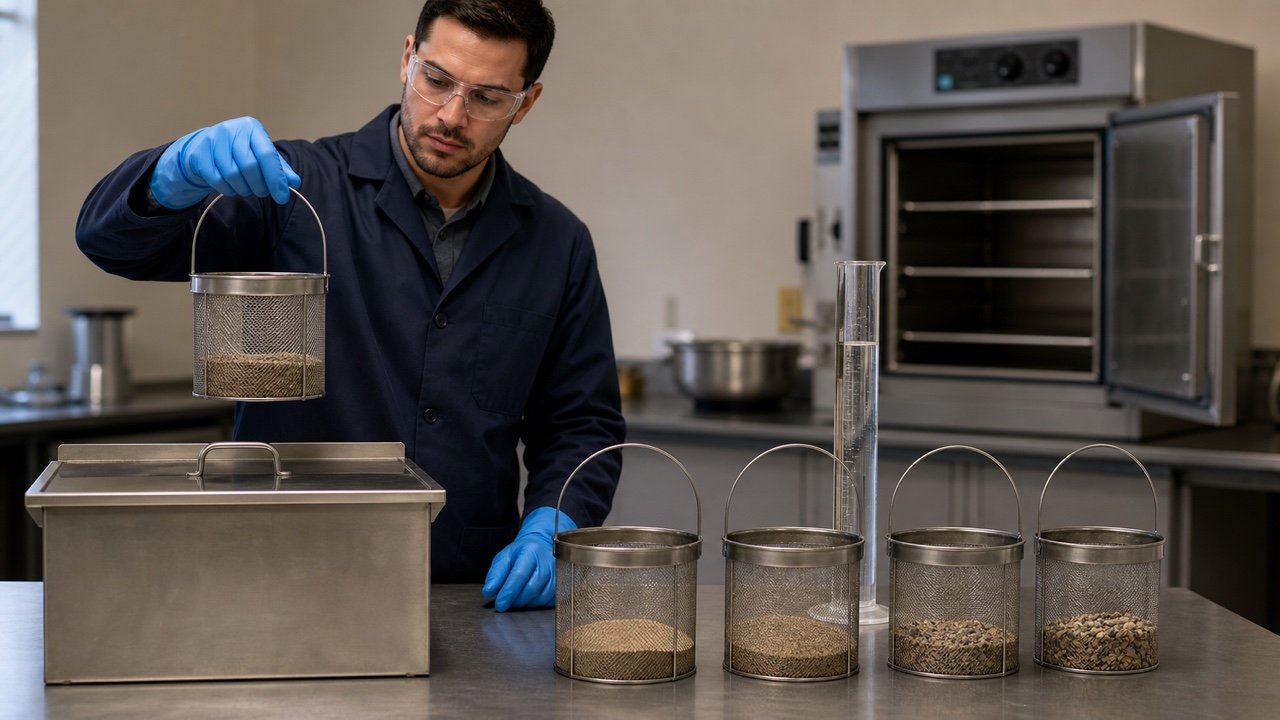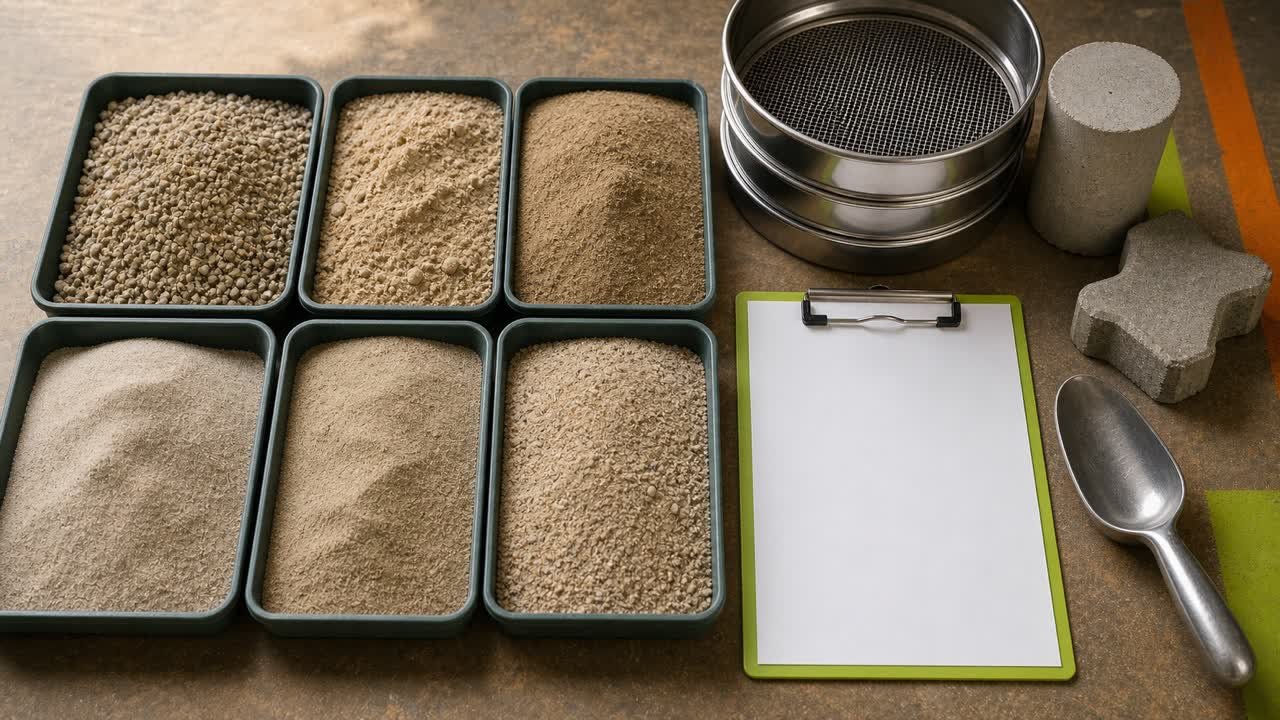
A methylene blue report can show a short number such as 2.0 mg/g, yet that number has little meaning until you identify the test method and particle fraction. ASTM C1777, AASHTO T 330, and EN 933-9 use different specimens and measurement systems.
Check the method first. Then verify the dye or colorimeter record, dry specimen mass, units, report precision, sample identity, and project requirement.
How should you interpret a methylene blue value?
Interpret the value as the mass of methylene blue adsorbed per unit mass of the particle fraction tested under the named method. Report it with the method designation, fraction, units, sample identity, and project limit.
The value responds to both the amount and characteristics of clay minerals in the specimen. It is an empirical test result rather than a direct clay percentage. A value of 2.0 mg/g does not mean that the aggregate contains 2% clay.
ASTM C1777-20 states that its results are not expected to correlate with AASHTO T 330 or EN 933-9. The methods can return different values for the same source even when each report uses mg/g.
Which methylene blue method produced the result?
The method controls the particle fraction, measurement system, endpoint, calculation record, and intended comparison. Record the full designation and revision shown on the report.
| Method family | Particle fraction stated in public source | Measurement | Main report check |
|---|---|---|---|
| ASTM C1777-20 | Fine aggregate or mineral filler finer than 4.75 mm | Colorimeter detects the concentration change after mixing, filtering, and dilution | Calibration or absorbance record, dilution basis, specimen mass, and current worksheet |
| AASHTO T 330 | Fraction passing the 75 micrometre (No. 200) sieve | Titration with a visual endpoint | Dye concentration, cumulative endpoint volume, dry mass, endpoint confirmation, and current method |
| EN 933-9:2022 MB | 0/2 mm fraction | Titration with a visual endpoint | Test portion, 10 g/L solution, cumulative volume, endpoint, and national adoption |
| EN 933-9:2022 MBF | 0/0.125 mm fraction | Reference method in normative Annex A | Correct MBF label and fraction rather than an MB result |
The EN 933-9:2022 public scope identifies MB for the 0/2 mm fraction and MBF for the 0/0.125 mm fraction. It also permits another factory-production-control method only when a suitable relationship with the reference method has been established.
How is a titration methylene blue value calculated?
Multiply the dye concentration by the cumulative solution volume at the accepted endpoint. Divide that dye mass by the dry mass of the tested fraction.
MBV = C x V / M
| Symbol | Meaning | Unit used in the check |
|---|---|---|
| C | Methylene blue concentration | mg/mL |
| V | Total solution volume added at the accepted endpoint | mL |
| M | Dry mass of the particle fraction tested | g |
| MBV | Methylene blue mass per specimen mass | mg/g |
This equation is a dimensional mass-balance check for a titration record. The governing method can add preparation, correction, blank, endpoint-confirmation, and reporting requirements. Use the current controlled method for the laboratory result.
Are mg/g and g/kg the same numerical unit?
Yes. One milligram per gram equals 1 gram per kilogram because the numerator and denominator each increase by a factor of 1,000.
1 mg/g = 1 g/kg
The conversion only reconciles units. Method identity and specimen fraction still control whether 2 values can be compared.
Worked example: AASHTO-type titration arithmetic
Assume a report records a 5.0 mg/mL solution, 4.0 mL cumulative volume at the accepted endpoint, and 10.0 g dry mass for the tested fraction.
Dye mass = 5.0 mg/mL x 4.0 mL = 20.0 mg
MBV = 20.0 mg / 10.0 g = 2.0 mg/g
The reverse check returns the same numerator: 2.0 mg/g x 10.0 g = 20.0 mg. The arithmetic matches the report only if 4.0 mL is the cumulative accepted endpoint volume and 10.0 g is the required dry test fraction.
The FHWA AASHTO T 330 training module describes a 5 mg/mL solution and material passing the No. 200 sieve. The current licensed AASHTO method and project documents control the live test.
Worked example: EN-type 10 g/L solution arithmetic
Convert the solution concentration before calculating. A 10 g/L solution equals 10 mg/mL.
For 45.0 mL of solution and a 200.0 g dry test portion:
Dye mass = 10 mg/mL x 45.0 mL = 450 mg
MB = 450 mg / 200.0 g = 2.25 mg/g = 2.25 g/kg
This example checks units and arithmetic. EN 933-9:2022 controls the test portion, additions, stain test, endpoint confirmation, corrections, and report precision.
Why can equal methylene blue values describe different specimens?
Each method assigns the dye uptake to a different mass basis. Clay-active material can be concentrated in the fraction passing 75 micrometres, diluted across a 0/2 mm fraction, or expressed across the entire fine-aggregate specimen.
| Report A | Report B | Can you compare them directly? | Required action |
|---|---|---|---|
| 2.0 mg/g, AASHTO T 330 | 2.0 mg/g, ASTM C1777 | No | Keep each value with its method and tested fraction |
| 2.0 mg/g, ASTM C1777 | 2.0 g/kg, ASTM C1777 | Units are numerically equivalent | Confirm both reports used the same method, revision, specimen basis, and calculation |
| 2.0 g/kg MB, EN 933-9 | 2.0 g/kg MBF, EN 933-9 | No | Check the 0/2 mm versus 0/0.125 mm label and applicable requirement |
| 2.0 mg/g, same method | 2.0 mg/g, same method | Possibly | Confirm source, lot, sampling, preparation, laboratory controls, precision, and project use |
ASTM C1777 explains that T 330 can give the highest value for one source because clay can be concentrated in the passing-75-micrometre fraction. C1777 also warns that the AASHTO and EN values do not include the amount of material in the tested fraction relative to the full aggregate in the same way as C1777.
How much can one endpoint increment change the result?
The change equals the dye mass in one addition divided by the dry specimen mass. A smaller specimen or larger addition produces a larger step in the displayed MBV.
Using the 10.0 g specimen and 5.0 mg/mL solution from the first example, one 0.5 mL addition contains 2.5 mg of dye:
Endpoint step = 5.0 mg/mL x 0.5 mL / 10.0 g = 0.25 mg/g
| Accepted cumulative volume | Calculated MBV | Difference |
|---|---|---|
| 3.5 mL | 1.75 mg/g | Reference |
| 4.0 mL | 2.00 mg/g | +0.25 mg/g |
The current method controls addition size and endpoint confirmation. This calculation shows why a report near a project limit needs the raw endpoint record and method precision.
How does ASTM C1777 use a colorimeter?
C1777 mixes a specimen with methylene blue solution, filters the mixture, dilutes a portion by a fixed amount, and uses a colorimeter to determine the remaining concentration. The concentration change becomes the adsorbed dye mass used in the reported mg/g value.
A C1777 audit should retain the method revision, specimen identity and mass, solution record, colorimeter calibration or absorbance data, filter and dilution record, worksheet calculation, and report precision. A titration endpoint volume cannot replace those records.
ASTM names C1777 as a field and laboratory test. It also states that the standard does not address every safety concern. The laboratory must set chemical, health, environmental, and equipment controls for its work.
What should you check on a methylene blue report?
- Trace the sample: record project, material, supplier, source, lot or stockpile, sample number, sampling point, date, and quantity represented.
- Name the method: record ASTM C1777, AASHTO T 330, EN 933-9 MB, EN 933-9 MBF, or the project method with its revision.
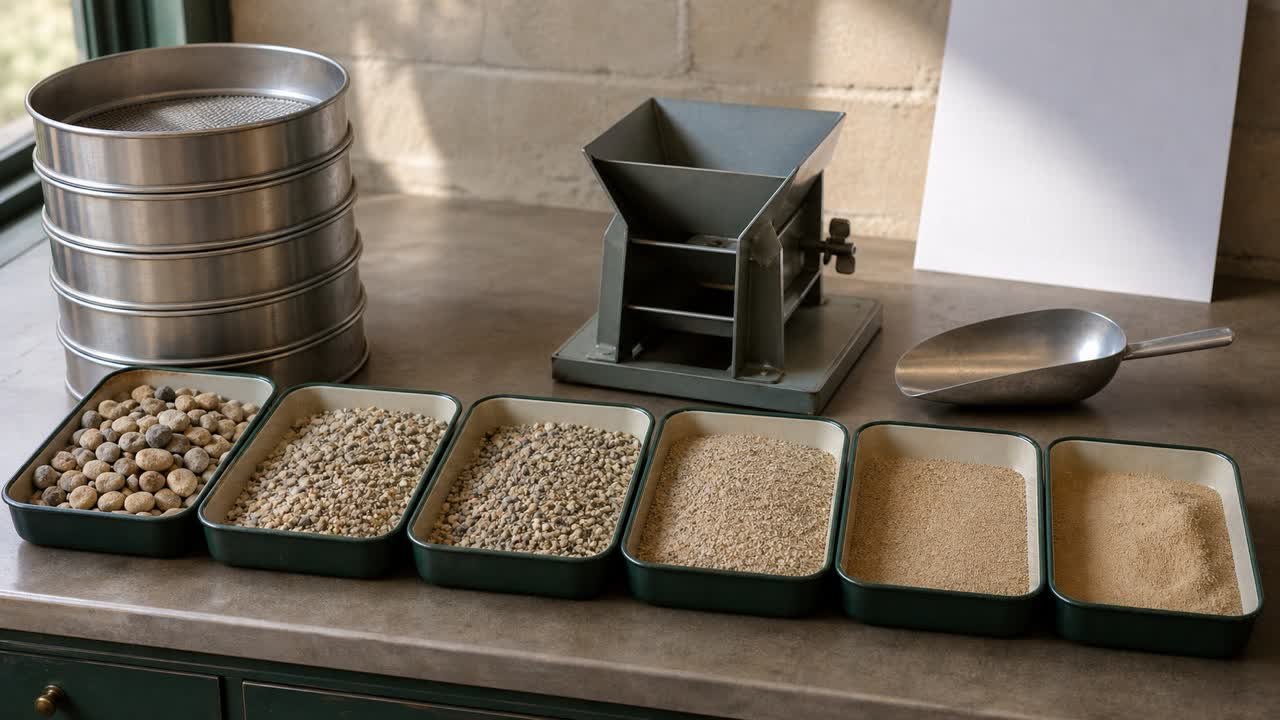
- Confirm the fraction: check the sieve or size fraction tested and how the laboratory prepared it.
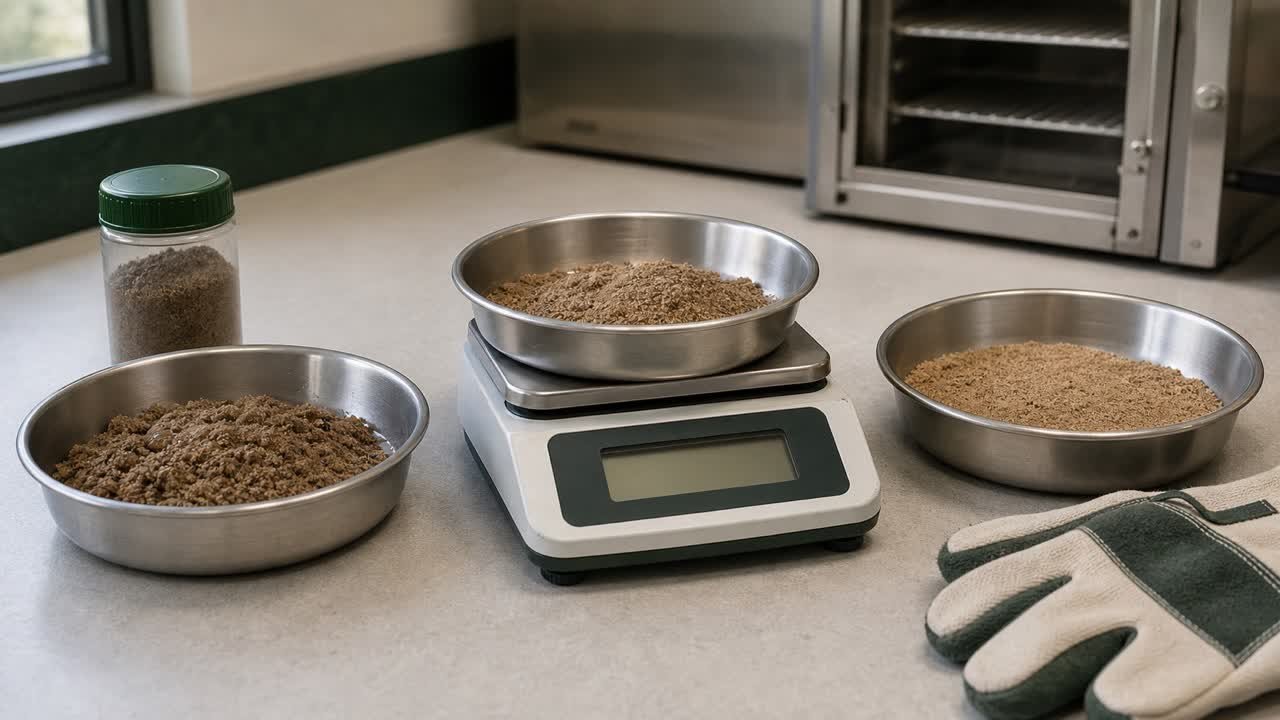
- Check the mass basis: verify dry specimen mass, decimal position, and any moisture correction required by the method.
- Check the measurement record: use cumulative titration volume and endpoint confirmation, or use the C1777 colorimeter calibration, dilution, and concentration record.
- Recalculate: retain unrounded inputs until the method says to round.
- Check repeats and precision: apply the method's duplicate, repeat, averaging, and report rules.
- Find the acceptance authority: cite the project specification, material class, application, edition, and decision rule.
What if the reported value is near the project limit?
Review raw measurements before assigning pass or fail. Check method and revision, particle fraction, cumulative endpoint volume, colorimeter range, specimen mass, concentration conversion, rounding order, repeat provisions, sample identity, and specification edition.
A 10-fold mass-entry error changes the result by a factor of 10. In the first example, entering 100.0 g instead of 10.0 g returns 0.20 mg/g instead of 2.0 mg/g.
Keep the unrounded calculation in the audit record. Compare the final reported value with the limit only after applying the governing method and project decision rule.
Does ASTM C1777 give a universal maximum MBV?
No. ASTM C1777-20 states that it does not provide recommended maximum values for specific applications. It says maximum values should be established from successful performance in the application under consideration.
Concrete, asphalt, mortar, filler, base, and other uses can have different performance concerns and specification systems. An old training range, supplier claim, national example, or unrelated research table cannot set the acceptance limit for a current project.
Is methylene blue the same as the No. 200 wash or sand equivalent test?
No. A No. 200 sieve wash test measures the mass percentage removed through the 75 micrometre sieve under its method. Methylene blue responds to dye adsorption by clay-active material in a defined fraction.
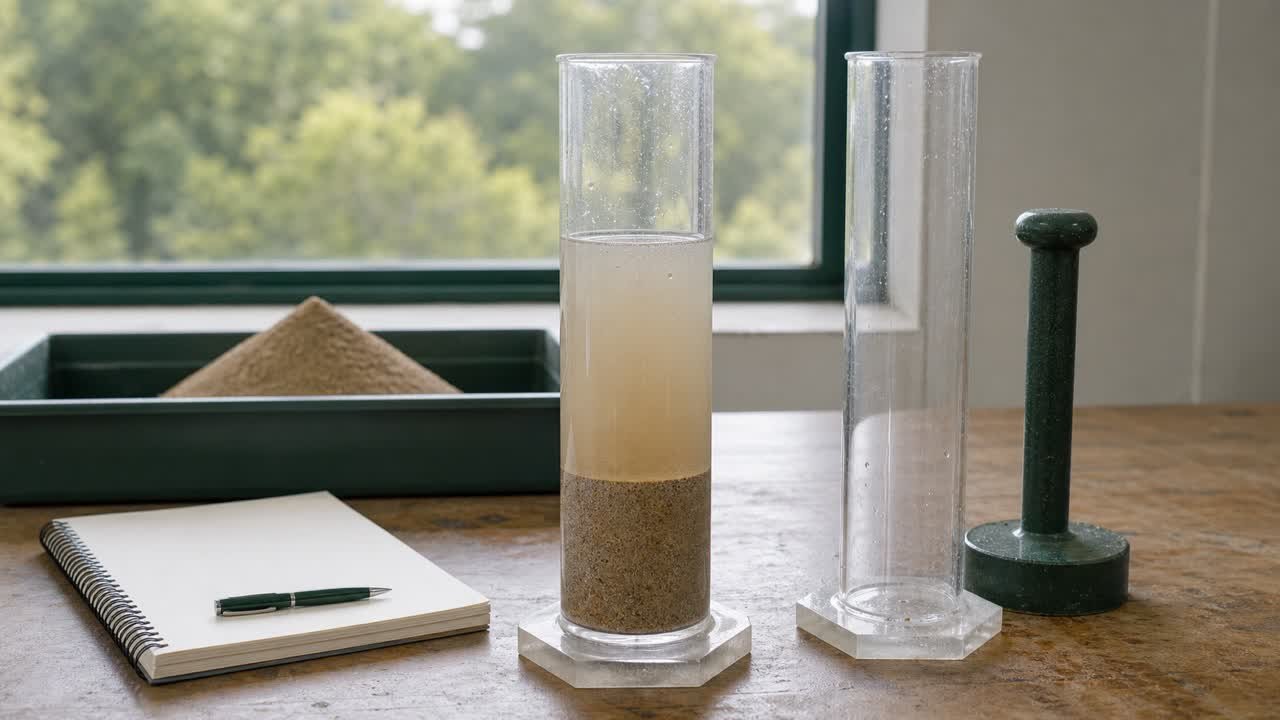
The sand equivalent test compares settled sand and clay-suspension readings to produce an empirical index. The tests answer separate questions, so one value cannot be converted into either of the others.
Use the sand sieve analysis guide to check the full particle-size distribution. Use the sand sampling guide to connect each result with a defined lot.
Common methylene blue report mistakes
- Leaving the method or revision off the report.
- Comparing C1777, T 330, and EN 933-9 values as one scale.
- Confusing MB with MBF under EN 933-9.
- Using total aggregate mass when the method tests a separated fraction.
- Entering g/L as mg/mL without converting the units.
- Using the last dye addition rather than cumulative endpoint volume.
- Using wet mass where the worksheet requires dry mass.
- Skipping the endpoint confirmation or colorimeter calibration record.
- Rounding the numerator before dividing by specimen mass.
- Copying a maximum value from another material, agency, country, or application.
- Treating MBV as a direct percentage of clay.
- Applying one sample to an unidentified delivery or stockpile.
After the material has been approved for its intended use, use the Sand Calculator for volume, supplier-density mass, or documented package yield. Return to the Sand material planning hub for quantity tools and related test guides.
Sources and source scope
- ASTM C1777-20, Standard Test Method for Rapid Determination of the Methylene Blue Value for Fine Aggregate or Mineral Filler Using a Colorimeter: active designation, scope, measurement system, units, method-comparison warning, clay-mineral context, and application-specific limit boundary. The licensed current standard controls the complete procedure.
- NBN EN 933-9:2022, Tests for geometrical properties of aggregates, Part 9: active 2022 adoption, 0/2 mm MB scope, 0/0.125 mm MBF scope, 10 g/L solution, reference-method status, production-control relationship, and safety warning.
- FHWA HMEC Module D Lesson 03, AASHTO T 330: older federal training source for the passing-No. 200 specimen, titration concept, solution concentration, endpoint, and workflow. The current licensed method and project documents control.
- Idaho Transportation Department FHWA-ID-24-313, Study of the Idaho Degradation Test and Other Methods for Assessing Aggregate Quality: public June 2024 research implementation of AASHTO T 330, specimen preparation, 0.5 mL additions, endpoint description, and MBV variables.
- NCAT Report 98-3, Tests for Plastic Fines in Aggregates Related to Stripping in Asphalt Paving Mixtures: a 10-aggregate research comparison involving methylene blue, sand equivalent, plasticity index, and asphalt moisture-damage tests. It is not a current acceptance specification.
Scope: this page checks report calculations, method identity, and review records. The current governing test method, project documents, laboratory procedures, sampling plan, acceptance rules, safety program, and responsible qualified people control testing and material approval.
BuildQuantities.com records its research and calculation checks on the methodology page. Report a formula, source, unit, or rendering problem through the corrections route.