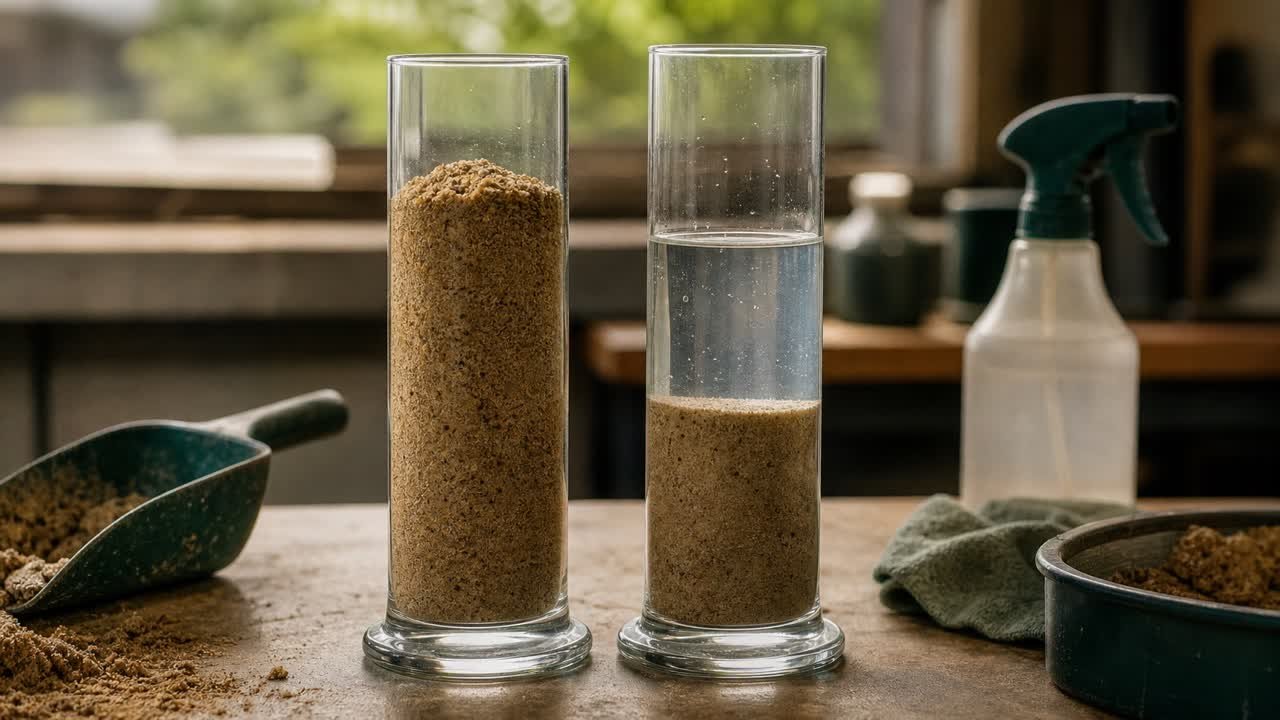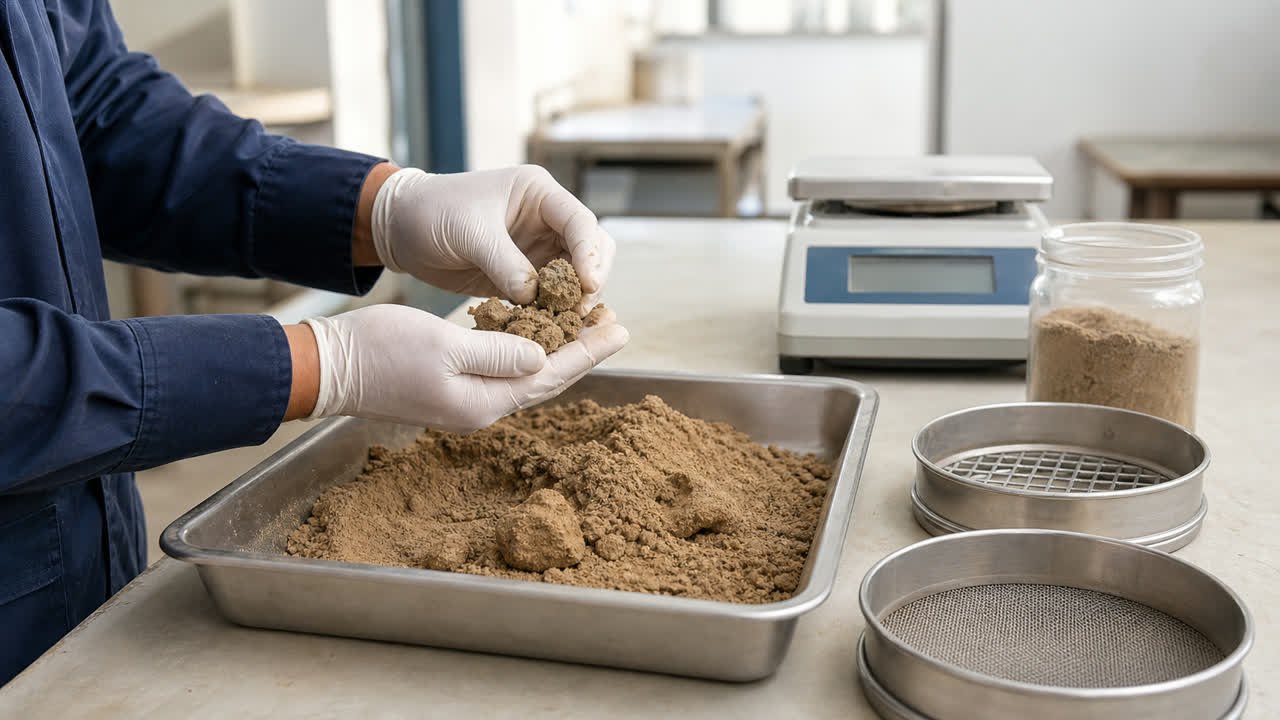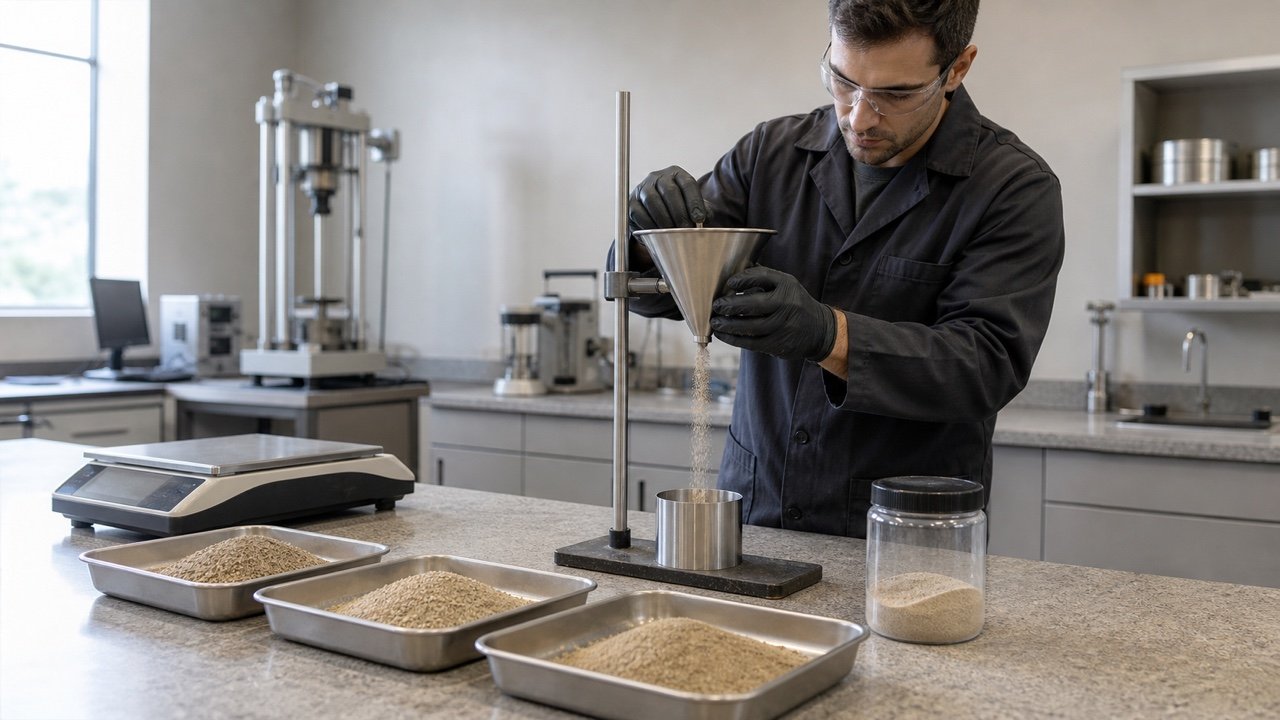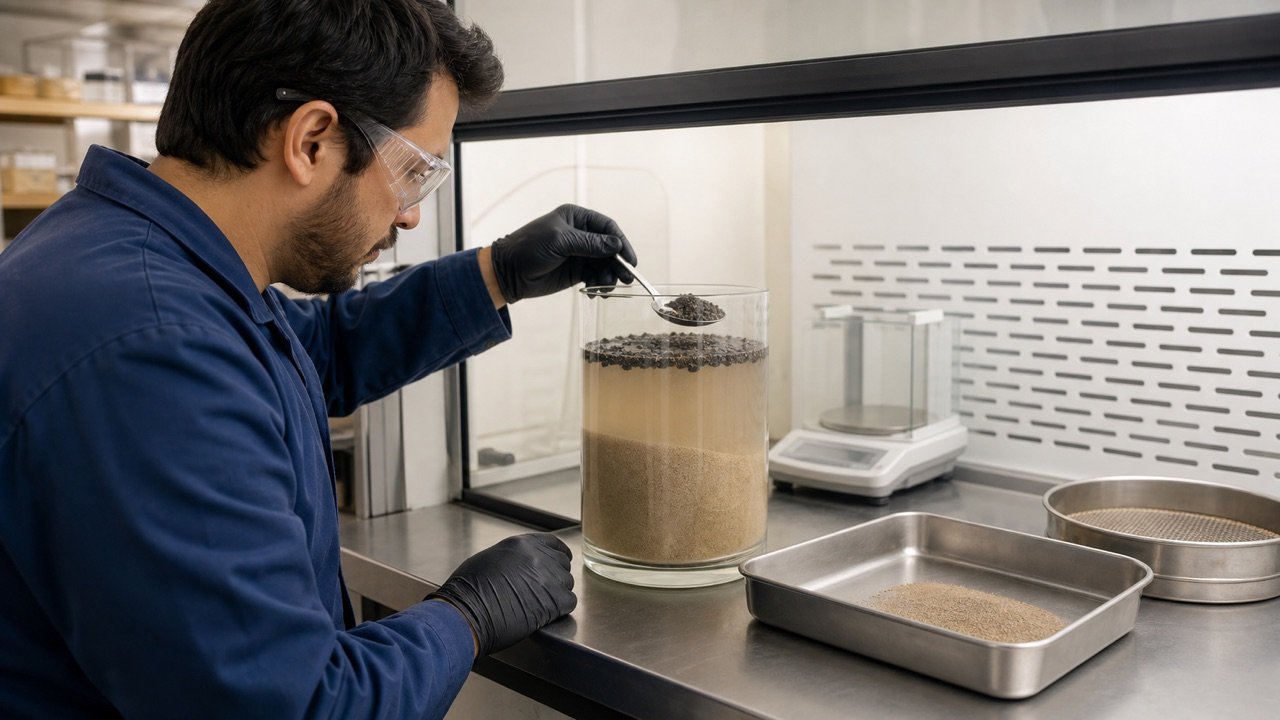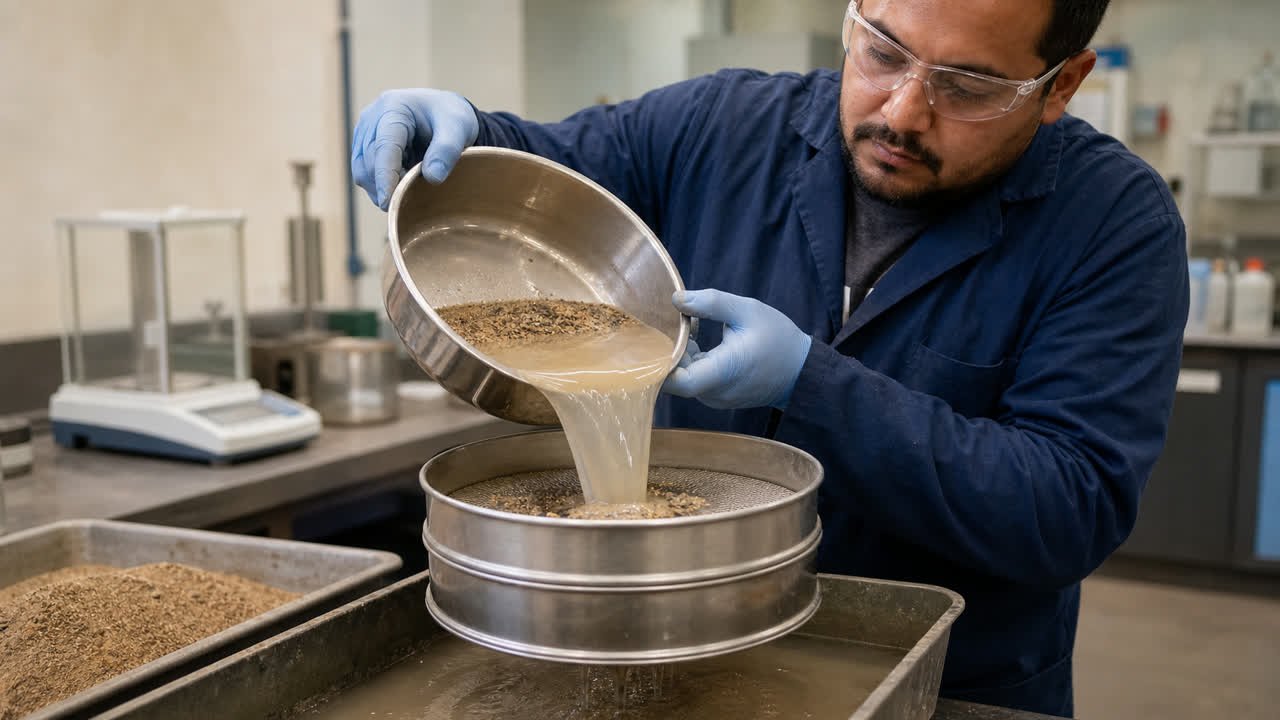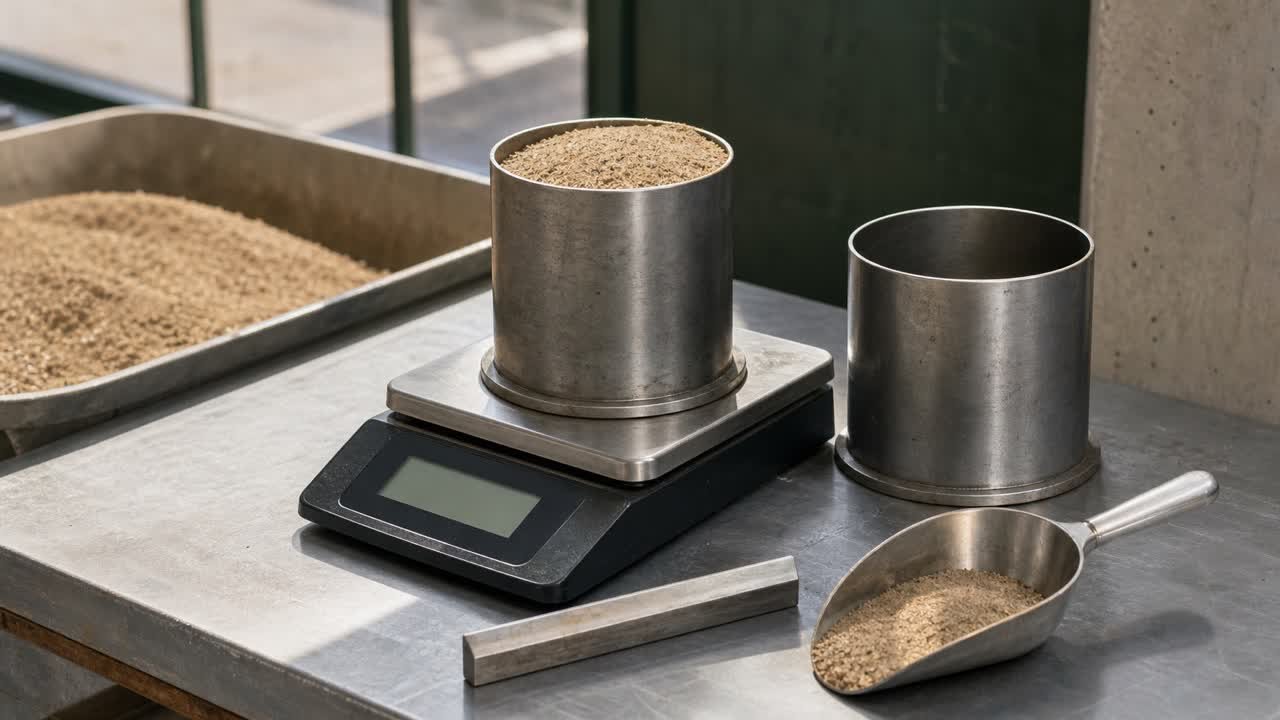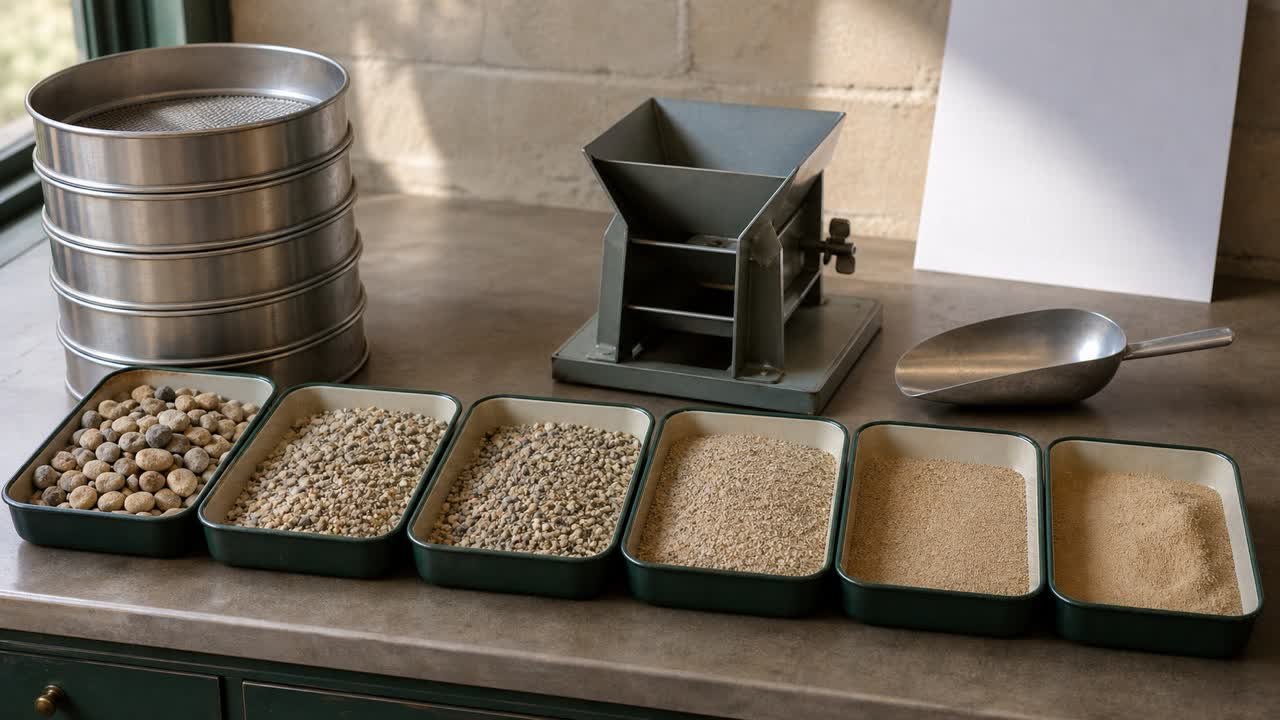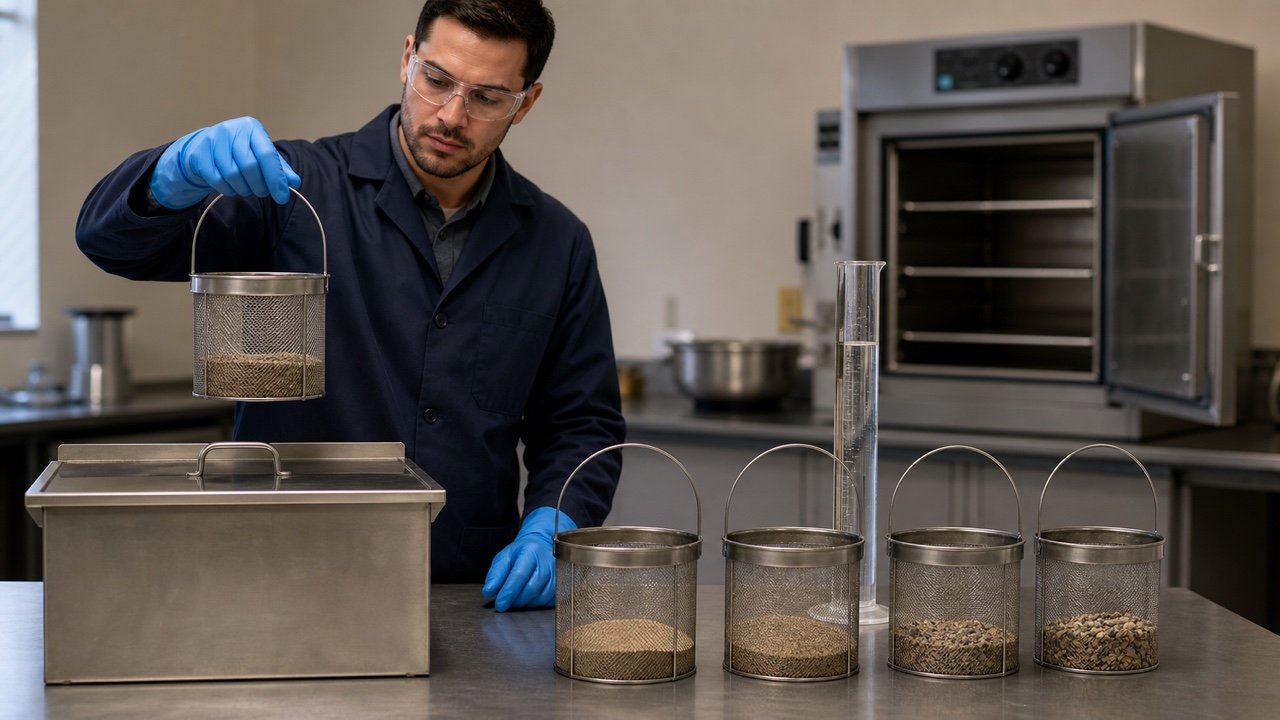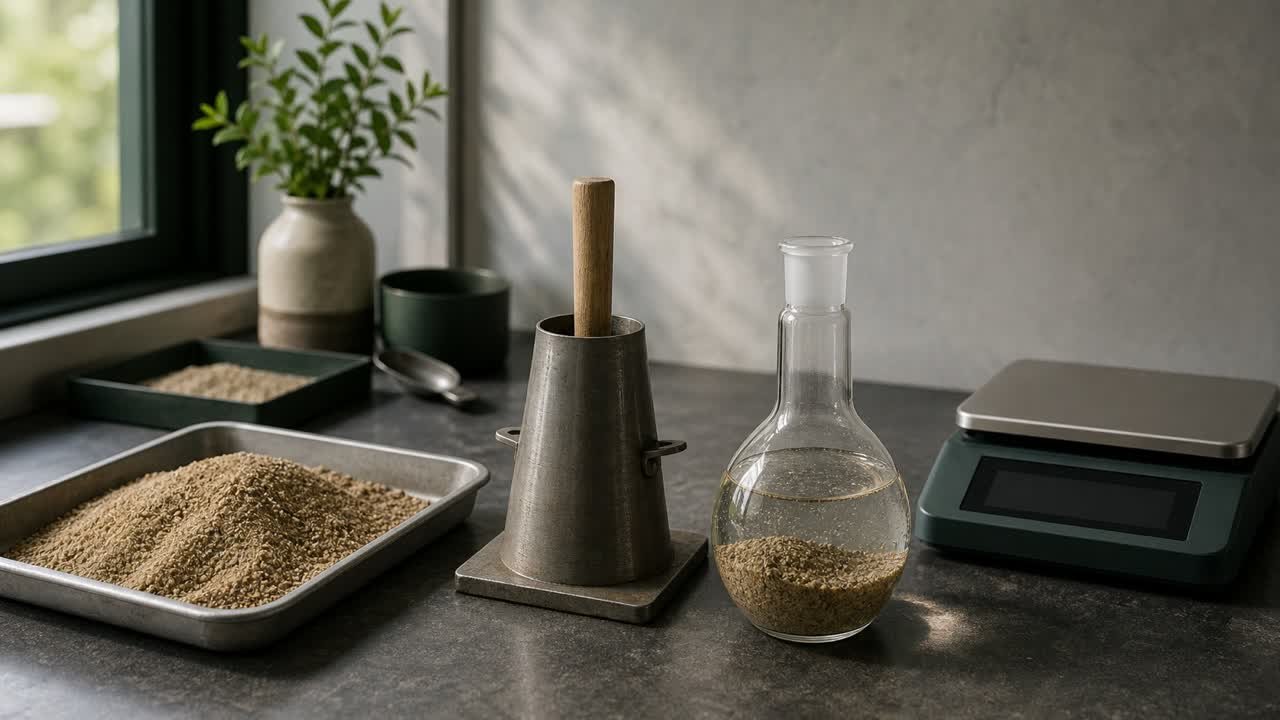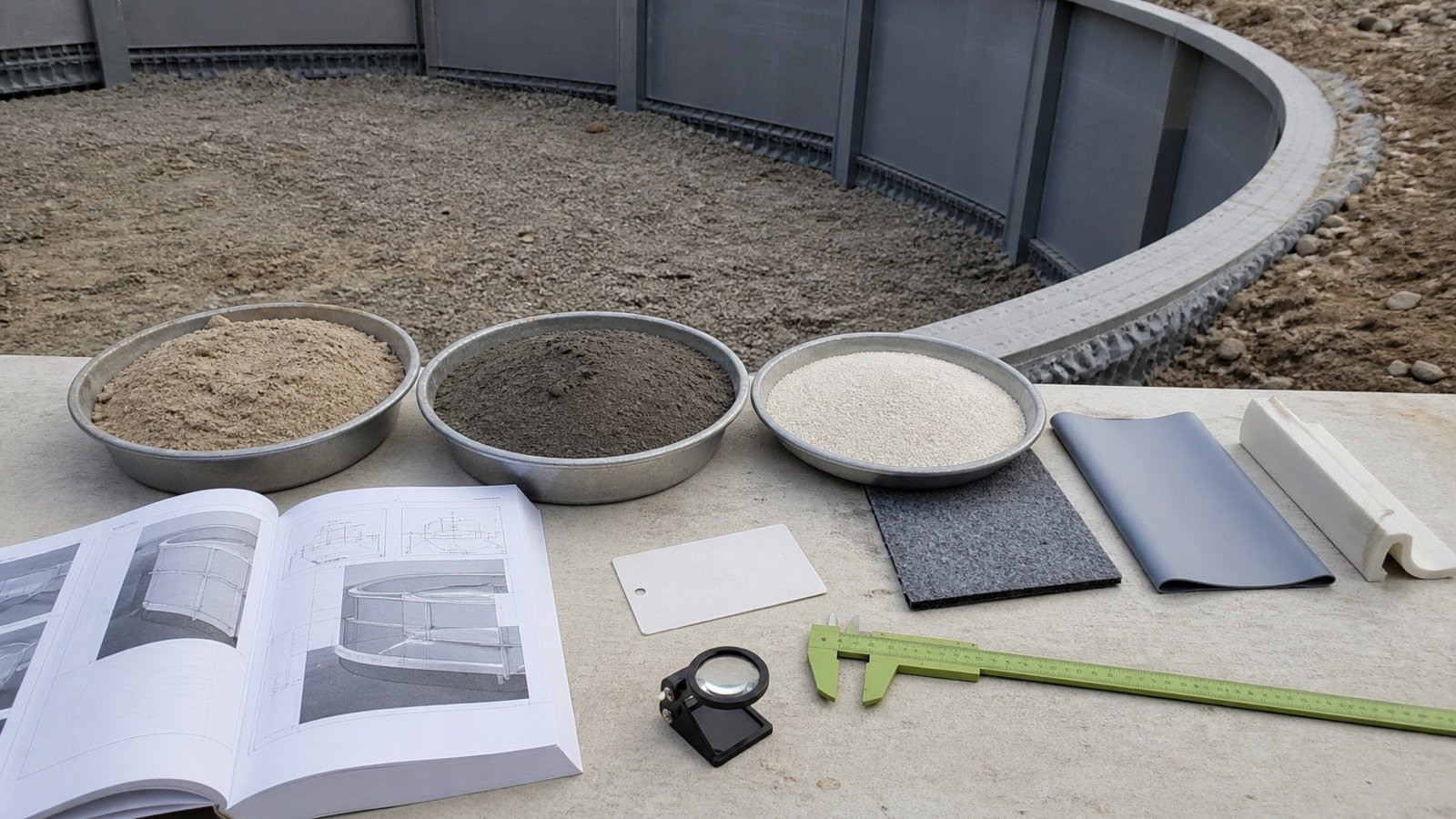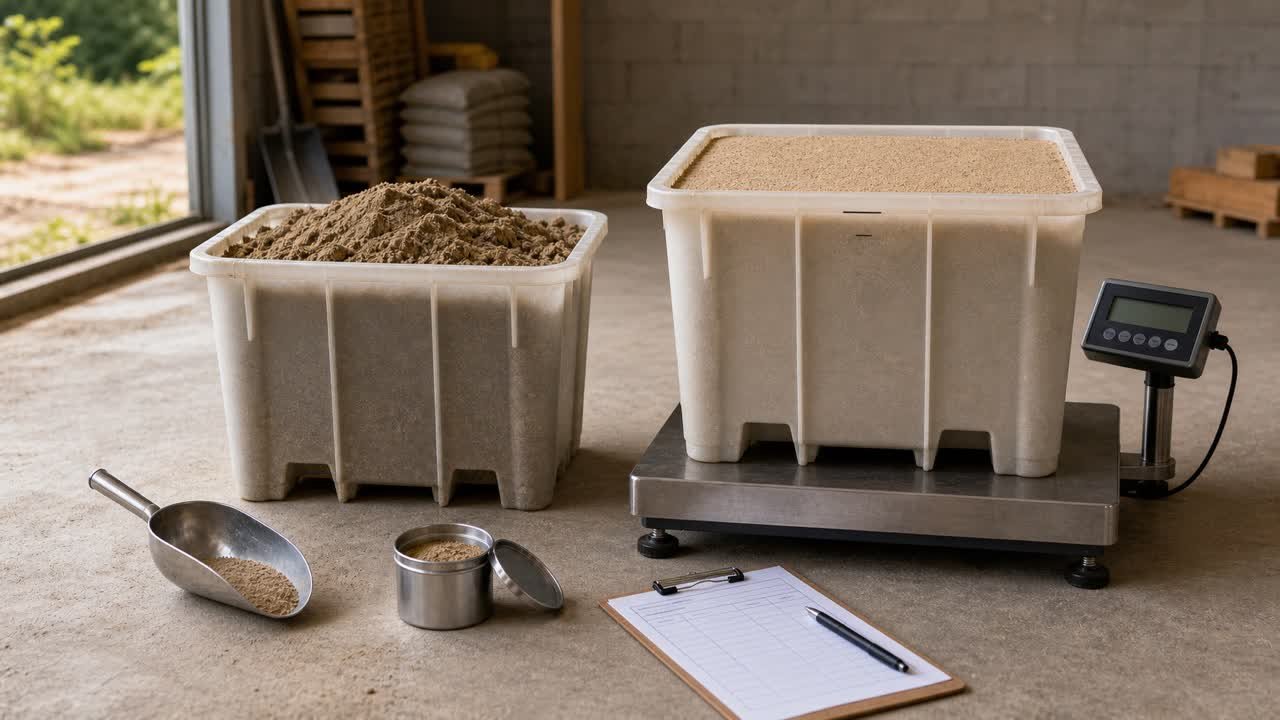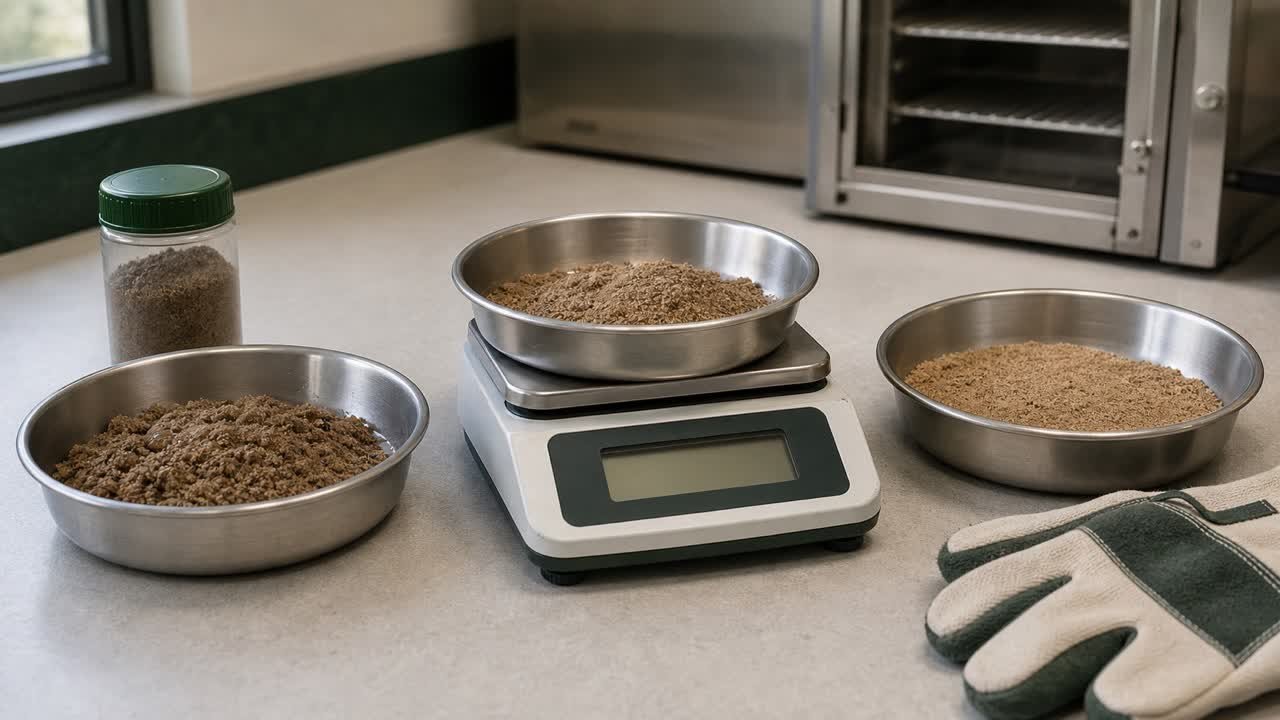
Wet sand includes aggregate and water, so its scale mass cannot be treated as dry sand without a stated moisture basis. A checked calculation starts with a representative sealed sample, removes the container tare, and compares the initial wet mass with the final cooled dry mass.
The result applies to the sampled material at that place and time. Use the governing test method, sampling plan, balance, drying equipment, and reporting rule when the value will control acceptance or production.
How do you calculate sand moisture content?
Subtract the final dry sample mass from the initial wet sample mass to find the evaporable water. Divide that water mass by the dry sample mass, then multiply by 100.
Moisture content, w (%) = (MW - MD) ÷ MD × 100
MW is the wet mass of sand only. MD is the final dry mass of sand only. Both masses must use the same unit and must exclude the container.
The current WSDOT implementation of AASHTO T 255 calculates total aggregate moisture on a dry-mass basis. Dividing by wet mass gives a different percentage and cannot be substituted without changing the definition.
Which masses must be recorded?
Record the empty container, wet sample plus container, and cooled dry sample plus container. Keep the same container through the test and identify every reading with its unit.
| Symbol | Recorded or calculated mass | Equation |
|---|---|---|
| C | Clean, dry empty container | Scale reading |
| WC | Wet sample plus container | Scale reading |
| DC | Cooled dry sample plus container | Scale reading after constant mass |
| MW | Wet sand only | WC - C |
| MD | Dry sand only | DC - C |
| Water mass | Mass removed during drying | MW - MD |
A zero or negative sample mass is invalid. A dry mass greater than the initial wet mass also needs investigation. Possible causes include mixed containers, transcription, scale drift, contamination, material loss or gain, and incompatible readings.
Worked example: calculate moisture after subtracting tare
A clean container weighs 128.4 g. The wet sample and container weigh 652.4 g. After drying to constant mass under the chosen method and cooling, the dry sample and container weigh 628.4 g.
| Step | Calculation | Result |
|---|---|---|
| Wet sand mass | 652.4 - 128.4 | 524.0 g |
| Dry sand mass | 628.4 - 128.4 | 500.0 g |
| Water mass | 524.0 - 500.0 | 24.0 g |
| Moisture content | 24.0 ÷ 500.0 × 100 | 4.8% |
The reverse check is 500.0 × 1.048 = 524.0 g. This fixture checks the arithmetic. It does not state a normal moisture content for a product, stockpile, or project.
Why is moisture divided by dry mass instead of wet mass?
Dry mass provides the fixed aggregate basis used by the cited aggregate method. Wet mass changes when water changes, so using it as the denominator defines a different ratio.
For a 100 g wet sample that dries to 95 g, the water mass is 5 g:
| Basis | Calculation | Result |
|---|---|---|
| Dry-mass basis used here | 5 ÷ 95 × 100 | 5.263% |
| Wet-mass basis | 5 ÷ 100 × 100 | 5.000% |
Both calculations can be performed, but they do not report the same defined quantity. A record should state the method and basis rather than showing only “5% moisture.”
How do you convert wet sand mass to dry sand mass?
When total moisture is already known on a dry-mass basis, divide the wet mass by 1 plus the moisture fraction.
Dry mass = wet mass ÷ (1 + w ÷ 100)
Wet mass = dry mass × (1 + w ÷ 100)
Water within wet mass = wet mass × w ÷ (100 + w)
Suppose a measured wet sand mass is 1,060 kg and a representative test reports 6.0% total moisture on a dry basis:
- Convert the percentage to a factor: 1 + 6 ÷ 100 = 1.06.
- Calculate dry sand: 1,060 ÷ 1.06 = 1,000 kg.
- Calculate water: 1,060 - 1,000 = 60 kg.
- Check the result: 1,000 × 1.06 = 1,060 kg.
Use a moisture result that represents the measured load, batch, or stockpile interval. A precise conversion cannot repair an unrepresentative sample.
What is the difference between total moisture, absorption and surface moisture?
Total moisture includes water absorbed within aggregate pores and free water on particle surfaces. For concrete mixture calculations, absorption and surface moisture must be separated because surface water contributes to mixing water.
| Term | Meaning | Quantity use |
|---|---|---|
| Oven-dry mass | Aggregate mass after drying under the stated method | Dry basis for total moisture and absorption calculations |
| Absorption | Water held in aggregate pores between oven-dry and saturated-surface-dry conditions | Connects dry and SSD aggregate bases |
| Surface moisture | Water above the SSD condition | Included in concrete mixing-water accounting |
| Total moisture | Absorbed moisture plus surface moisture for wet aggregate | Connects oven-dry mass with current wet mass |
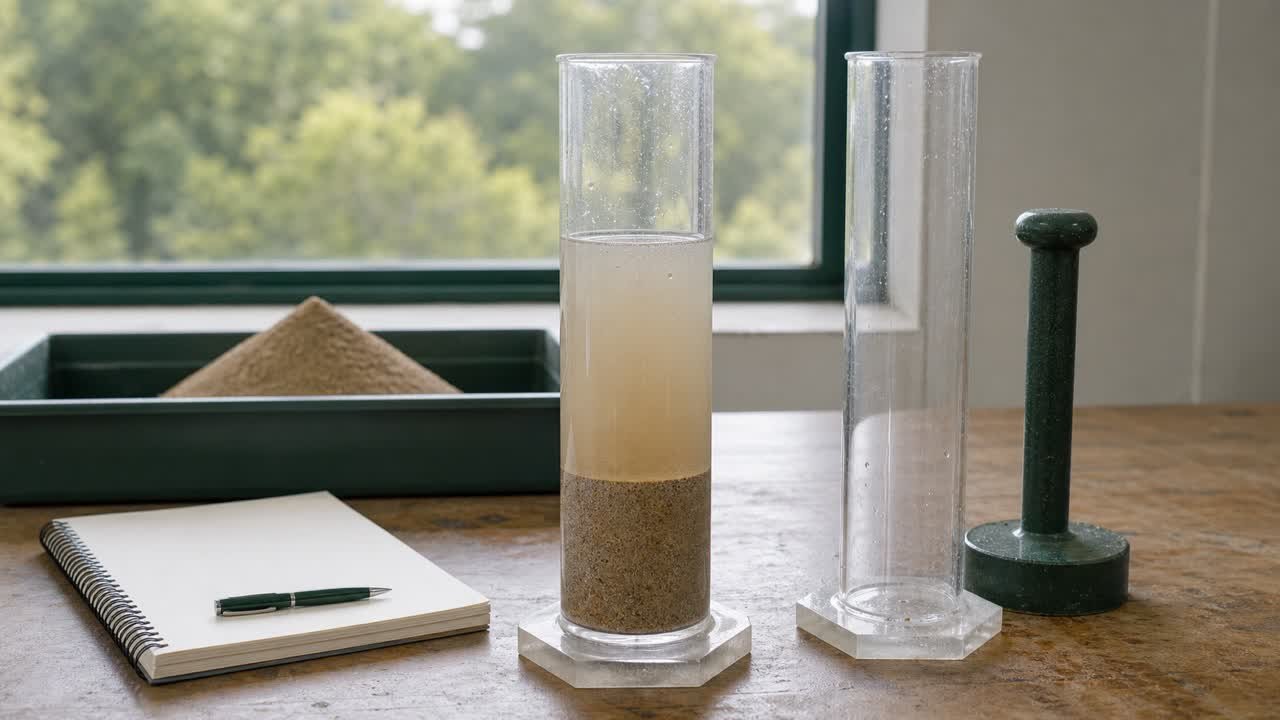
| Bulking | Change in apparent loose sand volume under a stated test | Volume correction, not a water-mass percentage |
Surface moisture (%) = total moisture (%) - absorption (%)
This subtraction uses percentages on the same dry-mass basis. Obtain absorption from the approved material test or mix record. Do not assume a value from the sand name or appearance.
How can moisture change a concrete batch calculation?
An approved concrete mix may state fine aggregate at saturated-surface-dry mass. The batch worksheet converts that SSD quantity to a dry basis, applies current total moisture to obtain the wet batch mass, and accounts for free surface water in the mixing water.
For an illustrative 1,000 kg oven-dry sand basis, 6.0% total moisture, and 1.0% absorption:
- Wet mass = 1,000 × 1.06 = 1,060 kg.
- SSD mass = 1,000 × 1.01 = 1,010 kg.
- Free surface water = 1,060 - 1,010 = 50 kg.
If the approved mix calls for the 1,010 kg SSD equivalent, 1,060 kg of this wet sand contains that aggregate basis plus 50 kg of surface water. The current mix design, all water sources, admixtures, batch size, project limits, and approved worksheet control the actual water setting.
The FHWA concrete batch moisture worksheet uses this same sequence for fine aggregate: convert SSD mass with absorption, calculate wet batch mass with total moisture, then account for aggregate free water in batch water.
How is sand dried to constant mass?
Follow the complete method named by the project. In the January 2026 WSDOT implementation of AASHTO T 255, the sample is representative, sealed or covered promptly, weighed with container tare, dried, checked after added drying intervals, cooled, and weighed again.
That method uses 110 ± 5°C for a controlled oven. It allows some other heat sources only when the agency permits them and requires frequent stirring for listed uncontrolled methods to avoid localized overheating.
Under the WSDOT method, constant mass is reached when the sample changes by less than 0.10% after the specified added drying interval:
Percent mass change = (previous dry mass - new dry mass) ÷ previous dry mass × 100
A fixed drying time alone does not prove constant mass. The applicable method may use a different apparatus, interval, temperature, threshold, sample size, or reporting precision, so transfer none of these details without checking its scope.
What safety controls apply during drying?
Use equipment, ventilation, hot-container handling, electrical controls, and personal protective equipment required by the laboratory or site. WSDOT warns that some minerals can overheat, crack, or explode during certain drying operations. Do not improvise a microwave, hot plate, or open-flame method.
How does sampling affect the moisture result?
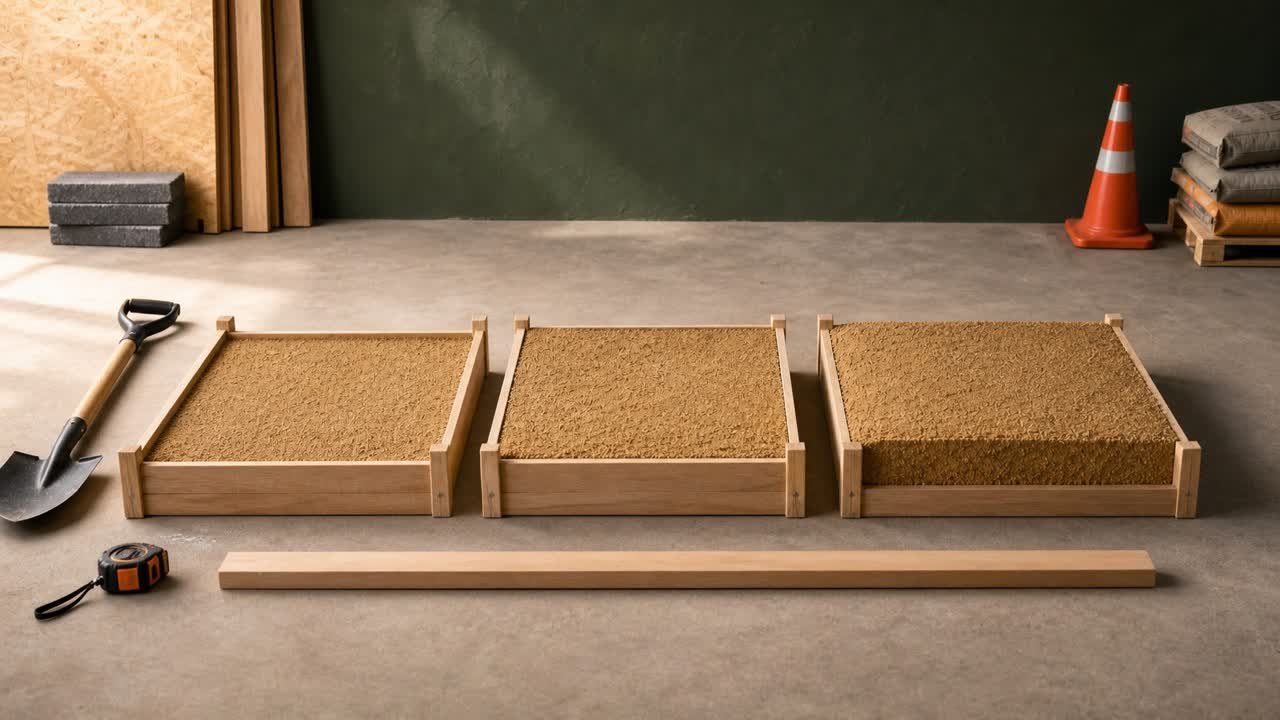
The test measures the sample, not every grain in the stockpile. Moisture can vary with rain, sun, drainage, crusting, stockpile depth, delivery time, and material handling.
- Define the lot or production interval before collection.
- Use the sampling point and increment plan required by the project.
- Seal or cover the moisture sample immediately.
- Record the sample location, date, time, recent weather, product, source, and delivery or batch reference.
- Retest when the represented material or moisture condition changes under the quality plan.
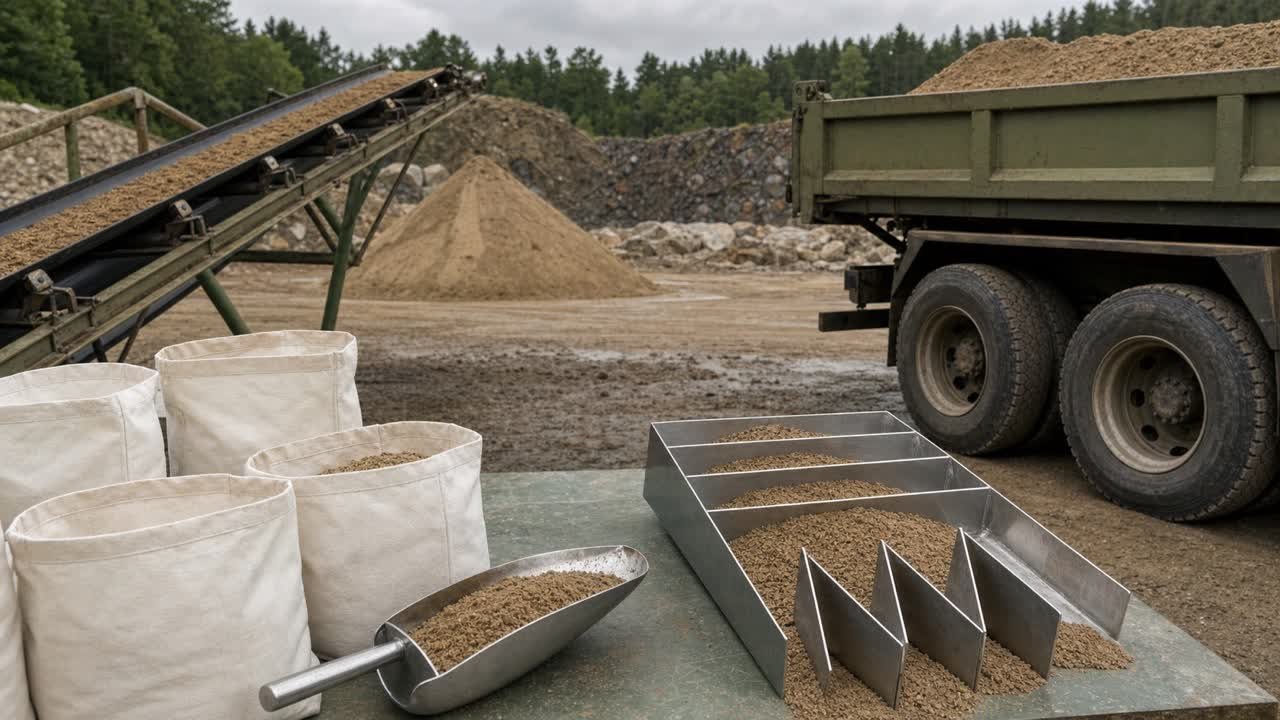
The Sand Sampling guide compares stockpile, stopped-belt, flowing-stream, and delivery sampling. Its sample-preservation steps are part of the measurement chain.
Can a moisture sensor replace a drying test?
Only when the approved process permits the instrument and its calibration, verification, material range, installation, and maintenance support the decision. A fast reading and a reference drying result can serve different roles.
Electrical, electromagnetic, probe, and other rapid methods can support production control, but their result can change with calibration, gradation, mineralogy, temperature, density, placement, and measurement depth. Check the instrument against the required reference method at the frequency and conditions set by the responsible program.
Record the device, serial number, calibration or correlation, material, location, time, operator, reading, and any reference sample. A manufacturer's general accuracy claim is not a project-specific verification.
What does a sand moisture result leave unanswered?
A total moisture result does not establish product suitability, gradation, contaminants, absorption, bulk density, bulking, compaction, strength, drainage performance, price, or legal load capacity.
It also does not establish one moisture value for a whole stockpile or future deliveries. Connect the result to the represented lot and combine it only with compatible data.
The Bulking of Sand guide covers apparent loose-volume change. The Sand Weight Chart explains mass-to-volume calculations with a documented bulk density. Keep those calculations separate from total moisture.
Common sand moisture calculation mistakes
- Leaving the container mass inside the wet and dry sample masses.
- Dividing water loss by wet mass when the governing aggregate method uses dry mass.
- Calling a sample dry after a fixed time without the method's constant-mass check.
- Weighing a hot container when the method requires the final cooled mass.
- Letting the sample dry in an open bag before its initial wet mass is recorded.
- Mixing grams, kilograms, pounds, or scale-display units in one equation.
- Rounding the wet and dry masses before calculating their small difference.
- Applying one sample result after rain, drainage, production, or stockpile conditions change.
- Using total moisture as surface moisture without subtracting tested absorption.
- Using moisture percentage as a bulking or compaction factor.
- Adjusting an approved concrete mix without its absorption values, water sources, and batch procedure.
- Publishing an instrument reading without its calibration and represented material.
What should a sand moisture record contain?
- Project, material, product, source, supplier, lot, and sample ID.
- Sampling point, method, date, time, sampler, and preservation.
- Test method, revision, project modifications, and laboratory.
- Container ID and tare mass.
- Wet combined mass, wet sample mass, drying apparatus, and temperature where required.
- Constant-mass readings, interval, threshold, cooled dry combined mass, and dry sample mass.
- Water mass, moisture equation, unrounded result, reported result, and units.
- Balance ID, resolution, calibration status, tester, checker, and deviations.
- Absorption source and SSD basis when a concrete correction is made.
- Linked delivery, stockpile, batch, mix, and retest decision.
Sources and source scope
- WSDOT Materials Manual, WAQTC FOP for AASHTO T 255 (25), January 2026: representative aggregate sample, moisture preservation, container tare, wet and dry masses, drying options, constant-mass check, dry-basis formula, safety caution, and reporting under that method.
- NRMCA TIP 6, Aggregate Moisture and Making Adjustments to Concrete Mixtures: oven-dry, air-dry, SSD, and wet aggregate states; absorbed and surface moisture; mixing-water context.
- FHWA Form 1638, Worksheet for Determining Concrete Batch Moisture/Absorption Corrections: SSD-to-dry conversion, wet batch mass, and aggregate free-water calculation in its concrete worksheet.
- ASTM C566-25, Total Evaporable Moisture Content of Aggregate by Drying: current standard identity and aggregate total-evaporable-moisture scope. The complete paid standard controls work performed to ASTM C566.
Scope: this guide checks quantity definitions and arithmetic. The current project documents, full test method, sampling plan, laboratory procedures, approved concrete mix, equipment instructions, safety controls, and responsible qualified people control testing, batching, acceptance, and construction.
Use the Sand Calculator after the required geometry, material, density or package yield, and quantity state are confirmed. Return to the Sand Material Planning hub for related tools and guides. BuildQuantities.com records its review process on the methodology page and accepts source or calculation reports through the corrections route.