A pool-base sand quantity is useful only after the exact pool instructions approve the material, footprint and layer. Some above-ground pool manuals specify a compacted granular foundation, while others state that sand must not be used to create a level base.
This calculator handles an approved uniform flat-base layer. It keeps the pool footprint, entered depth, allowance, supplier density and package volume separate. It does not use sand to correct sloping ground or estimate a cove, buttress excavation, drainage system or filter charge.
How much approved pool-base sand do you need?
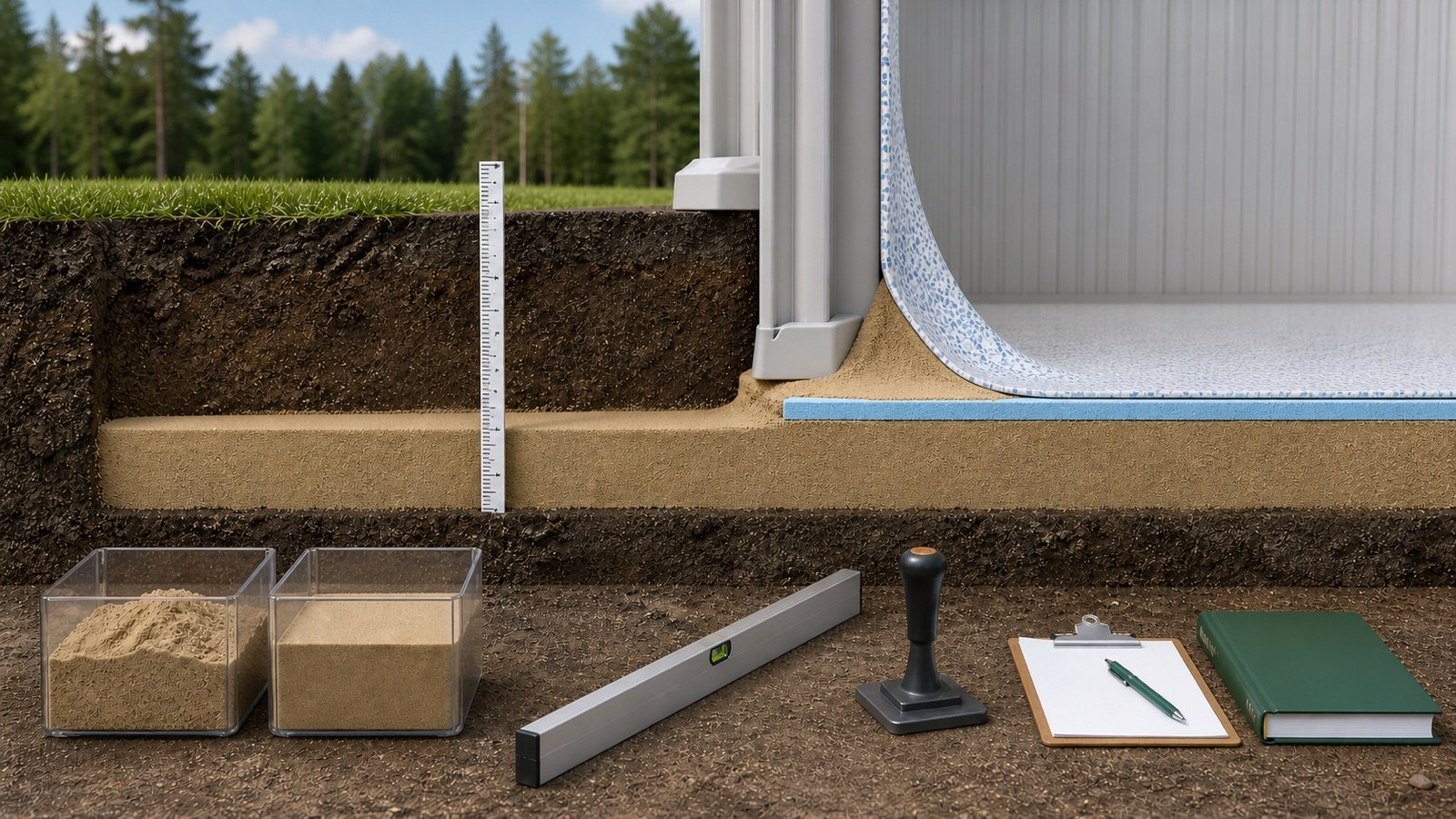
Multiply the approved flat-base area by the layer depth stated for the selected pool system. Choose round, racetrack oval, rectangle or manufacturer-stated area, then enter the depth from the current manual or project detail.
The measured result stays unchanged by purchasing assumptions. Add a planning allowance, supplier bulk density or package net volume only when a current project or product record supports that value.
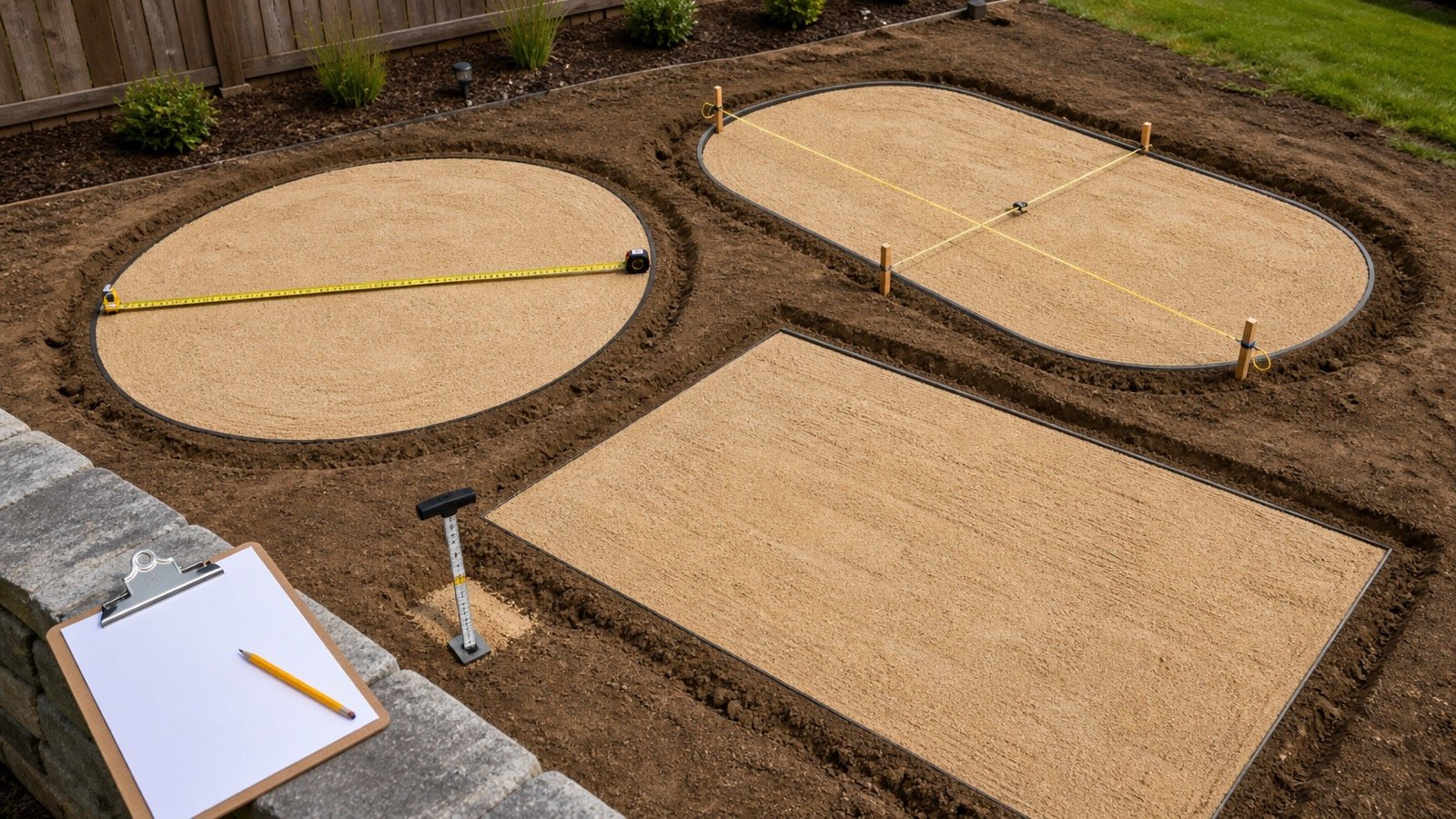
What does the calculator include?
The tool calculates one flat base with one uniform approved depth. It reports area, measured volume, planning volume, the equivalent volume unit, optional supplier-density mass and optional whole packages.
| Result | Calculation basis | Record to keep |
|---|---|---|
| Pool-base area | Selected shape or manufacturer-stated area | Pool model, manual revision and measured footprint |
| Measured volume | Area × approved flat-base depth | Depth value, unit and source |
| Planning volume | Measured volume × entered allowance factor | Allowance reason and approval |
| Estimated mass | Planning volume × entered supplier density | Exact product, material condition, density unit and date |
| Whole packages | Planning litres or cubic feet ÷ package net volume | Product, package size, label volume and date |
The checkbox confirms only that you performed that check. It does not verify your pool model or approve the installation.
Which pool footprint should you select?
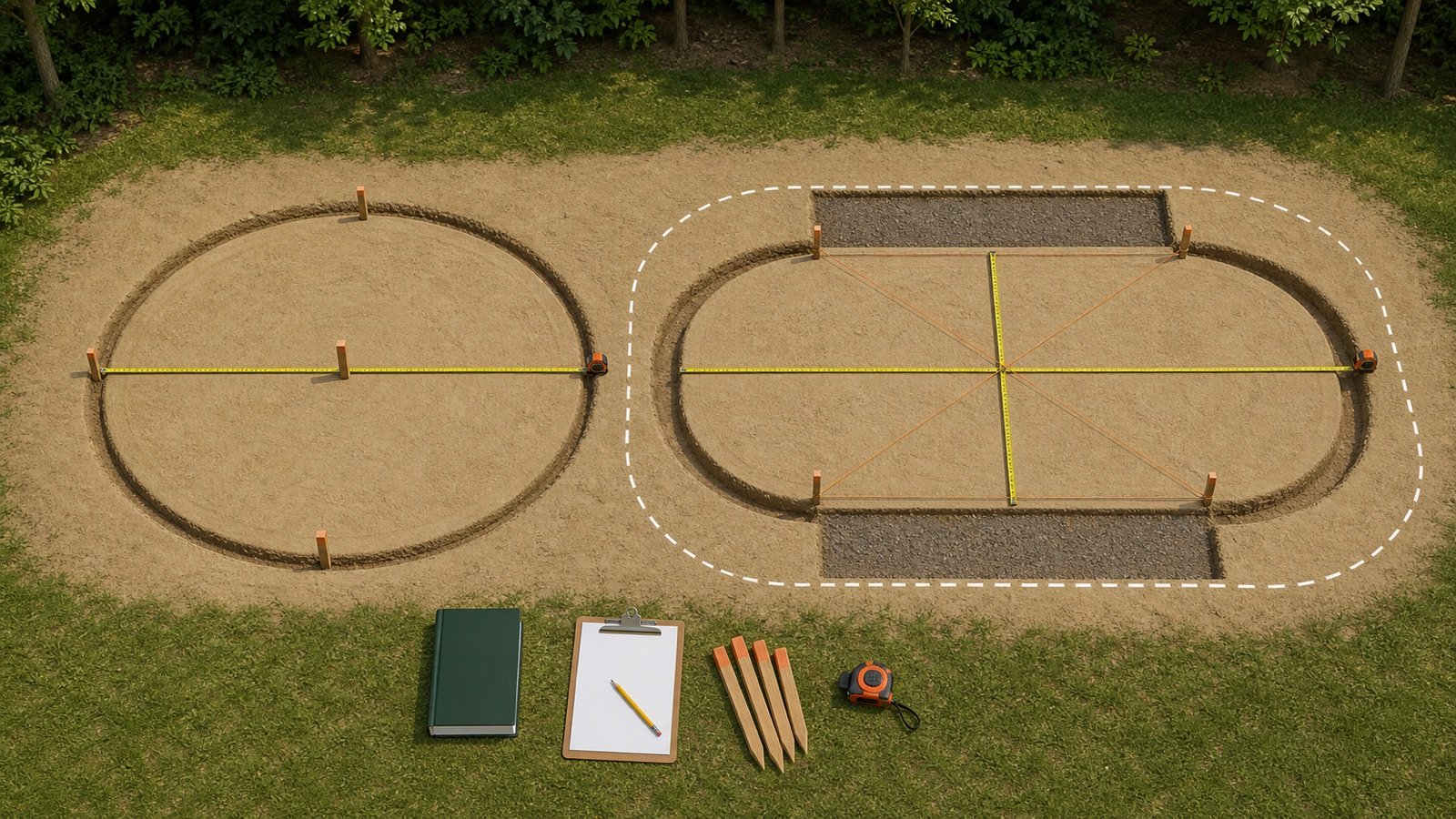
Choose the shape that matches the approved base boundary, not the water surface or the outer edge of a deck. Include an extra foundation radius, buttress area or support zone only when the pool instructions place it in the same uniform sand layer.
Round pool base
Enter the full base diameter through the centre. The calculator divides diameter by 2 to obtain radius and uses the circle area formula.
Racetrack-oval pool base
Use this option only when the footprint has a rectangular middle and 2 semicircular ends. Enter the total length and total width. The length must be at least the width because the straight middle equals length minus width.
An ellipse is not the same shape. An oval pool can also have buttresses, straps, side supports or a manufacturer-defined excavation that extends beyond the simple floor outline. Use manufacturer-stated area or a separate checked takeoff when the racetrack model does not match.
Rectangular pool base
Enter the full approved length and width of the uniform base layer. Keep support pads, trenches, thickened zones and separate materials out of this flat-layer rectangle unless the project detail includes them.
Manufacturer-stated area
Use stated-area mode when the current installation drawing, supplied takeoff or separately checked geometry already gives the flat-base area. Confirm that it has not included a cove, wall trench, buttress excavation or another material zone.
What formulas does the Pool Base Sand Calculator use?
Round area = π × (diameter ÷ 2)²
Racetrack-oval area = (length − width) × width + π × (width ÷ 2)²
Rectangle area = length × width
Measured flat-base volume = area × approved depth
Planning volume = measured volume × (1 + allowance % ÷ 100)
Estimated mass = planning volume × supplier bulk density
Whole packages = ceiling(planning secondary volume ÷ package net volume)
Metric mode converts centimetres to metres and reports cubic metres plus litres. Imperial mode converts inches to feet and reports cubic yards plus cubic feet. The calculator retains full precision and displays up to 3 decimal places.
Worked round-pool example
A current pool detail approves a uniform 2 in base layer within an 18 ft round footprint. The example does not set a depth for another pool.
- Radius: 18 ÷ 2 = 9 ft.
- Area: π × 9² = 254.469 ft².
- Depth: 2 ÷ 12 = 0.166667 ft.
- Measured volume: 254.469 × 0.166667 = 42.4115 ft³.
- Cubic yards: 42.4115 ÷ 27 = 1.5708 yd³.
Measured result: 1.571 yd³, or 42.412 ft³. A supplier-density mass or bag count stays blank until its controlling value is entered.
Worked racetrack-oval example
A checked footprint is 30 ft long and 15 ft wide, with 2 semicircular ends and a uniform 2 in approved layer.
- Straight middle length: 30 − 15 = 15 ft.
- Middle rectangle: 15 × 15 = 225 ft².
- Combined semicircular ends: π × 7.5² = 176.7146 ft².
- Total area: 401.7146 ft².
- Measured volume: 401.7146 × 2 ÷ 12 = 66.9524 ft³, or 2.4797 yd³.
Measured result: 2.48 yd³, or 66.952 ft³. An ellipse using the same total length and width would produce a different area, so confirm the plan shape before calculating.
Worked metric rectangle example
A manufacturer-approved rectangular base is 6 m by 4 m with a 5 cm uniform layer.
- Area: 6 × 4 = 24 m².
- Depth: 5 cm = 0.05 m.
- Measured volume: 24 × 0.05 = 1.2 m³, or 1,200 L.
- If a current product label states 20 L per package, 1,200 ÷ 20 = 60 packages before any documented allowance.
The 5 cm depth and 20 L package are calculation inputs for this example. Replace both with records for the selected pool and product.
Why does the calculator require a manual check?
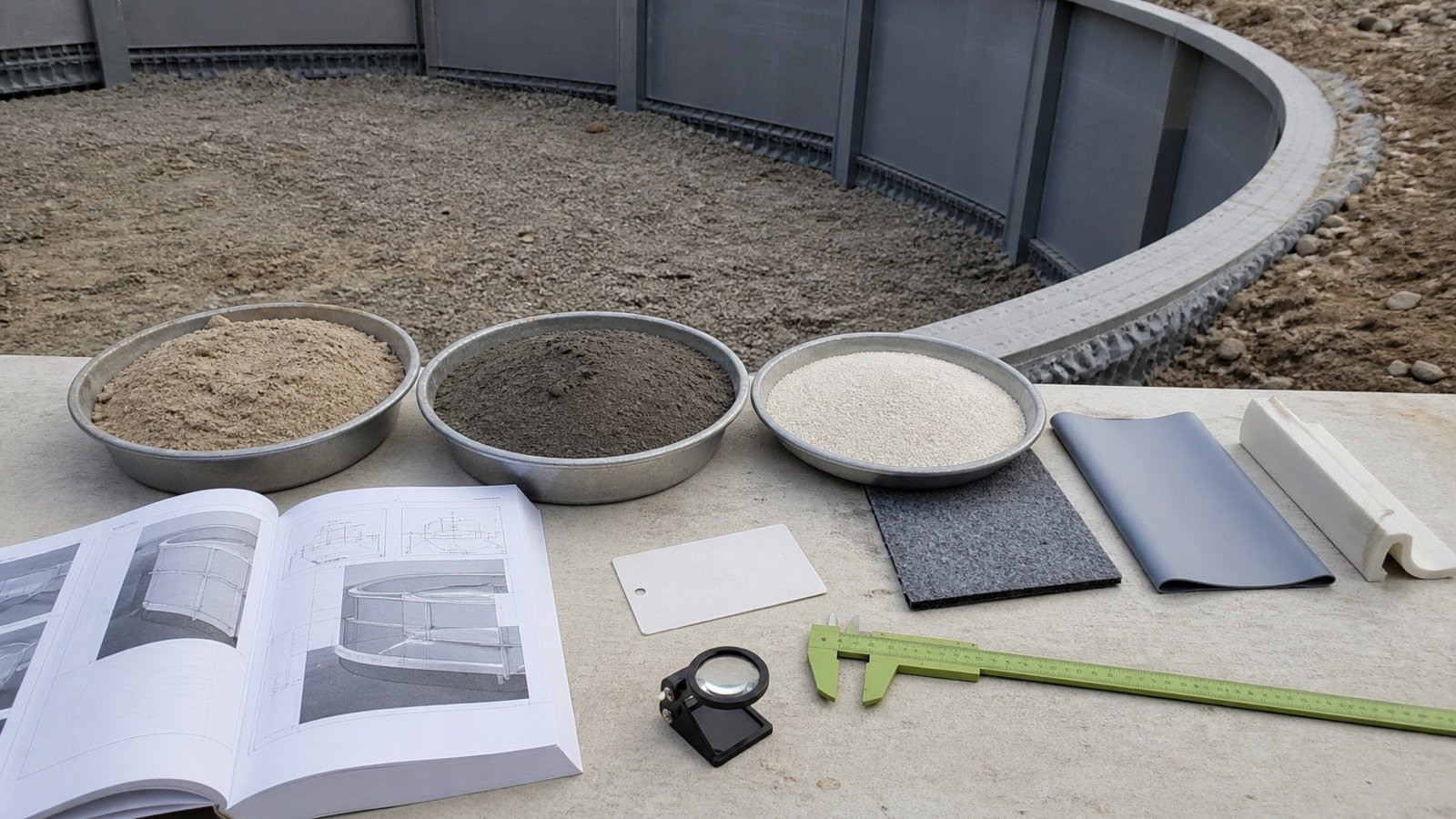
Pool base instructions are product-specific and can contradict general internet advice. Bestway manual S-S-004972 states that sand should not be used to create a level base and requires a flat, stable site. The CARVIN Equinox round-pool guide lists compaction sand or fine rock dust for its foundation and sets its own site, drainage and level requirements.
Those documents prove that one universal base rule would be unsafe. They do not cancel each other because they govern different pool systems. Use the current manual for the exact model, plus applicable permits, local rules and responsible installer guidance.
Can sand level a sloping pool site?
This calculator does not estimate fill for slope correction. Adding loose material to a low side can create a different support condition from excavating the high side to firm, level ground.
Bestway's cited instructions prohibit using sand to create a level base. The CARVIN guide also says to dig the high side rather than build up the low side and requires its foundation to meet a stated level tolerance. Follow the selected pool's instructions instead of converting a measured slope into a deeper average sand layer.
Why is the pool cove excluded?
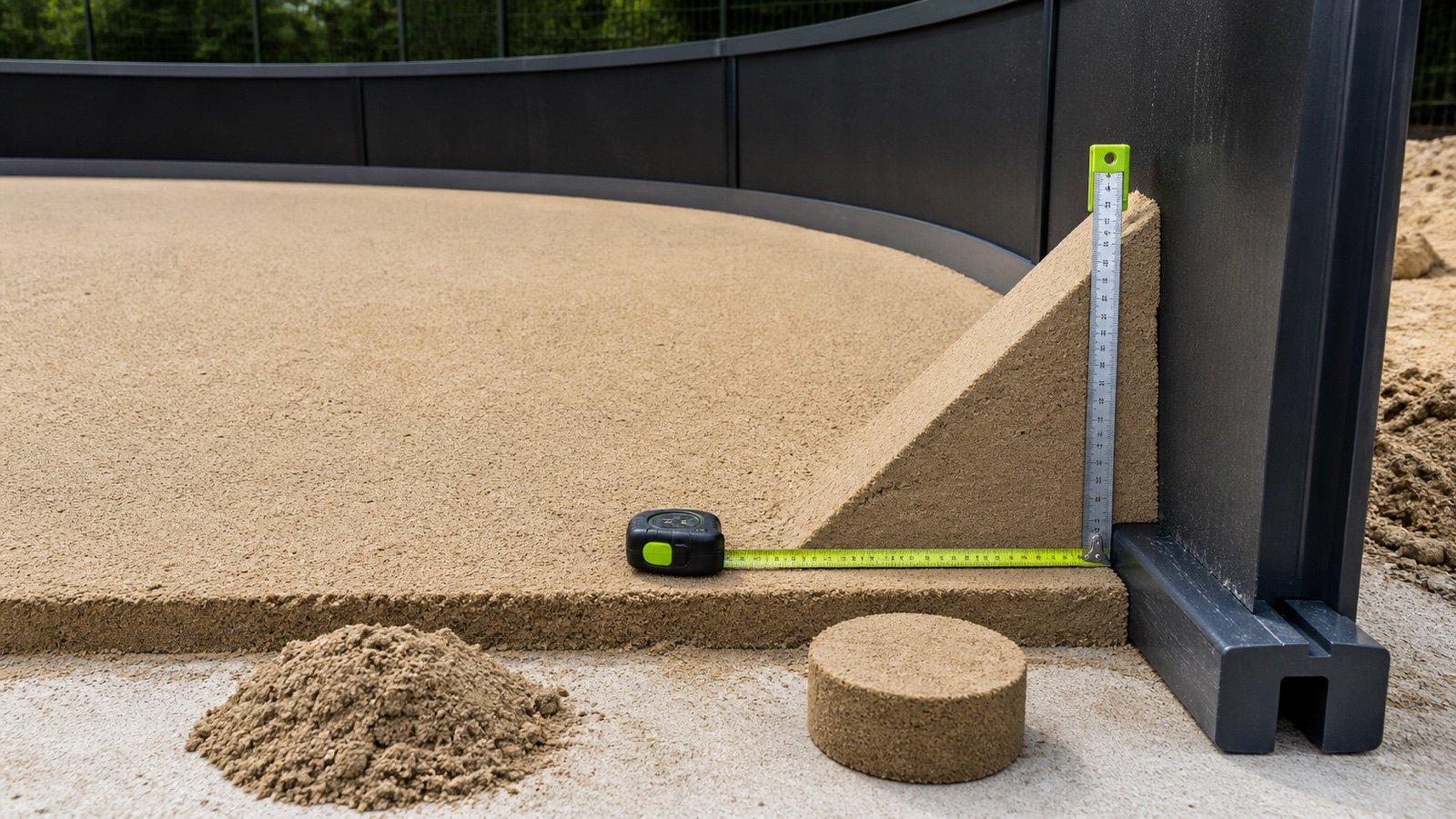
A cove is a separate transition at the wall and floor. Its material, shape, dimensions and structural role depend on the pool system. Treating it as a fixed number of bags hides the perimeter geometry and the manufacturer's required detail.
The cited Doughboy instructions warn against using materials that shift, such as sand, in that system's cove and describe screened damp earth or a preformed cove. Another pool can have another approved detail. Calculate a cove only from its current dimensions and permitted material, or use the manufacturer-supplied quantity.
Is pool-base sand the same as filter sand?
No quantity relationship should be assumed. Pool-base material occupies an installation layer under an approved pool system. Filter media sits inside a filter vessel and is controlled by the filter model, media specification and manual.
Do not enter a filter's required pounds or kilograms as base density or package yield. Use the filter manual to select the media grade and charge. Pool footprint does not calculate a filter charge.
How should supplier density and packages be used?
Enter bulk density only when the supplier states it for the exact base product and relevant loose or selling condition. Density converts planning volume to estimated mass; it does not establish actual delivered scale weight, vehicle payload or installed compaction.
Package count needs net volume per package in litres or cubic feet. A package marked only by mass does not state how much volume it will occupy in the approved base condition. Record the product name, package identifier, net volume, revision and date.
The Sand Bags vs Bulk guide explains how to compare the 2 purchasing routes without mixing package yield, bulk density and delivery units.
When should you use a planning allowance?
Allowance starts at 0%. Add one only when the project record supports a measured tolerance, handling loss or another named reason. Keep that percentage separate from material-state conversion and supplier rounding.
A general 10% extra cannot correct the wrong pool footprint, an unapproved depth, a sloping site, cove geometry or an unrelated density. Resolve each uncertainty where it occurs and preserve the measured volume before adding a planning quantity.
Which conditions need separate calculations?
| Condition | Why one flat-base result is insufficient | Action |
|---|---|---|
| Buttresses or side supports | The excavation or foundation can extend beyond the floor outline | Use the manufacturer drawing and separate zones |
| Different materials | Stone dust, sand, pads and concrete have different quantities and states | Keep one record per material |
| Changing approved depth | Volume changes by zone | Calculate each uniform zone separately |
| Cove | Perimeter cross-section and permitted material are system-specific | Use the approved cove detail |
| Sloped or unstable site | A flat-layer formula does not design the earthwork or support | Follow the manual and qualified site plan |
| Filter media | Filter vessel and media specification control the charge | Use the filter manual |
Common pool-base sand calculation mistakes
- Using a general internet depth before checking the exact pool manual.
- Adding sand to the low side to correct a slope.
- Using water-surface dimensions instead of the approved base boundary.
- Treating every oval as an ellipse or every oval as a racetrack.
- Ignoring buttresses, side supports, wall trenches or foundation extensions.
- Adding a generic cove allowance without an approved cross-section and material.
- Using package mass as package volume.
- Using a density from an unrelated sand or material condition.
- Applying allowance before preserving the measured geometry.
- Confusing base material with filter media.
- Treating estimated mass as vehicle payload or delivered scale weight.
- Assuming quantity output approves drainage, support, electrical work, barriers or permits.
What should the quantity record contain?
- Pool manufacturer, model, size, manual title, revision and access date.
- Approved base material, layer purpose, footprint boundary and depth.
- Shape model, dimensions, stated area, units and measurement source.
- Measured volume before allowance.
- Allowance percentage, reason, owner and approval.
- Supplier product, density, material condition, selling unit, increment and quote date.
- Package product, net volume, label revision and whole-package result.
- Separate cove, buttress, support-pad, drainage and earthwork records.
- Unresolved manufacturer, permit, code, utility, electrical and site checks.
Use the Sand Calculator for a general uniform sand layer that does not need the pool-manual gate or racetrack-oval model. Check the sand selection guide, Sand Coverage Guide and Sand Material Planning hub for related product, coverage and ordering records.
Sources and scope
- NIST Handbook 44 (2026), Appendix C: unit relationships used by the calculator.
- Bestway Pool Manual S-S-004972: one named product's flat-site requirements and warning not to use sand to create a level base.
- CARVIN Equinox Round Pool User's Guide: one named system's foundation material, site, drainage and level requirements.
- Doughboy Round Above-Ground Installation Instructions: one named system's cove warning and earth or preformed cove options.
Source scope: NIST supports the stated unit relationships. Each pool manual supports only its named system and revision. The current manual for the selected pool, manufacturer instructions, site conditions, utilities, permits, codes, drainage, product records and responsible professionals control the work.
Review note: Saleem Sial owns the research and editorial record. Formula fixtures, source checks, build validation and rendered QA form the internal publication gate. Waseem Sial, External Reviewer and Engineer, is listed for ongoing external review; no completed review date is claimed.