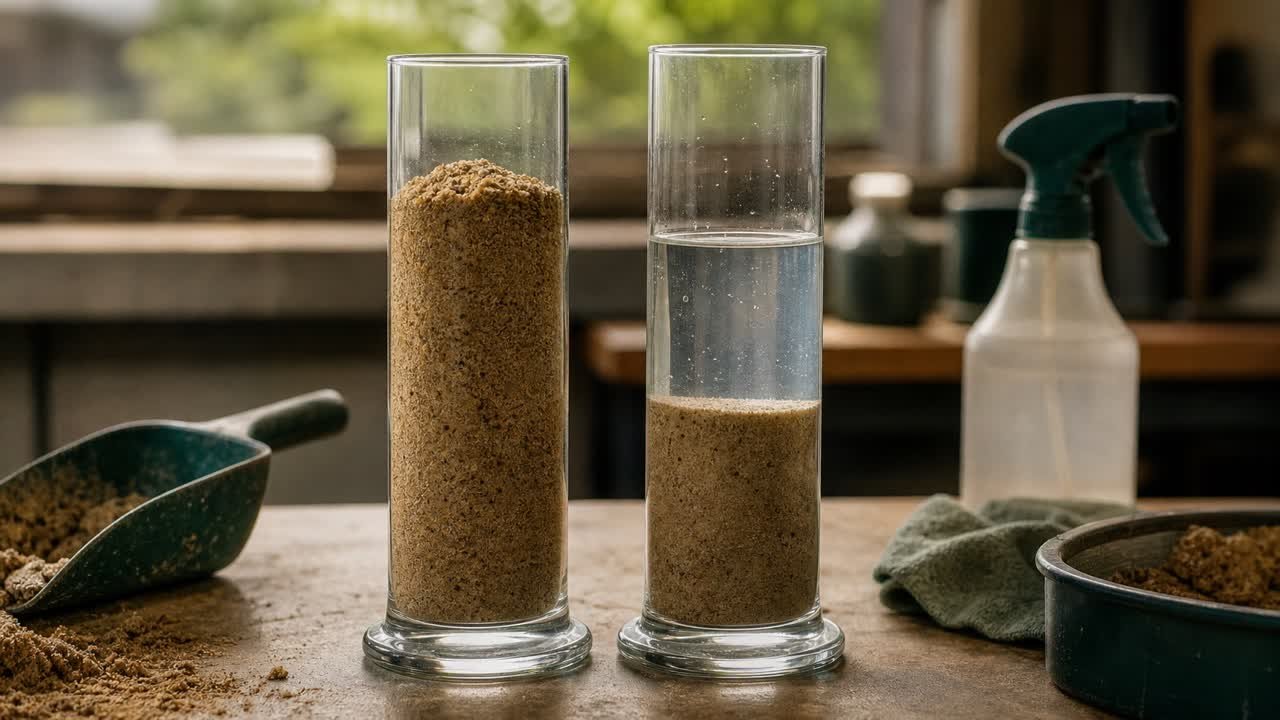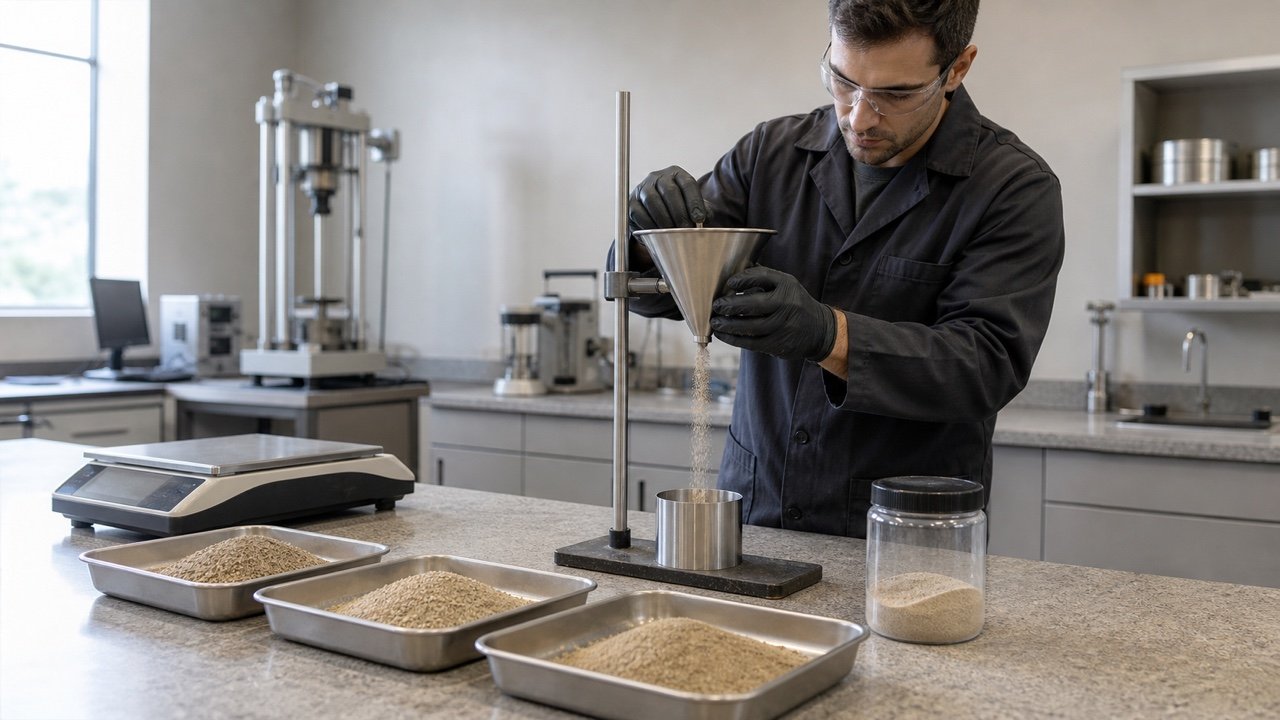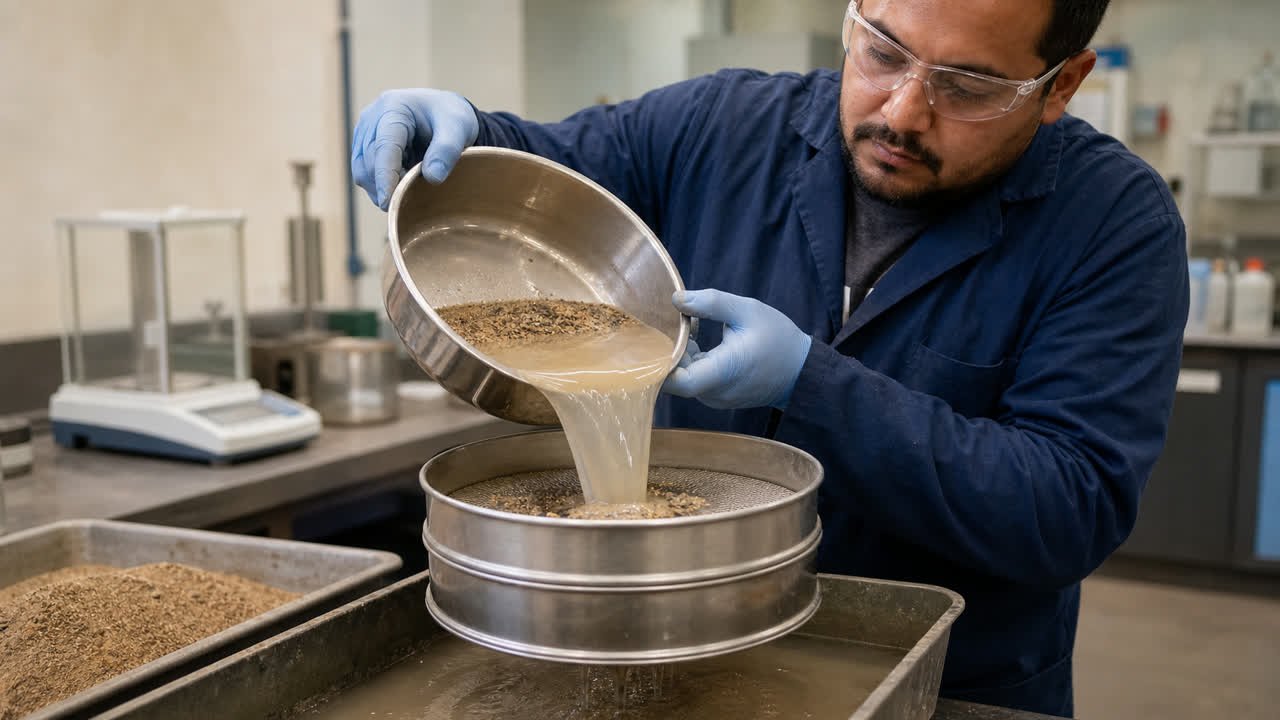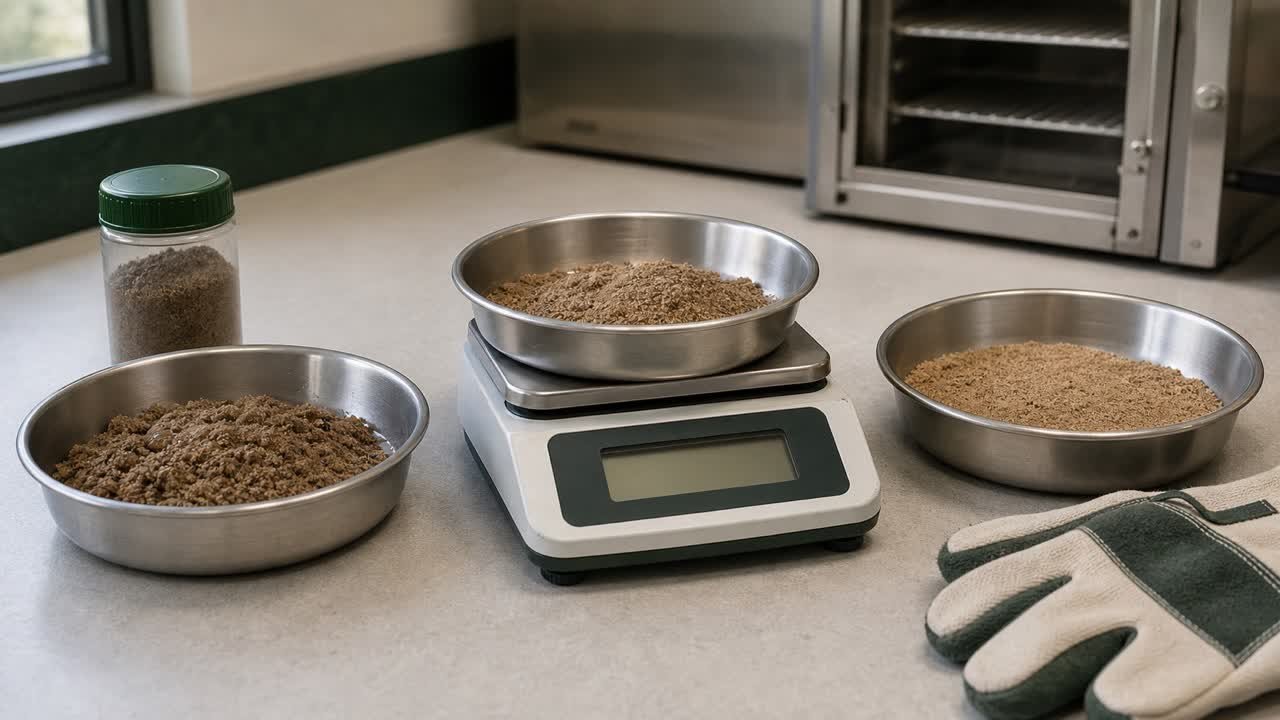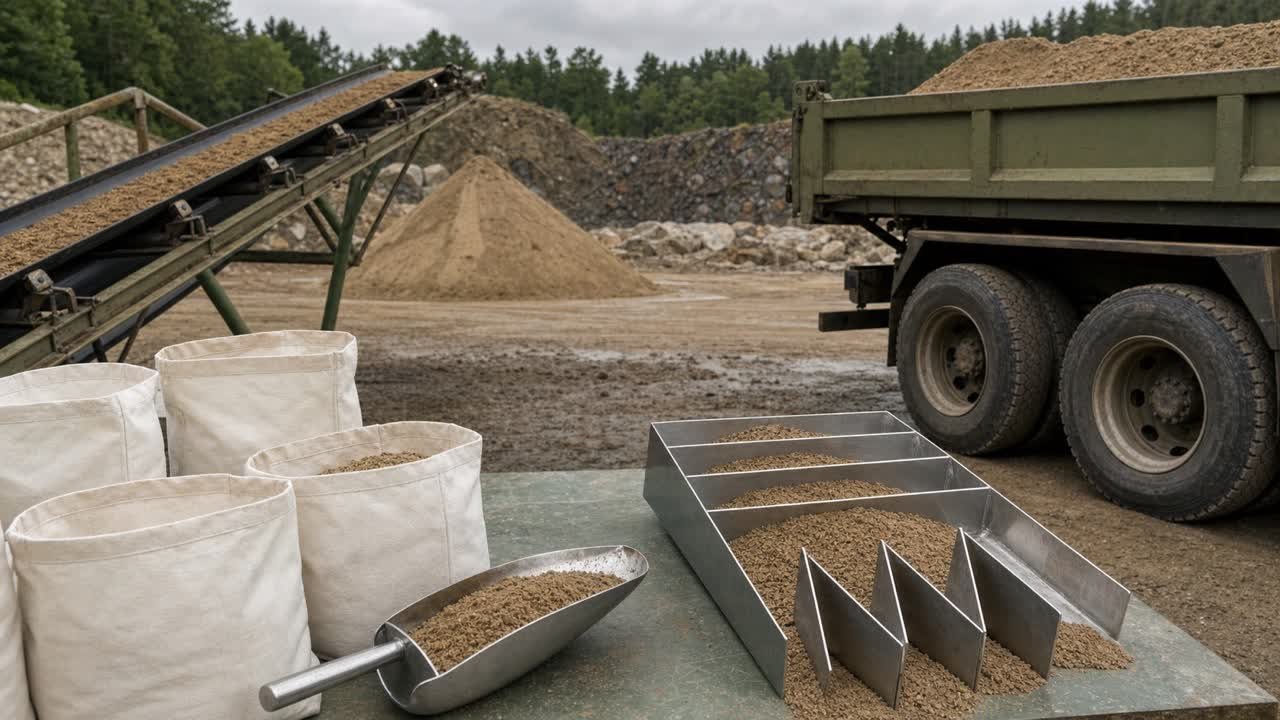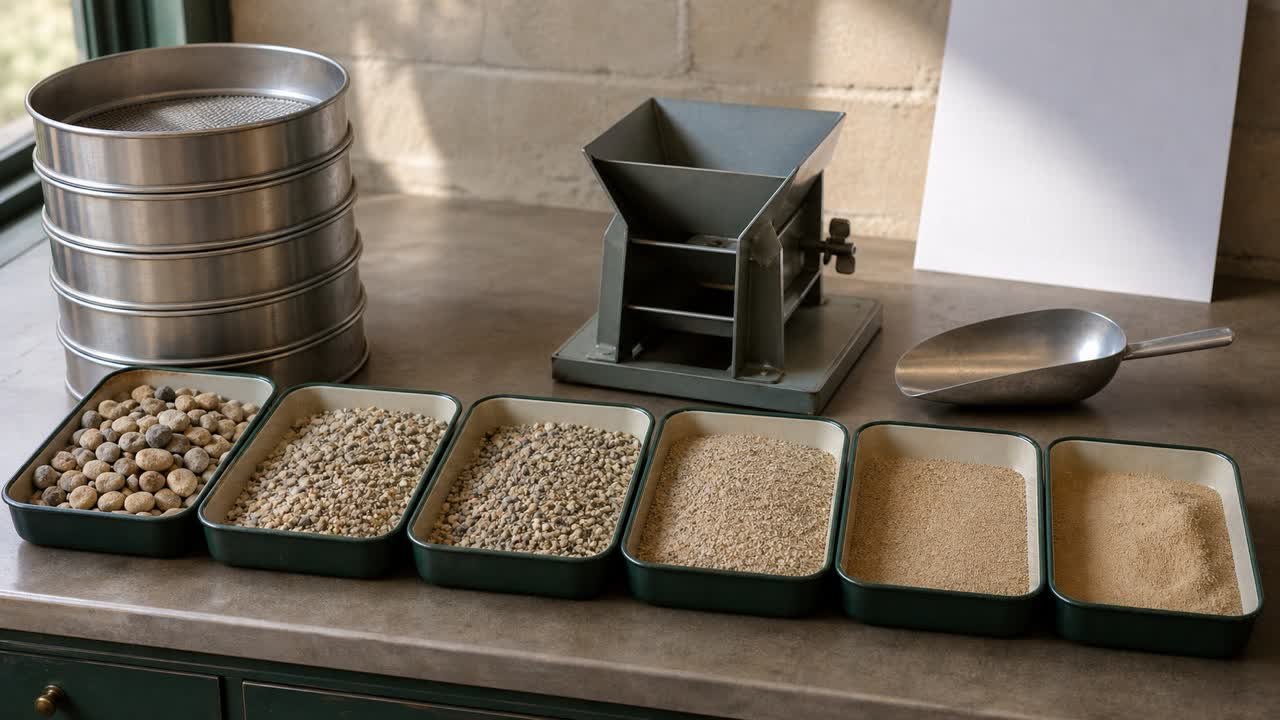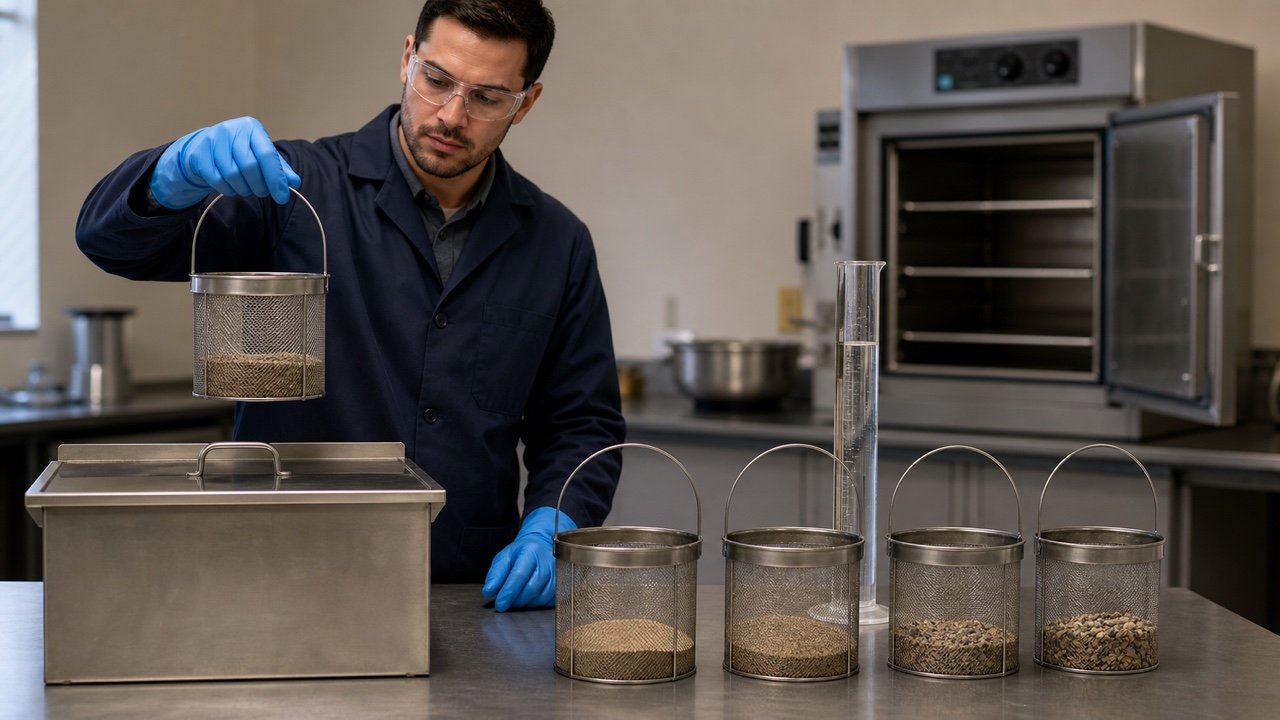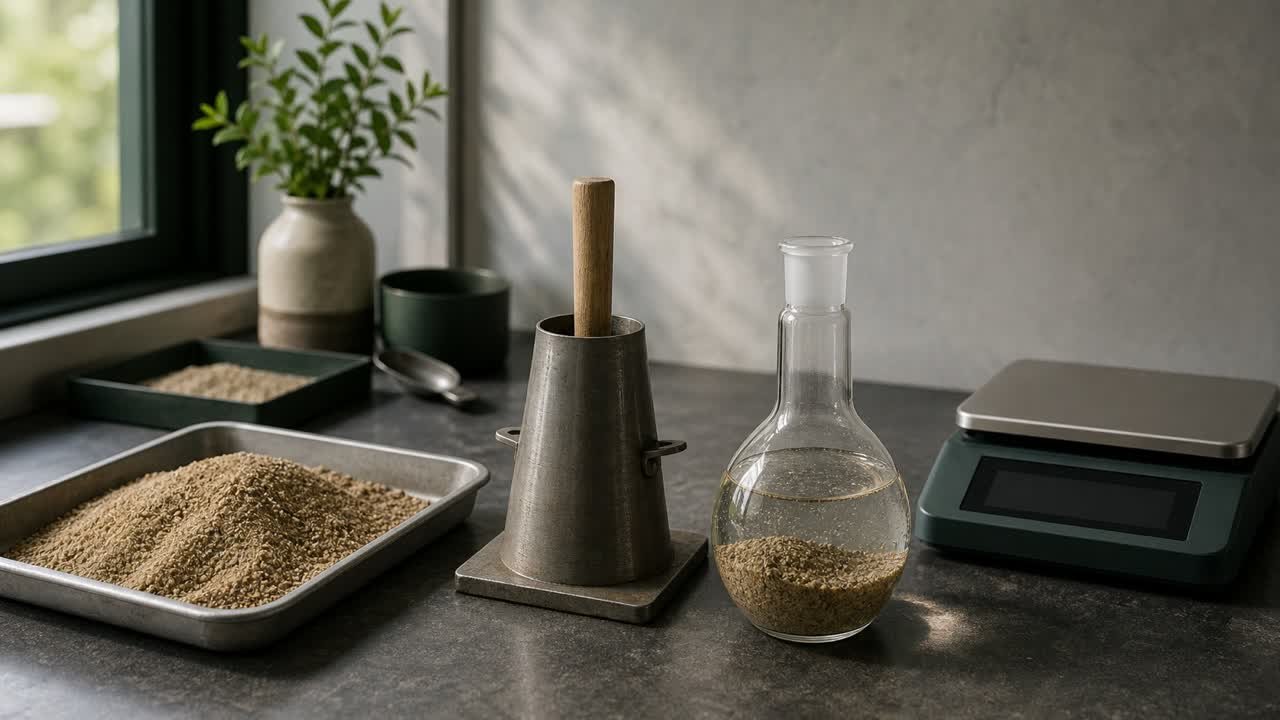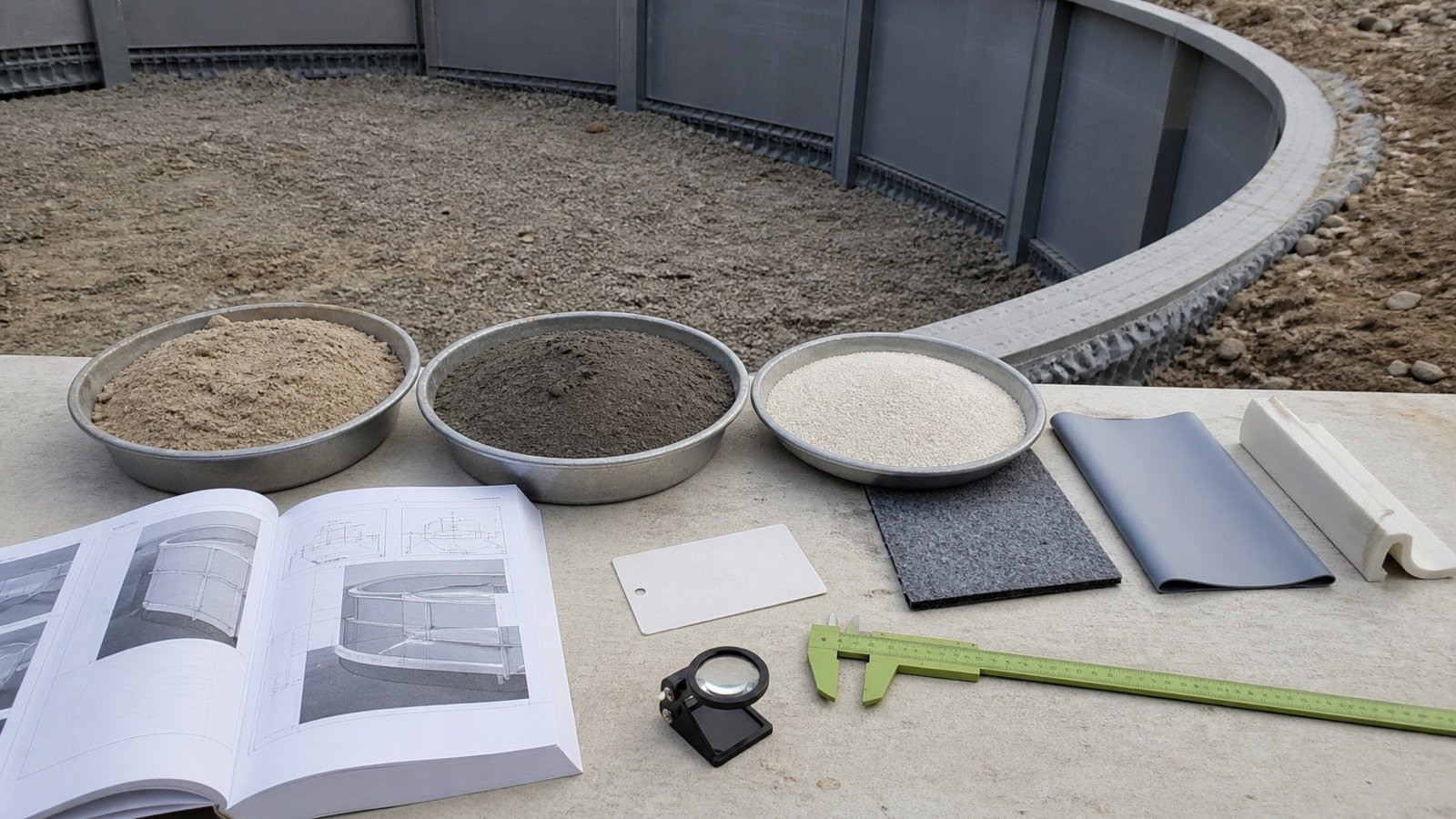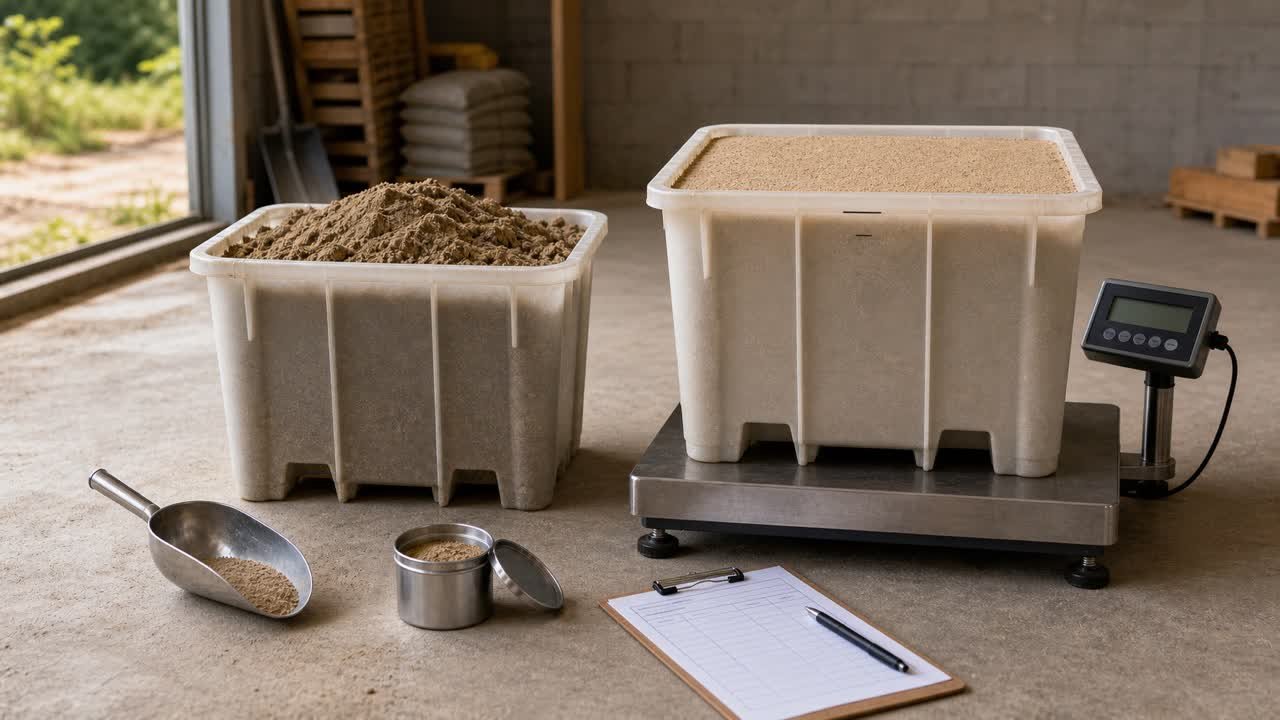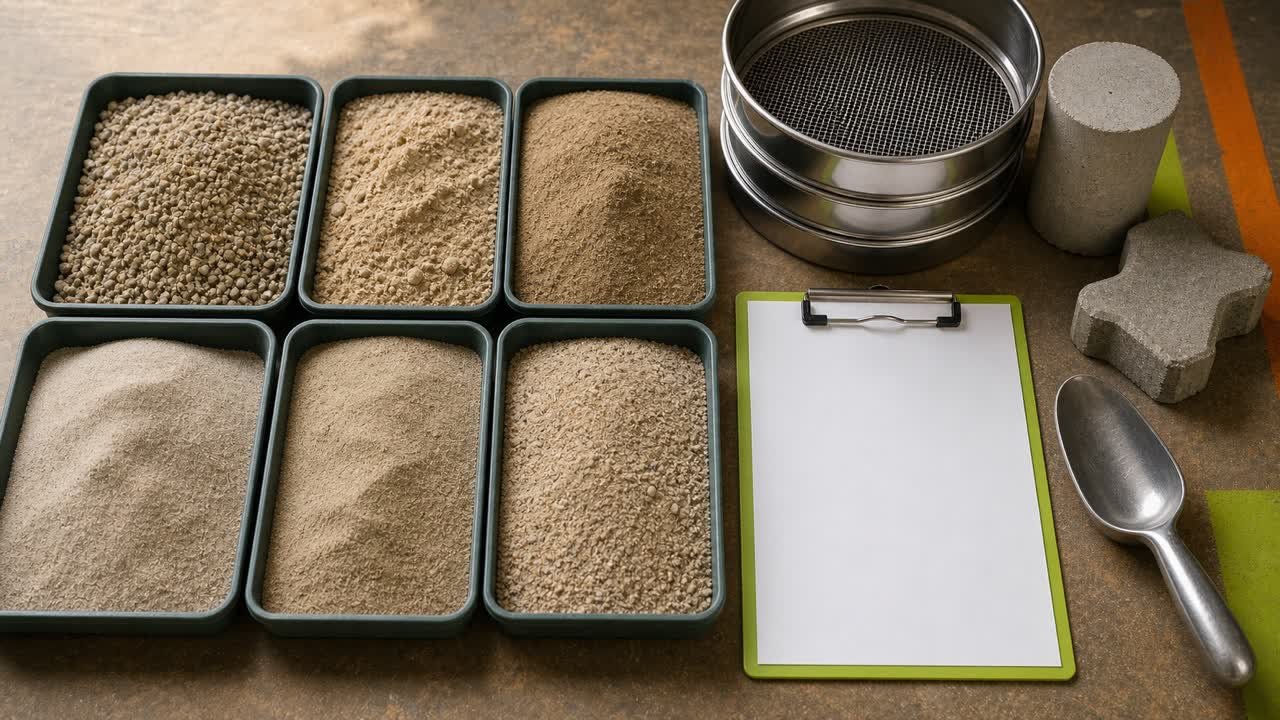
A clay-lumps and friable-particles result estimates how much of a defined aggregate fraction breaks down under a named test method. To check the report, you need the sample and lot, the exact method and revision, the tested size fraction, both dry masses, and the project acceptance clause.
The percentage alone cannot identify total clay minerals or approve a sand source. This guide shows the arithmetic through the accessible TxDOT Tex-413-A fine-aggregate method, then explains why results from ASTM, AASHTO, or another agency need their own procedure and limit.
How is the clay-lumps percentage in fine aggregate calculated?
Under TxDOT Tex-413-A, subtract the dry mass retained on the No. 20 sieve after the test from the initial dry mass of the tested portion. Divide that loss by the initial tested mass and multiply by 100.
- P is clay lumps in the tested fine-aggregate fraction, expressed as percent by mass.
- WT is the initial dry mass of the portion passing the No. 4 sieve and retained on the No. 16 sieve that enters the Tex-413-A clay-lumps test.
- WNo.20 is the dry mass retained on the No. 20 sieve after soaking, particle manipulation, wet sieving, drying, and cooling under that method.
Both masses must use the same unit. Grams cancel in the division, so the result is a percentage. Tex-413-A records masses to 0.1 g and reports the final percentage to the nearest 0.1%.
The equation and examples on this page follow Tex-413-A. Do not combine its sample preparation or denominator with ASTM C142/C142M, AASHTO T 112, Iowa IM 368, Kansas KT-7, or a project-specific modification.
What does ASTM C142/C142M determine?
ASTM C142/C142M-17(2023) covers the approximate determination of clay lumps and friable particles in aggregate. ASTM says the method has primary significance when aggregate acceptability is judged against ASTM C33/C33M.
The word approximate defines the result's scope. The test classifies material that breaks down under the specified wetting and manipulation process and passes the designated sieve. It does not perform mineralogical analysis, measure every clay-sized particle, or replace the other quality tests in a project specification.
The ASTM public page gives the method's scope and significance. The licensed current standard controls its complete sample preparation, apparatus, operation, calculation, precision, and reporting. An agency method can illustrate the arithmetic, but it cannot prove that a laboratory followed ASTM C142/C142M.
Which masses belong in the Tex-413-A calculation?
Use masses from the same tested portion and the same method sequence. The denominator is not the original stockpile sample, the full laboratory sample, or every particle passing the No. 4 sieve.
| Record | Tex-413-A meaning | Check before calculating |
|---|---|---|
| Original field sample | Material collected from the stockpile under the agency sampling method | Source, location, date, lot, sampler, and sample number are traceable |
| Reduced laboratory sample | Representative portion produced by splitting or quartering | Reduction did not discard one particle size or visible clumps |
| WT | Dry mass of the minimum 25 g test portion passing the No. 4 sieve and retained on the No. 16 sieve after the Tex-413-A preparation | Mass belongs to the tested portion and is recorded to 0.1 g |
| WNo.20 | Dry mass retained on the No. 20 sieve after the specified test sequence | Material was dried to constant mass, cooled, transferred without loss, and recorded to 0.1 g |
| WT − WNo.20 | Mass lost through the No. 20 sieve during the clay-lumps portion of this method | The record does not mix in unrelated wash loss, spills, or another specimen |
Tex-413-A first removes material finer than the No. 200 sieve during sample preparation. It then discards material retained on the No. 4 sieve and material passing the No. 16 sieve, leaving the fraction passing No. 4 and retained on No. 16 for this test. Its clay-lumps formula uses the initial and retained masses of that tested fraction. A report that inserts the whole pre-wash sample mass into the denominator changes the result.
Worked example 1: a 100.0 g tested portion
The report gives WT = 100.0 g and WNo.20 = 99.2 g. The mass loss is 0.8 g.
The reported Tex-413-A result is 0.8%. A reverse check gives 100.0 × (1 − 0.008) = 99.2 g retained, which matches the record.
This example verifies the arithmetic only. Compare 0.8% with the requirement for the material, use, contract, agency, and specification edition named on the project. The number does not carry its own pass or fail status.
Worked example 2: a 25.0 g tested portion
The report gives WT = 25.0 g and WNo.20 = 24.7 g. The lost mass is 0.3 g.
Tex-413-A reports the result as 1.2%. The reverse calculation, 25.0 × (1 − 0.012), returns 24.7 g retained.
A small mass difference can produce a visible percentage in a 25 g specimen. Balance resolution, complete transfer, constant mass, cooling, and careful records affect the calculation. Do not round 24.7 g to 25 g before applying the equation.
What if the retained mass is greater than the initial mass?
A retained mass above the initial mass produces a negative loss and does not support an ordinary clay-lumps result. Stop the calculation and investigate the record.
For example, WT = 25.0 g and WNo.20 = 25.2 g gives −0.8%. Do not replace that answer with zero. Check transcription, tare, sample identity, retained water, incomplete initial drying, weighing while hot, balance condition, foreign material, and material transferred from another pan.
The laboratory's quality procedure controls correction or retesting. Preserve the original observations and document the reason for any amended report.
Why can two official methods produce different records?
Test methods can differ in sample preparation, minimum mass, tested fraction, preliminary washing, manipulation, designated sieve, and reporting precision. A method designation is part of the result, not a footnote.
| Method | Visible fine-aggregate details | Use of the information |
|---|---|---|
| ASTM C142/C142M-17(2023) | ASTM's public page states an approximate determination and C33/C33M acceptability context | Use the licensed current standard for the complete ASTM procedure |
| TxDOT Tex-413-A, July 2023 | Minimum 25 g portion passing No. 4 and retained on No. 16, 24 ± 4 h soak, No. 20 wet sieve, 0.1% report | Use for a Tex-413-A report or project that adopts it |
| Iowa DOT IM 368 | Accessible page uses a 300 g No. 16-retained portion and records a separate No. 200 wash mass before the post-soak result | Use for the applicable Iowa requirement; do not transfer its denominator to TxDOT |
| Kansas DOT KT-7, 2012 | Fine aggregate coarser than No. 16, minimum 100 g, 24 ± 4 h soak, No. 20 wet sieve, 0.1% report | Historical agency example reflecting AASHTO T 112; verify the current project method |
These differences can change the reported value even when the material came from the same source. The correct comparison uses results produced under the method and sampling plan named by the project.
Is clay-lumps percentage the same as total clay or total fines?
No. The clay-lumps result is mass lost from a defined test fraction after the named wetting, manipulation, and wet-sieving process. Total clay mineral content, material passing the No. 200 sieve, sand equivalent, plasticity, and gradation answer different questions.
| Test or result | Primary question | What it does not establish alone |
|---|---|---|
| Clay lumps and friable particles | How much of the defined fraction breaks down and passes the designated sieve under the method? | Total mineralogical clay, gradation, or moisture |
| Material finer than No. 200 by washing | How much material is removed through the 75 µm sieve under the wash method? | How much No. 16-retained material breaks down after soaking |
| Sand equivalent | What empirical sand-to-clay-like fines index does the method produce? | Clay-lumps mass percentage or gradation |
| Sieve analysis | How is dry mass distributed across sieve sizes? | Friability after soaking or mineral identity |
| Organic-impurities color test | How does the liquid color compare with the method's reference? | Clay-lumps percentage or total organic content by mass |
Use the sand equivalent guide for that index, the sand sieve-analysis guide for particle-size distribution, and the organic-impurities guide for the separate color-screen decision.
Which report details should be checked before accepting the number?
A calculation is auditable only when it points back to the material represented by the specimen. Record the chain from the project lot to the final mass.
- Material and use: identify fine aggregate, intended work, contract item, and governing specification.
- Source and lot: record the producer, pit or quarry, stockpile, delivery, lot, and quantity represented.
- Sample: keep the sample number, sampler, date, location, sampling method, and chain of custody.
- Method: name the exact standard or agency designation, revision, and project modification.
- Preparation: record sample reduction, washing, drying, size separation, and tested portion.
- Equipment: identify the balance and sieves and retain required calibration or verification records.
- Timing: record the soak period and drying-to-constant-mass checks required by the method.
- Masses: retain the initial tested mass, final retained mass, unit, precision, and calculation sheet.
- Deviation: document spills, lost particles, wrong sieve, interrupted soak, equipment problems, or another departure.
- Decision: cite the clause and limit used to accept, reject, hold, resample, or request another test.
The sand sampling guide explains why a convenient scoop does not represent a stockpile, conveyor stream, or delivery lot without a sampling plan.
Which errors can create a false mass loss?
The formula treats every missing gram as material that broke down and passed the designated sieve. A spill or transfer loss can therefore inflate the result.
- Losing sound particles while decanting water or moving material between the pan and sieve.
- Using the wrong sieve or damaged sieve cloth.
- Forcing sound grains through the sieve with a tool, fingernail, or hard surface.
- Mixing masses from two specimens or two size fractions.
- Using the pre-wash whole-sample mass as WT.
- Adding No. 200 wash loss to a result whose method reports it separately.
- Recording an incorrect tare or dropping a decimal point.
- Rounding each mass before subtraction and division.
Incomplete final drying can move the result in the other direction because retained water increases WNo.20. Tex-413-A defines constant mass for this step and requires cooling before weighing. Follow the controlling method and laboratory safety procedure for hot pans, ovens, wet floors, and manual handling.
Does a test result pass or fail?
The project specification supplies the limit. The test method supplies the way to produce and report the result. Keep those two functions separate on the report.
ASTM C33/C33M is written for aggregate purchase and project specifications, while agency requirements can set different limits for different materials and uses. FHWA training material also shows that allowable values have varied with the contaminant and specification. A limit copied from a web page, another state, or another aggregate type cannot approve the current lot.
| Situation | Defensible next step |
|---|---|
| Calculation matches the mass records and is below the applicable limit | Record compliance for this requirement, then check the project's remaining aggregate requirements |
| Calculation matches but exceeds the applicable limit | Follow the contract's hold, notification, resampling, retest, or rejection process |
| Method or revision does not match the project | Ask the responsible party whether the result is acceptable or needs testing under the specified method |
| Sample or lot cannot be identified | Do not apply the number to an unverified stockpile or delivery; restore traceability or resample |
| Masses are impossible or a deviation affected the specimen | Stop the acceptance decision and use the laboratory quality procedure for correction or retesting |
After the material has been accepted for its intended use, use the Sand Calculator to estimate volume and supplier-density mass. Return to the Sand material planning hub for quantity tools, test guides, and reference charts.
Sources and source scope
- ASTM C142/C142M-17(2023), Standard Test Method for Clay Lumps and Friable Particles in Aggregates: active designation, approximate-determination scope, C33/C33M context, separate SI and inch-pound systems, and safety responsibility. The licensed current standard controls the complete ASTM procedure.
- ASTM C33/C33M-24a, Standard Specification for Concrete Aggregates: active aggregate-quality and project-purchase context and the listed clay-lumps test. The licensed specification and project documents control limits and exceptions.
- TxDOT Tex-413-A, Deleterious Material of Coarse and Fine Aggregate: July 2023 fine-aggregate preparation, tested fraction, minimum mass, soak, No. 20 wet sieve, constant-mass definition, formula, and 0.1% reporting used in the worked examples. Its procedure is agency-specific.
- Iowa DOT Materials IM 368, Determining the Amount of Clay Lumps & Friable Particles in Aggregates: accessible agency example using a 300 g fine-aggregate portion and separate No. 200 wash and post-soak records. Its requirements are not transferred to the TxDOT examples.
- Kansas DOT KT-7, Clay Lumps and Friable Particles in Aggregate: definitions, fine-aggregate size fraction, minimum mass, designated sieve, variables, and reporting example reflecting AASHTO T 112. Verify the current project method.
- FHWA, Level I Mixture Design: federal training context for AASHTO T 112 mass-loss reporting and variation in permissible values. It is not a current project acceptance specification.
Scope: this page checks a reported calculation and its decision trail. The current controlled test method, project documents, sampling plan, laboratory procedure, quality system, safety program, and responsible qualified people control testing and aggregate approval.
BuildQuantities.com records its source and editorial checks on the methodology page. Report a source, unit, formula, test-method, or rendering problem through the corrections route.