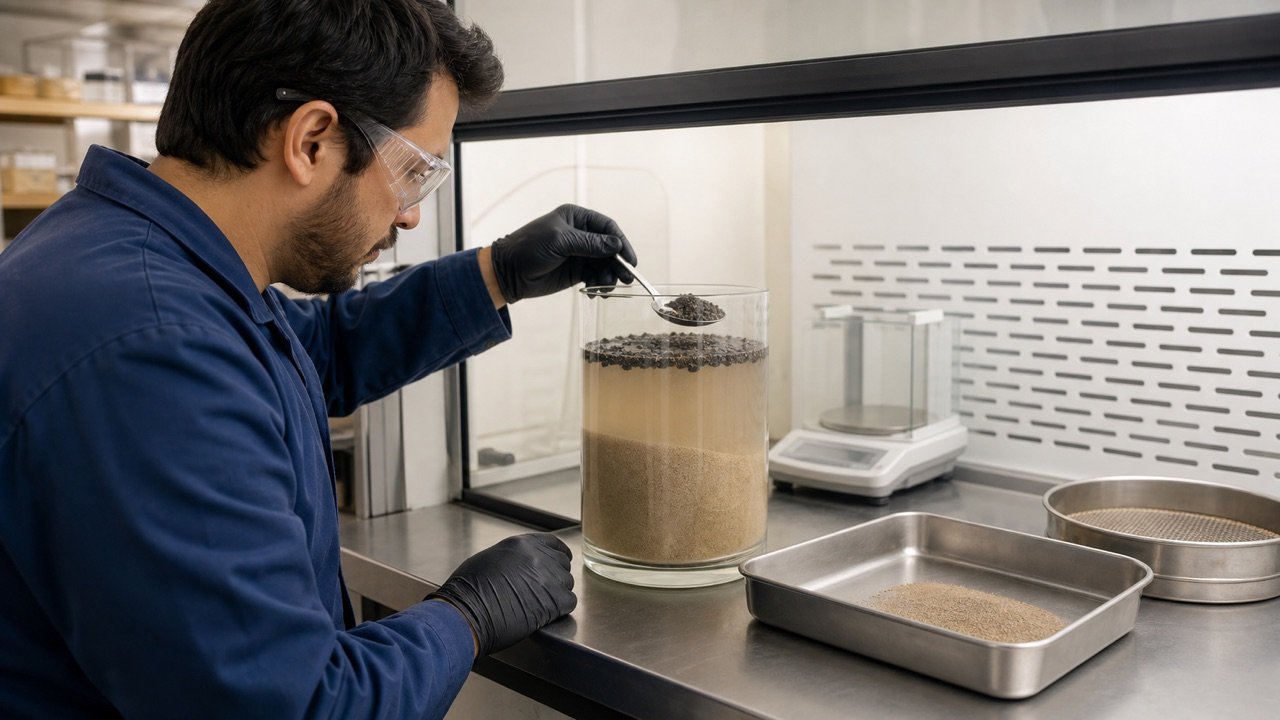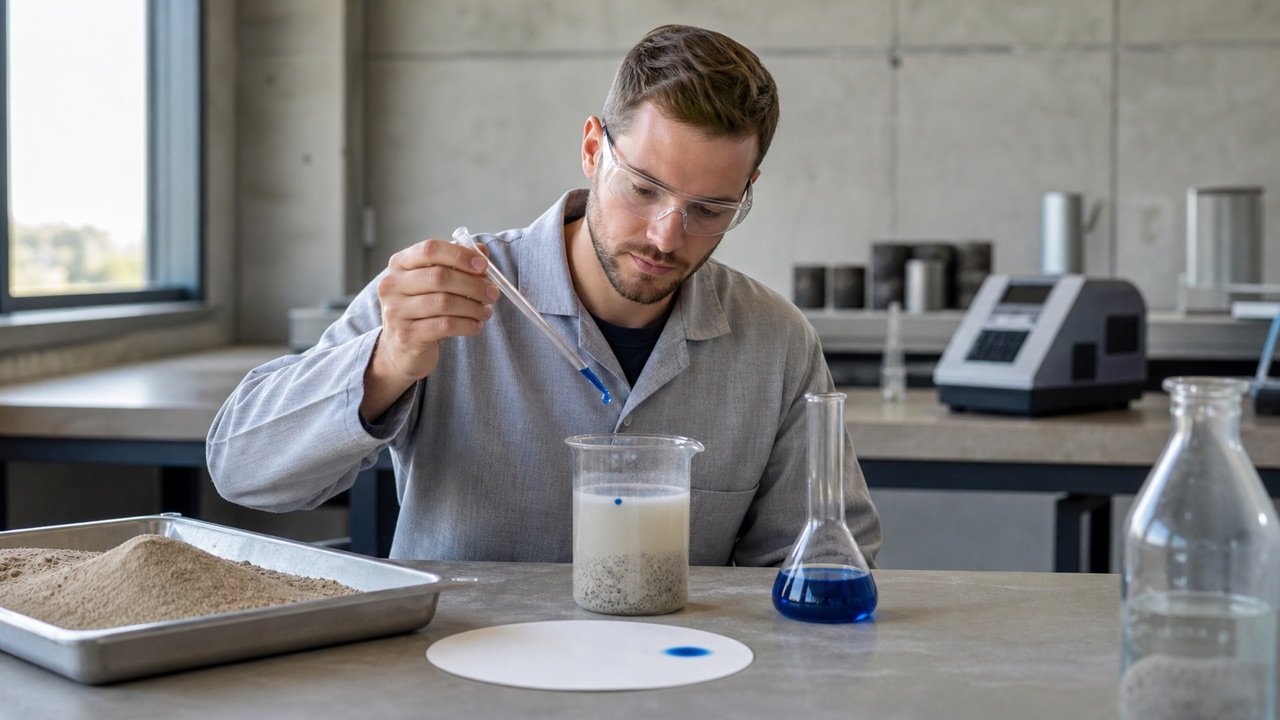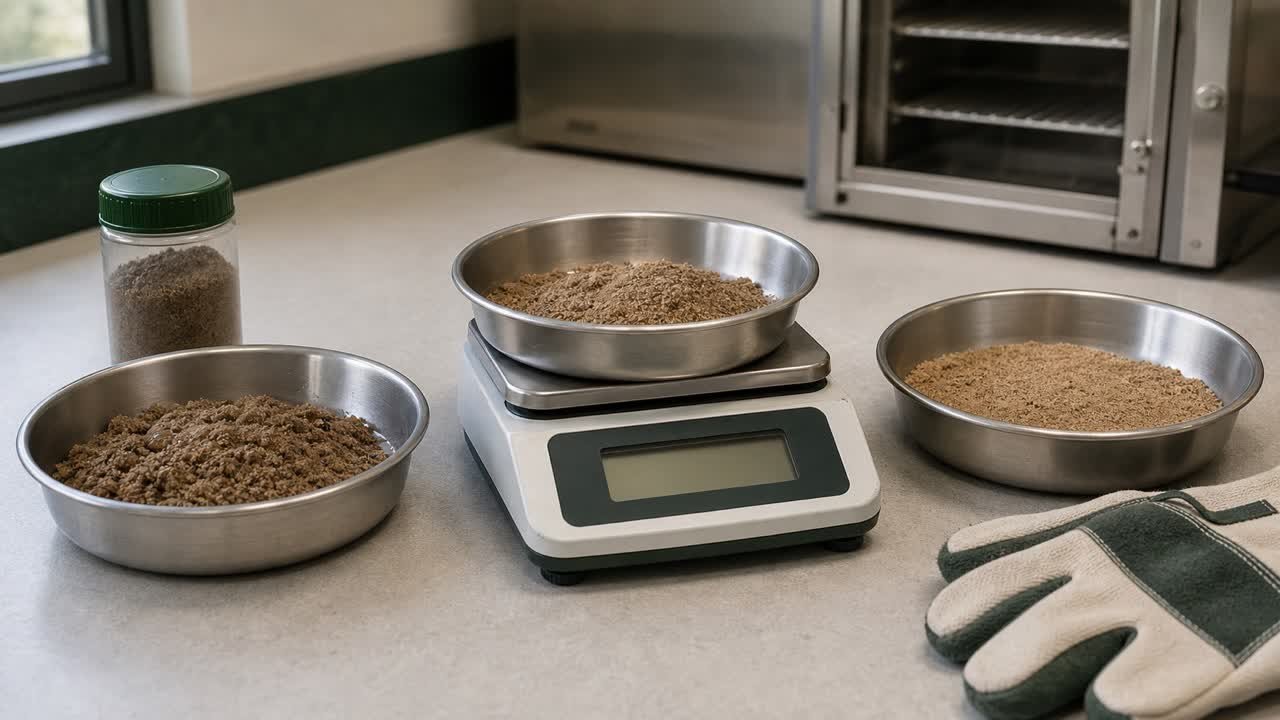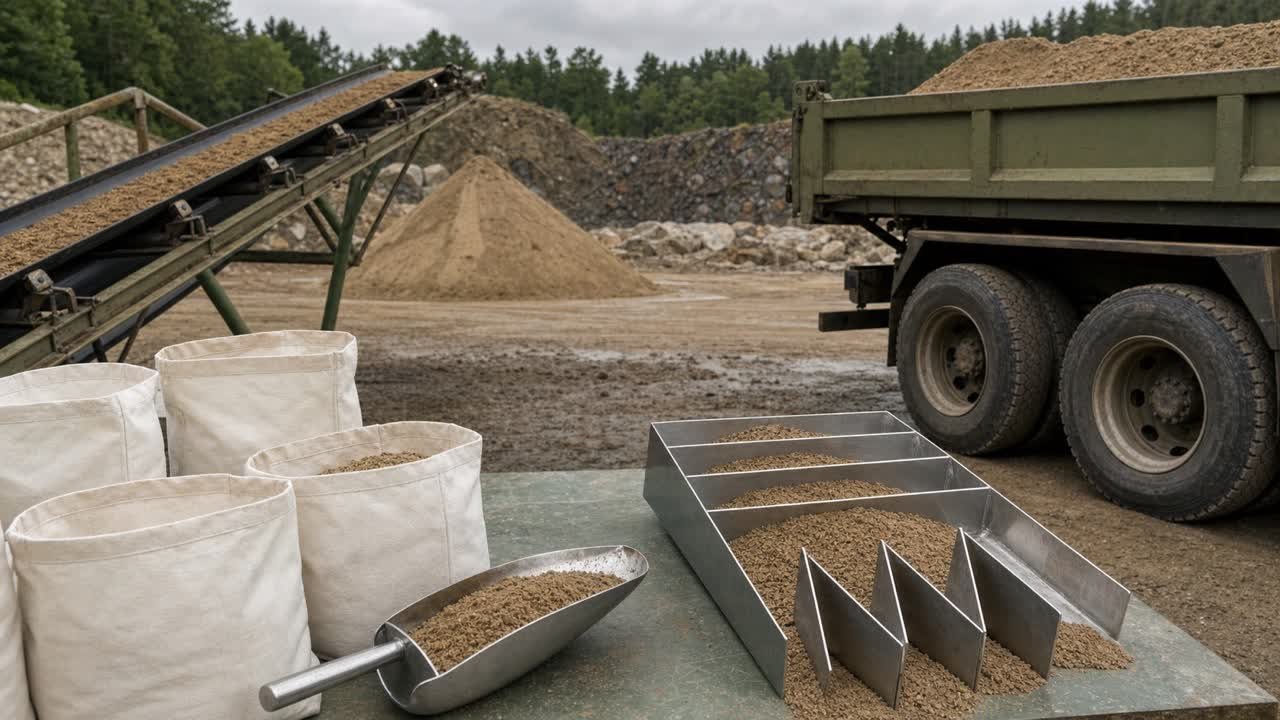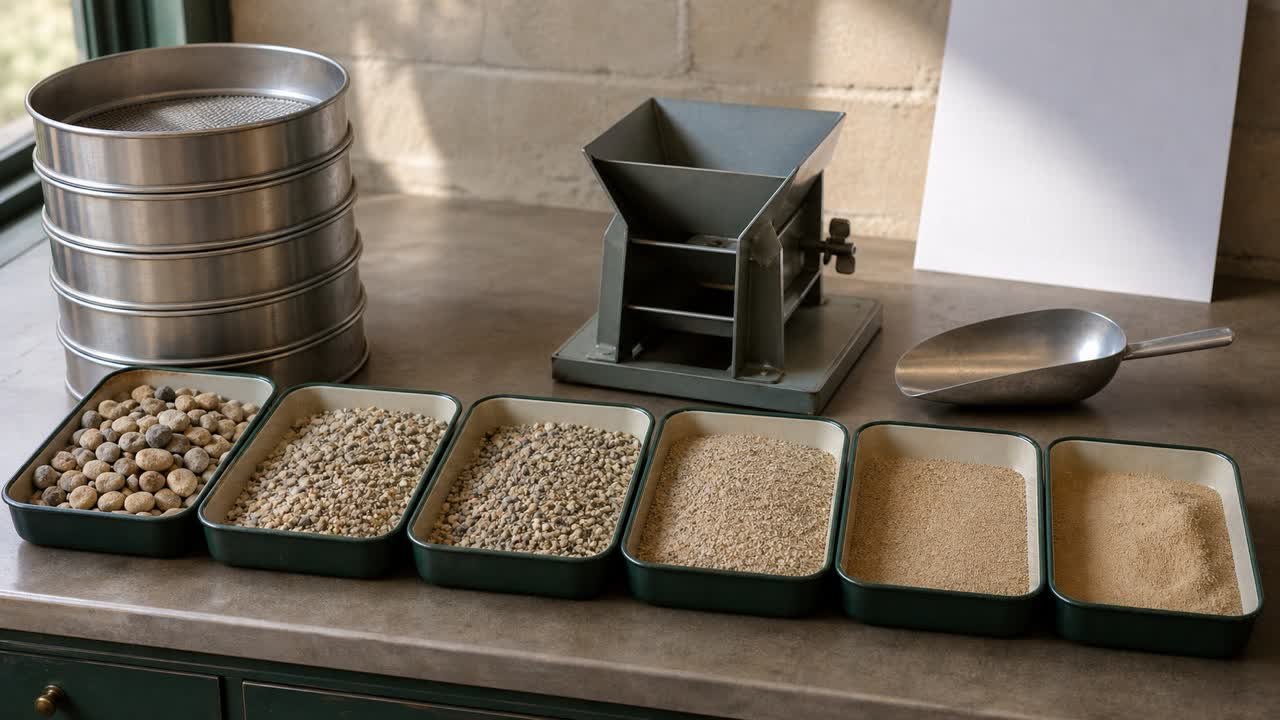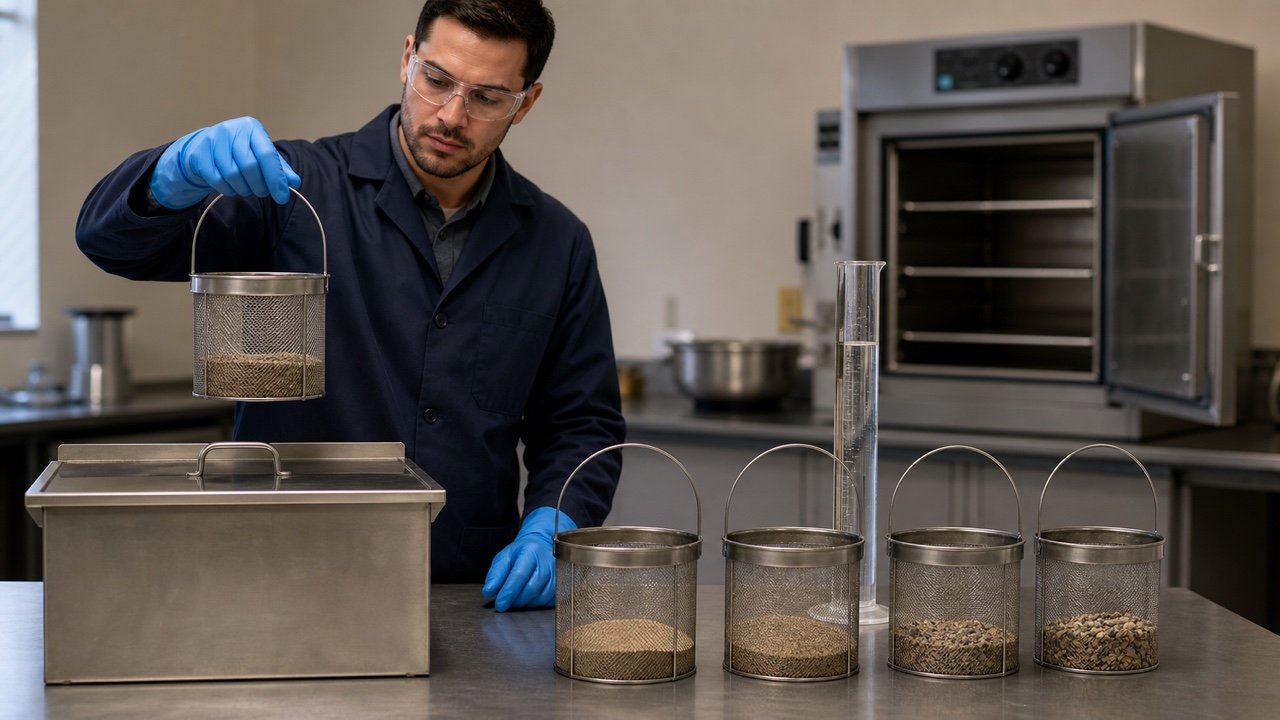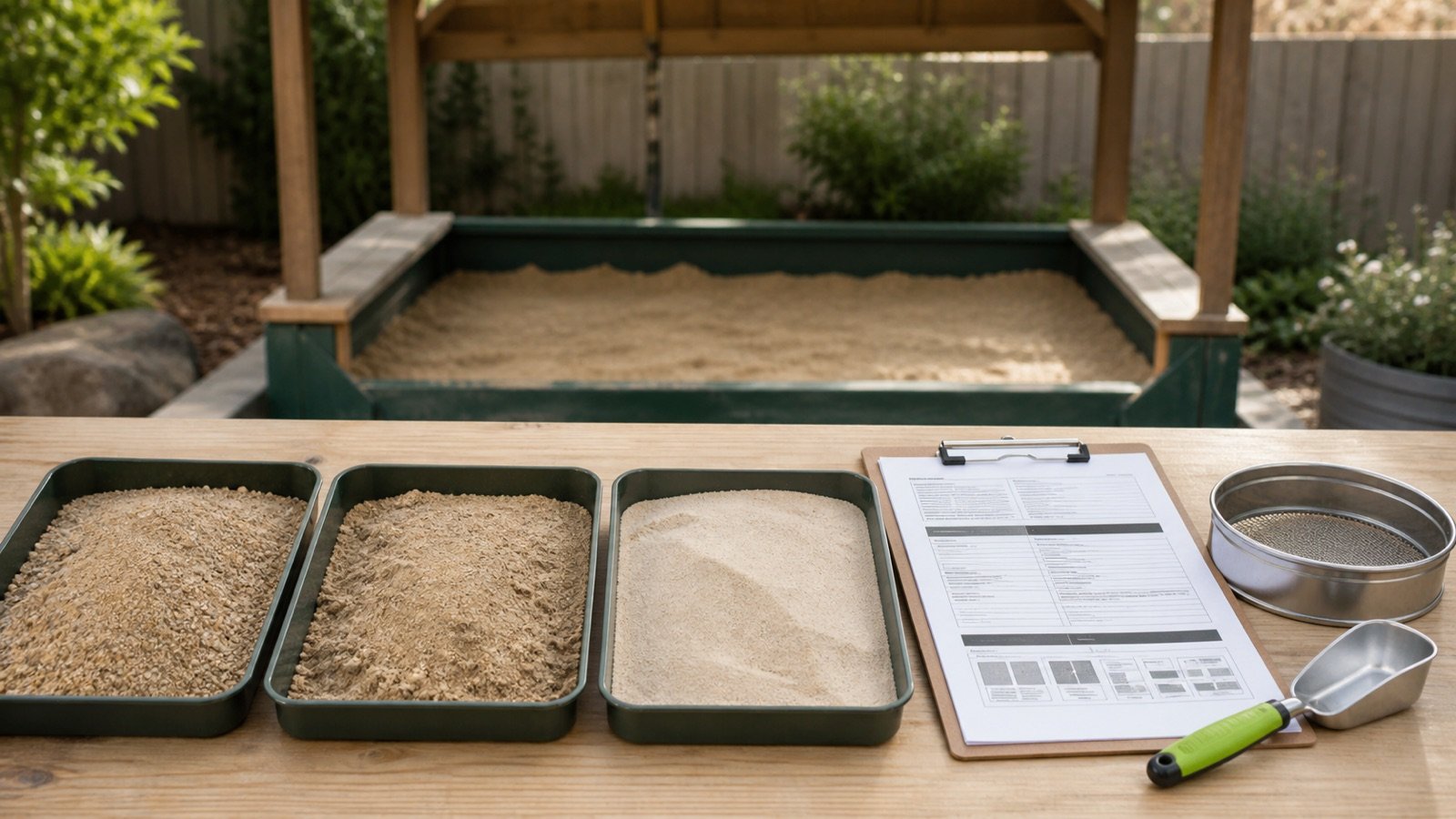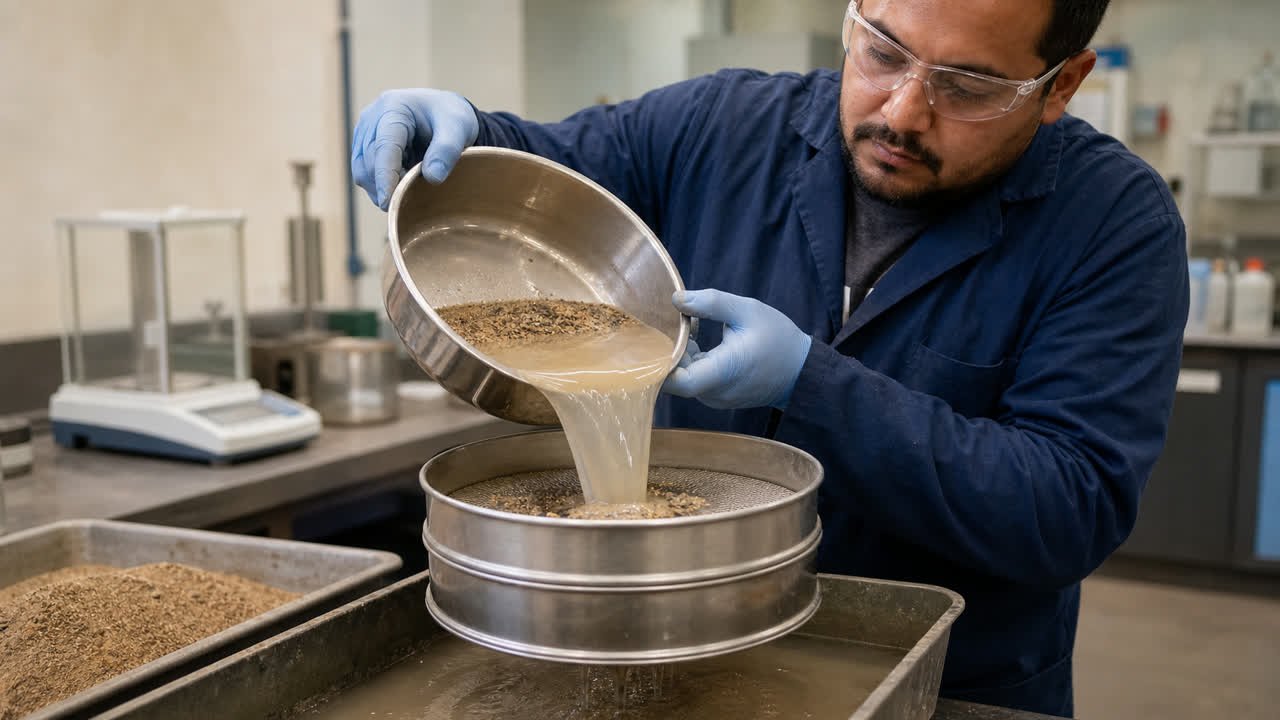
A No. 200 wash-test result comes from the dry mass lost when an aggregate sample is washed over a 75 µm sieve. Checking the number requires the original dry mass, the washed and redried mass, the exact test method, and the sample or lot represented.
The result is often called wash loss or material finer than No. 200 by washing. It is not automatically the total percent passing in a full sieve analysis, pure clay content, or a pass/fail decision. Those distinctions matter when a few tenths of a percent can change a report.
How is material finer than the No. 200 sieve calculated?
Subtract the dry mass after washing from the original dry mass. Divide the loss by the original dry mass and multiply by 100.
- Pwash is the percentage of material removed by washing through the 75 µm (No. 200) sieve.
- Moriginal is the original dry mass of the test sample before washing.
- Mwashed is the dry mass retained after washing, final drying, cooling, and weighing under the governing method.
Use the same mass unit for both values. Grams cancel in the division. Keep the observed masses unrounded until the final reporting step, then apply the precision required by the named standard or agency procedure.
A value calculated from the two dry masses is the amount removed by washing. A full gradation may add material that reaches the No. 200 pan during later dry sieving. Record those values separately before calculating the combined percent passing.
What does ASTM C117-23 measure?
ASTM C117-23 covers the amount of material finer than a 75 µm (No. 200) sieve in aggregate by washing. ASTM explains that wet sieving separates fine material from larger particles more efficiently and completely than dry sieving for this determination.
The method applies to fine or coarse aggregate. Clay particles and other aggregate particles dispersed by the wash water can pass out of the sample. Water-soluble material can also be removed. The result therefore describes mass removed under the method, not a mineralogical identification of clay or a separate measurement of silt.
ASTM provides a water-only procedure and a procedure that uses a wetting agent. Unless another procedure is specified, its public scope identifies water only as the default. The current licensed standard controls the complete sample size, apparatus, operation, calculation, precision, and report.
Which masses belong in the calculation?
Both masses must belong to the same specimen and the same method sequence. A field sample, reduced laboratory sample, wash-test specimen, and retained dry mass are related records, but they are not interchangeable numbers.
| Record | Meaning | Check before use |
|---|---|---|
| Field or source sample | Material collected from a stockpile, conveyor, delivery, or other defined lot | Source, location, date, sampler, lot, and sampling method are traceable |
| Reduced laboratory sample | Representative portion produced under the applicable sample-reduction method | Reduction did not preferentially discard fine or coarse particles |
| Moriginal | Dry mass of the actual test sample before washing | Correct specimen, tare, unit, balance record, and drying condition |
| Mwashed | Dry mass retained after the complete wash and final drying sequence | All retained material was returned, dried, cooled, and weighed without unrelated additions |
| Moriginal − Mwashed | Mass attributed to the wash loss | Missing mass did not come from a spill, incomplete transfer, wrong tare, or another specimen |
The January 2026 WSDOT FOP for AASHTO T 27-24 and T 11-25 uses a balance readable to 0.1 g in its joined gradation workflow. It records the original dry mass, washes the sample over the No. 200 sieve, determines the dry mass of the washed sample, and continues with sieving. A different agency or controlled standard may set its own sample and recording requirements.
Worked example 1: 500.0 g original dry mass
The original dry mass is 500.0 g. The washed, redried, and cooled mass is 487.5 g. The wash removed 12.5 g.
The wash-only result is 2.5%. A reverse check gives 500.0 × (1 − 0.025) = 487.5 g, which matches the recorded washed mass.
This calculation confirms the arithmetic. It does not establish that the sample was representative, the method was followed, or 2.5% meets the requirement for the specified material and use.
Worked example 2: when does 0.36% become 0.4%?
An original mass of 1000.0 g and a washed dry mass of 996.4 g give a 3.6 g loss.
The accessible WSDOT FOP reports the No. 200 percentage to 0.1%, so this result becomes 0.4% in that report. Keep 0.36% during the calculation and round once at the end. Another method or reporting system can require a different convention.
The reverse check is 1000.0 × (1 − 0.0036) = 996.4 g. If a spreadsheet returns another mass, check whether it divided by the washed mass, converted 0.36% to 0.36 instead of 0.0036, or rounded the loss too early.
How does wash loss differ from total percent passing No. 200?
The wash-only result uses material removed during washing. The full ASTM C136/C136M-25 gradation can include both that wash loss and additional material collected below the No. 200 sieve during dry sieving of the washed sample.
Suppose the 500.0 g example loses 12.5 g during washing and the later dry sieve places another 1.0 g in the No. 200 pan.
| Reported quantity | Calculation | Result |
|---|---|---|
| Removed by washing | 12.5 ÷ 500.0 × 100 | 2.5% |
| Additional dry-sieve No. 200 mass | 1.0 ÷ 500.0 × 100 | 0.2% |
| Combined full-gradation percent passing No. 200 | (12.5 + 1.0) ÷ 500.0 × 100 | 2.7% |
The 2.5% and 2.7% values answer related but different report questions. ASTM C117 says the additional dry-sieve amount is usually small. A large additional amount calls for a check of wash efficiency and can also indicate aggregate degradation.
When should plain water or a wetting agent be used?
Use the procedure required by the controlling method, agency, and project. ASTM C117 says plain water is adequate for most aggregates, while a wetting agent can help release fine coatings that adhere to larger particles.
The WSDOT FOP describes a dispersing agent as optional and says it must promote separation without degrading the aggregate or leaving residue. It also warns that excess detergent can create enough suds to overflow sieves and carry material away. That lost sound aggregate would increase the calculated wash loss.
| Condition | Report question | Why it matters |
|---|---|---|
| Water-only procedure | Was it the specified/default procedure for this method? | It provides the correct method identity for comparison |
| Wetting agent used | Was the agent required or permitted, and was its use recorded? | It can improve separation of adhering fines but changes the procedure record |
| Persistent foam or overflow | Was retained aggregate carried out of the sieve stack? | Physical sample loss can falsely increase the percentage |
| Large extra dry-sieve amount | Was the washing complete, or did particles degrade? | The combined result may expose a method or material problem |
What if the washed mass is greater than the original mass?
A washed mass above the original mass produces a negative loss and does not support an ordinary result. Stop the calculation rather than changing the answer to zero.
For example, 500.0 g before washing and 501.2 g afterward gives −0.24%. Check the tare, retained moisture, incomplete original drying, weighing while hot, sample identity, balance condition, transcription, foreign material, and whether particles from another pan entered the specimen.
Preserve the original observations. Use the laboratory quality procedure to investigate, amend, or repeat the work. A clean-looking zero hides a record problem and can lead to an unsupported acceptance decision.
Which errors create false wash loss?
The equation assigns every missing gram to material that passed out during washing. It cannot identify why the mass is missing.
- Spilling sound aggregate during agitation, decanting, transfer, or return from the sieve.
- Using a damaged sieve, forcing particles through the cloth, or overloading the washing setup.
- Stopping before adhering fines separate under the selected procedure.
- Losing material in excessive foam or overflow.
- Using an incorrect pan tare or mixing masses from two specimens.
- Rounding the original and washed masses before subtraction.
- Entering the after-wash mass as the denominator.
- Adding the dry-sieve pan twice when preparing a combined gradation result.
Incomplete final drying moves the mass in the other direction because retained water increases Mwashed. Follow the controlled method and laboratory safety procedure for ovens, hot pans, wet floors, glassware, sieves, and manual handling.
Is percent passing No. 200 the same as clay, silt, or sand equivalent?
No. The No. 200 wash test separates material by the specified sieve and wash process. It does not identify the mineral, plasticity, or engineering behavior of each particle that passes.
| Test or result | Question answered | Not established by that result alone |
|---|---|---|
| No. 200 wash loss | What mass is removed through the 75 µm sieve during washing? | Mineralogical clay content, plasticity, or project acceptance |
| Full sieve analysis | How is the dry aggregate mass distributed across the specified sieves? | Mineral identity or clay-like behavior |
| Sand equivalent | What empirical sand-to-clay-like fines index does the specified method produce? | No. 200 mass percentage or complete gradation |
| Clay lumps and friable particles | How much of a defined fraction breaks down under its wetting and manipulation method? | Total material finer than No. 200 |
Use the sand sieve-analysis guide for the full particle-size distribution, the sand equivalent guide for that separate index, and the clay-lumps guide for its defined mass-loss test.
The aggregate C117 method also has a different scope from soil methods such as ASTM D1140. If the sample is classified and specified as soil rather than aggregate, use the method and acceptance framework named for that work.
Which report details make the result auditable?
A valid calculation needs a traceable specimen and a named requirement. Record enough detail to follow the number from the project lot to the final decision.
- Material and use: identify the fine aggregate product, intended work, contract item, and governing specification.
- Source and lot: record the producer, pit or quarry, stockpile, delivery, quantity, and lot represented.
- Sample: keep the sample number, sampler, date, location, sampling method, and chain of custody.
- Method: name the exact ASTM, AASHTO, agency, or project designation and revision.
- Procedure: record water-only or wetting-agent use and any agency modification.
- Equipment: identify the balance and sieve records required by the laboratory quality system.
- Masses: retain original dry mass, washed dry mass, unit, precision, tare, and calculation sheet.
- Full gradation: keep wash loss and any additional dry-sieve No. 200 mass identifiable.
- Deviation: document a spill, foam, damaged sieve, incomplete wash, equipment problem, or other departure.
- Decision: cite the clause and limit used to accept, reject, hold, resample, or request more testing.
The sand sampling guide explains why a convenient scoop cannot represent a stockpile, conveyor stream, or delivery lot without a defined plan.
Does the result pass or fail?
The project specification provides the limit. The test method provides the way to produce and report the result. A percentage without its material use and governing clause has no universal pass/fail meaning.
ASTM C33/C33M-24a defines grading and quality requirements for concrete aggregates. Other concrete, asphalt, base, mortar, bedding, or drainage specifications can use different limits and exceptions. Use the current contract documents, not a number copied from another material or jurisdiction.
| Situation | Defensible next step |
|---|---|
| Arithmetic and records are valid, and the result meets the applicable clause | Record compliance for this requirement and check the remaining specified aggregate properties |
| The result exceeds the applicable limit | Follow the contract process for notification, hold, resampling, retesting, treatment, or rejection |
| The method or revision differs from the project requirement | Ask the responsible party whether the result is acceptable or needs testing under the specified method |
| The specimen cannot be tied to a source and lot | Do not apply the result to an unverified stockpile or delivery; restore traceability or resample |
| A mass is impossible or a deviation affected the sample | Stop the acceptance decision and use the laboratory quality procedure for investigation |
After the material is accepted for its intended use, use the Sand Calculator to estimate volume and supplier-density mass. Return to the Sand material planning hub for quantity tools, test guides, and reference charts.
Sources and source scope
- ASTM C117-23, Standard Test Method for Materials Finer than 75-µm (No. 200) Sieve in Mineral Aggregates by Washing: active designation, scope, wet-sieving significance, water-only and wetting-agent procedures, water-soluble material, and C136/C136M integration. The licensed current standard controls the complete ASTM procedure.
- ASTM C136/C136M-25, Standard Test Method for Sieve Analysis of Fine and Coarse Aggregates: current full-gradation context and the need for C117 when accurate No. 200 results are required. The licensed standard controls the complete procedure.
- WSDOT Materials Manual M 46-01.48, WAQTC FOP for AASHTO T 27 / T 11 (25): January 2026 agency workflow, adopted method editions, balance readability, sample sequence, wetting-agent cautions, calculation context, checks, and reporting. Its agency choices are not universal ASTM rules.
- Indiana DOT, AASHTO T 11 training procedure: accessible original-dry-mass, washed-dry-mass, and percentage calculation context. It does not replace the current controlled AASHTO method or project documents.
- ASTM C33/C33M-24a, Standard Specification for Concrete Aggregates: active concrete-aggregate grading and quality context. The licensed specification and current project documents control applicable limits and exceptions.
Scope: this page checks a reported calculation and its decision trail. The current controlled test method, project documents, sampling plan, laboratory procedure, quality system, safety program, and responsible qualified people control testing and aggregate approval.
BuildQuantities.com records its source and editorial checks on the methodology page. Report a source, unit, formula, method, or rendering problem through the corrections route.