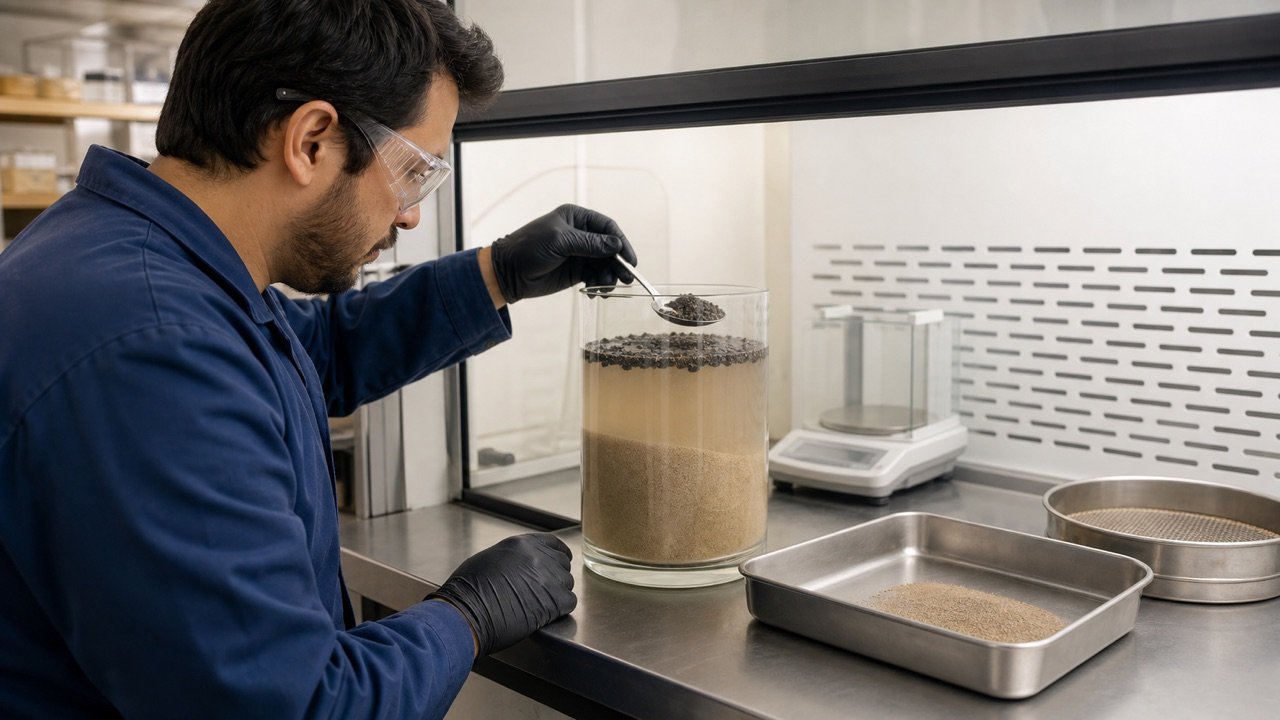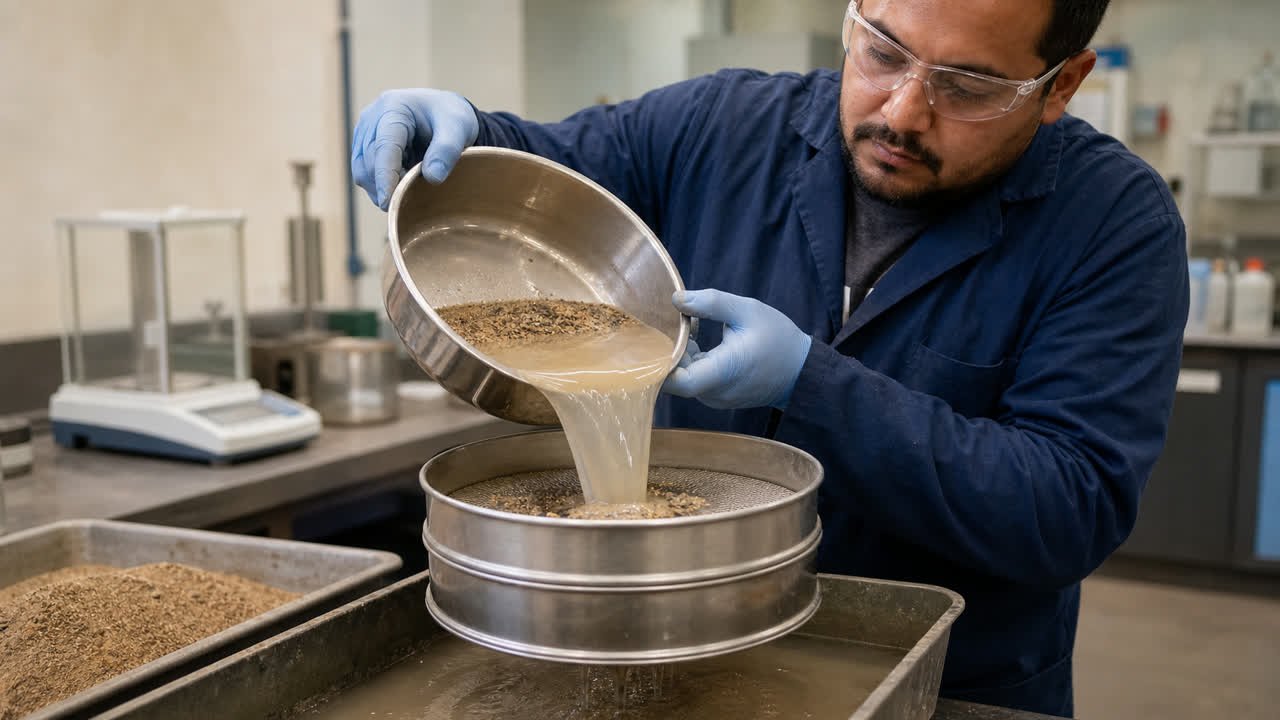
A sand soundness report records how fine-aggregate size fractions respond to repeated sulfate exposure and drying under a named test method. Checking the result requires more than reading the total percentage. You need each fraction's original and final dry mass, the assigned grading weight, the salt used, and the project requirement.
Sodium sulfate and magnesium sulfate results belong to separate reporting and acceptance contexts. The method also provides a preliminary estimate rather than a direct prediction of service life, so the result needs its source, sample, method, and intended use.
How is sand soundness loss calculated?
Calculate the mass loss for each tested size fraction. Multiply each fraction loss by its assigned grading weight, divide by 100, and add the weighted contributions.
- Li is the loss for size fraction i, as a percentage of its original dry mass.
- Wo,i is the original dry mass of that fraction before the sulfate cycles.
- Wf,i is the final retained dry mass after the complete specified sequence and final sieving.
- Gi is the grading or standard-distribution weight assigned to that fraction, in percent.
- Ci is the fraction's contribution in percentage points.
Use the same mass unit for the original and final mass. Keep the observed masses and intermediate results unrounded. Apply the reporting precision stated in the governing method only after the weighted sum is complete.
Name the test method and revision, sulfate salt, aggregate size class, and acceptance clause. A bare value such as 8% cannot be checked or compared safely.
What does ASTM C88/C88M-24 estimate?
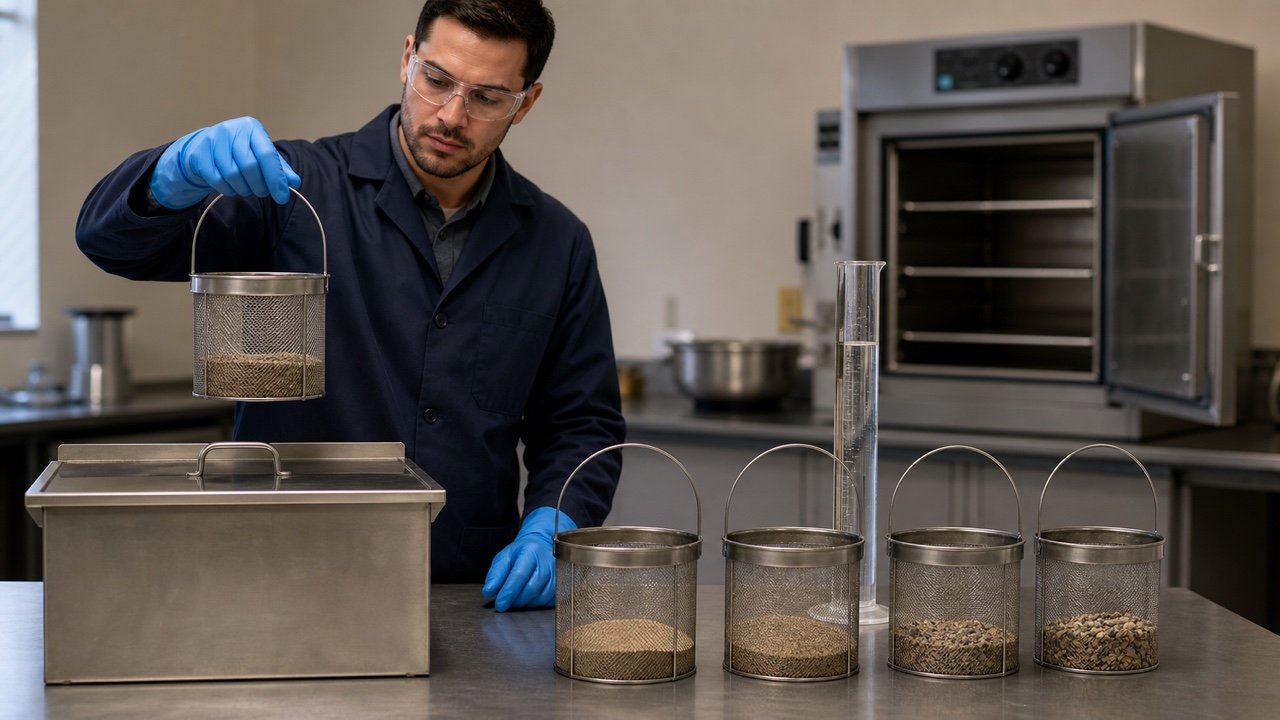
ASTM C88/C88M-24 uses repeated immersion in saturated sodium sulfate or magnesium sulfate solution followed by oven drying. ASTM describes the result as a preliminary estimate of aggregate soundness when adequate service records are unavailable.
The crystallization process creates internal expansive forces in permeable aggregate particles. It provides a controlled screening result related to weathering resistance. ASTM also states that the method has poor precision and may be unsuitable for outright rejection without confirmation by tests that better match the intended service.
That limitation changes how a result should be written. A higher loss shows more disintegration under the selected sulfate method. It does not establish an exact number of freeze-thaw cycles, years of service, or field failure date.
How do you calculate one size-fraction loss?
Suppose a prepared fine-aggregate fraction has an original dry mass of 100.0 g and a final retained dry mass of 94.8 g.
The fraction lost 5.2% of its original dry mass under the specified sequence. A reverse check gives 100.0 × (1 − 0.052) = 94.8 g, which matches the retained mass.
The arithmetic confirms the relationship between the 2 masses. It does not confirm sample representativeness, solution condition, cycle completion, washing, drying, final sieving, or project compliance.
How is the weighted average soundness loss checked?
The weighted result gives each tested fraction the share assigned by the governing method or grading basis. The following open example comes from California Test 214, an August 2010 California modification of AASHTO T 104.
| Fine fraction | Assigned weight | Fraction loss | Exact contribution |
|---|---|---|---|
| No. 4 to No. 8 | 22% | 4.7% | 1.034 points |
| No. 8 to No. 16 | 19% | 4.2% | 0.798 points |
| No. 16 to No. 30 | 24% | 3.6% | 0.864 points |
| No. 30 to No. 50 | 20% | 4.0% | 0.800 points |
| No. 50 to No. 100 | 15% | 8.1% | 1.215 points |
| Total | 100% | 4.711% |
The exact contributions add to 4.711%, reported as 4.7% in the California example. Calculate from the unrounded values, then round the final sum. Adding already rounded display contributions can move a result near an acceptance limit.
The 22%, 19%, 24%, 20%, and 15% weights belong to California Test 214's stated fine-aggregate basis. They are an open calculation example, not a universal ASTM C88 table for every report. Use the size fractions and weighting rule in the method named by the project.
Why must sodium and magnesium sulfate results stay separate?
ASTM says results from the 2 salts differ considerably. Magnesium sulfate is generally more severe, and specifications commonly allow different losses for magnesium and sodium results.
| Report item | What to verify | Decision risk |
|---|---|---|
| Sulfate salt | Sodium or magnesium is stated for the tested result | A result can be compared with the wrong limit |
| Method and revision | Exact ASTM, AASHTO, agency, or project designation | Cycles, fractions, calculations, and reporting provisions can differ |
| Aggregate class | Fine aggregate is distinguished from coarse aggregate | Specifications can set different permitted losses |
| Acceptance clause | Salt, material use, edition, and exceptions match the report | A generic threshold can produce an unsupported pass or fail |
The May 2025 TxDOT Tex-411-A, for example, identifies magnesium sulfate soundness for fine and coarse aggregate over 5 cycles. A result from that agency method should retain that identity instead of being relabeled as a generic sulfate value.
What if the fraction weights do not add to 100%?
Stop and check the governing method before calculating a final total. A 95% sum can indicate a missing fraction, an untested fraction, a copied grading basis, or a transcription error.
Do not silently divide the contributions by 0.95 to force the weights to 100%. Renormalization changes the result and is valid only when the specified method tells you to do it. Some methods provide instructions for fractions absent from the grading or unavailable in sufficient quantity. The current controlled procedure must settle that case.
Keep 3 ideas separate:
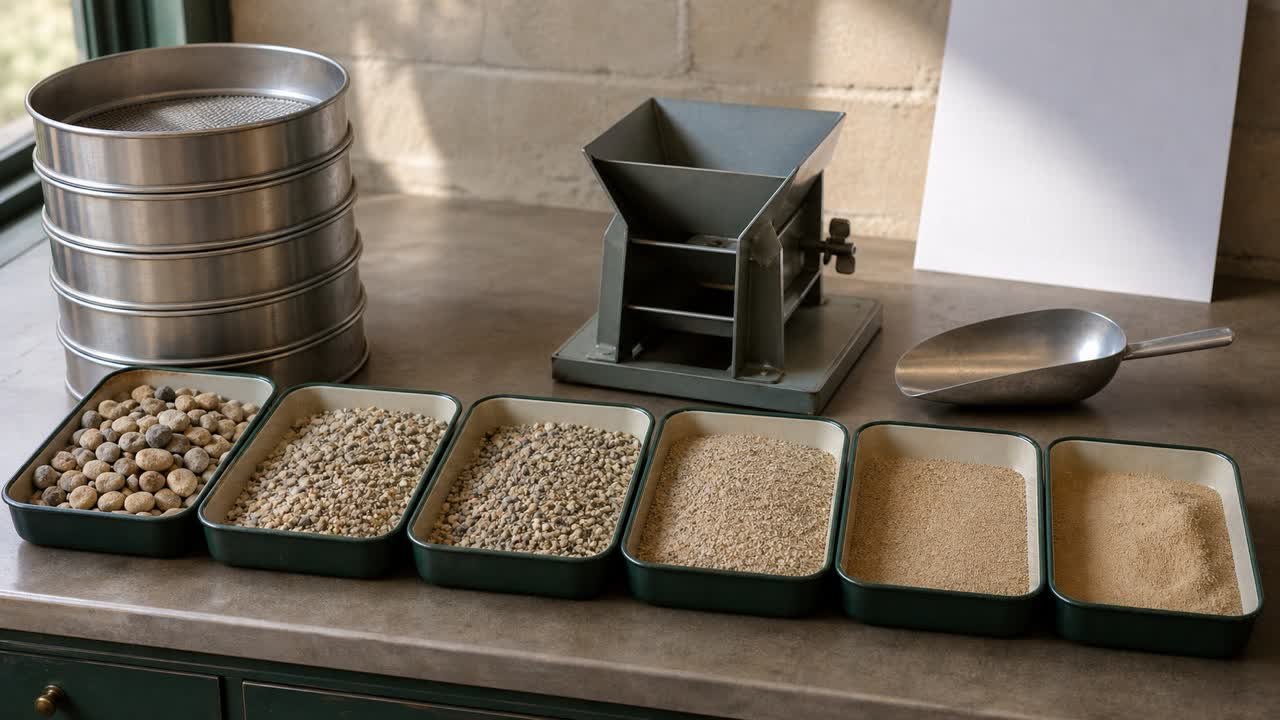
- Test fraction: the material prepared and exposed for one size interval.
- Fraction loss: the mass percentage lost from that test fraction.
- Grading weight: the share assigned to that fraction when forming the reported average.
The sand sieve-analysis guide explains size fractions, retained mass, cumulative retained, and percent passing. A gradation record and a sulfate-loss record use related fraction labels but answer different questions.
What does a negative loss mean?
A final retained mass above the original mass produces a negative value and does not support an ordinary soundness result. Preserve the recorded observations and investigate the record.
For example, 100.0 g before testing and 100.6 g after testing gives −0.6%. Check the tare, retained moisture or salt, original and final drying state, cooling, sample and fraction identity, material transferred from another basket, balance condition, and transcription.
Changing the number to zero hides the discrepancy. The laboratory quality procedure should determine whether the record can be corrected from traceable evidence or whether the work needs to be repeated.
Which errors can bias sulfate soundness loss?
The formula assigns missing mass to the tested fraction. It cannot identify whether the loss came from particle disintegration or a handling and record problem.
- A field sample or laboratory split that does not represent the source and lot.
- The wrong salt, solution condition, temperature, cycle count, or method edition.
- Loss of particles during transfer, immersion, washing, drying, or final sieving.
- Incomplete removal of retained salt before the final dry mass.
- Incomplete drying, weighing while hot, or moisture gained before weighing.
- Cross-contamination between size fractions or specimens.
- An incorrect tare, decimal, unit, balance record, or sample identifier.
- Using a grading weight from another method or product.
- Rounding each loss and contribution before forming the total.
- Comparing a sodium result with a magnesium requirement.
The open California method calls for clean and dry material before the first cycle, complete drying between cycles, cooling to room temperature, correct basket openings, and daily solution checks. Those points show why mass and method records matter. They remain California procedure details, and the controlled method for the actual project supplies the required laboratory steps.
Can the result predict freeze-thaw field performance?
The result supplies a preliminary laboratory estimate of soundness under sulfate crystallization. ASTM explains that the process simulates expansive forces associated with freezing water, while also warning about poor precision and differences between the 2 salts.
Field performance also depends on exposure, saturation, drainage, pore structure, climate, material production, mixture design, construction, and service conditions. Adequate performance records for the same aggregate and intended exposure can provide evidence that a single sulfate number cannot.
Use sulfate soundness with the other tests and evidence required by the project. The specific gravity and absorption guide, No. 200 wash-test guide, and clay lumps and friable particles guide cover separate properties. One result cannot substitute for the others.
Which report details make the result auditable?
A soundness percentage needs enough context to connect the arithmetic with the tested lot and the applicable decision.
- Project and material: intended use, contract item, product description, and governing specification.
- Source and lot: producer, pit or quarry, stockpile or delivery, quantity represented, and sampling location.
- Sample: identifier, date, sampler, sampling method, laboratory reduction, and chain of custody.
- Method: complete designation, revision, agency modification, salt, and specified cycle count.
- Fractions: sieve interval, original dry mass, final dry mass, individual loss, and any untested-fraction treatment.
- Weighting: origin of each grading weight, total weight check, exact contributions, and final rounding.
- Quality records: equipment identifiers, solution records, drying and cooling records, deviations, and corrective actions required by the quality system.
- Decision: salt-specific clause, limit, exceptions, and the action for a marginal or nonconforming result.
The sand sampling guide explains why a laboratory result cannot be assigned to an undefined stockpile, belt stream, or delivery lot.
Does the sand pass or fail?
The applicable project specification supplies the decision rule. Match its material use, aggregate class, sulfate salt, method edition, permitted loss, exceptions, and acceptance process to the report.
ASTM C33/C33M-24a provides requirements for concrete aggregates and includes conditions related to aggregate acceptance. Asphalt, base, drainage, mortar, or agency work can use other limits and provisions. A percentage copied from a general guide has no authority over the contract documents.
| Situation | Defensible next step |
|---|---|
| Calculation, method identity, salt, sample, and clause all match | Apply the specified decision rule and retain the full record |
| The report and limit use different salts | Stop the comparison and obtain the correct requirement or test result |
| The weighted basis is incomplete or unexplained | Resolve the missing fraction and method rule before reporting a total |
| The result exceeds the applicable limit | Follow the contract process for notification, hold, confirmation, resampling, retesting, or rejection |
| Adequate service records or specification exceptions may apply | Submit the evidence through the responsible project's approval process |
| The record contains an impossible mass or material deviation | Use the laboratory quality procedure before making an acceptance decision |
After the material is approved for its intended use, use the Sand Calculator to estimate volume and mass using a documented supplier density. Return to the Sand material planning hub for quantity tools, test guides, and reference charts.
Sources and source scope
- ASTM C88/C88M-24, Standard Test Method for Soundness of Aggregates by Use of Sodium Sulfate or Magnesium Sulfate: current designation, scope, test concept, service-record context, salt differences, poor precision, and interpretation cautions. The licensed standard controls the complete ASTM procedure.
- TxDOT Tex-411-A, Soundness of Aggregate Using Magnesium Sulfate: May 2025 agency-method identity, fine and coarse aggregate scope, magnesium sulfate, and 5-cycle context. The current agency document controls its procedure.
- California Test 214, Soundness of Aggregates by Use of Sodium Sulfate: open August 2010 agency calculation, fine-aggregate standard distribution, worked example, checks, and reporting. Its California-specific provisions are not universal ASTM requirements.
- NETTCP T104 Fine Aggregate report form: transparent traceability, individual mass-loss, and weighted-contribution fields. The older regional form illustrates report structure and does not set current project requirements.
- ASTM C33/C33M-24a, Standard Specification for Concrete Aggregates: current concrete-aggregate specification and conditional acceptance context. The licensed specification and project documents control limits and exceptions.
Scope: this page checks calculation and reporting logic. The current controlled test method, project documents, laboratory procedure, sampling plan, quality system, safety program, and responsible qualified people control testing and aggregate approval.
BuildQuantities.com records its source and calculation checks on the methodology page. Report a source, formula, unit, method, or rendering problem through the corrections route.