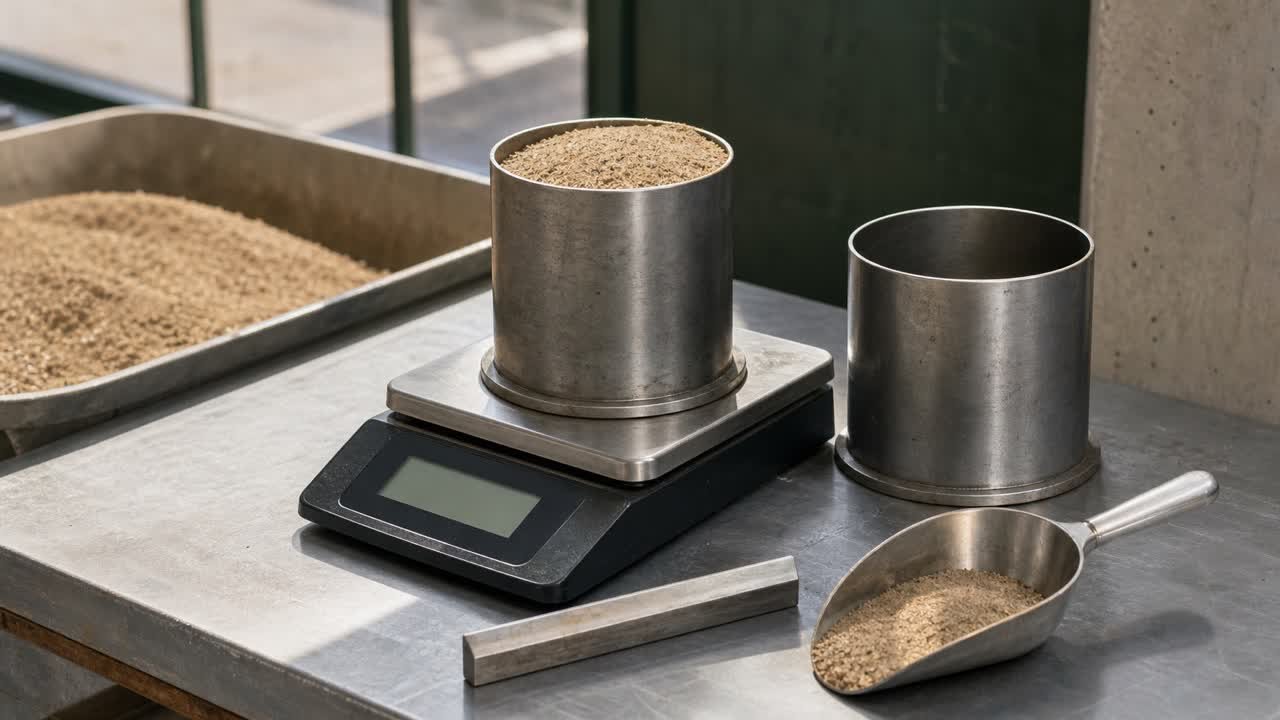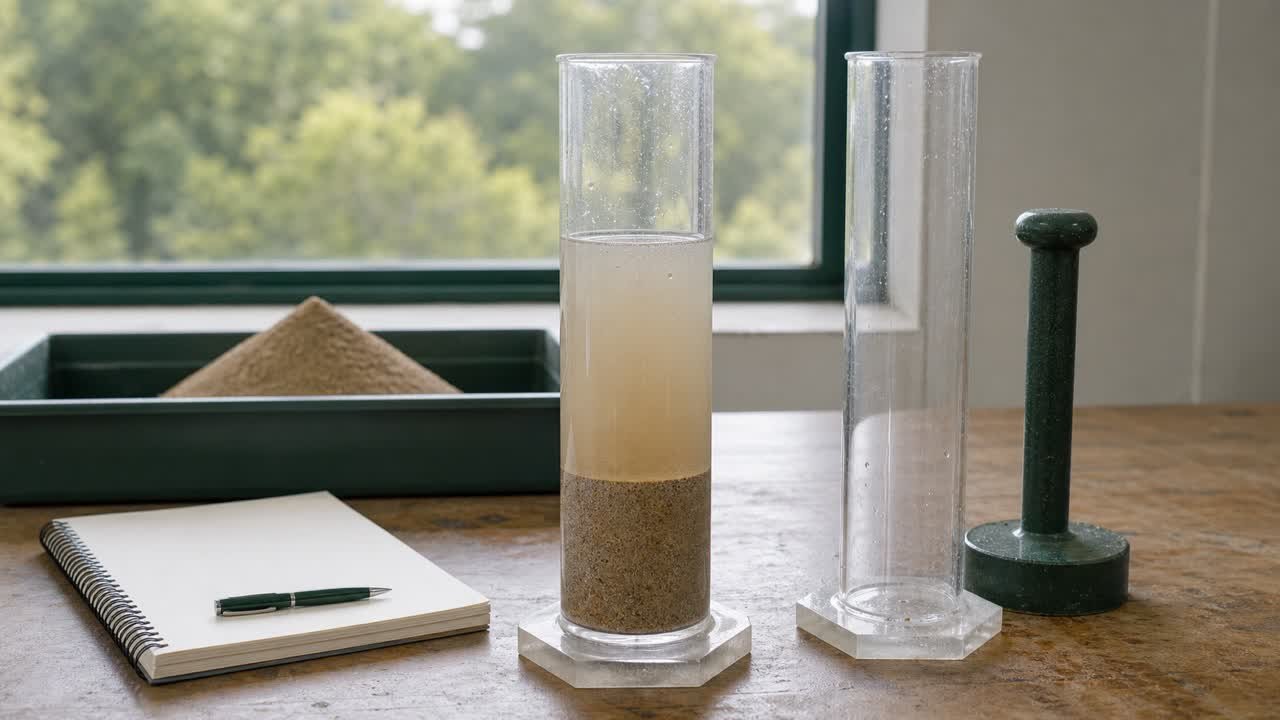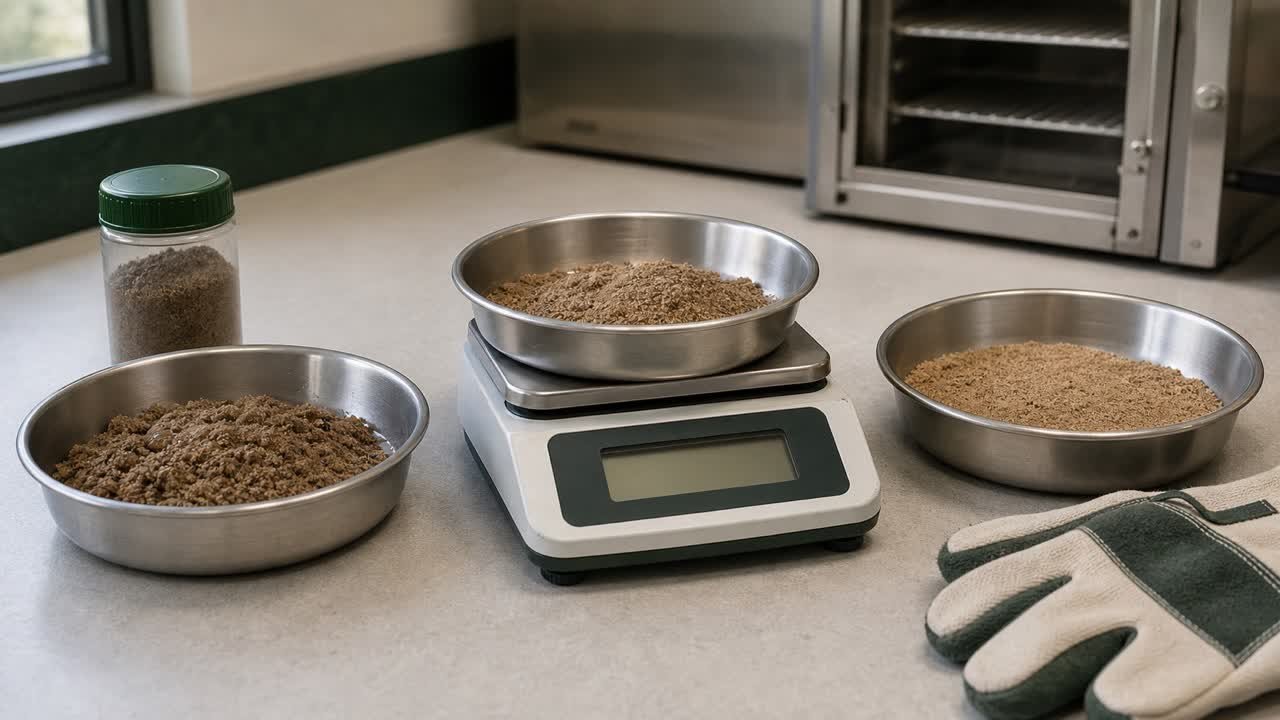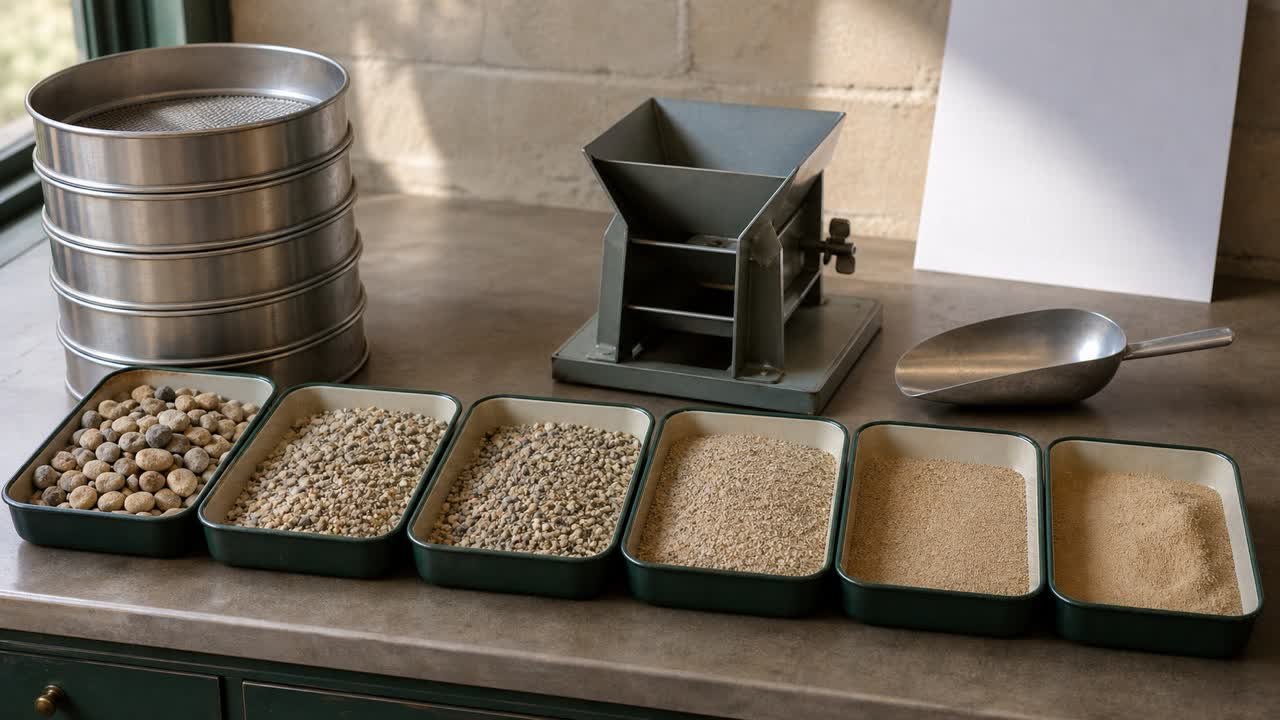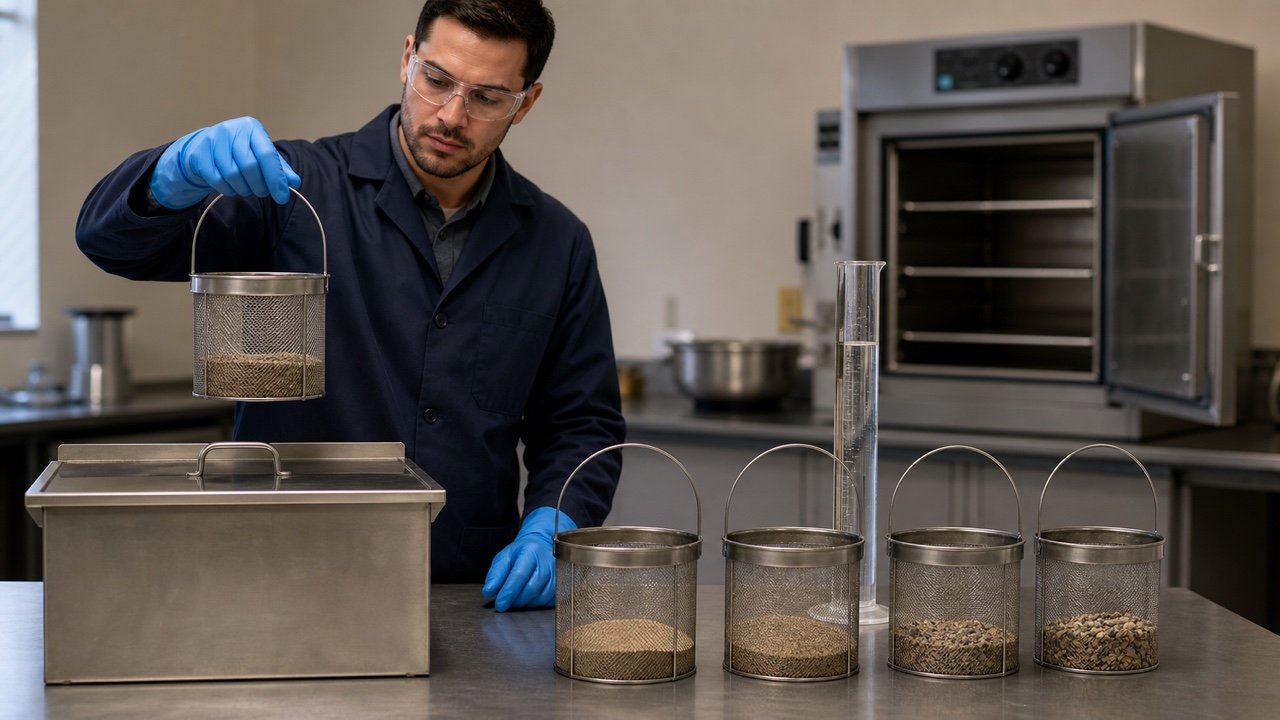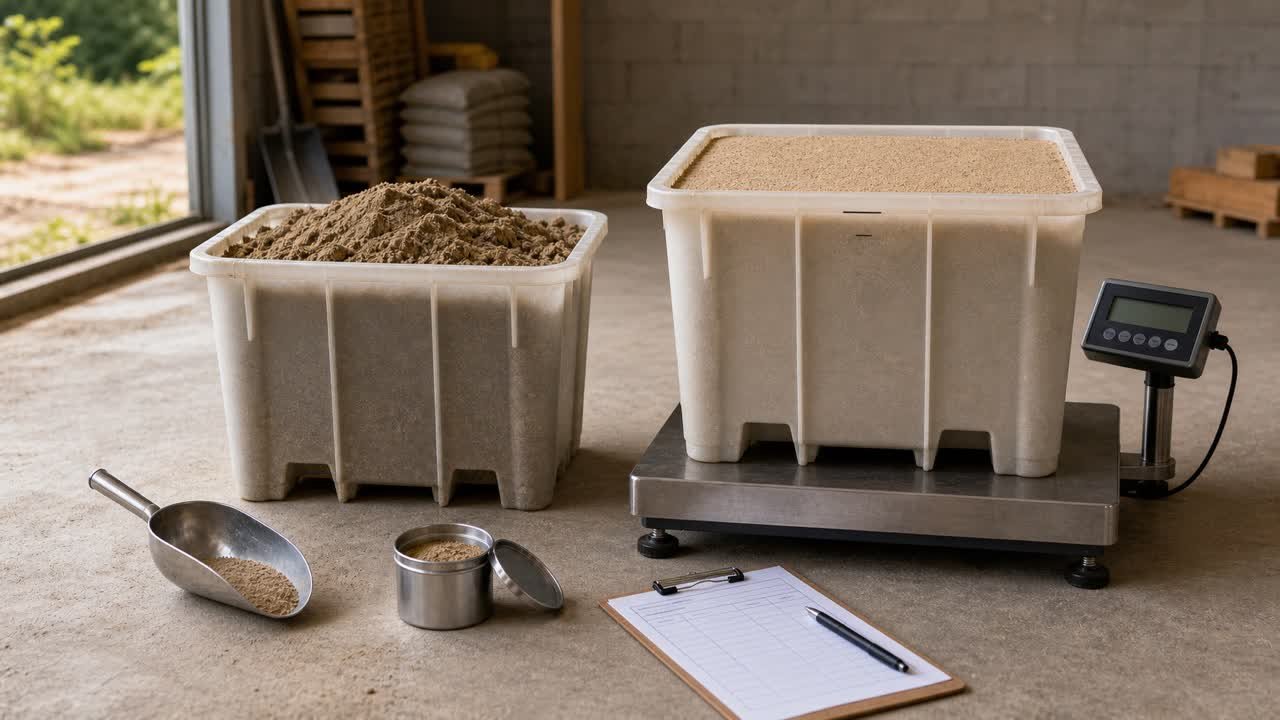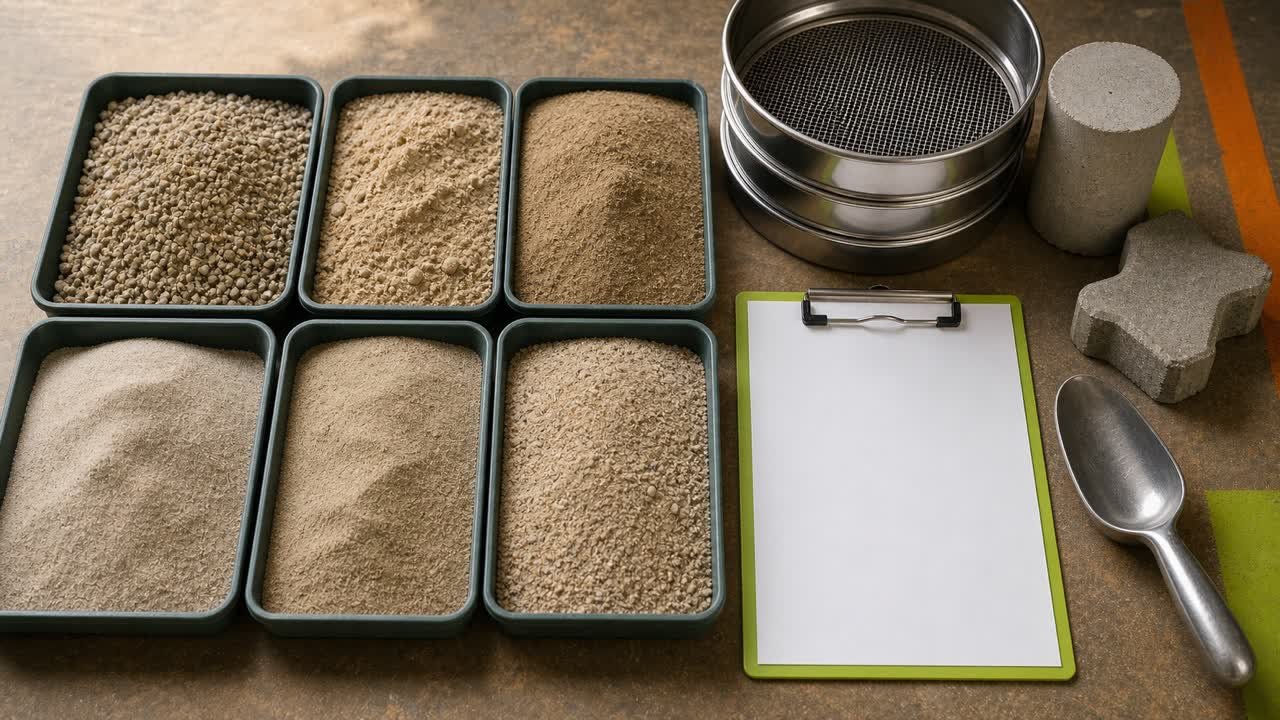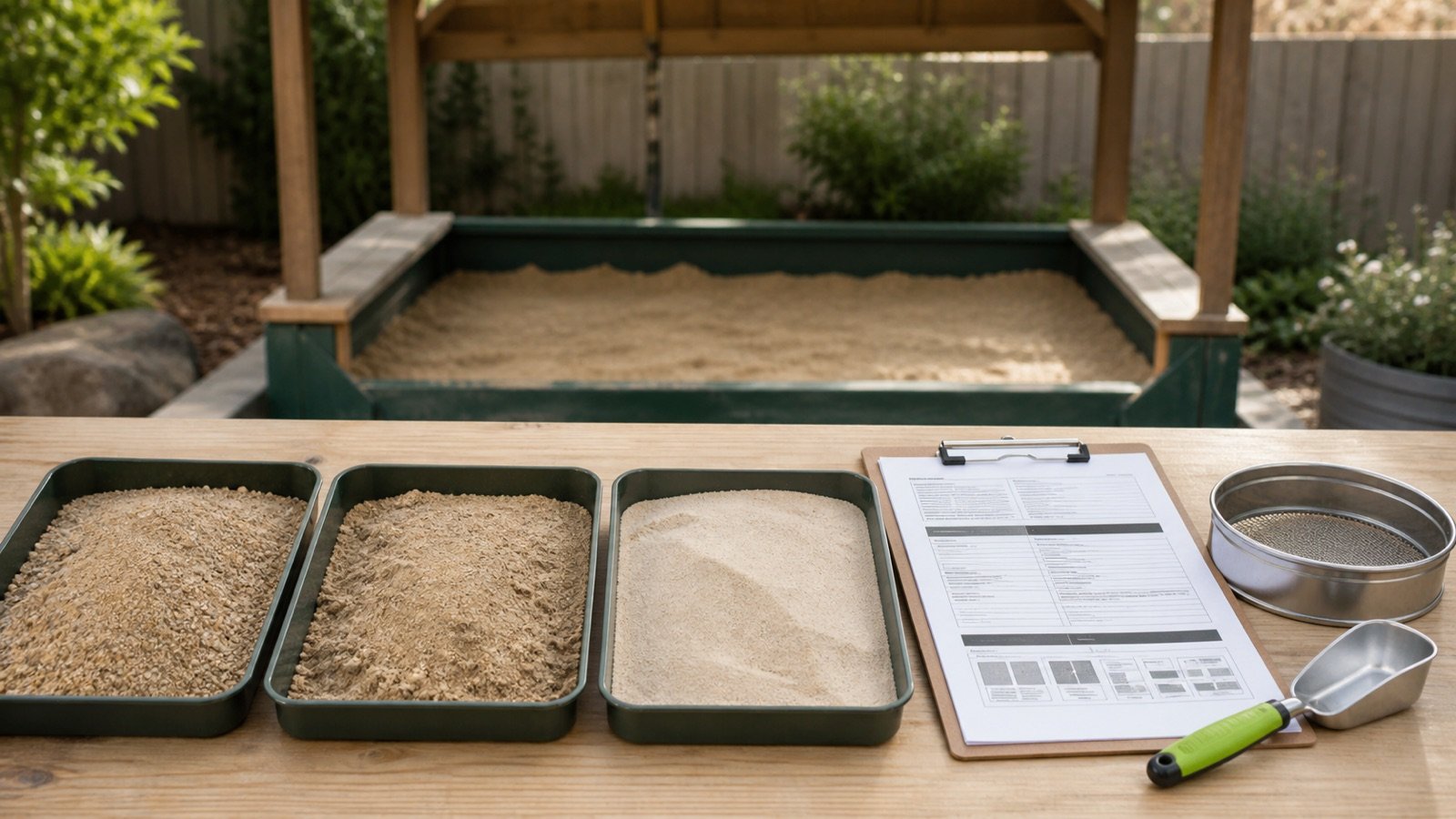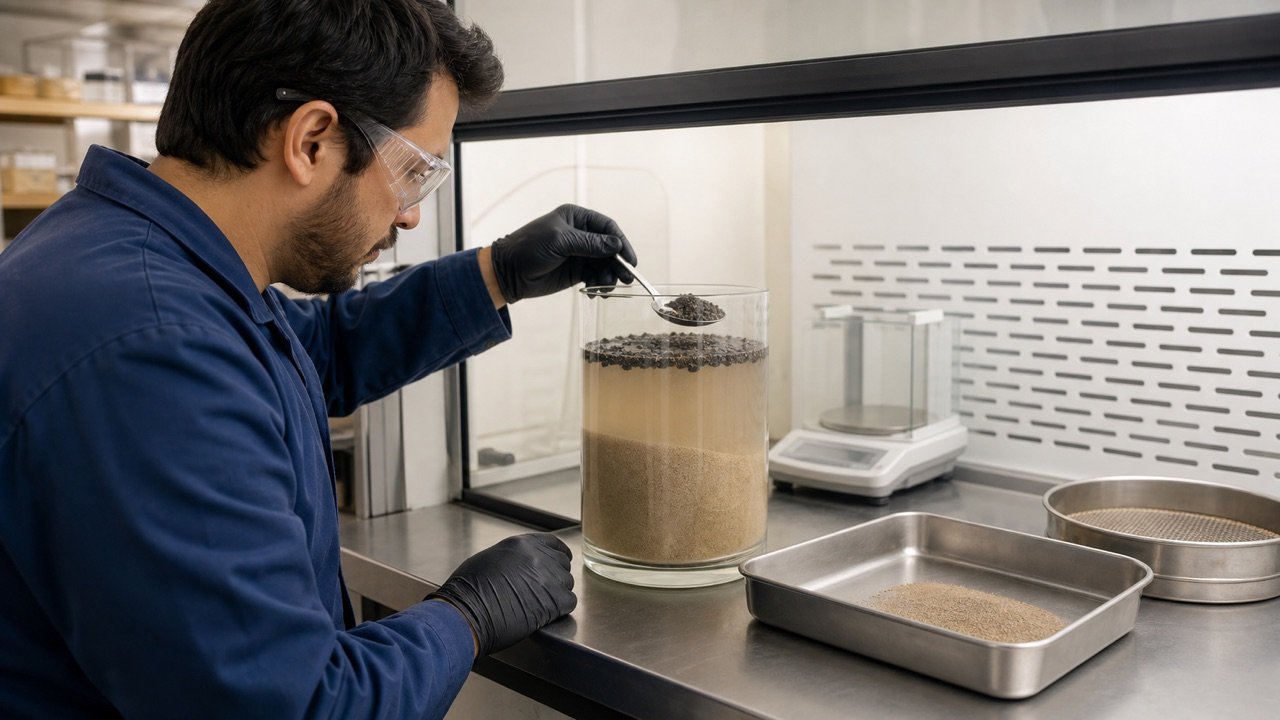
A lightweight-particles report can affect whether fine aggregate is accepted for concrete or another specified use. The percentage is useful only when the floating dry mass, the correct prepared-fraction mass, the heavy-liquid specific gravity, and the governing project rule stay attached to it.
This guide checks the calculation and report record. The laboratory must follow the current licensed method for specimen preparation, separation, recovery, drying, equipment, and safety.
What does a lightweight-particles result mean?
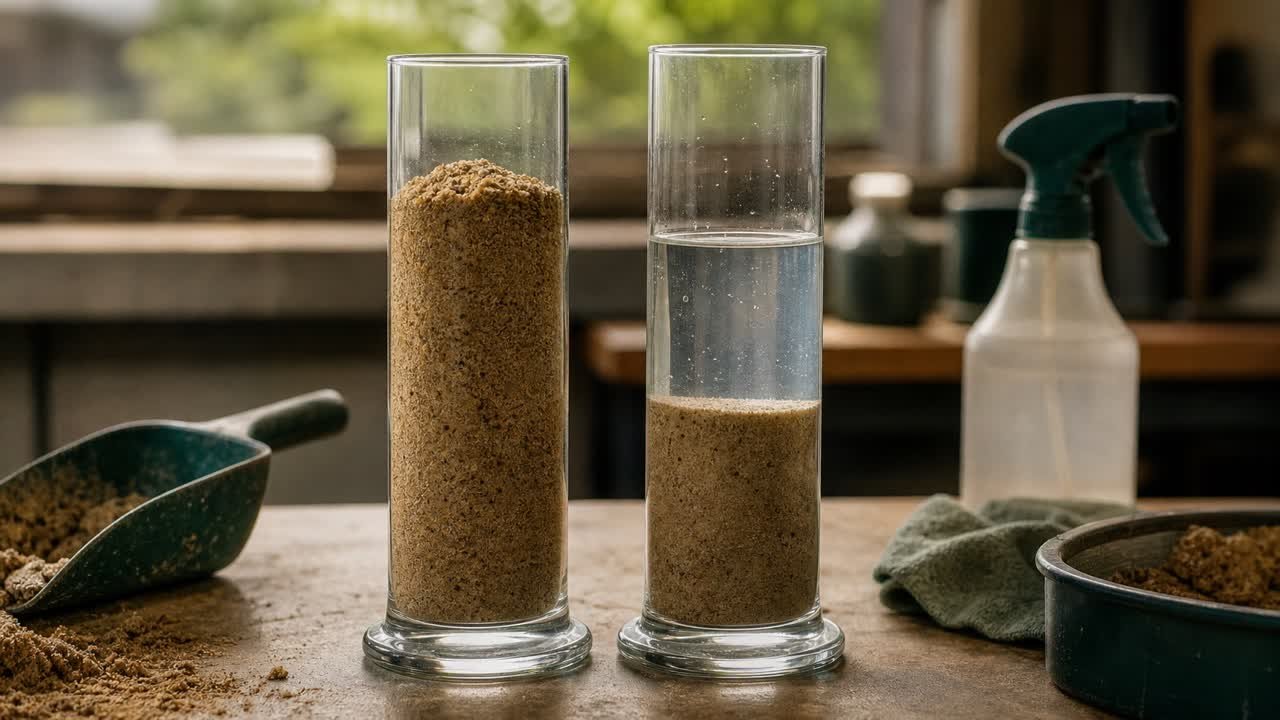
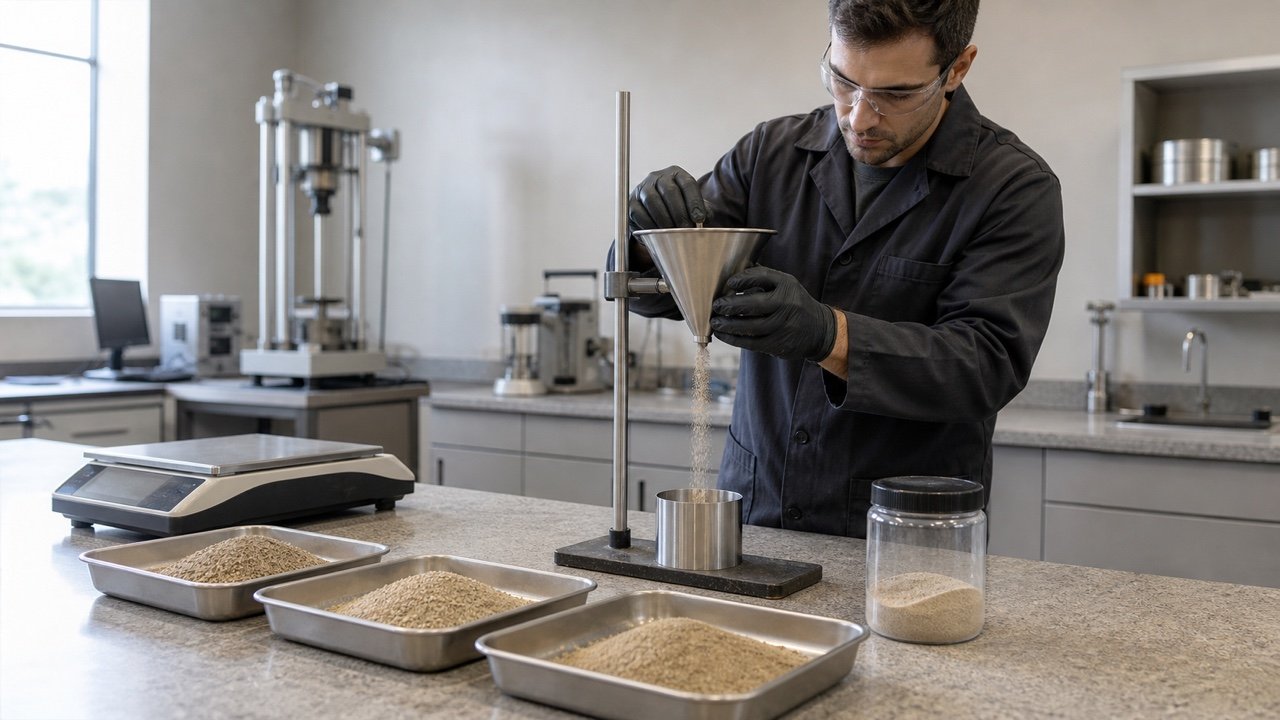
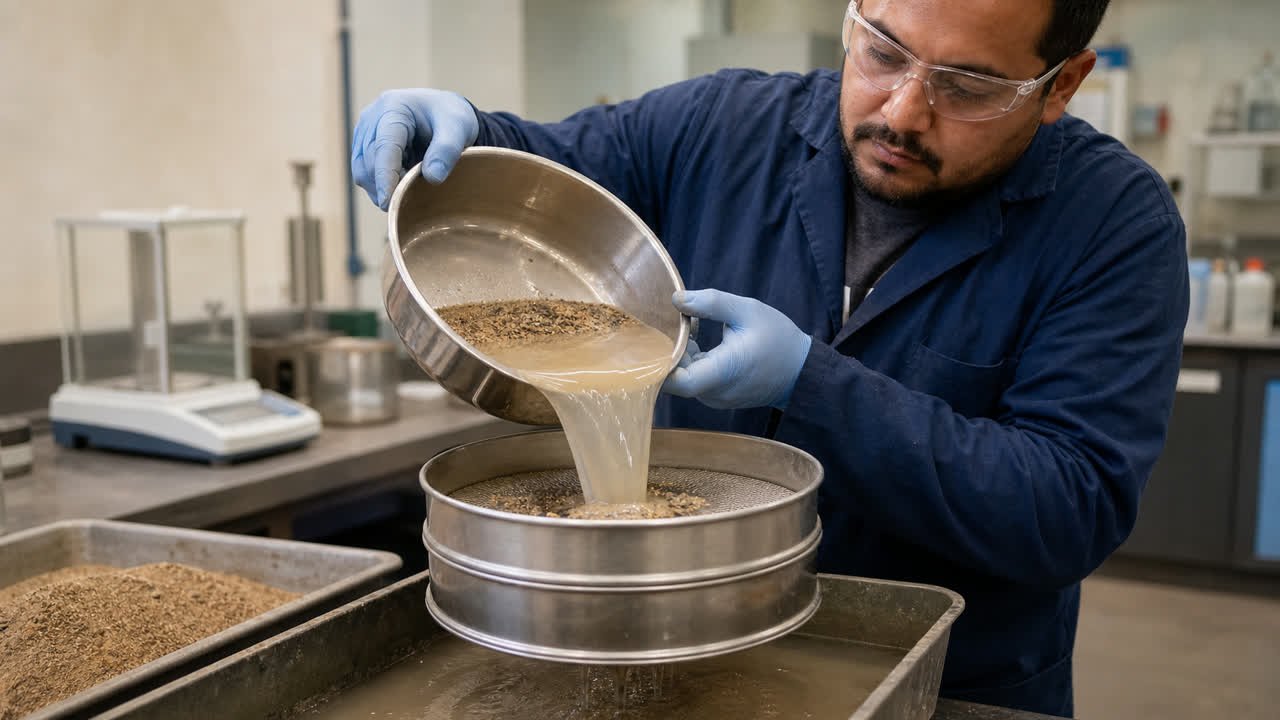
The result is the dry mass of particles that float in a heavy liquid, expressed as a percentage of the method-defined dry test portion. ASTM C123/C123M-23 covers sink-float separation of lightweight particles in fine and coarse aggregate.
The result describes behavior at a selected separation specific gravity. It does not identify the chemical or geological composition of every floating particle by itself.
A record written only as "0.4% lightweight particles" is incomplete. Add the method and revision, fine-aggregate designation, test fraction, liquid type and verified specific gravity, sample and lot, dry masses, report precision, project criterion, and test date.
Which records do you need to check the calculation?
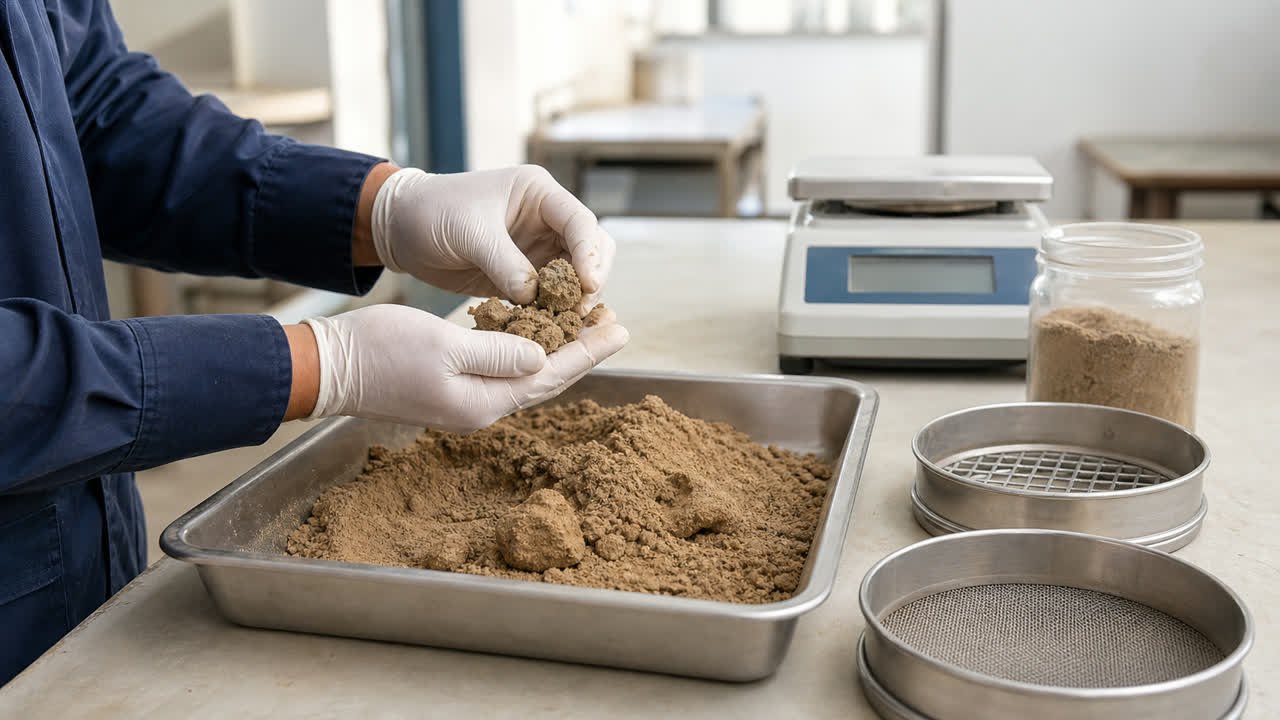
You need the dry mass of recovered floating particles and the dry mass of the prepared fine-aggregate portion coarser than the 300 micrometre (No. 50) sieve. Both values must come from the same specimen and use compatible mass units.
| Record | What to confirm | Why it matters |
|---|---|---|
| Method | Full designation, revision, and any agency modification | Preparation, liquid, recovery, precision, and reporting rules can differ |
| Sample identity | Source, product, lot or stockpile, sample number, location, and date | The result must remain traceable to the material it represents |
| Separation threshold | Liquid type and verified specific gravity | The threshold determines which particles float |
| Floating mass, W1 | Recovered particles on the required dry-mass basis | This is the numerator |
| Test-portion mass, W2 | Dry prepared fine aggregate coarser than the No. 50 sieve | This is the fine-aggregate denominator |
| Report rule | Required precision, repeats, and rounding | The displayed result may change near a project limit |
| Acceptance authority | Project specification, material class, use, edition, and decision rule | The test method does not create one limit for every project |
How do you calculate lightweight particles in fine aggregate?
Divide the dry mass of recovered floating particles by the dry mass of the prepared portion coarser than the No. 50 sieve. Multiply the quotient by 100.
Lightweight particles, L (%) = W1 / W2 x 100
| Symbol | Meaning | Unit |
|---|---|---|
| L | Lightweight-particle content of the prepared fine-aggregate fraction | % by mass |
| W1 | Dry mass of particles that floated and were recovered | g |
| W2 | Dry mass of the prepared specimen coarser than 300 micrometres (No. 50) | g |
Use the same mass unit for W1 and W2. Grams are convenient because the floating fraction can be small. Keep the unrounded quotient in the audit record, then apply the named method's final reporting rule.
A current agency procedure can use the same ratio while changing preparation, apparatus, recovery, or reporting details. The West Virginia Division of Highways procedure MP 702.01.20, for example, publishes W1 divided by W2 for fine aggregate and supplies its own agency instructions. It does not replace ASTM C123/C123M-23.
Worked example: 2.4 g of floating particles
A worksheet shows W1 = 2.4 g and W2 = 600.0 g. The denominator is the recorded dry mass of the prepared portion coarser than the No. 50 sieve.
L = 2.4 g / 600.0 g x 100 = 0.400000%
The reverse check returns the floating mass:
600.0 g x 0.00400000 = 2.4 g
The arithmetic result is 0.400000%. The governing method and project documents control whether the reported value is 0.4%, 0.40%, or another permitted precision.
Worked example: a non-round test-portion mass
A second record shows W1 = 3.7 g and W2 = 742.5 g. Use 742.5 g rather than replacing it with a convenient assumed specimen mass.
L = 3.7 g / 742.5 g x 100 = 0.498316...%
Retain 0.498316...% for the calculation audit. Apply the required precision once, at the end. Early rounding of the quotient or either mass can change a near-limit comparison.
Why is the No. 50 denominator easy to get wrong?
The fine-aggregate denominator is the dry mass of the prepared portion coarser than 300 micrometres (No. 50), not automatically the mass of the entire field sample or every gram placed on an earlier worksheet.
Suppose the floating mass is 2.4 g, the prepared No. 50-retained portion is 600.0 g, and an earlier whole-sample mass is 1000.0 g:
| Denominator used | Calculation | Result | Status |
|---|---|---|---|
| 600.0 g No. 50-retained test portion | 2.4 / 600.0 x 100 | 0.400% | Uses the defined fine-aggregate mass basis |
| 1000.0 g earlier whole sample | 2.4 / 1000.0 x 100 | 0.240% | Wrong denominator for this calculation |
The substitution lowers the result by 0.160 percentage points in this example. A clean spreadsheet formula cannot correct a mass that belongs to the wrong preparation stage.
What does the heavy-liquid specific gravity change?
The selected specific gravity sets the sink-float boundary. ASTM C123/C123M-23 states that a liquid with specific gravity 2.0 separates particles that may be classified as coal or lignite. Heavier liquid is used to check other lightweight particles such as chert and shale with specific gravity below 2.40.
| Test purpose | Threshold context from ASTM's public summary | Record needed |
|---|---|---|
| Particles that may be classified as coal or lignite | Heavy liquid at specific gravity 2.0 | Liquid identity, measured specific gravity, temperature or correction record required by the method, and time of verification |
| Other low-specific-gravity particles, including cited chert or shale cases | Heavier liquid for particles below the selected threshold, with ASTM citing less than 2.40 | Required separation value from the specification and proof that the prepared liquid met it |
| Project names another method or modified threshold | Project-specific | Written method, modification, authority, and acceptance basis |
A 2.0 result and a higher-threshold result answer different classification questions. Do not combine them in one percentage or compare them as if the separation boundaries were identical.
Does the test prove that every floater is coal or lignite?
No. The method separates particles by their behavior in a liquid of selected specific gravity. ASTM's wording says particles at the 2.0 threshold may be classified as coal or lignite; the physical separation alone is not a complete petrographic or chemical identification.
Record the report category used by the governing specification. When particle identity affects the decision, obtain the additional examination required by the project or a qualified petrographer rather than assigning a material name from color alone.
ASTM also notes that the method can help identify porous aggregate particles in research or petrographic analysis. That use still depends on the selected threshold and the study's identification process.
Can visual picking replace sink-float separation?
Visual picking uses appearance and operator judgment; sink-float separation uses a controlled density threshold. They can sort particles differently, so the report must name the method actually performed.
A Nebraska Department of Transportation study compared AASHTO T 113 with visual procedures for the aggregates in its program. The comparison supports a practical audit rule: keep method identity with each result and avoid treating unlike classification procedures as interchangeable.
Photographs can document a recovered fraction. They do not establish the liquid specific gravity, dry mass, sample representativeness, or project compliance on their own.
How much does a small mass difference change the result?
With W2 = 600.0 g, each 0.1 g change in W1 changes the result by 0.0166667 percentage points. The calculation is 0.1 / 600.0 x 100.
| W1 | Calculated result | Change from 2.4 g case |
|---|---|---|
| 2.3 g | 0.383333% | -0.016667 percentage points |
| 2.4 g | 0.400000% | Reference |
| 2.5 g | 0.416667% | +0.016667 percentage points |
This is an arithmetic sensitivity check. It does not state balance tolerance, method precision, or an acceptance band. Those values come from the current controlled method, laboratory quality system, and project specification.
How should you check a result near the project limit?
Reproduce the raw calculation first, then check method compliance and apply the exact written decision rule. Keep the unrounded value visible during the audit.
| Situation | Check before assigning pass or fail | Boundary |
|---|---|---|
| Unrounded result lies near the maximum | W1, W2, units, final precision, and rounding instruction | Use the rule named by the project; do not select precision after seeing the outcome |
| Liquid verification is missing | Preparation log, specific-gravity measurement, temperature controls, and method requirement | The percentage lacks a documented separation threshold |
| Duplicate results differ | Sampling, preparation, liquid condition, recovery, drying, and method precision provisions | Follow the governing repeat and reporting procedure |
| Result differs from source history | Lot, sampling location, tested fraction, method revision, and laboratory record | Do not merge unlike lots or methods |
| No acceptance value appears in the contract | Project specification, drawings, agency requirements, submittal, and responsible authority | Do not copy a limit from another website or project |
ASTM C33/C33M-24a is the active concrete-aggregate specification found during this review, and ASTM C123/C123M-23 states that its method is used for C33 conformance. A project's contract documents, material class, use, and approved modifications still control the actual acceptance decision.
Which record problems make the percentage invalid?
Some entries fail a basic mass-balance or traceability check before any comparison with a limit.
| Record problem | Why it fails or needs investigation |
|---|---|
| W2 is blank, zero, or negative | The percentage has no valid positive denominator |
| W1 is negative | A recovered dry mass cannot be negative |
| W1 is greater than W2 | The numerator cannot exceed the test portion on the stated mass basis; check sample identity, moisture, tare, units, and transcription |
| W1 was weighed wet or with residual liquid | Water or retained heavy liquid can increase the apparent floating mass |
| W1 and W2 use different units | The ratio is wrong until the units match |
| W2 came from the whole sample or coarse-aggregate branch | The denominator does not match the fine-aggregate formula |
| Specific gravity is absent | The separation threshold cannot be audited |
| Sample or lot is absent | The result cannot support a traceable material decision |
Preserve the original entry and correction trail. A silent replacement may repair the arithmetic while breaking the laboratory record.
Is the fine-aggregate calculation the same as the coarse-aggregate calculation?
The numerator remains the recovered floating dry mass, but the prepared denominator fraction differs. The fine-aggregate calculation uses the portion coarser than the No. 50 sieve. The coarse-aggregate branch uses its method-defined coarser fraction.
Label the aggregate size class beside every result. A coarse-aggregate denominator inserted into a fine-aggregate worksheet can produce plausible arithmetic that answers the wrong question.
The same separation liquid may also be used for a different target category only when the governing method and specification say so. Keep the fraction, threshold, and acceptance class together.
What safety boundary applies to the heavy liquid?
The laboratory's current procedure, safety data, ventilation controls, personal protective equipment, waste plan, and applicable regulations control chemical selection and handling. ASTM C123/C123M-23 states that users are responsible for appropriate safety, health, and environmental practices and for determining regulatory applicability.
A calculation guide cannot authorize a chemical, substitute liquid, disposal method, exposure control, or workspace. Stop the test and follow the laboratory's approved safety process when the liquid identity, safety data, ventilation, spill controls, or waste route is unclear.
What should a complete report audit include?
- Trace the sample: record project, source, product, lot or stockpile, sample number, sampling point, and date.
- Name the method: record the full designation, revision, agency modification, and fine-aggregate classification.
- Record the threshold: identify the heavy liquid and the required and measured specific gravity under the method's conditions.
- Check the denominator: confirm W2 is the dry prepared portion coarser than the No. 50 sieve.
- Check recovery: confirm floating particles were completely recovered, cleaned as required, dried, cooled, and weighed on the stated basis.
- Recalculate: divide W1 by W2, multiply by 100, and keep the unrounded value.
- Check quality records: review balance status, liquid verification, repeats, corrections, and method-required controls.
- Apply the report rule: use the named method's precision and rounding instruction.
- Apply the project rule: cite the material class, intended use, specification edition, criterion, and decision authority.
Use the sand sampling guide when the test cannot be tied to a representative lot. Use the sand sieve analysis guide to check the source gradation and the No. 50 fraction.
Which related tests answer different questions?
Lightweight-particle separation measures a density-threshold fraction. Other sand tests evaluate different material properties.
- Clay lumps and friable particles are separated through the named soaking, hand-breaking, sieving, and mass-loss procedure.
- Organic impurities testing uses a color comparison or the specified follow-up strength procedure. It does not weigh a sink-float fraction.
- Fine-aggregate Micro-Deval measures mass loss under a defined wet-abrasion process.
- Material finer than the No. 200 sieve measures material removed through the 75 micrometre sieve under its washing method.
One test result cannot be converted into another. Use every method required by the project and keep each acceptance criterion with the property it evaluates.
Common lightweight-particles report mistakes
- Reporting a percentage without the method, edition, or aggregate size class.
- Calling every floating particle coal or lignite without the required identification basis.
- Using the original whole-sample mass instead of the No. 50-retained prepared portion.
- Using a coarse-aggregate denominator in the fine-aggregate calculation.
- Leaving the liquid specific gravity or verification record blank.
- Weighing floaters before the required cleaning, drying, and cooling conditions are met.
- Losing particles during skimming, transfer, cleaning, or filtration.
- Mixing grams and kilograms in W1 and W2.
- Rounding W1, W2, or the quotient before the final reporting step.
- Applying a limit or decimal convention from another agency, use, or specification edition.
- Treating a photograph or visual pick as proof of a controlled sink-float result.
- Changing a suspicious entry without preserving the original record and correction reason.
After the aggregate has been approved for its intended use, use the Sand Calculator for volume, supplier-density mass, or documented package yield. Return to the Sand material planning hub for quantity tools and related test guides.
Sources and source scope
- ASTM C123/C123M-23, Standard Test Method for Lightweight Particles in Aggregate: active method identity, sink-float scope, C33 use, specific-gravity threshold context, research and petrographic use, and safety responsibility. The licensed standard controls the complete procedure and reporting requirements.
- ASTM C33/C33M-24a, Standard Specification for Concrete Aggregates: current active specification identity, concrete-aggregate scope, quality context, and project-specification role. The contract and approved project requirements control final acceptance.
- West Virginia Division of Highways MP 702.01.20, Lightweight Particles in Aggregates: public agency example of the W1/W2 fine-aggregate formula, dry-mass labels, and agency reporting instruction. It is not ASTM C123/C123M-23.
- ACI E1-16, Aggregates for Concrete: educational context for heavy-liquid separation and weighing of the floating fraction. It does not replace the current method or project specification.
- Nebraska DOT, Evaluation of Lightweight Pieces in Aggregates: documented comparison of sink-float and visual approaches for the studied aggregate program. Its findings do not establish a universal correlation or limit.
- FHWA Materials Notebook: federal technical reference identifying AASHTO T 113 for lightweight pieces. The current licensed method and project requirements control testing.
Scope: this page checks a fine-aggregate result's arithmetic, mass basis, threshold record, traceability, and decision workflow. The current governing method, project specifications, laboratory quality system, sampling plan, safety program, and responsible qualified people control testing and material approval.
BuildQuantities.com records its research and calculation checks on the methodology page. Report a formula, source, unit, or rendering problem through the corrections route.