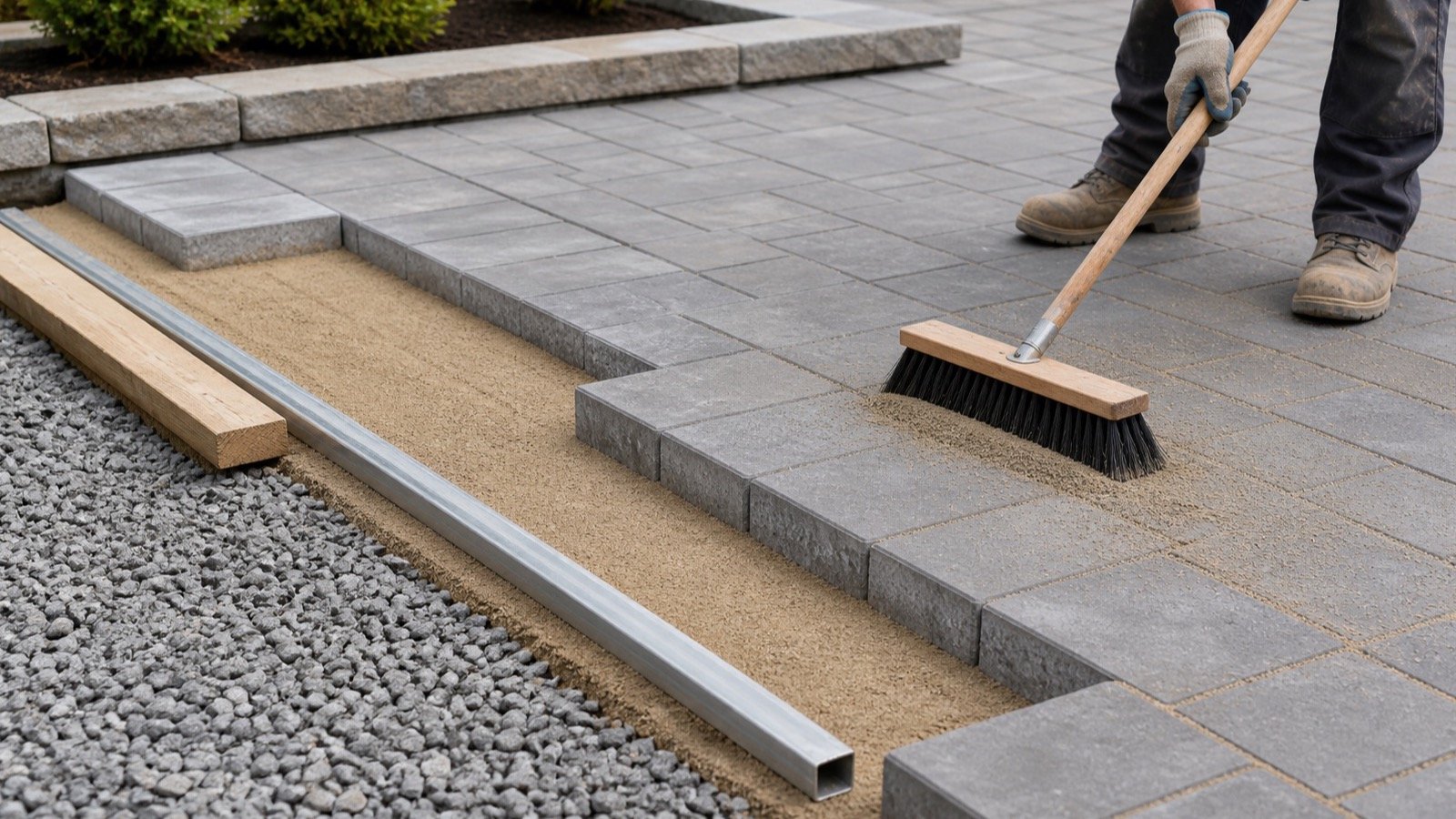
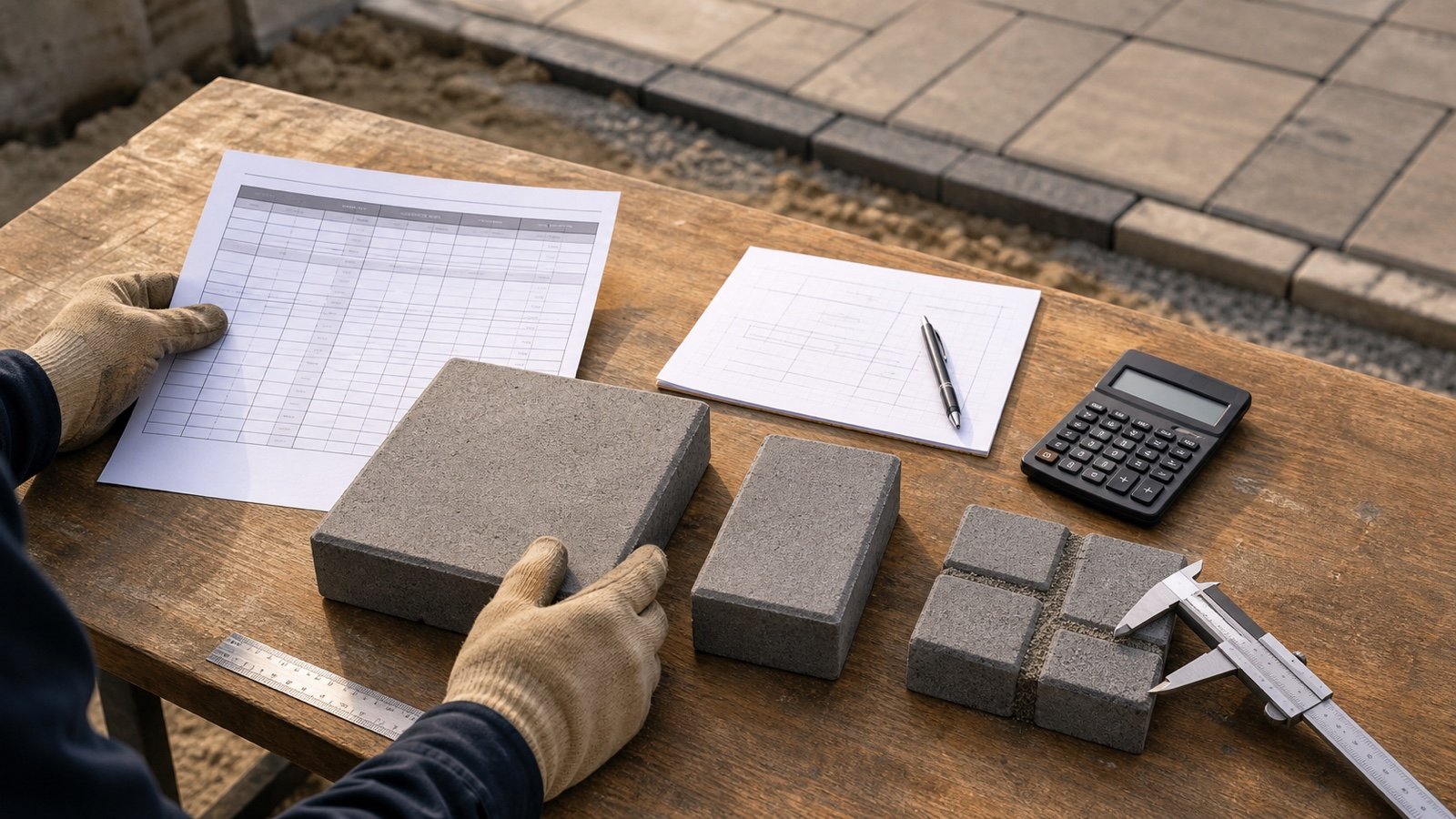
Paver sand is ordered for 2 different locations. Bedding sand forms the selected layer below the pavers. Joint sand fills the gaps after the pavers are placed, so its bag count comes from the chosen product's current coverage information.
This calculator keeps those records separate. It calculates bedding volume from paved area and depth, then uses optional supplier and manufacturer inputs for bulk rounding, mass, bedding packages, and joint-sand bags. Use the paver bedding-sand depth guide to confirm the screed state, base elevation, paver thickness and mock-up record before entering depth. Check the paver bedding sand vs joint sand guide before selecting products for the 2 locations. Measure the joints with the Polymeric Sand Joint Width and Depth Guide, then use the Polymeric Sand Coverage Chart guide to record the correct product row before entering coverage.
How much bedding and joint sand do you need for pavers?
Enter the paved area and the approved uncompacted bedding depth. Add a current package yield or supplier record when you need a purchasing conversion. For joint sand, enter the selected product's stated coverage per bag for the actual paver and joint conditions.
The result is a quantity plan for an already selected pavement system. Drawings, specifications, drainage, base preparation, edge restraints, traffic, climate, paver type, product instructions, and responsible project people govern the construction.
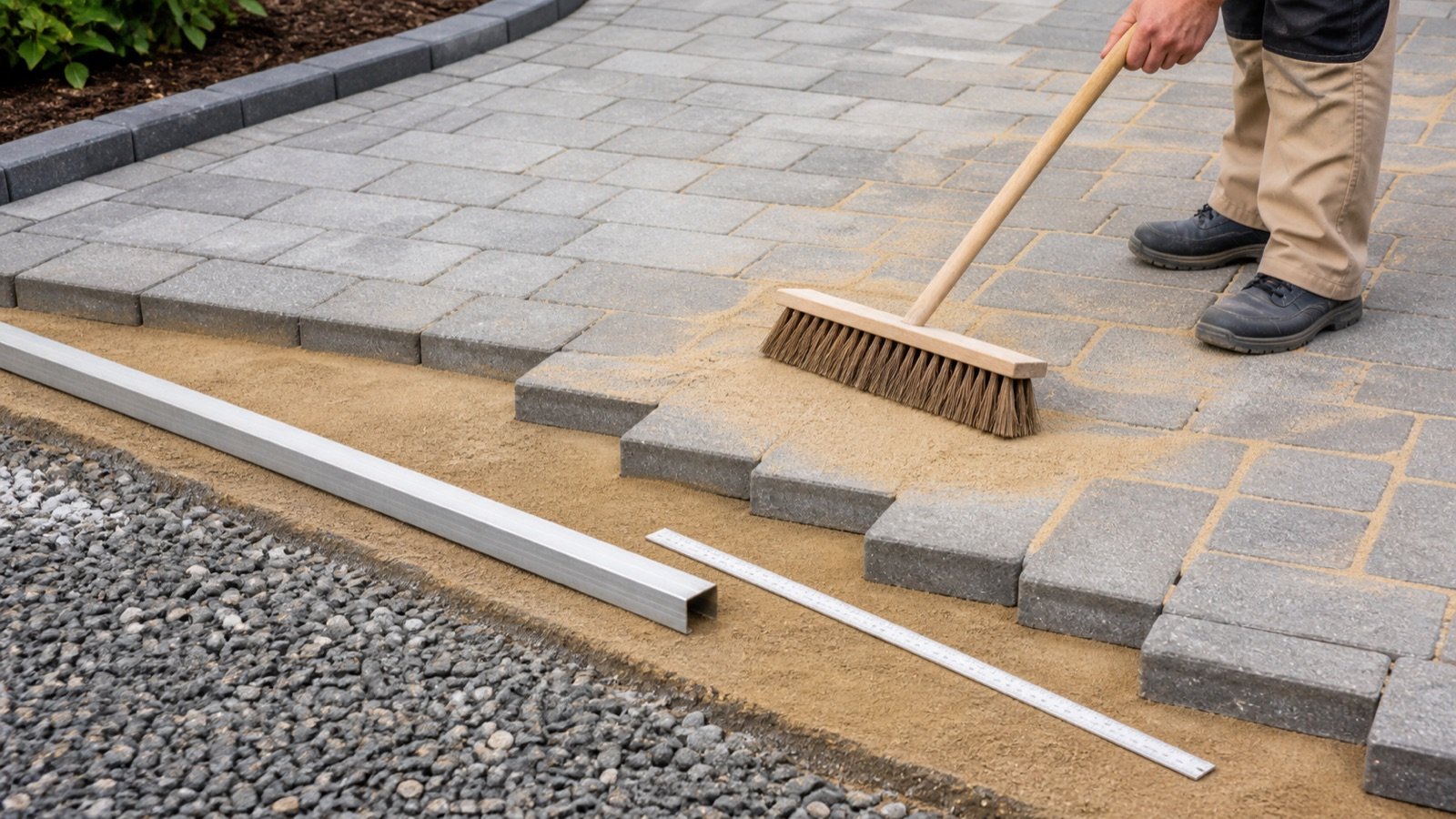
What does each calculator result mean?
| Result | Calculation | Evidence to keep |
|---|---|---|
| Paved area | Length × width, or entered known area | Drawing or checked site measurement |
| Measured bedding | Area × selected bedding depth | Unrounded geometry and depth source |
| Supplier basis | Measured bedding after the entered state increase | Material states, direction, value, and source |
| Rounded bulk order | Supplier basis rounded upward to the entered increment | Current supplier selling increment |
| Bedding packages | Supplier-basis litres or cubic feet ÷ package yield | Exact product and current volume yield |
| Joint-sand bags | Allowance-adjusted paved area ÷ product coverage | Product, bag size, paver, joints, coverage row, and revision |
Which paver area should you measure?
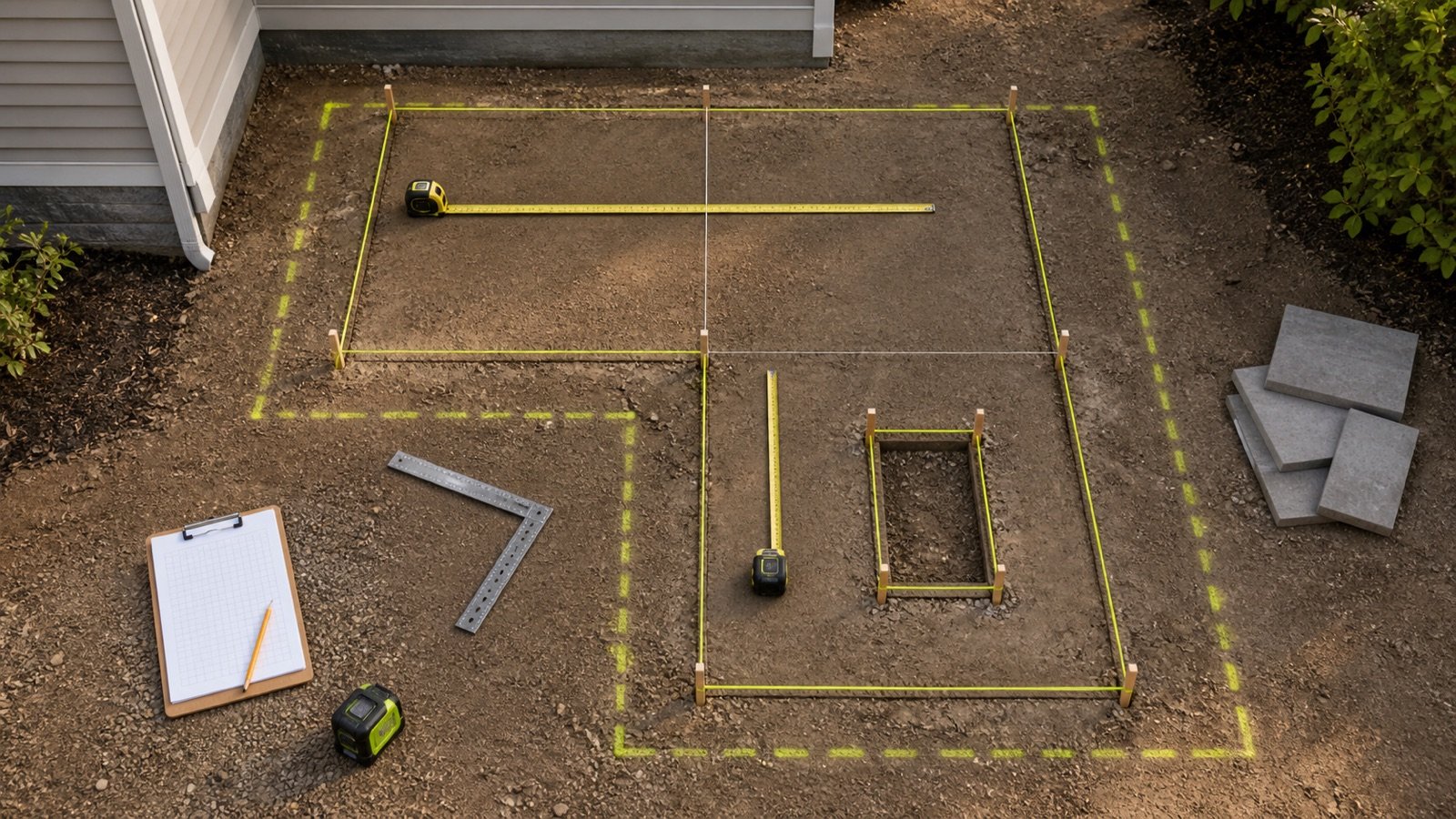
Measure the plan area that will receive the same paver system, bedding product, selected depth, and joint-sand coverage basis. Rectangle mode multiplies length by width. Known-area mode accepts a checked area from a drawing or separate takeoff.
Split curves, borders, steps, channels, walls, drains, planters, utility covers, and paver zones when their treatment changes. Deduct a large excluded area only when the measurement basis clearly excludes it. Small cuts and joints are handled through the project's documented material plan, not hidden by changing the paved area.
Which bedding depth belongs in the calculator?
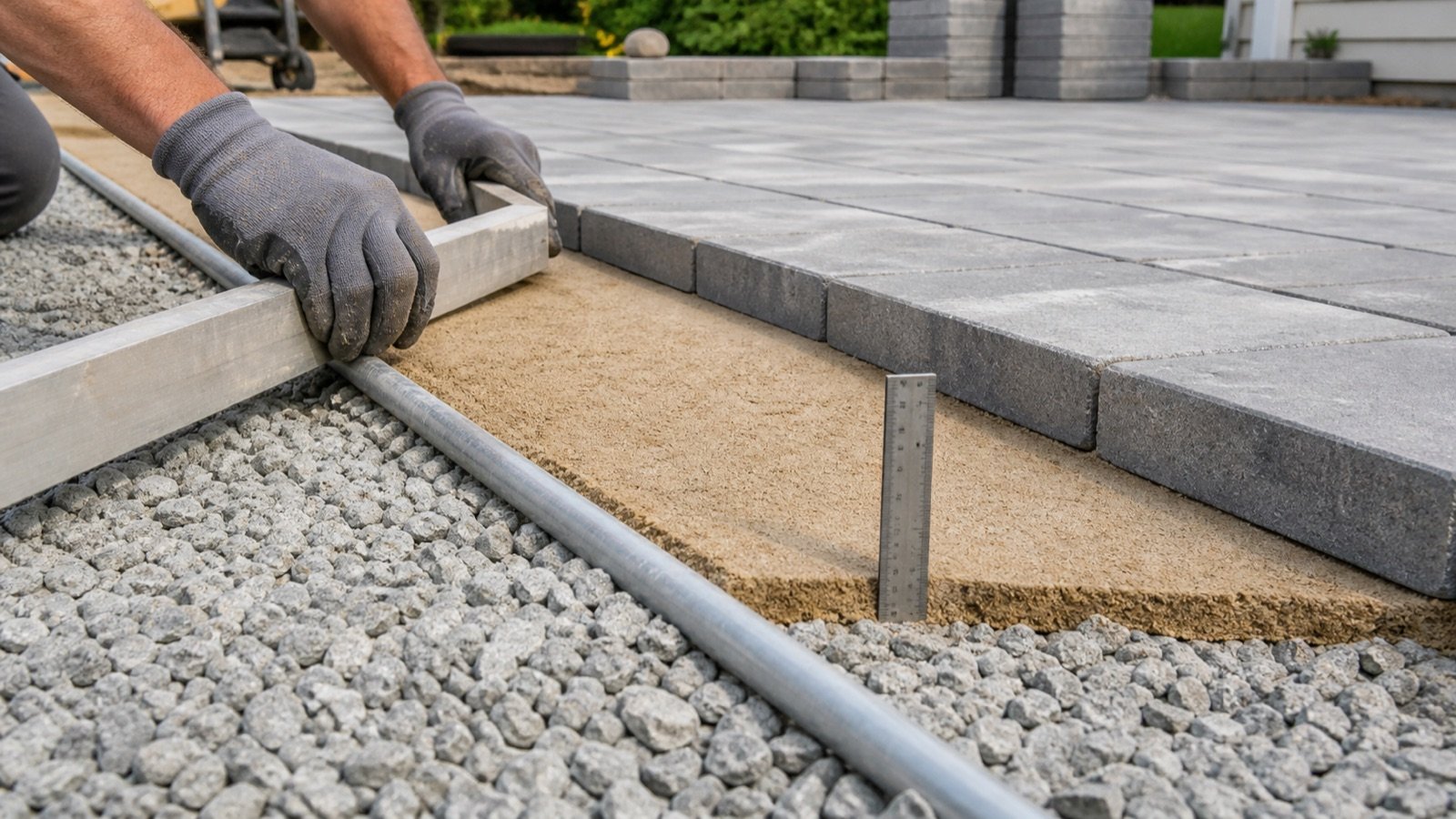
Enter the approved uncompacted screed depth for the selected system. CMHA PAV-TEC-002-22 describes a nominal 1 in (25 mm) bedding layer in its stated interlocking-concrete-pavement context and warns against using bedding sand to correct an uneven base.
That reference does not make 25 mm a global default. Product systems, specifications, paver type, traffic, site conditions, and local requirements can change the detail. Record the depth source beside the takeoff.
What formulas does the Paver Sand Calculator use?
Paved area = length × width, or entered known area
Measured bedding volume = paved area × selected bedding depth
Supplier-basis volume = measured bedding × (1 + entered increase % ÷ 100)
Rounded bulk order = ceiling(supplier basis ÷ increment) × increment
Whole bedding packages = ceiling(supplier-basis secondary volume ÷ package yield)
Whole joint bags = ceiling(paved area × allowance factor ÷ current coverage per bag)
Metric depth converts millimetres to metres. Imperial depth converts inches to feet, and cubic feet divide by 27 for cubic yards. Full precision continues through the calculation before the final whole-unit rounding.
Worked metric paver-sand example
A checked paved area is 60 m² and the selected uncompacted bedding depth is 25 mm.
- Measured bedding: 60 × 0.025 = 1.5 m³.
- An entered 8% supplier-state increase gives 1.62 m³.
- A confirmed 0.25 m³ increment rounds the bulk order to 1.75 m³.
- An entered density of 1,550 kg/m³ gives 2,712.5 kg, or 2.7125 metric tonnes, for that rounded order.
- A current 25 L bedding-package yield gives 1,620 ÷ 25 = 64.8, rounded to 65 packages.
- A joint product covering 7 m² per bag with an entered 5% area allowance gives 63 ÷ 7 = 9 bags.
The density, yield, coverage, increment, and allowances are example inputs. Replace them with records for the selected products, supplier state, pavers, joints, and project.
Worked imperial paver-sand example
A 20 ft × 15 ft rectangle has 300 ft² of paved area. The selected bedding depth is 1 in.
- Measured bedding: 300 × 1 ÷ 12 = 25 ft³, or 0.926 yd³.
- An entered 5% supplier-state increase gives 26.25 ft³, or 0.972 yd³.
- A 0.25 yd³ increment rounds the bulk order to 1 yd³.
- An entered density of 1.45 short tons/yd³ gives 1.45 short tons, or 2,900 lb.
- A 0.5 ft³ bedding yield gives 52.5, rounded to 53 packages.
- A joint product covering 65 ft² per bag with a 10% area allowance gives 330 ÷ 65 = 5.077, rounded to 6 bags.
Why does joint-sand coverage need a product record?
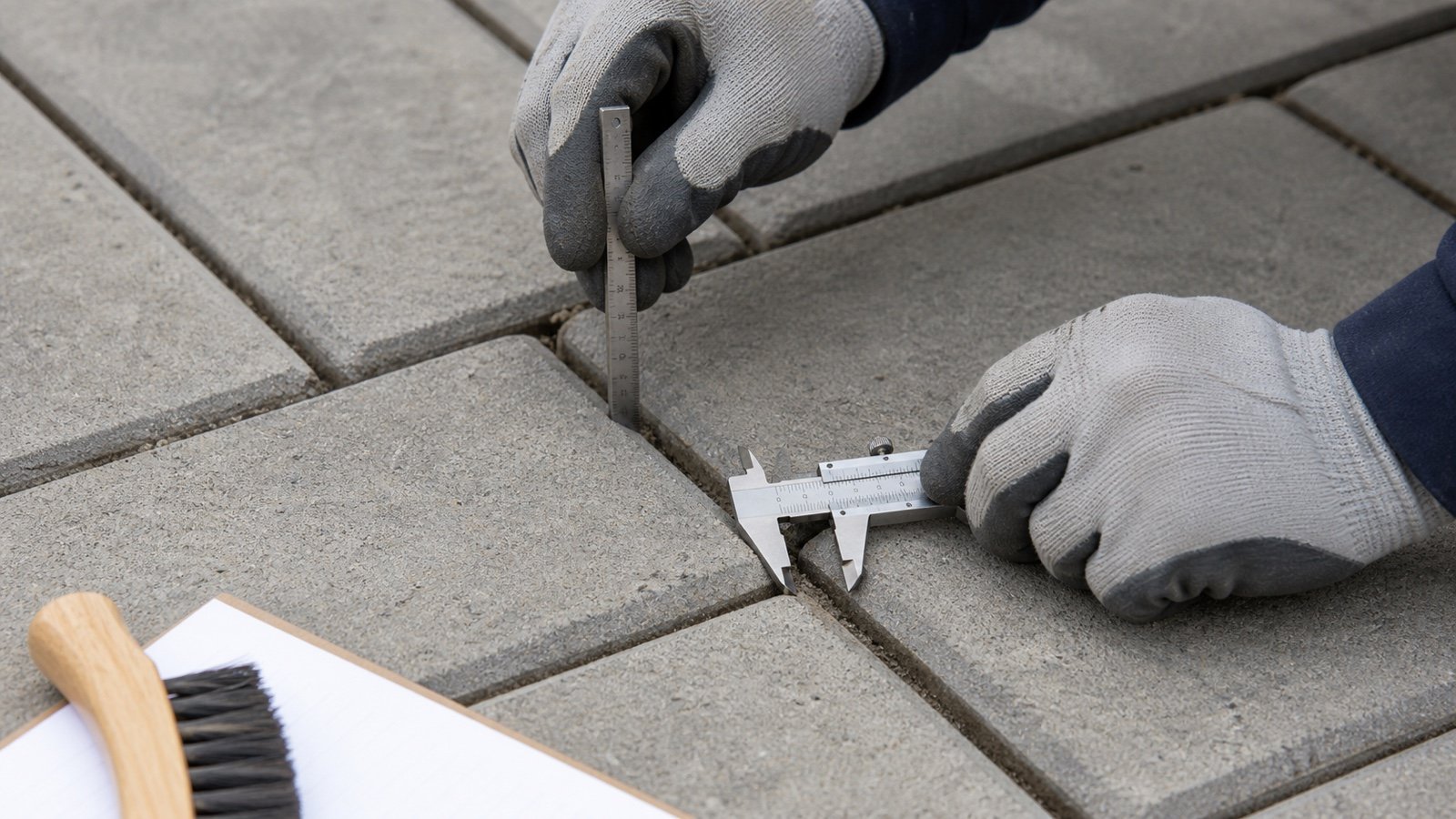
Coverage changes with the bag size, paver dimensions and shape, joint width, joint depth, surface texture, compaction, installation loss, and the product itself. A single internet value cannot preserve those conditions.
Techniseal's March 2023 SMARTSAND sheet lists different coverage ranges for narrow and wide joints from the same 50 lb package. Alliance Gator also publishes separate narrow- and wide-joint ranges for one 50 lb product. These records show variation within named products. They do not establish coverage for another sand.
Choose the applicable row from the current manufacturer chart. When the chart gives a range, use the value supported by the actual paver and joint geometry or contact the manufacturer. Record the product name, bag size, market, chart row, revision, and access date.
Can joint sand be estimated by volume instead?
A detailed joint-volume takeoff needs total joint length, actual joint width, fill depth, intersections, edge conditions, product bulk behavior, and field loss. A generic paver grid can give false precision when paver shapes, spacers, chamfers, patterns, and cuts change.
This calculator uses product coverage per bag because manufacturers commonly publish that purchasing basis. Use a project-specific joint model only when its geometry and material conversion have separate evidence.
How should bedding package yield and bulk density be used?
Bedding package yield is a volume per package, such as litres or cubic feet. Package weight alone does not give volume. Copy the current volume yield for the exact product and package when the manufacturer supplies one.
Bulk density converts the rounded supplier volume into estimated mass. Enter it only when it describes the selected sand in the same moisture, compaction, and selling state as the order. A delivered scale ticket records actual delivered mass.
Keep loose, compacted, placed, and measured volumes separate. The optional supplier-basis percentage starts at 0% because no state-change factor fits every product, moisture condition, placement method, or project.
How should supplier rounding be recorded?
Enter a cubic-metre or cubic-yard increment only after the supplier confirms it. The calculator rounds the supplier-basis volume up once. An exact boundary stays exact, so 0.54 m³ with a 0.18 m³ increment remains 0.54 m³.
Minimum orders, whole bags, bulk volume increments, mass increments, delivery charges, and vehicle payloads are separate commercial limits. Keep each term in the unit used by the supplier.
Which conditions need separate calculations?
| Condition | Why the quantity changes | Action |
|---|---|---|
| Several bedding depths | Volume per square unit changes | Calculate each depth zone separately |
| Different paver sizes or patterns | Joint length and product coverage can change | Use the matching coverage row for each zone |
| Borders and field pavers | Joint geometry or product may differ | Keep separate area and product records |
| Existing-joint refill | Remaining sand, cleaned depth, and contamination vary | Measure the repair and follow the repair product instructions |
| Slabs or porcelain units | Bedding and joint systems can differ from concrete pavers | Use the specified system and manufacturer data |
| Steps or vertical work | Plan area does not represent all material zones | Use the approved detail and separate geometry |
What does compaction change?
Compaction can change the bedding layer and joint fill, but it does not justify a universal percentage. Bedding is screeded and the pavers are seated according to the system procedure. Joint sand may be swept, compacted, refilled, and activated in a product-specific sequence.
Use the entered supplier-state increase only when a source connects the measured placed layer to the supplier's selling state. Do not apply the same percentage again as waste, settlement, or joint allowance.
Common paver-sand calculation mistakes
- Combining bedding and joint sand into one density-based quantity.
- Using a fixed 1 in or 25 mm bedding depth without checking the selected system.
- Using bedding sand to correct base elevation or surface irregularity.
- Copying joint coverage without matching bag size, paver, joint width, depth, and chart revision.
- Using package weight as a package volume yield.
- Applying one coverage value across borders, mixed pavers, and changing joints.
- Rounding every small area before adding zones that share one product basis.
- Adding the same allowance in the area, supplier factor, and product coverage.
- Treating an estimated mass as a delivery payload or scale weight.
- Using quantity output as approval of drainage, base, slope, paver, or joint design.
What construction and safety checks remain?
Confirm excavation, drainage, subgrade, base thickness and compaction, finished elevation, slope, bedding specification, edge restraints, paver layout, cutting, joint material, weather limits, activation, curing, and opening to traffic before work.
Cutting concrete pavers and handling dry silica-containing materials can create respirable crystalline silica. For United States construction workplaces, use the applicable OSHA requirements, employer exposure-control plan, equipment controls, product safety data, housekeeping methods, and protective equipment. Other locations may apply different rules.
What should the paver-sand record contain?
- Project area, drawing or sketch, revision, dimensions, exclusions, units, and measurement date.
- Paver system, bedding product or specification, selected uncompacted depth, and depth source.
- Measured bedding volume, supplier-state increase, material states, direction, and source.
- Supplier product, density, selling increment, minimum order, quote basis, and date.
- Bedding package product, package size, volume yield, and whole-package result.
- Joint-sand product, bag size, paver type, joint width and depth, coverage row, allowance, and whole bags.
- Separate zones, edge conditions, repairs, unresolved design checks, and installation limits.
Use the Sand Calculator for a general area-and-depth layer. The sand selection guide, sand coverage guide, and bags versus bulk guide help check the product, geometry, and selling unit. The sand planning hub lists published sand resources.
Sources and scope
- CMHA PAV-TEC-002-22: separate bedding and joint-sand functions, bedding preparation, and nominal 25 mm context within its stated system.
- CMHA PAV-TEC-017-22: bedding-sand selection and joint-sand role in the stated vehicular interlocking-concrete-pavement context.
- Techniseal SMARTSAND TDS and Alliance Gator Supersand G2: named-product examples showing coverage changes with joint conditions.
- NIST Handbook 44 (2026), Appendix C: unit relationships used in the calculator.
- OSHA Respirable Crystalline Silica in Construction: United States occupational hazard and control context.
Source scope: CMHA supports the stated pavement-system and layer context. The manufacturer pages support only their named products and stated conditions. NIST supports unit relationships. OSHA supports the named United States workplace scope. Project drawings, specifications, current product data, site conditions, supplier records, local requirements, safety controls, and responsible professionals govern the work.
Review note: Saleem Sial owns the research and editorial record. Formula fixtures, source checks, build validation, and rendered QA form the internal publication gate. Waseem Sial, External Reviewer and Engineer, is listed for ongoing external review; no completed review date is claimed.