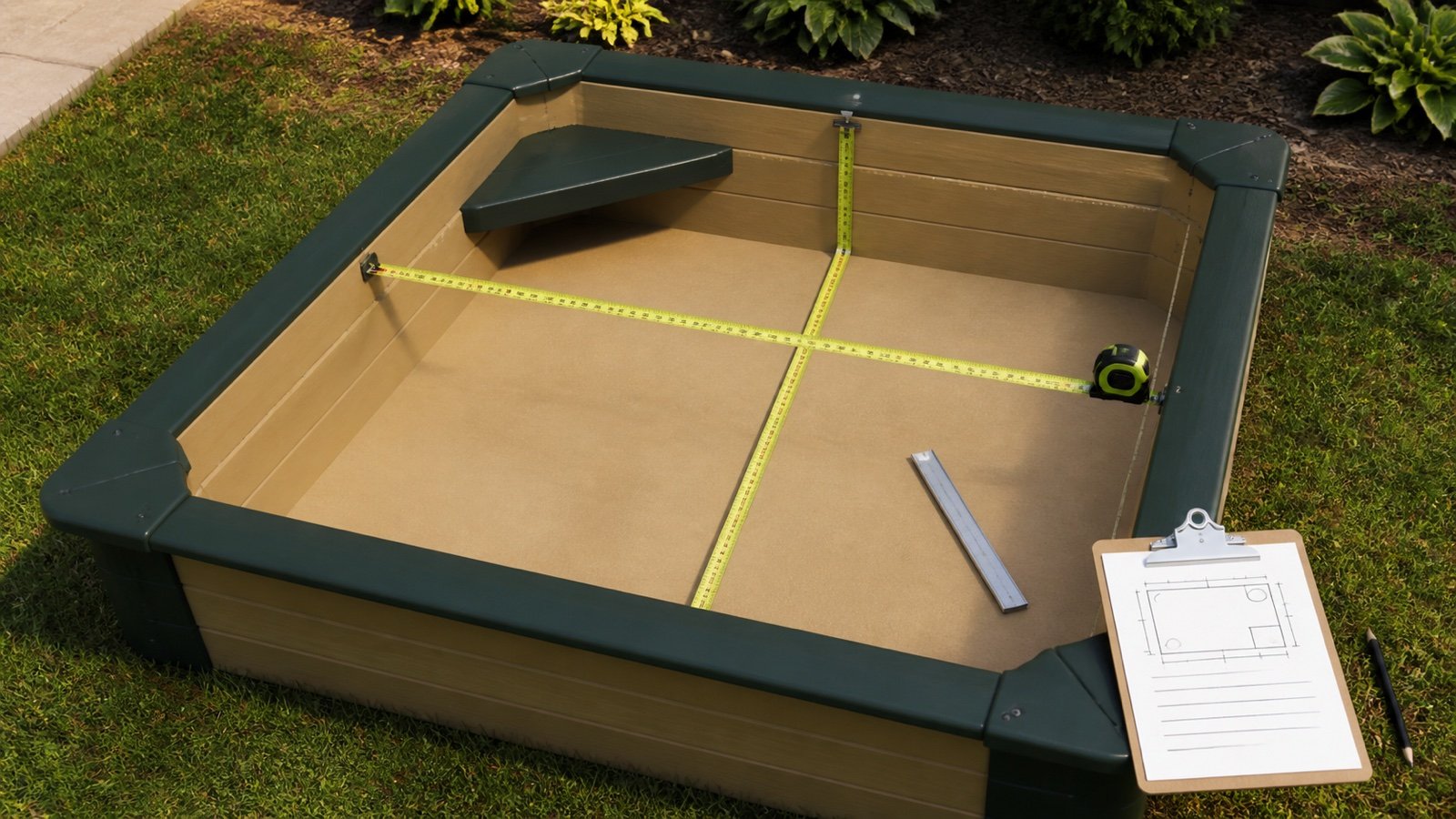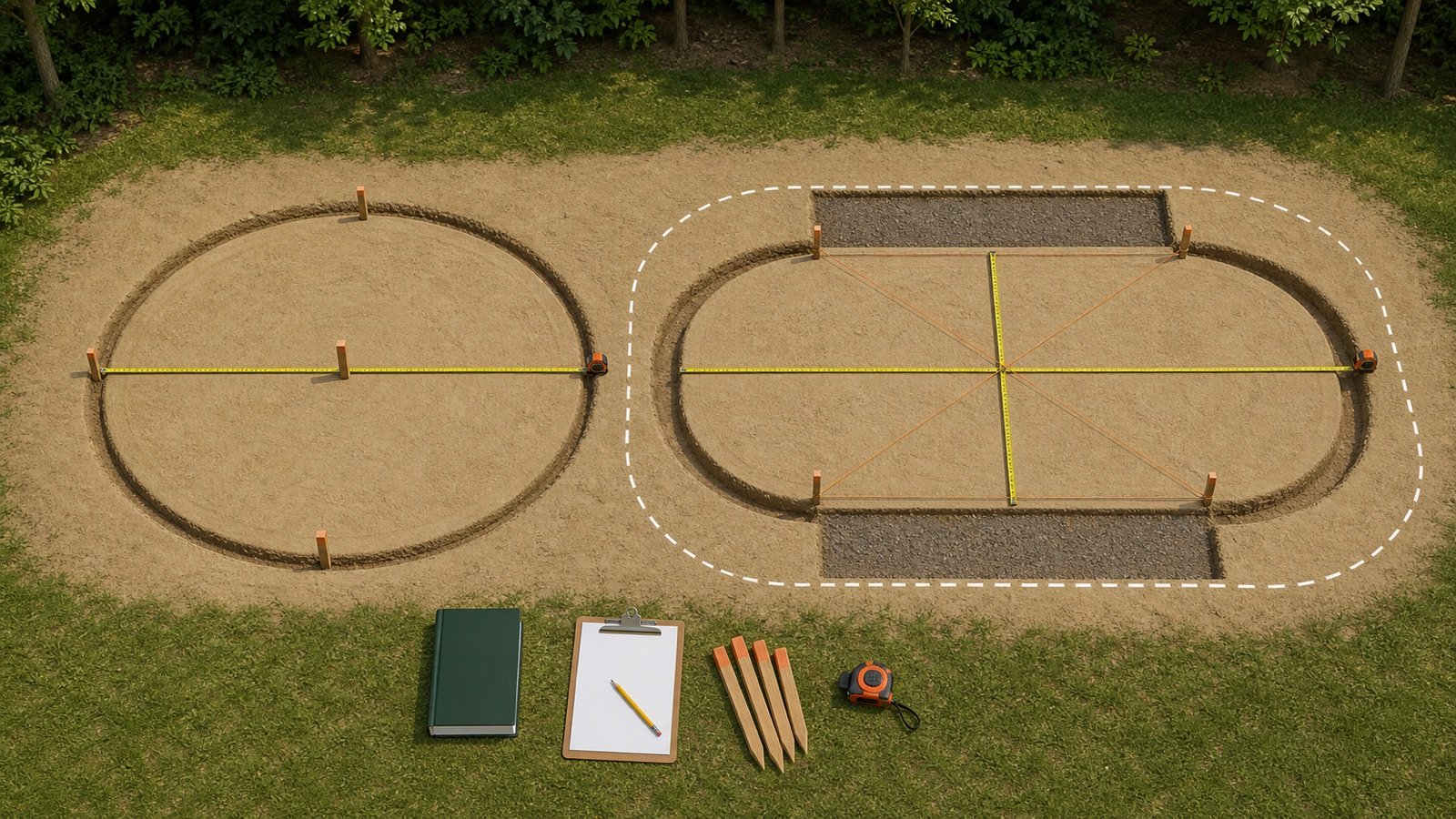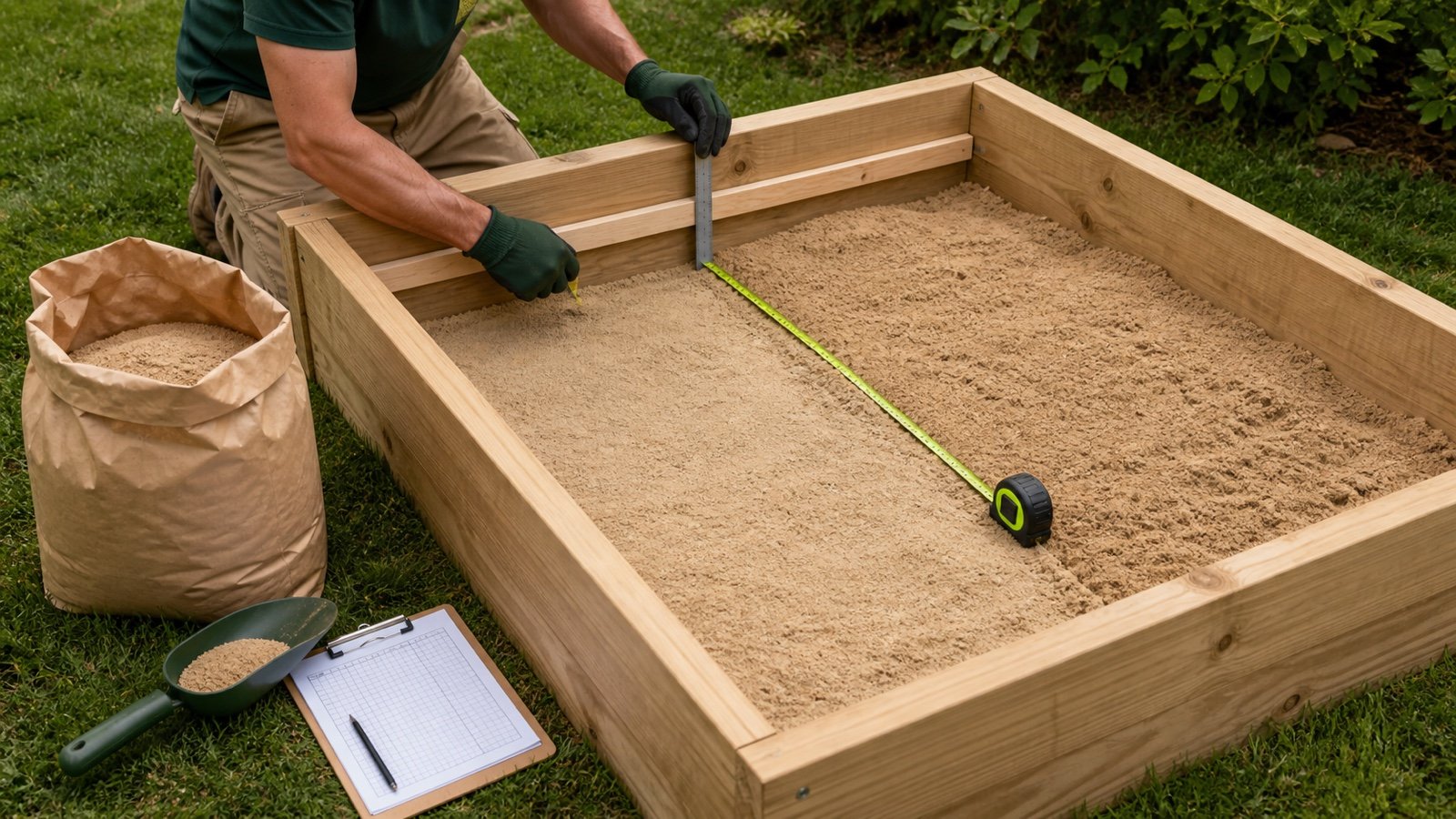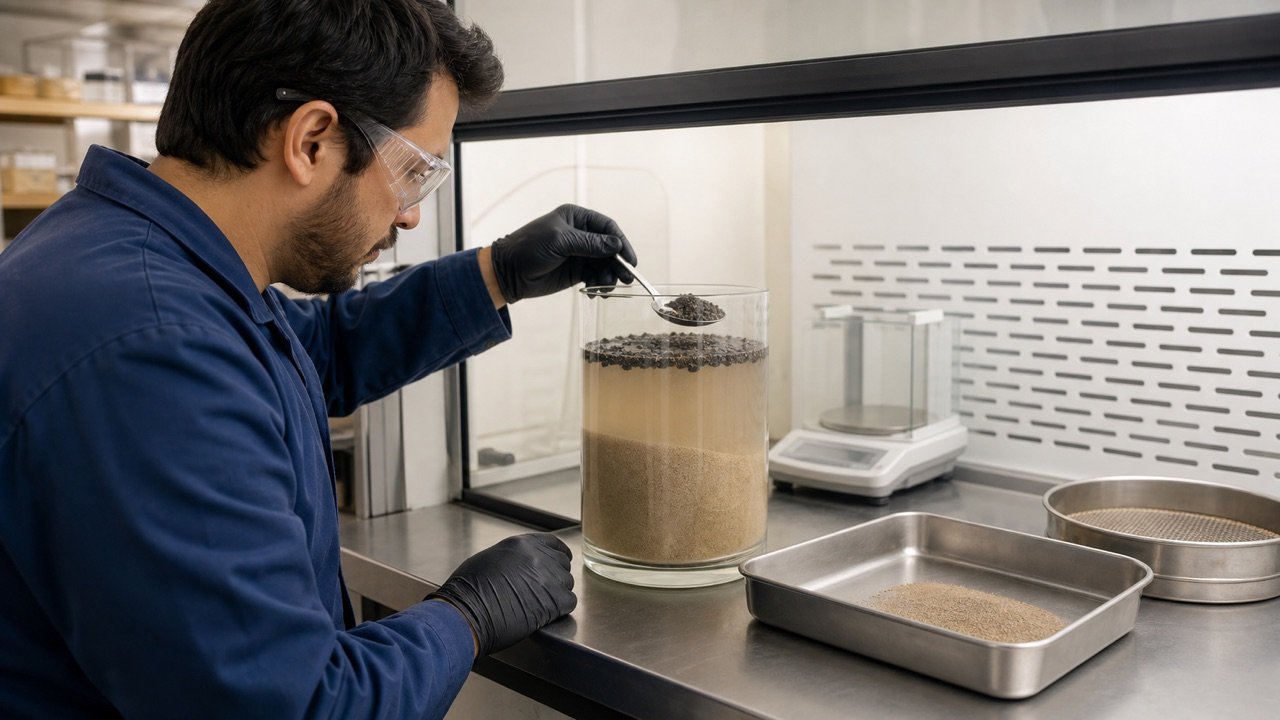
A fine aggregate angularity report uses loose uncompacted void content as an indirect indicator of particle shape and surface texture. Reproducing the percentage requires the calibrated measure volume, net dry aggregate mass, bulk-dry specific gravity, test method, and report precision.
Method A, Method B, and Method C prepare and interpret the aggregate differently. Keep the method name with the result before comparing samples or applying a project specification.
How is fine aggregate angularity calculated?
Subtract the aggregate's calculated solid volume from the calibrated measure volume. Divide the remaining volume by the measure volume and multiply by 100.
- U is uncompacted void content, in percent.
- V is the calibrated cylindrical-measure volume, in millilitres.
- F is the net dry mass of fine aggregate in the measure, in grams.
- Gsb is the bulk dry specific gravity of the fine aggregate.
Net mass means the filled-measure mass minus the empty-measure mass. Use the unrounded V, F, and Gsb values in the equation. The governing method controls the calculation precision, number of determinations, averaging, and final report rounding.
A value such as 46% needs Method A, B, or C, the Gsb used, sample identity, and the applicable specification. The percentage alone cannot show whether 2 reports are comparable.
What does uncompacted void content measure?
ASTM C1252-23 covers loose uncompacted void content of fine aggregate. Under a known grading, the result indicates particle angularity, sphericity, and surface texture relative to fine aggregates tested at the same grading.
ASTM associates higher Method A or B void content with greater angularity, lower sphericity, rougher surface texture, or a combination of those properties. Lower values are associated with rounder, smoother, or more spherical particles under the same test basis.
The test is indirect. It does not count fractured faces or measure compacted-mixture air voids. ASTM lists possible relationships with concrete water demand, grout or mortar flow, asphalt-mixture stability and voids in mineral aggregate, and fine-aggregate stability in base material. Mixture proportions, binder, grading, compaction, and other aggregate properties still affect those outcomes.
How do Methods A, B, and C differ?
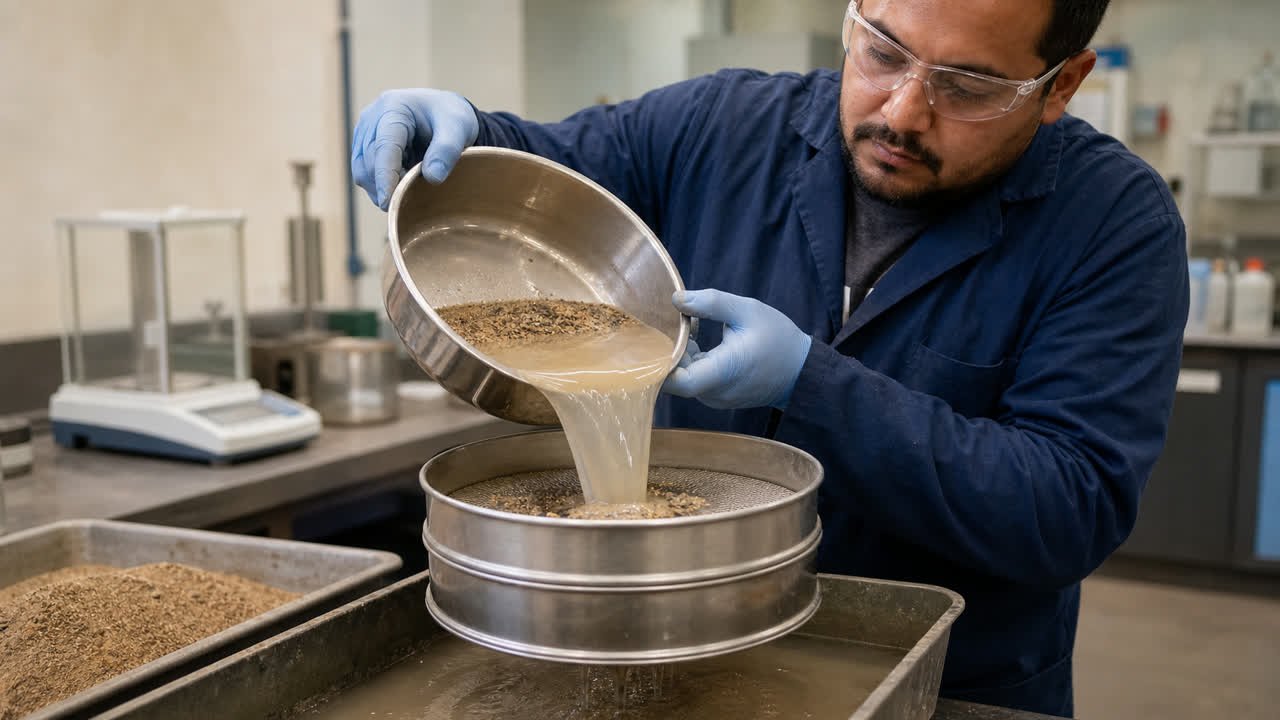
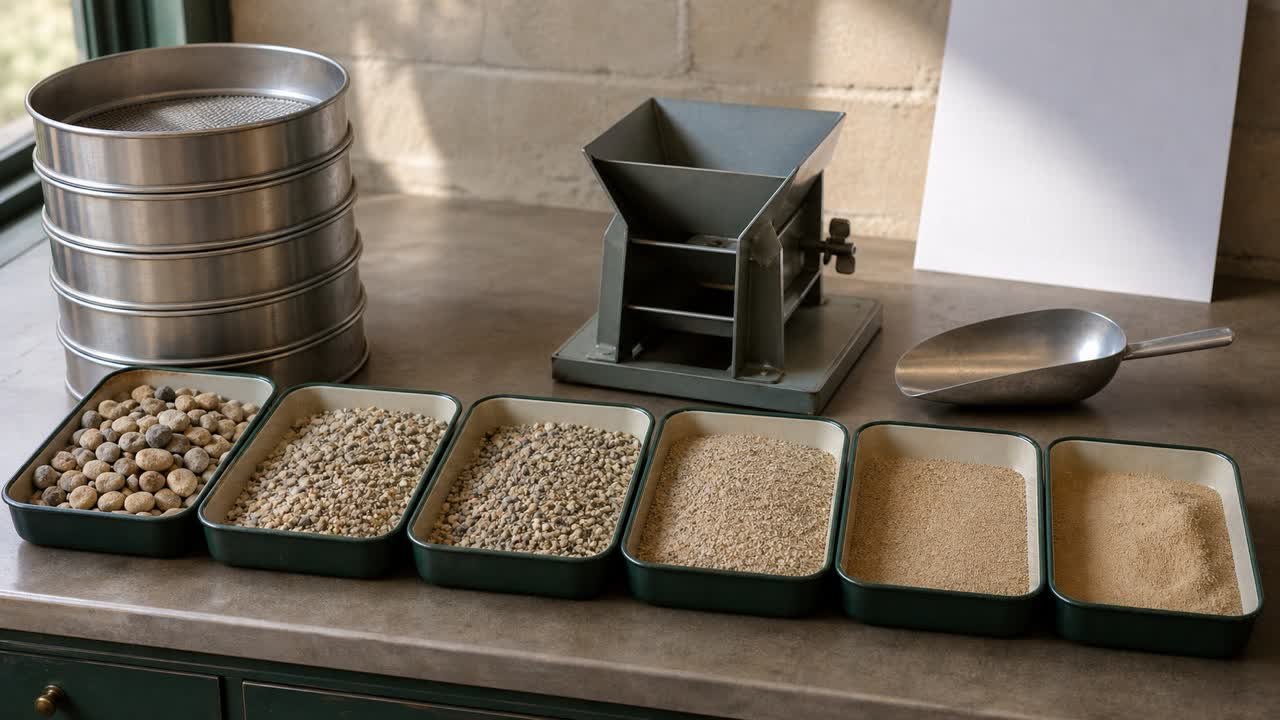
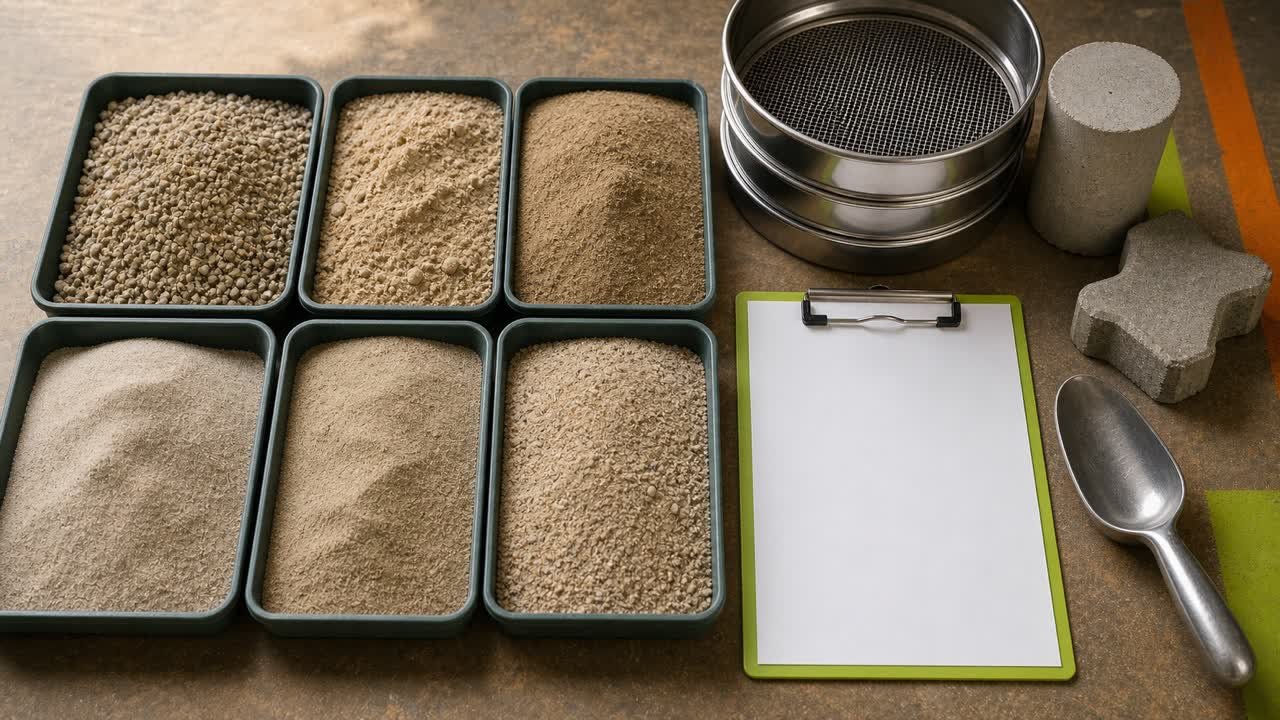
ASTM C1252 has 3 procedures. Method A uses a standard graded sample, Method B tests 3 individual size fractions separately, and Method C tests the material finer than the 4.75 mm (No. 4) sieve in its as-received grading.
| Procedure | Test basis | What mainly affects U | Comparison boundary |
|---|---|---|---|
| Method A | Standard graded sample recombined from specified size fractions | Particle shape, sphericity, and surface texture under the standard grading | Compare with Method A results produced on the same valid basis |
| Method B | Three defined size fractions tested separately | Shape and texture of each individual fraction | Its average is not directly comparable with Method A |
| Method C | As-received material finer than the No. 4 sieve | Grading as well as particle shape and texture | Changing gradation can change U without a matching change in particle shape |
Single-size fractions usually leave more void space than a well-graded sample because smaller particles are unavailable to occupy spaces between larger particles. ASTM therefore says the Method A result is not directly comparable with the average of Method B's individual fractions.
Method C can support mixture-proportion work because it retains the as-received grading effect. It cannot isolate shape and texture when gradation changes between samples. Use the sand sieve-analysis guide to check whether 2 Method C samples have the same particle-size distribution.
Which mass and specific gravity belong in the formula?
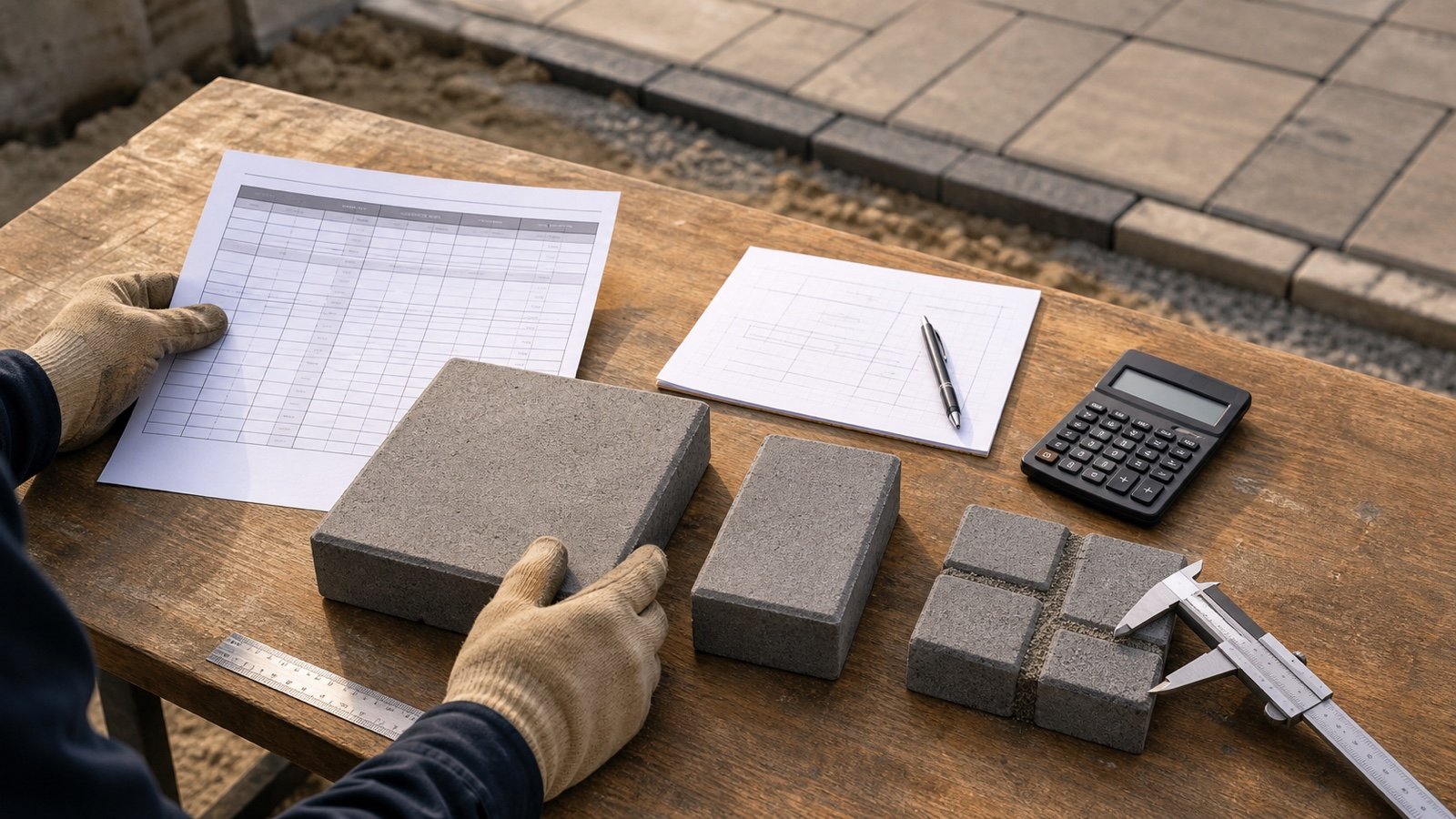
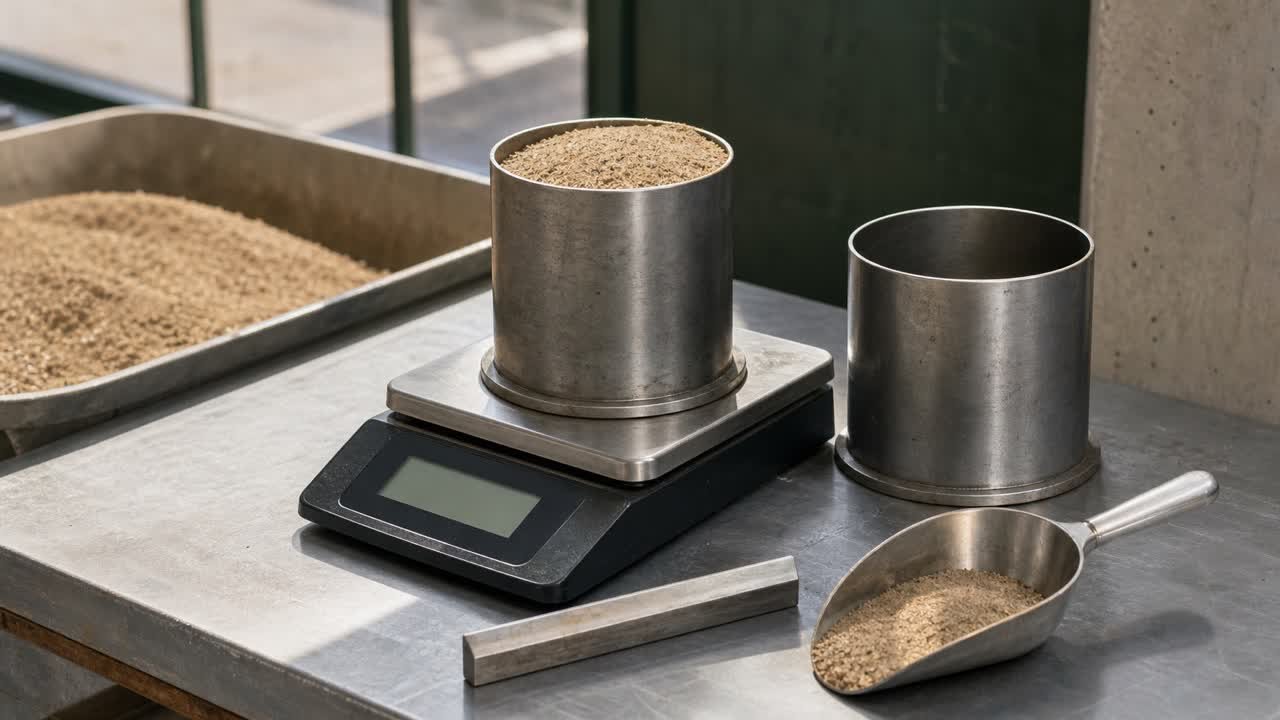
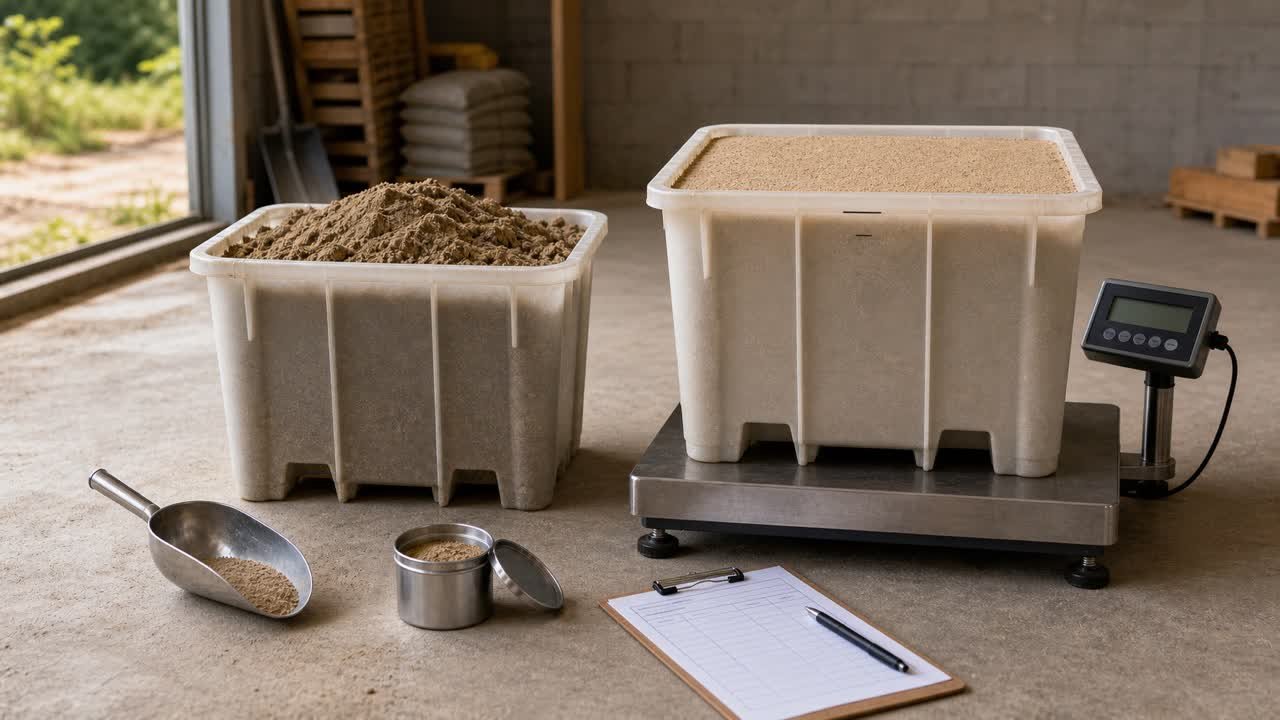
Use the net dry aggregate mass held by the calibrated measure and the bulk dry specific gravity required by the method. Keep the tare, filled mass, and net mass visible so a reviewer can reproduce F.
| Record | Meaning | Check |
|---|---|---|
| Empty measure mass | Tare of the clean cylindrical measure | Correct measure and balance record |
| Filled measure mass | Measure plus struck-off fine aggregate | Same run, no spill, unit in grams |
| F | Filled mass minus empty mass | Positive net dry aggregate mass |
| V | Calibrated internal volume of that measure | Current traceable calibration, in mL |
| Gsb | Bulk dry specific gravity for the tested fine aggregate | Correct source, grading, state, and method |
Bulk dry, saturated-surface-dry, and apparent specific gravity use different particle-volume states. Substituting SSD or apparent specific gravity changes F/Gsb and therefore changes U. The sand specific gravity and absorption guide explains those states and their report labels.
Worked example: can you reproduce the WSDOT result?
The January 2026 WSDOT FOP for AASHTO T 304 gives V = 99.8 mL, F = 146.2 g, and Gsb = 2.636.
First calculate the aggregate volume term: 146.2 ÷ 2.636 = 55.4628. The unoccupied part of the measure is 99.8 − 55.4628 = 44.3372. Dividing by 99.8 and multiplying by 100 gives 44.426%.
A reverse check returns the recorded mass:
This check confirms the arithmetic. The sample, apparatus, preparation, material flow, strike-off, balance, and Gsb records still need their method and quality checks.
How are 2 determinations averaged and reported?
Calculate each determination first, then average the results in the order and precision required by the governing method. Consider a 100.0 mL measure, Gsb of 2.650, and 2 net masses.
| Run | Net mass F | Unrounded U | Calculated U to 0.1% |
|---|---|---|---|
| 1 | 143.4 g | 45.8868...% | 45.9% |
| 2 | 142.8 g | 46.1132...% | 46.1% |
| Average | 46.0% |
The WAQTC FOP inside WSDOT's January 2026 manual calculates each determination and the average to 0.1%. The WSDOT errata on page 1 replaces the report instruction and requires the final uncompacted-void average to the nearest 1% for WSDOT reporting. This example would be reported as 46% under that errata.
Read the adopted agency document as a complete package. Another agency, contract, or ASTM-controlled report can use a different precision. Do not apply WSDOT's errata to an unrelated project.
How much can specific gravity change the result?
A small Gsb change can move U enough to affect a result near a specification threshold. WSDOT states that a 0.05 specific-gravity difference changes calculated void content by about 1 percentage point.
Use V = 100.0 mL and F = 145.0 g:
- At Gsb = 2.650, U = 45.283%.
- At Gsb = 2.600, U = 44.231%.
- The difference is about 1.05 percentage points.
The January 2026 WSDOT FOP says fraction-specific Gsb may be needed when some size fractions differ by more than 0.05 from the value typical of the complete sample. ASTM also notes that the method's relationship to shape and texture depends on the size fractions having equal or nearly equal specific gravities.
Check mineral type, porosity, source blend, and fraction before reusing one Gsb across every sample. A value copied from a supplier sheet or earlier lot needs evidence that it represents the tested material and required grading.
What causes an impossible void result?
An ordinary result falls between 0% and 100%. A negative value means F/Gsb exceeds the measure volume. A value above 100% requires zero or negative mass, which also signals an invalid record.
Example: V = 100.0 mL, Gsb = 2.650, and F = 270.0 g. The maximum solid-volume mass implied by V × Gsb is 265.0 g. The equation returns −1.89%.
Preserve the observations and check:
- empty-measure tare and filled-measure mass;
- mL versus another volume unit;
- bulk dry versus SSD or apparent specific gravity;
- decimal placement and copied sample values;
- moisture state, contamination, and material from another run;
- measure identity, calibration, and balance record.
Do not change a negative result to zero. Use the laboratory quality procedure to correct a traceable clerical error or repeat invalid work.
Which handling errors change uncompacted packing?
The test depends on aggregate falling and occupying the measure without compaction before strike-off. Disturbance changes packing and therefore changes F.
- Vibration, tapping, or moving the measure before strike-off can pack more material into V and reduce calculated U.
- A partial flow, blocked funnel, particle loss, or spill can reduce F and increase calculated U.
- An uneven or repeated strike-off can change the retained mass.
- Material left on the measure exterior can increase the filled mass.
- A damp sample changes the recorded mass and particle flow.
- Cross-contamination changes the test grading and packing.
- Rounding F/Gsb before completing the equation can shift the final percentage.
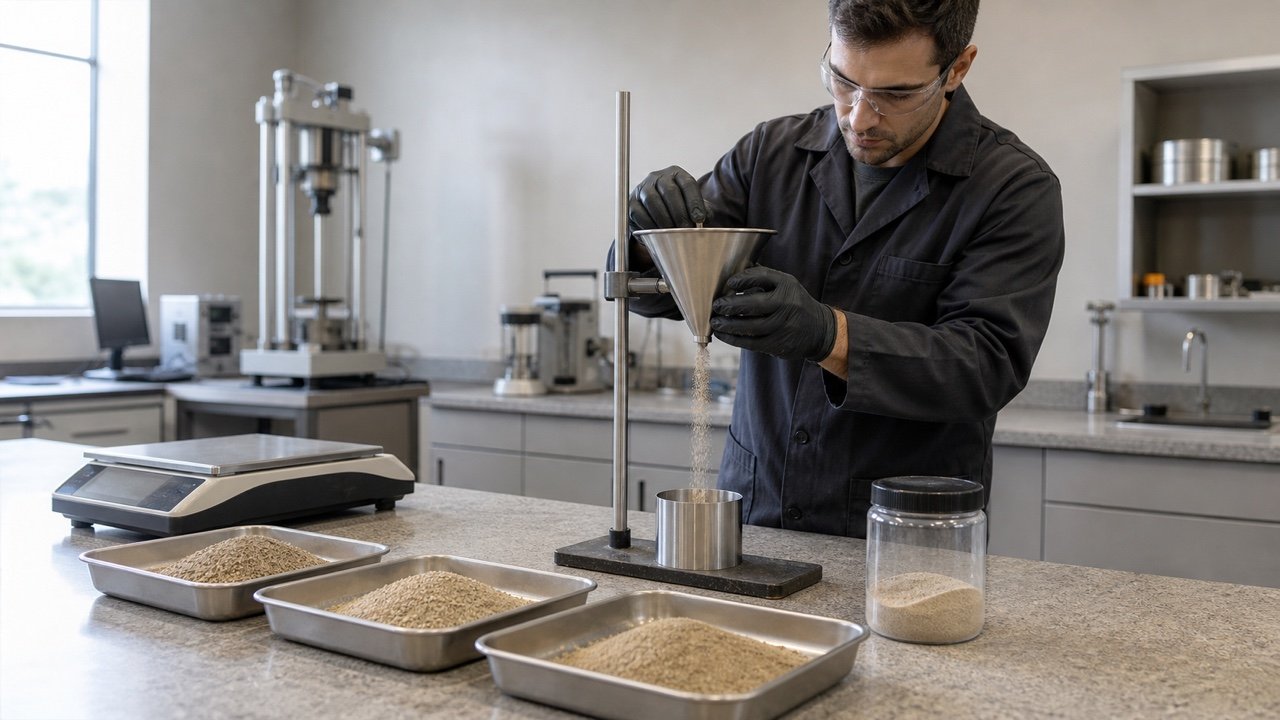
The WSDOT FOP calls for a centered funnel and measure, free aggregate flow, one rapid strike-off pass, and protection from vibration or disturbance until strike-off is complete. The controlled method and laboratory safety procedure supply the complete apparatus, preparation, operation, and handling requirements.
Is uncompacted void content the same as mixture air voids?
No. U is the void percentage inside a loose fine-aggregate sample placed under the named C1252 or T 304 procedure. Compacted asphalt air voids, voids in mineral aggregate, concrete air content, bulk density, and soil void ratio use different specimens and equations.
| Result | Specimen state | Question answered |
|---|---|---|
| Fine aggregate U or FAA | Loose uncompacted fine aggregate under Method A, B, or C | How much void space remains under the specified test basis? |
| Bulk density or unit weight | Aggregate placed under a named loose or compacted procedure | What mass occupies a stated bulk volume? |
| Asphalt mixture air voids | Compacted asphalt specimen | What air volume remains in the compacted mixture? |
| Voids in mineral aggregate | Compacted asphalt mixture with aggregate and absorbed-binder volume rules | What intergranular void volume exists in the aggregate structure? |
The sand bulk-density guide covers mass per bulk volume. Do not transfer a U value into a quantity estimate as a compaction, waste, shrinkage, or density factor.
Which report details make the result auditable?
A complete report ties the percentage to a defined sample, test basis, and project decision.
- Project and material: intended use, contract item, product, mix or layer, and governing specification.
- Source and lot: producer, pit or quarry, stockpile or delivery, quantity represented, and sampling location.
- Sample: identifier, sampling date, sampler, reduction method, test date, and laboratory.
- Method: ASTM C1252, AASHTO T 304, agency adoption, revision, and Method A, B, or C.
- Inputs: measure identity and V, tare, filled mass, net F, bulk dry Gsb, and Gsb source.
- Runs: each determination, average, intermediate precision, and final report rounding.
- Conditions: spill, blocked flow, vibration, damp material, uneven strike-off, or other deviation.
- Decision: specification clause, required method, limit, exceptions, and action.
The May 2026 WSDOT HMA Mineral Aggregates form keeps V, F, G, U, sample-fraction masses, specification, and average visible. The sand sampling guide explains how the specimen connects to a stockpile, belt stream, delivery, or defined lot.
Does the fine aggregate pass or fail?
The project specification supplies the acceptance rule. Match the required method, aggregate use, source or blend, limit, rounding, and exceptions to the report.
A common value range from a textbook or competitor page cannot replace the contract clause. The same number can have different meaning under Method A and Method C because Method C retains the as-received grading effect.
| Situation | Defensible next step |
|---|---|
| Method, sample, Gsb, calculation, and clause match | Apply the stated project decision rule and retain the supporting record |
| Method is missing or differs from the requirement | Obtain the method identity or test under the required procedure |
| Method C gradation changed between samples | Review the gradations before attributing the U change to particle shape |
| Gsb is assumed, from another source, or uses the wrong state | Resolve the specific-gravity basis and recalculate |
| Result is near the limit and agency rounding is unclear | Apply the governing adoption, errata, and reporting precision before deciding |
| Input is impossible or a handling deviation affected packing | Stop the acceptance decision and follow the laboratory quality procedure |
After the material is approved for its intended use, use the Sand Calculator to estimate volume and mass from a documented supplier density. Return to the Sand material planning hub for quantity tools, test guides, and reference charts.
Sources and source scope
- ASTM C1252-23, Standard Test Methods for Uncompacted Void Content of Fine Aggregate: current designation, scope, Methods A/B/C, interpretation, comparability limits, Gsb role, and listed mixture-property uses. The licensed standard controls the complete ASTM procedure.
- WSDOT Materials Manual M 46-01.48, T 304: January 2026 agency adoption, AASHTO T 304-22 basis, Method A sample, formula, 2 determinations, Gsb sensitivity, example, and WSDOT reporting errata. Its agency choices do not apply universally.
- WSDOT DOT Form 350-161, HMA Mineral Aggregates: May 2026 report fields for V, F, G, U, standard sample fractions, specification, and average.
- California Test 234, Uncompacted Void Content of Fine Aggregate: open August 2010 agency source for calibration context, standard graded sample, bulk dry specific gravity, and handling sensitivity. Its California procedure does not replace current project documents.
- ASTM STP paper, Fine Aggregate Angularity: Conventional and Unconventional Approach: research context on the indirect nature and limitations of void-content angularity assessment. It is not an acceptance specification.
Scope: this page checks calculation and report logic. The current controlled test method, agency adoption, project documents, laboratory procedure, sampling plan, quality system, safety program, and responsible qualified people control testing and aggregate approval.
BuildQuantities.com records its source and calculation checks on the methodology page. Report a source, formula, unit, method, or rendering problem through the corrections route.