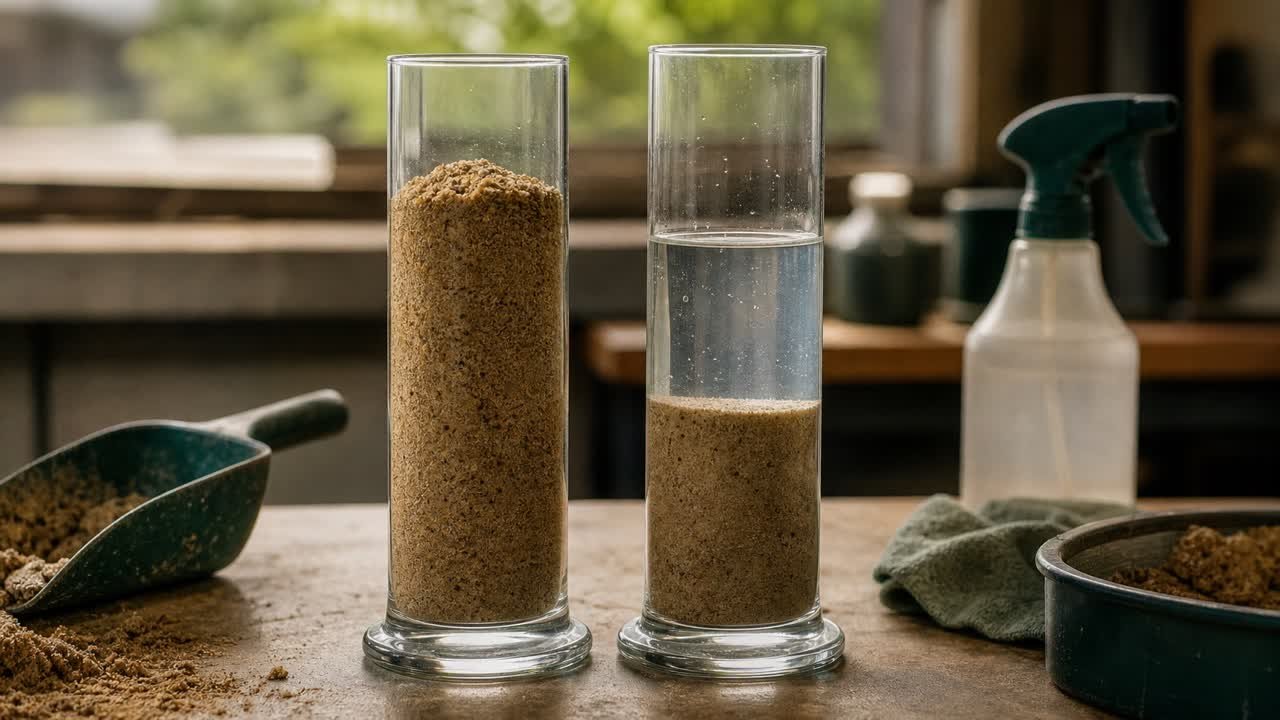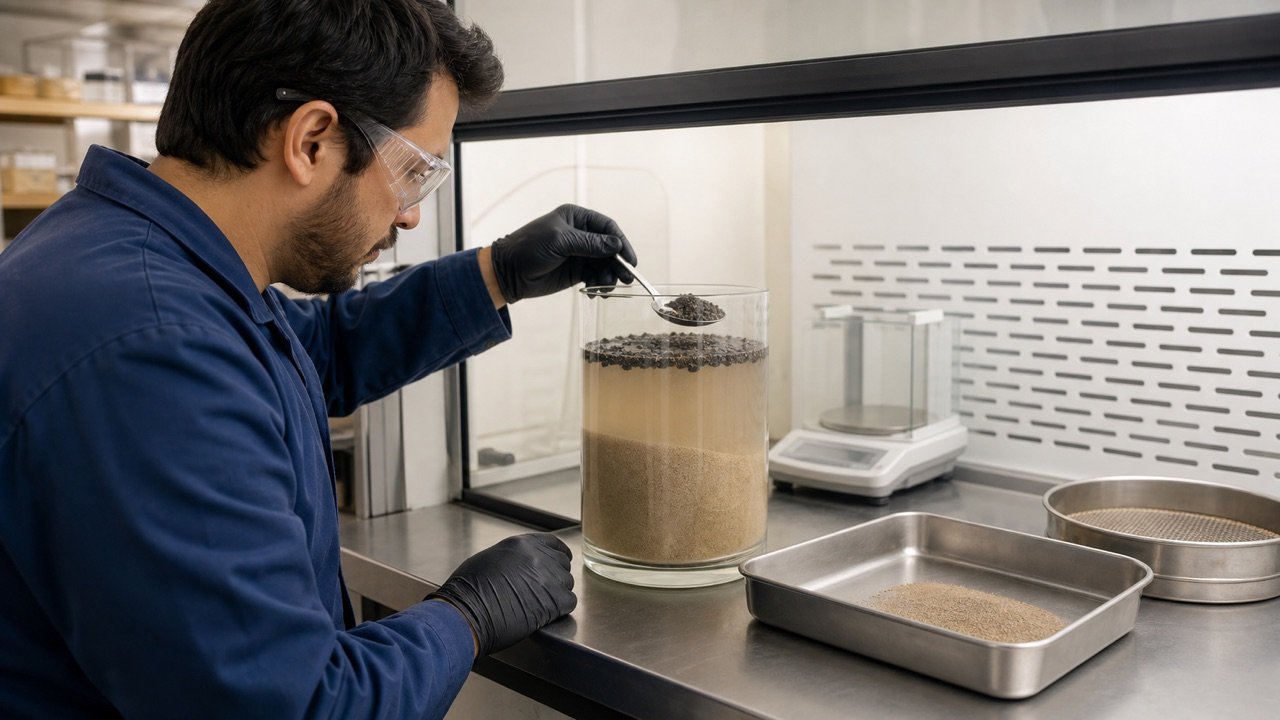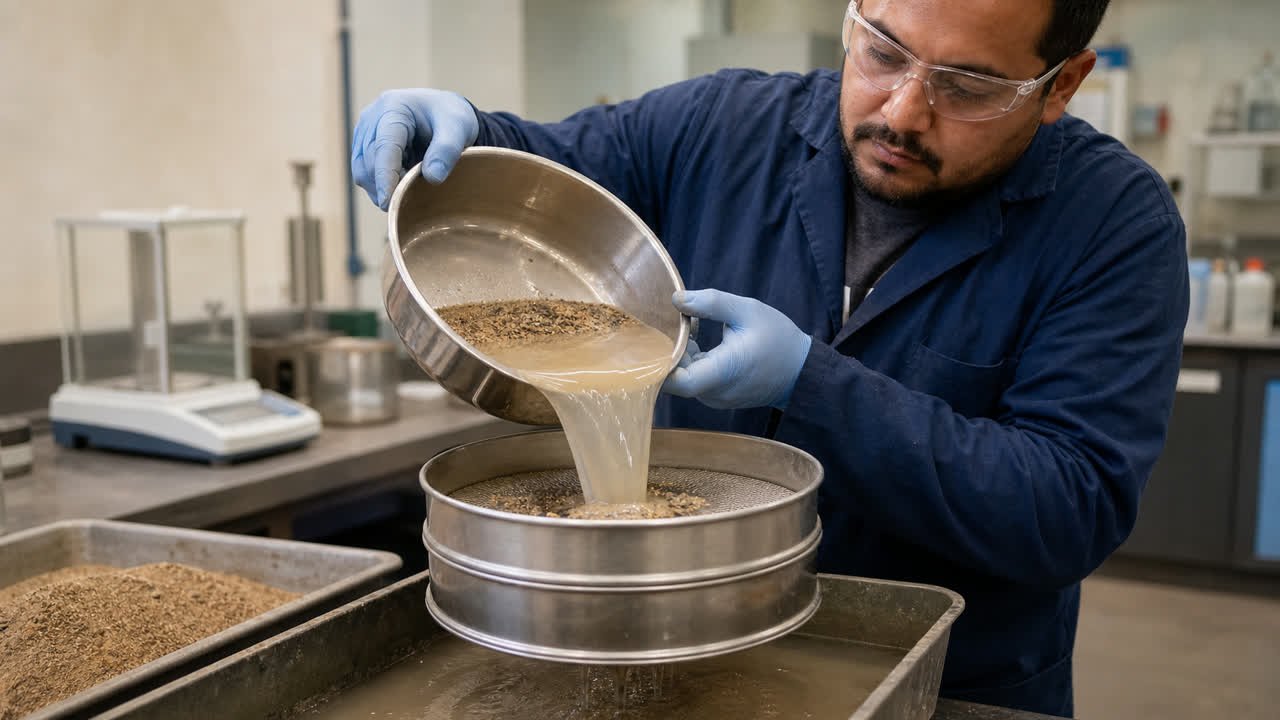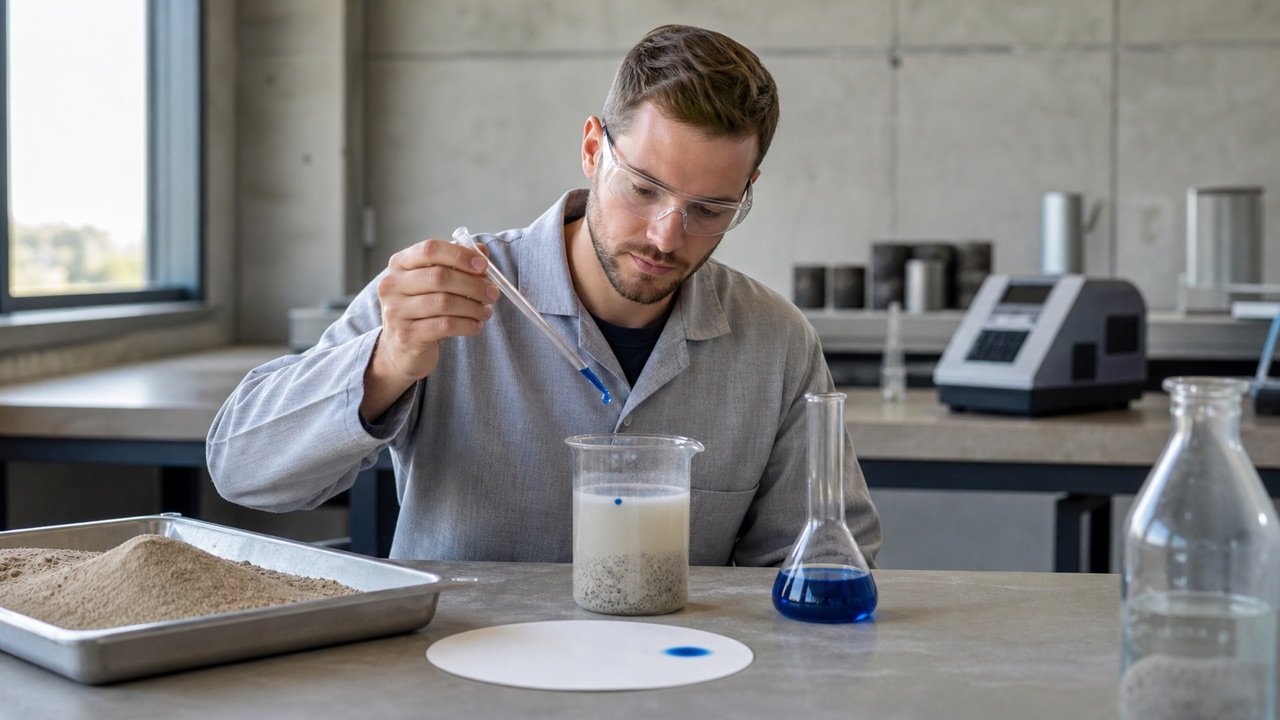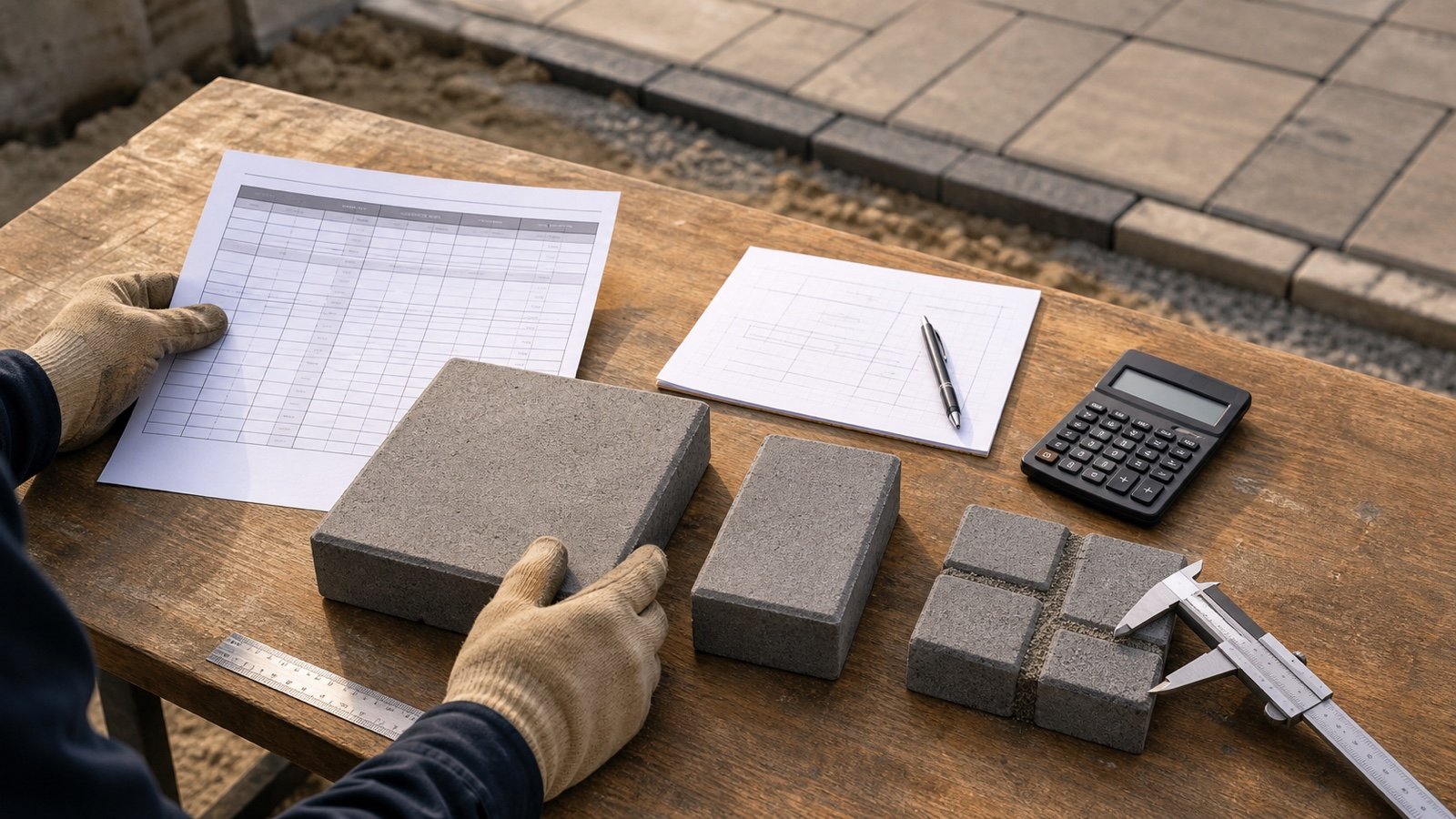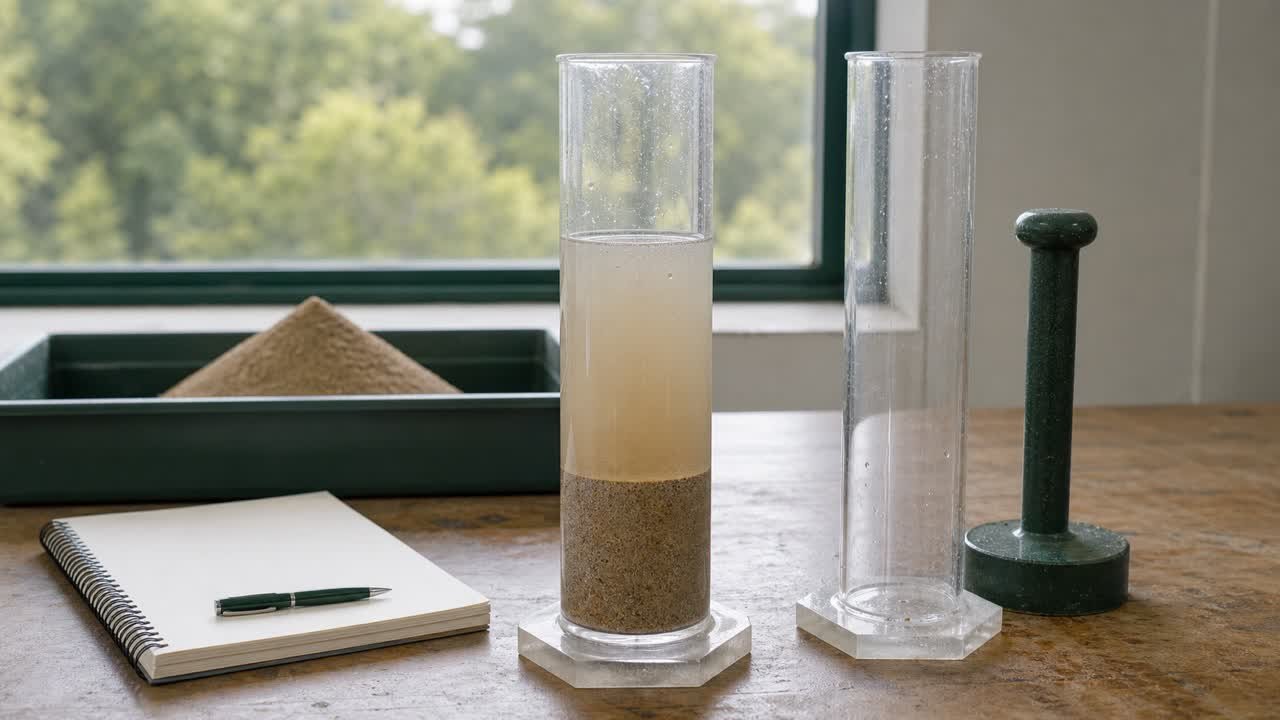
A sand equivalent test report compares the settled sand reading with the clay suspension reading from a prepared fine-aggregate or granular-soil specimen. To check the result, identify the governing method, confirm both recorded readings, apply any required indicator correction, and then follow that method's calculation and rounding rules.
The calculated value does not approve a product by itself. The sample record, test method, project specification, acceptance rule, and material lot determine how the result can be used.
How is the sand equivalent value calculated?
Divide the final sand reading by the clay reading and multiply by 100. Both readings must come from the same specimen and use the same cylinder scale.
Sand equivalent (SE) = sand reading ÷ clay reading × 100
ASTM D2419-22 defines sand equivalent as an empirical value for the relative amount, fineness, and character of clay-like material in the test specimen. Its public scope covers granular soils and fine aggregates passing the 4.75 mm No. 4 sieve.
The formula produces an SE value. The contract, agency specification, material class, and acceptance plan supply the minimum requirement and explain whether one result, an average, or another rule controls.
What does the sand equivalent test measure?
The test indicates the relative proportion of clay-like or plastic fines and dust to the coarser sand-size portion under standardized conditions. A higher result generally indicates a greater relative sand portion and fewer clay-like fines in the tested specimen.
The number is an empirical index. An SE of 45 does not mean that the specimen contains 45% sand by mass or 55% clay by mass. The test separates and reads sediment columns under a named procedure; it does not weigh clay as a direct percentage of the original sample.
ASTM describes D2419 as a rapid field correlation test and notes that a minimum value may be specified to limit permissible clay-like or clay-size fines. That wording matters: the method provides the measurement, while the applicable project document supplies the required minimum.
Which sand reading belongs in the formula?
Use the final sand reading defined by the governing method, not an uncorrected weighted-foot indicator level. Some apparatus produces an observed indicator reading that needs a fixed subtraction before it becomes the sand reading.
For example, California Test 217 instructs the operator to subtract 10 in from the observed weighted-foot indicator reading. The remainder is recorded as the sand reading. The same method records the top of the sediment column as the clay reading.
| Record field | What to verify | Why it matters |
|---|---|---|
| Observed indicator level | Whether the apparatus and method require an offset | An uncorrected level can produce an impossible or inflated SE value |
| Final sand reading | Correction completed and required reading precision applied | This value is the formula numerator |
| Clay reading | Correct sediment boundary and required reading precision | This value is the formula denominator |
| Method and revision | Exact designation named by the project | Preparation, apparatus, timing, correction, and reporting rules can differ |
Worked example: how do you calculate and round SE?
Suppose the final sand reading is 3.2 and the clay reading is 6.9. The raw ratio is 46.3768%, which is 46.4 to the nearest 0.1.
SE = 3.2 ÷ 6.9 × 100 = 46.3768... = 46.4
Under the reporting rule in the cited California Test 217, a calculated value that is not a whole number is reported at the next higher whole number. The reported value for this example is 47.
A second fixture uses a sand reading of 3.3 and a clay reading of 8.0:
SE = 3.3 ÷ 8.0 × 100 = 41.25 = 41.3, reported as 42 under the cited rule
Use the rounding sequence stated in your governing method. Ordinary rounding, always-round-up rules, intermediate reading precision, and the order used for averaging can produce different reported values near a specification limit.
How can you verify a real sand equivalent report?
Recalculate every individual specimen before checking the average. A public Caltrans DIME test record provides 3 pairs of readings and their reported values.
| Specimen | Sand reading | Clay reading | Calculated value | Reported SE |
|---|---|---|---|---|
| 1 | 41 | 47 | 87.234... | 88 |
| 2 | 40 | 47 | 85.106... | 86 |
| 3 | 40 | 46 | 86.956... | 87 |
The 3 whole-number results average to 87. The public record also identifies the sample, source, stockpile location, test method, laboratory, tester, dates, solution temperature, and temperature correction. Those fields connect the arithmetic to an actual material record.
The example proves how that report's math was reconstructed. Its value is not a minimum requirement for other projects or products.
What should you check before accepting the reported result?
Audit the report in a fixed order. This keeps a formula check from being mistaken for a complete acceptance review.
- Trace the sample: confirm project, material, source, stockpile or lot, sample number, location, quantity represented, sampler, and date.
- Confirm the method: record the exact standard, agency method, revision, preparation option, and required number of specimens.
- Check the readings: verify the sand and clay values, recorded precision, weighted-foot correction, and any noted reading difficulty.
- Recalculate each specimen: divide the final sand reading by the clay reading and multiply by 100.
- Apply the reporting rule: use the method's stated precision and rounding sequence.
- Check repeat results: apply the named method's difference, retest, selection, and averaging provisions.
- Review corrections: confirm whether temperature or another documented correction applies and how it was established.
- Compare with the right limit: use the project specification, material class, layer, edition, and acceptance provision tied to the tested lot.
The FHWA 1626 worksheet illustrates useful traceability fields for an AASHTO T 176 workflow, including source, sampling location, quantity represented, lot, preparation, soaking and sedimentation times, readings, and individual values.
Which conditions can change the result?
Sample preparation, solution condition, temperature, agitation, irrigation, settling time, vibration, and reading technique can affect the measured columns. Treat these as controlled test conditions, not optional formatting details.
Can temperature require a correction?
Yes, when the governing method requires it. The accessible California Test 217 edition sets a working-solution target of 72 ± 5°F and describes a material-specific correction curve when testing outside that range. A generic correction copied from another aggregate is not valid evidence for the sample.
Why do timing and vibration matter?
The sediment column develops over a prescribed period. California Test 217 uses a 10 ± 1 min wetting period and a 20 min ± 15 s sedimentation period in the retrieved edition, and it requires a level work surface free from vibration.
Do not apply these exact values to a report governed by another standard without checking that standard. Use them to see why the report should name the method and why a disturbed cylinder or undocumented delay needs review.
What if the clay boundary is unclear?
Follow the governing method's instruction and document the event. The retrieved California method provides a procedure for delayed boundary formation and distinguishes the response when tap water was used. Guessing the interface or choosing a convenient reading undermines the result.
Does a higher sand equivalent always mean the material passes?
No universal SE value passes every project. A higher result represents fewer clay-like fines relative to sand under the test conditions, but acceptance depends on the specified minimum, material use, test method, sampling plan, and decision rules.
| Question | Where the answer comes from | What the SE report contributes |
|---|---|---|
| Was the arithmetic reported correctly? | Recorded readings and governing calculation rule | Inputs, individual values, corrections, and average |
| Does the tested specimen meet the required minimum? | Applicable project specification and edition | Comparable reported SE value |
| Which material does the result represent? | Sampling plan, source, lot, location, dates, and chain of custody | Tested specimen identifier |
| Is the material suitable for the full intended use? | All required properties, tests, drawings, and approvals | One empirical fine-aggregate quality index |
A result near the minimum needs special care. Check transcription, reading correction, rounding order, repeat-test rules, temperature record, sample identity, and specification edition before declaring compliance.
Is sand equivalent the same as sieve analysis?
No. Sieve analysis reports the mass distribution across stated particle-size openings. Sand equivalent indicates the relative amount and character of clay-like or plastic fines and dust under a sedimentation test.
A product can need both tests because each answers a different question. The sand sieve analysis guide explains retained mass, cumulative retained, percent passing, and fineness modulus. Neither result establishes moisture, bulk density, absorption, organic impurities, strength, or durability.
Sampling also controls what both tests represent. Use the sand sampling guide to connect a specimen with a stockpile, belt stream, delivery, or defined lot.
Common sand equivalent calculation mistakes
- Dividing the clay reading by the sand reading.
- Using the observed weighted-foot indicator level before the required correction.
- Mixing readings from different specimens.
- Using a rounded display value as an input when the method requires more precise recorded readings.
- Applying ordinary nearest-whole rounding when the named method requires the next higher whole number.
- Averaging raw results when the method requires individually reported values first.
- Treating SE as the mass percentage of sand or clay.
- Copying a passing threshold from another agency, layer, product, or method.
- Ignoring temperature, settling time, vibration, unclear boundaries, or repeat-result provisions.
- Applying one specimen's result to an unidentified stockpile or delivery.
After the product has been approved for its intended use, use the Sand Calculator for volume, supplier-density mass, or documented package yield. Return to the Sand material planning hub for quantity tools and related test guides.
Sources and source scope
- ASTM D2419-22, Standard Test Method for Sand Equivalent Value of Soils and Fine Aggregate: current public designation, scope, purpose, significance, minimum-value context, and laboratory-competency caution. The licensed standard controls the complete procedure.
- California Test 217, Method of Test for Sand Equivalent: accessible California procedure, cylinder readings, indicator correction, timing, temperature controls, formula, and reporting rule.
- FHWA Form 1626, Worksheet for Determining Sand Equivalent: project and specimen traceability, timing, readings, calculation, rounding, and averaging fields for the stated AASHTO T 176 workflow.
- TxDOT Tex-203-F, Sand Equivalent Test, August 2020 archive: a method-specific example of reading precision, formula, paired-value review, upward reporting, and a maximum reported value.
- California DOT DIME test 2024-01-10-20-5: public source, sample, method, temperature, three reading pairs, individual values, average, dates, and verification record.
- FHWA Chapter 5, Evaluation of Soil and Rock Properties: sand equivalent's place among separate aggregate quality and durability tests.
Scope: this page checks report calculations and review records. The current governing test method, project documents, laboratory procedures, sampling plan, acceptance rules, and responsible qualified people control testing and material approval.
BuildQuantities.com records its research and calculation checks on the methodology page. Report a formula, source, unit, or rendering problem through the corrections route.