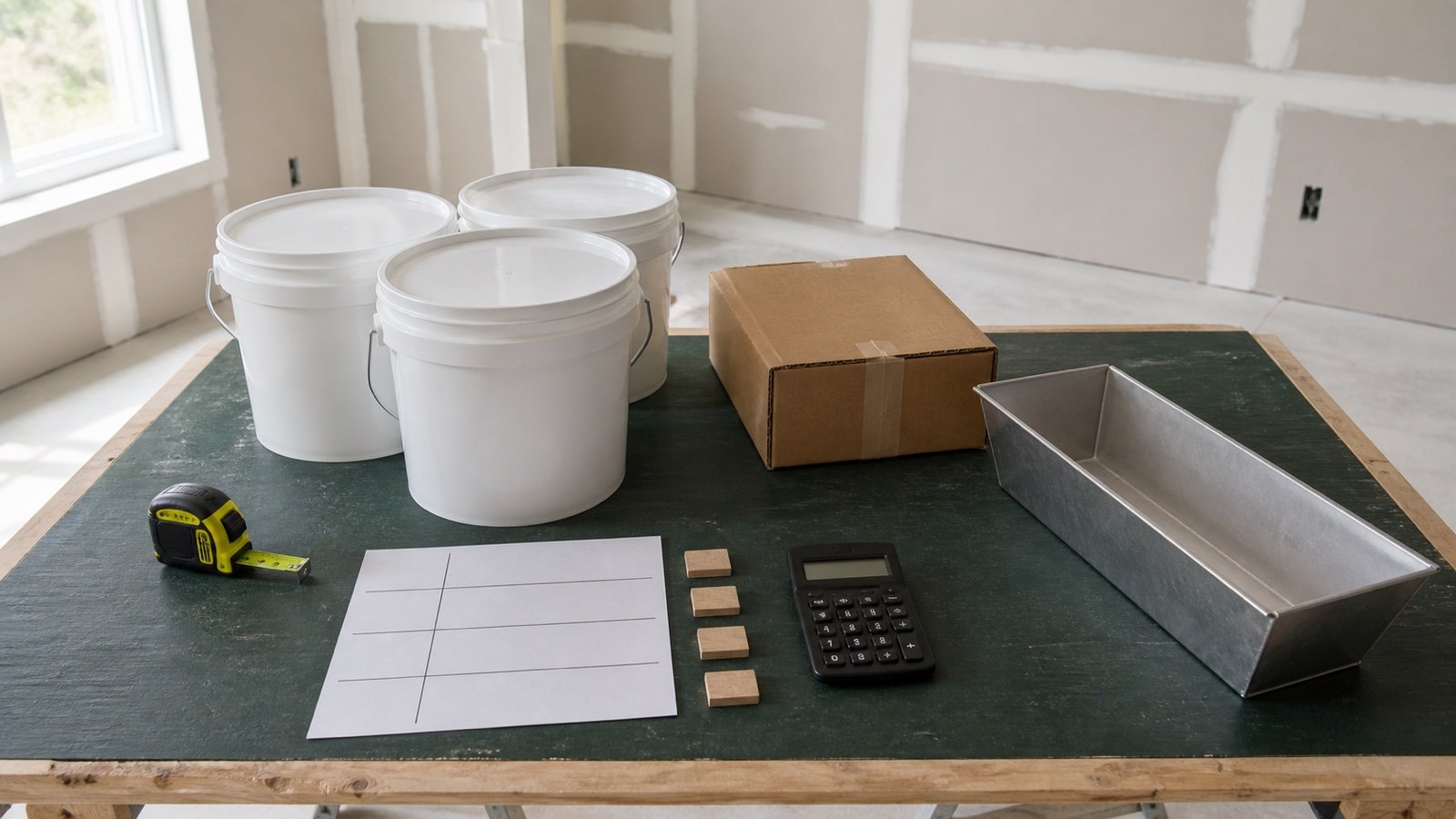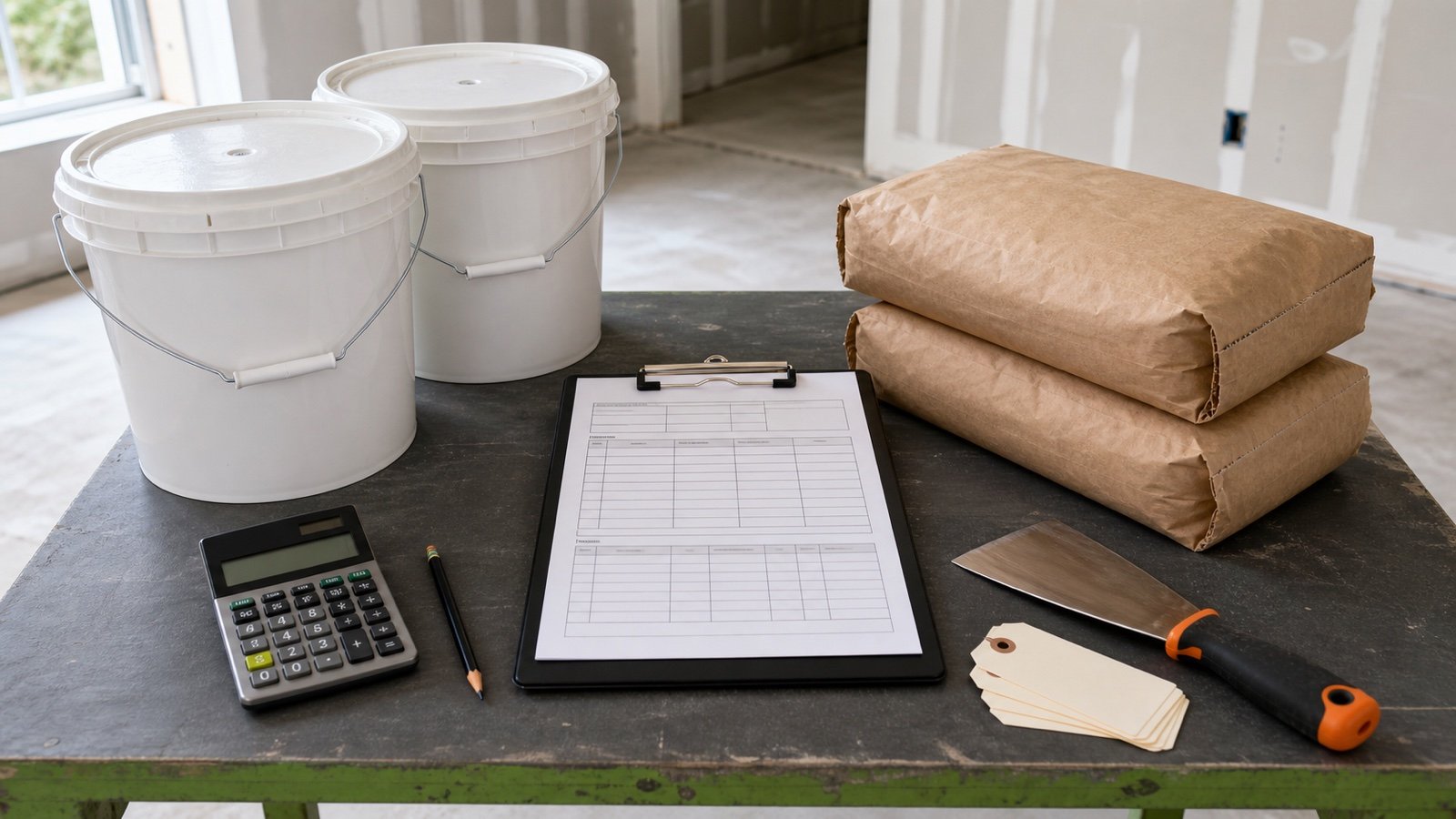
Ready-mix and setting-type joint compounds use different quantity records. Ready-mix products commonly use liquid volume, while setting compounds arrive as dry bags that the user mixes with water.
Choose the product and application first. Then carry its named coverage, package and timing instructions into a separate calculator run.
What is the difference between ready-mix and setting-type joint compound?
Ready-mix compound arrives premixed in a pail or carton and hardens as it dries. Setting-type compound arrives as dry powder, requires job-site water and hardens through a chemical setting process as well as drying.
AWCI describes these as the 2 basic formulations used for gypsum-panel joints and fastener heads. National Gypsum adds schedule, humidity, tape and repair context for its named product lines. The current product document and project specification control the selection.
| Record field | Ready-mix compound | Setting-type compound |
|---|---|---|
| Supplied form | Premixed material in a pail or carton | Dry powder in a bag |
| Calculator basis | US gallons or litres when the source uses volume | Pounds or kilograms when the source uses dry package mass |
| Hardening record | Drying conditions and permitted recoat state | Working-time and setting-time ranges |
| Mixing record | Product instructions for stirring or permitted water adjustment | Water amount, batch size, sequence, clean tools and no-retemper direction |
| Purchase boundary | Current pail or carton volume | Current bag mass |
| Scope check | Named use such as taping, finishing or skim work | Named use such as prefill, repair or joint finishing |
Which product type should you enter in the calculator?
Enter the product that the current specification, approved submittal or accepted repair method assigns to the measured work. Use ready-mix volume mode for a volume-based record and dry-compound mass mode for a bag-mass record.
- Identify the exact manufacturer, product and product number.
- Record the application, such as tape embedding, fill, finish, skim or repair.
- Copy the published coverage amount and reference area with every qualifier.
- Confirm the current package from the target supplier and market.
- Run the Drywall Joint Compound Calculator once for that product and scope.
A job that uses setting compound for prefills and ready mix for finish coats needs 2 rows. Keep the quantities separate through ordering, stock control and field reconciliation.
Does the number on a setting-compound bag show coverage?
The suffix on the named USG Durabond products identifies an approximate setting-time class. It does not state area coverage, bag mass or the amount of compound needed for a project.
USG J17A lists Durabond 20 at a 20 to 30 minute setting range, Durabond 45 at 30 to 80 minutes, Durabond 90 at 85 to 130 minutes and Durabond 210 at 180 to 240 minutes. Temperature of the mixing water can change those ranges.
National Gypsum also separates working time from setting time for ProForm Quick Set Lite. Its current manufacturer article defines working time as the spreadable period and setting time as the point after which another layer can be applied. Store both ranges outside the coverage field.
A 45-minute label cannot replace square feet per bag, pounds per reference area or a current package record.
Can ready-mix gallons be converted into setting-compound pounds?
Keep ready-mix volume and setting-compound dry mass separate unless the exact product source supplies a compatible conversion for the same material state. Water, formulation and mixed consistency prevent a generic gallon-to-pound conversion.
Mixing water belongs in the batch procedure. It does not increase the number of dry bags purchased or turn a dry-package coverage record into ready-mix volume.
| Value | Quantity row | Reason |
|---|---|---|
| Ready-mix gallons or litres | Named ready-mix product | Volume includes the supplied product state |
| Dry pounds or kilograms | Named setting compound | Package mass describes the material before job-site water |
| Mixing water | Batch instruction | Water controls preparation and consistency within product limits |
| Whole pails or bags | Purchase schedule | Package rounding follows each product's sold amount |
Worked example: 1,000 square feet in 2 named product records
This example compares package arithmetic for 2 manufacturer records. The project may compare them only after its specification and application permit each product. The figures do not establish equal performance or interchangeability.
Ready-mix record
USG J2051 gives Sheetrock UltraLightweight All Purpose Joint Compound approximate coverage of 9 to 10 US gal per 1,000 ft² and lists a 4.5 US gal pail as one package example.
- Lower endpoint: 1,000 × 9 ÷ 1,000 = 9 US gal.
- Lower package ratio: 9 ÷ 4.5 = 2.0000, so 2 pails.
- Upper endpoint: 1,000 × 10 ÷ 1,000 = 10 US gal.
- Upper package ratio: 10 ÷ 4.5 = 2.2222, so 3 pails.
- Upper purchase remainder: 3 × 4.5 − 10 = 3.5 US gal.
Setting-compound record
The ProForm Quick Set Lite sales sheet lists an 18 lb (8.2 kg) bag and approximate coverage of 325 ft² per bag.
- Exact bags: 1,000 ÷ 325 = 3.0769.
- Whole bags: ceiling(3.0769) = 4.
- Purchased dry mass: 4 × 18 = 72 lb.
- Nominal covered area: 4 × 325 = 1,300 ft².
- Nominal area remainder: 1,300 − 1,000 = 300 ft².
The ready-mix result remains in gallons and pails. The setting result remains in dry pounds and bags. Record the applicable product scope and source beside each result.
Why can 2 coverage endpoints change the ready-mix order?
A coverage range can cross a whole-package boundary. At 1,000 ft², the J2051 lower endpoint fits 2 listed 4.5 gal pails, while the upper endpoint needs 3.
Record who selected the planning endpoint and why. Package rounding follows that documented amount; it cannot decide which endpoint applies.
How should setting compound be divided into batches?
Divide the planned dry mass into batches that the crew can apply within the named working time and the product's mixing instructions. Keep the full purchase quantity and each mixed batch in separate records.
USG J17A tells users to mix only what they can use within the working time, use a clean container for each batch, add one bag to about 5 to 6 qt of clean water, and avoid retempering. Those directions belong to the named Durabond line and cannot set the water ratio for another product.
National Gypsum tells Quick Set Lite users to follow the water amount printed on the package, add powder to clean drinkable water, allow the mix to soak, remix and avoid excessive mixing. Hot water, dirty tools, foreign material and overmixing can shorten the observed working range for that named product.
When does a partial-bag calculation need another check?
A partial-bag calculation needs the selected product's permitted proportioning method and a scale or batch method suitable for the work. Do not estimate dry powder by eye when the product requires a controlled water-to-powder ratio.
- Keep the purchased package count as whole bags.
- Record the dry amount assigned to each batch.
- Use the product's stated water method for that batch.
- Keep opened stock separate from unopened bags.
- Discard material according to the product and site rules after it starts to set.
The calculator returns whole packages and a package-rounding remainder. It does not design a partial-bag mixing ratio.
Can every setting compound be used for a thin skim coat?
Product-line instructions differ. USG J17A says not to use its Durabond setting-type compounds for thin skim coats, while National Gypsum lists skimming among the uses for its ProForm Quick Set Lite product.
Record the exact product instead of applying one type-wide rule. The project finish schedule, current submittal and manufacturer instructions decide whether a skim application is permitted and which coverage basis applies.
Use the joint compound coverage guide to record a separate full-surface rate when the selected skim system provides one.
How do drying conditions affect the selection record?
Schedule and site conditions can affect product selection and recoat timing. National Gypsum recommends considering setting products for tight schedules, cold or humid conditions, certain movement concerns, mesh tape and small repairs within its product guidance.
Ready-mix remains tied to drying conditions and product instructions. A set or working-time number does not prove that the material has dried enough for sanding, decoration or another operation.
Record air and surface conditions when the specification or product document requires them. Use the current instructions rather than adding an unsourced time allowance to the quantity.
How should a mixed-product drywall job be scheduled?
Create one work-package row for each product and application. A crew may use a setting compound for approved prefills or repair work and a ready-mix product for named finishing coats, but the takeoff must preserve those scopes.
| Field | Setting-compound row | Ready-mix row |
|---|---|---|
| Area or measured work | Approved prefill, repair or joint scope | Approved tape, fill, finish or skim scope |
| Coverage | Named dry-product record | Named ready-mix record |
| Package | Current bag mass | Current pail or carton volume |
| Timing | Working and setting ranges | Drying and recoat conditions |
| Batch control | Water, batch amount and clean-tool record | Stirring and permitted adjustment record |
| Field closeout | Dry issued mass, mixed batches and discarded set material | Issued volume, returns and measured usable remainder |
The Drywall Material Takeoff Worksheet keeps panels, tape, compounds, fasteners and trims on separate schedules. Link every compound row back to its current source.
Which shortcuts cause quantity errors?
- Using the bag's timing suffix as an area-coverage value.
- Converting a ready-mix gallon into dry pounds with a generic density.
- Adding mixing-water weight to the dry package order.
- Combining setting and ready-mix coverage before package rounding.
- Assigning one product-type rule to every skim, tape, fill and repair application.
- Treating 4.5 gal, 5 gal, 18 lb or 25 lb as permanent standard packages.
- Using the number of purchased drywall sheets as the treated area.
- Hiding discarded set material inside a general allowance.
Measure the accepted receiving surface with the wall and ceiling drywall measurement guide. Keep unused sheets and untreated faces out of the compound area.
What should the final comparison record contain?
- Project, room or zone and finish-schedule revision.
- Manufacturer, exact product, product number and supplied form.
- Application and accepted treated area.
- Coverage amount, reference area, qualifier and source revision.
- Ready-mix volume or dry mass, kept in its original quantity state.
- Current package, supplier, market and check date.
- Working, setting, drying and recoat conditions in separate fields.
- Mixing-water and batch instructions for the selected dry product.
- Base amount, approved allowance, exact packages, whole packages and remainder.
- Prepared by, checked by, date and unresolved substitutions.
Return to the Drywall material planning hub for the panel and compound tools. The calculation methodology explains unit and rounding controls, and the corrections route accepts a source or arithmetic issue.
Safety, product and specification limits
Read the current product data and safety data before mixing, applying, cleaning or sanding joint compound. Control airborne dust during dry-powder handling and sanding under the applicable product and workplace instructions.
OSHA's interpretation explains the US construction scope for joint-compound sanding and exposure assessment. NIOSH reports reduced dust exposure with tested vacuum-sanding controls in its cited drywall-sanding work.
This guide does not select a joint system, tape, finish level, repair method, skim product, batch ratio, exposure control or disposal method. Project documents, approved submittals, manufacturer instructions and applicable workplace requirements control those decisions.
Sources and source scope
- AWCI Interior Gypsum Wall and Ceiling Finishing: drying and chemically setting formulations, supplied form, general application and stated limitations.
- National Gypsum setting compounds versus ready mix: manufacturer selection context for schedule, conditions, tape and repair work.
- ProForm Quick Set Lite sales sheet: 18 lb package, approximate 325 ft² coverage, named timing ranges and product scope.
- USG Sheetrock Durabond J17A: named set ranges, mixing method, batch controls, sanding and skim limits.
- USG Sheetrock UltraLightweight All Purpose J2051: named 9 to 10 US gal/1,000 ft² ready-mix range and listed package examples.
- National Gypsum setting-compound mixing and timing guide: product-specific batch sequence, working versus setting time and factors that change observed timing.
- OSHA silica-standard interpretation: US construction scope for joint-compound sanding and exposure assessment.
- NIOSH Drywall Sanding, Hand Sanding: sanding-dust exposure and tested vacuum-control context.
Source scope: Manufacturer sources support their named products, packages, applications, timing and qualifiers. AWCI supports the general formulation distinction. OSHA and NIOSH support the stated US workplace context. The sources do not establish universal product interchangeability, package availability, allowance, price, batch ratio or accepted project quantity.
Review responsibility: Saleem Sial owns the research and editorial record. Source checks, independent package fixtures, content review, internal-link review, build validation, crawl, schema review and rendered QA form the internal publication gate. Waseem Sial, External Reviewer and Engineer, remains listed for ongoing external review; no completed external-review date is claimed.