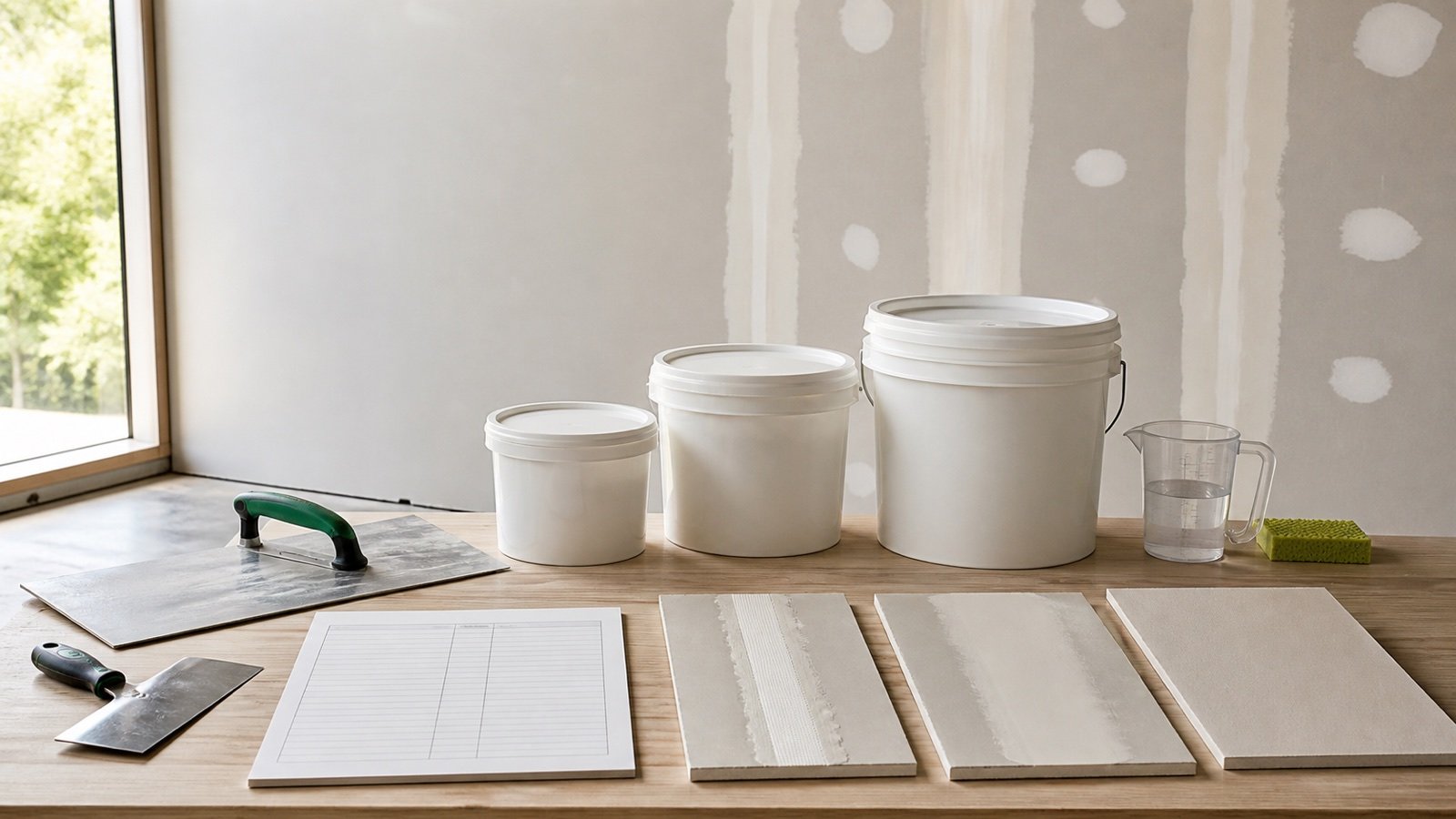
Joint-compound coverage belongs to a named product and a stated application. A figure such as 9 US gal per 1,000 ft² becomes useful after you record the work it covers, the current package and the source market.
Keep joint finishing, a full-surface skim coat, texture and repairs on separate quantity rows when their product instructions or consumption bases differ.
How much joint compound covers 1,000 square feet?
Current manufacturer records give approximate planning points near 9 to 10 US gal of ready-mix compound per 1,000 ft² of gypsum panels for their named joint-finishing products. Use the exact record for the selected product and application.
USG J2051 lists approximately 9 to 10 US gal per 1,000 ft² for Sheetrock UltraLightweight All Purpose Joint Compound. USG J963 lists approximately 9.4 US gal per 1,000 ft² for its Midweight All Purpose product. National Gypsum's ProForm FAQ gives a 9 US gal per 1,000 ft² rule of thumb for ready mix.
| Source record | Published amount | Equivalent area per US gallon | Qualifier to retain |
|---|---|---|---|
| USG J2051 UltraLightweight | 9 to 10 US gal/1,000 ft² | 111.111 to 100 ft²/US gal | Approximately; named product |
| USG J963 Midweight | 9.4 US gal/1,000 ft² | 106.383 ft²/US gal | Approximately; named product |
| National Gypsum ProForm FAQ | 9 US gal/1,000 ft² | 111.111 ft²/US gal | Rule of thumb; ready mix |
The figures sit close together, but their wording and product identity still matter. Preserve “approximately” or “rule of thumb” in the takeoff record rather than converting either into a guaranteed yield.
What does a coverage rate per 1,000 square feet mean?
The rate scales a stated compound amount through a reference area of gypsum panels. It does not mean that one gallon forms a uniform paint-like coat across 100 or 111 ft² of the complete panel face.
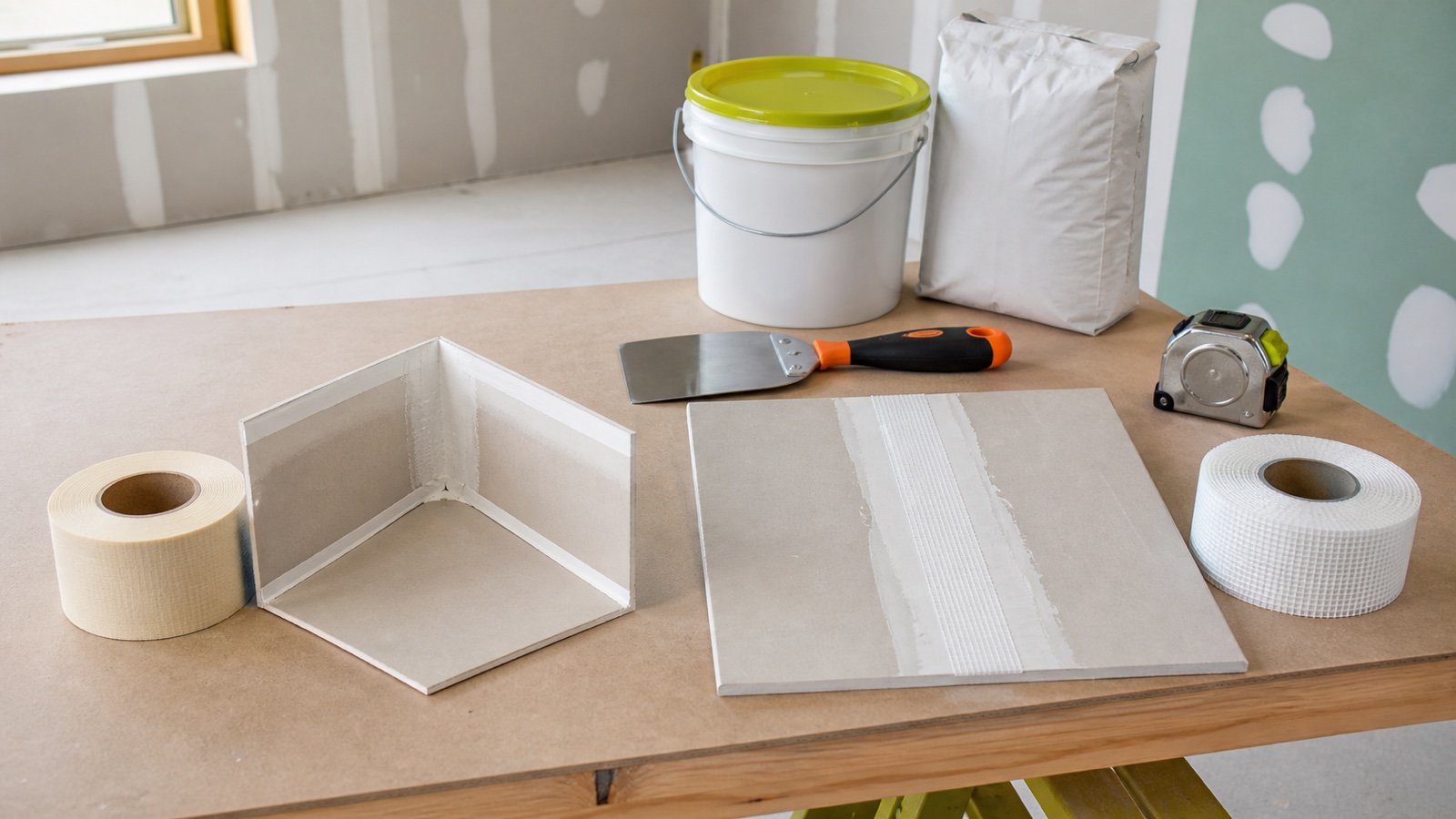
Joint finishing concentrates compound at taped joints, interior angles, fastener heads and accessories. A Level 5 skim coat adds material over the full surface, so the application scope must travel with the number.
Amount per area = published compound amount ÷ published reference area
Base compound = accepted board area × amount per area
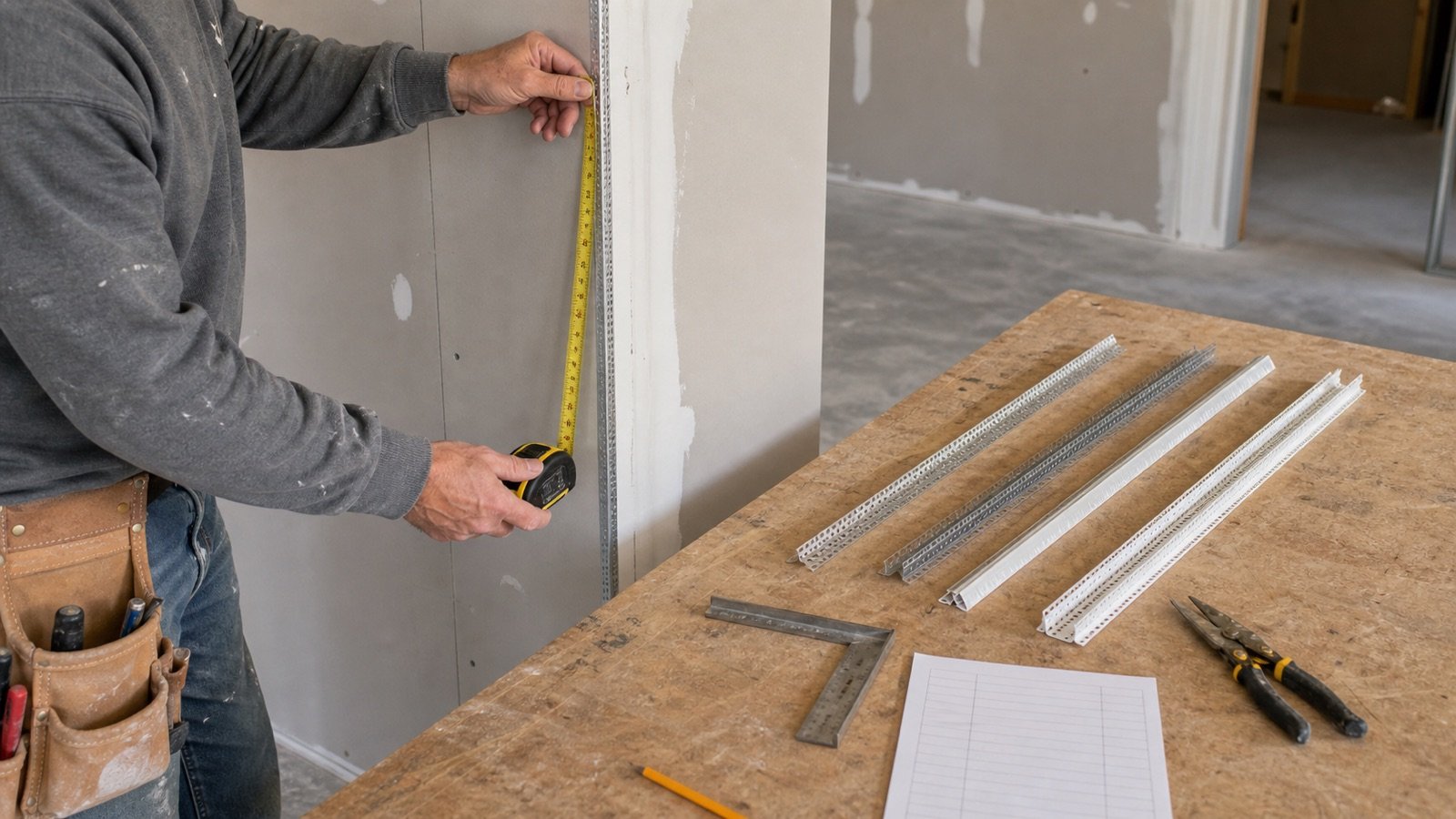
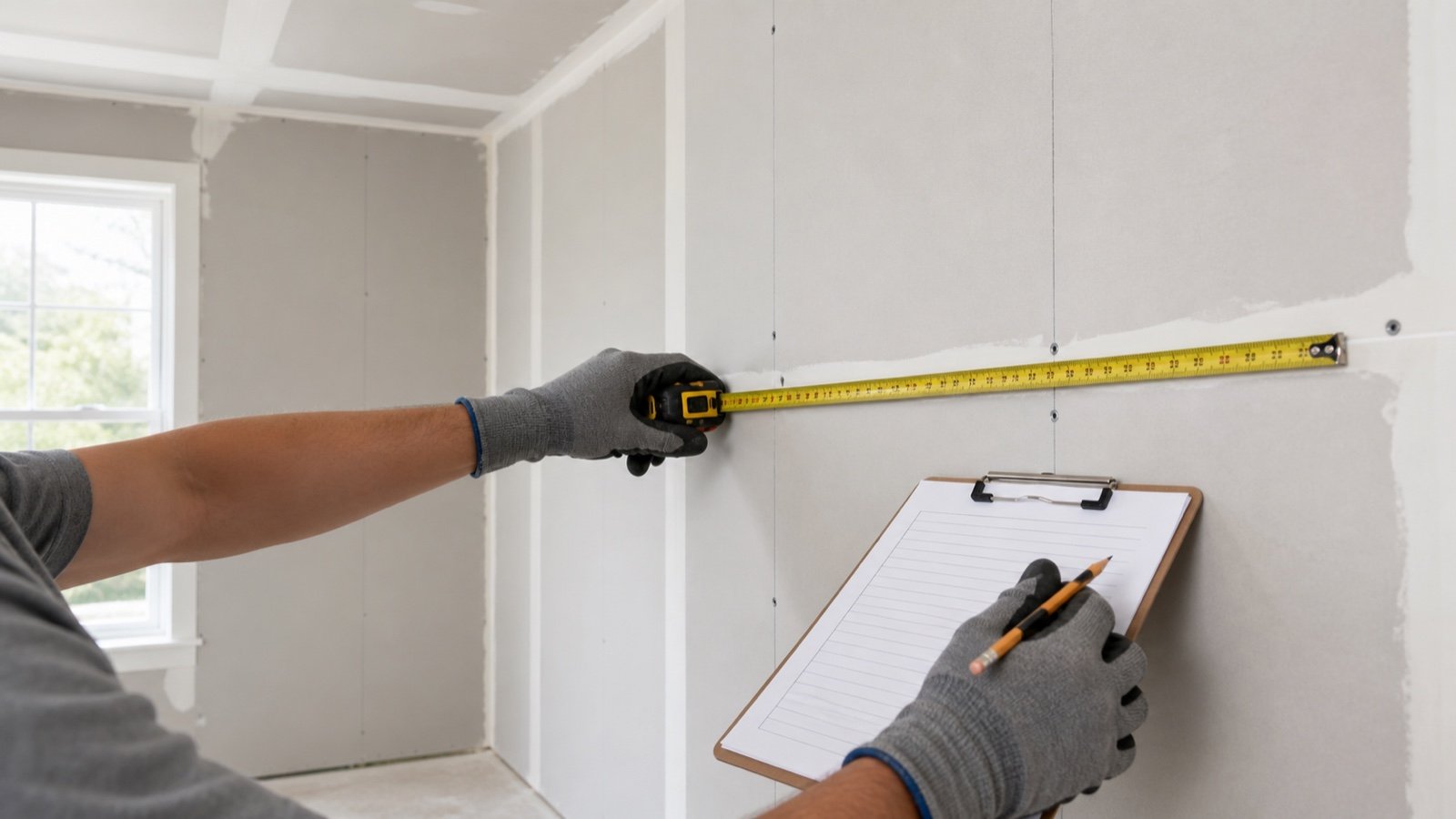
Use installed or scheduled panel face area that receives the stated treatment. Count both faces of a partition when both faces receive it. Keep surfaces with another compound, finish system or application on another row.
Which coverage rate should you enter in the calculator?
Enter the rate from the current document for the exact product and work. Record the manufacturer, product, product type, application, amount, reference area, document revision, market and retrieval date before calculation.
- Confirm the compound can perform the specified step, such as tape embedding, fill coats, finish coats or skim coating.
- Copy the coverage amount and its reference area in the units printed by the source.
- Keep any range, approximation and application note beside the value.
- Check the net amount of the package available from the supplier.
- Send one compatible rate and package to the Drywall Joint Compound Calculator.
Product name, application, rate, reference area and package must describe the same material state. Keep ready-mix volume and dry-compound mass in separate calculations.
How does the drywall finish level change the scope?
The finish level defines where tape and compound go and how many separate coats cover specific features. The selected finish can change consumption because the treated scope changes.
| Level | Compound scope to record | Quantity implication |
|---|---|---|
| Level 1 | Tape embedded at joints and interior angles | Joint-treatment quantity only |
| Level 2 | Embedded tape plus 1 coat on fasteners and accessories | More treated details than Level 1 |
| Level 3 | 1 separate coat on joints and angles; 2 on fasteners and accessories | Record the specified textured or wallcovering context |
| Level 4 | 2 separate coats on flat joints, 1 on interior angles and 3 on fasteners and accessories | Use a product rate that covers this work |
| Level 5 | Level 4 joint work plus a thin skim coat over the entire surface | Full-surface material needs an applicable coverage record |
The finish-level source defines work scope. It does not publish a universal gallon or pound multiplier for each level. Do not assign a preset rate to a level unless the selected product or approved project record supplies it.
Does a joint-finishing rate include a Level 5 skim coat?
Use a joint-finishing rate for a full-surface skim coat only when the source states that scope. USG J2051 gives its 9 to 10 US gal figure as product coverage and sends skim-coat work to separate USG finishing guidance.
CertainTeed's Level 5 description requires a thin skim coat of joint compound or a material made for that purpose over the entire surface. Create a separate skim row when its product, rate or package differs from the joint-treatment row.
- Record joint treatment by the applicable joint-finishing rate.
- Record skim material by the selected skim product's coverage instructions.
- Record sprayed or hand-applied texture by its own product and application rate.
- Record repairs and damaged-panel work from measured conditions or an approved repair schedule.
How do you convert between common coverage formats?
Keep the same amount and reference area while changing the display format. If a source gives gallons per 1,000 ft², divide 1,000 by the gallons to obtain square feet per gallon.
Area per US gallon = 1,000 ft² ÷ US gallons per 1,000 ft²
For the USG J963 rate, 1,000 ÷ 9.4 = 106.383 ft²/US gal. Reversing the operation returns 9.4 US gal per 1,000 ft².
J963 also prints 38.3 L per 100 m². Use that published metric pair together. NIST Appendix B explains conversion-factor use and rounding; retain precision during the calculation and round the displayed planning result at the end.
A ready-mix gallon cannot become a dry-compound pound from an area conversion. That change requires supported bulk density for the exact product and material state, and the calculator keeps volume and mass modes separate.
Worked example: 750 square feet at 9.4 gallons per 1,000 square feet
A 750 ft² scheduled surface uses the named J963 planning rate for this arithmetic fixture. The supplier confirms a 4.5 US gal package, and the project record approves a 5% compound allowance.
- Base amount: 750 × 9.4 ÷ 1,000 = 7.05 US gal.
- Allowance amount: 7.05 × 5 ÷ 100 = 0.3525 US gal.
- Planning amount: 7.05 + 0.3525 = 7.4025 US gal.
- Exact packages: 7.4025 ÷ 4.5 = 1.6450.
- Whole packages: ceiling(1.6450) = 2.
- Purchased amount: 2 × 4.5 = 9 US gal.
- Package remainder: 9 − 7.4025 = 1.5975 US gal.
The 5% allowance adds 0.3525 US gal. Whole-package rounding adds another 1.5975 US gal above the planning amount. Keep those amounts separate so the purchase record shows why 2 containers were ordered.
Why can a small coverage change add a whole container?
A rate change can cross a package boundary even when the calculated gallons change by less than 1. The boundary depends on the current net package amount.
| Entered rate | Calculated amount | Exact packages | Whole packages | Package remainder |
|---|---|---|---|---|
| 9 US gal/1,000 ft² | 9 US gal | 2.0000 | 2 | 0 US gal |
| 9.4 US gal/1,000 ft² | 9.4 US gal | 2.0889 | 3 | 4.1 US gal |
| 10 US gal/1,000 ft² | 10 US gal | 2.2222 | 3 | 3.5 US gal |
USG J2051 lists 4.5 gal pails and 3.5 or 4.5 gal cartons, with availability varying by market. Confirm the package sold for the project before using this boundary table.
Which job conditions can change compound consumption?
Panel area alone cannot describe joint density or every finish detail. Split the takeoff or use an approved project record when the current work differs from the conditions behind the published rate.
- Panel size, direction and layout change total joint length and the number of butt joints.
- Rooms with many corners, soffits, returns or small surfaces concentrate joint work per square foot.
- Corner bead, specialty trim and control details add separate coated lengths.
- Damaged faces, repairs, gaps and rejected work add material outside the planned new-board scope.
- Substrate condition, tool choice, application method and coat width can change consumption.
- A full skim coat, texture or separate topping product needs its own supported rate.
The Drywall Material Takeoff Worksheet keeps sheets, joints, tape, compound, fasteners and trim on separate schedules before procurement.
How can completed work improve the next estimate?
A comparable completed area can supply a project-specific check when the records preserve product and scope. Use accepted quantities from the same compound, finish system, application method and site conditions.
| Record | Required detail | Keep outside the comparison |
|---|---|---|
| Completed area | Accepted panel face area by finish scope | Unfinished or rejected areas |
| Product issued | Exact product, lot, package and amount | Another compound or material state |
| Product returned | Accepted unopened stock and measured usable remainder | Unmeasured open containers |
| Separate work | Repairs, texture, skim coat and rework | Consumption that belongs to joint finishing |
| Normalized rate | Verified consumed amount ÷ comparable area | A universal rate for unrelated projects |
Document the calculation, reviewer and date. A field rate from one job remains a comparison point; product data and the current project specification still control product selection and scope.
Which coverage shortcuts cause ordering errors?
| Shortcut | Required check |
|---|---|
| One gallon rate for every compound | Named product, type and application |
| One rate for every finish level | Specified finish scope and supported consumption record |
| 4.5 or 5 gal as a permanent standard package | Current supplier net package in the target market |
| Gallons converted to pounds with generic density | Separate volume and mass records or exact supported density |
| Allowance hidden inside coverage | Base amount, documented allowance and package remainder on separate lines |
| Purchased sheets used as finished area | Accepted panel face area receiving the stated treatment |
| Level 5 skim included in joint finishing | Separate full-surface product and coverage scope when required |
| Old project rate reused without context | Comparable product, finish, method, conditions and checked reconciliation |
Measure the receiving surface first with the wall and ceiling drywall measurement guide. Then apply one supported product rate rather than combining area, package and allowance assumptions in a single shortcut.
What should the final coverage record contain?
- Project, area ID, drawing or specification revision and finish level or treatment scope.
- Accepted wall and ceiling face area, with both partition faces identified where applicable.
- Manufacturer, exact product, product number, ready-mix or dry state and intended application.
- Coverage amount, reference area, printed units, range or qualifier and document revision.
- Current package amount, supplier, market, availability check and quote date.
- Separate allowance percentage, reason, approval and calculated amount.
- Exact and whole packages, purchased amount and package remainder.
- Excluded skim coat, texture, repairs, rework and specialty details.
Return to the Drywall material planning hub for the sheet calculator, compound calculator and current guides. The calculation methodology explains unit and rounding checks, and the corrections route accepts a source or arithmetic issue.
Safety, product and specification limits
Read the current product data and safety data before mixing, applying or sanding compound. USG J2051 directs users to ventilate the area, use stated eye and respiratory protection and use vacuum-attached or wet sanding to reduce dust.
OSHA's interpretation explains that dry sanding joint compound can create high nuisance-dust exposure and that the employer must assess the task under the applicable US construction rules. NIOSH reports lower dust exposure with tested vacuum-sanding controls in its cited drywall-sanding work.
This guide does not select a compound, finish level, tape system, bead, skim material, texture, mixing water, drying schedule or exposure control. Current project documents, manufacturer instructions, supplier records and applicable workplace requirements control those decisions.
Sources and source scope
- USG Sheetrock UltraLightweight All Purpose Joint Compound J2051: named 9 to 10 US gal/1,000 ft² coverage, package examples, market note, skim-coat direction and product safety limits.
- USG Sheetrock All Purpose Midweight Joint Compound J963: named 9.4 US gal/1,000 ft² and 38.3 L/100 m² coverage plus package examples.
- USG joint-finishing coverage FAQ: approximately two 4.5 gal pails of the named product for 1,000 ft².
- National Gypsum ProForm FAQ: manufacturer rule of thumb of 9 US gal ready mix per 1,000 ft².
- CertainTeed recommended levels of finish: visible treatment scope for Levels 1 through 5, including the Level 5 full-surface skim coat.
- NIST Guide to the SI, Appendix B: conversion-factor use and rounding scope.
- OSHA silica-standard interpretation: US construction scope for joint-compound sanding and exposure assessment.
- NIOSH Drywall Sanding, Hand Sanding: sanding-dust exposure and tested vacuum-control context.
Source scope: Manufacturer records support their named products, stated applications, markets and qualifiers. CertainTeed supports finish-scope descriptions. NIST supports unit conversion. OSHA and NIOSH support the stated US workplace context. These sources do not establish a universal product rate, finish multiplier, allowance, package, price or accepted project quantity.
Review responsibility: Saleem Sial owns the research and editorial record. Source checks, independent arithmetic, content review, internal-link review, build validation, crawl, schema review and rendered QA form the internal publication gate. Waseem Sial, External Reviewer and Engineer, remains listed for ongoing external review; no completed external-review date is claimed.