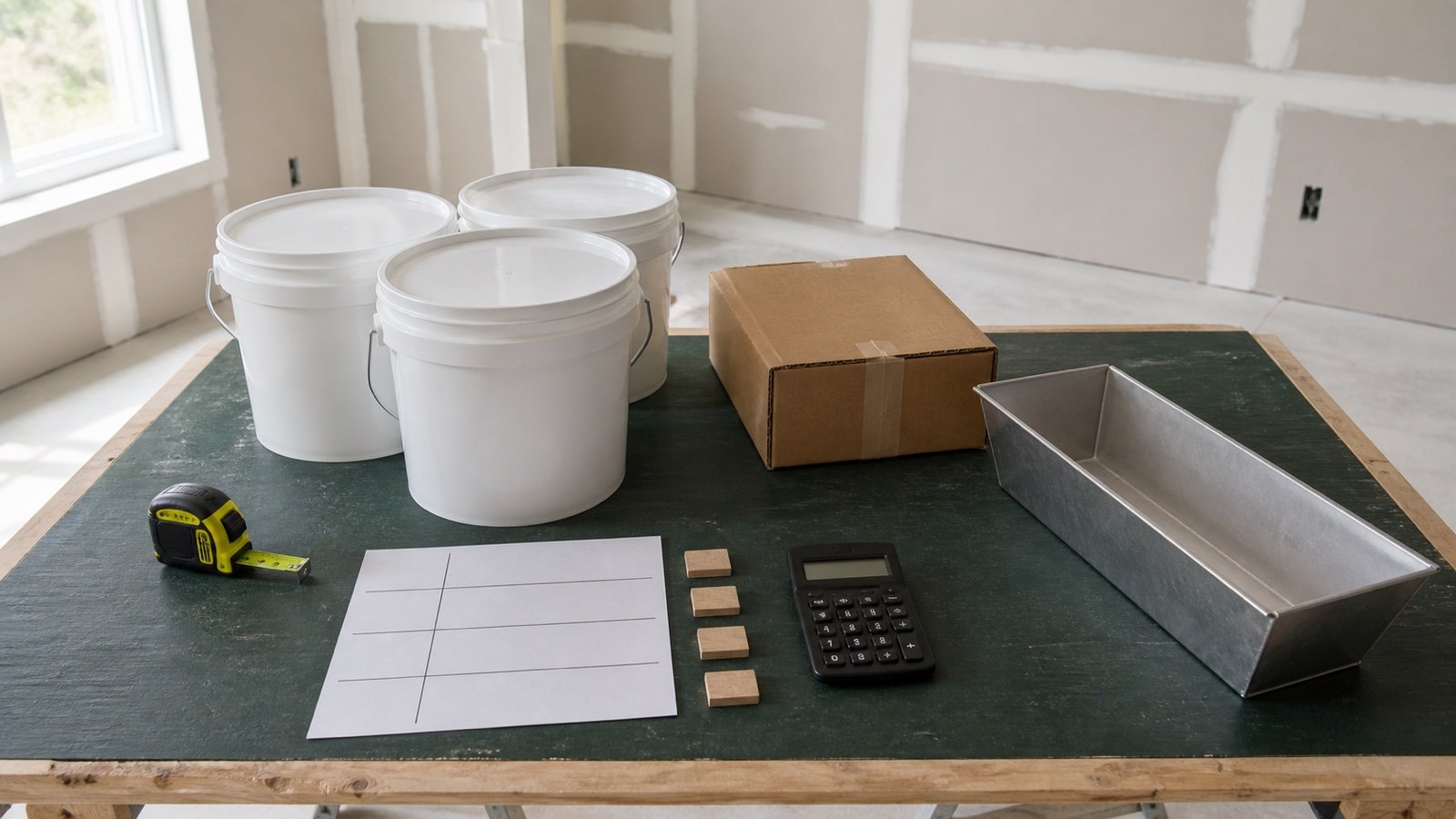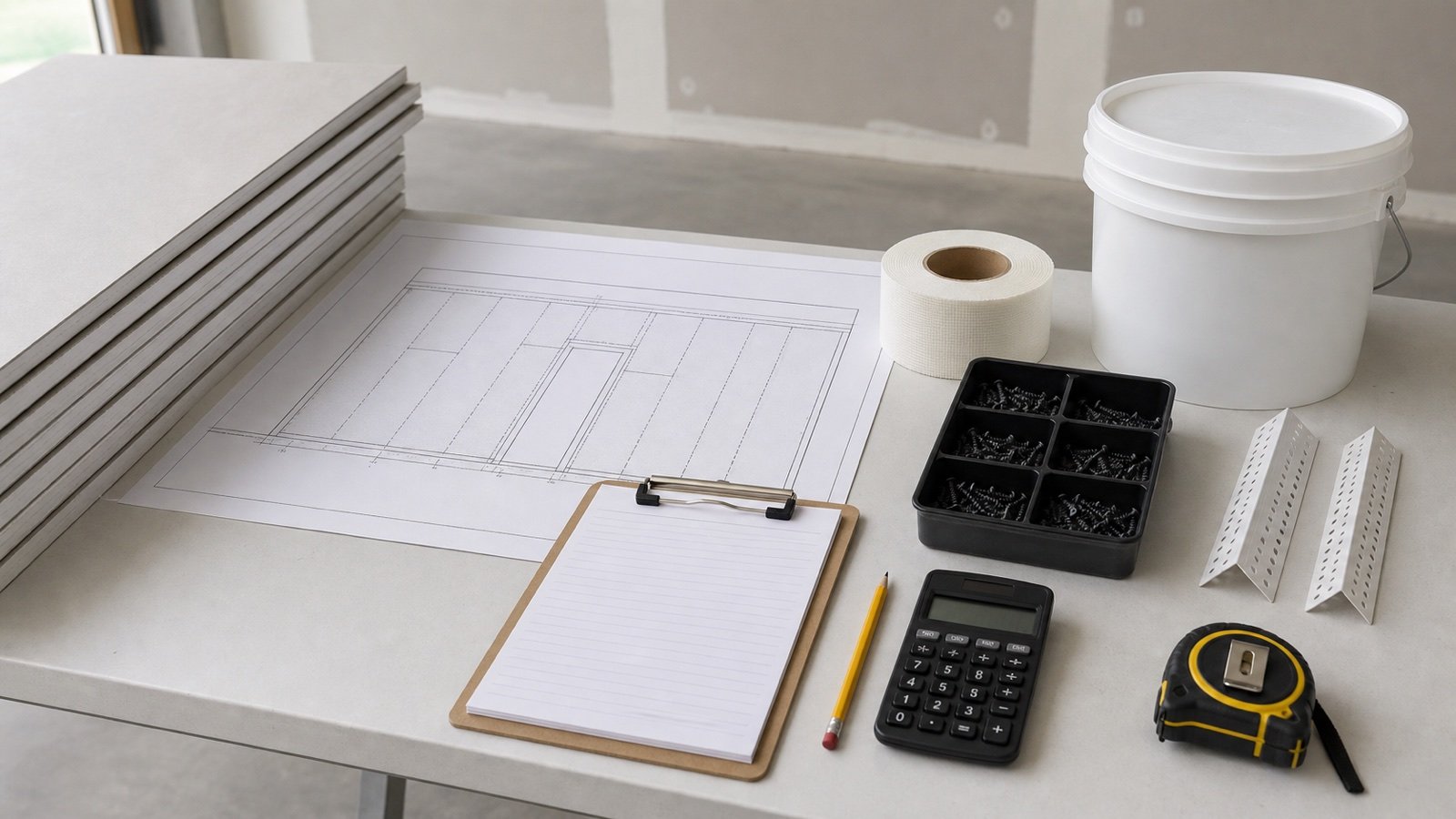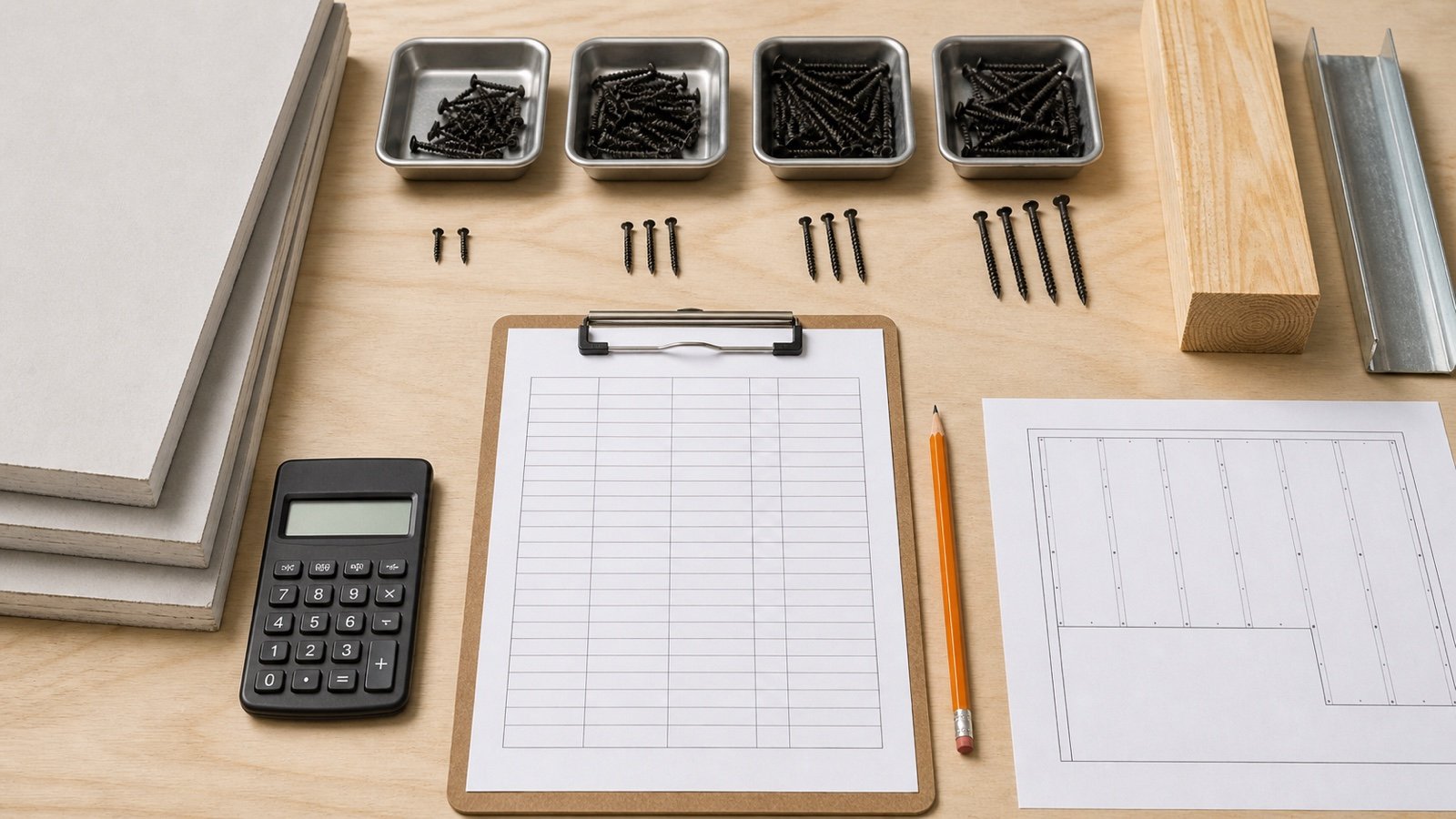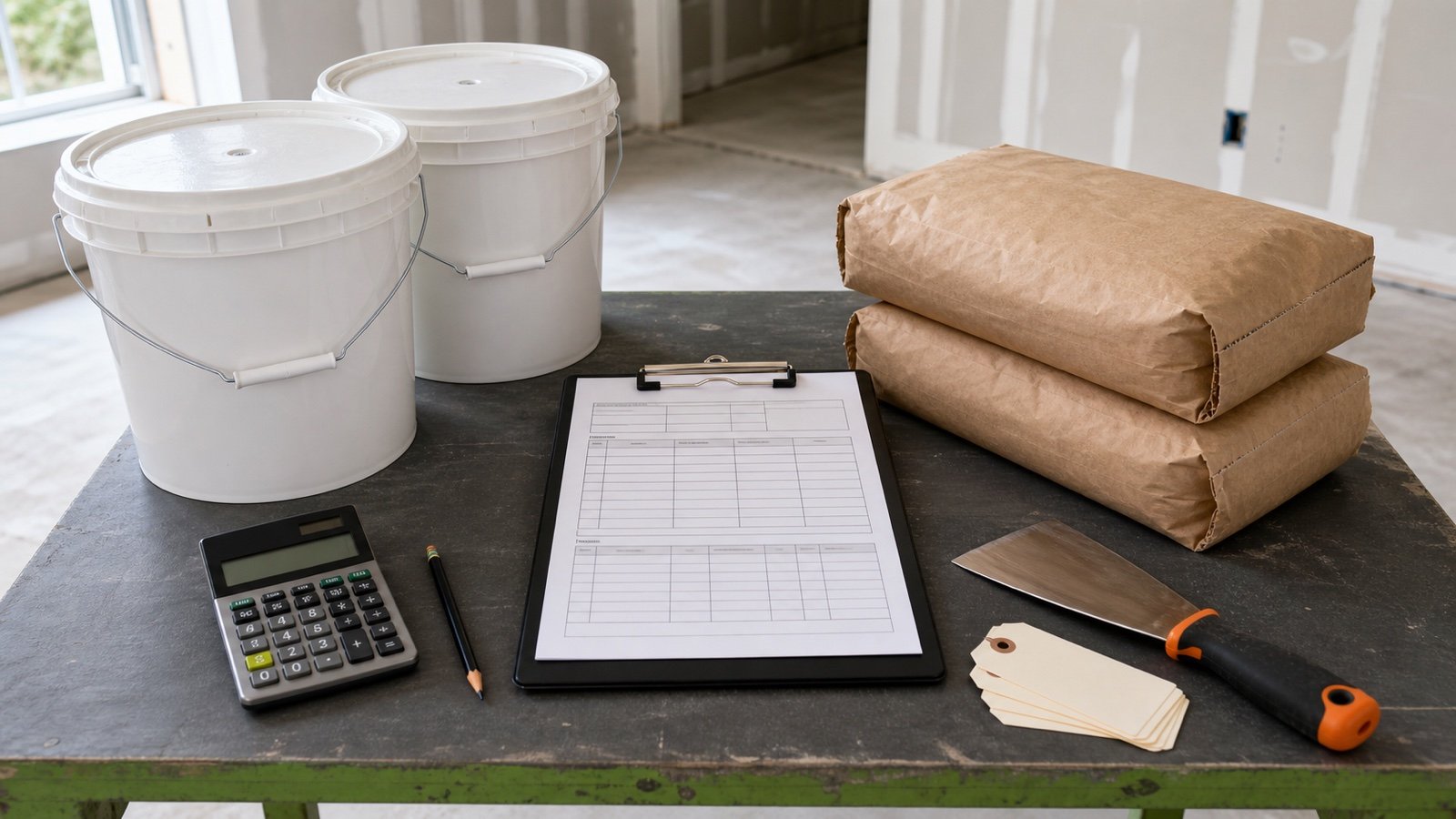
A joint compound total becomes hard to check when one job uses ready-mix for finishing, setting compound for prefills and stock left from an earlier area. Each product needs its own quantity state, package and field record.
This worksheet carries calculated quantities into purchasing, receiving and closeout. It keeps gallons with pails, dry pounds with bags and accepted site stock with the exact product it belongs to.
What should a joint compound ordering worksheet include?
A useful worksheet includes one row per exact product and application. Each row records the measured scope, manufacturer coverage, base amount, approved allowance, verified stock, package size, whole packages, supplier line, received quantity and field balance.
Do not combine ready-mix pails and setting-compound bags into one compound total. The Drywall Joint Compound Calculator calculates each product row before the worksheet reconciles the order.
A ready-mix row stays in gallons or litres. A dry setting-compound row stays in pounds, kilograms or whole named bags. Mixing water belongs in a batch record.
When should you use this worksheet?
Use it after the treated area, product and coverage record have been accepted. It fits projects that have several compounds, more than one delivery, existing stock, phased areas or a purchasing handoff between the estimator and site team.
The Drywall Material Takeoff Worksheet schedules panels, tape, fasteners, trims and compound. This page takes the compound rows from that broader takeoff through supplier release and field closeout.
Which documents belong beside the worksheet?
- Current drawings, finish schedule and accepted revision.
- Exact manufacturer product data and application scope.
- Coverage amount, reference area and every qualifier such as “approximately.”
- Current supplier package, stock status, market and quote date.
- Site stock count with product identity, condition and measured usable amount.
- Purchase order, delivery ticket, rejection note and return record.
A finish-level label cannot supply a universal compound rate. Use the joint compound coverage guide to select a product-specific record before filling the worksheet.
How should the worksheet columns be arranged?
Arrange columns in the order a quantity moves from scope to closeout. This exposes missing approvals before a buyer releases the order.
| Stage | Required fields | Check |
|---|---|---|
| Scope | Area or zone, application, drawing and finish revision | The row covers one stated treatment |
| Product | Manufacturer, exact product, product number and supplied form | The coverage and package belong to this product |
| Quantity basis | Treated area, coverage amount, reference area and unit | Area and product units are compatible |
| Planning | Base amount, allowance reason, planning amount and approver | Known extra work has a separate row |
| Stock | Unopened stock, accepted opened stock, condition and usable amount | Only matching usable material is deducted |
| Purchase | Package size, exact packages, whole packages and purchase remainder | Supplier package is current |
| Receiving | Ordered, delivered, rejected, short and accepted quantities | Delivery ticket matches the product row |
| Closeout | Issued, unused return, discarded material and usable balance | Next-job stock has a measured identity |
How do you calculate each order row?
Calculate one row from one accepted coverage record. Deduct verified usable stock before dividing by the current package size.
Base amount = treated area × product amount ÷ reference area
Planning amount = base amount × (1 + approved allowance ÷ 100)
Net purchase amount = max(0, planning amount − verified usable stock)
Whole packages = ceiling(net purchase amount ÷ current package size)
Purchase remainder = whole packages × package size − net purchase amount
Keep the unrounded package ratio beside the whole-package result. The allowance and package-rounding guide explains why a small quantity change can cross the next package boundary.
Worked example: ready-mix pails and setting-compound bags
This example has 2 independent product rows. It demonstrates purchasing arithmetic and does not say the products are interchangeable or approved for the same application.
Row A: ready-mix finishing compound
USG J963 gives its named Midweight ready-mix compound approximate coverage of 9.4 US gal per 1,000 ft² and lists a 4.5 gal pail among its package examples. The example assigns 1,000 ft² to that product, applies a documented 5% allowance and accepts 0.75 gal of matching usable stock.
- Base: 1,000 × 9.4 ÷ 1,000 = 9.4 US gal.
- Planning amount: 9.4 × 1.05 = 9.87 US gal.
- Net purchase: 9.87 − 0.75 = 9.12 US gal.
- Exact packages: 9.12 ÷ 4.5 = 2.0267 pails.
- Order: 3 pails, or 13.5 US gal.
- Purchase remainder: 13.5 − 9.12 = 4.38 US gal.
The source says package availability can vary by market. Confirm the actual supplier package before release.
Row B: setting compound
The ProForm Quick Set Lite sales sheet lists an 18 lb (8.2 kg) bag and approximate coverage of 325 ft² per bag. The example assigns 650 ft² to the named product record with no stock deduction.
- Exact bags: 650 ÷ 325 = 2.
- Whole bags: 2.
- Purchased dry mass: 2 × 18 = 36 lb.
- Nominal covered area: 2 × 325 = 650 ft².
Store the product's working and setting time outside the coverage field. Follow the water amount and mixing method printed for the selected package; added water does not increase the dry-package order.
| Product row | Quantity state | Verified stock | Order | Do not combine |
|---|---|---|---|---|
| Named ready-mix finish product | 9.12 US gal net | 0.75 US gal deducted | 3 × 4.5 gal pails | Dry bag mass |
| Named setting compound | 650 ft² through its bag-coverage record | 0 bags deducted | 2 × 18 lb bags | Ready-mix gallons or mixing water |
How should supplier alternatives be recorded?
Give every offered package or substitute a separate comparison line. Record the exact product, selling unit, availability date and whether the project accepts the change.
- Compare price only after quantities use the correct package and product scope.
- Keep pails and cartons separate when their volumes differ.
- Keep a proposed substitute pending until the controlling approval process accepts it.
- Recalculate whole packages after any product, coverage or package change.
A supplier's available 5 gal pail cannot replace a specified 4.5 gal product entry by editing the package cell alone. The product and coverage record must change together when the offered material changes.
How do receiving records change the order balance?
Receiving staff should compare delivered packages with the purchase row before adding them to site stock. Record shortages, wrong products, damaged seals and rejected packages as separate fields.
Accepted packages = delivered packages − rejected packages
Open order balance = ordered packages − accepted packages
Example: a purchase row orders 3 pails. The delivery brings 3, but 1 has a broken seal and the site rejects it. Accepted quantity is 2 pails and the open balance remains 1 pail. Do not count the rejected pail as usable stock.
How should field issue and leftover stock be closed out?
Record how many packages the store issued, how much unopened material returned and whether an opened balance passed the product and project condition checks. Give the usable balance a measured quantity and storage location.
| Record | Ready-mix example | Setting-compound example |
|---|---|---|
| Issued | Whole pails plus any accepted opened volume | Whole bags or controlled dry mass issued |
| Returned unopened | Sealed identified pails | Sealed identified bags |
| Opened balance | Measured same-product usable volume | Measured dry mass only when the package condition and procedure permit reuse |
| Discarded or rejected | Separate reason and quantity | Set, contaminated, wet or otherwise rejected material recorded separately |
| Next stock entry | Product, amount, location, date and condition | Product, mass, location, date and condition |
USG J963 tells users to keep its container sealed, protect it from freezing and extreme heat, check production date codes and rotate stock first in, first out. Apply those instructions only to the named product. Use the current data and safety sheet for every other item.
Which worksheet mistakes create wrong orders?
- Combining gallons and dry pounds into one compound total.
- Using a finish level as the coverage rate without an exact product record.
- Changing the package size without checking the offered product.
- Deducting opened stock without product, condition and usable-amount checks.
- Counting rejected delivery packages as accepted stock.
- Hiding a known skim coat, repair or change order inside a percentage allowance.
- Adding package remainder to the approved allowance.
- Using a bag's set-time number as coverage or package mass.
- Refreshing the review date without checking the source, arithmetic and supplier record.
Safety, specification and geographic limits
Read the current product data and safety data before handling, mixing, applying, cleaning or sanding joint compound. OSHA states that dry sanding can create high nuisance-dust exposure and that long work in dusty conditions can change silica-standard obligations. NIOSH reports that the 5 vacuum-sanding controls in its cited tests reduced dust exposure by 80% to 97%.
This worksheet does not select a finish level, joint system, compound, batch ratio, exposure control, storage acceptance rule or substitute. Project documents, accepted submittals, manufacturer instructions, supplier records and applicable workplace requirements control those decisions.
Return to the Drywall material planning hub for the sheet and compound tools. The calculation methodology explains source, unit and rounding controls. Send a source or arithmetic issue through the corrections route.
Sources and source scope
- USG Sheetrock Midweight Joint Compound J963: named ready-mix coverage, package examples, market limits and storage controls.
- USG joint-finishing coverage FAQ: named approximate pail estimate for UltraLightweight All Purpose compound.
- ProForm Quick Set Lite sales sheet: named 18 lb bag and approximate 325 ft² per bag record.
- National Gypsum ProForm literature page: current official sales-sheet location.
- National Gypsum setting-compound mixing guide: package-directed water, clean tools, mixing sequence and working-time controls.
- OSHA silica-standard interpretation: US construction scope for joint-compound sanding and exposure assessment.
- NIOSH Drywall Sanding, Hand Sanding: sanding-dust exposure and tested vacuum-control results.
Source scope: Manufacturer sources support their named products, packages, applications and qualifiers. OSHA and NIOSH support the stated US workplace context. The sources do not establish universal product interchangeability, allowance, stock usability, supplier acceptance, return terms, price or approved project quantity.
Review responsibility: Saleem Sial owns the research and editorial record. Source checks, independent worksheet fixtures, internal-link review, build validation, crawl, schema review and rendered QA form the internal publication gate. Waseem Sial, External Reviewer and Engineer, remains listed for ongoing external review; no completed external-review date is claimed.