A drywall corner-bead order starts after the product and cut plan are approved. The buyer still needs an exact item row, current selling unit, delivery record and clear disposition for damaged or surplus pieces.
Use one row for each manufacturer product, stock number, profile, material, stock length and attachment system. Keep quote, order, receipt and closeout quantities visible so a shortage or substitution cannot disappear inside one total.
What should a drywall corner-bead ordering worksheet contain?
Each row should identify the exact approved item, the calculated purchase need, the supplier's current selling increment and every quantity state through closeout. A person reading the row should be able to match it to the takeoff, quote, delivery ticket and stored material.
| Field group | Record | Check against |
|---|---|---|
| Project | Area, level, room, detail and drawing revision | Current project documents |
| Approved item | Manufacturer, product, stock number, profile, material, length and attachment system | Accepted submittal or product record |
| Takeoff | Base pieces, allowance pieces, matching stock and purchase need | Checked cut list and calculator result |
| Quote | Supplier item, selling unit, package quantity, quote date, expiry and stated terms | Current written quote |
| Order | Packages, ordered pieces, required date and delivery location | Purchase order |
| Receipt | Delivered, accepted, rejected, short and backordered pieces | Delivery ticket and inspection record |
| Closeout | Installed, returned, retained and transferred pieces | Return document and stock ledger |
Which record should be prepared first?
Build the run list, select the product and approve the stock-piece count before creating the purchase row. The ordering worksheet receives a checked result. It does not decide which profile or cut arrangement the project accepts.
- Measure and group complete runs with the drywall corner-bead measurement guide.
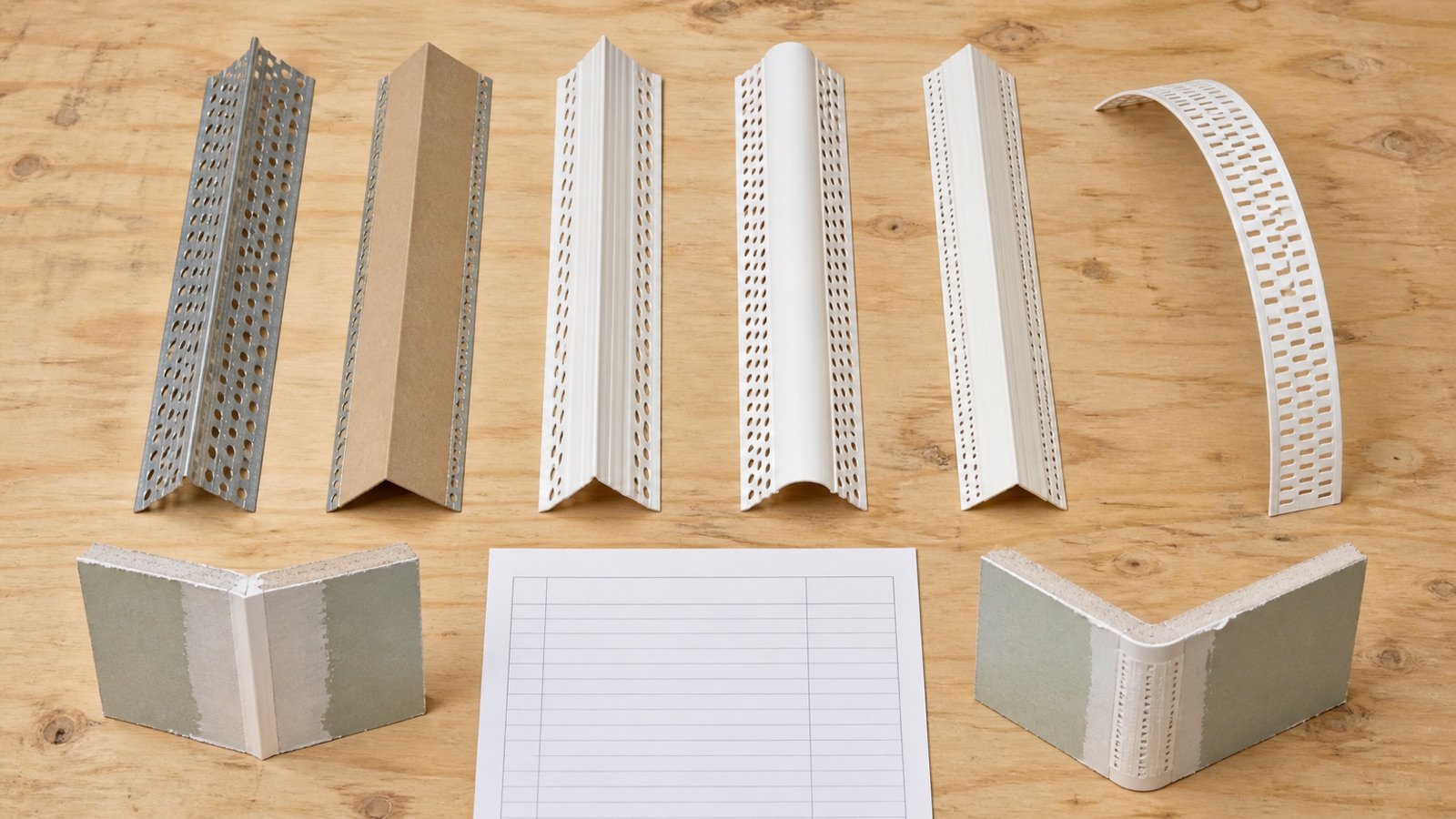
- Separate each approved profile and attachment system with the corner-bead type guide.
- Use the Drywall Corner Bead Calculator to calculate base pieces, allowance, matching stock, purchase pieces and packages.
- Review the corner-bead allowance record before accepting extra pieces.
- Transfer one approved item and its result into one order row.
Why does each exact product need a separate row?
Length alone cannot identify drywall corner bead. The row also needs the profile, material, nose or radius, attachment system, finish or exposure scope, and manufacturer item number used by the project and supplier.
Trim-Tex lists 8 ft, 9 ft and 10 ft Mud Set Rigid items under different stock numbers, each at 50 pieces per box. Grip-Rite lists 8 ft, 9 ft, 10 ft and 12 ft metal-bead SKUs with carton counts of 63, 56, 50 and 42 for the displayed shiny-finish items. These product records show that package math belongs to an exact item and length.
| Changed field | Reason for separation |
|---|---|
| Stock or SKU number | The supplier and manufacturer identify another item |
| Profile, angle or radius | The corner geometry changes |
| Metal, paper-faced, vinyl or composite | Material and installation requirements can differ |
| Attachment system | Compound-set, adhesive, fastened and other systems are not automatic substitutes |
| Stock length | Complete cuts and pieces per carton can change |
| Selling increment | Package count and remainder change |
| Finish or exposure scope | The approved use can change |
How do you transfer calculator results into the order?
Copy the approved planning pieces, matching stock and purchase need without recalculating them in the buyer's sheet. Then apply the exact selling unit from the current quote once.
Purchase need = maximum(0, base pieces + allowance pieces − usable matching stock)
Whole packages = ceiling(purchase need ÷ current pieces per package)
Ordered pieces = whole packages × pieces per package
Package remainder = ordered pieces − purchase need
Enter 1 piece per package only when the supplier confirms individual-piece sales. Trim-Tex says it ships full boxes to dealers, while a local dealer may sell smaller quantities. The current quote controls the actual order.
Worked example: 17 pieces from 10-piece packages
A checked cut plan needs 18 base pieces of one approved 8 ft item. The accepted allowance is 1 full piece, and the site has 2 usable matching pieces. The current supplier quote states 10 pieces per selling package.
- Planning need:
18 + 1 = 19 pieces. - Purchase need:
19 − 2 = 17 pieces. - Packages ordered:
ceiling(17 ÷ 10) = 2 packages. - Ordered pieces:
2 × 10 = 20 pieces. - Package remainder:
20 − 17 = 3 pieces.
The order row shows all 5 numbers. The buyer keeps the 17-piece purchase need visible because the 3-piece difference came from the selling increment.
What quote details should be checked before purchase?
Match the quoted supplier item to the approved product row. Record commercial terms from the current quote without carrying them forward as permanent product facts.
- Supplier item code and manufacturer stock number.
- Product name, profile, material, attachment system and stock length.
- Individual piece, box, carton, bundle or pallet selling unit.
- Pieces in the quoted unit and minimum-order quantity.
- Price basis, currency, tax, freight, unloading and delivery location.
- Quote date, expiry, stated lead time and required-on-site date.
- Return, restocking, cancellation and special-order terms.
- Partial-package or broken-carton availability.
Clinch-On states that its special-length orders need advance notice, full-carton quantities and have a no-return policy. That condition belongs to its stated special-length process. Copy the terms from the supplier's current quote for the item you will buy.
How should 2 supplier quotes be compared?
Compare matching items and delivered scope. A lower unit figure can describe another stock length, package size, finish, freight basis or return condition.
| Check | Quote A | Quote B |
|---|---|---|
| Exact manufacturer item | Match or approved exception | Match or approved exception |
| Stock length and pieces per unit | Copy stated values | Copy stated values |
| Order quantity | Whole stated units | Whole stated units |
| Delivered price basis | Include stated freight and fees | Include stated freight and fees |
| Required date | Supplier commitment | Supplier commitment |
| Return and cancellation terms | Copy stated terms | Copy stated terms |
Keep a changed item on a separate comparison row. Send an unresolved technical difference for project approval before award.
How should a proposed substitution be handled?
Put a proposed replacement on hold until the responsible project party accepts it. Record the supplier proposal, reason, date and supporting product documents beside the original approved row.
- Keep the original product row unchanged.
- Create a pending substitution row for the proposed manufacturer item.
- Compare profile, dimensions, material, attachment, finish, exposure, compatibility and required project performance.
- Recalculate stock pieces and packages if stock length or selling increment changes.
- Record the approval, rejection or requested revision and the person responsible.
- Release only the accepted row for purchase.
A supplier's statement that 2 items are similar does not update the project documents. Quantity planning also cannot approve a structural, fire, sound, movement, corrosion or finish-system change.
What should be checked when the delivery arrives?
Match the delivery ticket and physical material to the purchase row before moving pieces into usable stock. Count sealed units and inspect opened, loose or visibly damaged material under the site's receipt procedure.
- Purchase-order row and delivery-ticket item.
- Manufacturer label, product name and stock number.
- Profile, material, attachment system, finish and stock length.
- Packages delivered and pieces in each opened unit.
- Bent, dented, twisted, wet, contaminated, torn or otherwise suspect material.
- Short shipment, overage, backorder and unauthorized substitution.
- Accepted storage location and rejected-material location.
- Photos, ticket notes and supplier notification when required.
Keep a suspect piece in a rejected or quarantined count until the supplier and project process resolve it. Do not subtract it from the shortage or add it to usable stock at the same time.
Worked example: accepted, rejected and surplus pieces
The 2-package order in the first example delivers all 20 pieces. Receipt inspection accepts 19 and quarantines 1 bent piece. The site already has the 2 matching stock pieces that were deducted during estimating.
- Delivered pieces: 20.
- Rejected or quarantined pieces: 1.
- Accepted delivery:
20 − 1 = 19 pieces. - Usable quantity available:
19 accepted + 2 site stock = 21 pieces. - Planning need: 19 pieces.
- Accepted usable surplus:
21 − 19 = 2 pieces.
The ledger shows 2 usable surplus pieces and 1 separate rejected piece. A supplier credit or replacement for the rejected piece remains open until a document closes it.
How should staged deliveries and backorders be recorded?
Keep the original ordered quantity fixed and add dated receipt lines. Each line shows delivered, accepted, rejected and backordered pieces for the same purchase row.
Example: an order for 50 pieces receives 30 accepted pieces on Monday and 20 on Friday. If 2 Friday pieces are rejected, the accepted total is 48 and the unresolved shortage is 2. Record any promised replacement date as pending until the material arrives and passes the same check.
A revised required date or split shipment can affect work planning and freight. Record those commercial effects from the supplier and project documents; do not hide them inside quantity allowance.
Can package remainders be returned?
Return eligibility depends on the current supplier terms, product condition, package state, order type and return window. Record the decision after receipt. Never assume every full piece or sealed carton is returnable.
| Disposition | Required record |
|---|---|
| Return | Supplier authorization, quantity, condition, date, fees and credit reference |
| Project spare | Exact product, full or cut length, condition and storage location |
| Transfer to stock | Receiving stock ID, quantity, product identity and custodian |
| Use on approved revision | Revision reference and installed location |
| Reject or dispose | Cause, quantity, approval and required handling record |
Opened cartons, loose sticks, special lengths and made-to-order items may carry different terms. The written supplier authorization settles the transaction.
Worked example: 2 different products
Item A needs 7 pieces and the quote sells 5-piece packages. Item B needs 4 pieces and the quote sells 6-piece packages.
- Item A:
ceiling(7 ÷ 5) = 2 packages, 10 pieces ordered and 3 pieces of package remainder. - Item B:
ceiling(4 ÷ 6) = 1 package, 6 pieces ordered and 2 pieces of package remainder.
The worksheet keeps 2 order rows and 2 remainder records. The 3 pieces from Item A cannot satisfy the 4-piece need for Item B because the item identities differ.
Which ordering mistakes cause weak records?
- Ordering from a family name without the exact stock number.
- Using one carton count for every stock length.
- Combining square, bullnose, offset, reveal and flexible products.
- Applying package rounding before deducting accepted matching stock.
- Replacing purchase need with ordered pieces and losing the remainder.
- Accepting a substitution without a separate product check.
- Moving a damaged delivery into usable stock before resolution.
- Counting the same rejected piece as a shortage and a usable remainder.
- Assuming last month's price, lead time or return terms remain current.
- Closing the order without recording returns and transferred stock.
What should the final worksheet show?
| Quantity | Meaning | Source document |
|---|---|---|
| Planning pieces | Base plus approved allowance | Checked takeoff |
| Usable matching stock | Accepted stock deducted before purchase | Stock inspection |
| Purchase need | Planning pieces less matching stock | Calculator result |
| Ordered pieces | Whole selling units released to supplier | Purchase order |
| Accepted delivery | Received pieces admitted to usable stock | Delivery inspection |
| Rejected or quarantined | Pieces awaiting disposition | Dispute or rejection record |
| Returned | Material accepted back by the supplier | Return authorization and credit |
| Retained or transferred | Unused matching pieces placed in named stock | Closeout stock ledger |
Add the final row to the drywall material takeoff worksheet so panels, tape, compound, fasteners and corner bead remain coordinated without merging their selling units.
Safety, specification and supplier limits
This worksheet tracks quantities and transaction states. It does not select a bead, approve a substitution, accept damaged material, set an attachment schedule or replace project drawings, specifications, current product instructions and responsible professional review.
Long metal or rigid trim can have sharp edges and can bend during handling. Follow the selected manufacturer's safety information and the site's controls for lifting, cutting, personal protective equipment, storage and damaged-material isolation.
Return to the Drywall planning hub for related tools and guides. Review the calculation methodology or report a formula, source or content issue through the corrections route.
Sources and source scope
- Trim-Tex Mud Set Rigid Corner Bead: named stock numbers, lengths and box quantities for one product family.
- Trim-Tex FAQ: product-specific package variation, full-box manufacturer shipments, possible smaller dealer quantities and local price variation.
- Grip-Rite Corner Bead: named length-specific SKUs and carton-count examples.
- Clinch-On FAQs: the manufacturer's stated special-length lead time, carton minimum and return condition.
- ASTM C1047-19: public scope and condition context for gypsum-wallboard accessories.
Source scope: manufacturer pages support their named products and displayed terms. ASTM supports its published scope. These sources do not approve this worksheet's examples, verify a local quote, accept a substitution, guarantee stock or establish universal price, delivery or return terms.
Review note: Saleem Sial owns the research and editorial record. Source checks, independent fixtures, page tests, build validation, link crawl, schema review and rendered QA form the internal publication gate. Waseem Sial, External Reviewer and Engineer, is listed for ongoing external review; no completed review date is claimed.