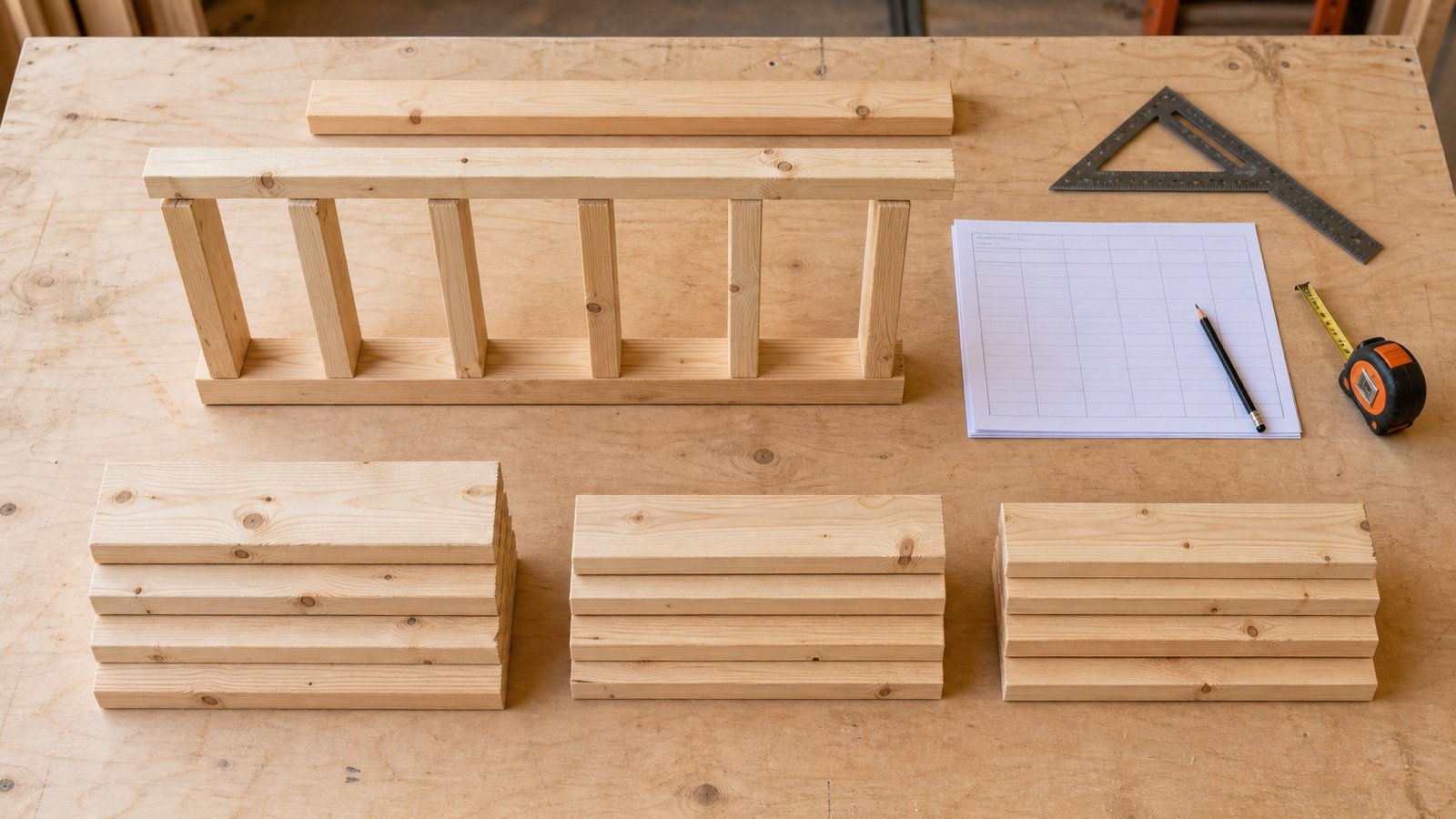
A wall-plate calculator gives you a length-based piece count. The purchase order still needs a matching lumber product, quoted stock length, feasible segment plan and supplier selling unit.
Close the order in 4 stages: verify the product row, check cuts against stock, apply the supplier quote and reconcile what the crew accepts at delivery.
How do you turn a wall-plate estimate into a lumber order?
Group the checked planning length by plate role, complete product identity and quoted stock length. Round each group to whole pieces, deduct only accepted matching stock, test the required segments and apply any supplier increment stated in the quote.
| Stage | Required record | Output |
|---|---|---|
| 1. Product row | Plate role, size, grade, species group, seasoning, treatment and wall/detail references | One auditable material group |
| 2. Stock and cuts | Quoted stock length and every required segment | Length-based and segment-checked pieces |
| 3. Supplier order | Selling increment, minimum, quote date, price, lead time and delivery basis | Pieces or packs to order |
| 4. Receiving | Delivered, accepted, quarantined, returned and short quantities | Usable project stock and open issues |
Keep bottom and top plate rows separate unless all product fields and stock lengths match. The role should remain visible after consolidation so a revision can trace the affected walls.
Which product details belong on the order row?
Copy the complete product requirement from the current project documents and match it to the supplier item. A label such as 2x4 plate does not identify grade, species group, seasoning, treatment or length.
NIST PS 20-25 lists the core information on an American Lumber Standard grade mark: mill identification, grading agency symbol, species or species group, dry or green state when manufactured, and grade. Record the fields needed by the project and purchase contract.
| Field | Ordering check |
|---|---|
| Plate role | Bottom, first top, upper top or separate lumber tie |
| Nominal and required dimensions | Match the drawing, specification and supplier description |
| Grade and species group | Match the accepted requirement and grade mark |
| Seasoning or moisture designation | Match the specified product condition |
| Treatment and end use | Match the accepted location and quality mark |
| Stock length | Use the current quoted supplier item |
| Wall and detail references | Keep affected IDs and revision with the row |
The 2021 IRC Section R317 gives an edition-specific example of additional quality-mark fields for preservative-treated lumber, including treating plant, preservative, retention, end use, treatment standard and inspection agency. The current locally adopted requirements and project specification control the actual product.
Which wall-plate stock length should you order?
Select from matching lengths that the supplier confirms for the required product. Compare the whole-piece count, segment feasibility, handling limits, delivery access and leftover usefulness.
No universal plate stock length fits every yard or project. Availability can change by species group, grade, treatment, region, branch and delivery date. Record the supplier, branch, item, quote date and quote expiry.
| Check | Record |
|---|---|
| Matching item | Supplier SKU or complete written description |
| Available lengths | Each quoted full stock length |
| Length-based pieces | Planning length divided by that stock length, rounded up |
| Segment-checked pieces | Pieces needed after assigning required cuts |
| Selling unit | Piece, pack, bundle or stated minimum |
| Logistics | Truck, unloading, site access and storage constraints |
| Quote status | Date, expiry, lead time, price and delivery basis |
A longer board can reduce joints or cut waste in one row and create a handling problem in another. Ask the designer or responsible authority before a stock choice changes an accepted splice or connection arrangement.
How is the length-based piece count calculated?
Divide the checked planning length by the matching stock length and round up. Treat the result as a lower bound until the segment plan passes.
Length-based pieces = ceiling(planning length ÷ matching stock length)
Pieces before supplier increment = maximum(0, length-based pieces − usable matching full pieces)
The Wall Plate Calculator performs this arithmetic for separate bottom and top rows. Prepare the wall inputs with the wall-plate takeoff worksheet.
Worked example: usable stock and a supplier increment
A checked top-plate row needs 86 ft after measured detail additions and its documented allowance. The matching quoted stock length is 16 ft. One accepted, full 16 ft piece remains in usable project stock. The example supplier sells this item in 2-piece increments.
Length-based pieces = ceiling(86 ft ÷ 16 ft) = 6
Pieces before increment = 6 − 1 = 5
Order pieces = ceiling(5 ÷ 2) × 2 = 6
Available length after receipt = (1 + 6) × 16 ft = 112 ft
Length surplus = 112 ft − 86 ft = 26 ft
| Field | Value | Evidence |
|---|---|---|
| Planning length | 86 ft | Checked takeoff row |
| Stock length | 16 ft | Matching supplier item |
| Usable stock | 1 full piece | Accepted stock inspection |
| Selling increment | 2 pieces | Example supplier quote |
| Order | 6 pieces | Rounded after the stock deduction |
The 2-piece increment belongs to this example. Enter the actual supplier rule for the current item. The 26 ft surplus also needs a cut check; it does not promise 26 ft of reusable segments.
Why can a cut list require more pieces than total length?
Total-length division assumes every remainder can serve another required segment. Long required segments can block that reuse.
Suppose the accepted cut record needs 14 ft, 14 ft, 14 ft, 14 ft and 8 ft segments. Their total is 64 ft, so dividing by 16 ft stock returns 4 pieces. Each 14 ft segment consumes one stock piece, and the 8 ft segment needs another. The cut plan needs 5 pieces.
| Method | Calculation | Result |
|---|---|---|
| Length-based lower bound | ceiling(64 ft ÷ 16 ft) | 4 pieces |
| Required segment assignment | Four 14 ft cuts plus one 8 ft cut | 5 pieces |
| Order basis before usable stock | Use the higher checked result | 5 pieces |
The wall-plate splices, laps and intersections guide explains how to preserve joint stations and assign detail additions before you build this cut list.
How should allowance be added to a wall-plate order?
Use an allowance that names the planning risk and approval source. Keep measured laps, returns and intersection pieces in the base requirement.
| Risk | Evidence to record |
|---|---|
| Cut loss | Reviewed segment plan and unusable remainder pattern |
| Delivery or handling damage | Project experience, handling method and supplier terms |
| Defect rejection | Project acceptance criteria and receiving history |
| Revision reserve | Known design uncertainty and responsible approval |
| Repair or future spare stock | Specified handover quantity and matching product identity |
One percentage can hide several unrelated assumptions. Record the reason even when the calculator accepts one combined allowance input.
When does stored lumber count as usable stock?
Count a stored piece after it matches the order row and passes the project acceptance check. The calculator's usable-stock field represents full pieces of the entered stock length.
- Match plate role, dimensions, grade, species group, seasoning and treatment.
- Confirm the full usable length after damage, holes, notches and prior cuts.
- Check the grade or treatment mark required by the project.
- Confirm that another wall or delivery phase has not claimed the piece.
- Record short offcuts in a segment inventory instead of the full-piece field.
A board with the correct dimensions can still belong to a different product row. Keep disputed or damaged lumber outside usable stock until the responsible person accepts it.
Which supplier terms belong with the order?
Attach the dated quote and preserve the terms that change quantity, timing or cost. Current pricing and availability cannot come from a generic article.
| Field | Why it changes the handoff |
|---|---|
| Supplier and branch | Availability can differ by location |
| Item description or SKU | Confirms the product group |
| Stock length and selling unit | Controls whole-piece and pack rounding |
| Minimum order | Can exceed the raw requirement |
| Price and taxes | Need the quote's currency and basis |
| Delivery fee and unloading basis | Changes cost and site preparation |
| Lead time and delivery window | Controls phase planning |
| Return and damage terms | Controls receiving evidence and claim handling |
| Quote date and expiry | Defines when the commercial data was current |
How should wall plates be checked at delivery?
Reconcile the delivered quantity against the purchase row before the crew mixes, cuts or installs the lumber. Separate accepted, quarantined, returned and short pieces.
- Confirm the delivery ticket, supplier item and stock length.
- Count pieces by product row and selling unit.
- Check identifying marks required by the order.
- Inspect visible damage, full length and usable condition.
- Photograph and isolate disputed material under the project procedure.
- Record accepted, quarantined, returned and shortage quantities.
- Update usable stock only with accepted pieces.
NIST PS 20-25 contains a defined complaint and reinspection framework for lumber sold under its applicable grading rules. It directs a buyer to keep disputed lumber intact and protected, and it gives specific time windows for stated tally, grade, size and moisture complaints. Check the current purchase contract, grading rules and legal requirements before handling a claim.
How should delivery shortages and damage change the order record?
Keep the original order, delivery result and replacement action as separate entries. A receiving shortage does not change the checked design requirement.
| Status | Record |
|---|---|
| Ordered | Issued purchase quantity and revision |
| Delivered | Physical pieces received |
| Accepted | Pieces released to usable project stock |
| Quarantined | Disputed pieces held intact under the project procedure |
| Returned | Pieces transferred back to the supplier |
| Short | Ordered quantity missing from delivery |
| Replacement | New supplier commitment, item and date |
Link the replacement to the same product row. Create a new row when the supplier proposes another size, grade, species group, seasoning, treatment or stock length.
Which wall-plate ordering shortcuts need evidence?
| Unverified entry | Required check |
|---|---|
| Use one stock length for bottom and top plates | Compare complete product rows and current availability |
| Add a fixed waste percentage | Name the risk and supporting record |
| Use calculator pieces as the final order | Complete the segment assignment |
| Deduct all lumber on site | Match identity, full length, condition and commitment |
| Round to a bundle shown online | Use the current supplier quote for the exact item |
| Accept a longer product as equivalent | Confirm design, specification, handling and supplier terms |
| Mix disputed pieces into the framing pile | Follow the purchase and inspection procedure |
What should the final wall-plate order package contain?
Issue the purchase order with enough evidence for the buyer, receiving crew and reviewer to reproduce the quantity.
- Current drawing and specification revision.
- Wall IDs, plate role and accepted layer count.
- Complete product identity and matching stock length.
- Planning length, segment list and cut-plan piece count.
- Usable matching stock and its inspection record.
- Supplier quote, selling increment and final order quantity.
- Delivery location, unloading basis and required date.
- Receiving, quarantine, shortage and replacement fields.
Use the bottom plate versus top plate guide when the 2 roles have different products or layer rules.
Safety, design and code limits
This guide supports quantity planning and purchasing. It does not design the wall, select plate layers, approve splices, choose treatment, verify load paths, specify fasteners or accept a substitution.
Follow the current drawings, specifications, accepted design, manufacturer information and locally adopted requirements. Send product or connection changes to the designer or authority responsible for approval.
OSHA 1926.250 requires lumber stored in covered US construction workplaces to rest on level, solidly supported sills and remain stable and self-supporting. Plan unloading, access and storage for the quoted stock lengths and actual workplace.
Return to the Drywall planning hub for related wall and panel tools. Review the calculation methodology or report a source, formula or page issue through the corrections route.
Sources and source scope
- NIST PS 20-25: current American softwood-lumber grade-mark, inspection and reinspection context.
- NIST Handbook 44, 2026, Appendix C: exact unit-conversion reference.
- 2024 IRC Chapter 6: edition-specific model-code examples showing that plate arrangements and connections depend on wall conditions.
- APA Advanced Framing Construction Guide, Form M400: coordinated framing context in which plate quantity and connection details change together.
- 2021 IRC Chapter 3: edition-specific preservative-treated-lumber quality-mark and connector context.
- OSHA 1926.250: US construction-workplace lumber storage requirements.
Source scope: NIST supports lumber-standard and unit records. ICC and APA provide edition- and system-specific construction context. OSHA supports the cited US workplace-storage rule. Supplier price, availability and commercial terms need a dated quote. None of these sources approves the project order or wall design.
Review note: Saleem Sial owns the research and editorial record. Source checks, independent arithmetic, content tests, build validation, link crawl, schema review and rendered QA form the internal publication gate. Waseem Sial, External Reviewer and Engineer, is listed for ongoing external review; no completed review date is claimed.