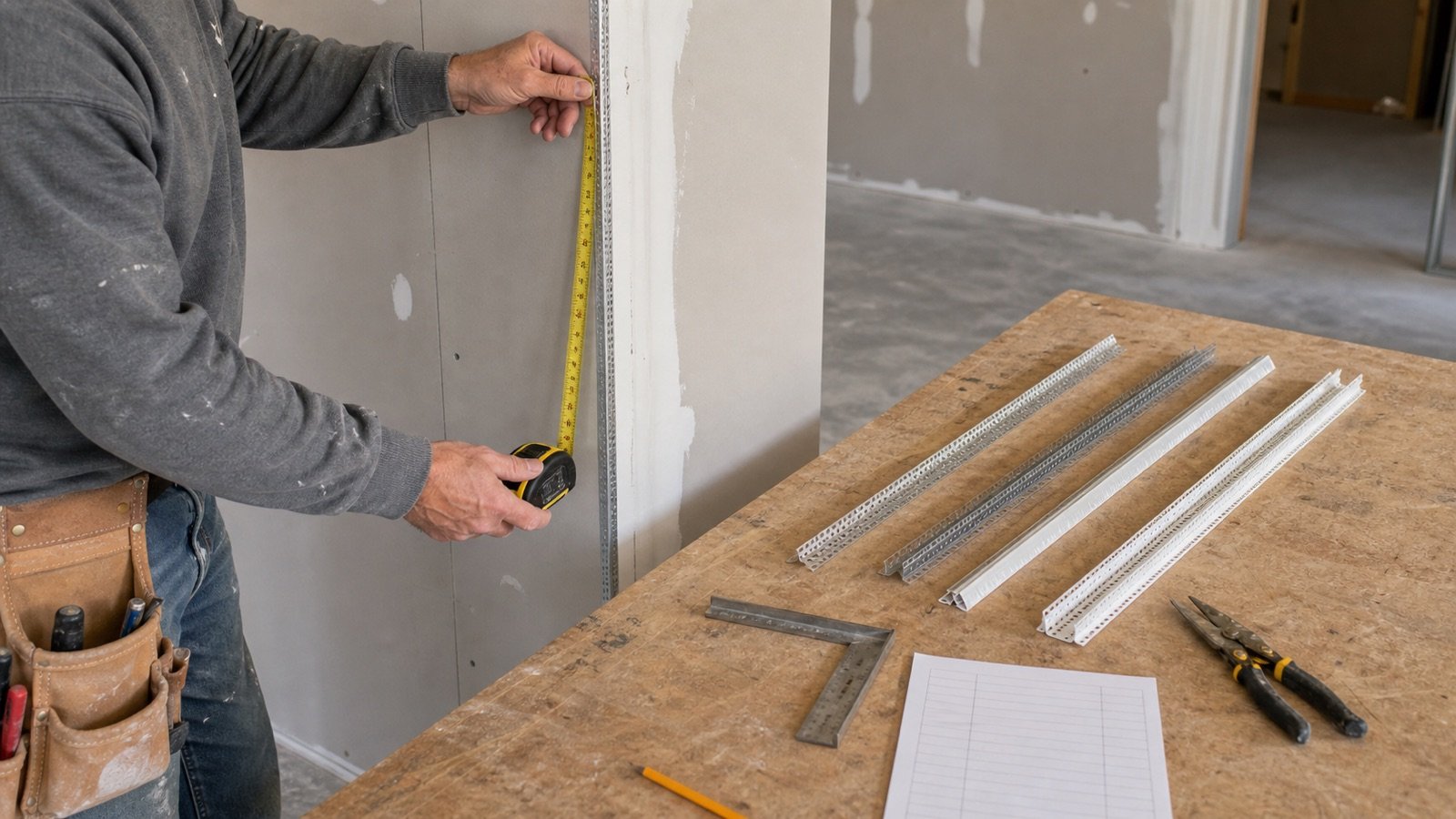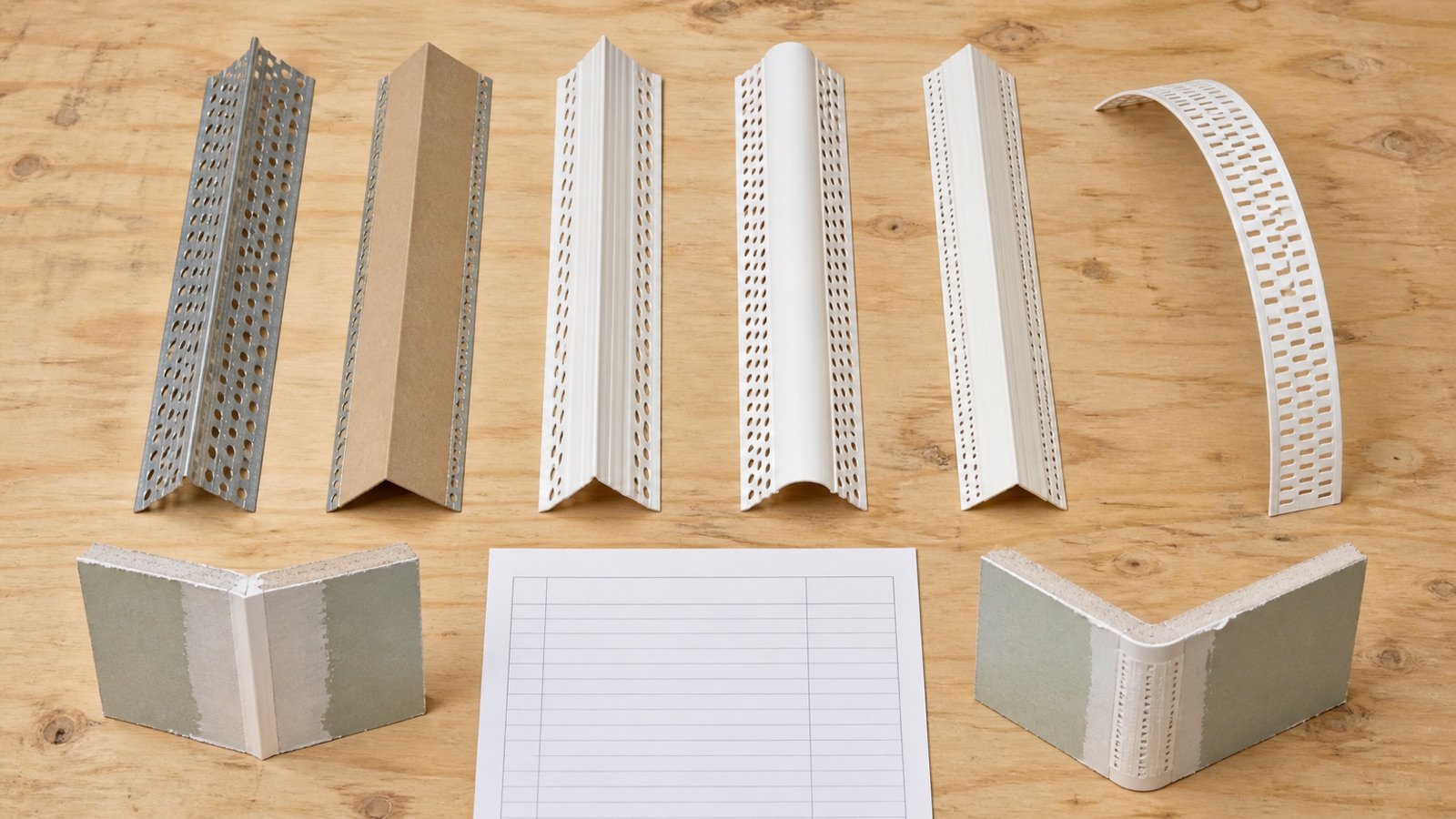
Drywall corner bead comes in several body materials, nose shapes and attachment systems. A correct selection starts with the corner detail, then identifies the exact product that matches its angle, curve, board thickness, finish and project requirements.
Keep each selected stock item on its own takeoff row. A 90-degree metal bead, a vinyl bullnose and a flexible archway bead can share a room, but they cannot share one stock-piece or package calculation.
Which drywall corner bead type should you choose?
Choose the product that matches 5 recorded facts: corner function, profile geometry, body material, straight or flexible form, and attachment system. Confirm the current submittal and installation instructions before measuring stock or approving a substitution.
| Decision | Record | Takeoff effect |
|---|---|---|
| Function | Outside corner, inside angle, exposed edge, reveal, transition or movement detail | Creates the correct accessory family |
| Geometry | Square, bullnose radius, chamfer, splayed, offset or another specified shape | Creates a separate profile row |
| Body | Bare metal, paper-faced metal, vinyl or another named composite | Identifies the product system |
| Form | Rigid straight piece, flexible stick or roll product | Changes measurement, cutting and stock handling |
| Attachment | Fastener, clinch, adhesive, compound embedment or a named combined method | Changes accessories and installation scope |
The project specification and accepted submittal control the final choice. Use the manufacturer category as a search aid, then copy the exact product name, stock number, length and package quantity into the takeoff.
How do metal, paper-faced metal and vinyl corner bead differ?
The body material describes one part of the product. It can affect shape, cutting method and approved application, while the current product instructions determine attachment, finish and exposure limits.
| Body family | What identifies it | Details to verify |
|---|---|---|
| Bare metal | A formed metal nose and flanges without a paper face | Metal type or coating, flange design, attachment method, fastener or clinch requirement, cut method and approved environment |
| Paper-faced metal | Paper tape laminated over a formed metal core or strips | Inside or outside use, angle, compound system, flange width, stock length and application tool |
| Vinyl | A formed rigid-vinyl body, sometimes with perforated or slotted mud legs | Straight or archway form, adhesive or mud-set method, profile, stock number, length and box quantity |
| Composite or reinforced tape | A paper or polymer face with reinforcing strips or a shaped core | Inside or outside use, permitted angle range, roll or stick form, compound compatibility and cut method |
USG describes its named paper-faced metal bead as paper tape laminated to a metal form. Its brochure lists square outside corners, bullnose profiles, offset corners, flexible tape and inside-corner products. Those items belong to one manufacturer family, yet they solve different geometries and use different stock formats.
Trim-Tex lists a named straight 90-degree vinyl bead and a separate pre-shaped archway item. The page also lists several straight-piece lengths from 6 ft 9 in through 12 ft. These are product examples, not default lengths for every vinyl bead.
Which profile matches the corner shape?
Match the bead nose and angle to the accepted architectural detail. The word “metal” or “vinyl” does not tell you whether the finished corner is square, rounded, chamfered or splayed.
| Profile or accessory | Condition | Record before ordering |
|---|---|---|
| Square outside corner | A straight outside corner with the selected nominal angle, often 90 degrees | Angle, nose shape, flange width, body and stock length |
| Bullnose | A rounded outside corner | Radius, outside or inside condition, caps, transitions and matching arch profile |
| Chamfer | A flat angled face across the corner | Chamfer dimensions, intersections and termination pieces |
| Splayed or offset | A corner that differs from the standard square profile | Accepted angle, orientation, leg dimensions and exact product |
| Flexible archway | A curved edge or arch | Arc path, minimum or permitted curve, stock form and transition to straight bead |
| Adjustable inside corner | An inside angle covered by a proprietary bead | Permitted angle range, inside orientation and finish method |
| L-bead or J-trim | An exposed board edge or abutment detail | Board-thickness fit, finish leg, tear-away strip if present and termination |
| Reveal or movement accessory | A specified gap, reveal, control or movement condition | Detail number, movement function, fire or acoustic scope and continuity |
ASTM C1047 covers accessories used with gypsum wallboard to protect edges and corners or provide architectural forms. That scope includes several accessory functions. It does not make a corner bead, edge trim and movement accessory interchangeable.
When does a straight bead become the wrong stock form?
A curved or changing-angle run needs a product whose current documents permit that geometry. Record the measured arc or angle, the permitted bend, the straight-to-curve transition and any limit on joints before assigning stock.
USG lists flexible metal tape in 25 ft and 100 ft rolls and a separate flexible outside-corner bead in 8 ft and 10 ft lengths. Trim-Tex lists a 10 ft archway item beside its straight 90-degree bead. These examples show why “flexible bead” still needs a manufacturer, stock number and form.
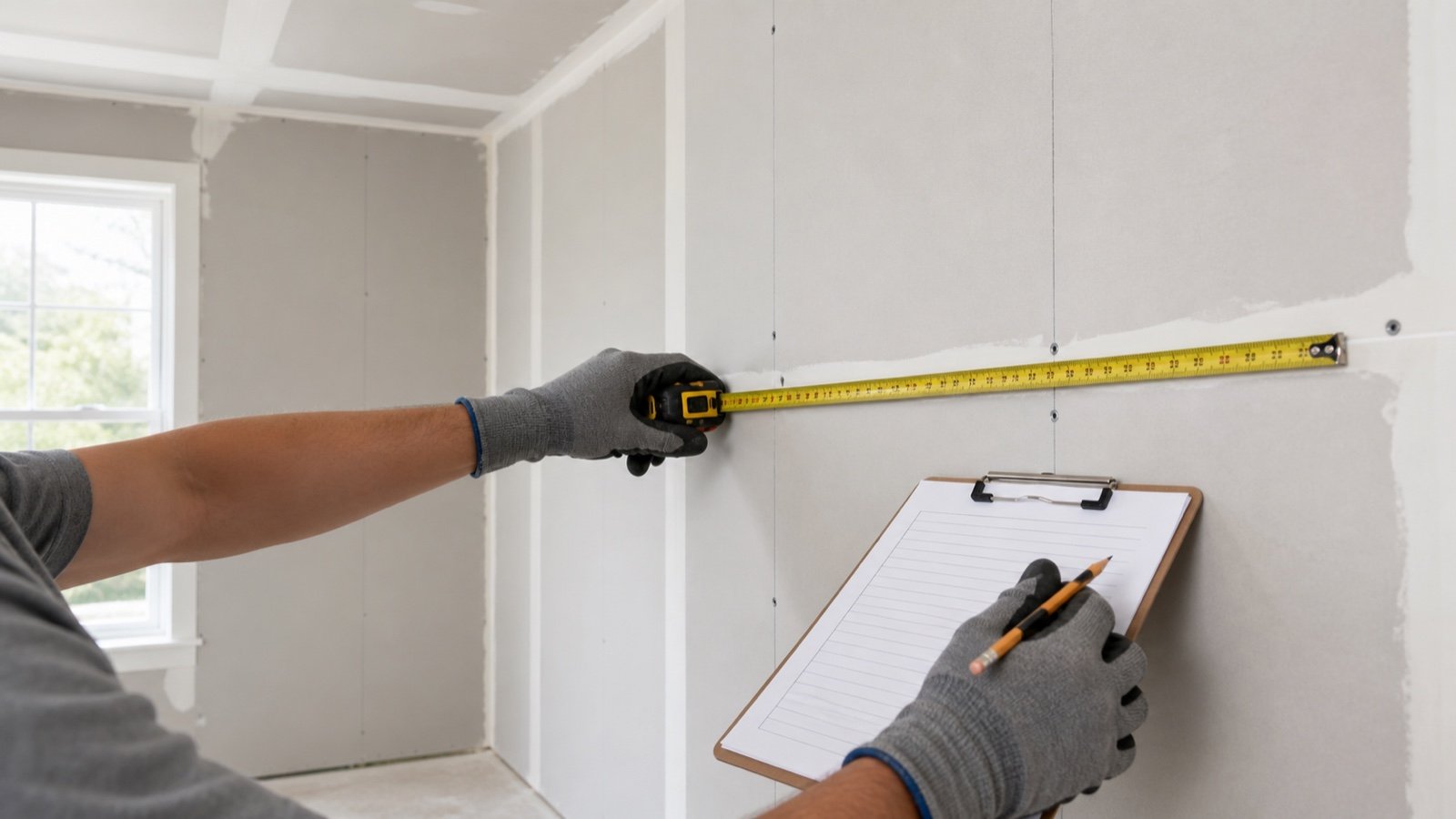
A straight chord across an arch is shorter than the curved path. Measure the accepted bead path with the method required by the selected product. Use the drywall corner-bead measurement guide to record endpoints, curves and transitions before calculating pieces.
Does the body material determine the attachment method?
The exact product determines the approved attachment and finish method. Broad material names are too wide for a site instruction or material order.
A bare metal bead may use fasteners, clinching or another named system. A paper-faced metal product may embed in joint compound, while another paper-faced item may have a separate installation option. Vinyl families include adhesive-applied and mud-set designs. Read the current installation guide for the stock number on the order.
USG J1124 directs users of its named paper-faced metal system to bed the trim in compatible joint compound, remove trapped air and apply later coats under stated conditions. That document supports the USG method. It does not set the method for unrelated metal, vinyl or composite products.
If a substitution changes the body, flange or attachment system, reopen the bead, compound, adhesive, fastener, labour and tool rows. A same-length replacement can still change the material list.
Which project conditions can change the selection?
Check the location, assembly and finish detail before accepting a bead. Product marketing cannot approve an exposure, rated construction or movement condition for the project.
- Interior, exterior-adjacent, humid, wet or corrosive exposure stated by the project
- Board type and thickness accepted by the accessory
- Corner angle, radius, flange coverage and finish level
- Impact or service condition required by the specification
- Fire, acoustic or movement-joint continuity shown in the assembly
- Adhesive, compound, fastener and coating compatibility
- Approved manufacturer, equal-substitution process and local availability
Record unresolved conditions as pending. A product family page can identify candidates, while the accepted project documents and current manufacturer data establish whether a candidate fits.
What should the corner-bead product schedule contain?
The schedule should let a buyer and field checker identify the same item without relying on a nickname such as “standard bead.” Use one row for each exact product and run class.
| Field | Entry | Check |
|---|---|---|
| Location and detail | Level, room, elevation, opening and drawing detail | Current revision |
| Function | Outside, inside, edge, reveal, transition or movement | Matches the detail |
| Profile | Square, radius, chamfer, angle or named shape | Dimensions shown |
| Product identity | Manufacturer, name and stock number | Accepted submittal |
| Body and form | Material plus rigid piece, flexible piece or roll | Matches measured geometry |
| Attachment | Current named method and related material | Current installation guide |
| Run data | Cut length, count and end conditions | Measurement ledger |
| Supply data | Stock length, pieces per package and supplier unit | Dated local item or quote |
| Status | Approved, pending, substituted or superseded | Responsible record |
Trim-Tex currently lists 50 pieces per box for its named standard Corner Bead and Archway family. Its named Rigid Corner Bead and Archway page lists 45 pieces per box. One manufacturer and one body material can still produce different package counts.
How do mixed corner-bead types change the takeoff?
Calculate each approved stock item on a separate row. Pooling all measured feet hides complete-cut limits, different stock lengths, different packages and pending accessories.
| Row | Condition | Declared stock | Base result |
|---|---|---|---|
| A | 8 identical square paper-faced metal vertical runs at 7 ft 11.5 in each | 8 ft pieces of the selected square product | 8 pieces |
| B | 2 bullnose vertical runs at 8 ft each | 8 ft pieces of the selected bullnose product | 2 pieces |
| C | 1 curved opening with a checked 9 ft 2 in arc | 10 ft flexible archway item accepted for the curve | 1 piece |
| D | 3 exposed board-edge runs | L-bead product and stock length pending | Pending |
Row A uses the 1/2 in vertical reduction stated in the named USG paper-faced guide. Each 95.5 in cut needs its own 96 in stock piece, so 8 runs need 8 pieces. Dividing the pooled 764 in of cut length by 96 in and rounding up also returns 8 here, but the complete-cut check remains the controlling step.
Row B stays separate because bullnose is a different stock item. Row C stays separate because the measured arc and flexible stock form need their own check. Row D stays pending until the edge-trim product, board-thickness fit, stock length and attachment system are known.
The approved rows contain 11 base pieces across 3 products. “11 corner beads” is still an incomplete order because it omits the product split and package quantities.
How should these rows be entered in the calculator?
Use the Drywall Corner Bead Calculator once per matching product group. Enter identical runs together only when product, cut length, stock length and end conditions agree.
- Open Row A and enter 8 runs at 7 ft 11.5 in with declared 8 ft stock.
- Run Row B as a separate bullnose calculation.
- Use a checked direct piece count for Row C when the curved cutting plan and product instructions approve it.
- Leave Row D outside the approved total until its exact trim is selected.
- Add a documented full-piece allowance by product when the project record supports one.
- Deduct only matching usable stock.
- Round each product through its current package quantity or enter 1 for individual pieces.
Carry the accepted product lines into the drywall material takeoff worksheet. The worksheet keeps bead, trim, compound, adhesive and fastener records connected without treating them as one quantity.
Can one corner bead be substituted for another?
A direct substitution needs the same accepted function, geometry, board compatibility, exposure scope, attachment and finish system. It also needs the approval path required by the project.
Compare the current submittals side by side. Check nose and flange dimensions, stock form, accessory transitions, installation materials, storage, warranty scope and referenced standards. Recalculate pieces and packages after the approved item changes.
A 10 ft square vinyl bead and a 10 ft paper-faced bullnose share a length only. Their profile, body, attachment materials and package records differ, so the takeoff keeps them on separate lines.
Which selection errors create a weak material order?
- Using “metal,” “paper” or “vinyl” as the complete product description.
- Choosing body material before confirming the corner function and profile.
- Counting ordinary inside tape as outside corner bead.
- Using a square bead at a radius, chamfer, splayed angle or curve.
- Measuring an arch with its straight chord.
- Assuming every vinyl bead uses the same adhesive or compound method.
- Copying one manufacturer's stock length or box quantity to another item.
- Pooling straight pieces, flexible rolls and edge trims by total length.
- Ordering caps or transitions without matching the radius and product family.
- Approving an exposure or rated-assembly use from a marketing comparison.
- Applying a universal allowance, price or installation spacing.
- Leaving a changed product under the old calculator row.
Safety, specification and scope limits
Follow the current product safety data, installation instructions and site controls for cutting edges, snips, knives, adhesives, compounds, dust, ladders and access equipment. The selected manufacturer defines the permitted tools and application materials for its product.
This guide supports product classification and quantity planning. It does not approve corner geometry, movement details, fire or acoustic assemblies, wet-area construction, substitutions, finish quality or jobsite safety. Use current drawings, specifications, accepted submittals, codes and qualified project professionals.
Return to the Drywall Planning Tools and Guides hub for related panel, tape, compound and fastener resources. The calculation methodology explains assumptions, rounding and source scope. Report a page issue through the corrections route.
Sources and source scope
- ASTM C1047-19 product page: scope of gypsum-board edge, corner and architectural accessories.
- USG Sheetrock Paper-Faced Metal Corner Bead: named product construction and interior family.
- USG paper-faced metal bead and trim brochure: named square, offset, bullnose, flexible and inside-corner examples with listed stock formats.
- USG installation guide J1124: named compound-embedded method and vertical cut instruction.
- Trim-Tex Corner Bead and Archway: named straight and flexible products, stock lengths and package quantities.
- Trim-Tex Rigid Corner Bead and Archway: separate low-profile stock and box example.
- Trim-Tex Adjustable Inside Corner Bead: named inside-angle range and separate stock record.
Source scope: ASTM supports the stated accessory scope. Manufacturer sources support their named products, dimensions, stock records and instructions. These sources do not select a project product, prove a universal performance ranking, approve a substitution or establish local price and availability.
Review note: Saleem Sial owns the research and editorial record. The internal publication gate covers source checks, worked fixtures, originality, build validation, link crawl, schema review and rendered QA. Waseem Sial, External Reviewer and Engineer, is listed for ongoing external review; no completed review date is claimed.