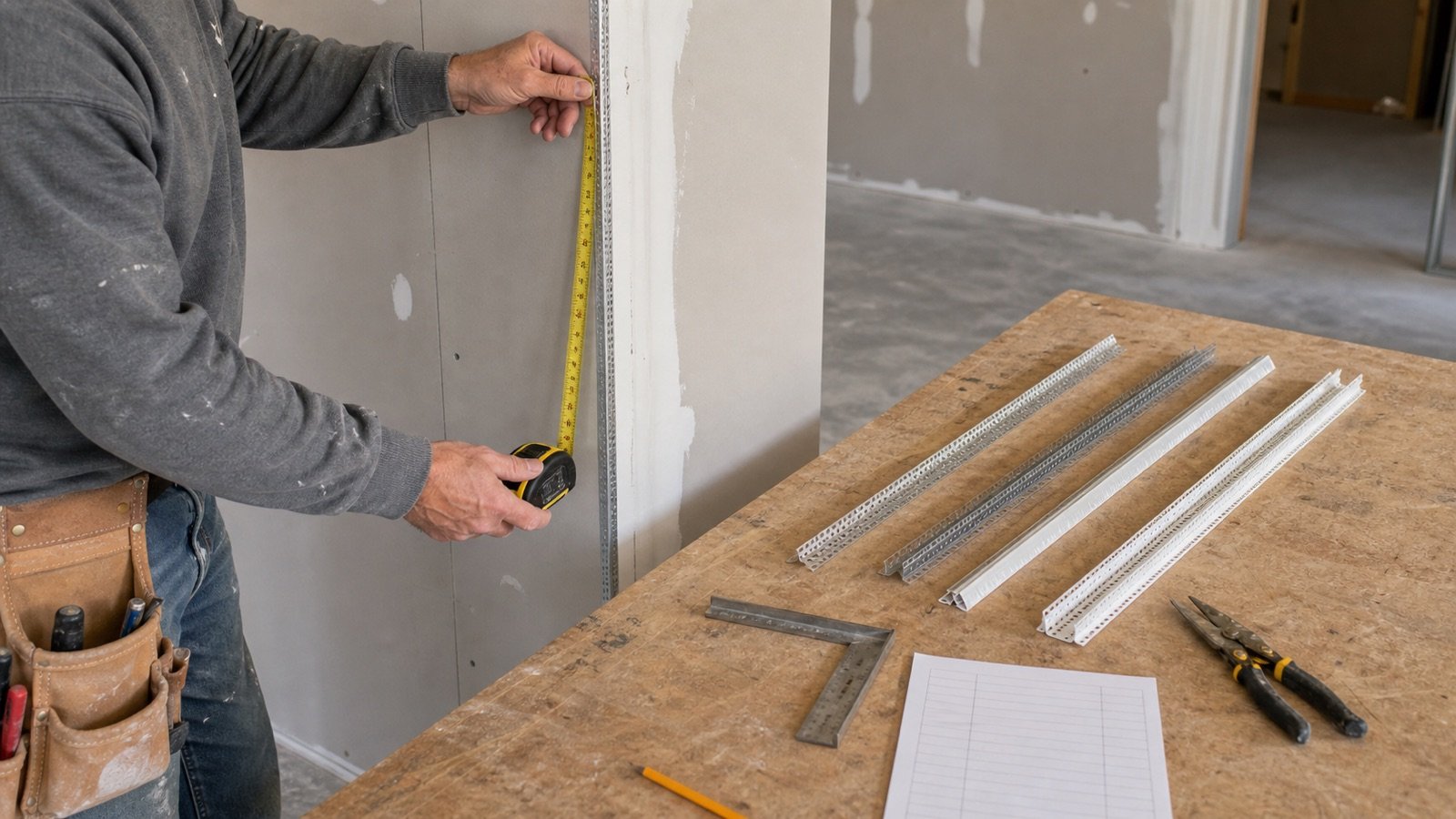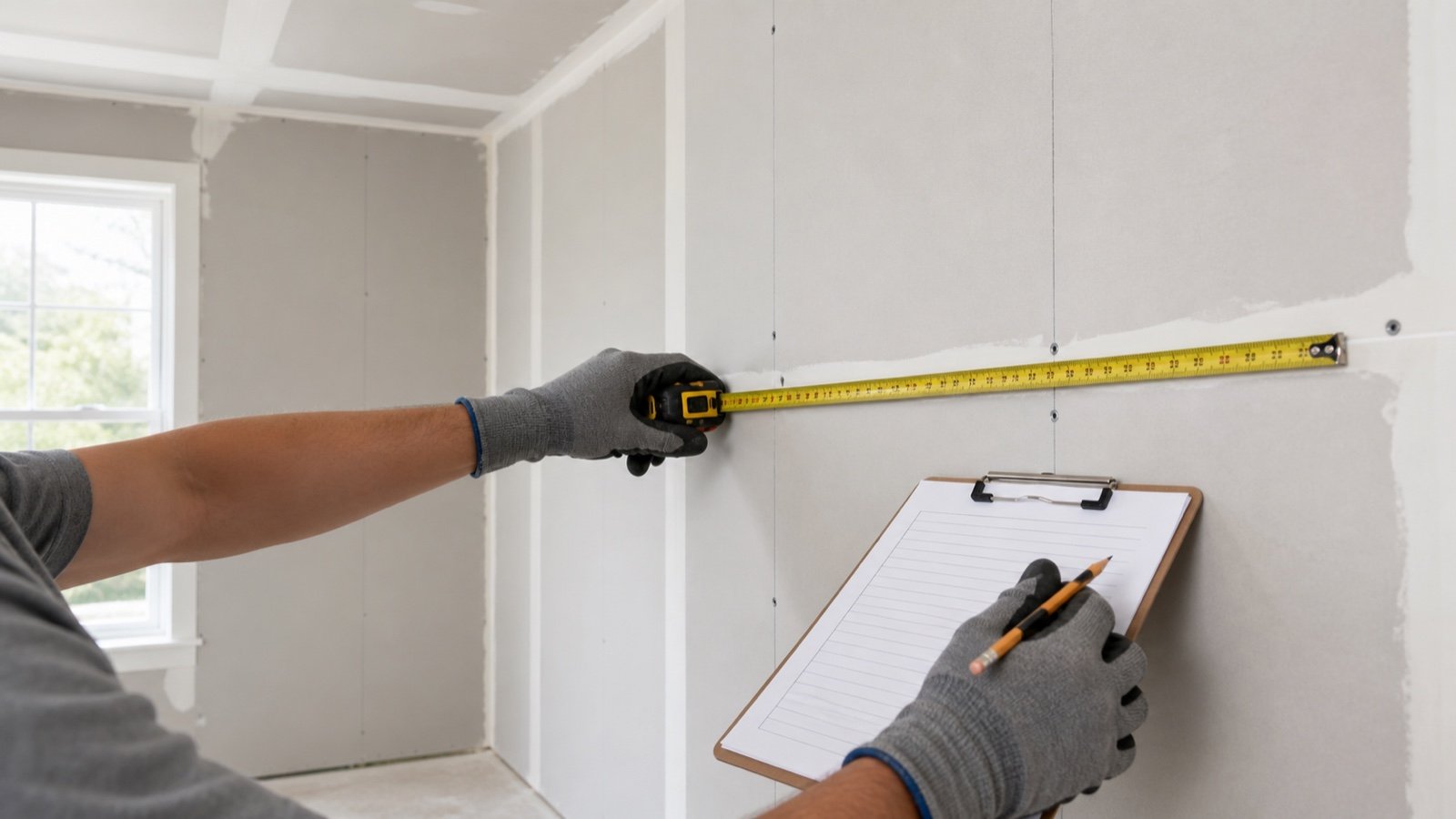
A drywall tape allowance covers identified uncertainty after you have measured the joints. Known repair seams, usable stock and the extra length left by whole-roll purchasing need their own entries because each changes the order in a different way.
Start with the accepted joint ledger. Add known taped work, document any uncertainty, subtract verified matching stock, and round the remaining requirement to the exact roll you can buy.
How much extra drywall tape should you buy?
Use a project-specific allowance with a written basis. The authoritative sources reviewed for this page publish product applications, approximate coverage and roll records, but they do not set one universal drywall-tape waste percentage.
Live calculators reviewed on 1 September 2026 commonly opened at 10% or described wider ranges. Those values show common website inputs. Your allowance needs a measured base, a reason, an approved basis and a date.
The Drywall Tape Calculator starts at 0%. Enter a percentage after the layout and uncertainty review instead of accepting a prefilled internet value.
Which quantities should stay separate?
Use separate fields for measured scope, known additions, uncertainty, existing stock and package remainder. The word waste cannot show which event produced the extra length.
| Quantity | What it records | How it changes the order |
|---|---|---|
| Checked base length | Accepted flat joints, butt joints and taped inside angles | Forms the measured requirement |
| Known added length | Approved repair seams, changed details or other measured taped runs | Add the measured length directly |
| Uncertainty allowance | A reviewed risk that cannot yet be measured | Add the stated length or percentage once |
| Verified usable stock | Matching tape with a checked usable remaining length | Deduct from gross planning length |
| New-package remainder | Length bought above the revised requirement after roll rounding | Record as carryover; do not add it as another allowance |
| Optional post-job spare | Material the owner chooses to retain for later work | Schedule as a separate purchasing decision |
Prepare the base with the drywall joint measurement guide. Count each shared joint once and keep each tape product on its own row.
How do you calculate a drywall tape allowance?
Calculate one product row at a time. Apply the approved percentage to its stated basis, then deduct matching stock before rounding new rolls.
Uncertainty allowance = allowance basis × allowance percentage ÷ 100
Gross planning length = checked base + known additions + uncertainty allowance
New tape requirement = max(0, gross planning length − verified usable stock)
New rolls = ceiling(new tape requirement ÷ declared roll length)
New-package remainder = new rolls × roll length − new tape requirement
- Close duplicate and missing joint rows.
- Add approved repairs and changed details as measured lengths.
- Name the unresolved condition that the allowance covers.
- Write the allowance basis and percentage or direct added length.
- Confirm the existing tape product, condition and usable length.
- Copy the current supplier roll length.
- Round the revised new requirement to whole rolls once.
Worked example: allowance, partial stock and new rolls
A checked project has 740 ft of ordinary taped joints and 18 ft of approved repair seams. The estimator records a hypothetical 3% uncertainty allowance on the combined 758 ft. This example tests the arithmetic; it does not recommend 3% for another job.
Uncertainty allowance = (740 ft + 18 ft) × 3% = 22.74 ft
Gross planning length = 740 ft + 18 ft + 22.74 ft = 780.74 ft
Without a stock deduction, the calculator divides 780.74 ft by a declared 250 ft roll and returns 4 whole rolls. The stock check finds 42 ft of usable matching tape.
New tape requirement = 780.74 ft − 42 ft = 738.74 ft
| Record | Length or count | Meaning |
|---|---|---|
| Gross planning length | 780.74 ft | Measured work plus known repairs and reviewed uncertainty |
| Usable matching stock | 42 ft | Verified length already available |
| New tape requirement | 738.74 ft | Length that new rolls must cover |
| New 250 ft rolls | 3 | ceiling(738.74 ÷ 250) |
| New tape purchased | 750 ft | 3 × 250 ft |
| New-package remainder | 11.26 ft | 750 − 738.74 ft |
The exact NIST conversion gives 738.74 ft = 225.167952 m and 250 ft = 76.2 m. Keep the supplier's declared package unit on the order, then use exact conversions as an arithmetic check.
Can one percentage apply to every tape row?
A single rate fits only when the reviewer accepts one uncertainty basis for the full product row. Projects with confirmed work and unresolved areas can use separate allowance rows.
| Scope row | Base | Reviewed rate | Added allowance | Planned row |
|---|---|---|---|---|
| Confirmed main joints | 500 ft | 0% | 0 ft | 500 ft |
| Unresolved retrofit returns | 120 ft | 5% | 6 ft | 126 ft |
| Repair seams with an unsettled cut plan | 40 ft | 10% | 4 ft | 44 ft |
| Total | 660 ft | Mixed | 10 ft | 670 ft |
The example rates are review inputs, not trade recommendations. A blanket 5% on all 660 ft would add 33 ft. The 23 ft difference comes from the chosen basis, so the order record must preserve that basis.
Why can a small allowance change the order by one full roll?
Whole-roll thresholds create large jumps in purchased length. A planning result below 500 ft fits within two 250 ft rolls; a result above 500 ft needs a third roll.
| Allowance | Planning length | Whole rolls | Package remainder |
|---|---|---|---|
| 0% | 480 ft | 2 | 20 ft |
| 4% | 499.2 ft | 2 | 0.8 ft |
| 4.16% | 499.968 ft | 2 | 0.032 ft |
| 4.17% | 500.016 ft | 3 | 249.984 ft |
| 5% | 504 ft | 3 | 246 ft |
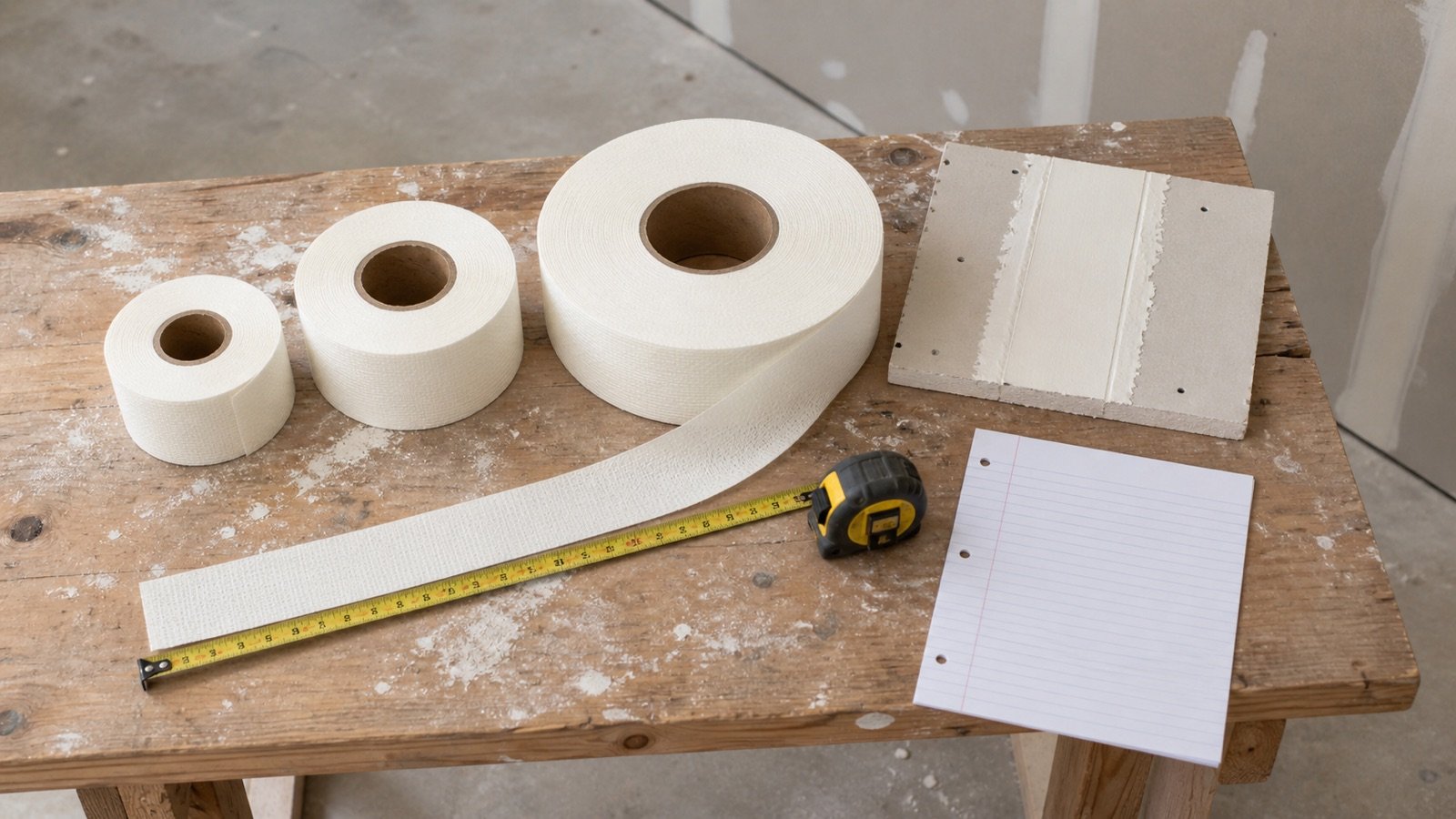
The threshold does not justify choosing 4.16%, 4.17% or 5%. It shows why the checker should review the measured scope and available stock near a package boundary. The drywall tape roll-size chart compares the same rounding behavior across named 75, 250 and 500 ft records.
How should a partial drywall tape roll be counted?
Deduct a partial roll after you match the manufacturer, product, width and required joint system. Measure or document the usable remaining length instead of estimating from roll diameter.
| Field | Required record |
|---|---|
| Identity | Manufacturer, exact product, tape type and width |
| Condition | Dry, clean and free from crushing, fraying, contamination or lost adhesion that affects the named product |
| Usable length | Measured length or a traceable remaining-roll record |
| Compatibility | Accepted joint location and matching compound system |
| Deduction | Subtract only from the matching product row |
National Gypsum's current guidance identifies tape lift, poor bond and blisters as application problems for its paper-tape method. Record tape removed during corrective work as actual usage when it occurs. Keep a forecast revision beside the original allowance so the reason for the change remains visible.
How should field changes revise the allowance?
Keep the original approved record and add a dated revision. Replace resolved uncertainty with measured added or removed tape instead of carrying the old percentage and the new length together.
Revised gross planning = prior gross planning + measured additions − measured removals − released uncertainty
- Name the room, wall, ceiling or repair ID.
- Record the drawing, sketch or field instruction revision.
- Measure new taped runs and removed runs.
- Release the allowance attached to a condition that has been resolved.
- Record installed usage, rejected tape and remaining stock.
- Recalculate new rolls from the revised balance.
A zero net change can still alter cut lengths or product rows. Keep the revision when the tape pattern or compound system changes.
Should a spare roll be included in the allowance?
Record optional spare stock after the installation requirement and supplier rounding. Name the owner, storage location, product and intended future use.
A roll already created by package rounding may cover the approved spare decision. Buying another roll needs a separate line so the installation allowance does not hide post-job inventory.
USG J1736 lists a 75 ft roll for occasional small or patching work in its named 2015 paper-tape record. Confirm the current product, supplier SKU and local availability before using that package for a repair-stock plan.
Which conditions can change the allowance review?
| Condition | Record needed | Action |
|---|---|---|
| Accepted panel layout | Joint ledger and revision | Measure the actual taped paths |
| Longer panels or changed orientation | Revised panel layout | Recalculate joint footage; USG J371 notes that longer horizontal panels can reduce joints in its described application |
| Repairs or changed openings | Approved detail and measured seams | Add known length directly |
| Several tape products | Product and compound schedule | Use separate allowance and package rows |
| Unresolved field detail | Issue owner, basis and review date | Add only the reviewed uncertainty |
| Existing partial rolls | Identity, condition and usable length | Deduct verified matching stock |
| Current supplier package | SKU, roll length, stock and quote date | Round the revised requirement once |
Which allowance mistakes change the purchase?
- Transferring a drywall-sheet waste percentage to tape without a tape-specific basis.
- Adding measured repairs and leaving the percentage that already covered them.
- Applying allowance after whole-roll rounding.
- Calling the full package remainder installation waste.
- Deducting an unidentified or damaged partial roll.
- Combining paper, fiberglass and specialty tape into one length.
- Rounding each room to a roll before combining matching product rows.
- Refreshing the percentage without recording who changed it and why.
What should the final allowance record contain?
- Project, area and revision.
- Exact tape product, width and compatible joint system.
- Checked base length and measurement source.
- Known additions by reason and measured length.
- Allowance basis, percentage or direct length, owner and date.
- Gross planning length.
- Verified usable stock and its condition record.
- Current supplier SKU and declared roll length.
- Whole new rolls, purchased length and package remainder.
- Optional post-job spare stock as a separate line.
Return to the Drywall planning hub for sheet, tape and compound tools. The calculation methodology explains rounding and unit checks. Send a source or arithmetic issue through the corrections route.
Sources and source scope
- Current USG Sheetrock Brand Paper Joint Tape page supports current product identity, flat-joint and inside-corner scope, ASTM C475 statement and its linked data sheet.
- USG Sheetrock Brand Paper Joint Tape J1736 supports the named approximate coverage, 75, 250 and 500 ft records, patching note and geographic limit.
- USG Sheetrock Brand Installation and Finishing Guide J371 supports its planning sequence, measurement context and joint-reduction note for longer horizontal panels.
- National Gypsum paper joint tape guidance supports current application context, named roll records and tape-lift, poor-bond and blister checks.
- NIST Handbook 44, 2026 Appendix C supports the exact foot-to-metre relationship.
Source scope: Manufacturer sources control their named products and document revisions. NIST controls the unit relationship. None of these sources sets a universal tape allowance, approves the example rates, selects a project system, confirms local stock or replaces current drawings and specifications.
Review note: Saleem Sial owns the research and editorial record. Source checks, independent fixtures, editorial review, build validation, link crawl, schema review and rendered QA form the internal publication gate. Waseem Sial, External Reviewer and Engineer, is listed for ongoing external review; no completed review date is claimed.