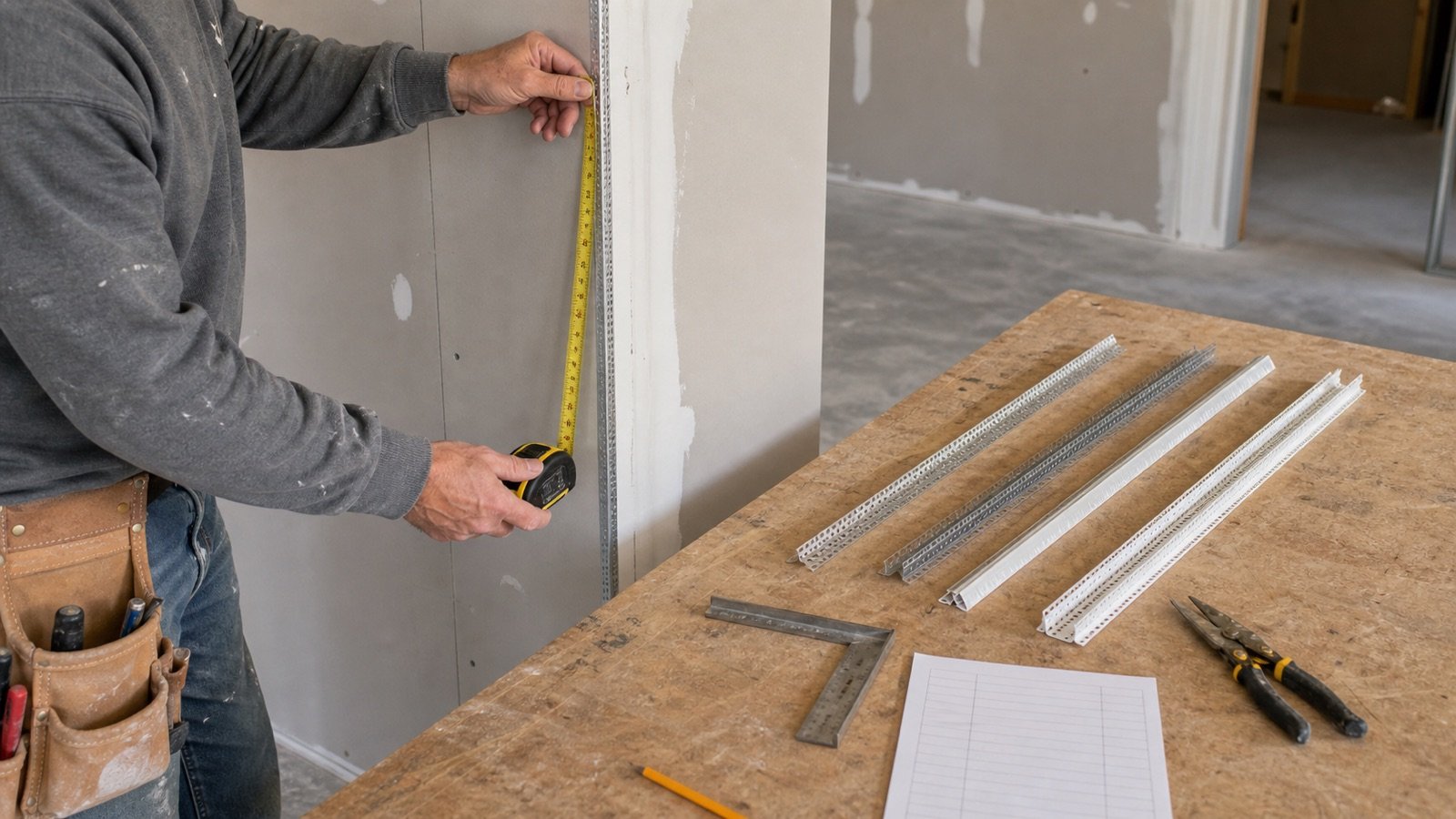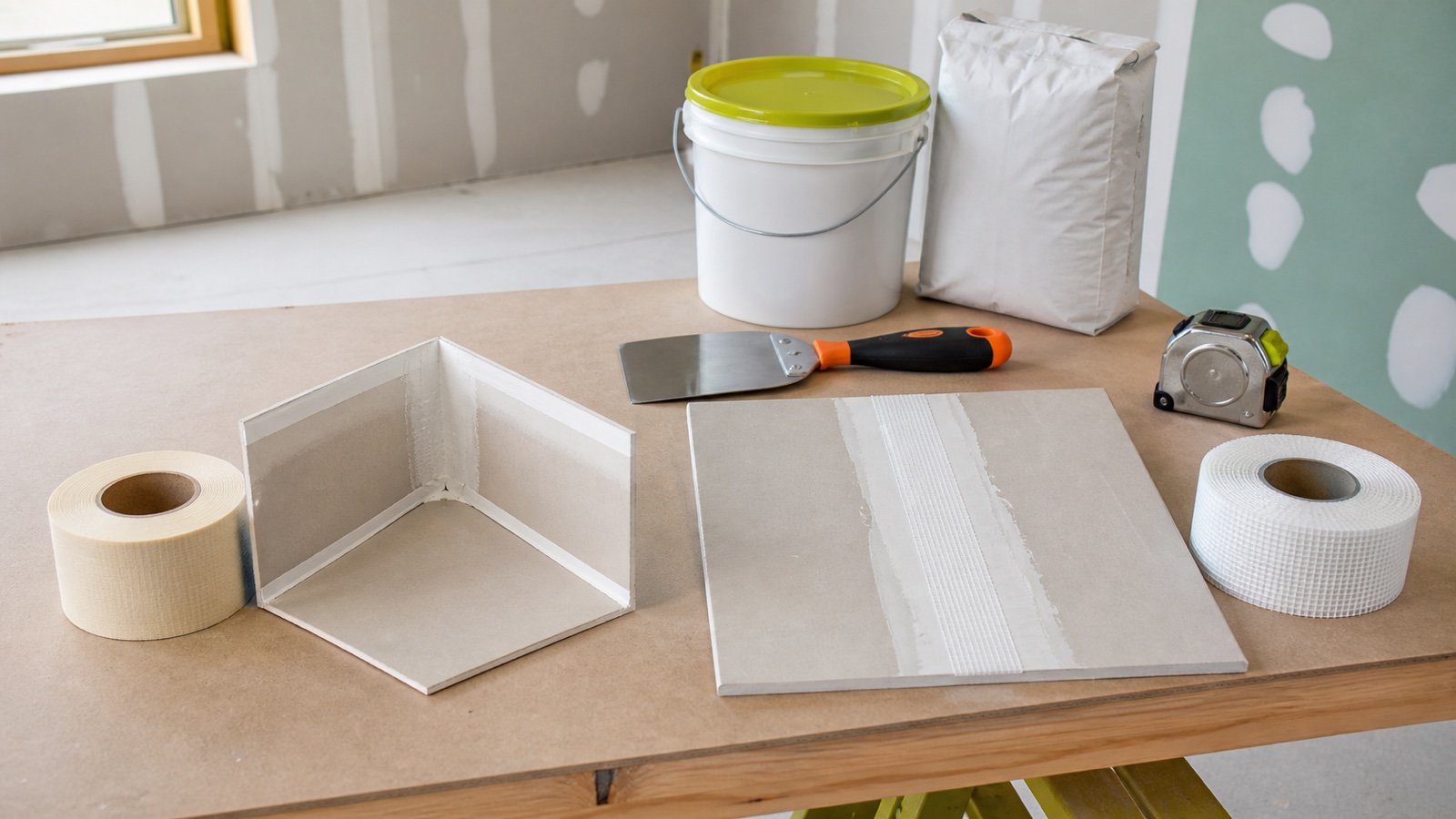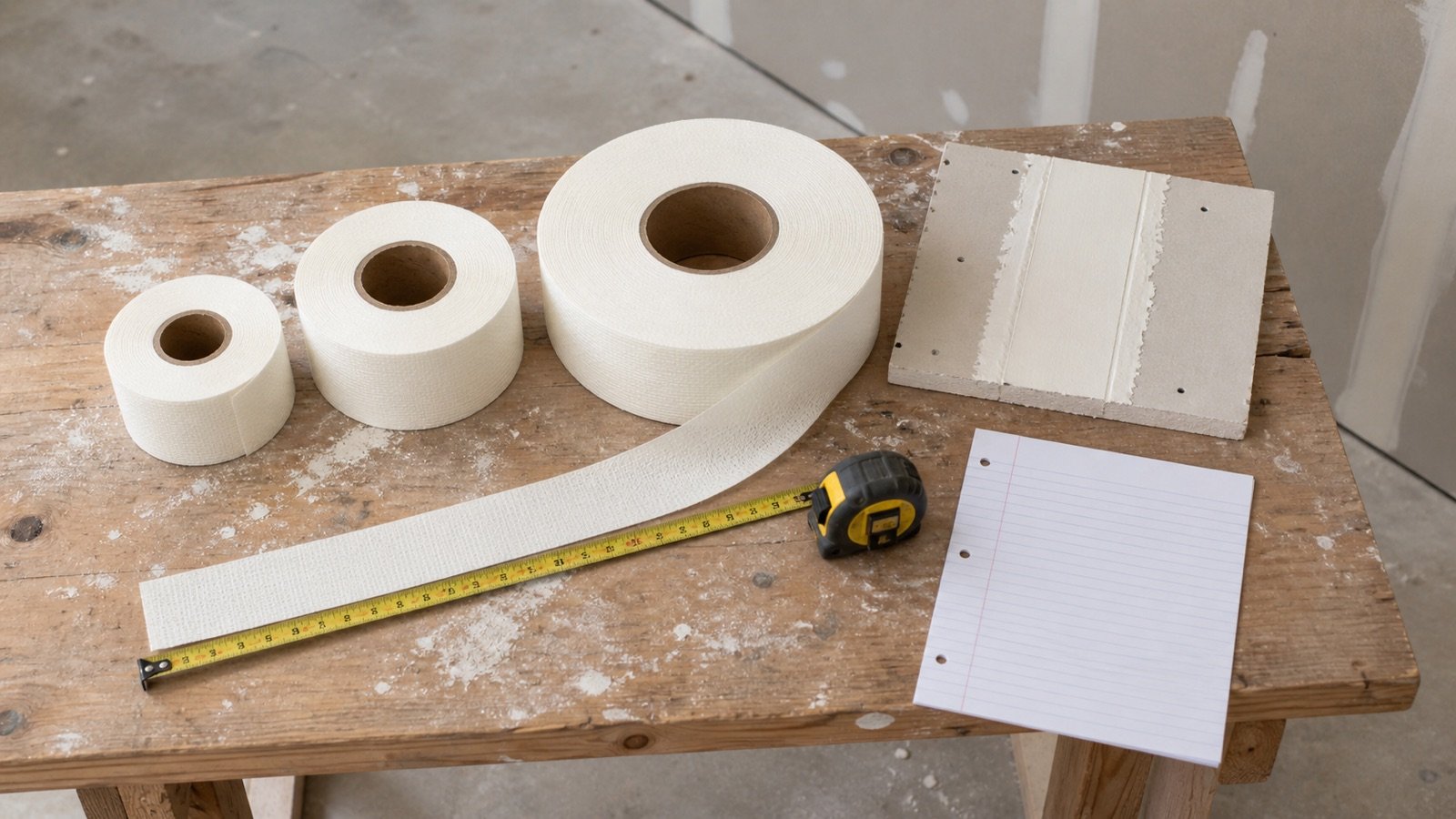
Drywall joint tape is sold in more than one roll length. The package you choose changes the number of rolls, purchased length and remainder, even when the checked joint total stays the same.
Use measured joint length for the order when an accepted panel layout is available. A manufacturer area record can provide a planning check, provided you retain the product name, approximate qualifier, reference area and document date.
What drywall tape roll sizes are available?
Named US paper-tape records include 75 ft, 250 ft and 500 ft rolls. Fiberglass, paperless, reinforced and specialty products can use other lengths, so copy the exact product and roll length instead of treating those 3 sizes as a universal list.
USG J1736 lists 75 ft, 250 ft and 500 ft rolls for Sheetrock Brand Paper Joint Tape. The current USG product page identifies the paper product and links its data sheet. National Gypsum's current paper-tape guidance also lists 75 ft, 250 ft and 500 ft ProForm rolls.
| Documented product | Declared roll records | Record limit |
|---|---|---|
| USG Sheetrock Brand Paper Joint Tape, J1736 | 75 ft, 250 ft and 500 ft | US product sheet, revision 10-15; geographic availability warning applies |
| USG Sheetrock Brand Fiberglass Drywall Tape, J780A | 75 ft and 250 ft | Named older US fiberglass submittal; confirm the current product and package |
| National Gypsum ProForm Paper Joint Tape | 75 ft, 250 ft and 500 ft | Current manufacturer guidance; supplier stock can differ |
A roll-size article cannot confirm what one store has today. Record the manufacturer, product, width, roll length, supplier SKU, branch, quote date and stock status before issuing the order.
How many drywall tape rolls do you need?
Divide the planning tape length by the declared length of the matching roll, then round up. Calculate each tape product on its own row.
Planning tape length = checked base length × (1 + allowance ÷ 100)
Whole rolls = ceiling(planning tape length ÷ declared roll length)
Purchased length = whole rolls × declared roll length
Package remainder = purchased length − planning tape length
The Drywall Tape Calculator performs this sequence and keeps allowance separate from the extra length created by roll rounding. Prepare the base length with the drywall joint measurement guide.
Drywall tape roll count chart from measured length
This chart starts with planning length, which means any documented allowance has already been added. It compares pure roll arithmetic for 75 ft, 250 ft and 500 ft packages.
| Planning length | 75 ft rolls | 250 ft rolls | 500 ft rolls |
|---|---|---|---|
| 50 ft | 1 | 1 | 1 |
| 75 ft | 1 | 1 | 1 |
| 76 ft | 2 | 1 | 1 |
| 250 ft | 4 | 1 | 1 |
| 251 ft | 4 | 2 | 1 |
| 500 ft | 7 | 2 | 1 |
| 501 ft | 7 | 3 | 2 |
| 750 ft | 10 | 3 | 2 |
| 1,000 ft | 14 | 4 | 2 |
The chart does not choose a product. A 500 ft paper roll, a 500 ft fiberglass roll and a 500 ft paperless roll remain separate order items because their tape and joint-system requirements differ.
Worked example: 620 ft of checked joints
A measured joint ledger totals 620 ft. The approved order record adds 5% for a documented project condition, which produces 651 ft of planning tape.
Planning length = 620 ft × 1.05 = 651 ft
| Declared roll | Calculation | Whole rolls | Purchased length | Remainder |
|---|---|---|---|---|
| 75 ft | ceiling(651 ÷ 75) | 9 | 675 ft | 24 ft |
| 250 ft | ceiling(651 ÷ 250) | 3 | 750 ft | 99 ft |
| 500 ft | ceiling(651 ÷ 500) | 2 | 1,000 ft | 349 ft |
Nine 75 ft rolls leave the least package remainder in this example. The purchase decision still needs current price, carton rules, application method, machine compatibility, roll-change time and a plan for usable carryover. Package remainder alone does not identify the lowest installed cost.
How much area does one roll of drywall tape cover?
A roll covers a linear joint length. Square-foot coverage comes from a source-specific relationship between panel area and expected tape length, so it remains an approximate planning check.
USG J1736 records approximate paper-tape coverage of 370 ft per 1,000 ft² of gypsum panels. Its named rate equals 0.37 ft of tape per ft². J780A gives the same approximate rate for its named fiberglass tape, though equal area rates do not make the 2 joint systems interchangeable.
Named area-check tape = panel area × 370 ft ÷ 1,000 ft²
At that specific rate, a 250 ft roll has a mathematical reference area of about 675.7 ft² and a 500 ft roll has about 1,351.4 ft². Those figures divide package length by an approximate product rate. They do not promise that a real layout will produce that coverage.
USG 370 ft per 1,000 ft² planning chart
This table applies only to the named approximate USG record. It includes no allowance and rounds the calculated tape length up to whole 75 ft, 250 ft or 500 ft rolls.
| Panel area | Approx. tape | 75 ft rolls | 250 ft rolls | 500 ft rolls |
|---|---|---|---|---|
| 100 ft² | 37 ft | 1 | 1 | 1 |
| 250 ft² | 92.5 ft | 2 | 1 | 1 |
| 500 ft² | 185 ft | 3 | 1 | 1 |
| 750 ft² | 277.5 ft | 4 | 2 | 1 |
| 1,000 ft² | 370 ft | 5 | 2 | 1 |
| 1,500 ft² | 555 ft | 8 | 3 | 2 |
| 2,000 ft² | 740 ft | 10 | 3 | 2 |
Use the source-labelled area mode in the calculator when the panel layout is unavailable. Replace the area result with the checked joint ledger before ordering when the project has enough layout information.
Worked area check: 2,400 ft² of panels
A planning record uses 2,400 ft² of panel area and the named USG rate. The estimated tape length is 888 ft before any project allowance.
Approximate tape = 2,400 ft² × 370 ft ÷ 1,000 ft² = 888 ft
| Declared roll | Whole rolls | Purchased length | Remainder |
|---|---|---|---|
| 75 ft | 12 | 900 ft | 12 ft |
| 250 ft | 4 | 1,000 ft | 112 ft |
| 500 ft | 2 | 1,000 ft | 112 ft |
Four 250 ft rolls and two 500 ft rolls buy the same 1,000 ft in this fixture. Current unit price, package availability and application workflow decide between those rows. The 888 ft requirement remains approximate because its input came from panel area.
Why can equal drywall areas need different tape lengths?
Panel orientation, sheet length, room geometry and joint-treatment scope set the linear joint total. Two projects with the same face area can have different butt joints, inside corners and wall-to-ceiling angles.
- Longer sheets can remove some butt joints when the layout permits them.
- More rooms can add inside corners without changing total panel area.
- Ceilings can add taped wall-to-ceiling angles when the accepted system includes them.
- Openings and partial sheets can change the seam arrangement.
- Control joints, trims and outside-corner products belong to their documented systems rather than ordinary joint-tape length.
The Drywall Material Takeoff Worksheet keeps panel layout and finishing materials in one record. Use the measured centerline total once the layout is accepted.
Should you buy 75 ft, 250 ft or 500 ft rolls?
Choose among matching products that a current supplier stocks. Compare whole-roll quantity, remainder, price, carton requirement, handling and application equipment.
| Check | 75 ft example | 250 ft example | 500 ft example |
|---|---|---|---|
| Small repair or short run | Can reduce unused length | May leave reusable stock | Can create a large remainder |
| Many rooms or long runs | More roll changes | Moderate roll count | Fewer roll changes when the product and method suit |
| Automatic taping equipment | Check equipment instructions | Check equipment instructions | J1736 identifies its 500 ft paper roll for taping machines |
| Supplier terms | Confirm product, width, roll length, price, stock, carton quantity, returns and quote date | ||
USG J1736 describes its 75 ft paper roll for occasional small work, its 250 ft roll as a popular hand-application size, and its 500 ft roll as suitable for taping machines with fewer roll changes. Apply those notes to the named paper product and current workflow.
Can a partial drywall tape roll count as usable stock?
Deduct a partial roll after you confirm the exact tape product, condition and usable remaining length. A visual guess at the roll diameter cannot support a reliable deduction.
- Match manufacturer, product, width and joint-system assignment.
- Check moisture, contamination, crushing, fraying, loss of adhesion and storage limits that apply to the product.
- Measure or document the usable remaining length.
- Deduct that length from the same product row.
- Round the revised requirement to complete new rolls.
Keep an opened 250 ft paper roll separate from a new 250 ft fiberglass roll. Equal declared length does not create interchangeable stock. The paper versus mesh drywall tape guide explains the product and compound boundary.
Why can a 75 ft label show 22.8 m instead of 22.86 m?
NIST records 1 international foot as exactly 0.3048 metre. The exact conversions are 75 ft = 22.86 m, 250 ft = 76.2 m and 500 ft = 152.4 m.
USG J1736 prints 75 ft as 22.8 m while its 250 ft and 500 ft values appear as 76.2 m and 152.4 m. Record the package's declared quantities as printed. Use exact conversions for checking arithmetic, and avoid changing a supplier SKU because a rounded secondary-unit label differs by one decimal place.
Which mistakes change the roll order?
| Mistake | Result | Correction |
|---|---|---|
| Using one universal area factor | Layout and source limits disappear | Name the rate or measure joints |
| Combining tape products | One roll count can hide incompatible systems | Use one row per product and width |
| Adding allowance after roll rounding | The order can be rounded twice | Add approved allowance to length, then round rolls once |
| Calling package remainder waste | Purchasing surplus gets mixed with cut loss or damage | Record allowance and remainder separately |
| Assuming converted size means local stock | The order can reference a package the supplier does not sell | Use the current supplier SKU and label |
| Deducting an unidentified partial roll | Usable stock can be overstated | Match product and measure remaining length |
What should the drywall tape order record contain?
- Project area, drawing or room reference and revision.
- Measurement method: joint ledger or named area record.
- Base length, allowance reason, allowance amount and planning length.
- Manufacturer, product, tape type, width and compatible joint-system record.
- Declared roll length, exact supplier SKU and whole rolls.
- Purchased length, package remainder and accepted usable stock.
- Supplier branch, quote date, price, carton rule, stock and return terms.
- Person who checked the takeoff and the date of that check.
Return to the Drywall planning hub for sheet, tape, compound and fastener tools. Use the Drywall Joint Compound Calculator only with a compatible product record. The calculation methodology explains rounding and unit checks, and the corrections route accepts source or arithmetic reports.
Sources and source scope
- USG Sheetrock Brand Paper Joint Tape J1736 supports the named paper product's approximate coverage, 75 ft, 250 ft and 500 ft package records, application notes and geographic limit.
- Current USG Sheetrock Brand Paper Joint Tape page supports current product identity, commodity code, intended joint locations and the linked data sheet.
- USG Sheetrock Brand Fiberglass Drywall Tape J780A supports the named older fiberglass package and approximate coverage record. Confirm current instructions before use.
- National Gypsum paper joint tape guidance supports its current 75 ft, 250 ft and 500 ft ProForm paper-tape records.
- NIST Handbook 44, 2026 Appendix C supports exact foot-to-metre and square-foot-to-square-metre relationships.
Source scope: Manufacturer documents control only their named products and document revisions. NIST controls unit relationships. These sources do not set a universal roll size, area rate, allowance, local price, supplier stock or joint-system selection.
Review note: Saleem Sial owns the research and editorial record. Source checks, independent fixtures, editorial review, build validation, link crawl, schema review and rendered QA form the internal publication gate. Waseem Sial, External Reviewer and Engineer, is listed for ongoing external review; no completed review date is claimed.