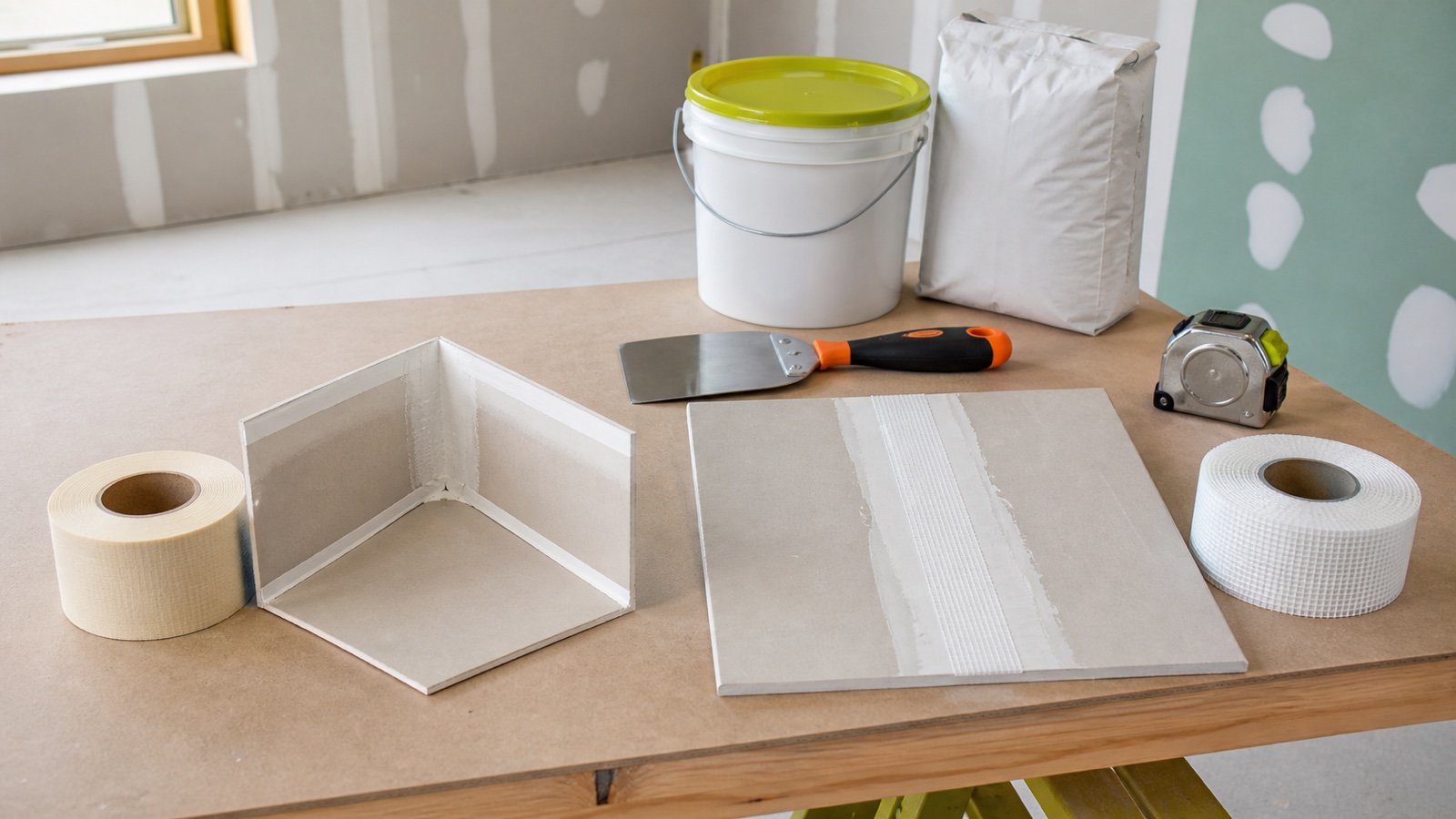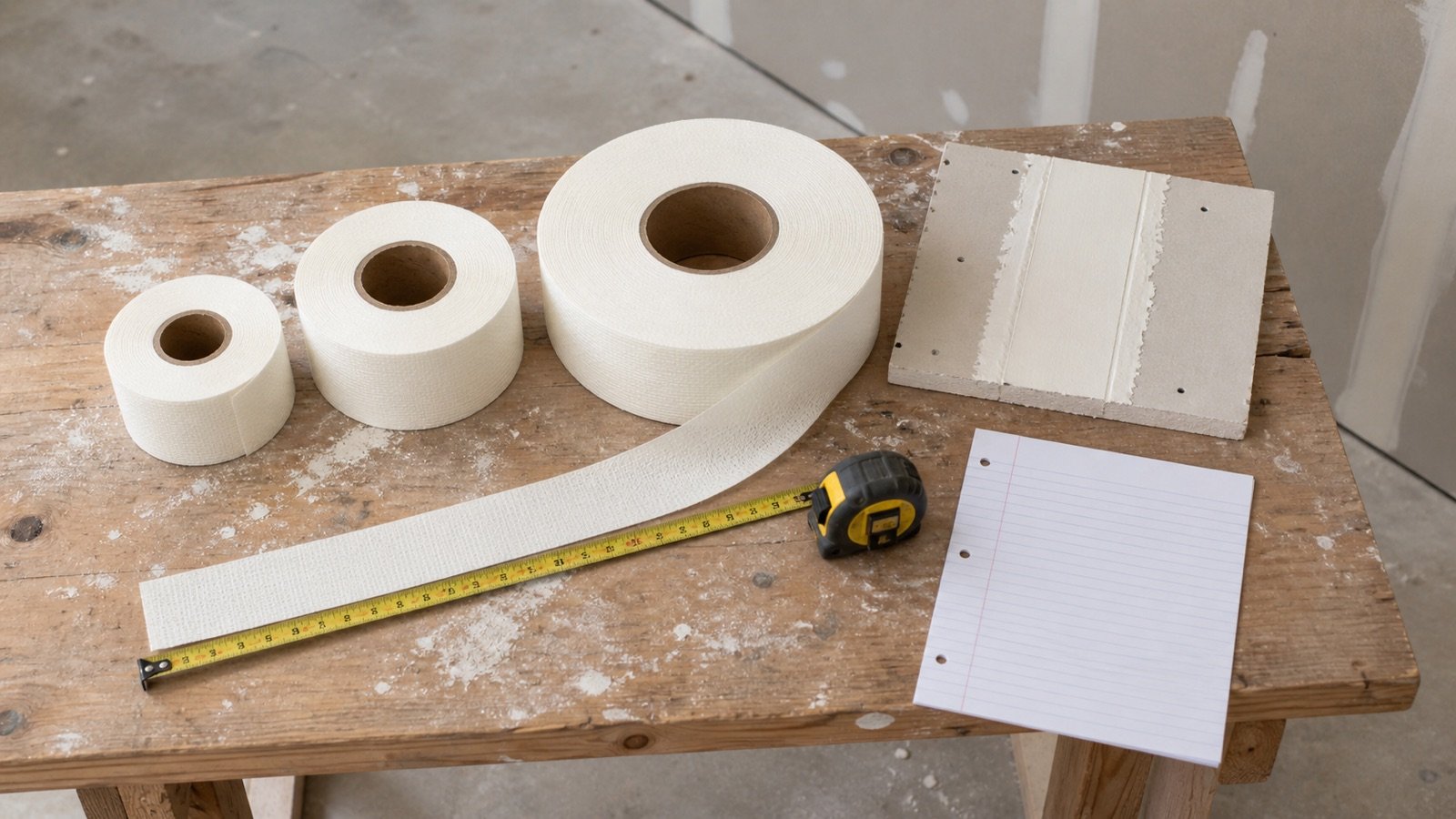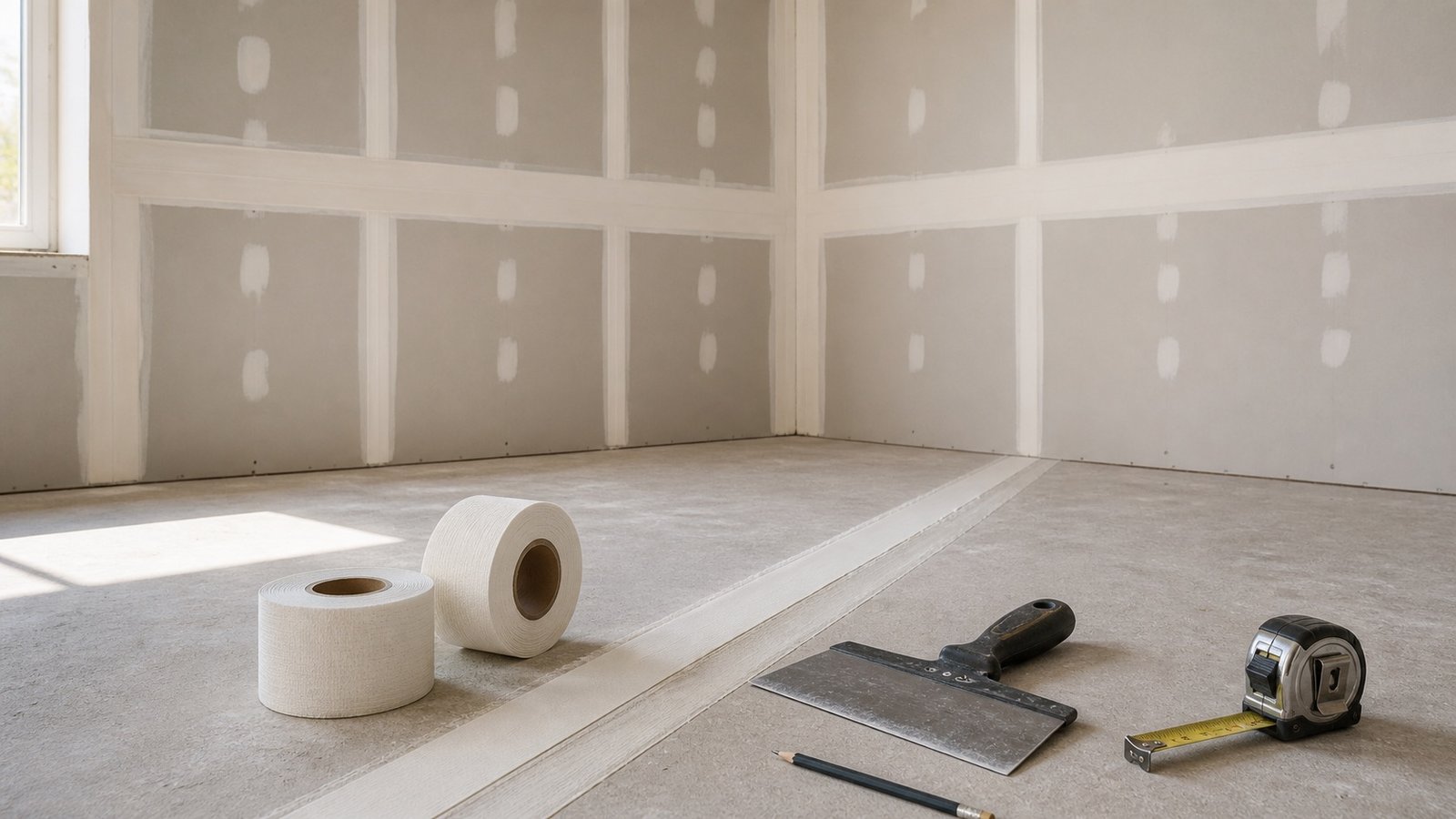
A drywall tape order starts with the joints the approved panel layout creates. Flat joints, butt joints and taped inside angles consume linear tape; the panel face area can provide a product-specific planning check when measured joint lengths are not ready.
This calculator keeps those methods separate. It also shows the entered allowance apart from the extra length created when the result rounds up to complete rolls. Use the drywall tape roll-size and coverage chart to compare named package records and whole-roll breakpoints. Use the drywall tape waste allowance guide to document known additions, uncertainty and usable stock before purchasing.
How much drywall tape do you need?
Add each accepted taped joint once, add any documented allowance, then divide by the length on the selected tape roll and round up. If you use a published area rate, multiply the finished board area by the stated tape length and divide by the source's reference area before applying allowance and roll rounding.
Measured joint length responds to the actual sheet layout. A manufacturer area rate remains an approximate product planning record and should retain its product, application, market and date.
What does the Drywall Tape Calculator return?
The calculator returns tape length and whole rolls from one declared measurement basis. It keeps allowance and purchase rounding visible as separate additions.
| Output | Meaning | Check before ordering |
|---|---|---|
| Base tape length | Measured taped runs or area scaled through a published rate | Joint ledger or product record |
| Entered allowance length | User percentage applied to the base length | Reason and approval |
| Planning tape length | Base length plus entered allowance | Existing usable stock |
| Exact roll ratio | Planning length divided by current roll length | Unrounded purchase boundary |
| Whole rolls | Exact roll ratio rounded up | Supplier's current package |
| Roll-rounding remainder | Purchased length minus planning length | Storage, returns and future use |
A small project can have a large remainder when the selected roll is long. Keep that remainder outside the allowance so the order record shows why each extra foot or metre appears.
Which calculation method should you use?
Use measured joints after the panel layout and treatment details have been accepted. Use a published area rate for an early product-specific check or when the layout record is incomplete.
| Method | Required inputs | Strength | Main limit |
|---|---|---|---|
| Measured joint lengths | Flat and butt joints, taped inside corners and other approved taped runs | Responds to the accepted panel layout | Needs a complete joint ledger |
| Published area rate | Finished board area, tape length and source reference area | Fast check tied to a named source | Approximate rate can miss layout-specific seam changes |
Do not combine the 2 methods in one total. Use them as separate estimates, compare the results and resolve a material difference by checking the layout and product scope.
How do you measure drywall joints for tape?
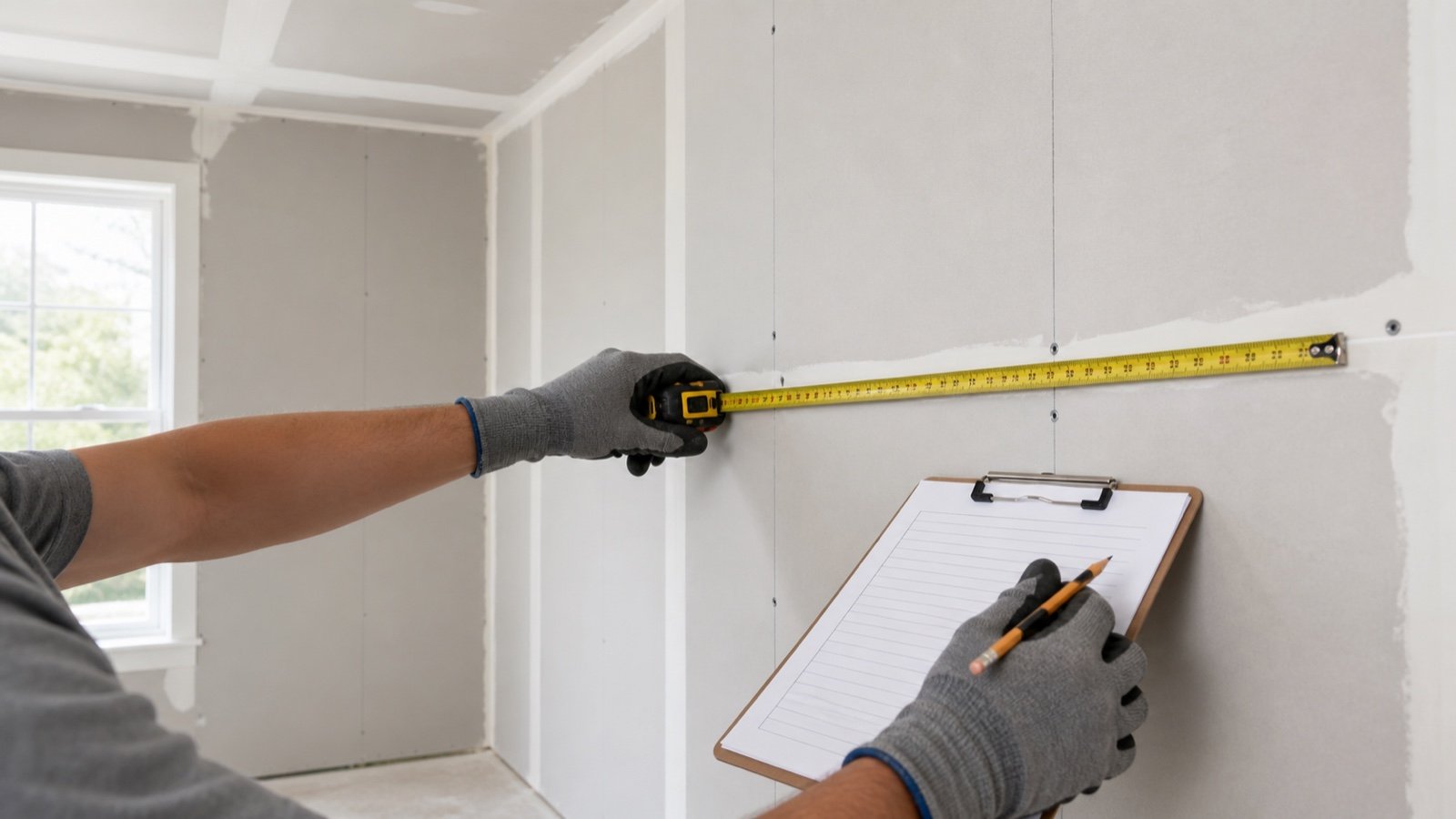
Mark the accepted panel layout on each wall and ceiling elevation. Trace panel-to-panel joints, then record each continuous run once.
- List flat and butt joints. Measure the centerline length of every accepted panel joint that receives tape.
- List inside angles. Add vertical wall corners and wall-to-ceiling angles only where the specified system uses joint tape.
- Record special taped details. Keep repairs, control-joint terminations and proprietary details on separate rows when the documents require tape.
- Exclude untreated edges. Perimeters hidden by another accepted finish, control joints and outside corners using bead need their own product rules.
- Check duplicate runs. A joint belongs in the ledger once even though 2 board edges meet there.
The drywall material takeoff worksheet provides separate rows for sheets, joints, tape, compound, fasteners and trims. Use the Drywall Calculator and the wall and ceiling measurement guide before the joint layout is fixed.
What formula calculates drywall tape rolls?
Measured mode adds linear runs. Area-rate mode scales a declared tape length through a declared board area. Both methods apply allowance before whole-roll rounding.
Measured base tape = flat and butt joints + taped inside corners + other approved taped runs
Area-rate base tape = finished board area × tape for reference area ÷ coverage reference area
Planning tape = base tape × (1 + entered allowance ÷ 100)
Whole rolls = ceiling(planning tape ÷ roll length)
Roll remainder = whole rolls × roll length − planning tape
The ceiling function rounds any positive fraction of a roll to the next whole roll. The interface keeps the exact ratio visible so you can see whether the estimate sits close to a package boundary.
Worked example: measured joints and one 250-foot roll
A reviewed room layout has 112 ft of flat and butt joints plus 24 ft of taped inside corners. The selected roll contains 250 ft. A documented 5% allowance applies to the measured tape length.
- Base tape: 112 + 24 = 136 ft.
- Allowance: 136 × 5% = 6.8 ft.
- Planning tape: 136 + 6.8 = 142.8 ft.
- Exact roll ratio: 142.8 ÷ 250 = 0.5712.
- Whole rolls: ceiling(0.5712) = 1 roll.
- Purchased tape: 1 × 250 = 250 ft.
- Roll remainder: 250 − 142.8 = 107.2 ft.
The 107.2 ft remainder comes from the sold roll length. It is not another 79% project allowance.
Worked example: USG's approximate area-rate record
USG's J780A submittal states approximate fiberglass drywall tape coverage of 370 ft per 1,000 ft² of gypsum panels. The same sheet lists 75 ft and 250 ft rolls for the named product and says availability can vary by geographic market.
For 1,000 ft², 0% allowance and a declared 250 ft roll:
- Base tape: 1,000 × 370 ÷ 1,000 = 370 ft.
- Exact roll ratio: 370 ÷ 250 = 1.48.
- Whole rolls: ceiling(1.48) = 2.
- Purchased tape: 2 × 250 = 500 ft.
- Roll remainder: 500 − 370 = 130 ft.
The source calls 370 ft approximate. The result should remain a named-product planning check, not a promise that every 1,000 ft² layout creates 370 ft of joints.
Why can 2 equal board areas need different tape lengths?
Board area does not describe panel size, orientation, room perimeter, openings or joint placement. Those variables change the total length of taped joints.
A 1,000 ft² open wall assembled from long sheets can create fewer butt joints than the same area divided among short walls, returns, soffits and small ceiling zones. Repeated doors and windows also change cut pieces and joint locations. Measure the accepted layout when that difference affects the order.
The drywall sheet size chart explains panel face area and available lengths. It does not select an installation orientation or prove that one layout meets the project requirements.
Should outside corners be counted as joint tape?
Count an outside corner only through the specified corner product and its instructions. Many outside corners use metal, vinyl, paper-faced or composite bead with its own stock lengths and treatment method.
Ordinary paper joint tape can fold into inside angles because the product is precreased. That does not make the same tape a universal outside-corner product. Keep corner bead and trim in separate takeoff rows unless the selected system documentation states otherwise.
How should a published coverage rate be recorded?
Save the manufacturer, exact tape product, tape type, stated application, coverage length, reference area, roll lengths, market, document revision and retrieval date. Preserve qualifiers such as “approximately.”
| Field | Named source example | Reason |
|---|---|---|
| Product | USG Sheetrock Brand Fiberglass Drywall Tape | Rates and compatibility belong to the named product |
| Coverage | Approximately 370 ft per 1,000 ft² | The qualifier and reference area control interpretation |
| Packages | 75 ft and 250 ft in J780A | Whole-roll results depend on the package entered |
| Application | Drywall interior joints and corners within the submittal scope | Another detail may use another product |
| Market | US document with stated geographic availability limits | Local stock can differ |
CGC's Canadian paper-tape data sheet gives an approximate metric record of 120 m per 100 m² and lists 22.9 m, 76.2 m and 152.4 m rolls. Use the record for the market and product you will purchase rather than converting a package and assuming local availability.
How does the metric switch work?
The unit switch uses exact relationships: 1 ft equals 0.3048 m, and 1 ft² equals 0.09290304 m². It converts all populated lengths and areas while keeping the roll ratio unchanged.
The measured fixture converts 136 ft to 41.4528 m, 142.8 ft to 43.52544 m and a 250 ft roll to 76.2 m. The result remains 1 roll with a 32.67456 m remainder.
A converted number does not establish a product sold in that size. Enter the roll length printed on the current package or supplier record after switching units.
How should allowance and roll rounding be handled?
Set allowance to 0% until a layout, work method or project record supports another value. Apply the chosen percentage to base tape before dividing by roll length.
Roll rounding can create enough remainder to cover documented cuts or minor repairs. Check that remainder before adding a separate percentage. Keep unopened rolls, opened usable stock, damaged tape and nonreturnable leftovers on separate lines.
The drywall allowance guide explains why layout loss, damage, spare stock and supplier increments need separate records. The same accounting principle applies to tape even though the selling unit is a roll rather than a sheet.
Which tape-estimating mistakes change the answer?
- Counting both board edges instead of the joint centerline once.
- Using sheet count multiplied by a fixed seam length without checking layout.
- Adding all wall and ceiling perimeters when some angles will not receive tape.
- Counting outside corners as ordinary joint tape without the selected corner detail.
- Using a 370 ft per 1,000 ft² record as an exact universal constant.
- Entering a 500 ft roll because it is common while buying a 250 ft or metric package.
- Adding allowance after rounding to full rolls.
- Adding roll remainder to the allowance.
- Combining paper tape, fiberglass tape and proprietary corner products in one package count.
- Assuming converted US package lengths prove product availability in another market.
What conditions need separate calculations?
| Condition | Required record |
|---|---|
| Several tape products | One row per product and roll length |
| Paper tape and fiberglass tape | Separate compatible joint systems and package counts |
| Corner bead or flexible corner trim | Measured corner lengths and the selected product's stock size |
| Control or movement joints | Project detail and specified accessory |
| Repair patches | Measured repair perimeter or named repair method |
| Existing site stock | Verified product, condition and usable length |
| Current cost | Whole rolls multiplied by a dated local quote |
What should the tape takeoff record contain?
- Project, room or zone and drawing revision.
- Panel size, orientation and accepted layout reference.
- Flat joints, butt joints and taped inside angles by location.
- Other specified taped details.
- Manufacturer, exact tape, type and compatibility record.
- Base length, allowance reason and planning length.
- Current roll length, exact ratio, whole rolls and remainder.
- Existing usable stock, supplier and quote date.
- Prepared by, checked by, date and unresolved details.
Use the Drywall Joint Compound Calculator after you have a product coverage record for the finishing scope. Return to the Drywall planning hub for sheet, tape and compound tools.
Product, safety and specification limits
The calculator estimates quantity. It does not approve a tape type, compound, joint system, finish level, corner detail, movement joint, fire-rated assembly or repair method.
USG J780A specifies setting-type joint compound for the named fiberglass tape and excludes ready-mixed or drying-type compounds for the first coat over that product. USG's paper-tape information identifies different application features. Follow the current documentation for the exact tape and compound combination.
Verify project drawings, specifications, tested assembly details, manufacturer instructions and local requirements before installation. Review the calculation methodology or send a source or formula issue through the corrections route.
Sources and source scope
- USG Sheetrock Fiberglass Drywall Tape J780A: named approximate coverage, package lengths, compatibility and market limits.
- USG Sheetrock Paper Joint Tape: current product identity and linked documentation.
- USG Interior Finishing Products Catalog J1424: named US paper-tape roll lengths.
- CGC Drywall Joint Tape data sheet: Canadian metric and imperial coverage and package records.
- NIST Handbook 44, 2026 Appendix C: exact length and area conversions.
Source scope: USG and CGC sources support their named products, applications, packages, coverage qualifiers and markets. NIST supports unit relationships. These sources do not establish a universal tape rate, allowance, joint layout, compatible system, local package, price or accepted project quantity.
Review note: Saleem Sial owns the research and editorial record. Source checks, independent formula fixtures, interface tests, build validation, link crawl, schema review and rendered QA form the internal publication gate. Waseem Sial, External Reviewer and Engineer, is listed for ongoing external review; no completed review date is claimed.