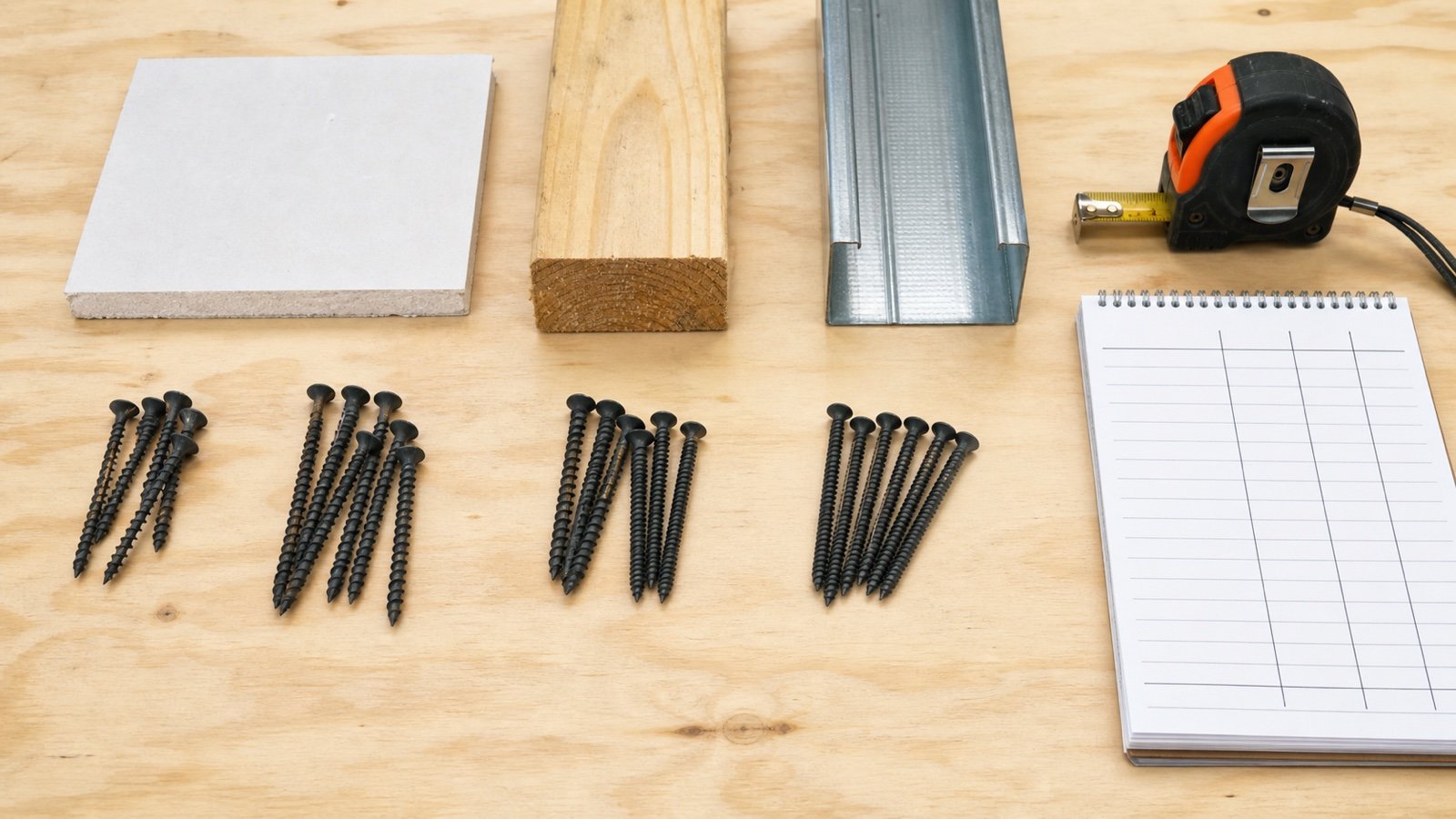
A drywall screw count is not yet a purchase order. The estimator still has to match the approved screw specification, check usable stock, read the current package label and round the final shortage to packages.
This guide keeps count-labelled boxes and weight-labelled packages separate. It also shows why a screws-per-pound number from another brand, length or package should not decide the order.
How do you order the right number of drywall screw boxes?
Start with the approved base count for one complete screw specification. Add a documented allowance, deduct only usable matching stock, then divide the remaining purchase need by the verified count in the current package and round up once.
Allowance screws = ceiling(base count × allowance percentage ÷ 100)
Planning need = base count + allowance screws
Purchase need = planning need − usable matching stock
Whole packages = ceiling(purchase need ÷ verified screws per package)
A box count, net weight, product code or package size can change. Record the source and check date instead of carrying an old number into a new order.
What information belongs on each purchase row?
One row should identify both the technical screw and the package being ordered. If any screw field changes, start another row even when the boxes look similar.
| Field | Record | Reason |
|---|---|---|
| Location and assembly | Drawing, wall, ceiling, layer or listed system | Retains the technical basis |
| Screw identity | Type or standard, gauge, length, thread, point, head and coating | Prevents unlike stock from being combined |
| Approved base count | Checked fastening positions before allowance | Separates installation need from purchasing |
| Allowance | Percentage, count and reason | Makes the planning assumption visible |
| Usable stock | Matching unopened packages plus verified loose count | Reduces duplicate purchasing |
| Package identity | Manufacturer, product code and seller item | Connects the row to the current product |
| Label basis | Piece count, net weight or both | Controls the conversion method |
| Package evidence | Label, manufacturer sheet or supplier record and check date | Supports the entered package size |
The drywall screw size guide explains the specification fields. The drywall screw takeoff worksheet produces the approved base count.
When can a count-labelled box go straight into the calculator?
Use the printed or documented piece count when it belongs to the exact product being ordered and the package is current. Enter that count as screws per box in the Drywall Screw Calculator.
Check the screw identity as well as the large number on the package. A 1,000-piece container of one length or thread does not replace a 1,000-piece container specified for another condition.
If a seller page and the physical label disagree, stop the conversion. Confirm the product code, package revision and supplied quantity with the seller or manufacturer before release.
How should a weight-labelled package be handled?
Do not convert weight to pieces with a universal screws-per-pound rate. Use an exact-product manufacturer or supplier record that connects the same screw and current package to both a documented count and a documented net weight.
| Available record | Action | Limitation |
|---|---|---|
| Exact package states a piece count | Use that count after matching the product code | Recheck if package or listing changes |
| Exact-product source states count and net weight | Use its product-specific relationship as a planning check | Do not transfer it to another screw |
| Package states net weight only | Ask the supplier or manufacturer for exact-product quantity data | No defensible piece conversion yet |
| Only a competitor calculator or forum estimate is available | Record it as unverified and do not release the order from it | It is not technical or package evidence |
Product-specific pieces per unit weight = documented package count ÷ documented package net weight
This relationship is valid only for the product record that supplied both numbers. Length, gauge, point, head, thread and manufacturing variation can change the mass of each screw.
Current calculator results illustrate the risk of a borrowed default. Pages reviewed on 2026-08-29 showed substantially different pieces-per-pound assumptions for nominal drywall screws. Those disagreements support checking the exact product; they do not establish a preferred conversion.
How do you check existing stock before ordering?
Count stock under the same screw identity used in the purchase row. Include sealed packages with a verified count and loose screws that have been positively identified and counted.
- Match type or standard, gauge, length, thread, point, head and coating.
- Keep wood-framing and steel-framing products in separate bins and rows.
- Exclude rusty, damaged, contaminated or unidentified screws.
- Record opened-package quantities as a counted number, not a guessed fraction.
- Cap the stock deduction at the planning need so purchase need cannot become negative.
Usable stock deduction = minimum(planning need, verified matching stock)
A weight check can help audit a known exact product when the tare weight and product-specific mass basis are documented. It should not be used to identify mixed loose screws.
What does a complete box-order example look like?
Assume a checked takeoff has 550 screws for one declared specification. The estimator documents a 5% allowance, counts 100 usable matching screws in stock and verifies 250 screws in the current box.
| Step | Arithmetic | Result |
|---|---|---|
| Allowance | ceiling(550 × 5 ÷ 100) | 28 screws |
| Planning need | 550 + 28 | 578 screws |
| Purchase need | 578 − 100 | 478 screws |
| Whole boxes | ceiling(478 ÷ 250) | 2 boxes |
| Purchased pieces | 2 × 250 | 500 screws |
| Box-rounding remainder | 500 − 478 | 22 screws |
The 5% allowance and 250-piece package are declared inputs for this arithmetic fixture. They are not recommendations or market facts. The project must document its own allowance and current package count.
Why should package rounding happen only once?
Combine compatible purchase rows before dividing by the package count. Rounding every room or elevation separately can buy more packages than the combined shortage requires.
For example, 2 matching rooms each need 130 screws after stock. Rounding each room against a 250-piece box orders 2 boxes. Combining the compatible shortage gives 130 + 130 = 260, which also needs 2 boxes. With 2 rooms at 120 each, separate rounding orders 2 boxes while the combined 240-screw shortage needs 1.
Keep rows separate when the screw specification, delivery phase, storage responsibility, supplier package or cost code must remain separate. The smallest package count is not always the right operational split.
How should the allowance be selected?
Use a documented project decision based on handling, access, crew workflow, breakage, dropped screws, packaging and replenishment risk. There is no universal percentage that suits every job.
Apply allowance after the technical base count closes and before matching stock is deducted. Keep box-rounding remainder separate from allowance: allowance covers the documented planning risk, while remainder results from the selling increment.
Do not reuse the drywall sheet cut-waste percentage as a screw allowance. Offcuts change panel yield; screws are counted fastening positions plus a separate handling decision.
What should happen when packages are opened or returned?
Record actual use and remaining matching stock at the end of each phase. An opened package can become verified stock for the next compatible phase when its contents remain identifiable and serviceable.
- Write the product code and counted remainder on the bin or stock ledger.
- Keep returns under the seller's current policy and package condition rules.
- Compare planned use with actual issued quantity before setting the next allowance.
- Do not combine unlabeled loose screws solely to clear inventory.
- Record substitutions and approvals before altering the purchase row.
Which ordering mistakes cause the largest errors?
- Ordering before the fastening schedule and base count are approved.
- Using a generic screws-per-sheet rate for mixed conditions.
- Converting pounds with a value from another length, gauge or brand.
- Reading package weight as a guaranteed piece count.
- Deducting approximate or nonmatching stock.
- Applying allowance twice in the worksheet and calculator.
- Rounding each compatible room to a box before combining shortages.
- Mixing a package remainder with the planned allowance.
- Using an old seller listing without checking the current product code.
What should be checked before the order is released?
- Confirm the current drawing, assembly and fastening schedule.
- Check the base count and all direct-count exceptions.
- Verify every screw identity field.
- Record the allowance and its reason.
- Count only usable matching stock.
- Confirm the exact current package and label basis.
- Use a piece count only when the source supports that exact product.
- Combine compatible shortages, then round once.
- Check supplier availability, substitutions and delivery phases.
- Save the source, check date, preparer and checker with the order.
The drywall material takeoff worksheet coordinates screws with panels, tape, compound and trim. Return to the Drywall planning hub for related tools and guides.
Quantity planning does not approve a fastener, assembly or substitution. Project drawings, listed assemblies, manufacturer instructions, the adopted local code and qualified project professionals control the work.
Sources and source scope
- USG Sheetrock Brand Installation and Finishing Guide, J371 supports a manufacturer-specific estimating table that reports Type W screws by weight for named panel quantities. It does not establish a universal pieces-per-pound conversion.
- National Gypsum Drywall Materials Calculator supports its visible statement that the estimate excludes waste and its direction to installation instructions. It does not select this article's allowance or package size.
- 2024 International Residential Code, Chapter 7 Wall Covering supports keeping fastening conditions and screw specifications separate under the stated US model-code scope. Check the adopted local edition and amendments.
Source scope: these sources support the separation of technical need, allowance and package conversion. They do not verify a current seller's inventory, package count, price, return policy or a project's usable stock.
Review note: Saleem Sial owns the research and editorial record. Source checks, arithmetic fixtures, editorial review, build validation, link crawl, schema review and rendered QA form the internal publication gate. Waseem Sial, External Reviewer and Engineer, is listed for ongoing external review; no completed review date is claimed.