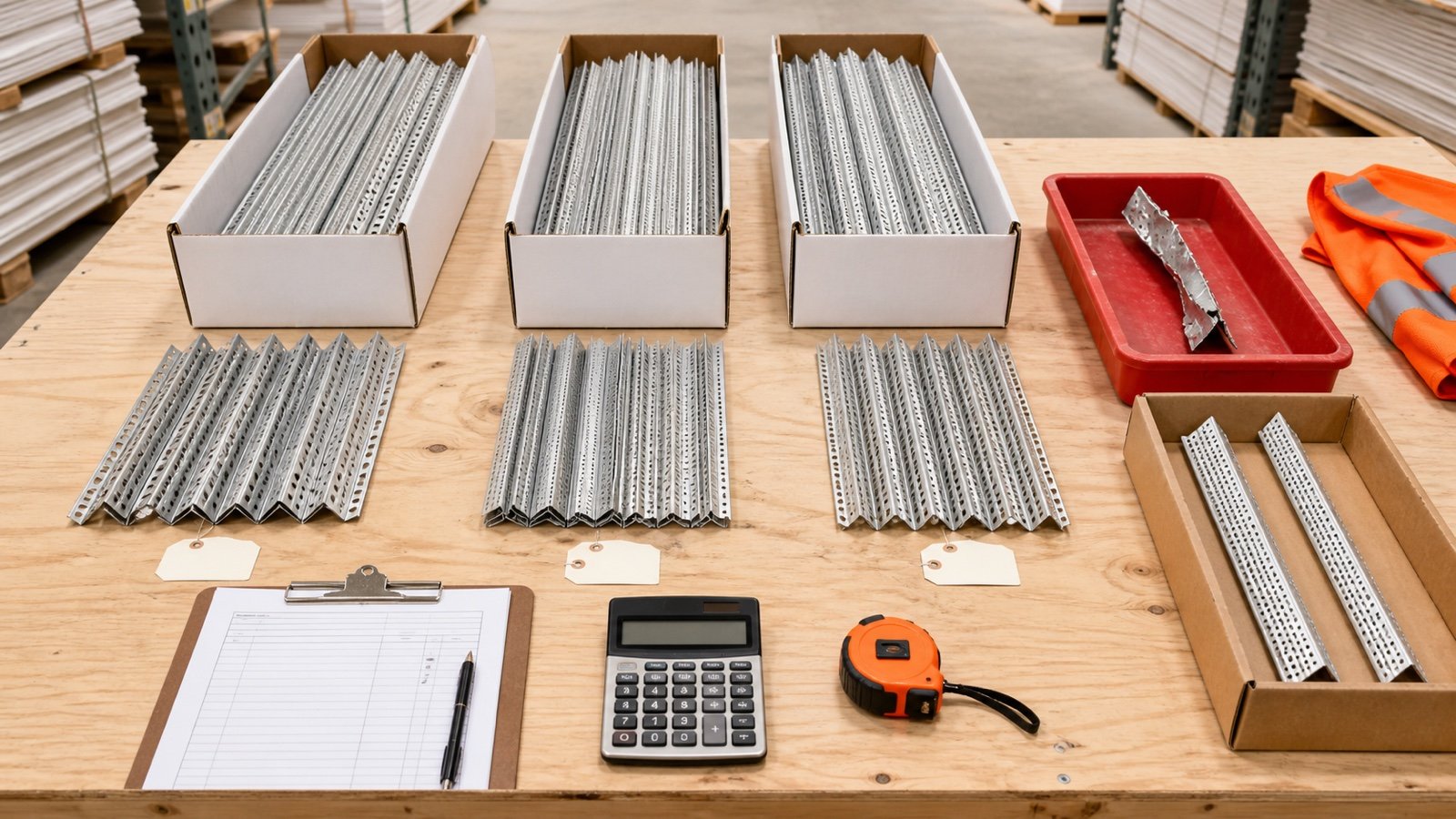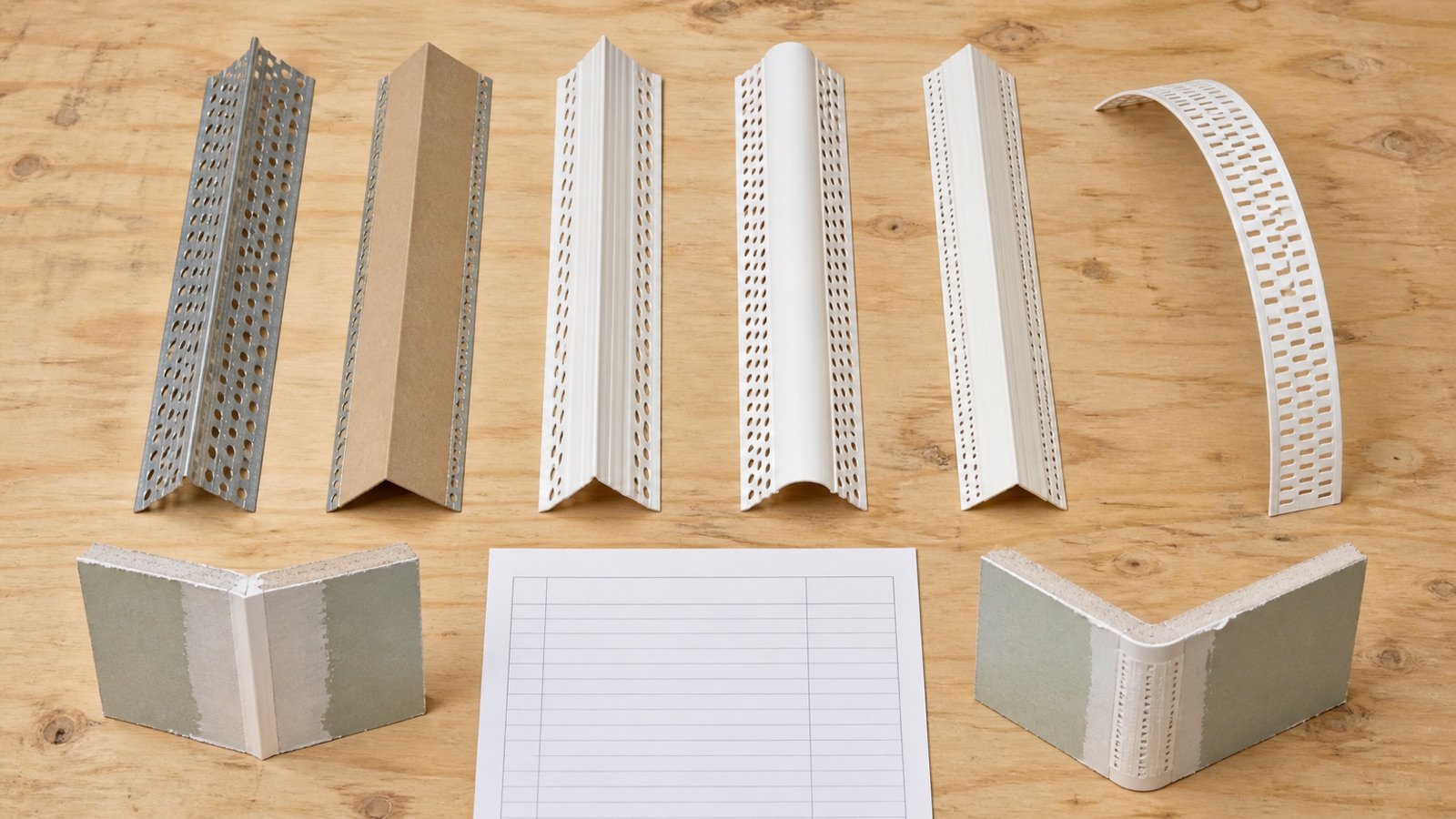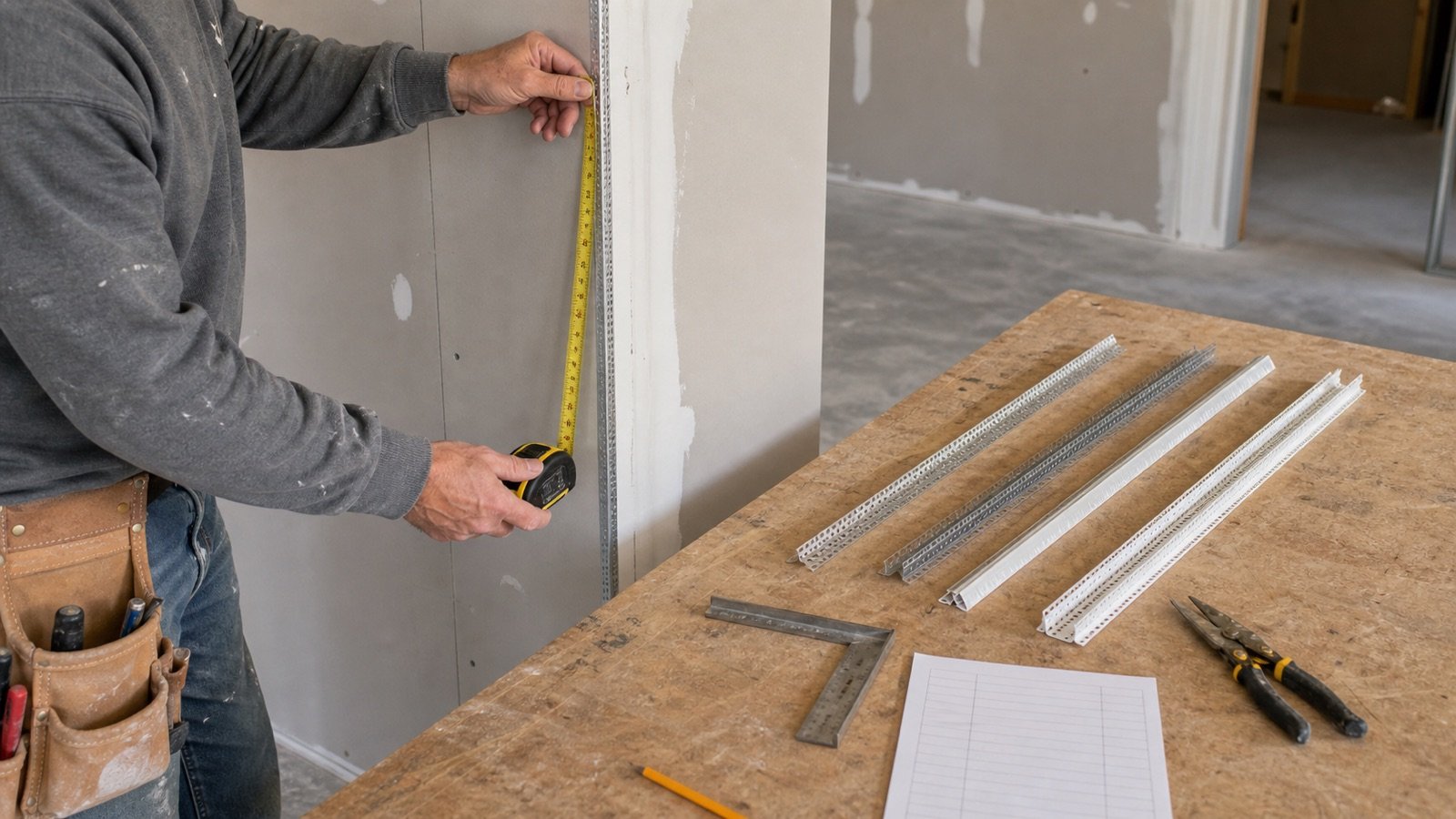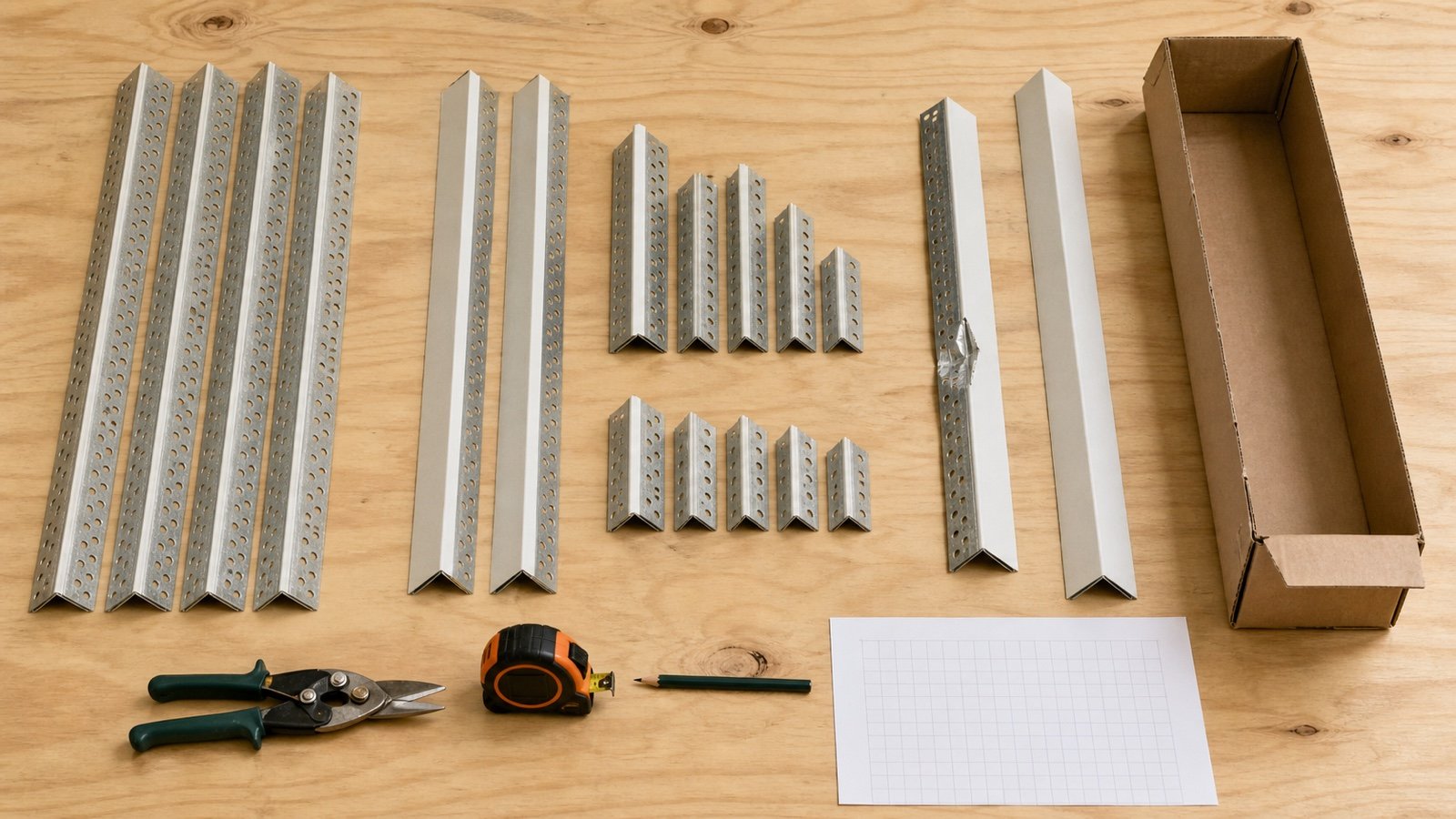
A drywall corner-bead allowance covers specific pieces that the checked cutting plan may not supply. Those pieces can cover expected rejected cuts, transport damage, site handling or a deliberate repair spare.
Start with the base stock-piece count for one selected product. Add a documented allowance before deducting usable matching stock, then apply the supplier's current package size once.
How much extra drywall corner bead should you order?
Use the smallest whole-piece allowance that your project record supports. No reviewed primary source sets one universal drywall corner-bead waste percentage, so begin at 0% and add pieces for named risks that remain after the cut plan and stock check.
A percentage is one input method. The result must still make sense as whole physical pieces. For a base need of 18 pieces, 5% gives ceiling(18 × 0.05) = 1 extra piece. For a base need of 2 pieces, the same method also gives 1 extra piece, which equals 50% of the base count after rounding.
| Record | Meaning | Can it reduce the order? |
|---|---|---|
| Base pieces | Full stock pieces required by the accepted cut layout | No, this is the starting need |
| Physical offcuts | Individual remnants with known product, length and condition | Yes, after a checked cut assignment |
| Rejected pieces | Bent, dented, contaminated, miscut or otherwise unusable stock | No |
| Allowance pieces | Whole extra pieces added for documented project risks | No, they add to planning need |
| Usable matching stock | Verified full pieces of the same product and suitable length | Yes, before package rounding |
| Package remainder | Full pieces bought beyond the post-stock need because of the selling increment | It can become stock after receipt and inspection |
Which risks can support an allowance?
Record the cause, affected product and expected whole-piece effect. A project-specific note gives the estimator and buyer something they can check after installation.
- Repeated difficult cuts: mitres, intersections, narrow returns or other accepted details may create a higher rejected-cut risk than straight full-height corners.
- Transport and handling: long rigid pieces can arrive or reach the work area bent, dented or twisted. Inspect before assigning them to runs.
- Storage exposure: the selected product may need dry, level and weather-protected storage. Separate wet, contaminated or distorted material.
- Site revisions: added corners, changed openings or revised profiles can create a new quantity. Record the drawing revision rather than hiding the change inside waste.
- Deliberate spares: the project team may retain matching pieces for repair or phased work. Name the spare quantity and destination.
ASTM C1047 covers the condition of accessories within its scope and says twist or camber cannot prevent intended use. ClarkDietrich tells users to keep its named paper-faced products dry, off the ground, supported on a level platform and protected from weather. These sources support inspection and storage checks. They do not prescribe an allowance percentage.
Why should the cut plan come before the allowance?
The cut plan establishes how many complete runs fit in each stock piece. An allowance added to total linear feet can miss a geometric constraint when separate remnants cannot form one complete run.
Example: 3 corners each need a 6 ft complete piece and the selected stock is 10 ft. The total run length is 18 ft. Dividing by 10 ft gives 2 pieces, yet each 10 ft stock piece yields only one complete 6 ft cut. The base requirement is 3 stock pieces before any allowance.
Use the drywall corner-bead measurement guide to build the run list. Select and separate each product with the corner-bead type guide, then calculate complete cuts with the Drywall Corner Bead Calculator.
Can leftover lengths be combined into one usable offcut?
Credit each offcut as one physical piece. Summed leftover length can describe material loss, but it cannot supply a longer run unless one recorded offcut has the required length and the accepted detail permits that use.
Consider 24 runs at 2.4 ft cut from 10 ft stock. Each stock piece supplies 4 complete runs, so 6 stock pieces cover the base need. Each piece has 0.4 ft left, assuming the entered cut length already includes the required product trim and no separate kerf adjustment applies.
The ledger contains 6 offcuts at 0.4 ft each. Their summed length is 2.4 ft, but none of the 6 pieces can supply another 2.4 ft run. Record 6 × 0.4 ft, not one 2.4 ft stick.
| Check | Required record |
|---|---|
| Product identity | Manufacturer, product, stock number, profile, material and attachment system match |
| Physical length | One measured remnant fits one assigned cut |
| Condition | No bend, dent, twist, crack, contamination or damaged face that prevents accepted use |
| End detail | Remaining ends can receive the required cut or intersection |
| Joint rule | The run remains one piece unless the product and project detail permit a joint |
| Traceability | Offcut ID links to its bin, bundle or marked location |
How do rejected cuts differ from spare pieces?
A rejected cut records material already lost. A spare piece records usable material held for a stated future need. Keep both quantities visible so the next estimate can compare the allowance assumption with the result.
For each rejection, record the date, product, piece length, cause and disposition. Useful cause codes include wrong measurement, wrong angle, damaged face, bent nose, failed mitre, transport damage and drawing change.
For each spare, record whether it remains sealed, full length, cut length or assigned to a repair location. A spare that enters general site stock needs a stock record before a later project deducts it.
How should existing corner-bead stock be deducted?
Deduct verified matching full pieces after the base count and allowance are set. Cap the deduction at the planning need and keep short offcuts in the cut ledger.
- Match the manufacturer, product name, stock number, profile and material.
- Confirm the attachment system and project acceptance.
- Measure each opened piece. A printed carton length does not prove the length of a loose stick.
- Inspect the nose, flanges, face and ends under usable light.
- Record the storage location so the installer can find the credited material.
- Deduct the accepted full-piece count before rounding to the seller's package.
A 10 ft piece cannot replace a required 12 ft one-piece run. A vinyl bullnose cannot replace a metal square bead because both pieces happen to be 10 ft long.
When should package rounding occur?
Round to the current selling increment after base pieces, allowance and usable stock are settled. Package rounding can create extra full pieces, so show the remainder before adding another spare quantity.
Allowance pieces = ceiling(base pieces × allowance percentage ÷ 100)
Planning pieces = base pieces + allowance pieces
Pieces to purchase = maximum(0, planning pieces − usable matching stock)
Whole packages = ceiling(pieces to purchase ÷ current pieces per package)
Package remainder = whole packages × pieces per package − pieces to purchase
Trim-Tex currently lists 8 ft, 9 ft and 10 ft versions of one named Mud Set Rigid product at 50 pieces per box. ClarkDietrich lists one named splayed profile at 63 pieces per 8 ft carton and 50 pieces per 10 ft carton. These examples show why the buyer must copy the exact item and package record.
A local supplier may sell individual pieces. Enter 1 piece per package when that is the confirmed selling unit. Recheck the quote when the product, length, market or supplier changes.
Worked example: allowance, stock and package remainder
A checked layout needs 18 full 8 ft pieces of one approved product. The estimator documents 5% for rejected cuts and handling, finds 2 usable matching pieces in stock and confirms 10 pieces per supplier package.
- Base pieces: 18.
- Allowance pieces:
ceiling(18 × 5 ÷ 100) = 1. - Planning pieces:
18 + 1 = 19. - Usable matching stock: 2 pieces.
- Pieces to purchase:
19 − 2 = 17. - Whole packages:
ceiling(17 ÷ 10) = 2. - Purchased pieces:
2 × 10 = 20. - Package remainder:
20 − 17 = 3pieces.
The order includes 1 planned allowance piece. The supplier's selling increment creates 3 more pieces after the stock deduction. The buyer should decide whether those 3 pieces stay sealed, go into project stock or support an approved return.
How can a project choose between a percentage and named pieces?
A percentage works for repeated work when the team has a current record that connects the rate to accepted and rejected pieces. Named whole pieces give a clearer record on small projects, unusual profiles and phased work.
| Condition | Useful method | Required support |
|---|---|---|
| Large repeated straight-run group | Documented percentage converted to whole pieces | Current production or closeout record for the same product and detail |
| Small room or repair | Named spare-piece count | Reason for each extra piece |
| Mixed profiles | Separate allowance for each product row | Product-specific risk and package record |
| Difficult mitres or intersections | Checked trial cuts plus named pieces | Approved detail and cutting method |
| Uncertain revision | Hold item or revision quantity | Request for information, sketch or drawing revision |
| Large package remainder | Review the remainder before adding allowance | Supplier selling unit and return terms |
Which product instructions can change the cut quantity?
Use the current instruction for the selected product. USG's J371 guide tells users of its named method to cut vertical corner trim 1/2 in shorter than the wall height. That cut instruction changes the entered run length for that method.
Other products can have different end gaps, intersection cuts, archway preparation or attachment requirements. Copy the accepted detail into the cut list. Do not transfer one manufacturer's instruction to another product.
How should revisions and field changes be recorded?
Freeze the original base count, then add a dated revision row. This keeps a design change out of the rejected-cut rate and shows which drawing created the purchase.
Example: Revision A required 18 pieces. Revision B adds 2 boxed-column corners under the same product. Record 2 revision pieces, update the base to 20 and recalculate the documented allowance. If the new corners use another profile, create another product row.
At closeout, compare accepted installed pieces, rejected pieces, unused full pieces, remaining offcuts and returned packages. That record can support a later allowance for comparable work. It does not create a universal rate for every bead and detail.
Which allowance mistakes cause weak orders?
- Applying 10% because a calculator displayed it as a default.
- Adding allowance to linear feet before checking complete cuts per stock piece.
- Combining separate short offcuts into one imaginary longer piece.
- Counting a damaged stick as usable stock.
- Deducting another profile because its length matches.
- Adding spare pieces after package rounding without reviewing the package remainder.
- Using an old carton quantity for a current supplier item.
- Hiding a drawing revision inside waste.
- Refreshing the allowance percentage without a closeout record.
- Failing to mark where credited stock is stored.
What should the allowance ledger contain?
| Field | Entry |
|---|---|
| Product row | Manufacturer, product, stock number, profile, material, length and attachment system |
| Base calculation | Run group, cutting-list reference, complete cuts per piece and base pieces |
| Allowance | Percentage or named pieces, reason, approver and date |
| Stock credit | Full matching pieces, location, length and condition check |
| Package record | Supplier, selling unit, quote date, whole packages and remainder |
| Offcut record | Individual piece ID, physical length, end condition and assigned cut |
| Rejection record | Piece ID, cause, date and disposition |
| Closeout | Installed, rejected, unused, returned and transferred quantities |
Add the completed product row to the drywall material takeoff worksheet. Keep panel, tape, joint compound, fastener and corner-bead quantities in their own records.
Safety, specification and supplier limits
Quantity planning does not select the bead, approve a joint, set an attachment schedule or replace the project drawings and current product instructions. Confirm the angle, radius, material, exposure, finish and system before ordering.
Metal edges and cutting tools can cause cuts. USG and ClarkDietrich include glove guidance for named products and tasks. Follow the selected manufacturer's instructions, safety data and site controls for cutting, adhesives, compound, sanding dust, access equipment and disposal.
Return to the Drywall planning hub for related tools and guides. Review the calculation methodology or report a formula, source or content issue through the corrections route.
Sources and source scope
- ASTM C1047-19: accessory scope and condition requirements in the public standard record.
- USG Installation and Finishing Guide J371: named cut and handling instructions.
- Trim-Tex Mud Set Rigid Corner Bead: named stock lengths, stock numbers and box quantities.
- Trim-Tex FAQ: product variation and cutting context.
- ClarkDietrich Paper-Faced Corner Bead: named storage guidance.
- ClarkDietrich Splayed Corner Bead: named length, carton and sharp-edge records.
Source scope: the manufacturers support their named products and displayed records. ASTM supports the standard scope and condition requirement. These sources do not select an allowance, approve this page's examples, verify local stock, define a universal waste factor or establish current local price and availability.
Review note: Saleem Sial owns the research and editorial record. Source checks, independent fixtures, page tests, build validation, link crawl, schema review and rendered QA form the internal publication gate. Waseem Sial, External Reviewer and Engineer, is listed for ongoing external review; no completed review date is claimed.