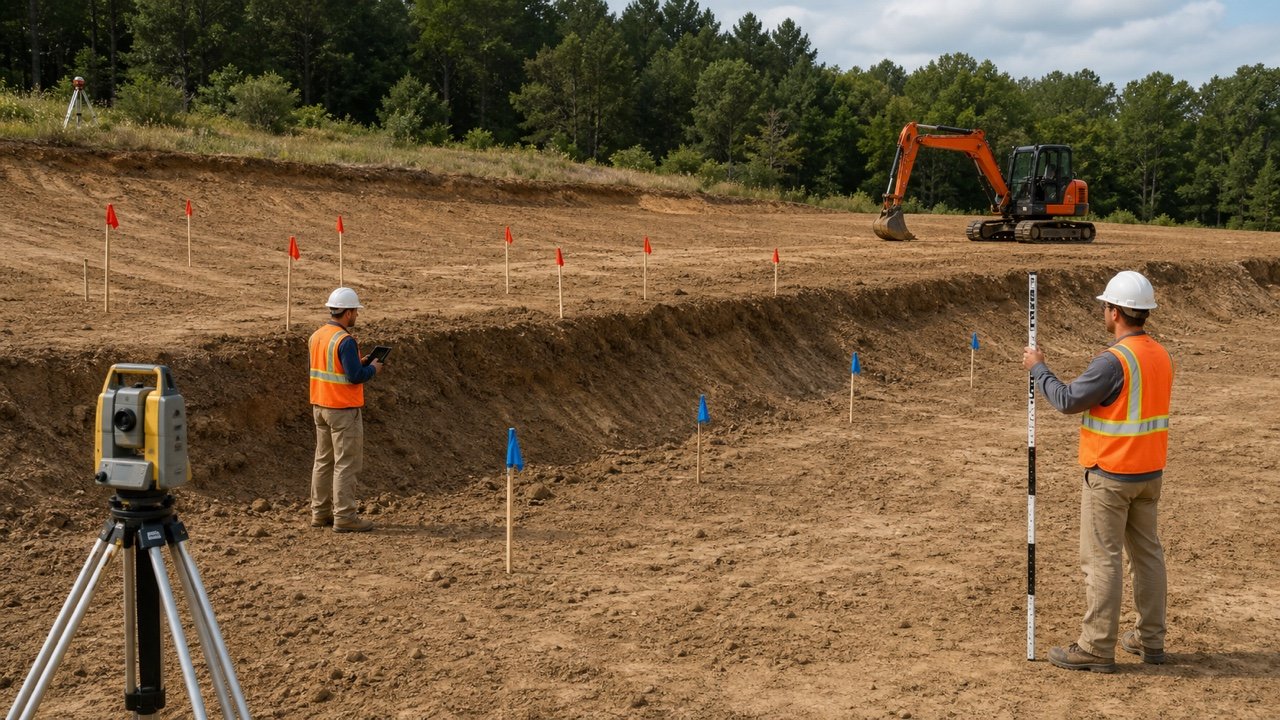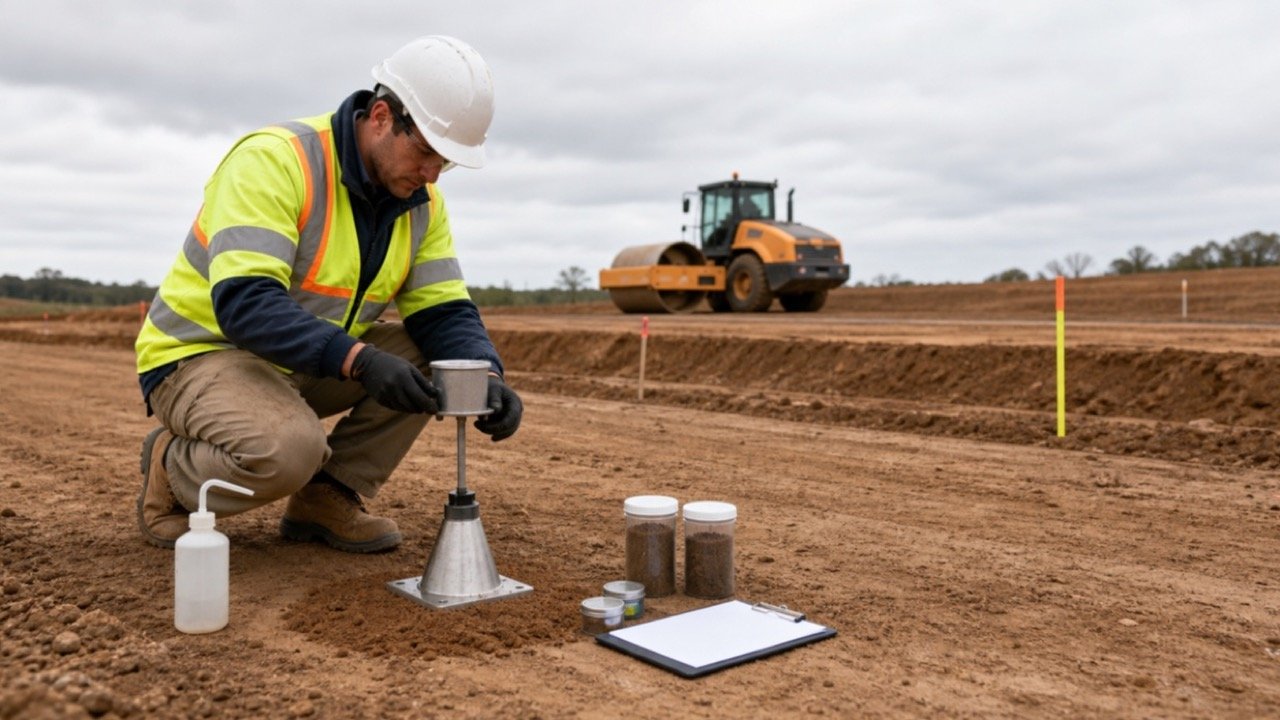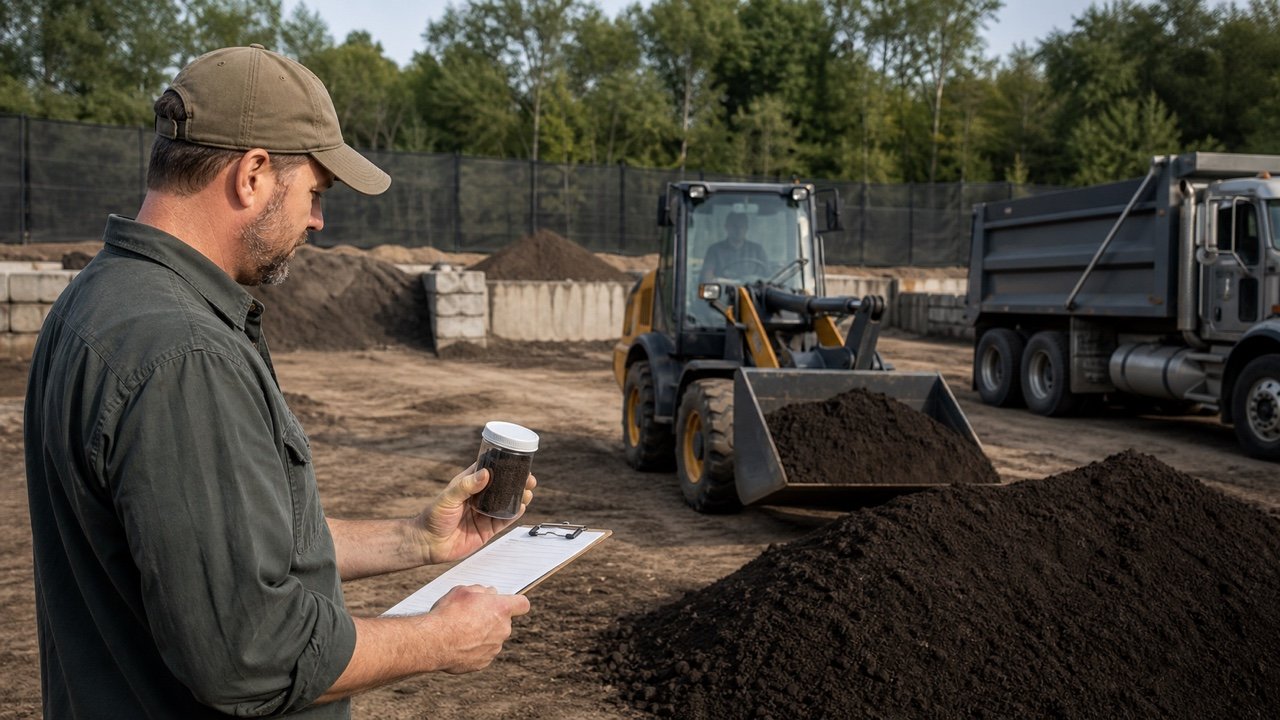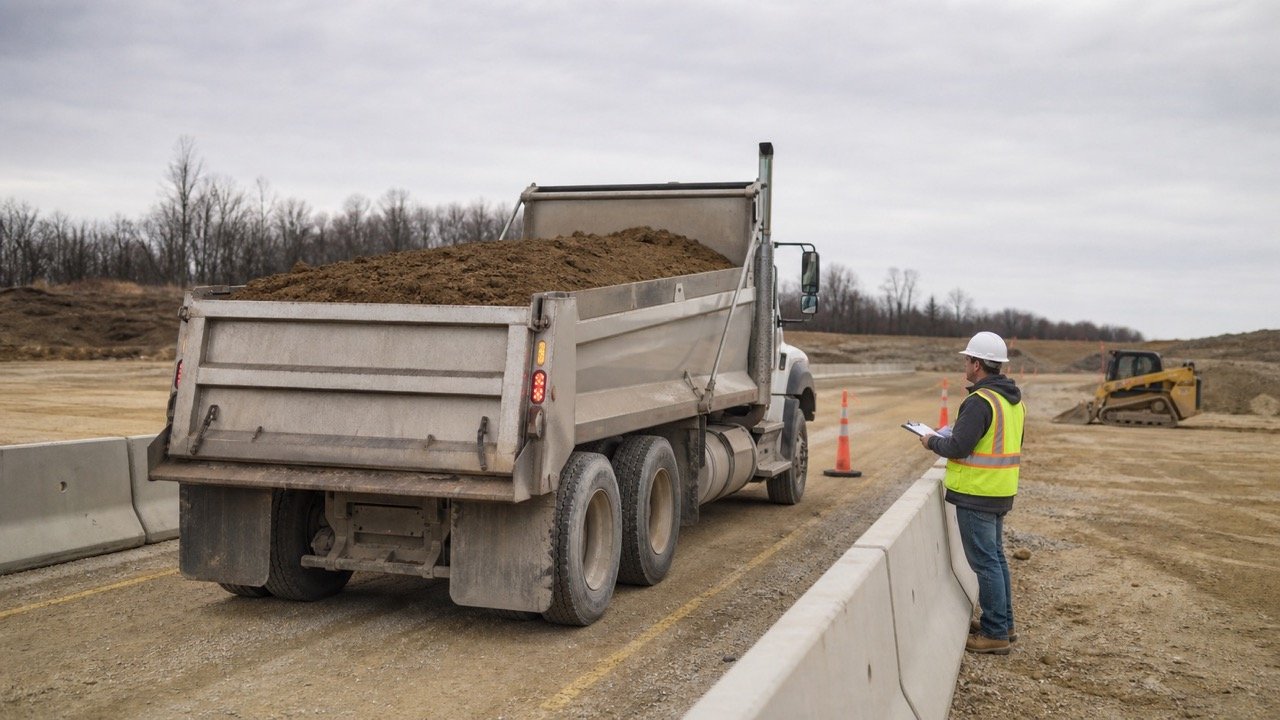
A fill dirt delivery plan starts after the material, placed geometry and loose order basis have been approved. It connects that quantity to specific trucks, a legal route, a prepared receiving area, named destination zones and a ticket record for every load.
Check body volume and payload separately. Then set the dispatch pace from the site's safe receiving capacity, not from the largest number of trucks a supplier can send.
What should a fill dirt delivery plan include?
The plan should identify the approved source and material, quantity state, truck constraints, route, arrival process, dump or staging area, site responsibilities, ticket fields, exception handling and daily reconciliation.
Record whether it was accepted into a named zone, accepted partially, held, diverted, rejected and returned, or rejected and stockpiled under an approved process. Do not let a ticket enter the accepted total before that status is clear.
- Freeze the approved loose delivery quantity by product, source and destination.
- Confirm the exact vehicle types, usable body volumes and usable payloads.
- Approve the public route and the on-site one-way movement or controlled reversing plan.
- Inspect access, turning, ground support, overhead hazards and the dump or staging area.
- Set a delivery window and arrival pace that receiving, inspection, dumping and spreading can handle.
- Assign dispatcher, gate, receiver, spotter, equipment, testing and acceptance responsibilities.
- Use unique tickets and a live load ledger.
- Reconcile accepted, partial, held, rejected, returned and missing records at each shift end.
Start with the Fill Dirt Calculator for simple placed geometry. Use the Bank vs Loose Volume guide when a material-state conversion is still unresolved.
What must be approved before dispatch?
Release trucks only after the material source, product, loose quantity, route, receiving zone and acceptance process are identified. A low price or the label clean fill does not establish suitability.
| Item | Evidence to confirm | Stop condition |
|---|---|---|
| Material role | Drawing, specification, geotechnical requirement or approved site instruction | Structural fill, general fill, topsoil and unsuitable soil are being treated as the same product |
| Source | Named borrow site, quarry, stockpile or supplier and approval status | Unknown, changed or mixed source |
| Physical properties | Required classification, gradation, moisture-density or other project evidence | Missing test or material approval |
| Environmental status | Applicable source history, sampling, certification, permits and receiving-site approval | Unresolved contamination, debris, invasive species or regulatory requirement |
| Quantity state | Approved loose order quantity and its calculation chain | Bank, loose and compacted values have been mixed |
| Vehicle and route | Haulier fleet details, legal limits, permits, restrictions and approved route | Payload, axle, bridge, height, width, road or time restriction unresolved |
| Site readiness | Controlled entrance, ground, turning, dumping, inspection and spreading plan | Unsafe access, overhead conflict, unstable ground or unavailable receiver |
Caltrans requires project review of imported borrow source, material type, testing, access and environmental commitments in its highway context. Other projects and jurisdictions use their own approval process.
EPA warns that clean fill in construction language can mean material screened of obvious debris without proving it is safe for gardening. Confirm the environmental definition and evidence required at the receiving location.
How many loads of fill dirt should be planned?
Calculate the load count by usable body volume and by usable payload. The greater count controls the first planning screen, subject to the exact vehicle, route, material, loading and legal limits confirmed by the haulier.
Planned loose mass = approved loose volume × matching loose bulk density
Loads by volume = ceiling(approved loose volume ÷ usable body volume)
Loads by payload = ceiling(planned loose mass ÷ usable payload)
Controlled planned loads = greater of volume count and payload count
A nominal truck class does not supply these inputs. Ask for usable body volume and payload for the actual vehicle, material and route. Keep the truck's tare, gross and axle constraints in the haulier's controlled record.
Worked imperial load-planning example
A hypothetical approved order requires 160 yd³ of loose fill. A matching planning density is 1.35 short tons/yd³. The haulier confirms 12 yd³ usable body volume and 15 short tons usable payload for the proposed vehicle and route.
| Stage | Calculation | Result |
|---|---|---|
| Planned loose mass | 160 × 1.35 | 216 short tons |
| Loads by volume | ceiling(160 ÷ 12) | 14 loads |
| Loads by payload | ceiling(216 ÷ 15) | 15 loads |
| Controlled plan | greater of 14 and 15 | 15 loads |
| Even-split volume check | 160 ÷ 15 | 10.6666667 yd³/load |
| Even-split mass check | 216 ÷ 15 | 14.4 short tons/load |
Payload controls this fixture. The density and vehicle values are arithmetic inputs, not standard values. Real loads can vary, so dispatch and receiving records must use actual legal loading and ticket evidence rather than forcing every truck to equal the average.
Worked metric load-planning example
A second hypothetical order requires 210 m³ loose. Its matching planning density is 1.55 t/m³. The haulier confirms a usable body volume of 16 m³ and usable payload of 22 t for the route.
| Stage | Calculation | Result |
|---|---|---|
| Planned loose mass | 210 × 1.55 | 325.5 t |
| Loads by volume | ceiling(210 ÷ 16) | 14 loads |
| Loads by payload | ceiling(325.5 ÷ 22) | 15 loads |
| Controlled plan | greater of 14 and 15 | 15 loads |
FHWA's U.S. Interstate standards include gross, single-axle, tandem-axle and bridge-formula limits. Off-Interstate rules, state exceptions, permits and route restrictions can differ. A calculated 22 t payload does not authorize that payload on a particular truck or road.
The Order Quantity guide gives the detailed state, density, supplier-increment and package conversion workflow when the loose order basis has not been established.
How should truck arrival spacing be planned?
Use the complete load, travel, gate, inspection, dump, return and queue cycle as a planning input. Compare the theoretical fleet rate with what the receiving lane, dump point, testing, spreading equipment and site traffic can safely process.
Theoretical fleet rate = truck count ÷ cycle time in hours
Theoretical dispatch interval = cycle time ÷ truck count
Suppose 6 trucks have a hypothetical complete cycle of 75 minutes, or 1.25 hours.
| Check | Calculation | Result |
|---|---|---|
| Theoretical fleet rate | 6 ÷ 1.25 | 4.8 loads/hour |
| Theoretical interval | 75 ÷ 6 | 12.5 minutes/load |
| Eight-hour arithmetic | 4.8 × 8 | 38.4 load cycles before real constraints |
The 38.4 result is not a delivery promise or a whole-load schedule. Startup, final trips, source queues, traffic, weighing, tarping, breaks, inspections, testing, dumping, spreading, weather, refuelling, maintenance and legal working hours change completed production.
If the site can safely receive only 3 loads per hour, dispatching at 4.8 creates a queue. Reduce fleet release, add a separate approved receiving process, or change the work sequence through the responsible logistics plan.
What should be checked on the delivery route?
Check the public route and the private site route as separate systems. The haulier and responsible authorities control road legality; the project controls entry, movement and interaction inside the site.
- Vehicle class, actual dimensions, tare, usable payload, axle arrangement and body type.
- Posted weight, axle, bridge, height, width, length and time restrictions.
- Permit, escort, cover, spillage, wheel-cleaning and public-road requirements.
- Turning radii, gate operation, road width, grade, crossfall, surface strength and edge support.
- Overhead power, communications, trees, structures, signs, bridges and raised-bed clearance.
- Underground services, culverts, septic assets, soft shoulders and hidden voids.
- Pedestrians, neighbours, school or peak traffic, work zones and emergency access.
- One-way circulation, passing points, holding areas and controlled reversing.
- Wet-weather closure, dust, mud, lighting and road-maintenance triggers.
OSHA requires covered access roadways and grades to be constructed and maintained for safe movement of the vehicles involved. That rule does not supply a universal driveway width, grade or ground-bearing value.
What makes a dump or staging area ready?
The area should support the loaded vehicle and remain stable as the body rises and material moves. It also needs safe separation from people, excavations, edges, utilities, traffic and other equipment.
| Condition | Check before release |
|---|---|
| Ground support | Stable, level-enough approved surface without soft, saturated, uncompacted, voided or undermined areas |
| Edge distance | Project-defined separation from excavations, embankment edges, slopes, shoulders, walls and buried structures |
| Overhead space | Raised-body envelope clear of power lines, structures, branches, lighting and other objects |
| Truck position | Approved orientation, wheels, cross-slope, side-slope and stopping point for the exact vehicle |
| People and plant | Worker-free dump zone, controlled loader or dozer interaction and an assigned signal process |
| Material flow | Expected soil moisture, freezing, sticking, bridging and uneven discharge risks addressed |
| Exit | Bed-lowered confirmation, clean route, wheel condition and no blocked emergency path |
NIOSH recommends pre-planning stable dumping surfaces, staging that minimizes backing and an internal traffic-control plan. It identifies unstable or soft ground, slopes, uneven loading, long or raised beds and incomplete material flow as tip-over factors.
Stop the truck before dumping when ground, clearance, traffic or communication differs from the approved plan. A driver arrival does not make a marginal area acceptable.
How should reversing and ground workers be controlled?
Design the route to reduce reversing and keep people out of truck paths and blind spots. When reversing is required, apply the site's trained communication and spotter process plus the governing law.
For covered U.S. construction vehicles with an obstructed rear view, OSHA 29 CFR 1926.601 requires an audible reverse alarm or backing only when an observer signals it is safe. OSHA-approved State Plans may have different or stricter rules.
- Use one recognized signal system and confirm it before movement.
- Keep the spotter visible to the driver and outside the vehicle path.
- Stop movement when visual or communication contact is lost.
- Keep receivers, samplers, surveyors and equipment operators out of blind spots.
- Use barriers and marked walkways where the plan requires them.
- Provide lighting and high-visibility apparel appropriate to the work and conditions.
- Do not let a ticket signature draw the receiver into an active dump or backing zone.
NIOSH reported 809 deaths among construction and extraction workers from dump-truck injuries during 2011 to 2020. That national count supports careful planning; it does not estimate risk for one project.
What information belongs on a fill delivery ticket?
The ticket should identify the material, source, vehicle, quantity basis, time and receiving disposition. Preserve the original supplier or scale record and add site information without hiding changes.
| Group | Fields |
|---|---|
| Identity | Unique ticket or electronic ID, project, order, date and shift |
| Source | Approved source, plant or borrow ID, product description, material code and approval reference |
| Vehicle | Vehicle or fleet ID and haulier |
| Quantity | Unit, gross, tare and net mass, or measured volume and the controlled measurement basis |
| Time | Loaded or weighed, dispatched, arrived, received and departed |
| Destination | Site, phase, station, zone, lift, stockpile or placement area |
| Inspection | Visual condition, sampling or test ID, weather and discrepancy note |
| Disposition | Accepted, partial, held, diverted, rejected, returned or another approved status with quantity |
| Custody | Driver, receiver, responsible reviewer and electronic or physical record location |
WSDOT's current documentation manual requires vehicle and quantity information on its item tickets and describes optional source, placement, time, material and serial fields. Its forms and payment rules apply to WSDOT projects; the traceability principles help define a private project record.
How should partial, rejected and returned loads be handled?
Keep every exception visible in the load ledger and exclude unresolved or rejected quantity from accepted totals. Record the physical location and custody of any material left on site.
| Status | Quantity treatment | Record needed |
|---|---|---|
| Full accepted | Add verified net quantity to the named source and destination | Ticket, receipt and zone |
| Partial accepted | Add only the supported accepted portion | Partial quantity, reason, remaining disposition and authorizer |
| Held on truck | Do not add to accepted quantity | Hold reason, location, release or return |
| Held in quarantine area | Keep separate from accepted work | Mapped stockpile, quantity, controls, test and final decision |
| Rejected and returned | Exclude from accepted site quantity | Ticket, reason, departure and source acknowledgement |
| Diverted to another zone or site | Remove from the original destination and assign to the approved destination | Instruction, ticket cross-reference and receipt |
| Spillage or cleanup | Do not silently count as placed fill | Location, recovered or disposed quantity and corrective action |
| Duplicate or missing ticket | Hold the ledger entry | Source, vehicle, time and verified replacement or cancellation |
A rejected load can still appear in source scale records. The receiving ledger needs a disposition so the gross dispatched total is not confused with accepted material incorporated into the site.
How do you reconcile fill delivery tickets?
Reconcile by unique ticket, source, product, vehicle, unit, net quantity and destination at the end of each shift. Keep source totals and accepted site totals side by side.
In a hypothetical 15-load metric plan, 13 full accepted tickets total 286.0 t, 1 partial accepted ticket is 9.5 t, and 1 rejected-and-returned ticket is 20.0 t.
| Record | Calculation | Result |
|---|---|---|
| Full accepted | 13 ticket net masses | 286.0 t |
| Partial accepted | Verified site-accepted part | 9.5 t |
| Rejected and returned | Excluded from accepted total | 20.0 t |
| Gross ticket mass seen | 286.0 + 9.5 + 20.0 | 315.5 t |
| Accepted net mass | 286.0 + 9.5 | 295.5 t |
| Difference from 325.5 t plan | 325.5 - 295.5 | 30.0 t remaining |
The 30.0 t difference is a planning remainder, not automatic authority to order more. Check whether the 325.5 t basis still applies, whether placed geometry changed, and whether accepted material, density, compaction, tickets or returns need review.
WSDOT requires daily reconciliation of electronic tickets with its receipt log and explicit notes for partial loads and missing tickets. A smaller project can apply the same control with its own contract-approved ledger.
Should ticket mass be converted back to cubic volume?
Convert only when an approved purpose and compatible density support it. A scale ticket measures mass; it does not measure loose body volume or accepted compacted geometry.
- Keep the ticket mass in its original unit.
- Identify the material source, moisture and state represented by any density.
- Do not use a laboratory particle density or unrelated generic soil density.
- Keep scale quantity, loose delivery volume, placed geometry and compacted acceptance separate.
- Use survey or approved field measurement where the contract or project requires geometric quantity.
The Fill Compaction Records guide explains density and moisture acceptance by lift. A passed field density result does not convert all delivery tickets into a final volume.
How should material be assigned to zones and lifts?
Direct each accepted load to the approved material zone, stockpile or current lift. Preserve source and ticket identity through any temporary stockpile, blending or later movement.
- Mark the active destination and its quantity limit on the daily plan.
- Confirm the material code before the truck enters the placement stream.
- Record the ticket against the receiving zone before or at disposition.
- Separate sources or products where the specification, testing or acceptance requires it.
- Track material moved from a temporary stockpile into final work.
- Close the zone against accepted tickets, survey geometry, placement records and compaction tests.
- Investigate overrun, shortage, duplicate assignment or unplaced stock before finalizing.
The Cut and Fill Volume guide keeps gross geometry and source availability separate. Delivery tickets show material movement, while approved surfaces and tests show installed work.
What changes when weather or access deteriorates?
Pause or revise dispatch when the approved route, dump surface, visibility, drainage, material condition or receiving capacity no longer exists. A queue of loaded trucks increases pressure but does not remove the stop condition.
| Change | Check before resuming |
|---|---|
| Rain or thaw | Road support, rutting, slope, dump stability, mud control, material moisture and drainage |
| High wind | Vehicle and raised-body restrictions, dust and site controls |
| Blocked one-way route | Approved alternate, passing control, reversing process and emergency access |
| Overhead work or utility change | Clearance, isolation, signs and responsible approval |
| Equipment breakdown | Safe holding capacity, dump and spreading backlog, revised dispatch release |
| Receiver or tester unavailable | Authorized substitute, ticket custody and inspection or hold process |
| Material appearance changes | Source, product, moisture, debris, segregation, sample and approval |
| Night or poor visibility | Lighting, signs, workers, communication and permitted operating window |
NIOSH recommends inspecting the work area before and during the shift because dump-truck conditions change. Record the pause, trucks affected, revised instruction and restart authorization.
Common fill dirt delivery mistakes
- Using an advertised truck yardage as actual usable project capacity.
- Checking body volume while ignoring material mass and legal payload.
- Applying a generic soil density without its source, moisture and loose condition.
- Dispatching before the material source or environmental status is approved.
- Treating clean fill as proof of suitability or safety.
- Assuming a legal public-road truck can safely enter the site driveway or dump area.
- Ignoring axle, bridge, height, width, permit or time restrictions.
- Sending more trucks than the receiver, dump point or spreading equipment can process.
- Allowing uncontrolled reversing or workers inside blind spots.
- Dumping on soft, sloped, edge-affected or overhead-conflicted ground.
- Signing a ticket without matching material, source, unit, vehicle and disposition.
- Counting gross dispatched quantity as accepted site quantity.
- Deleting rejected tickets or counting a partial load as full.
- Converting scale mass to volume with an unrelated density.
- Using tickets alone as proof of final geometry or compaction.
What should the final delivery record contain?
Close the delivery package only when the plan, tickets, exceptions and installed-work records can be traced without unexplained gaps.
- Approved material, source, specification, environmental and test records.
- Placed geometry, loose order calculation, density basis, allowance and supplier increment.
- Haulier, vehicle types, usable body and payload evidence, route and permits.
- Site logistics, traffic, access, dump, overhead and wet-weather controls.
- Dispatch schedule, actual arrival record, delays and changes.
- Every original ticket with source, vehicle, unit, net quantity, time and destination.
- Partial, held, diverted, rejected, returned, spilled, duplicate and missing-ticket resolutions.
- Daily source, gross dispatched, accepted, stockpiled, placed and returned totals.
- Survey, zone, lift, compaction, testing and final acceptance cross-references.
- Prepared by, received by, reconciled by, dates and remaining exceptions.
Return to the Landscaping Planning hub for the fill dirt, topsoil, compost and mulch workflows that follow separate material and acceptance rules.
Sources and source scope
- FHWA, Commercial Vehicle Size and Weight Program: U.S. Interstate gross, axle and bridge-formula context and the state-rule boundary.
- FHWA Federal Lands, Earthwork Design: borrow, waste, haul route, time and cost context.
- WSDOT Construction Manual M 41-01, Chapter 10 Documentation: item-ticket fields, electronic receiving, partial loads, missing tickets and daily reconciliation within WSDOT projects.
- CDC/NIOSH Publication 2023-137, Preventing Dump Truck-related Injuries and Deaths During Construction: stable dumping, traffic-control planning, backing, blind spots, tip-over and overhead hazards.
- OSHA 29 CFR 1926.601, Motor Vehicles and 29 CFR 1926.602, Material Handling Equipment: covered U.S. construction vehicle, reversing and access-road requirements.
- Caltrans Construction Manual, Section 4-19 Earthwork: imported-borrow source, testing, access, environmental and quantity-record context.
- U.S. EPA, Steps to Creating a Community Garden or Expand Urban Agriculture at a Brownfields Site: the limit of the clean-fill label and certified-soil context for gardens.
Source scope: the agency sources establish controls inside their jurisdictions and project settings. The governing project documents, current supplier and haulier evidence, applicable transport and environmental law, site-specific safety plan, competent people and responsible acceptance authority control the actual material, route, payload, access, dumping, ticket and acceptance decisions. All numerical values are hypothetical calculation fixtures.