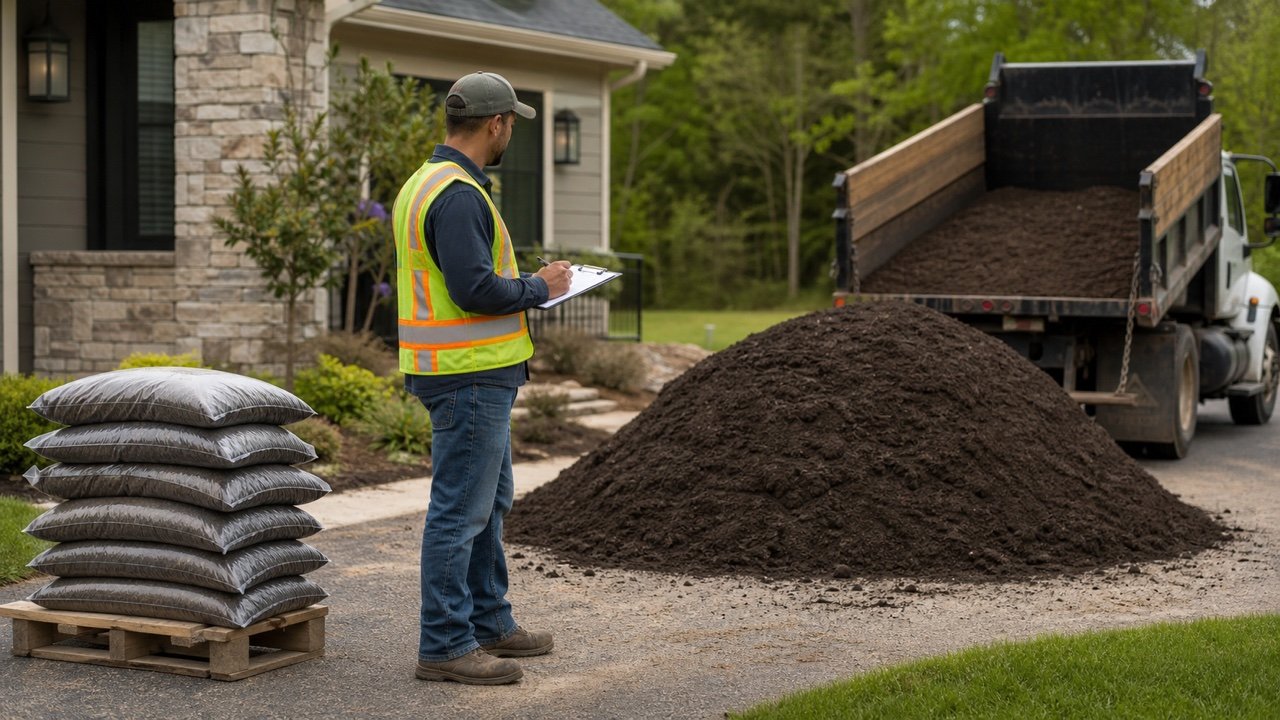
Topsoil ordering starts with the volume required in the finished layer. Loose delivery, handling allowance, package rounding, and weight are different stages and should not be hidden inside one generic cubic-yard result.
This calculator shows placed volume first. It changes that result only when you enter a documented loose-delivery adjustment, a separate handling allowance, or the current net volume for one package.
How much topsoil do you need?
Multiply the measured area by the placed depth you need to add. The result is cubic metres and litres in metric mode, or cubic yards and cubic feet in imperial mode.
Use the placed result for the geometry record. Use the loose-delivery and final planning results only when their entered percentages match the material, supplier, placement method, and project condition.
What does the Topsoil Calculator show?
The calculator reports measured area, placed volume, loose-delivery volume, final planning volume, and the placed equivalent in litres or cubic feet. A package result appears only after you enter the current net volume of the selected package.
| Result | Formula | Meaning |
|---|---|---|
| Placed volume | Area × placed depth to add | Finished geometric layer before delivery or handling assumptions |
| Loose-delivery volume | Placed volume × (1 + entered delivery adjustment ÷ 100) | Planning conversion based on a documented loose-to-placed value |
| Final planning volume | Loose-delivery volume × (1 + entered handling allowance ÷ 100) | Shows the separate effect of a supported handling allowance |
| Whole packages | Planning L or ft³ ÷ package volume, rounded up | Order count for one current packaged product |
Both optional percentages start at 0%. The tool does not insert a standard settling factor, bag size, density, price, supplier increment, or truck capacity.
Which measurements should you enter?
Measure the surface that will receive topsoil and the placed depth still required. Use rectangle or circle mode for simple areas. Use known-area mode when a drawing, survey, or separate calculation already provides the area.
- Measure length, width, or diameter in the unit printed beside the field.
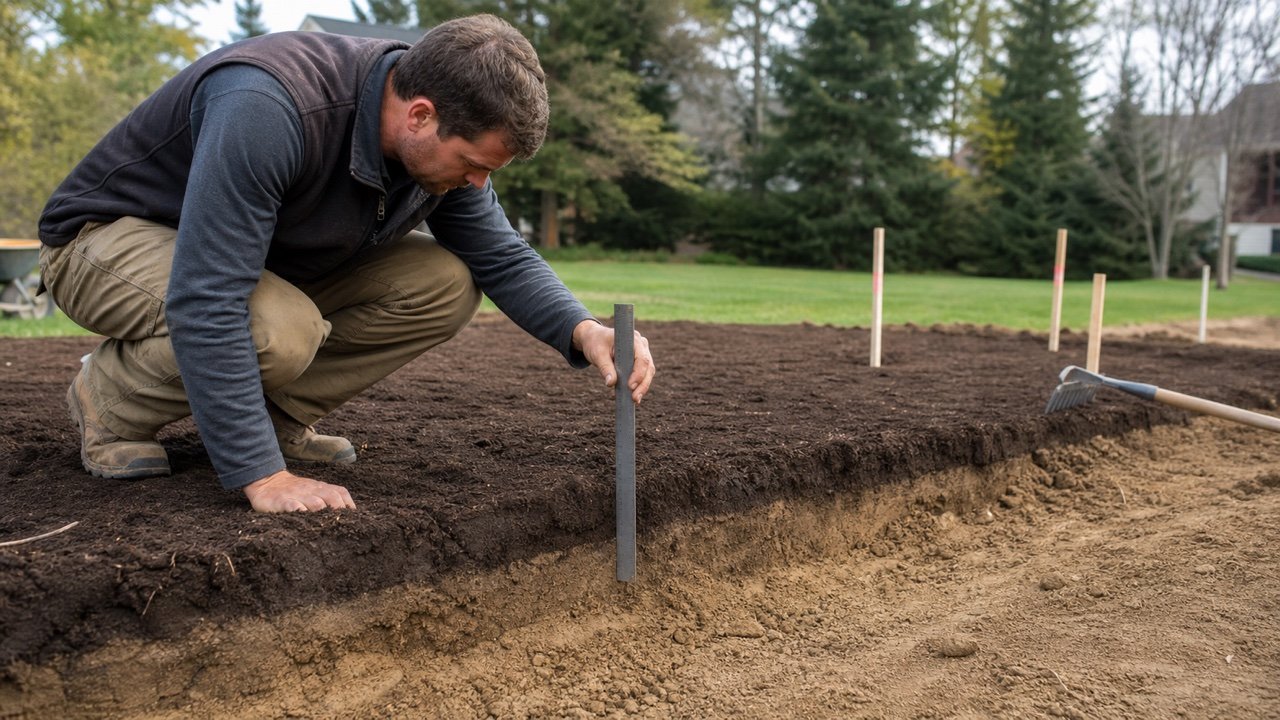
- Use the depth to add, not the total depth of the entire soil profile.
- Separate zones with different finished levels or depths.
- Exclude a permanent opening only when topsoil will not occupy it.
- Record where each measurement was taken and what grade or datum controls it.
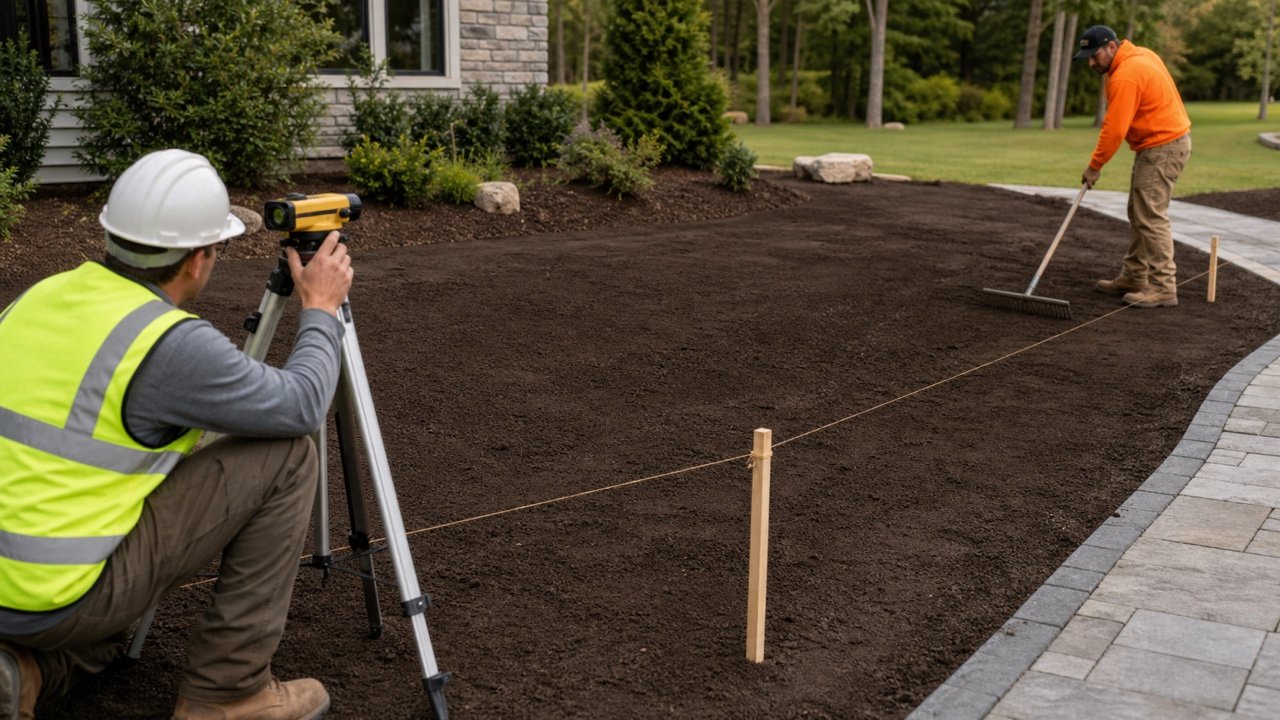
A surface that rises or falls across the site may need sections, spot levels, cross-sections, or a grading model. One average layer is suitable only when it represents the actual required geometry.
How is topsoil volume calculated?
Rectangle area = length × width
Circle area = π × (diameter ÷ 2)²
Placed volume = area × placed depth to add
Metric mode divides centimetres by 100 before multiplying square metres. Imperial mode divides inches by 12 before multiplying square feet, then divides cubic feet by 27 to show cubic yards.
NIST conversion tables support the unit relationships. They do not determine soil suitability, placed depth, density, compaction, delivery adjustment, or order allowance.
Worked metric example
A rectangular area measures 10 m by 4 m and needs 10 cm of placed topsoil.
- Area: 10 × 4 = 40 m².
- Placed depth: 10 cm = 0.10 m.
- Placed volume: 40 × 0.10 = 4 m³.
- A documented 15% loose-delivery adjustment gives 4 × 1.15 = 4.6 m³.
- A separate 5% handling allowance gives 4.6 × 1.05 = 4.83 m³.
- For a product labelled 30 L per package: 4,830 ÷ 30 = 161 packages.
The percentages and package size demonstrate the calculation order. They are not defaults for another soil, supplier, site, or package.
Worked imperial example
A measured 600 ft² area needs a 4 in placed layer.
- Placed depth: 4 ÷ 12 = 0.333333 ft.
- Placed volume: 600 × 4 ÷ 12 = 200 ft³.
- Cubic yards: 200 ÷ 27 = 7.407 yd³.
- A documented 10% delivery adjustment gives 220 ft³ or 8.148 yd³.
- At 1.5 ft³ per package: 220 ÷ 1.5 = 146.667, so the result is 147 whole packages.
No separate handling allowance is used in this example. The exact package quotient stays visible before the whole-package ceiling.
What is a loose-delivery adjustment?
It is a user-entered percentage that converts the calculated placed layer into a larger loose-delivery planning volume. Enter it only when a project record, supplier statement, field trial, specification, or responsible professional provides a value that fits the selected material and placement condition.
Soil does not have one universal change in volume. Texture, aggregation, organic content, moisture, screening, stockpiling, handling, placement, and compaction can change the relationship. USDA NRCS guidance also shows that bulk density, moisture, soil texture, and compaction must be interpreted together.
Leave this input at 0% when the supplier already quotes a delivered volume intended to satisfy the placed quantity, when the contract controls another method, or when no defensible factor is available. Record the placed requirement and ask the supplier how to convert it.
How is handling allowance different?
Handling allowance is applied after the optional loose-delivery adjustment. It may cover a separately documented project condition such as verified measurement tolerance or handling loss. It should not repeat the same settlement, compaction, or supplier-rounding effect.
Before entering both percentages, write one sentence describing what each covers. If the explanations overlap, using both can double-count the same uncertainty. Supplier minimums and selling increments belong after the calculator result and should remain visible in the order record.
Why does the calculator not show a default weight?
Mass requires bulk density for the exact soil and material state. Loose, stockpiled, moist, screened, blended, placed, and compacted topsoil can produce different values. A generic tons-per-yard result can appear precise while describing the wrong product or state.
When a supplier sells by weight, give them the placed and planning volumes and request the product-specific density or their own conversion basis. Record the unit, moisture or material condition, test or source, and date. Do not use the calculator result to approve a vehicle payload or legal road load.
How should bags be calculated?
Use net volume from the current package label: litres per package in metric mode or cubic feet per package in imperial mode. Package mass such as 20 kg or 40 lb is not a volume and cannot be entered in that field.
The tool divides final planning volume by package volume and rounds the last result upward. Confirm package identity, current size, stock, pallet quantity, damaged-package policy, and returns before ordering. A seller's pallet or minimum-order rule remains separate.
How do you handle irregular areas and changing depths?
Divide an irregular boundary into measurable shapes. Calculate each section and add the unrounded placed volumes. For a triangle, area equals base × perpendicular height ÷ 2; enter that result with known-area mode.
For changing fill depths, use zones or cross-sections. A 100 m² area that needs 5 cm on one half and 15 cm on the other requires 10 m³ placed: 50 × 0.05 + 50 × 0.15. Applying the simple 15 cm maximum to the whole area would produce 15 m³.
A sloped surface can have more actual surface area than its plan view. Use surveyed or measured surface area when the difference matters. Keep the drawing and section totals with the final calculation.
How do you choose the topsoil and placed depth?
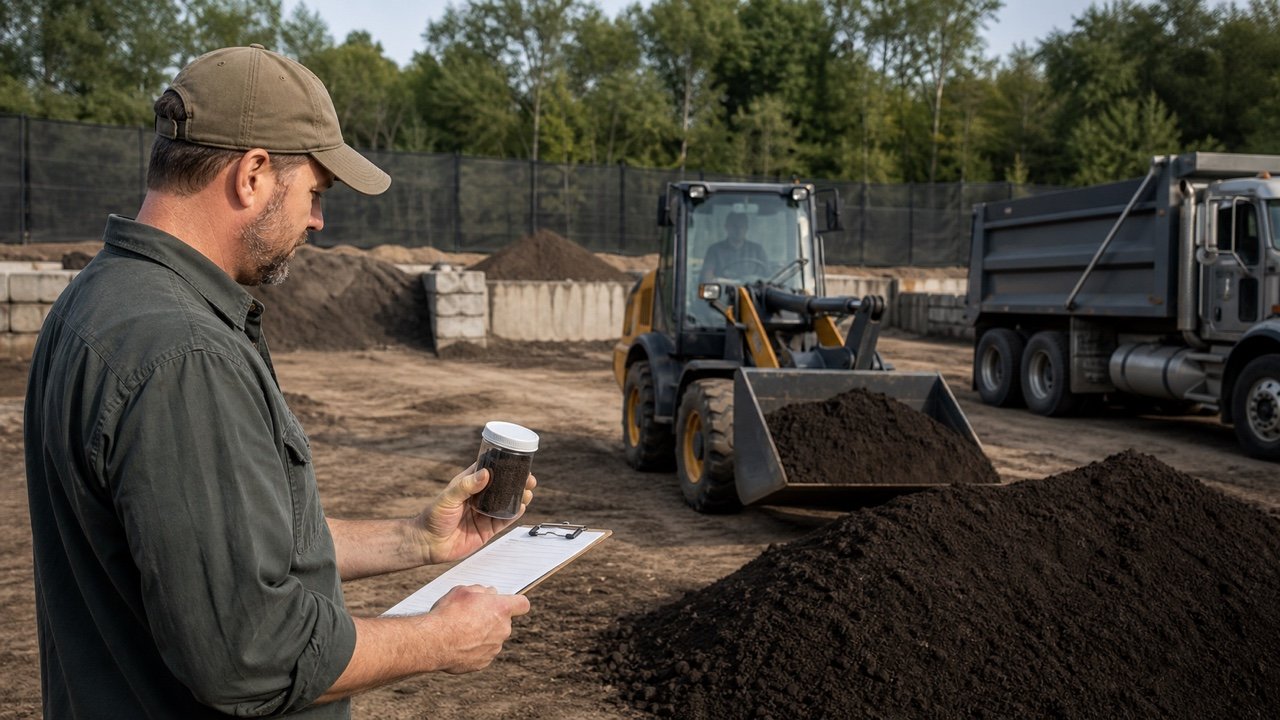
Use the current drawing, landscape specification, soil assessment, plant requirements, local rules, and responsible project advice. The word topsoil does not prove that a product has the texture, organic content, nutrient status, drainage, contaminant limits, or other properties required for the intended use.
Some jurisdictions and projects refer to standards such as BS 3882 for imported or manufactured topsoil. Leeds City Council's guidance describes topsoil as a dynamic material that can be damaged by poor handling and says its document must be read with the full standard. Check the exact standard edition and contract requirements that apply to the site.
What delivery and site conditions matter?
- Confirm product name, source, screening or blend, and required test records.
- Ask whether the quote is by cubic yard, cubic metre, bag, weight, or load.
- Record the material state described by any conversion factor.
- Check access width, overhead clearance, unloading location, surface capacity, and weather.
- Protect drains, paving, waterways, retained vegetation, and stored material.
- Avoid unsuitable handling conditions when the governing instructions restrict them.
- Keep final grade, drainage, utility, and structure clearances under responsible design control.
Common topsoil calculation mistakes
- Using the total desired soil profile instead of the depth still to add.
- Applying one depth across changing grades.
- Calling loose delivery, placed volume, and compacted volume the same thing.
- Using a universal 10% or 15% settling preset without evidence.
- Applying allowance to cover the same effect already included in the delivery adjustment.
- Converting volume to tons with an unrelated density.
- Entering package mass as package volume.
- Rounding each zone before adding the placed total.
- Treating quantity output as proof of soil quality, plant suitability, grading, drainage, contamination, or transport safety.
What should the order record contain?
- Area sketch, dimensions, zones, datum, and required placed depth.
- Placed volume before any adjustment.
- Loose-delivery percentage, evidence, and resulting volume.
- Handling allowance, reason, and final planning volume.
- Product name, source, specification, test documents, and material condition.
- Current package volume or supplier selling unit and increment.
- Quote date, delivery basis, site access, and final rounded order.
This record lets a later reviewer locate a difference in geometry, placed depth, volume state, adjustment, allowance, product, package label, or supplier rounding.
Sources and scope
- NIST Guide to the SI, Appendix B and NIST Handbook 133, 2026 Appendix E: unit relationships only.
- USDA NRCS Soil Health Educators Guide: bulk density, moisture, aeration, and compaction context.
- USDA NRCS Understanding Soil Risks and Hazards: texture, moisture, density, and compaction limits.
- Leeds City Council topsoil guidance: handling and BS 3882 context within its stated scope.
Review note: Saleem Sial owns the research and editorial record. Internal formula fixtures, sources, build validation, and rendered QA are required before publication. Waseem Sial, External Reviewer and Engineer, is listed for ongoing external review; no completed review date is claimed.