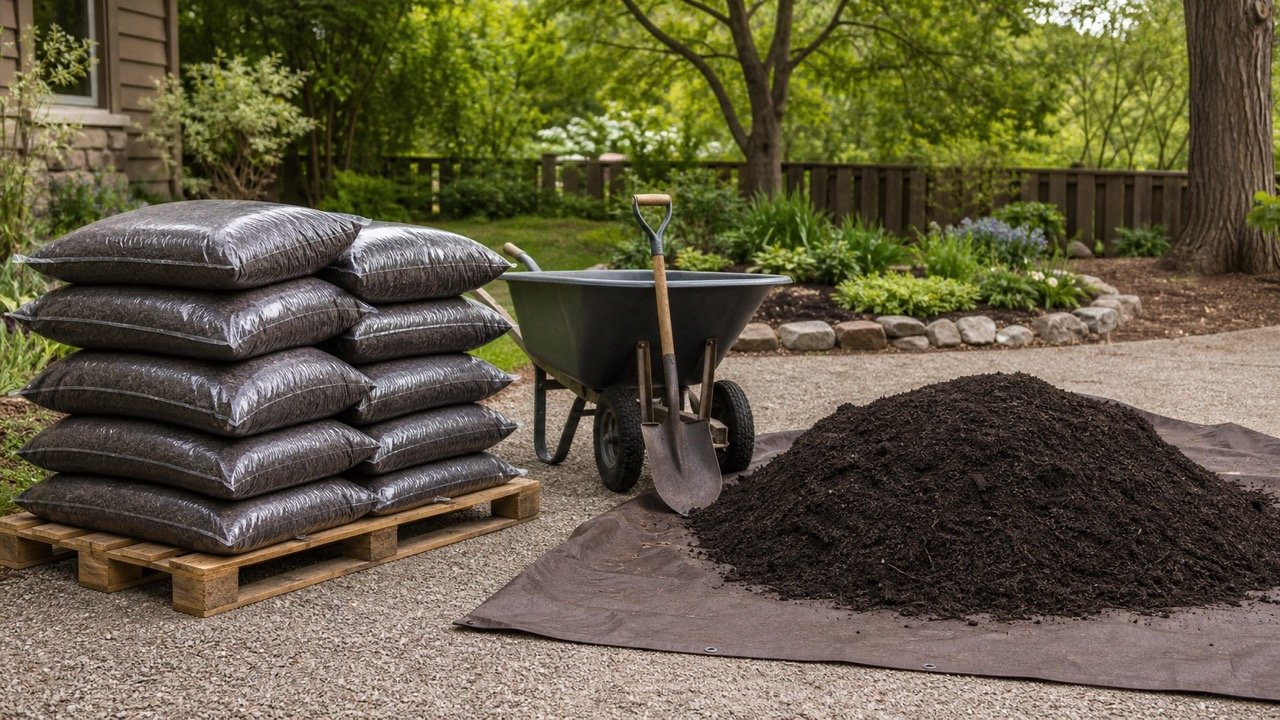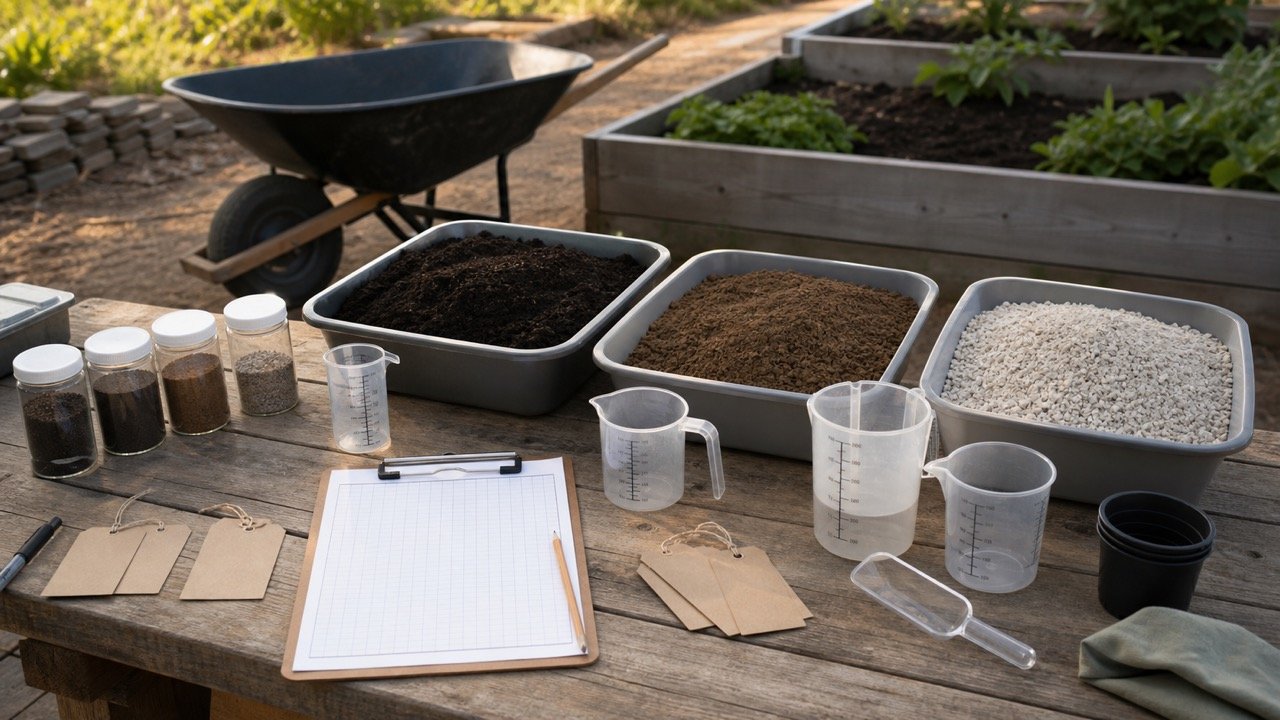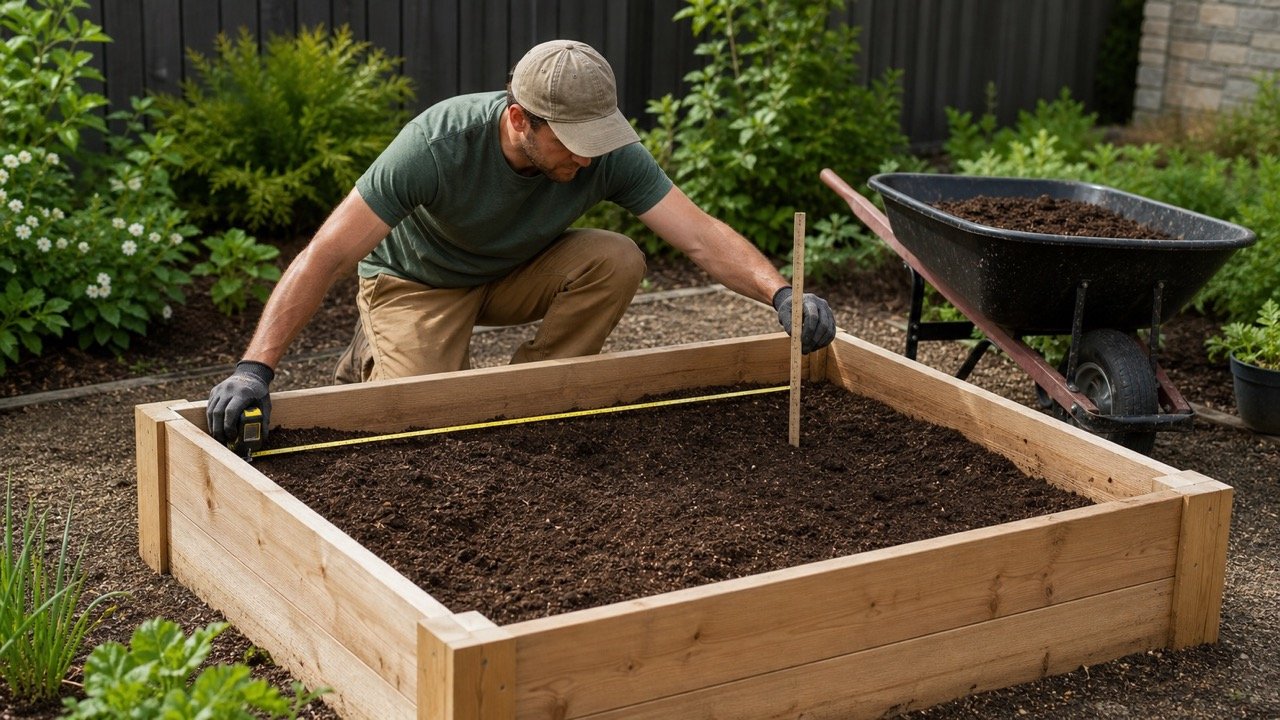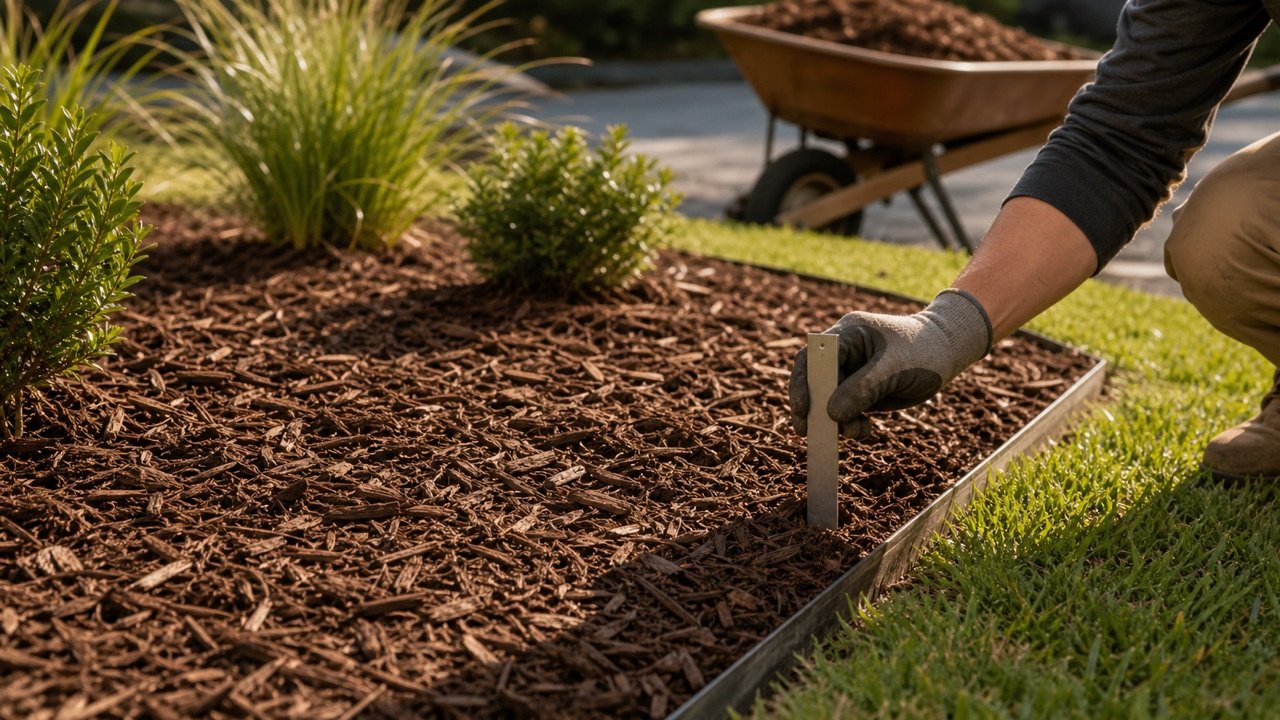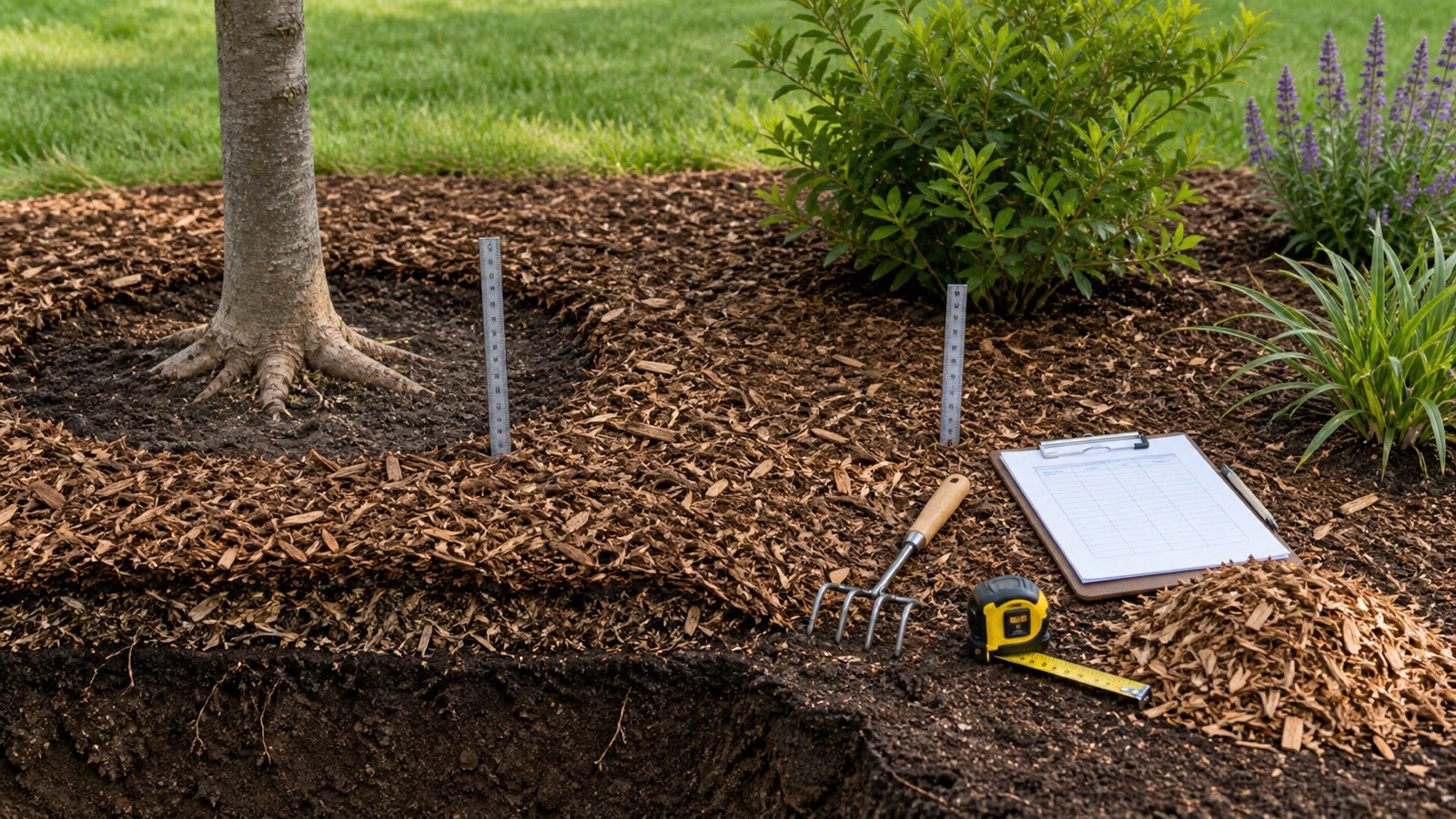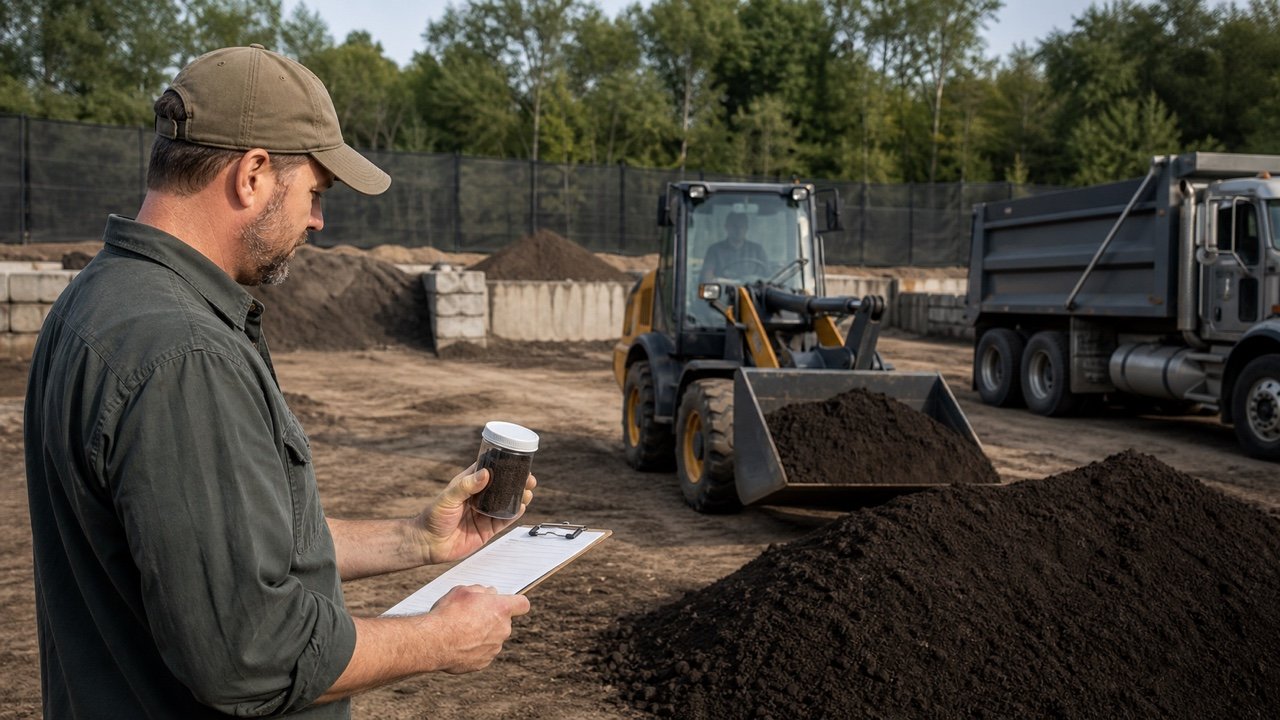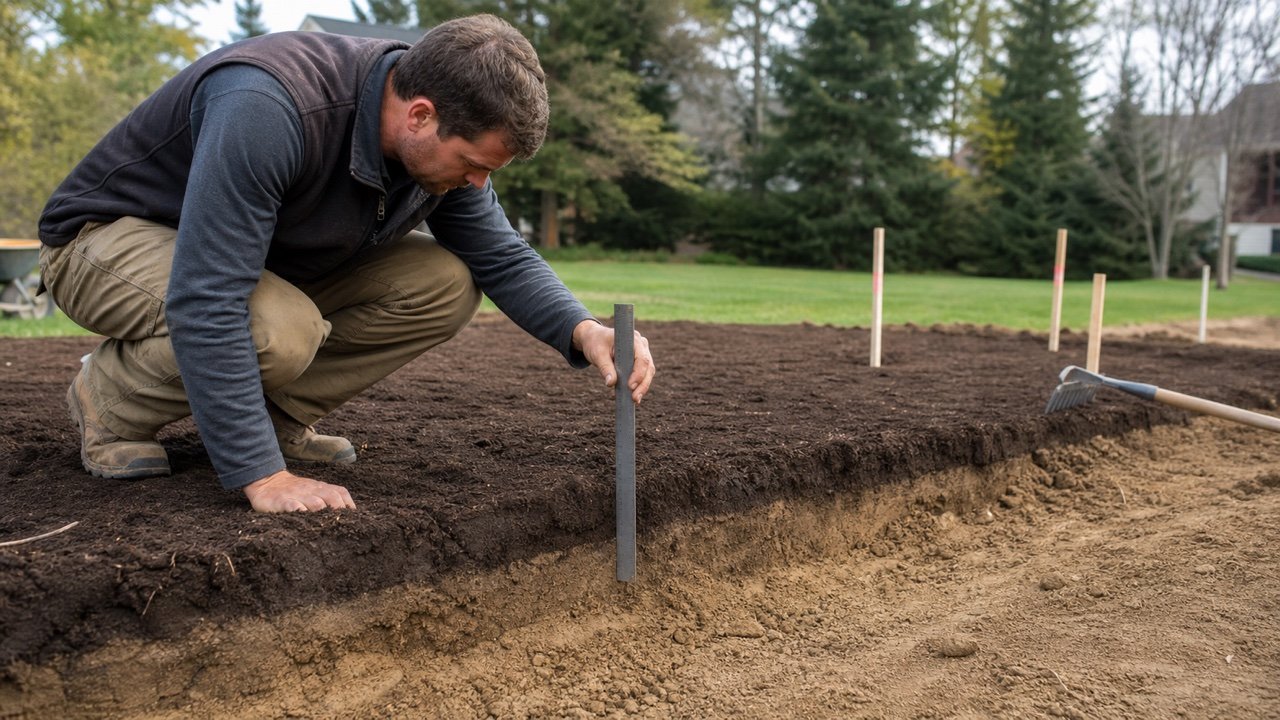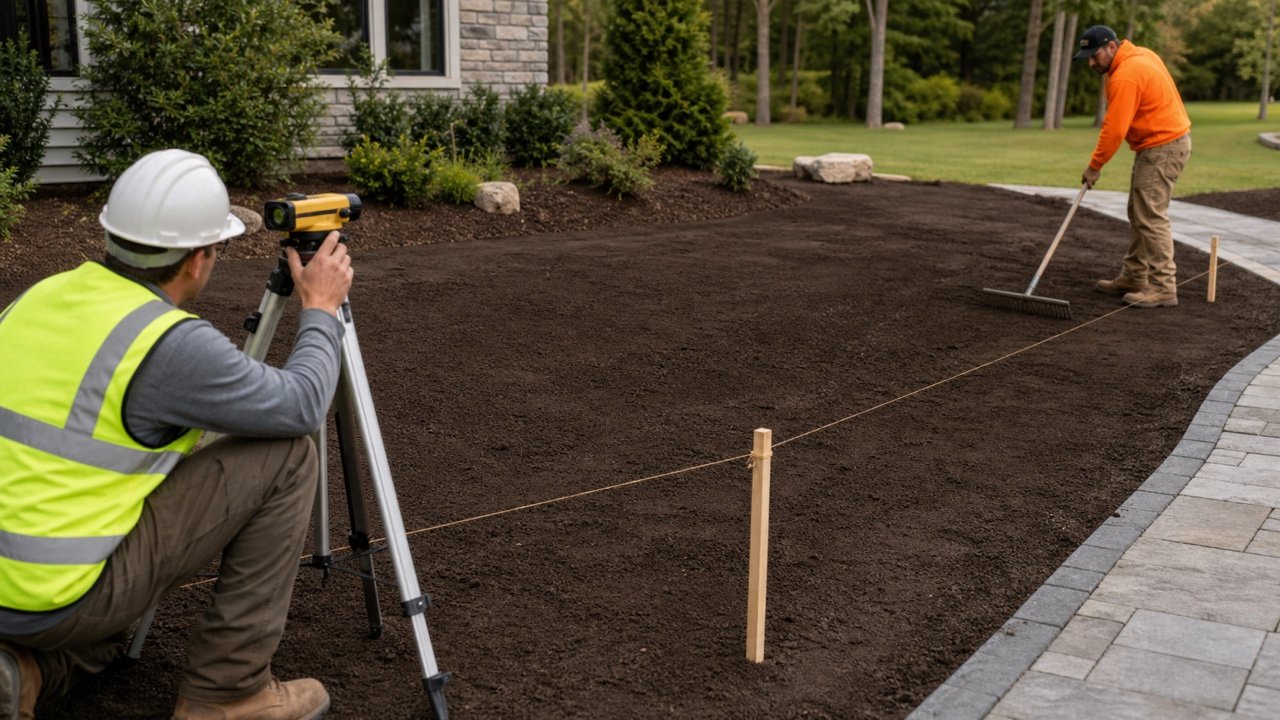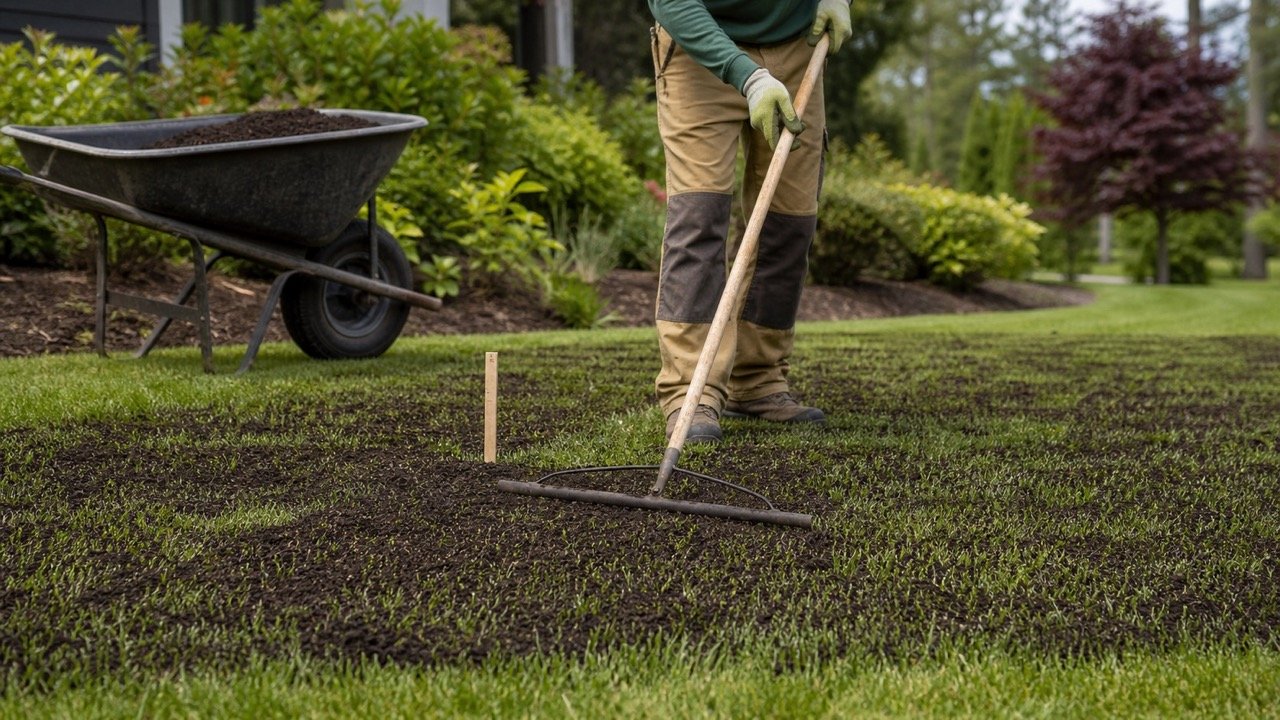
Compost topdressing starts with a site decision, not a standard depth copied from a coverage chart. An established lawn, an existing vegetable bed and a new bed under preparation use compost in different ways.
Select the depth from current soil and compost evidence, the intended use and applicable local guidance. Then calculate the direct-layer volume exactly and control how that volume is distributed across the work area.
How deep should compost topdressing be?
There is no single depth for every lawn or garden bed. U.S. extension examples commonly place established-lawn surface applications near 1/4 in, while some guidance allows a wider range under a stated lawn workflow. Existing garden-bed examples also vary with soil, compost and incorporation method.
A 1/4 in layer over an established lawn, a 1/2 in annual garden-bed layer and a 3 in amendment incorporated into a new bed describe different operations. Their numbers cannot be exchanged without checking the original source and site conditions.
| Application | Published example | Important scope |
|---|---|---|
| Established lawn | Oregon State University Extension: 1/4–1/2 in after mowing and core aeration | Home lawn workflow in OSU guidance; grass, season, site and compost still need review |
| Established lawn | University of Connecticut: about 1/4 in mature compost after core aeration | Organic lawn guidance; rake compost into the holes |
| Established lawn | University of New Hampshire: up to 1/4 in | Soil test and compost source matter, especially phosphorus |
| Existing vegetable or flower garden | University of Minnesota: about 1/2 in of non-manure compost for soil building | Composted manure is treated as a fertilizer; repeated applications need nutrient review |
| Existing vegetable bed | Oregon State University Extension: 1/4–1 in annually | Annual existing-bed guidance with soil-test and incorporation context |
| New vegetable or landscape bed | Oregon State University Extension: 3–4 in incorporated into 8–12 in of soil | First preparation, not a direct surface layer over established plants or turf |
These examples help frame questions for a local extension adviser, soil laboratory, landscape plan or product supplier. They do not create a default for another climate, soil, compost feedstock, turf species, planting system or regulation.
Once the depth is supported, enter it in the Compost Calculator using Direct compost layer mode.
Is the work topdressing, incorporation or a soil mix?
Topdressing is a measured layer placed on an existing surface. Incorporation mixes a measured amendment into a defined soil depth. A soil mix combines ingredients by a verified recipe. Record the correct operation before measuring compost.
| Operation | What the depth represents | Calculation boundary |
|---|---|---|
| Established-lawn topdressing | Thin compost layer spread over existing turf | Lawn treatment area × direct compost depth |
| Existing-bed topdressing | Compost placed over the current bed surface | Open bed area × direct compost depth |
| New-bed incorporation | Loose compost spread before mixing into a stated soil depth | Surface compost geometry plus the source's incorporation instruction |
| Compost share of a growing medium | Compost percentage of the complete mix-zone volume | Total mix-zone volume × verified compost volume share |
| Low-spot repair | Variable geometric deficit, possibly using another material | Measured zones or surface comparison, followed by a material decision |
Use the calculator's Mix component mode only when a source defines compost as a percentage by volume of a complete mix zone. A 25% mass recipe cannot be entered as 25% by volume without compatible density data and a separate conversion.
What must be checked before choosing a depth?
Confirm the purpose, current soil condition, compost properties and surface limitations before turning a published example into a project value.
- Define the treatment area and whether it is lawn, existing bed or new preparation.
- State the purpose: soil building, aeration-hole filling, seed cover, annual bed maintenance or another approved task.
- Review a current soil test for pH, organic matter, phosphorus, potassium, salts and any locally relevant concerns.
- Identify the compost feedstock, maturity, screen, analysis, intended use and product instructions.
- Check whether manure, biosolids, added fertilizer or a high-salt ingredient changes the application limit.
- Confirm the depth source, region, plant or turf context, incorporation method and date.
- Inspect thatch, turf density, crowns, stems, drainage, erosion, depressions and hardscape interfaces.
- Keep nutrient limits and geometric volume as separate checks. The lower approved application controls.
University of Minnesota Extension advises more frequent soil testing where compost and manure are used because phosphorus and potassium can build over time. University of New Hampshire Extension also warns that manure-based compost can add phosphorus a lawn does not need.
How is compost topdressing volume calculated?
Multiply the net treatment area by the selected direct-layer depth after converting both to compatible units. Keep the measured volume unrounded until all compatible zones are combined.
Cubic feet = area in ft² × depth in inches ÷ 12
Cubic yards = area in ft² × depth in inches ÷ 324
Cubic metres = area in m² × depth in millimetres ÷ 1,000
Litres = area in m² × depth in millimetres
The imperial shortcut denominator is 324 because 12 in make 1 ft and 27 ft³ make 1 yd³. A table or calculator that gives 0.64 yd³ for 1,000 ft² at 1/4 in fails this geometry check. The exact result is 0.771605 yd³.
NIST supports the unit relationships. It does not select a compost depth or product.
How much compost covers 1,000 square feet?
The exact quantity depends linearly on depth. The table below is arithmetic coverage only. Select a row after a responsible source supports that depth for the site.
| Depth | Cubic feet | Cubic yards |
|---|---|---|
| 1/8 in | 10.416667 ft³ | 0.385802 yd³ |
| 1/4 in | 20.833333 ft³ | 0.771605 yd³ |
| 3/8 in | 31.250000 ft³ | 1.157407 yd³ |
| 1/2 in | 41.666667 ft³ | 1.543210 yd³ |
| 1 in | 83.333333 ft³ | 3.086420 yd³ |
Doubling the depth doubles the volume. That relationship is useful for checking arithmetic, yet it says nothing about whether the deeper layer suits the turf, soil or compost.
How much compost covers 100 square metres?
In metric units, 1 mm spread over 1 m² equals 1 L. This makes a direct litre check possible before converting to cubic metres.
| Depth | Litres | Cubic metres |
|---|---|---|
| 3 mm | 300 L | 0.300 m³ |
| 6 mm | 600 L | 0.600 m³ |
| 10 mm | 1,000 L | 1.000 m³ |
| 12.5 mm | 1,250 L | 1.250 m³ |
| 25 mm | 2,500 L | 2.500 m³ |
Imperial fractions and rounded metric labels are not exact equivalents. For example, 1/4 in equals exactly 6.35 mm. Use one unit system through the main calculation when the contract, product or field control needs a precise match.
Worked lawn topdressing example in cubic yards
An established 1,000 ft² lawn has a project-supported direct compost depth of 1/4 in. The example calculates measured geometry before allowance or supplier rounding.
| Stage | Calculation | Result |
|---|---|---|
| Depth in feet | 0.25 ÷ 12 | 0.020833 ft |
| Measured volume | 1,000 × 0.020833 | 20.833333 ft³ |
| Cubic yards | 20.833333 ÷ 27 | 0.771605 yd³ |
| Independent shortcut | 1,000 × 0.25 ÷ 324 | 0.771605 yd³ |
The 1/4 in depth reflects the example's approved input. It is not a default. Keep the 0.771605 yd³ measured result separate from later handling allowance, package count, supplier minimum and delivery increment.
Worked metric lawn example
A 250 m² lawn has a supported direct compost depth of 6 mm.
| Stage | Calculation | Result |
|---|---|---|
| Depth in metres | 6 ÷ 1,000 | 0.006 m |
| Measured volume | 250 × 0.006 | 1.500 m³ |
| Litres | 1.500 × 1,000 | 1,500 L |
| Independent litre check | 250 × 6 | 1,500 L |
A 6 mm arithmetic input is close to 1/4 in but is not identical to 6.35 mm. Preserve the unit and depth that the approved instruction actually uses.
Worked existing-bed example
An existing 100 ft² garden bed has a locally supported annual surface layer of 1/2 in.
| Stage | Calculation | Result |
|---|---|---|
| Measured cubic feet | 100 × 0.5 ÷ 12 | 4.166667 ft³ |
| Measured cubic yards | 4.166667 ÷ 27 | 0.154321 yd³ |
Subtract the footprints of permanent paving, tanks or other untreated areas. Keep plant stems and woody crowns clear according to the applicable plant-care instruction. If bed depth, compost source or nutrient status changes by zone, calculate the zones separately.
How do you spread the calculated volume evenly?
Divide the treatment area into measured zones and allocate a known compost volume to each zone. This prevents the first section from consuming material intended for the rest of the site.
A 250 m² lawn at 6 mm requires 1.5 m³. Split into five equal 50 m² zones:
Volume per zone = 50 m² × 6 mm = 300 L = 0.300 m³
- Mark the verified treatment boundary and excluded areas.
- Divide the area into zones that match access, slope and spreading method.
- Measure or assign the target volume for each zone before spreading.
- Place small piles or controlled spreader passes across the whole zone.
- Rake or drag the material into a uniform layer using the approved method.
- Keep established grass blades visible where the lawn instruction requires it.
- Check representative high, low, dense and thin points.
- Record surplus, shortage, clumps, wind loss, runoff, contamination or a changed boundary.
- Move to the next zone only after the current allocation is reconciled.
A depth gauge at a few points cannot prove average volume by itself. The known zone volume controls the average layer, while point checks reveal local ridges, bare patches and buried turf.
What changes after core aeration or overseeding?
Core holes, thatch and seed placement change the field purpose without changing the area-times-depth geometry. Follow one named lawn workflow and record its order of operations.
| Condition | Check |
|---|---|
| After core aeration | Confirm whether compost should fill holes, remain as a thin surface layer or both; do not count hole volume separately unless the method measures it |
| Overseeding | Follow seed depth, surface contact, species, timing and moisture instructions; a compost layer can bury seed when too deep |
| Dense thatch | Confirm mowing, dethatching or aeration steps before spreading; compost resting above thatch may not reach soil |
| Dormant or stressed turf | Use local turf guidance for timing and recovery capacity before adding a layer |
| Wet or saturated surface | Delay traffic and spreading when rutting, compaction, runoff or smearing would result |
Oregon State University Extension combines mowing, core aeration and a 1/4–1/2 in compost layer in its existing-lawn example. University of Connecticut describes about 1/4 in after core aeration. Their regional workflows support those examples, not a universal sequence.
When should soil or compost evidence reduce the depth?
Reduce, change or stop the proposed application when nutrient, salt, maturity, contamination, feedstock or plant evidence conflicts with the geometric plan.
| Finding | Required decision |
|---|---|
| Soil phosphorus or potassium already high | Use the soil-test recommendation; select a lower-nutrient option or omit compost where advised |
| Manure-based compost with material phosphorus | Treat it as a nutrient source and match the analysis to the site's allowable nutrient rate |
| High soluble salts | Use laboratory and local guidance; a thin layer can still exceed a plant or soil limit |
| Immature or unstable compost | Do not apply until product maturity and intended use are established |
| Unknown feedstock or contamination concern | Hold the material and obtain the required source, test or certification evidence |
| Visible debris, clumps or unsuitable screen | Reject, rescreen or redirect under an approved process |
| Product instructions conflict with the plan | Resolve the conflict before ordering or spreading |
| Runoff, drainage or water-quality restriction | Follow the governing setback, timing, storage and application controls |
Penn State Extension's 2025 vegetable-garden guidance uses both soil and compost tests to control nutrient application and notes the risk of phosphorus over-application. That method shows why cubic volume alone cannot select a safe nutrient rate.
Myth versus reality: can one compost depth fix every lawn problem?
| Myth | Reality |
|---|---|
| A thicker layer works faster | More volume also adds more nutrients, salts and surface cover. Turf can be buried and garden nutrient limits can be exceeded. |
| Compost fills every low spot | A deep depression needs diagnosis and measured repair geometry. The cause may be erosion, drainage, backfill settlement or another defect. |
| Any dark material is mature compost | Colour does not establish maturity, feedstock, salts, nutrients, contaminants or intended use. |
| A coverage table chooses the application rate | The table converts a chosen depth to volume. Soil, compost, plant and local evidence choose the depth. |
| The entire property can use one setting | Lawn, beds, slopes, wet areas and plant zones can need different materials, depths or no compost. |
| Annual repetition is automatically helpful | Repeated compost can build phosphorus, potassium or salts. Current tests should control need and frequency. |
Use the Topsoil Depth Guide when the required material is a growing soil layer rather than compost. A compost surface application should not conceal deep settlement, failed fill or a drainage defect.
How should irregular lawns and beds be measured?
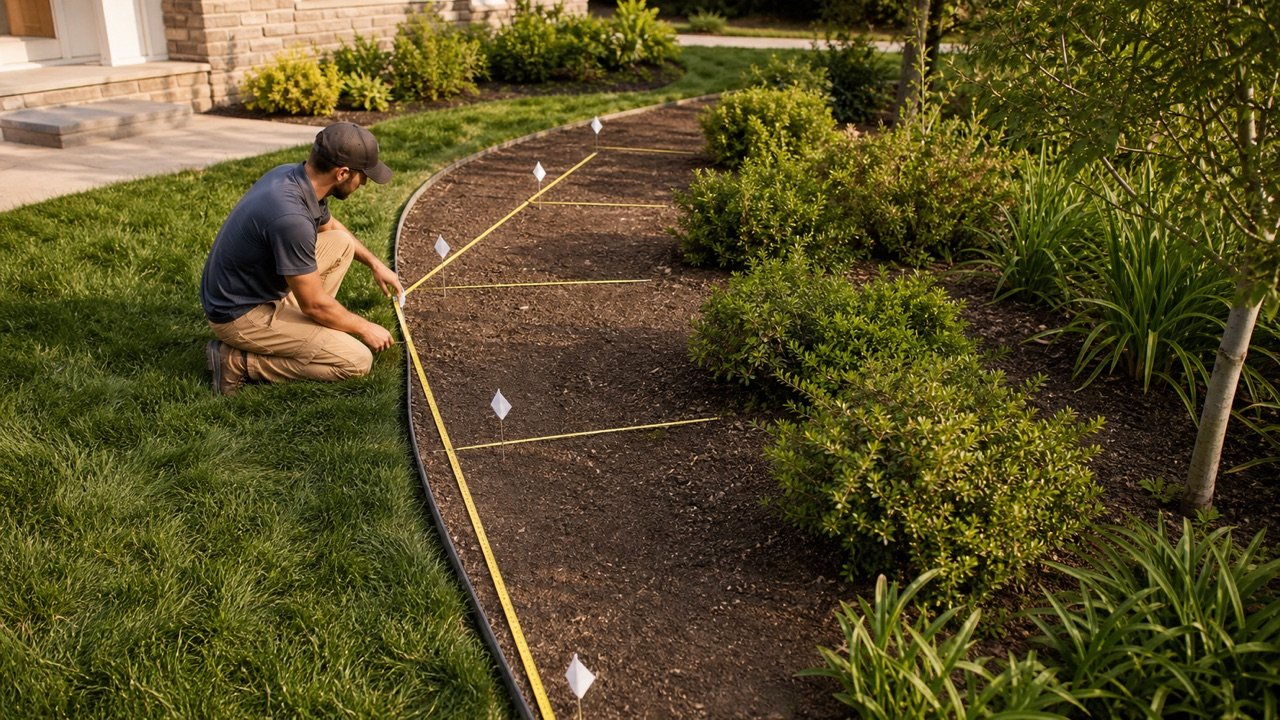
Divide the boundary into measured rectangles, triangles, circles or surveyed zones. Subtract permanent untreated areas once, then multiply each net zone by its own supported depth.
Total measured compost = Σ(net zone area × zone depth)
Keep zones separate when depth, compost product, soil-test recommendation, slope or application method changes. Combine unrounded volumes only where the same later allowance and order basis apply.
The area workflow in the Irregular Landscape Bed Measurement guide can support boundary decomposition. Compost depth and product decisions still come from the compost record.
Common compost topdressing mistakes
- Using one internet depth for lawns, vegetable beds, new beds and raised-bed mixes.
- Copying a coverage table without checking area × depth geometry.
- Dividing square feet times inches by the wrong cubic-yard factor.
- Calling 1/4 in exactly 6 mm instead of 6.35 mm where precision matters.
- Using a direct surface depth as a compost percentage in a soil mix.
- Applying a new-bed incorporation rate over established turf.
- Ignoring soil phosphorus, potassium, salts or organic-matter results.
- Treating manure-based compost like a low-nutrient plant-derived product.
- Accepting unknown, immature, contaminated or poorly screened compost.
- Measuring the gross property area while ignoring paving and untreated zones.
- Spreading the full pile from one end without zone allocations.
- Burying turf blades, crowns, stems or seed under local ridges.
- Using compost to fill a deep depression before diagnosing its cause.
- Adding an arbitrary allowance to compensate for an uncertain depth.
- Rounding each bed or zone before the complete measured total is known.
What should the topdressing record contain?
- Project, date, location, responsible people and intended outcome.
- Lawn, existing-bed or new-bed operation and the exact treatment boundary.
- Area sketch, dimensions, exclusions, zones and calculation revision.
- Selected depth, units, source, region, purpose and limits.
- Soil-test laboratory, sample date, pH, organic matter, nutrients, salts and recommendation.
- Compost product, supplier, feedstock, maturity, screen, analysis and intended use.
- Measured volume before allowance, all conversions and independent arithmetic check.
- Zone allocations, spreading method, point observations and grass or plant clearance.
- Weather, moisture, access, runoff and storage controls.
- Surplus, shortage, rejected material, changed boundaries and corrective work.
- Later package or bulk order, receipt and supplier rounding as separate records.
Return to the Landscaping Planning hub to keep compost, topsoil, mulch and fill dirt calculations tied to their own material and project purpose.
Sources and source scope
- Oregon State University Extension, How to use compost in gardens and landscapes: direct volume method and source-scoped lawn, existing-bed and new-bed examples.
- University of Connecticut, Organic Lawn Care: established-lawn compost topdressing after core aeration.
- University of New Hampshire Extension, Organic Turf: Frequently Asked Questions: lawn topdressing, compost-source and phosphorus context.
- University of Minnesota Extension, Soil testing for lawns and gardens: soil-test purpose, non-manure compost examples and repeated-nutrient limits.
- Colorado State University Extension, Using Compost in Colorado Gardens: application-context, incorporation, salt, feedstock and maturity limits.
- Penn State Extension, Less is More: How to Apply Compost in Your Vegetable Garden: soil-and-compost test method and nutrient over-application boundary.
- NIST Guide to the SI, Appendix B.8: inch, foot, cubic-foot, cubic-yard, litre and cubic-metre conversion relationships.
Source scope: the extension publications give examples for their audiences, regions, materials and methods. They do not establish one global compost depth. The current soil test, compost analysis, product instructions, local extension or agronomic recommendation, plant and turf needs, environmental requirements and responsible site decision control the application. The numerical worked examples are calculation fixtures.