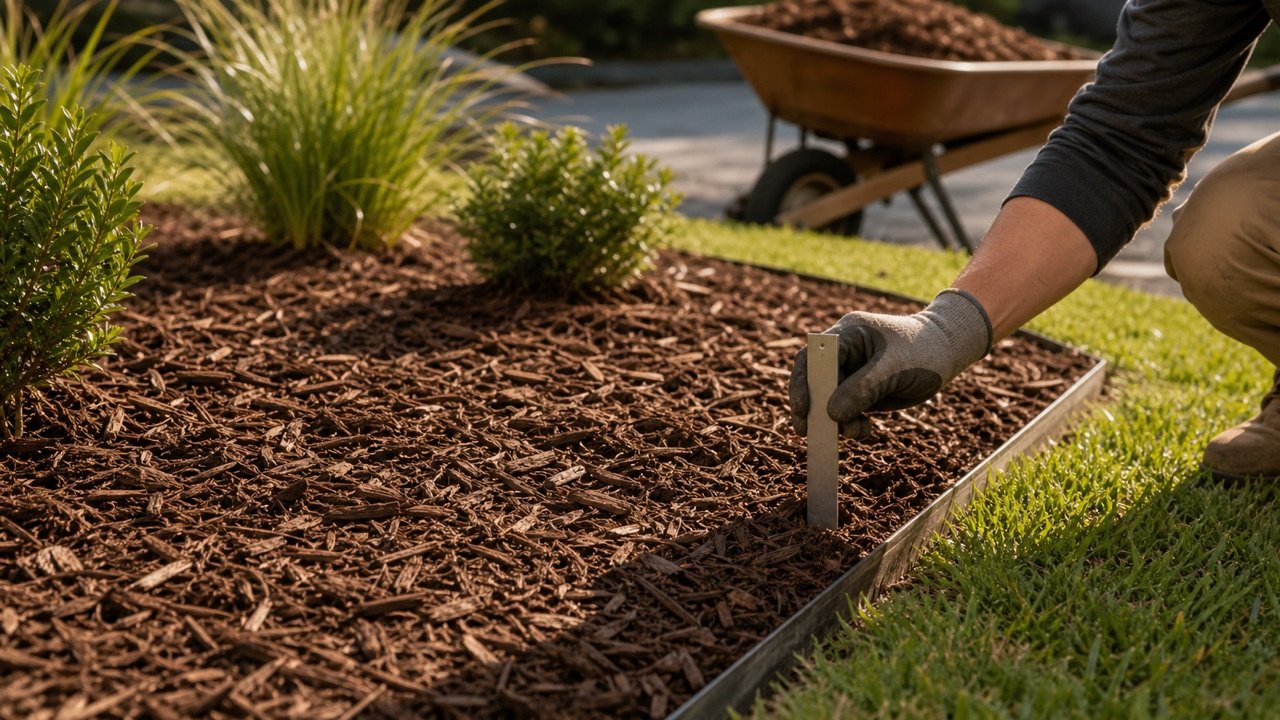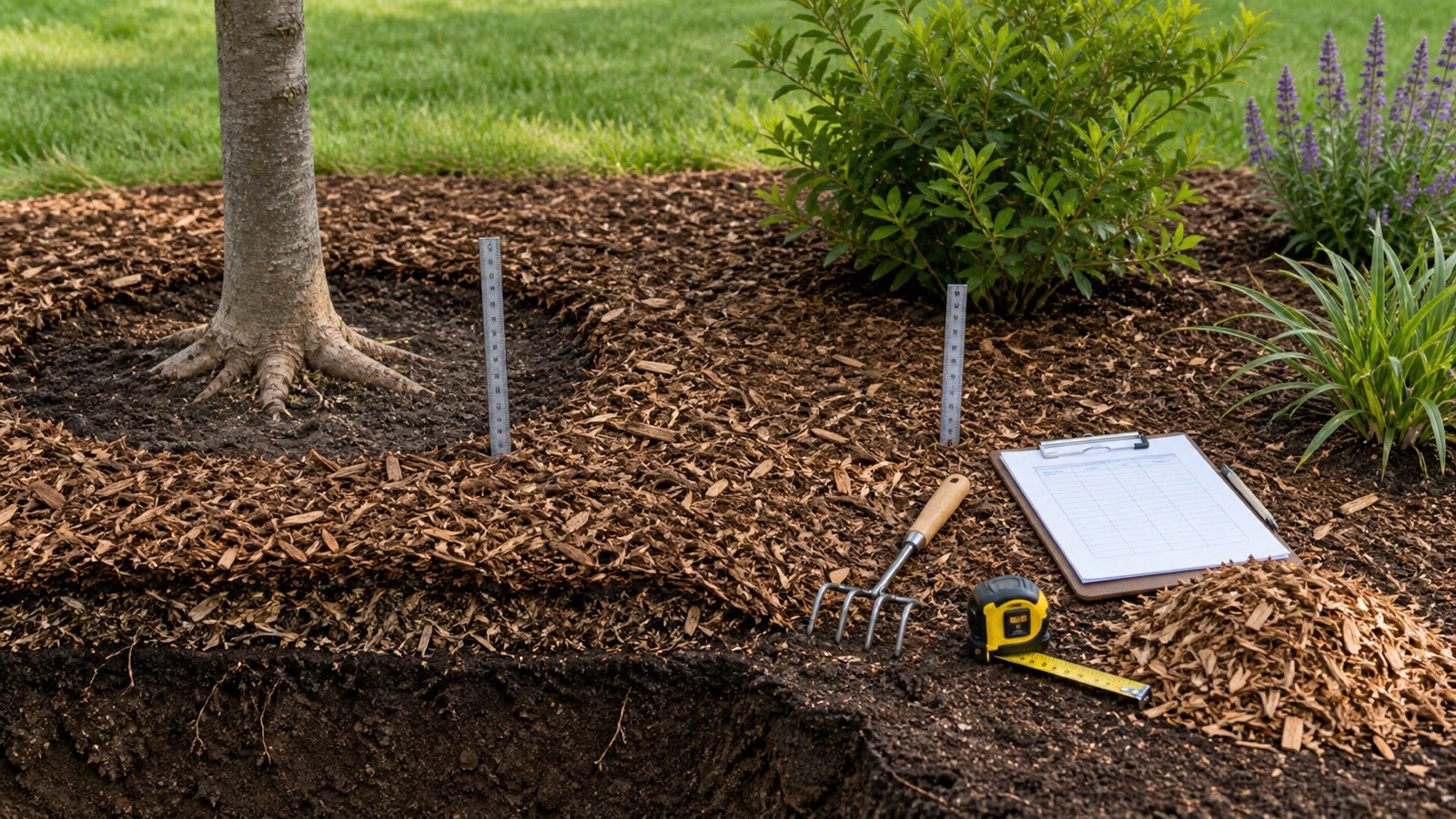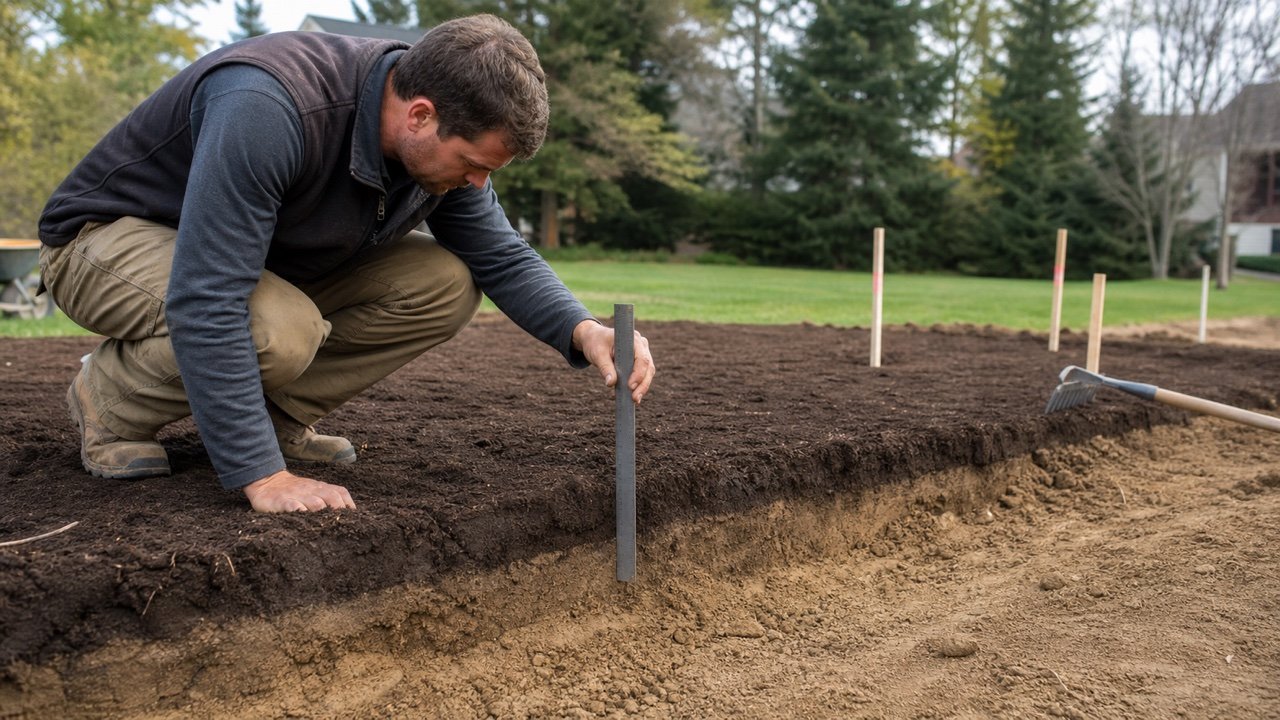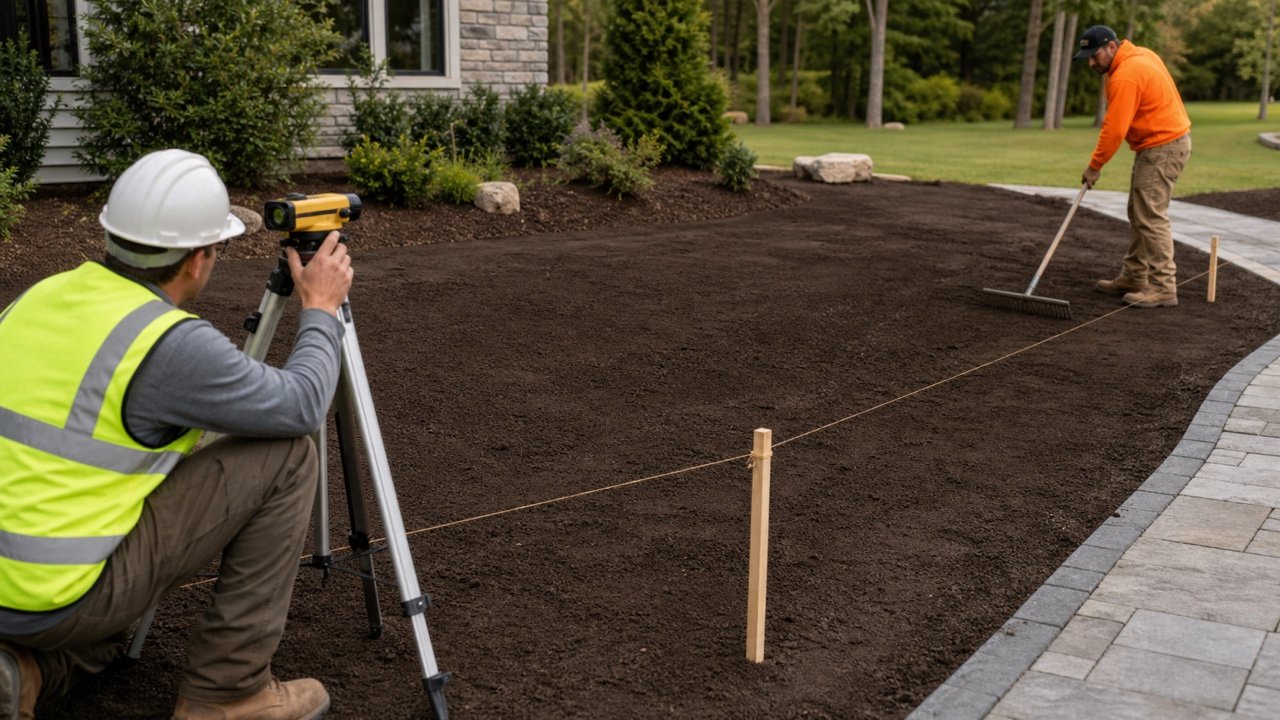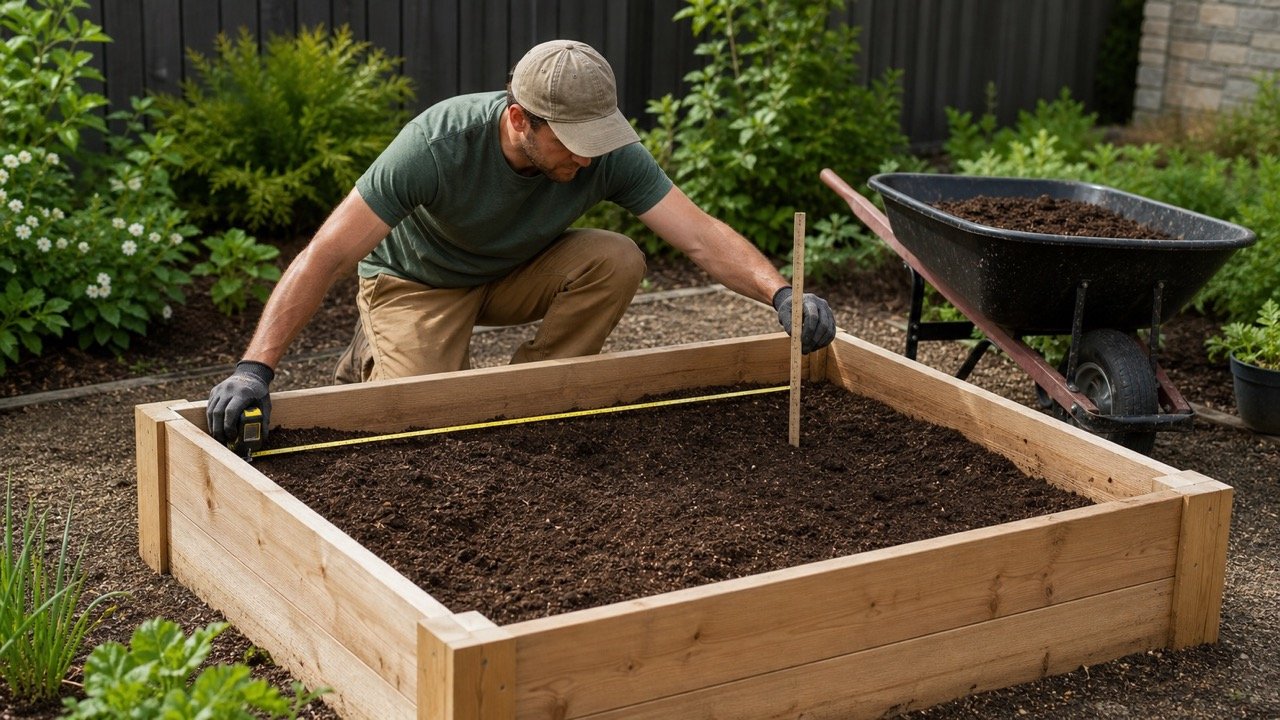
Garden-bed quantity starts with the space the material will actually occupy. Nominal outside dimensions, full board height and a guessed empty-bed depth can each overstate the order.
Measure the internal boundary, target fill elevation, intentional headspace and accepted existing material. Then decide whether the result is complete soil mix, a direct compost layer or the compost component of a verified recipe.
What garden-bed volume should you calculate first?
Calculate the net clear volume that must be filled to the target elevation. This is the complete material zone before a compost percentage is applied.
Net new fill = gross clear target volume - compatible existing fill - permanent exclusions
Compost component = net complete-mix volume × verified compost share ÷ 100
A 24 ft³ empty space does not automatically require 24 ft³ of compost. It may require 24 ft³ of complete soil mix, with compost forming only a documented share.
| Task | Depth represents | Result |
|---|---|---|
| Direct compost layer | Compost itself spread over an existing bed | Measured compost volume |
| New or refilled bed | Complete growing-medium zone | Total soil-mix volume before component split |
| Compost component | Verified compost share of the complete mix zone | One ingredient volume plus an unresolved or recorded balance |
Use the Compost Calculator in Direct layer mode for the first task and Mix component mode for the third. Choose the depth or share from current project, soil, product and plant evidence.
Should you measure inside or outside a raised bed?
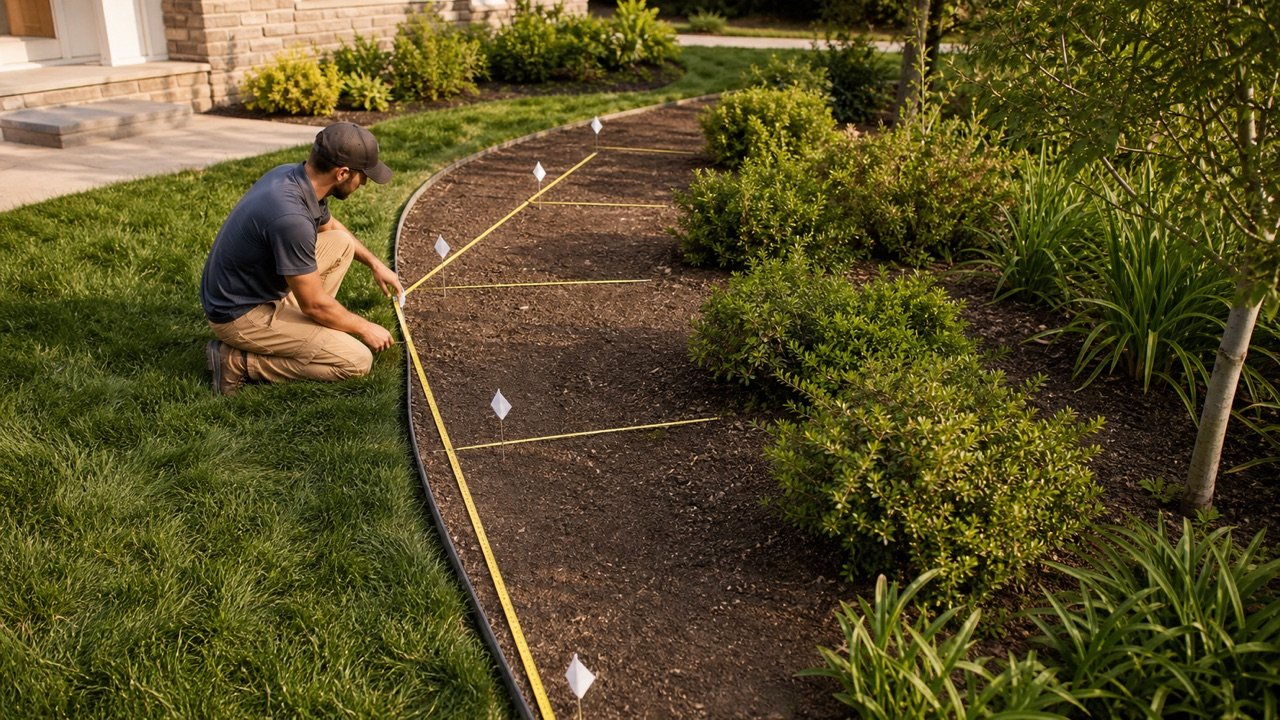
Measure between the internal faces that contain the material. Wall thickness, internal posts, liners, reservoirs and curved corners can reduce clear space.
- Confirm the bed is in its final position and shape.
- Measure clear internal length and width at the fill zone.
- Check whether the bed tapers or bows from top to bottom.
- Set the target finished fill elevation.
- Measure the vertical depth from the accepted base or existing surface to that elevation.
- Mark any deliberate headspace below the top edge.
- Record permanent objects that occupy measurable volume.
- Use sections when dimensions or depth change.
A manufacturer's 4 ft × 8 ft label may describe the outside footprint. Measure the assembled bed. Do not infer the clear volume from a product name.
Is bed height the same as fill depth?
Only when material fills from the stated base to the full top edge. Headspace, an existing soil connection, drainage components, a false bottom or an uneven base changes the occupied depth.
| Boundary | How it affects volume |
|---|---|
| Top of board | Physical edge; use as the fill elevation only when the plan calls for material to that level |
| Target fill line | Finished surface used in the volume calculation |
| Headspace | Intentional unfilled depth between target fill and top edge |
| Existing accepted surface | Lower boundary for a top-up calculation |
| Original ground | May connect to the mix zone where the bed has an open bottom |
| False bottom or reservoir | Permanent occupied zone excluded from soil-mix volume |
Do not subtract coarse branches, debris or an improvised filler as a harmless volume-saving measure. Material suitability, decomposition, drainage, nutrients, pests, settlement and the intended growing profile require their own review.
How do you calculate a rectangular garden bed?
Multiply clear internal length, width and fill depth using compatible units.
Cubic feet = internal length in ft × internal width in ft × fill depth in in ÷ 12
Cubic yards = cubic feet ÷ 27
Cubic metres = internal length in m × internal width in m × fill depth in m
Litres = cubic metres × 1,000
NIST supports the unit conversions. The formula describes geometry and does not select the bed depth, recipe or material.
How much error can external dimensions create?
An 8 ft × 4 ft bed made with 1.5 in walls has a 7.75 ft × 3.75 ft clear interior when the wall occupies 1.5 in on each side. At a hypothetical 10 in fill depth, using the outside dimensions overstates the clear volume by about 10.11%.
| Stage | Calculation | Result |
|---|---|---|
| Internal length | 8 ft - 3 in | 7.75 ft |
| Internal width | 4 ft - 3 in | 3.75 ft |
| Clear internal volume | 7.75 × 3.75 × 10 ÷ 12 | 24.218750 ft³ |
| Outside-dimension result | 8 × 4 × 10 ÷ 12 | 26.666667 ft³ |
| Overstatement | 26.666667 - 24.218750 | 2.447917 ft³ |
| Relative overstatement | 2.447917 ÷ 24.218750 × 100 | 10.107527% |
The wall thickness and 10 in depth are arithmetic inputs, not a bed specification. Measure the actual walls, liners and target level.
How do you calculate the compost share?
Apply a compost share only after the complete net mix-zone volume is known. Confirm that the source defines percentage by volume.
Suppose the 24.218750 ft³ clear volume above has a verified recipe with 25% compost by volume:
| Component | Calculation | Volume |
|---|---|---|
| Complete mix | Measured clear volume | 24.2187500 ft³ |
| Compost | 24.2187500 × 0.25 | 6.0546875 ft³ |
| Compost in cubic yards | 6.0546875 ÷ 27 | 0.2242477 yd³ |
| Remaining ingredients | 24.2187500 - 6.0546875 | 18.1640625 ft³ |
| Ledger check | 6.0546875 + 18.1640625 | 24.2187500 ft³ |
The 25% share demonstrates arithmetic. Oregon State University Extension describes up to 25% compost by volume in one raised-bed workflow using excavated soil. That scoped example does not establish a recipe for every product, crop, soil or bed.
Can a raised bed be filled with compost alone?
Oregon State University Extension advises using native soil or a soil mix with compost and explains that compost lacks the mineral component of earthen soil and planting mixes. University of Minnesota Extension also documents problems caused by excessive compost and manure, including high nutrient concentrations.
Obtain a complete growing-medium recommendation for the intended plants and site. Record every component, its volume basis and its share. A calculator should not turn an unknown recipe into 100% compost.
| Record | Required check |
|---|---|
| Total mix zone | Net clear geometry after existing fill and exclusions |
| Compost share | Verified percentage by volume and source |
| Other ingredients | Names, shares, material states and source instructions |
| Share total | All percentages total 100%, or the unresolved balance stays visible |
| Mixing basis | Loose components, finished blend or another defined state |
| Acceptance | Product, soil test, drainage, nutrient and plant requirements |
How do you deduct existing soil from a raised bed?
Measure the positive depth deficit from the existing accepted surface to the target fill elevation. Divide an uneven surface into zones instead of applying one guessed average to the whole bed.
Zone deficit = maximum(0, target elevation - measured existing elevation)
Net new mix = Σ(zone area × representative positive deficit)
A 4 ft × 8 ft bed is divided into four equal 8 ft² zones. Their representative positive deficits are 2, 3, 4 and 5 in.
| Zone | Area | Deficit | New mix |
|---|---|---|---|
| A | 8 ft² | 2 in | 1.333333 ft³ |
| B | 8 ft² | 3 in | 2.000000 ft³ |
| C | 8 ft² | 4 in | 2.666667 ft³ |
| D | 8 ft² | 5 in | 3.333333 ft³ |
| Net new complete mix | 9.333333 ft³ | ||
At a hypothetical verified 20% compost share, compost is `9.333333 × 0.20 = 1.866667 ft³`. The remaining 7.466667 ft³ belongs to the other recorded ingredients.
Four corner readings do not always represent four equal zones. Use a grid, sections or another method suited to the actual surface, then state how each representative depth was obtained.
How do you handle high and low spots?
Sum positive deficits for new fill. Record high spots separately until the approved correction says whether material may be removed, redistributed or left in place.
- Do not cancel a local 4 in deficit with a distant 4 in high spot when plant, drainage or interface requirements differ.
- Do not add material above the target merely to consume a supplier minimum.
- Investigate erosion, leakage, decomposition, compaction, animal disturbance or failed support before repeating a top-up.
- Preserve required clearance at stems, crowns, irrigation outlets and bed edges.
- Remeasure after correction where final elevation or headspace matters.
Use the Compost Topdressing Depth guide when the task is a direct surface layer over an established bed. This page handles the geometry after that depth has been selected.
How do you calculate an L-shaped garden bed?
Calculate a larger simple shape and subtract a verified untreated notch, or divide the bed into non-overlapping rectangles. Apply the mix depth only to the net area.
A metric bed occupies a 4 m × 2 m rectangle with a 1.2 m × 0.8 m untreated notch. The complete mix depth is a hypothetical 0.35 m.
| Stage | Calculation | Result |
|---|---|---|
| Outer area | 4 × 2 | 8.00 m² |
| Notch | 1.2 × 0.8 | 0.96 m² |
| Net area | 8.00 - 0.96 | 7.04 m² |
| Complete mix | 7.04 × 0.35 | 2.464 m³ |
| Hypothetical 22% compost | 2.464 × 0.22 | 0.54208 m³ |
| Compost litres | 0.54208 × 1,000 | 542.08 L |
The notch must lie fully inside the outer rectangle and remain untreated. Avoid subtracting the same path, post or opening in both the area sketch and a later volume deduction.
How do you calculate a circular bed?
Use the internal diameter at the material boundary. Square the radius before multiplying by π and depth.
Circular mix volume = π × (internal diameter ÷ 2)² × fill depth
A circular bed has a 1.2 m internal diameter and a hypothetical 0.25 m complete mix depth.
| Stage | Calculation | Result |
|---|---|---|
| Radius | 1.2 ÷ 2 | 0.6 m |
| Complete mix | π × 0.6² × 0.25 | 0.282743 m³ |
| Hypothetical 15% compost | 0.282743 × 0.15 | 0.042412 m³ |
| Compost litres | 0.042412 × 1,000 | 42.412 L |
Use measured segments or a survey method for an oval, keyhole, tapered or irregular bed. A named shape should match the physical boundary within the required accuracy.
Do loose component volumes add exactly after mixing?
Use component shares as a planning ledger under the recipe's stated volume basis. Mixing, particle rearrangement, moisture, compaction, decomposition and placement can change bulk volume.
Record whether the percentages describe loose ingredients before blending, the finished supplied mix or another state. Do not calculate a 10 ft³ final deficit, order ingredient volumes that total 10 ft³, and then promise the blend will finish at exactly 10 ft³ without compatible evidence.
Keep these records separate:
- measured clear bed volume;
- existing accepted fill;
- planned loose ingredient volumes;
- supplier's finished mix quantity;
- placed surface and headspace;
- later decomposition or settlement;
- handling allowance and supplier rounding.
Should you add a settlement allowance?
Start at 0%. Add a planning adjustment only when the exact soil mix, material state, placement method and supporting source define it.
Oregon State University Extension notes that newly filled beds can sink as compost in a mix continues to decompose and advises refilling as needed. It does not publish one universal settlement percentage for every mix. A competitor's automatic 10% or 15% addition is not project evidence.
Measure the bed after placement and at the required follow-up stage. Diagnose loss from decomposition, consolidation, erosion, removal, leakage or support movement before applying a factor to the next order.
What does the volume calculation leave unresolved?
The result does not approve the bed structure, saturated weight, foundation, drainage, liner, irrigation, soil recipe, compost quality, nutrient loading, crop suitability or food-growing safety.
Oregon State University's raised-bed guidance notes that framing must support soil, plants and irrigation water and gives reinforcement advice for its described beds. Use the current bed manufacturer, project designer and local requirements for the actual structure. Quantity geometry cannot replace that check.
| Decision | Evidence needed |
|---|---|
| Structural capacity | Bed system, dimensions, material, connections, soil mass, water and responsible design |
| Drainage | Base, native soil, outlets, liner, slope, irrigation and plant needs |
| Growing-medium recipe | Soil test, product analysis, crop, climate and qualified recommendation |
| Compost acceptance | Feedstock, maturity, salts, nutrients, contaminants, screen and intended use |
| Order quantity | Current package label, bulk increment, minimum, delivery and access |
Common garden-bed volume mistakes
- Using nominal outside length and width.
- Using full board height while leaving unrecorded headspace.
- Ignoring a false bottom, reservoir, post or permanent internal object.
- Subtracting an existing soil pile without measuring its surface and state.
- Averaging uneven deficits from too few unrepresentative points.
- Cancelling high and low areas that require different correction.
- Counting an L-shaped notch twice.
- Using diameter as radius in a circular formula.
- Treating total soil-mix volume as pure compost volume.
- Applying a mass percentage as a volume percentage.
- Using recipe shares that do not total 100%.
- Assuming loose ingredient volumes stay unchanged after mixing.
- Adding a generic settlement, compaction or waste factor.
- Rounding every bed before the compatible total is complete.
- Using volume to approve bed strength, drainage or material safety.
What should the garden-bed quantity record contain?
- Bed ID, location, intended plants and measurement date.
- Sketch with internal boundaries, wall thickness, shape and scale.
- Target fill elevation, headspace and lower boundary.
- Existing fill grid or sections and positive deficits.
- Permanent exclusions and their measured volumes.
- Complete net mix volume in original and order units.
- Direct-layer or mix-component mode.
- Compost share, volume basis, source and arithmetic.
- Every remaining ingredient and a 100% share check.
- Material condition, mixing, placement and follow-up measurement stage.
- Structural, drainage, product, soil-test and plant approvals.
- Prepared by, checked by, revision and unresolved assumptions.
The Irregular Landscape Bed Measurement guide provides additional area-decomposition checks. Return to the Landscaping Planning hub to keep compost, topsoil, mulch and fill dirt in separate material records.
Sources and source scope
- Oregon State University Extension, How to use compost in gardens and landscapes: area-depth volume method, raised-bed material role, source-scoped compost-share example and settlement boundary.
- Oregon State University Extension, Raised bed gardening: framed-bed, soil-mix, drainage, support and soil-test context.
- University of Minnesota Extension, How to correct problems caused by using too much compost and manure: excess compost, nutrients and raised-bed soil-management boundary.
- NIST Guide to the SI, Appendix B.8: inch, foot, cubic-foot, cubic-yard, millimetre, litre and cubic-metre conversion relationships.
Source scope: the extension publications give regional garden guidance, example recipes and management boundaries. They do not approve a universal bed depth, compost share or structural system. The actual bed, target elevation, existing fill, complete recipe, soil and compost tests, product instructions, plant needs, drainage and responsible design control the project. All worked percentages and dimensions are calculation fixtures unless a source and scope are stated.