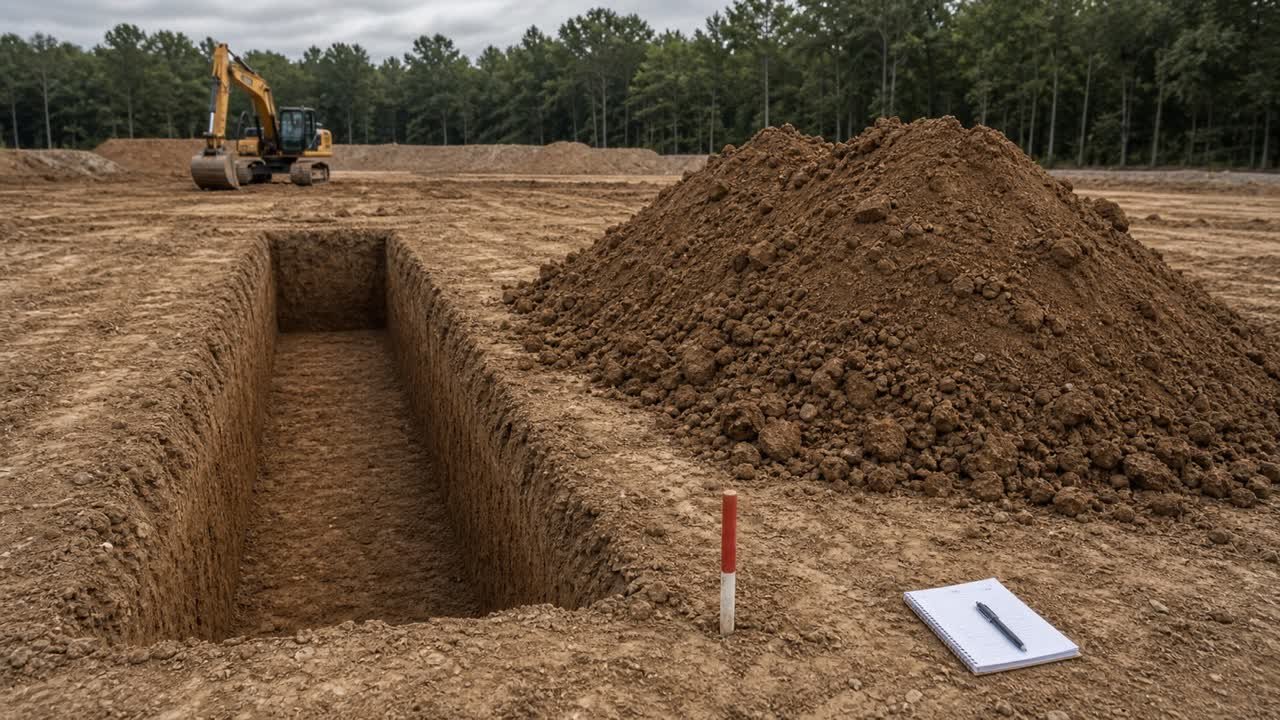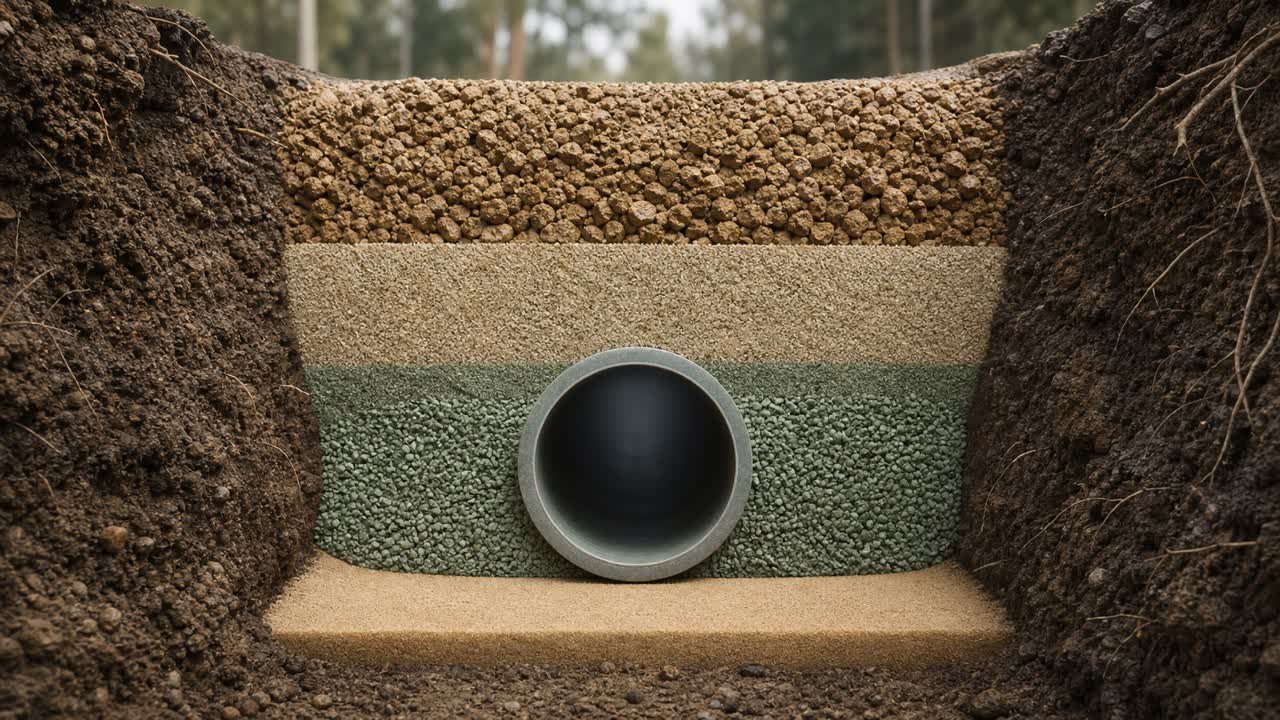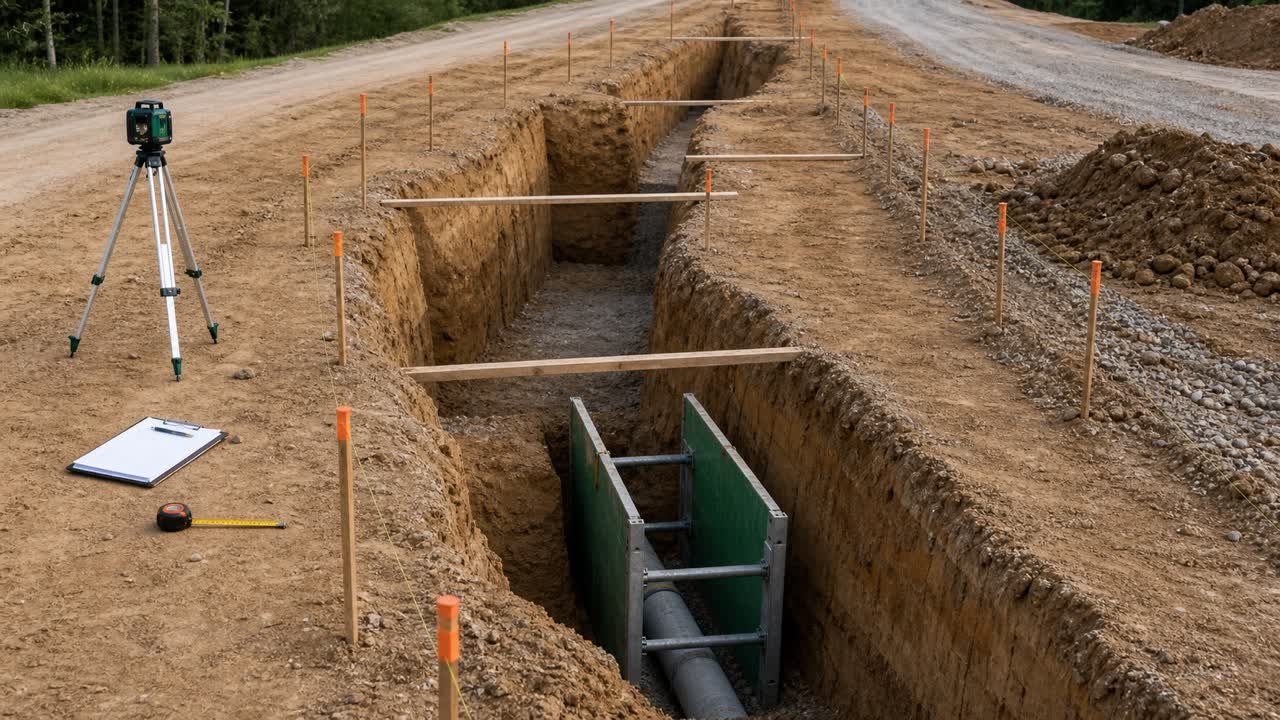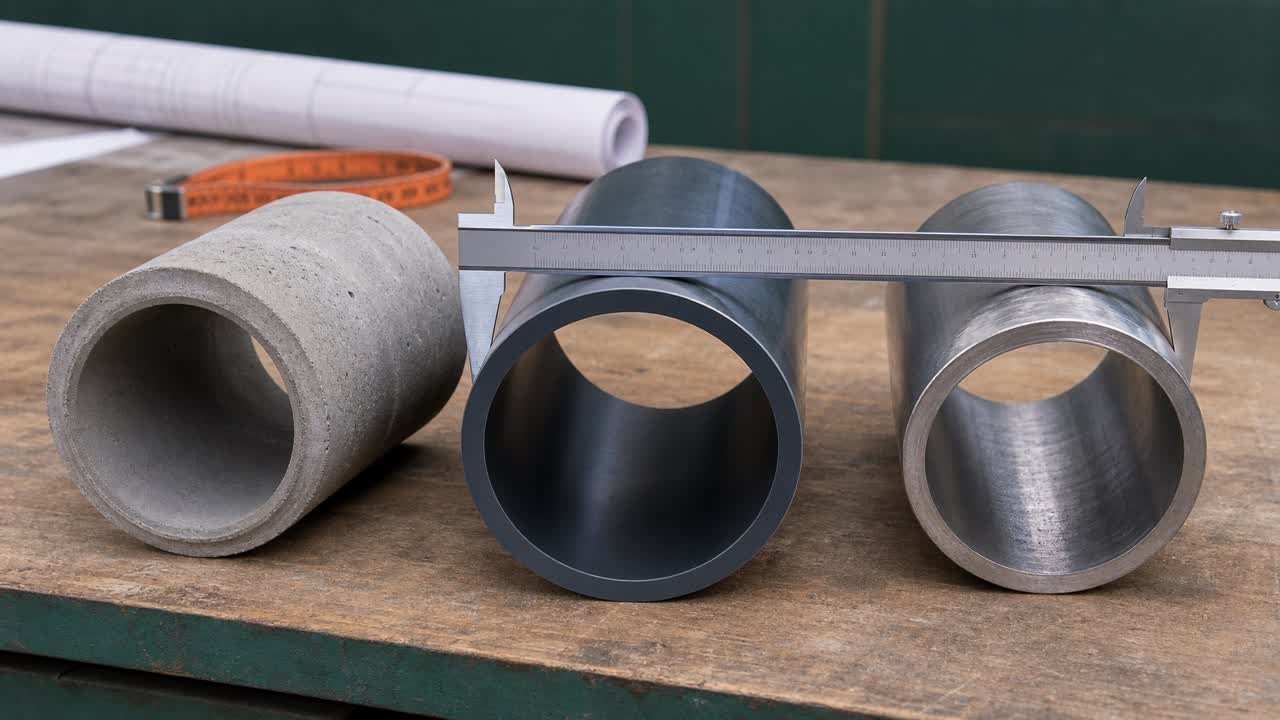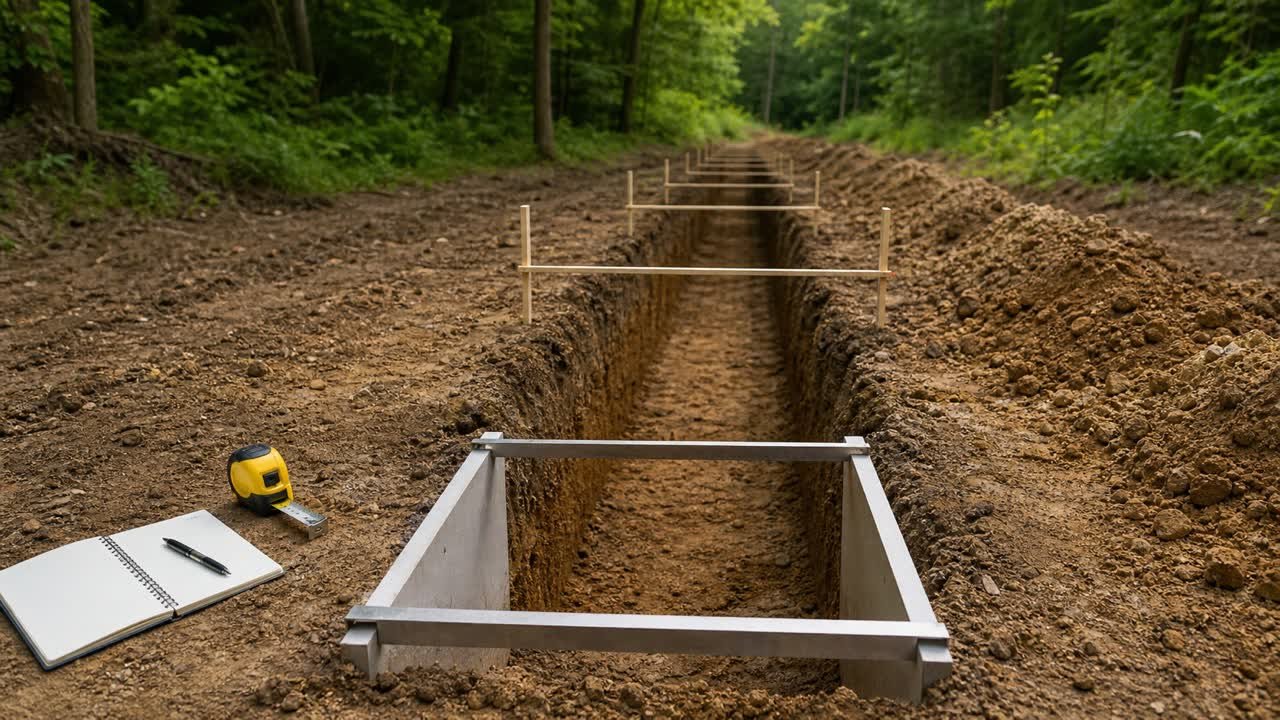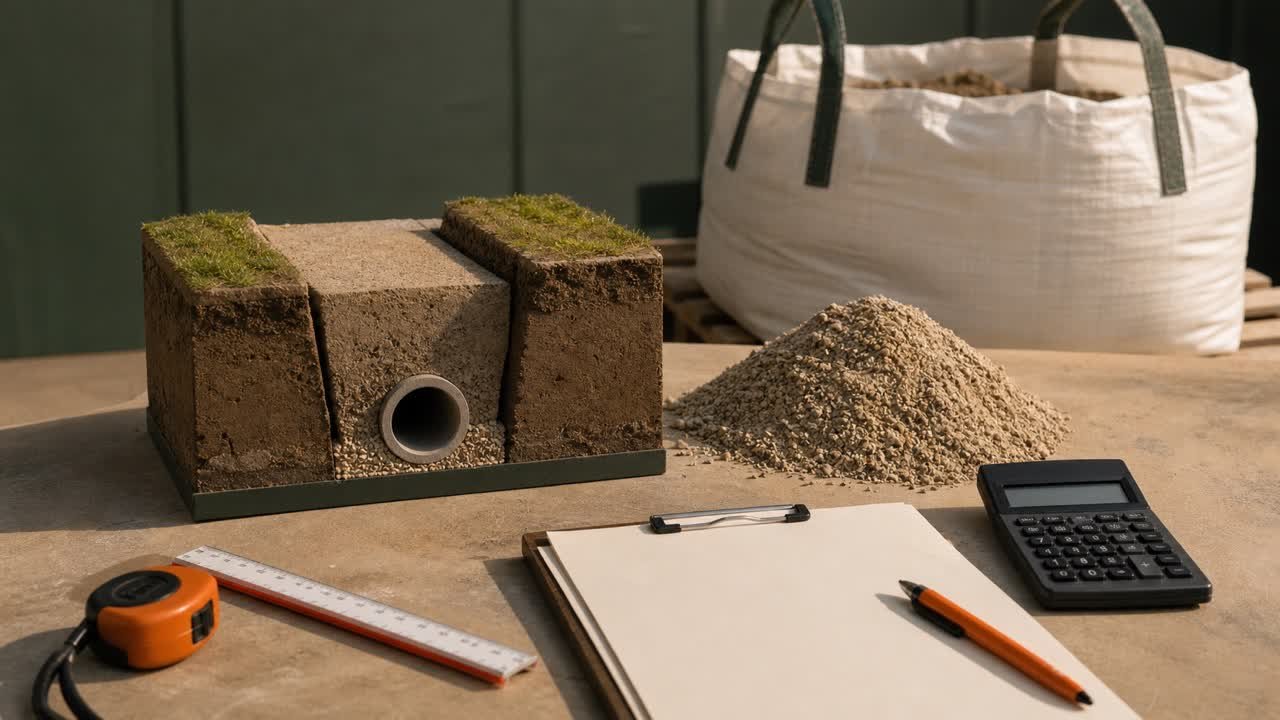
A trench takeoff usually ends with a volume, but suppliers may sell bedding or backfill by cubic yard, cubic metre, short ton, metric tonne, bag, bulk bag, or truckload. Converting between those units requires more than a unit conversion.
First identify the material state represented by the measured space. Then use product and supplier information that matches that state. Keep the base volume, state conversion, allowance, and commercial rounding as separate lines so another person can check the order.
How do you convert trench volume into an order quantity?
Start with the net volume for each specified material zone. Convert that volume to the supplier's delivery state, apply a documented project allowance, convert to the supplier's selling unit, and round once to the stated order increment.
The volume state and density condition must describe the same material condition. Ask the supplier whether its density, yield, or yardage represents loose, stockpiled, delivered, rodded, placed, or compacted material.
- Verify the net space. Separate bedding, pipe surround, selected backfill, final backfill, and any other product that will be ordered separately.
- Label the volume state. State whether the quantity is measured in place, bank, loose, placed, or compacted.
- Select the approved product. Match the project specification, drawing, accepted submittal, and supplier product name.
- Convert the material state. Use a project, supplier, test, or measured-yield factor whose direction is documented.
- Add a supported allowance. Account only for identified handling, overbreak, trimming, testing, or placement conditions.
- Convert to the selling unit. Use the supplier's matching bulk density, package yield, bulk-bag content, or volume basis.
- Apply commercial rounding. Round to whole bags, the supplier's weight or volume increment, and feasible legal loads.
- Confirm the quote. Record product, source, unit, minimum, increment, delivery basis, fees, validity date, and who confirmed it.
Which trench volume should enter the order calculation?
Use the volume that represents the exact product and material state you plan to buy. Gross excavation belongs in an excavation or spoil record, while an imported bedding or backfill order starts from its net material zone or the remaining compacted deficit after approved reuse.
| Available quantity | Use it for | Next check |
|---|---|---|
| Gross bank excavation | Excavation measurement and initial spoil source | Use the Trench Excavation Calculator, then classify reuse, stockpile, and export separately |
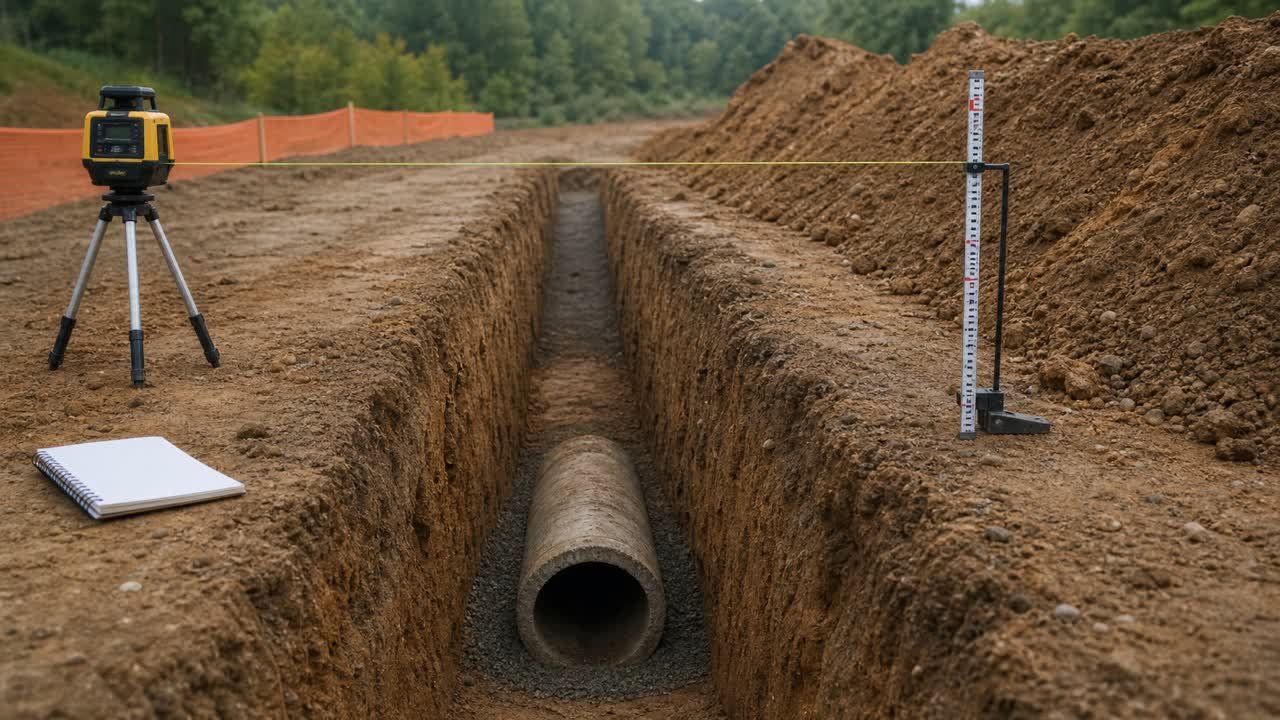
| Net bedding or pipe-zone volume | One specified imported product after pipe and permanent displacement | Check the trench backfill deduction ledger and keep each product on its own row |
| Compacted deficit after approved reuse | Imported final backfill or selected fill | Use the trench spoil balance before converting the deficit to the supplier's delivery state |
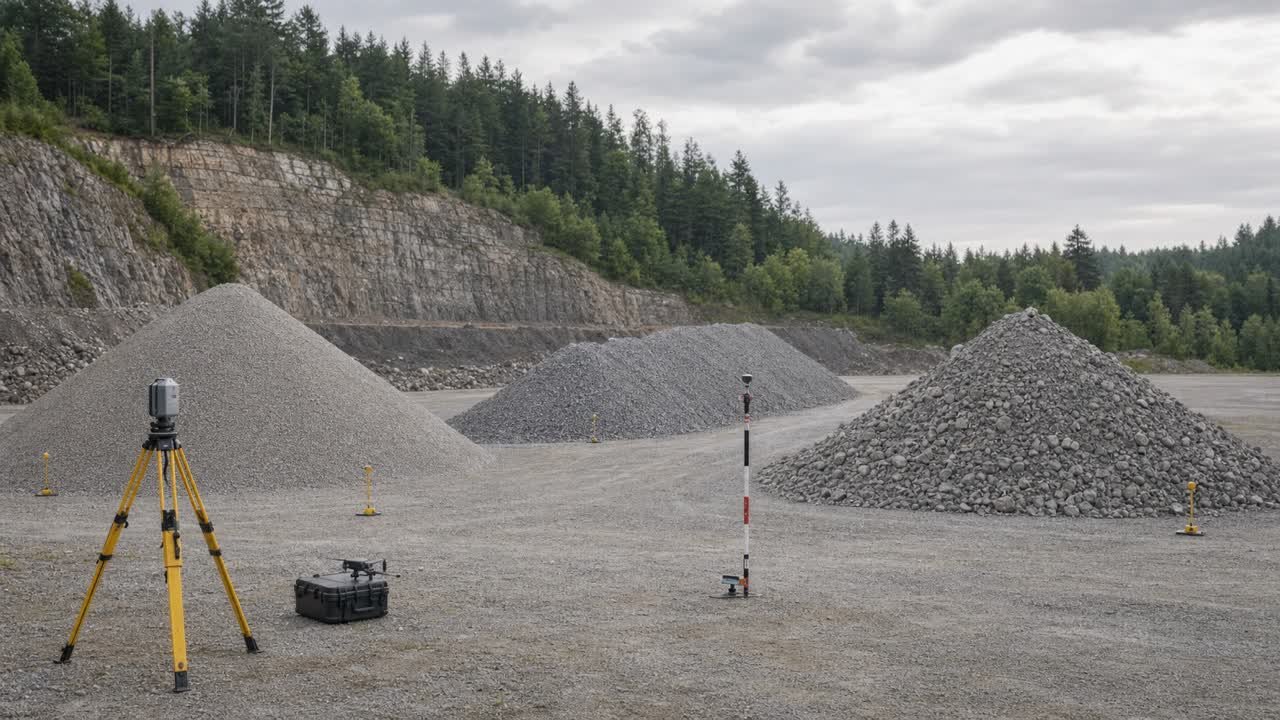
| Measured temporary stockpile volume | Loose inventory or haul planning for the named stockpile | Use the stockpile volume and survey guide; convert only when the quote or demand uses another state |
| Manufacturer package yield | Whole bags or packages for the exact product | Confirm the current yield conditions and round up after the product-level planning quantity is known |
Do not send the same volume through more than one starting path. For example, a compacted import deficit from the spoil balance already reflects approved site reuse. Subtracting reusable soil again in the supplier-order worksheet would understate the order.
What information do you need before converting the volume?
You need a checkable geometric quantity and current product-order information. A material name such as gravel or sand is too broad to support an order conversion by itself.
| Input | What to record | Where to verify it |
|---|---|---|
| Net trench volume | Unrounded volume for each material zone and section | Takeoff, project drawing, field measurement, or approved change record |
| Volume state | Bank, loose, delivered, placed, or compacted | Calculation method and project records |
| Product identity | Exact material class, gradation, source, and product code | Specification, accepted submittal, and supplier quote |
| State-conversion factor | Factor value, direction, conditions, and evidence | Project test, measured yield, supplier data, or approved estimating basis |
| Bulk density | Mass per volume with moisture and packing condition | Supplier data, product test, or project-approved source |
| Package yield | Usable volume per bag or package under stated conditions | Current manufacturer product data |
| Allowance | Percentage or fixed quantity and the condition it covers | Project history, measurement, procedure, or approved estimate basis |
| Selling increment | Whole bag, 0.5 t, 1 yd³, full bulk bag, or another increment | Current supplier quote |
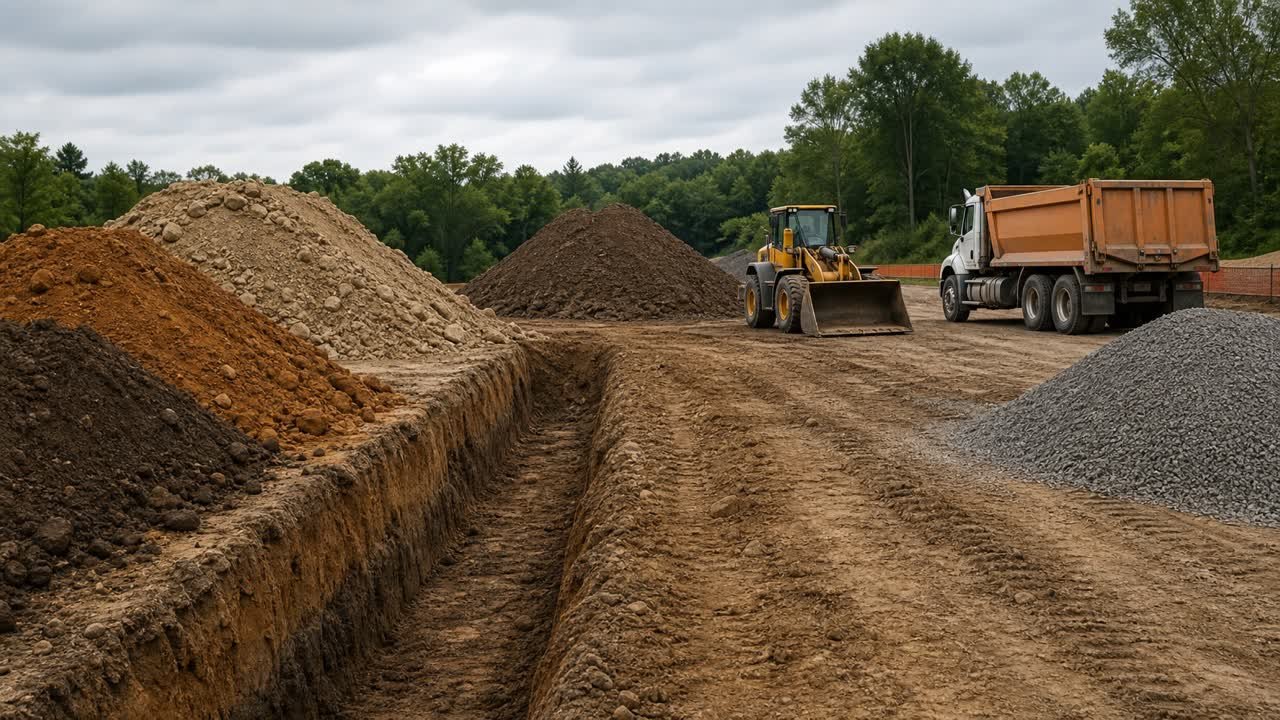
| Delivery constraints | Vehicle body volume, usable payload, access, route, and unloading limits | Supplier, haulier, site logistics plan, and applicable law |
Use the pipe bedding and backfill zone guide to split unlike materials before ordering. The Trench Excavation Calculator checks a uniform gross excavation, but the supplier order must use the net quantity for the named product.
Why must placed, loose, and compacted volumes stay separate?
Material volume changes when particles are excavated, transported, placed, and compacted. A measured compacted space and a loose truck body do not represent the same condition.
The U.S. Office of Surface Mining Reclamation and Enforcement describes bank, loose, and compacted cubic yards as separate measures of material state. Caterpillar's earthwork tables also distinguish in-bank, excavated loose, and compacted fill volumes, and warn that exact weight varies with moisture, grain size, and compaction.
| State | What the volume represents | Common quantity use |
|---|---|---|
| Bank | Material before excavation in its natural position | Cut or borrow measurement |
| Loose | Excavated or processed material with its current void structure | Stockpile, loader bucket, truck body, or loose supplier order |
| Placed | Material distributed in the work before or during the stated placement process | Layer and delivery reconciliation |
| Compacted | Material after the required compaction process | Finished trench-zone space or accepted fill quantity |
The bank and loose volume guide explains these states in more detail. Write the state beside every number rather than relying on a spreadsheet heading that says only “volume.”
How should a state-conversion factor be applied?
Define the factor as an equation before using it. Factor direction matters because a loose-to-placed yield factor and a placed-to-loose multiplier are reciprocals, not interchangeable percentages.
For a factor defined as the placed volume produced by 1 unit of loose delivery volume:
Loose order basis = required placed volume ÷ loose-to-placed yield factor
If the verified yield factor is 0.92, each 1.00 m³ of loose delivery is expected to produce 0.92 m³ in the stated placed condition. A required placed volume of 21.4867 m³ would therefore need a loose basis of 21.4867 ÷ 0.92 = 23.3551 m³ before any separate allowance.
The 0.92 factor is a hypothetical calculation fixture. It is not a standard factor for bedding, aggregate, sand, gravel, or backfill. Product gradation, moisture, source, placement method, lift thickness, compactive effort, target condition, and measurement method can change yield.
When can the conversion be skipped?
If the supplier sells by a volume already stated on the same basis as the required quantity, a separate state conversion may be unnecessary. Confirm what the quoted yard or cubic metre represents and whether loading, settlement, or compaction is already included.
Do not add a second compaction factor because a product label or calculator already includes one. Record the exact formula from the source so the chain can be audited.
How do you convert trench volume to tons or tonnes?
Multiply the volume by a bulk density that represents the same product and material state. Then convert the resulting mass to the supplier's weight unit.
Order mass = volume in stated condition × matching bulk density
ASTM C29/C29M covers aggregate bulk density in loose or compacted conditions. Those conditions are different measurements. A supplier value without its test or packing condition cannot safely bridge a compacted trench space and a loose delivered order.
Worked metric example: cubic metres to tonnes
Assume the following values are documented for one hypothetical order. They demonstrate the sequence and do not prescribe a density, yield, or allowance.
- Required placed volume: 21.4867 m³
- Verified loose-to-placed yield factor: 0.92
- Project-specific handling allowance: 3%
- Supplier's loose bulk density for the quoted product: 1.62 t/m³
- Supplier selling increment: 0.5 t
| Stage | Calculation | Result |
|---|---|---|
| Placed requirement | From the checked trench-zone takeoff | 21.4867 m³ placed |
| Loose basis | 21.4867 ÷ 0.92 | 23.3551 m³ loose |
| Planning quantity | 23.3551 × 1.03 | 24.0558 m³ loose |
| Unrounded mass | 24.0558 × 1.62 | 38.9703 t |
| Supplier-rounded order | Round up once to 0.5 t | 39.0 t |
The order record should retain all 5 stages. Writing only “39 t required” hides the measured volume, the state factor, the allowance, and the supplier increment.
Short tons and metric tonnes are different units
NIST Handbook 133, 2026 Appendix E states that 1 U.S. short ton equals 2,000 lb and 1 metric tonne equals 1,000 kg. Record the actual unit instead of writing only “tons,” especially when a quote crosses countries or software settings.
How do you convert trench volume to cubic yards or cubic metres?
Use an exact unit conversion only after the material state has been identified. The conversion changes the unit, not the material condition.
- 1 yd³ = 27 ft³.
- 1 yd³ = 0.764554857984 m³.
- 1 m³ = 1.307951 yd³ to the precision shown in NIST Handbook 133.
For example, 55.0311 yd³ of placed material remains a placed volume after a unit conversion. If a hypothetical loose-to-placed yield factor is 0.90, the loose basis becomes 55.0311 ÷ 0.90 = 61.1457 yd³.
Worked imperial example: cubic yards and truckloads
Assume a project-specific allowance of 4%, a supplier order increment of 0.5 yd³, and a haulier-confirmed usable body volume of 10 yd³ per load for the quoted product and vehicle.
| Stage | Calculation | Result |
|---|---|---|
| Placed requirement | Checked trench-zone takeoff | 55.0311 yd³ placed |
| Loose basis | 55.0311 ÷ 0.90 | 61.1457 yd³ loose |
| Planning quantity | 61.1457 × 1.04 | 63.5915 yd³ loose |
| Supplier-rounded volume | Round up to 0.5 yd³ | 64.0 yd³ loose |
| Loads by body volume | 64.0 ÷ 10, rounded up | 7 loads |
A body-volume result alone does not approve 7 legal loads. The material mass, actual vehicle tare, axle configuration, route, permits, road limits, and supplier loading practice can reduce usable payload.
How do you convert volume to bags or bulk bags?
Use the current manufacturer's stated yield or net content for the exact product. Divide the order-basis volume by the supported usable yield, then round up to whole packages.
Package count = order-basis volume ÷ stated yield per package
A hypothetical 0.90 m³ requirement and a manufacturer-stated yield of 0.028 m³ per package gives 0.90 ÷ 0.028 = 32.1429 packages. The commercial order is 33 whole packages.
Bag mass and bag yield answer different questions. A 25 kg label states mass. It does not prove the compacted volume the bag will produce. Use the manufacturer's yield table and conditions where available, and check whether water, consolidation, layer thickness, or application method affects that yield.
How much allowance should be added?
Add only an allowance tied to a named condition and evidence. There is no universal trench bedding or backfill percentage that suits every product, trench, crew, specification, and measurement basis.
| Condition | How to treat it | Evidence to keep |
|---|---|---|
| Measured overbreak | Add measured extra geometry to the correct zone rather than hiding it in a percentage | Stations, widths, depths, photos, survey, and approval |
| Irregular trench bottom | Use field sections or an approved average where the geometry can be measured | Section measurements and calculation method |
| Handling loss or spillage | Use project records or a documented estimating basis | Prior deliveries, tickets, return quantities, and conditions |
| Testing or trial placement | List the fixed quantity separately when it will not remain in the measured work | Testing plan and supplier unit |
| Supplier minimum | Show it as a commercial constraint after the technical requirement | Current written quote |
| Uncertain design or quantity boundary | Resolve the drawing or scope question before adding a broad contingency | RFI, instruction, revised drawing, or written assumption |
Keep allowance outside the base geometry. This prevents a later measurement correction from being confused with loss, yield, or commercial rounding.
How many truckloads should be ordered?
Calculate both the volume-constrained and payload-constrained load counts. Use the greater result, then confirm legal and operational limits with the supplier or haulier.
Loads by volume = round up (order volume ÷ usable volume per load)
Loads by payload = round up (order mass ÷ usable payload per load)
Planned loads = greater of the 2 results
Usable payload is not a universal truck rating. It depends on vehicle tare, body, axle layout, material density, moisture, route, jurisdiction, permits, and loading control. FHWA notes that U.S. federal weight compliance also considers axle number and spacing through the bridge formula, while permits are handled by states.
A light material may fill the body before reaching payload. A dense or wet material may reach payload before the body is full. Ask the haulier for the supported payload and body-volume limit for the exact vehicle and route.
What usually goes wrong in the conversion?
- Using gross trench excavation as the order volume without subtracting the pipe, structures, reused material, or other permanent zones.
- Combining different bedding and backfill products into one volume.
- Using nominal pipe size where outside diameter controls displacement.
- Treating bank, loose, placed, and compacted volumes as interchangeable.
- Applying a bulking percentage whose direction is undocumented.
- Multiplying a compacted space by a loose density without a supported state conversion.
- Using a generic online density instead of the quoted product's condition.
- Reading bag mass as installed volume.
- Adding allowance to a supplier figure that already includes yield or compaction.
- Rounding every trench segment before summing the same product.
- Rounding down to fit a preferred delivery count.
- Using body volume as the only truck constraint.
- Writing “tons” without stating short tons, long tons, or metric tonnes.
- Failing to retain quote dates, delivery tickets, and revised quantities.
What should the final order record show?
A useful order record lets the estimator, buyer, site team, and reviewer trace the supplier quantity back to the measured work.
- Project, location, trench run, stations, drawing, specification, and revision.
- Material zone, exact approved product, source, and supplier product code.
- Net unrounded geometry with its unit and material state.
- Pipe, structure, bedding, reuse, and other deductions.
- State-conversion equation, factor direction, source, date, and conditions.
- Allowance value, reason, evidence, and approval.
- Bulk density or package yield with matching material condition.
- Unrounded selling-unit quantity and supplier rounding increment.
- Vehicle body-volume and usable-payload checks when loads are planned.
- Quoted unit price, delivery, minimum, fees, taxes, expiry, and exclusions.
- Prepared by, checked by, order date, delivery tickets, returns, and final reconciliation.
Save the unrounded calculation even when the purchase order shows only the rounded commercial quantity. After placement, compare delivered tickets with the accepted work and record why the actual yield differed.
Safety, design, and supplier limits
A quantity conversion does not approve excavation support, pipe installation, bedding class, backfill material, compaction, groundwater control, haul route, or vehicle loading. Follow the governing drawings, specifications, accepted submittals, safety plan, and applicable law.
For U.S. construction, OSHA says spoil and equipment should be kept at least 2 ft back from an adequately protected excavation or retained by another suitable method. Site access and stockpile placement can therefore change delivery sequence and temporary storage needs.
Current supplier information controls the commercial order. Confirm the product, material state, density or yield, selling unit, minimum, increment, delivery capacity, access requirements, fees, and quote validity before placing it.
Sources and source scope
- NIST Handbook 133, 2026 Appendix E: exact relationships for cubic feet, cubic yards, cubic metres, pounds, U.S. short tons, kilograms, and metric tonnes.
- U.S. Office of Surface Mining Reclamation and Enforcement Directive TSR-1 Appendix A: bank, loose, and compacted volume definitions in its earthmoving-estimation context.
- Caterpillar Material Density Tables: material-state distinctions and the warning that exact weight changes with moisture, grain size, and compaction. Its published values are estimating references, not supplier product data.
- ASTM C29/C29M-23: test-method scope for aggregate bulk density in loose or compacted condition.
- FHWA Oversize/Overweight Load Permits: U.S. federal axle-spacing and bridge-formula context and the state role in permits.
- OSHA Construction Trenching eTool and 29 CFR 1926.651: U.S. excavation hazards, inspections, and spoil-setback context.
Scope: the formulas show how documented inputs move through an order calculation. Supplier data, project requirements, tests, field measurements, legal load limits, and responsible qualified people control the actual order and work.
Review responsibility: Saleem Sial owns the published calculation, source, and editorial checks. Waseem Sial, External Reviewer and Engineer, remains listed for ongoing external review; no completed external-review date is claimed.
Return to the Earthwork & Drainage Calculators hub, check the gross trench excavation volume, or review why verified pipe OD belongs in the takeoff.