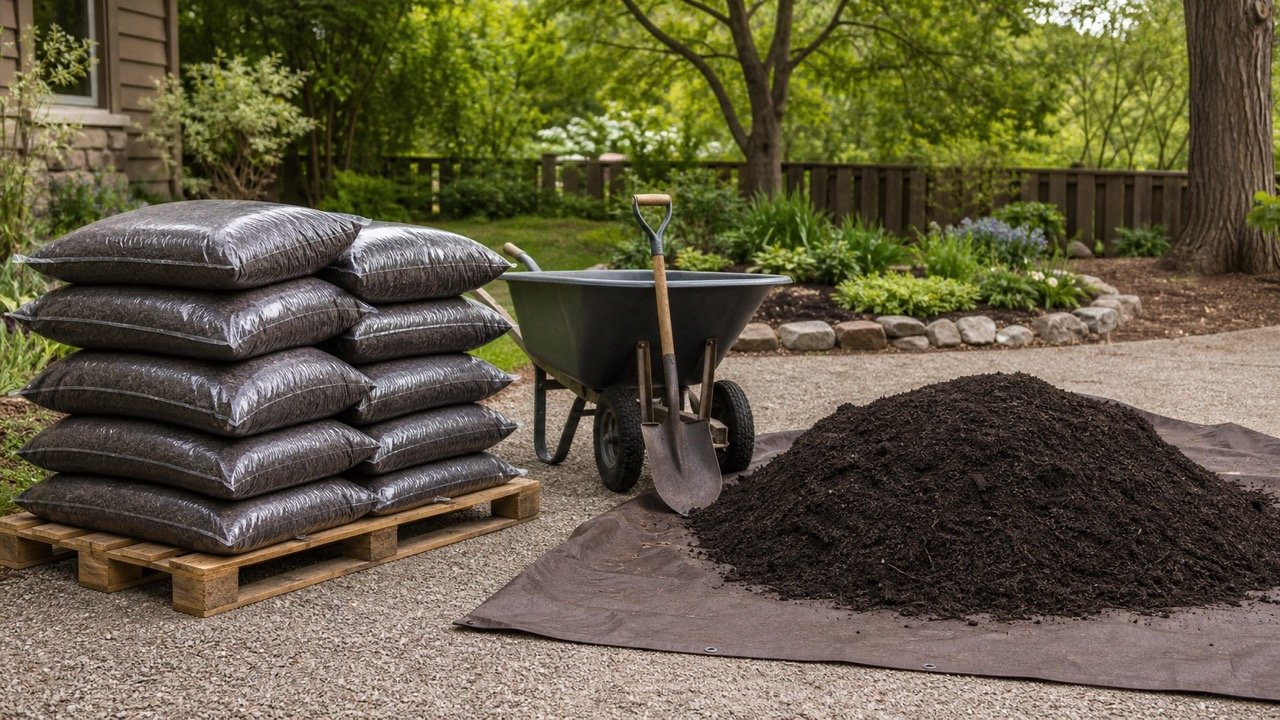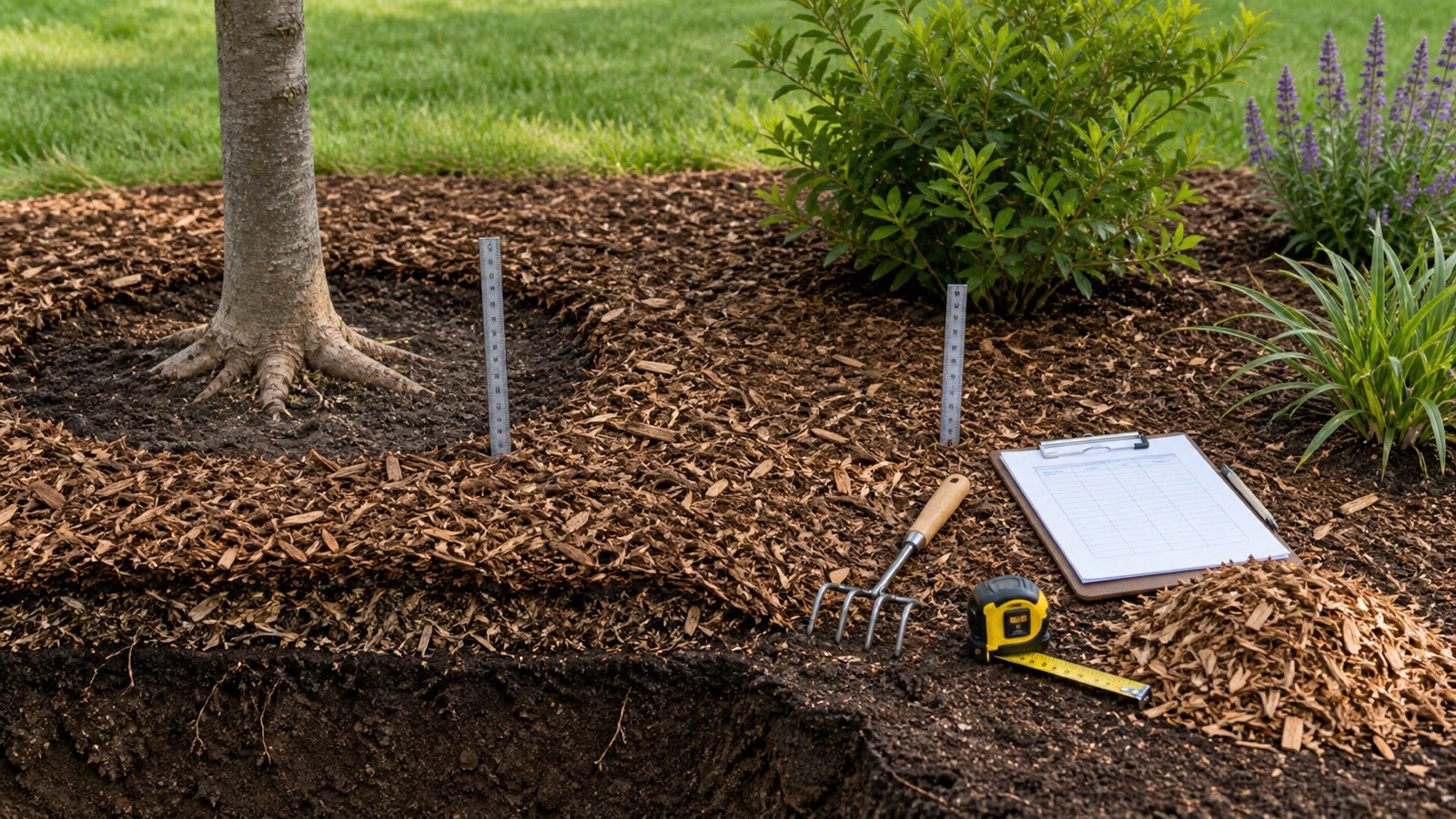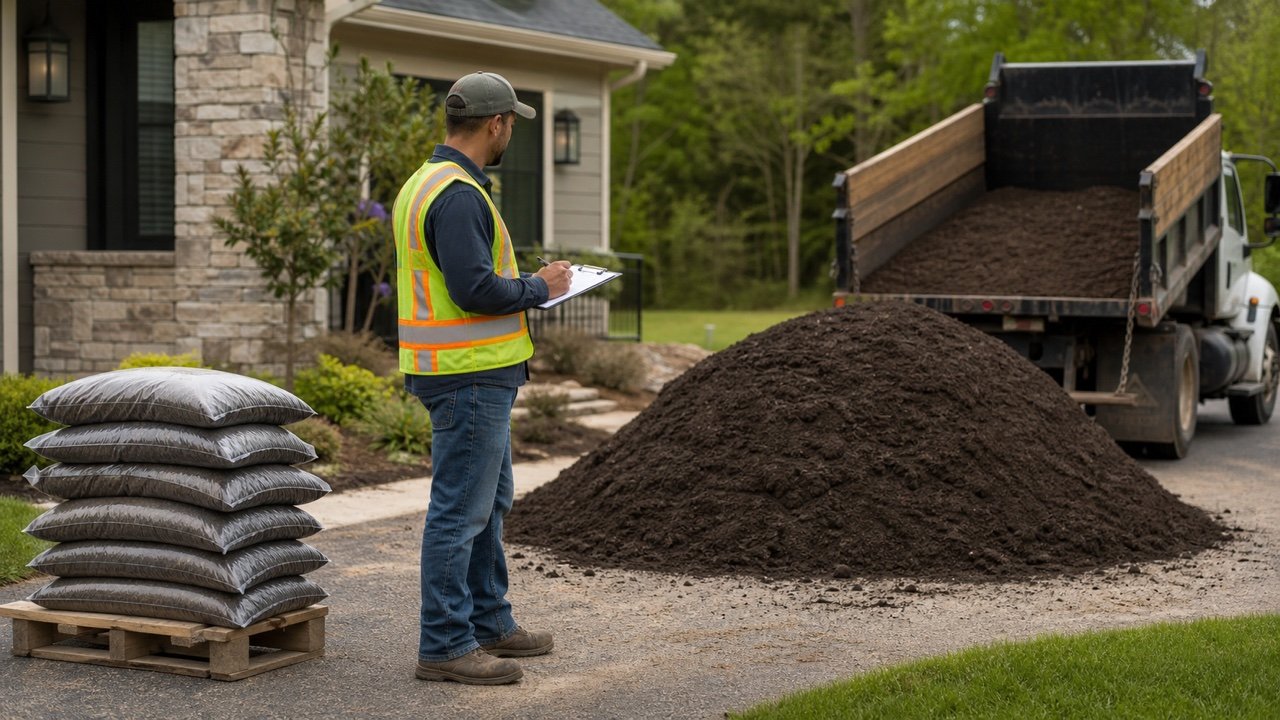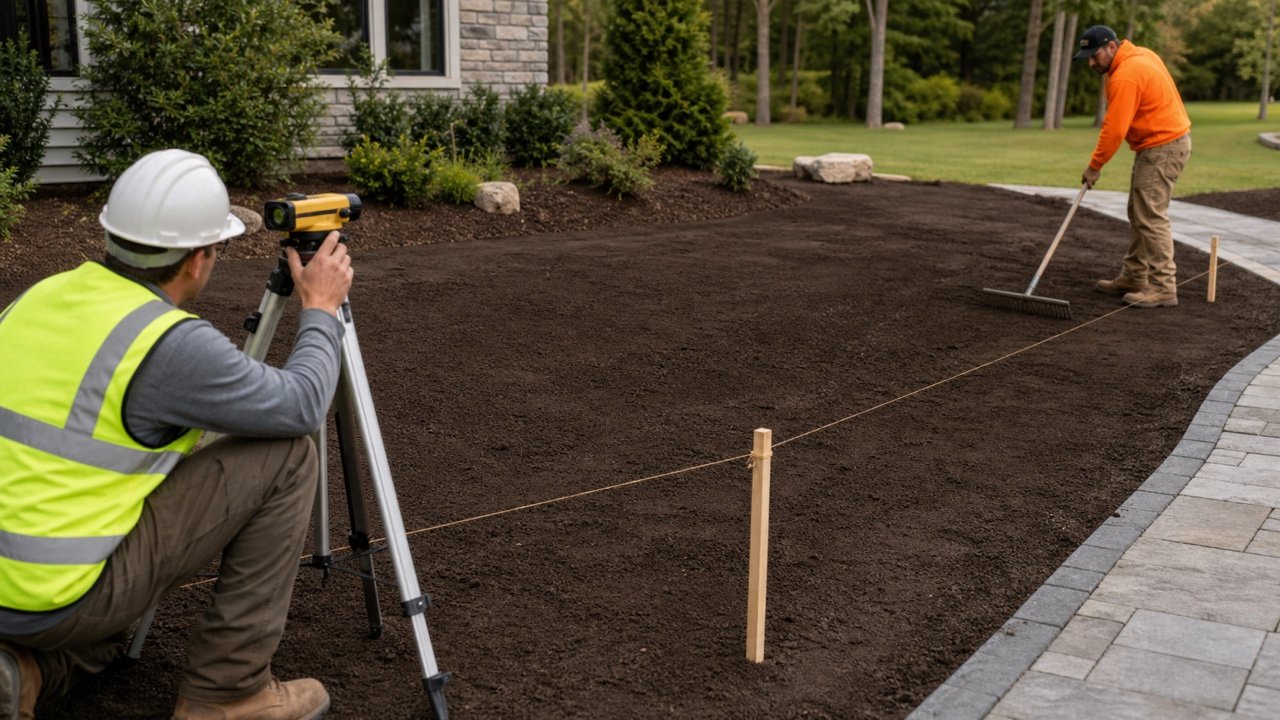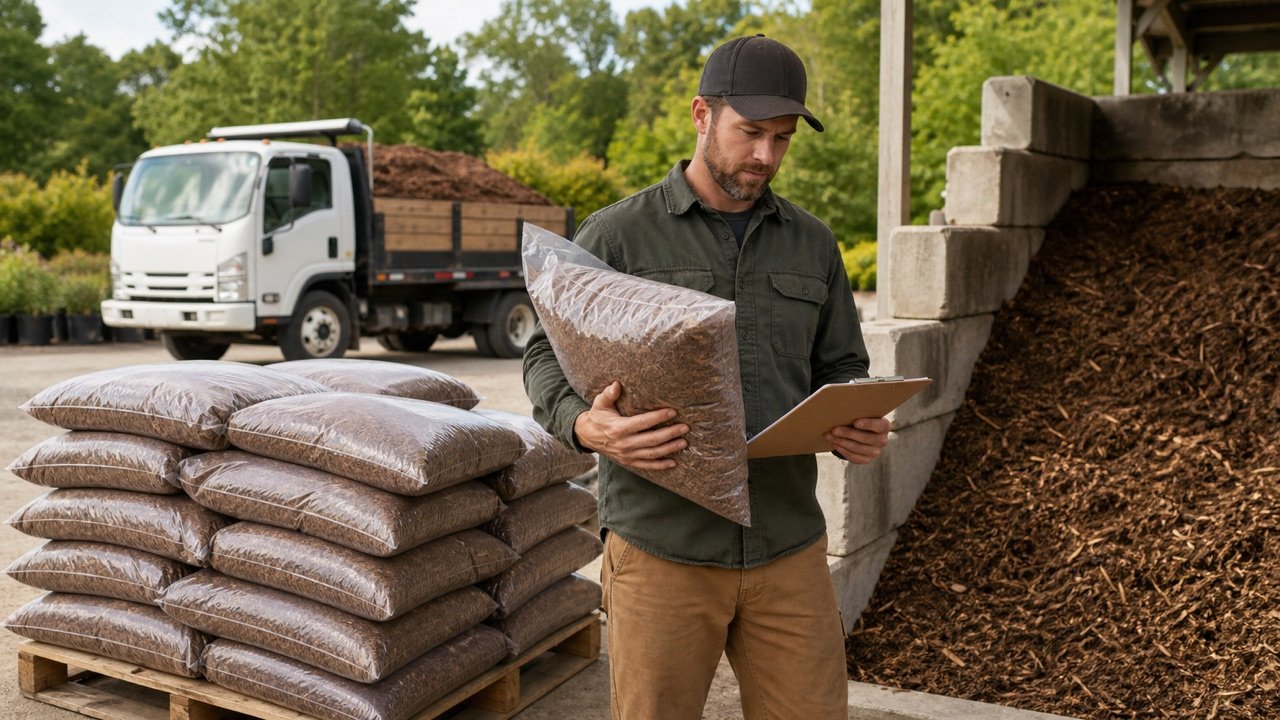
Bagged and bulk mulch should be compared as two complete orders for the same project, not by a fixed rule such as bags below one cubic yard and bulk above it. Package rounding, the supplier's selling increment, delivery fees, product differences, and the drop site can reverse the result.
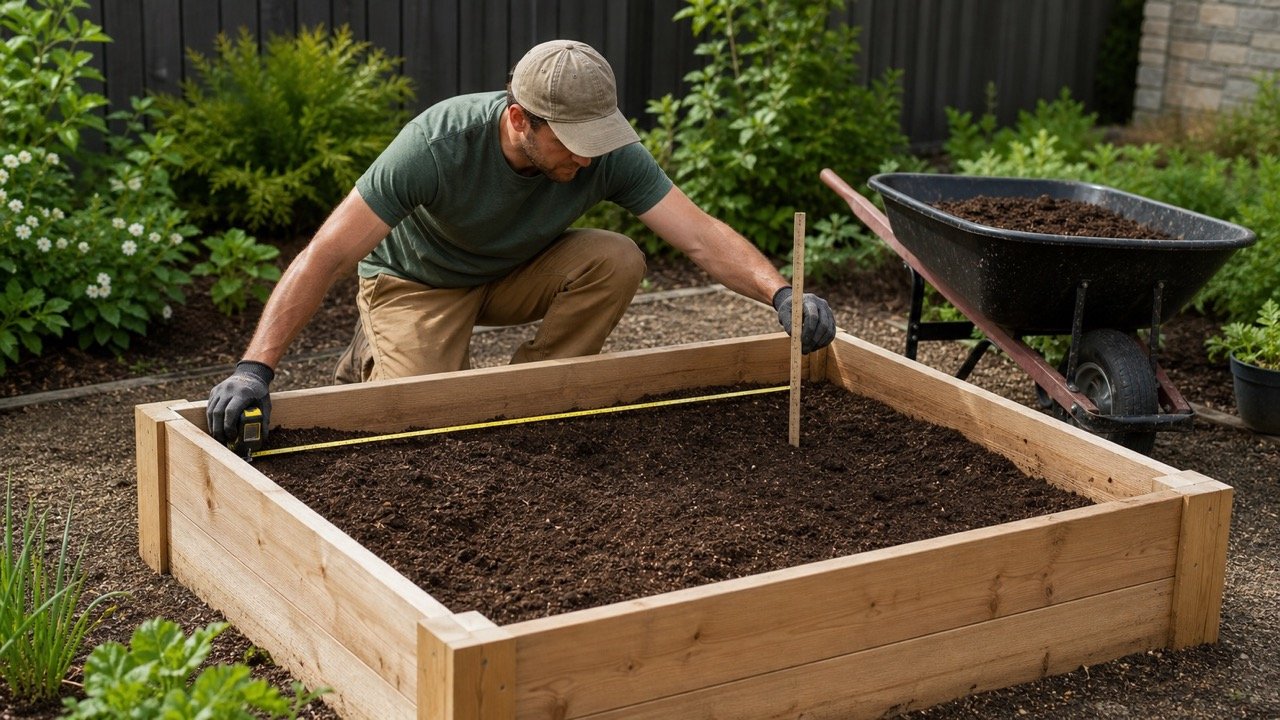
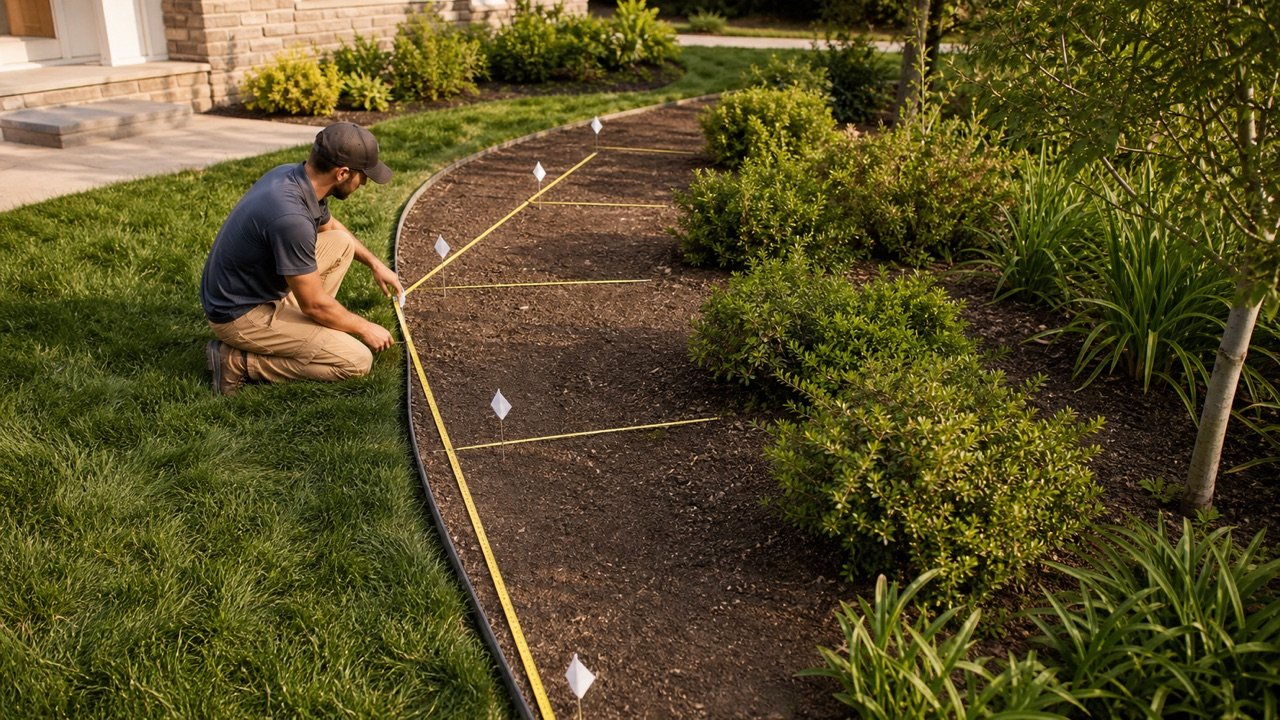
Start with the approved planning volume from the bed measurement. Then collect a current package label and a written bulk quote that describe materials suitable for the same intended use.
Should you buy mulch in bags or in bulk?
Choose the option that supplies the required planning volume, matches the specified material, fits the site, and has the better complete order outcome. Bags can win one comparison and bulk can win another even when their unit prices stay unchanged.
A fixed delivery fee weighs heavily on a small bulk order. Whole-package rounding, a promotion, a bulk minimum, or a supplier increment can move the decision again. Calculate both actual orders.
| Check | Bagged offer | Bulk offer |
|---|---|---|
| Quantity record | Net volume on the current package label × whole packages | Quoted cubic yards or cubic metres after supplier rounding |
| Cost record | Whole packages × price, plus applicable pickup, delivery, pallet, or other fees | Rounded bulk quantity × unit price, plus delivery, minimum, zone, fuel, or other fees |
| Product match | Exact labelled product and package | Exact quoted material, source, grade or description, and intended use |
| Site gate | Pickup or delivery, carrying route, storage, and packaging plan | Truck access, approved drop location, surface protection, pile containment, and spreading route |
| Final evidence | Label, receipt, promotion terms, availability, and return terms | Written quote, quantity basis, delivery ticket, schedule, and supplier terms |
Use the Mulch Calculator to establish measured and planning volume. Use the Mulch Coverage Guide only when you need to check area covered at a known depth.
Are the bagged and bulk products comparable?
Confirm the material scope before comparing price. Two offers called hardwood, bark, natural, coloured, playground, composted, or wood-chip mulch may not describe the same product or intended use.
- Record the product or supplier name and the exact material description.
- Check source material, particle form, colour or treatment, screening, maturity or processing claims, and stated intended use where relevant.
- Review current product instructions, warnings, certifications, and local application guidance.
- Ask whether the available bulk lot and packages match the sample or description used for approval.
- Keep premium, treated, certified, playground, agricultural, and general landscape products in separate comparisons unless the project accepts them as alternatives.
The University of Florida IFAS Extension mulch guide describes meaningful differences among mulch materials and their applications. It does not state that bagged or bulk supply is inherently better. Product records and the intended use control that decision.
How do you convert mulch bags to cubic yards?
Read the net volume from the selected package. One cubic yard contains 27 cubic feet, so divide the required cubic feet by the package's cubic-foot volume and round the final package quotient up.
Required ft³ = planning yd³ × 27
Whole U.S. packages = ceiling(required ft³ ÷ label ft³ per package)
A 2 ft³ label is an example, not a default. One cubic yard divided by 2 ft³ equals 13.5 packages before whole-package rounding. A different label changes the result.
For a metric label, convert the project volume to litres. One cubic metre contains 1,000 litres.
Required litres = planning m³ × 1,000
Whole metric packages = ceiling(required litres ÷ label litres per package)
Do not convert mulch volume to weight to compare formats unless a relevant, current bulk-density value and material condition are available. The bag label and bulk quote in this workflow are volume records.
How do you calculate the actual bag order cost?
Multiply the whole package count by the current package price, then add every applicable fee on the same tax basis used for the bulk quote.
Bag order total = whole packages × price per package + bag-order fees
Bag-order fees can include delivery, pickup, pallet, deposit, or service charges when the seller applies them. Record promotion quantity limits, membership conditions, coupon exclusions, delivery thresholds, taxes, and return terms instead of assuming the shelf price is the final order cost.
The equivalent material rate can help check a quote:
Bag equivalent per yd³ = package price × 27 ÷ label ft³
Bag equivalent per m³ = package price × 1,000 ÷ label litres
This rate ignores whole-package rounding and fixed fees. Use it as a diagnostic, then let the project-specific order total control the comparison.
How do you calculate the actual bulk order cost?
Ask how the supplier sells and rounds the material. If the approved planning quantity is 2.8 yd³ and the supplier sells in 0.5 yd³ increments, the order quantity is 3 yd³.
Bulk order quantity = ceiling(planning quantity ÷ supplier increment) × supplier increment
Bulk order total = bulk order quantity × quoted unit price + bulk-order fees
Record minimum order, delivery zone, fuel or service charge, split-load restriction, waiting time, rescheduling, cancellation, access, unloading, tax, and payment terms when they apply. Do not infer truck capacity, load legality, or delivery quantity from a generic vehicle name. The supplier and delivery record control those values.
How can the cheaper option change with project size?
The following fixtures use hypothetical prices to test the formulas. They are not market averages, supplier quotes, or purchasing recommendations.
| Input or result | 2.8 yd³ project | 7.2 yd³ project |
|---|---|---|
| Required cubic feet | 75.6 ft³ | 194.4 ft³ |
| Bag label and price | 2 ft³ at $4.25 | 2 ft³ at $4.25 |
| Whole packages | 38 | 98 |
| Bag order total | $161.50 | $416.50 |
| Bulk price, increment, delivery | $42/yd³, 0.5 yd³, $65 | $42/yd³, 0.5 yd³, $65 |
| Rounded bulk order | 3 yd³ | 7.5 yd³ |
| Bulk order total | $191 | $380 |
| Difference on these inputs | Bags cost $29.50 less | Bulk costs $36.50 less |
For the 2.8 yd³ project, 2.8 × 27 = 75.6 ft³. Dividing by the 2 ft³ label gives 37.8, so the order is 38 packages. The bulk offer rounds to 3 yd³. The $65 delivery fee makes the bulk total higher for this fixture.
For the 7.2 yd³ project, 7.2 × 27 = 194.4 ft³ and the order is 98 packages. The bulk quantity rounds to 7.5 yd³. The same fixed delivery fee is now spread across a larger order, and bulk has the lower total. Different prices, fees, increments, labels, or tax treatment create a different crossover.
How does a metric comparison work?
A hypothetical 1.6 m³ project needs 1,600 L. With a 40 L package at 6.20 currency units, the order is exactly 40 packages and the package total is 248.
A bulk quote at 85 per m³, sold in 0.25 m³ increments with a delivery fee of 70, rounds 1.6 m³ to 1.75 m³. The total is 1.75 × 85 + 70 = 218.75 currency units.
Bulk is lower on those inputs. The example excludes tax and other fees. Use one currency, one tax basis, current label volume, and current quote terms in a real comparison.
What should the supplier quote include?
A unit price without scope and delivery terms is not a complete offer. Request enough detail to reproduce the order total and assess whether the material and delivery fit the project.
- Material name, description, source or product, colour or treatment, and intended-use information.
- Price per cubic yard or cubic metre, selling increment, minimum, and quantity to be invoiced.
- Delivery address, zone, date window, truck type where relevant, and unloading method.
- Delivery, fuel, service, split-load, pallet, deposit, tax, and other charges.
- Access requirements, overhead and width restrictions, turning space, grade, surface, and approved drop location.
- Cancellation, weather, waiting, failed-delivery, damage, return, refund, and leftover terms.
- Quote date, expiry, stock status, contact, and revision reference.
Can the site receive a bulk delivery?
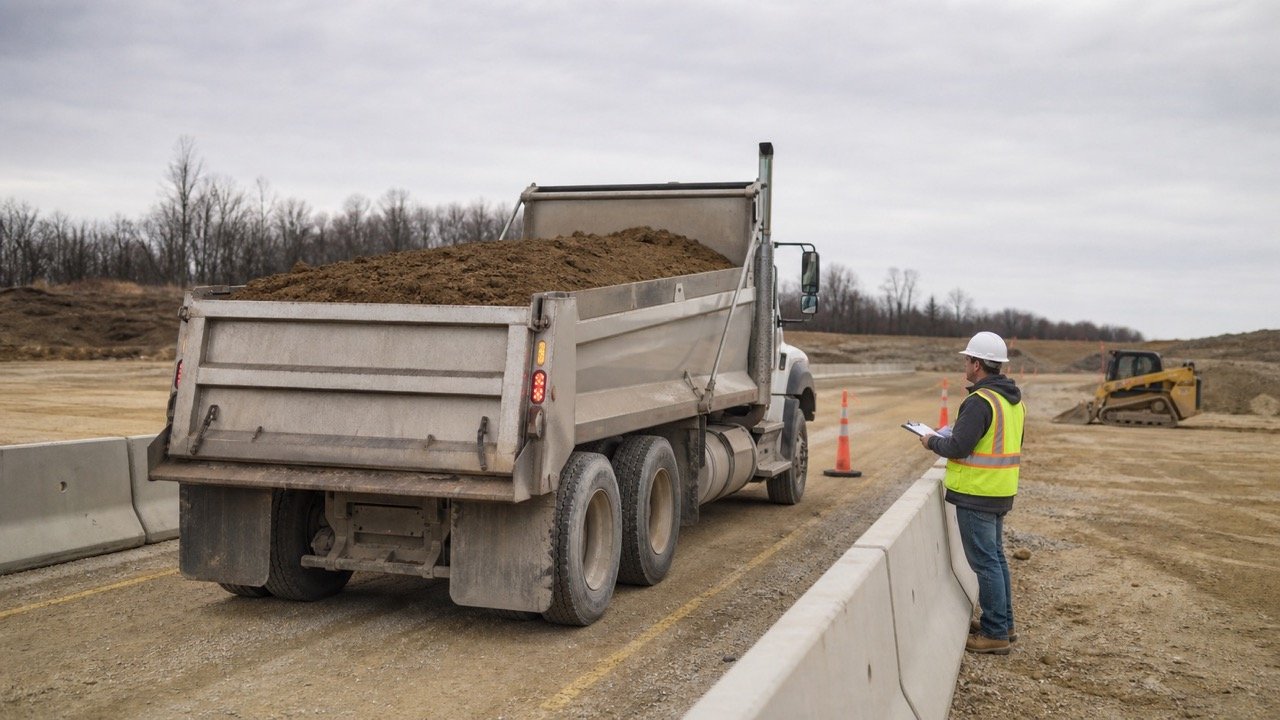
Approve the delivery route and drop point before price decides the order. A low material rate does not solve an inaccessible or unacceptable unloading location.
| Site condition | Question to resolve | Record |
|---|---|---|
| Narrow, steep, soft, gated, or overhead-restricted access | Can the supplier's stated vehicle and unloading method enter and leave safely? | Supplier access approval and site dimensions |
| Driveway, street, lawn, or hardscape drop | Is placement allowed, and what surface protection or permit is required? | Approved drop sketch and responsibility terms |
| Rain, wind, drainage, or public exposure | Can the pile be contained and protected without runoff, obstruction, or unsafe access? | Weather and containment plan |
| Several distant beds | Will packages, carts, or a staged bulk pile produce the workable distribution route? | Travel path, equipment, crew, and sequence |
| No same-day installation | Where and how can the material be stored under applicable product and site guidance? | Storage location, duration, and protection |
Supplier approval does not replace property-owner permission, traffic control, permits, utility clearance, surface-load review, site safety planning, or qualified direction where those are required.
How should handling and labour affect the decision?
Keep material cost, transport, handling, cleanup, and installation as separate estimate lines. Do not claim one format saves labour without measuring the actual workflow.
- For packages, count pickup or delivery, unloading, carrying distance, stairs, gates, opening, empty packaging, and returns.
- For bulk, count delivery coordination, pile containment, loading carts or equipment, travel distance, cleanup, and remaining material.
- Record crew size, equipment, production basis, working hours, and constraints if labour affects the decision.
- Check lifting, equipment, vehicle, public, and site controls under the applicable safety plan.
A package can be moved in separate units, while a bulk load arrives as a pile or container under the supplier's method. Whether either workflow is practical depends on the actual site and resources.
What does the bag's net-volume label prove?
The label supplies the declared package volume used in the buyer's quantity calculation. It does not prove that every individual package or lot has passed an official inspection.
NIST Handbook 133, 2026 provides official procedures for checking the net contents of packaged goods. NIST also provides a specific training resource for mulch and soils labelled by volume that connects Handbook 130 method-of-sale and labelling rules with Handbook 133 Section 3.10 testing.
Those procedures have sampling, equipment, test, and evaluation requirements. A shopping calculation is not an official lot test. Keep the package label and receipt, and use the applicable seller, manufacturer, or local weights-and-measures complaint process if a quantity issue needs investigation.
How should you plan leftovers and returns?
Calculate the volume added by whole-package or bulk-increment rounding before ordering. Then decide whether that remainder has an approved use, storage location, or return path.
- Bag remainder = whole packages × label volume − planning volume.
- Bulk remainder = supplier-rounded order quantity − planning volume.
- Record unopened-package return terms and deadlines rather than assuming returns are accepted.
- Do not spread excess material above the chosen depth or against trunks and stems merely to consume it.
- Keep different products or visibly different lots separate until their use is approved.
Common bagged versus bulk comparison mistakes
- Comparing a bag shelf price with a bulk unit price before adding fees and rounding.
- Assuming every bag contains 2 ft³ or every supplier sells in whole cubic yards.
- Using one project-size threshold for every location, season, promotion, and delivery zone.
- Comparing unlike mulch products as though purchase format were the only difference.
- Applying a price range from an article instead of obtaining a current local quote.
- Mixing tax-included and tax-excluded totals.
- Ignoring promotion limits, minimum orders, stock, quote expiry, or return terms.
- Choosing bulk before the truck route and drop site are approved.
- Using leftover material to make the layer deeper than the applicable guidance.
What should the comparison record contain?
- Project, measured volume, planning volume, allowance basis, and calculation revision.
- Package product, label volume, whole count, price, fees, taxes, availability, and terms.
- Bulk product, selling unit, increment, rounded quantity, price, fees, taxes, availability, and terms.
- Like-for-like scope decision and any approved material substitution.
- Delivery route, drop location, storage, handling workflow, labour, equipment, and safety controls.
- Calculated totals, remaining volume, selected offer, approver, quote date, and expiry.
Browse the landscaping planning hub for related quantity tools. Use the Topsoil Calculator or Compost Calculator for those materials because their placement states, product records, and mix decisions differ.
Sources and scope
- NIST Handbook 130, Current Edition: current U.S. model method-of-sale and packaging-labeling reference; local adoption and enforcement must be checked.
- NIST Handbook 133, Current Edition: official packaged-goods net-content inspection context.
- NIST Laws and Regulations Resources: links mulch and soil labelled-by-volume training to Handbooks 130 and 133.
- NIST Special Publication 447: supports customary and metric volume relationships used in the conversion.
- University of Florida IFAS Extension, Choosing and Installing Mulches: supports material and application context in its stated scope.
This page compares quantity, cost, delivery, and handling records. It does not provide current prices, endorse a seller or product, verify package or bulk quantity, establish legal compliance, approve vehicle access, select mulch for a site, or replace product instructions, supplier terms, local rules, horticultural guidance, or professional assessment.