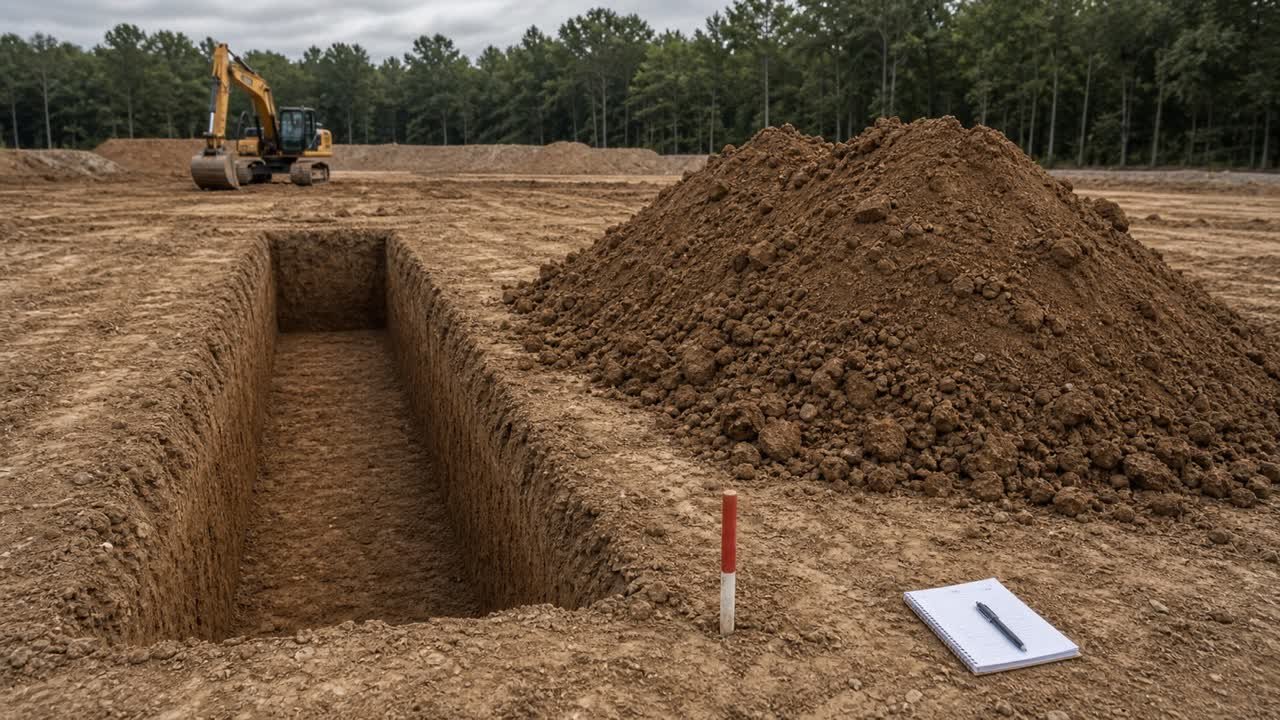
Fill quantity depends on both geometry and material state. The volume required in place is not automatically the same as loose material ordered, weight delivered, or volume after a specified compaction process.
This calculator starts with in-place geometry. It supports a uniform rectangle, circle, known area, or a rectangular wedge whose depth changes linearly between 2 ends.
How much fill dirt do you need?
For a uniform layer, multiply plan area by the required in-place depth. For a rectangular wedge, multiply length and width by the average of the 2 endpoint depths.
Apply a loose-order adjustment only when a project or supplier record supports it. Keep any separate handling allowance visible, and enter supplier density only when it describes the selected material in the same loose order state.
What does the Fill Dirt Calculator return?
The primary result is calculated in-place volume. The tool then shows a loose-order volume, final planning volume, plan area, average depth, and the in-place equivalent in litres or cubic feet. Optional mass appears only when you enter a supplier loose bulk density.
| Result | Calculation | Use |
|---|---|---|
| In-place fill | Area × uniform or average wedge depth | Records the simple finished geometry |
| Loose-order volume | In-place volume × (1 + entered adjustment ÷ 100) | Converts between defined states using documented project data |
| Planning volume | Loose-order volume × (1 + handling allowance ÷ 100) | Shows a separate supported handling allowance |
| Optional mass | Planning volume × entered supplier loose bulk density | Checks a weight-based quote for the same material state |
Every optional control starts at 0 or blank. The calculator has no universal shrink/swell factor, density, waste percentage, price, truck capacity, compaction target, or safe slope.
Which geometry should you choose?
- Rectangle: one length, width, and uniform depth.
- Circle: one diameter and uniform depth.
- Known area: a verified plan area and uniform depth.
- Rectangular wedge: one length and width with depth changing linearly from the start value to the end value.
The wedge model suits a simple planar change across a rectangle. It does not fit a bowl, mound, twisting surface, isolated low spots, compound slopes, or terrain with nonlinear changes.
How is uniform fill volume calculated?
Rectangle area = length × width
Circle area = π × (diameter ÷ 2)²
Uniform in-place volume = plan area × in-place depth
Metric mode converts centimetres to metres before multiplying square metres. Imperial mode converts inches to feet before multiplying square feet, then divides cubic feet by 27 to report cubic yards.
How is a wedge calculated?
Average wedge depth = (start depth + end depth) ÷ 2
Wedge volume = length × width × average wedge depth
This formula is exact for a rectangular plan where depth changes linearly in one direction. One endpoint may be zero. Both endpoints cannot be zero because that would define no fill.
Measure the depth difference perpendicular to the existing and proposed surfaces. Do not enter a design slope ratio as a depth. The calculator reports quantity from entered geometry; it does not decide whether the proposed surface is stable, drains correctly, or complies with a drawing.
Worked metric example
A rectangular area measures 12 m by 5 m and needs 30 cm of in-place fill.
- Area: 12 × 5 = 60 m².
- Depth: 30 cm = 0.30 m.
- In-place volume: 60 × 0.30 = 18 m³.
- A documented 20% loose-order adjustment gives 18 × 1.20 = 21.6 m³.
- A separate 5% handling allowance gives 21.6 × 1.05 = 22.68 m³.
- At a supplier-documented loose density of 1,500 kg/m³, optional mass is 22.68 × 1,500 = 34,020 kg, or 34.02 metric tonnes.
The percentages and density are fixture inputs, not recommendations. A value from another soil, moisture condition, test, stockpile, or supplier may not represent this order state.
Worked imperial wedge example
A rectangular area is 30 ft long and 20 ft wide. Required fill changes linearly from 0 in to 18 in.
- Average depth: (0 + 18) ÷ 2 = 9 in, or 0.75 ft.
- Plan area: 30 × 20 = 600 ft².
- In-place volume: 600 × 0.75 = 450 ft³.
- Cubic yards: 450 ÷ 27 = 16.667 yd³.
- A documented 15% loose-order adjustment gives 19.167 yd³.
No handling allowance or density is used. Applying the 18 in maximum across the full rectangle would give 33.333 yd³, twice the linearly changing wedge volume.
What do bank, loose, and compacted states mean?
Earthwork records must label the material state. Bank volume describes material before excavation in its original position. Loose volume describes disturbed material in a stockpile, haul unit, or delivery state. Compacted or in-place volume describes placed material under a defined project condition.
FHWA's Earthwork Representation Guide treats shrink/swell factors as inputs that adjust between defined states. That is why this calculator asks for a project value instead of inserting a standard percentage.
The primary result here is the simple in-place geometric requirement, not bank excavation volume. If material is excavated elsewhere, cut-to-fill balance needs compatible bank, loose, and compacted relationships plus suitability and loss decisions. Use the Cut and Fill Volume guide to measure gross existing-versus-proposed geometry, then use the Bank vs Loose Volume guide to define state conversion and factor direction.
How should the loose-order adjustment be entered?
Enter the percentage increase from calculated in-place volume to the loose volume you plan to order. For example, 20% changes 10 in-place yd³ to 12 loose yd³.
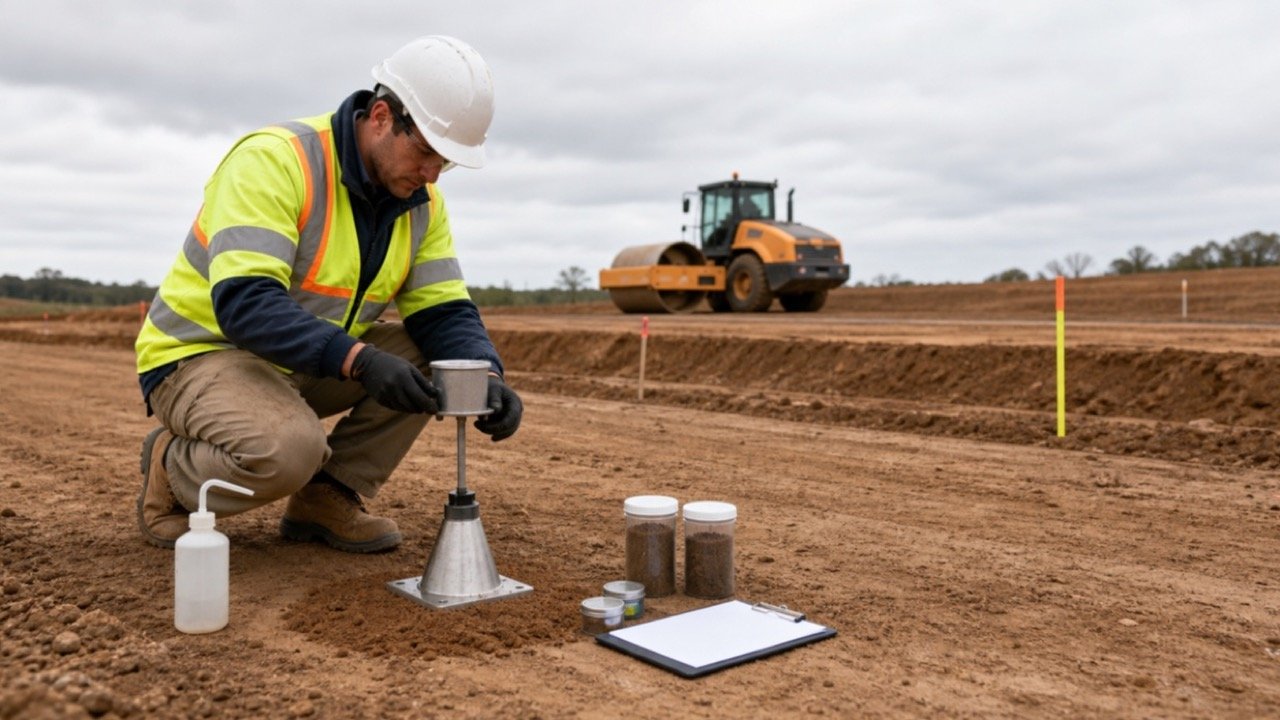
Use a value from the governing specification, geotechnical or materials record, supplier statement, test section, measured production history, or responsible project professional. Record the soil description, source, moisture condition, state definitions, test basis, and date.
Do not enter a ratio or factor without converting it to the field's percentage definition. A factor of 1.20 corresponds to a 20% increase. A statement that loose material compacts to 80% of loose volume does not equal a 20% increase from required compacted volume: 1 ÷ 0.80 = 1.25, which is a 25% increase. Confirm the intended definition before calculating.
When can allowance double-count volume?
The loose-order adjustment changes the material state. Handling allowance is a second, optional planning stage. It should cover only a separate documented effect.
Write down what each percentage represents. If both cover compaction, settlement, spillage, or supplier rounding, the result may count the same effect twice. Supplier minimums and load increments should normally be applied after the calculated planning volume and recorded separately.
Why is supplier density optional?
Bulk density depends on material composition, particle arrangement, moisture, and the state being measured. The density field therefore has no preset.
Metric mode expects kilograms per cubic metre and returns kilograms plus metric tonnes. Imperial mode expects short tons per cubic yard and returns short tons plus pounds. The entered value must match the loose planning volume, not an in-place or laboratory condition with a different density.
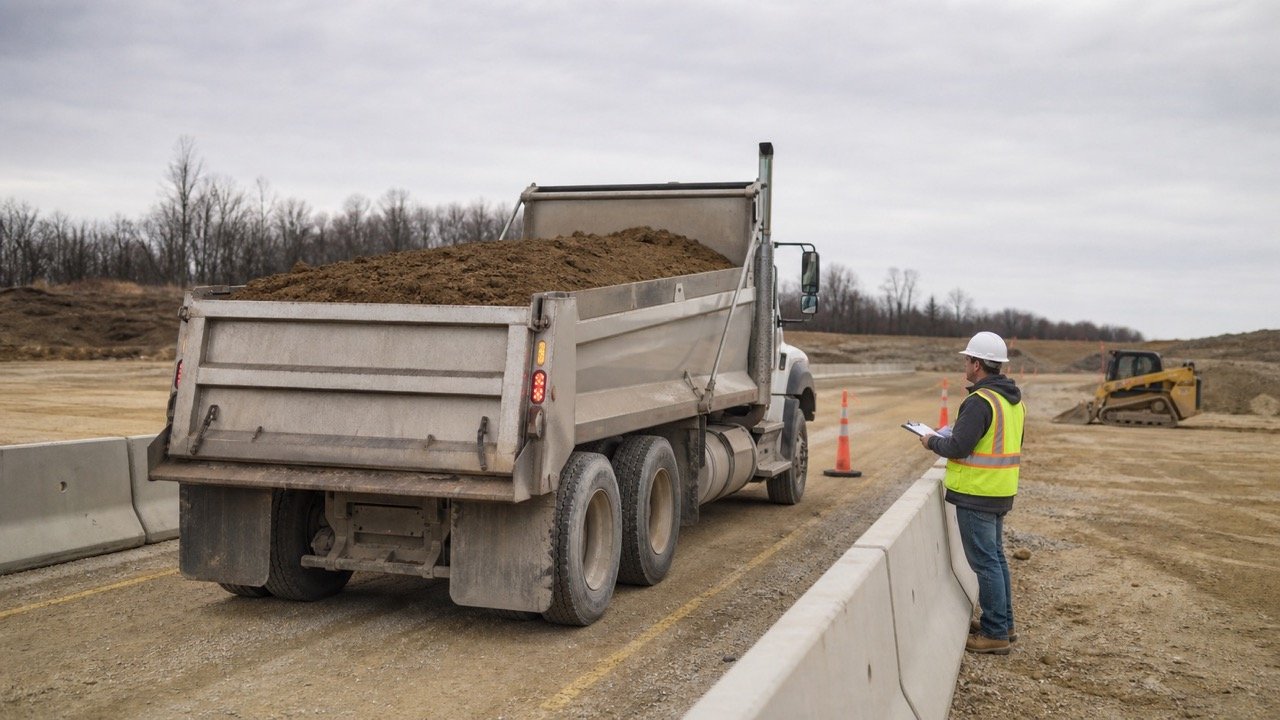
Mass helps compare a quote. It does not approve a haul vehicle, axle load, public-road limit, loading practice, or site access. Those decisions require the actual vehicle, route, law, operator, and material condition.
How do you measure changing or irregular fill?
Split the site into sections that each match a defensible geometry. Use a wedge only where depth changes linearly across a rectangular plan. For several rectangles or wedges, calculate each and add their unrounded in-place volumes before applying a common supported state factor.
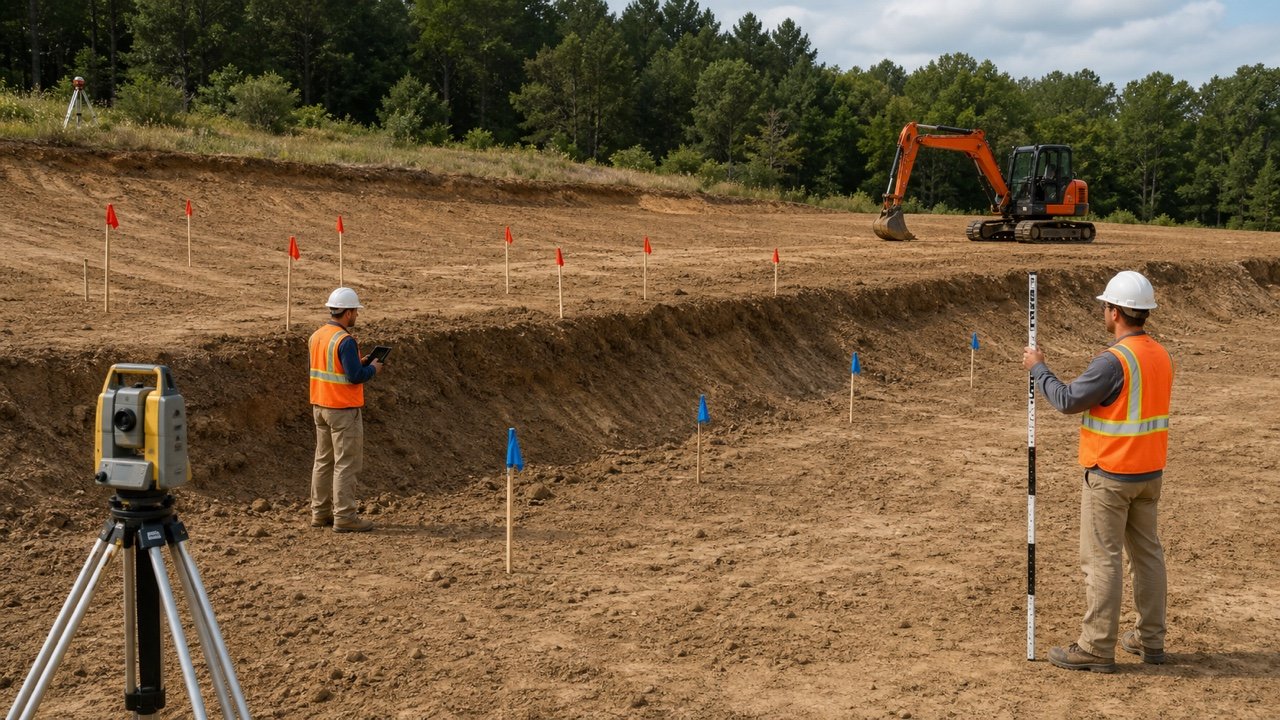
For complex grading, compare existing and proposed surfaces with survey points, grids, cross-sections, average end areas, or a triangulated surface method appropriate to the project. A few hand-measured depths cannot prove a large or safety-critical earthwork volume.
| Condition | Treatment |
|---|---|
| Uniform low area | Rectangle, circle, or verified known area |
| Linear depth change across a rectangle | Wedge with measured endpoint depths |
| Several linear panels | Calculate separate wedges and add unrounded volumes |
| Curved, twisting, or compound terrain | Use survey/model methods, not one average-depth input |
| Cut and fill on the same site | Use a cut/fill balance with state and suitability controls |
What material and project checks stay outside the calculator?
Fill dirt is not automatically suitable structural fill, drainage material, planting soil, pipe-zone material, or retaining-wall backfill. Drawings, specifications, classification, moisture control, testing, contamination assessment, and responsible acceptance determine suitability.
Do not use this page to design foundations, embankments, slopes, retaining structures, drainage, excavations, or trench support. Water conditions, underground services, adjacent structures, loading, and soil behavior can change safety and design requirements.
OSHA excavation guidance describes serious cave-in and site hazards and assigns inspection duties to a competent person in its jurisdiction. A cubic-volume result does not replace excavation protection, utility location, permits, access control, or applicable local requirements.
Common fill dirt mistakes
- Using maximum depth over an area whose fill tapers to zero.
- Using a simple wedge for nonlinear terrain.
- Calling bank, loose, and in-place cubic yards interchangeable.
- Entering a universal 10–30% compaction preset without project evidence.
- Confusing a retained-volume percentage with an increase percentage.
- Applying allowance to the same effect already covered by the loose adjustment.
- Using an unrelated density to calculate tons.
- Assuming a standard truck capacity or legal payload.
- Rounding section volumes before adding them.
- Treating quantity as material acceptance, grading, drainage, structural design, or excavation safety approval.
What should the fill order record include?
- Existing and proposed surface source, datum, date, and measurement method.
- Section sketch, geometry, dimensions, endpoint depths, and unit system.
- In-place volume before adjustment.
- Loose-order adjustment, exact definition, evidence, and resulting volume.
- Handling allowance, separate reason, and final planning volume.
- Material source, description, specification, moisture condition, tests, and acceptance record.
- Supplier density and state when mass is used.
- Selling unit, minimum, rounding increment, delivery basis, access, and final order.
Sources and scope
- NIST Guide to the SI, Appendix B and NIST Handbook 133, 2026 Appendix E: unit relationships only.
- FHWA Earthwork Representation Guide: defined volume states and user-entered adjustment-factor context.
- OSHA Trenching and Excavation Safety: safety boundary; requirements depend on jurisdiction and site.
Review note: Saleem Sial owns the research and editorial record. Formula fixtures, sources, build validation, and rendered browser QA form the internal publication gate. Waseem Sial, External Reviewer and Engineer, is listed for ongoing external review; no completed review date is claimed.