Tile adhesive mixing starts with the exact product instructions, not the bag weight alone. Products sold in the same 20 kg size can require different amounts of water, and one product can publish different ranges for grey and white powder.
Record the manufacturer, product, market, package, colour and data-sheet revision before measuring a batch. Then keep the water range, mixing sequence and working-time limits with the batch record.
How much water should you add to tile adhesive?
Add the amount stated for the exact product, package and application row. Use the permitted range as written. Do not copy a ratio from another 20 kg or 50 lb bag.
SikaCeram-288 Flex S1 lists 5.4–5.8 L for its 20 kg grey product and 6.0–6.4 L for its 20 kg white product. OPTIMIX TA345 lists 7.4–8.0 L for one 20 kg bag. These named examples show why package mass cannot set a universal water amount.
| Product and source market | Package or row | Published water | What the value can support |
|---|---|---|---|
| SikaCeram-288 Flex S1, India | 20 kg grey | 5.4–5.8 L | That exact grey product row |
| SikaCeram-288 Flex S1, India | 20 kg white | 6.0–6.4 L | That exact white product row |
| OPTIMIX TA345, Hong Kong | 20 kg | 7.4–8.0 L | That named lightweight product |
| MAPEI Porcelain Tile Mortar, Canada | 25 lb (11.3 kg) | 2.37–2.84 L | That named product and package |
| MAPEI Porcelain Tile Mortar, Canada | 50 lb (22.7 kg) | 4.73–5.68 L | That named product and package |
The table compares instruction formats. Product quality, performance and suitability need their own evidence. Check the current local package and technical data because formulations and market instructions can differ.
How do you calculate water for several full bags?
Multiply both endpoints of the product's water range by the number of full bags. Keep each endpoint visible instead of replacing the range with an automatic midpoint.
Full-bag water range = number of bags × water range per bag
Three 20 kg grey SikaCeram-288 bags at 5.4–5.8 L per bag require 16.2–17.4 L across 3 controlled full-bag batches. This total supports planning and reconciliation. Keep the 3 batches separate unless the approved equipment and process support another batch size.
Container capacity, mixer capacity, stated mixing method, pot life, placement rate and working conditions set the practical batch size. Measure each batch separately when that is the accepted workflow.
Can you scale the ratio for a partial bag?
Scale a partial bag only when the current manufacturer instructions permit it and the dry powder used is a representative sample. The arithmetic alone does not grant permission to divide a package.
Partial-batch water minimum = partial powder mass × full-bag water minimum ÷ full-bag powder mass
Partial-batch water maximum = partial powder mass × full-bag water maximum ÷ full-bag powder mass
Assume a 20 kg product has an accepted 5.4–5.8 L range and its manufacturer permits an 8 kg partial batch. The calculated water range is:
- Minimum water: 8 × 5.4 ÷ 20 = 2.16 L.
- Maximum water: 8 × 5.8 ÷ 20 = 2.32 L.
The 8 kg batch and permission are calculation conditions, not a general instruction for SikaCeram-288 or another product. If the package says to mix one bag, mix full units, or gives no safe partial-batch method, stop and obtain product guidance.
| Check | If confirmed | If unconfirmed |
|---|---|---|
| Manufacturer permits package division | Continue with its method | Use a full package or ask technical support |
| Powder sample is representative | Weigh the accepted dry amount | Do not assume the top of an opened bag has the full formulation |
| Water endpoint and ratio basis are clear | Scale both endpoints | Clarify whether the ratio is by mass or volume |
| Measuring equipment has suitable resolution | Record actual powder and water | Use a larger batch or suitable equipment |
| Storage and contamination controls are accepted | Seal and identify the remainder as instructed | Do not plan on the opened remainder |
What does a water-to-powder ratio by weight mean?
A ratio stated by weight compares water mass with dry-powder mass. Keep that mass basis instead of treating it as a bucket-volume ratio. Follow the manufacturer's units and stated method.
SikaCeram-288 gives a water-to-powder ratio by weight and also publishes litres of water per bag. Its grey ratio is 0.27–0.29, which corresponds to 5.4–5.8 L on the manufacturer's 20 kg row. Use the published litre row when that is the exact package being mixed.
Do not calculate a powder volume from bag size or loose bulk density unless the manufacturer provides and permits that method. Weighing the dry powder avoids settling and scoop-packing errors in a permitted partial batch.
What mixing sequence should you follow?
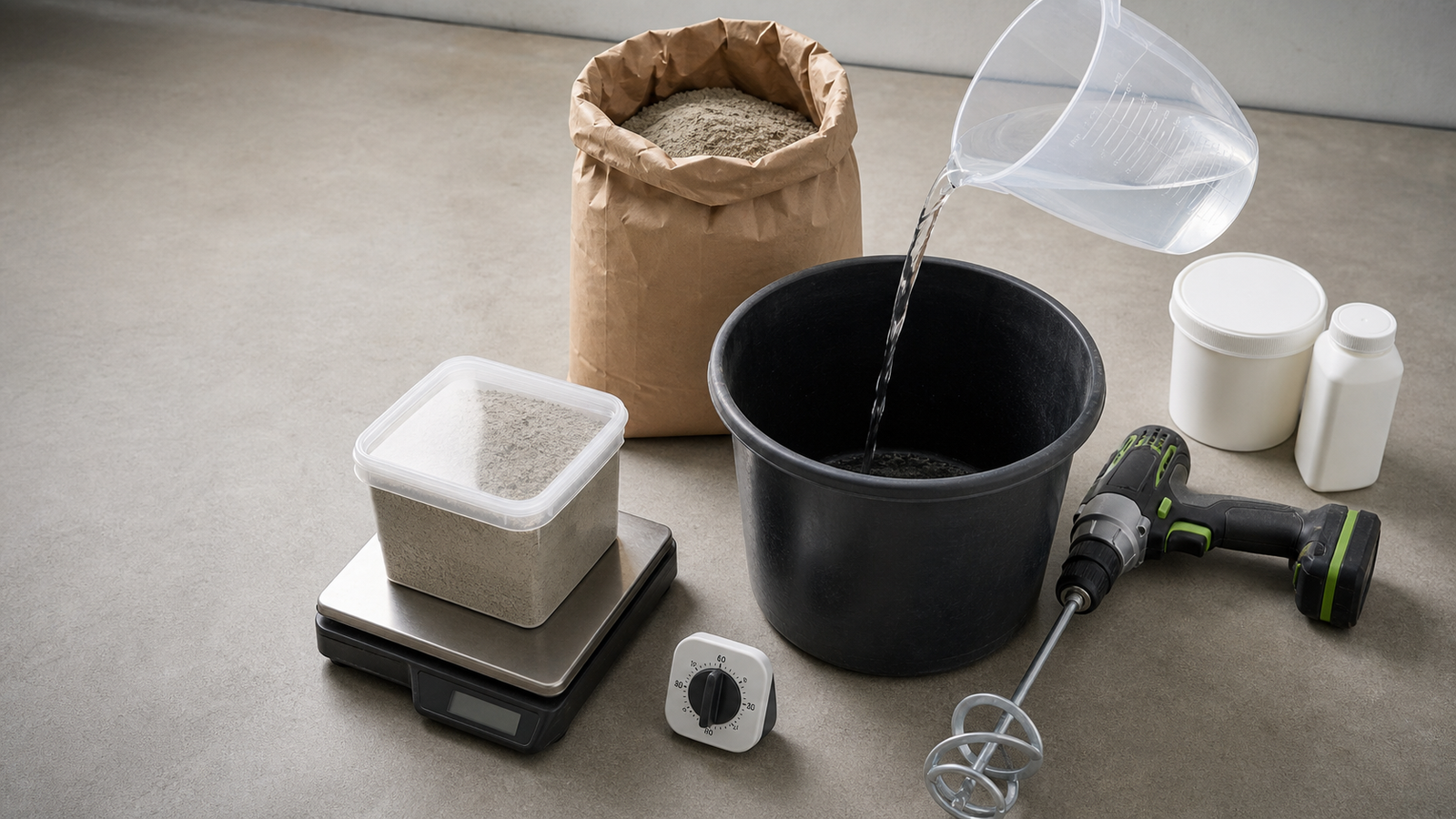
Use the sequence, mixer, speed and times stated for the selected product. A common cementitious-product sequence places measured water in a clean container, adds powder while mixing, allows a stated maturing or slake period, and then remixes.
For SikaCeram-288, Sika instructs users to place the minimum recommended clean cold water in a clean container, add powder while mixing below 500 rpm, mix for about 5 minutes, allow about 5 minutes to mature, and remix for about 15 seconds. Additional water may be added during its first mixing step only up to that product's stated maximum.
MAPEI's Porcelain Tile Mortar instructions use clean water, gradual powder addition, about 300 rpm mixing for about 3 minutes, 5 minutes standing and 1 minute remix. If that named mix becomes heavy or stiff within its stated period, the sheet says to remix without adding more liquid.
- Confirm product identity and current instructions.
- Use a clean container and suitable measuring vessel or scale.
- Measure the selected water endpoint.
- Add materials in the stated order.
- Mix with the specified paddle, speed and duration.
- Observe the full stated maturing or slake time.
- Remix for the stated duration.
- Mark the batch time and use only within all applicable limits.
Do not transfer one manufacturer's sequence to a different chemistry. Product instructions can require another order, liquid additive or full-component set.
Should you use the minimum, maximum or midpoint water?
Use the value supported by the product instructions and actual application conditions. A range gives controlled adjustment space; it does not make every point equally suitable for every use.
SikaCeram-288 tells the user to start with its minimum and add water during initial mixing if necessary, up to the maximum. Another product can give one amount or different ranges by application. Record the chosen value and never exceed the product maximum to chase easier spreading.
| Entry | Why it matters |
|---|---|
| Published range | Preserves the manufacturer's permitted endpoints |
| Initial measured amount | Shows the actual starting batch |
| Permitted addition during initial mixing | Confirms the final amount remained within the maximum |
| Final batch water | Allows consistent later batches |
| Reason for selected value | Connects the choice to the named instruction and condition |
Are pot life and open time the same?
No. Pot life concerns the mixed material in its container under stated conditions. Open time concerns material after it has been spread and exposed before tile placement. The spread layer can become unsuitable before the bucket time ends.
OPTIMIX TA345 warns that open time after spreading is much shorter than pot life. SikaCeram-288 lists a pot life of at least 180 minutes for a 100 g mass at 27°C and an open time above 30 minutes under its cited test method. These laboratory records do not promise the same site time for a large bucket or exposed mortar bed.
| Clock | Where it applies | Planning use |
|---|---|---|
| Mixing time | Material under mechanical mixing | Follow the stated duration and speed |
| Maturing or slake time | Mixed material resting before final remix | Do not treat this as installation time |
| Pot life | Mixed material retained in the container under stated test conditions | Set an upper batch-use check |
| Open time | Adhesive exposed after spreading | Limit the area spread ahead of tile placement |
| Adjustment time | Recently placed tile under stated conditions | Do not merge it with pot life |
How should temperature change batch size?
Use temperature to review working time and batch size, not to invent extra water. Check the product's permitted application range and temperature-specific instructions before work starts.
OPTIMIX TA345 publishes typical pot-life values of about 90 minutes at 22°C, 60 minutes at 30°C and 30 minutes at 38°C. The data sheet says site results vary with ambient, substrate and tile conditions. The useful planning response is a smaller batch or faster controlled workflow when conditions shorten usable time, subject to the product instructions.
MAPEI's hot-weather bulletin states that warm or hot mixing water can shorten pot life and open time. It also tells users to follow package and technical-data water amounts, speed and timing. Temperature does not authorize overwatering.
Worked batch plan: 2 full bags and one permitted partial batch
A crew needs 48 kg of dry powder from a product whose 20 kg package uses 5.4–5.8 L. The manufacturer has permitted proportional partial batching, and the accepted equipment can mix one full bag at a time.
- Batch 1: 20 kg powder and 5.4–5.8 L water.
- Batch 2: 20 kg powder and 5.4–5.8 L water.
- Batch 3: 8 kg powder and 2.16–2.32 L water.
- Total dry powder: 20 + 20 + 8 = 48 kg.
- Total water range: 12.96–13.92 L.
Each batch still receives its own measured water, start time, maturing time, remix time and disposition. The total water supports preparation and reconciliation. Keep it out of a combined mixing container unless that batch is approved.
Which tile adhesives do not use water per bag?
Ready-mixed pastes and pre-batched multi-component products need their own instructions. Do not place them in a dry-powder water formula.
| Product state | Batch basis | Water-per-bag method |
|---|---|---|
| Single-component cementitious powder | Named powder package plus stated water or additive | Use only the exact product row |
| Ready-mixed paste | Supplied product and container instructions | Do not add water unless expressly instructed |
| Powder plus liquid additive | Named powder and named liquid system | Follow the system ratio, not a water-only table |
| Pre-batched 2-component adhesive | Parts A and B in the stated ratio | No water calculation unless the instructions state one |
MAPEI describes Premium Mortar as a premixed alternative to traditional thin-set mortars that require water and mixing. SikaCeram-428 Super Bond T is a 5 kg pre-batched set with 4.6 kg Part A and 0.4 kg Part B, a 92:8 ratio by weight. Its instructions say to mix full units only.
What should you do with a batch that is too wet, too dry or too old?
Stop and follow the exact product instructions. Record what was measured, when the batch started, its condition and the action taken. Do not repair a batch through an unapproved addition.
- If too much water was measured before powder addition, set the water aside and remeasure rather than guessing extra powder.
- If the final mix exceeds the stated maximum, do not use arithmetic to approve it.
- If the mix feels stiff after slake, check whether the named product allows remixing without added water.
- If pot life, open time or another applicable limit has passed, discard the affected material as instructed.
- If a skin forms on spread SikaCeram-288, its instructions say to remove and discard that layer and apply fresh adhesive.
- Do not return contaminated or setting material to a fresh batch.
How should each adhesive batch be recorded?
A short batch sheet connects purchased powder with measured water, installation time and discarded material. It also helps explain a difference between planned and observed consumption.
- Project, area, installer and date.
- Manufacturer, product, colour, package, market and batch or lot identifier.
- Technical-data or package revision used.
- Ambient, substrate and mixing-water conditions required by the project record.
- Dry powder or full units issued.
- Published water or component range and actual amount used.
- Container, paddle, mixer speed and mixing duration.
- Mix start, maturing start, remix and discard times.
- Area or location served by the batch.
- Usable return, discarded quantity and reason.
- Deviation, technical query and approval record.
Which mixing-ratio mistakes change the batch?
- Using one litres-per-20-kg value for every adhesive.
- Ignoring product colour when the water rows differ.
- Reading a mass ratio as a loose powder-volume ratio.
- Using an automatic midpoint without checking the instructions.
- Dividing a bag without confirmed partial-batch permission.
- Measuring dry powder with an unverified scoop.
- Adding powder and water in the wrong sequence.
- Mixing too fast or too long and entraining excess air.
- Skipping the stated maturing or slake period.
- Adding water after remix when the product forbids it.
- Treating pot life and open time as one clock.
- Increasing water because the site is hot.
- Adding water to a ready-mixed paste.
- Splitting a two-component set that requires full-unit mixing.
- Adding mixing-water mass to the dry-powder purchase quantity.
Safety and installation limits
Read the current product data, safety data and package instructions before opening or mixing material. Use the specified protective equipment, dust controls, electrical equipment and mixing area. Keep water away from live electrical connections.
Cementitious powder can contain Portland cement and crystalline silica. OSHA provides United States construction information for respirable crystalline silica. The product safety data and rules for the actual work location control handling and exposure measures.
This page checks quantity and batch arithmetic. It does not select an adhesive, approve a substrate or tile system, replace installation instructions, set required mortar contact, extend working time or approve a nonconforming batch.
Use the Tile Adhesive Calculator to estimate compatible dry product and whole bags. Check Tile Adhesive Coverage per Bag, Tile Adhesive Consumption Rate and Tile Adhesive Allowance for the other parts of the takeoff. Return to the tile planning tools and guides or review the calculation methodology.
Sources and source scope
- SikaCeram-288 Flex S1: named product's package and colour water ranges, maturing time, pot life, open time and mixing sequence.
- OPTIMIX TA345 Lightweight Tile Adhesive data sheet: named product's water demand, mixing method, times and temperature-specific typical pot life.
- MAPEI Porcelain Tile Mortar technical data sheet: named product's package water bands, mixer speed, slake, remix and no-added-liquid instruction.
- MAPEI Installing Tile in Hot Weather: mixing-water temperature, product water limits, speed, timing and workflow context.
- SikaCeram-428 Super Bond T: one two-component product's packaging, 92:8 ratio and full-unit mixing condition.
- MAPEI Premium Mortar: premixed product-state boundary.
- OSHA silica construction information: United States workplace hazard context.
Source scope: Manufacturer instructions apply only to the named products, packages, colours, markets, revisions and stated conditions. OSHA supports the named United States workplace context. The partial-batch fixtures demonstrate arithmetic only and do not authorize package division.
Review responsibility: Saleem Sial owns the research and editorial record. Source verification, independent endpoint arithmetic, product-state review, internal-link review, build validation, link crawl, schema review and rendered QA form the internal publication gate. Waseem Sial, External Reviewer and Engineer, remains listed for ongoing external review; no completed external-review date is claimed.