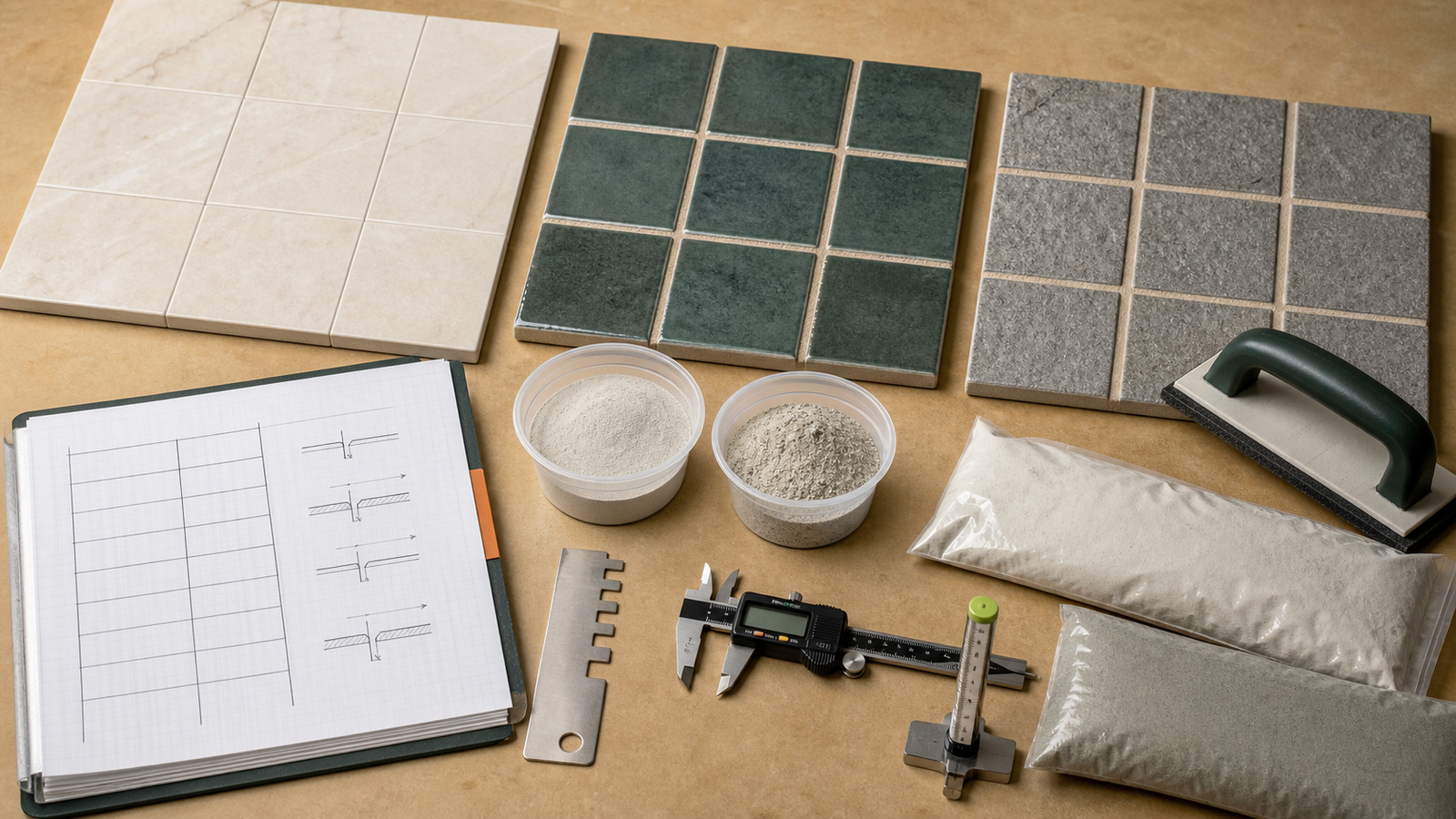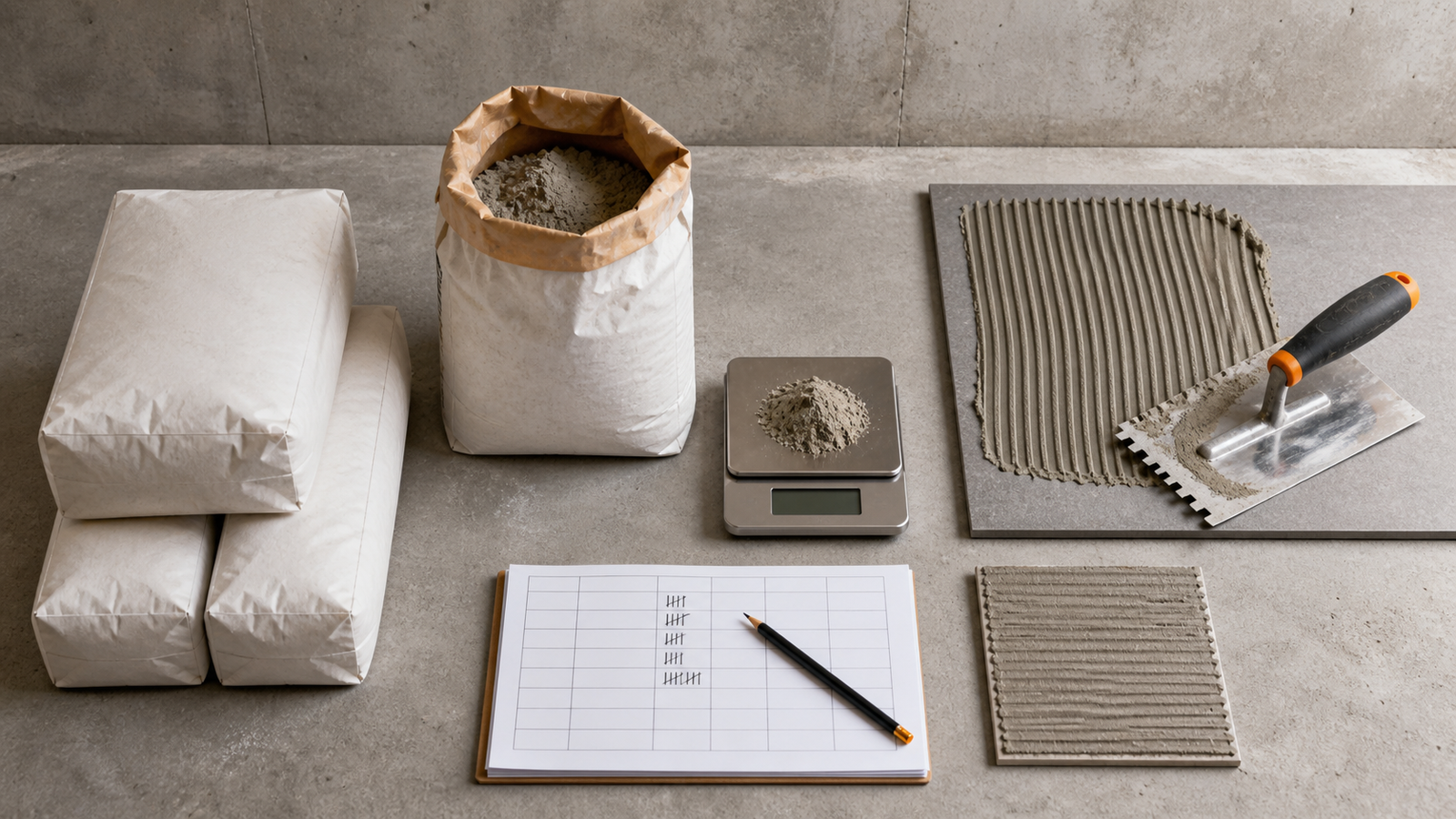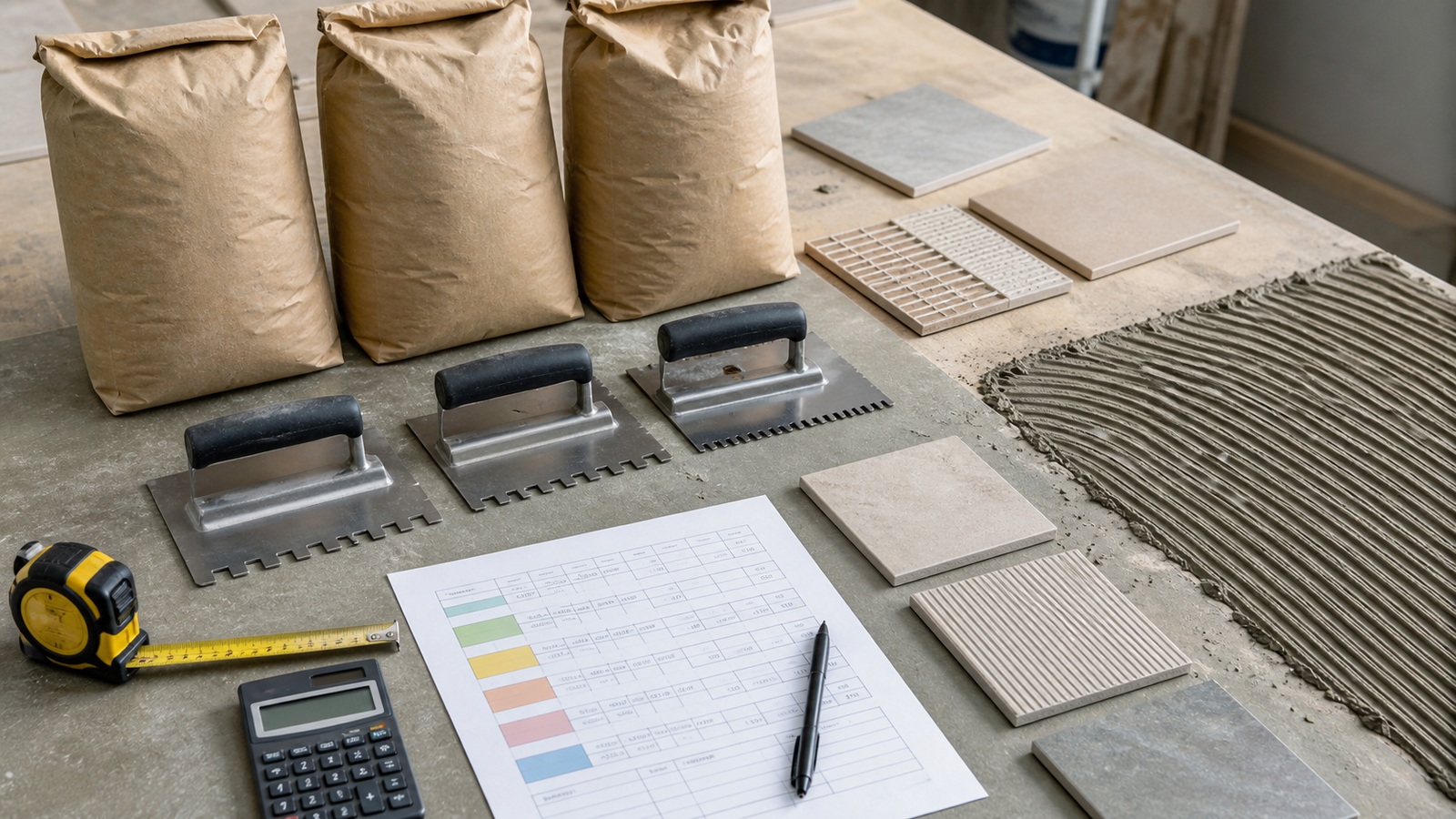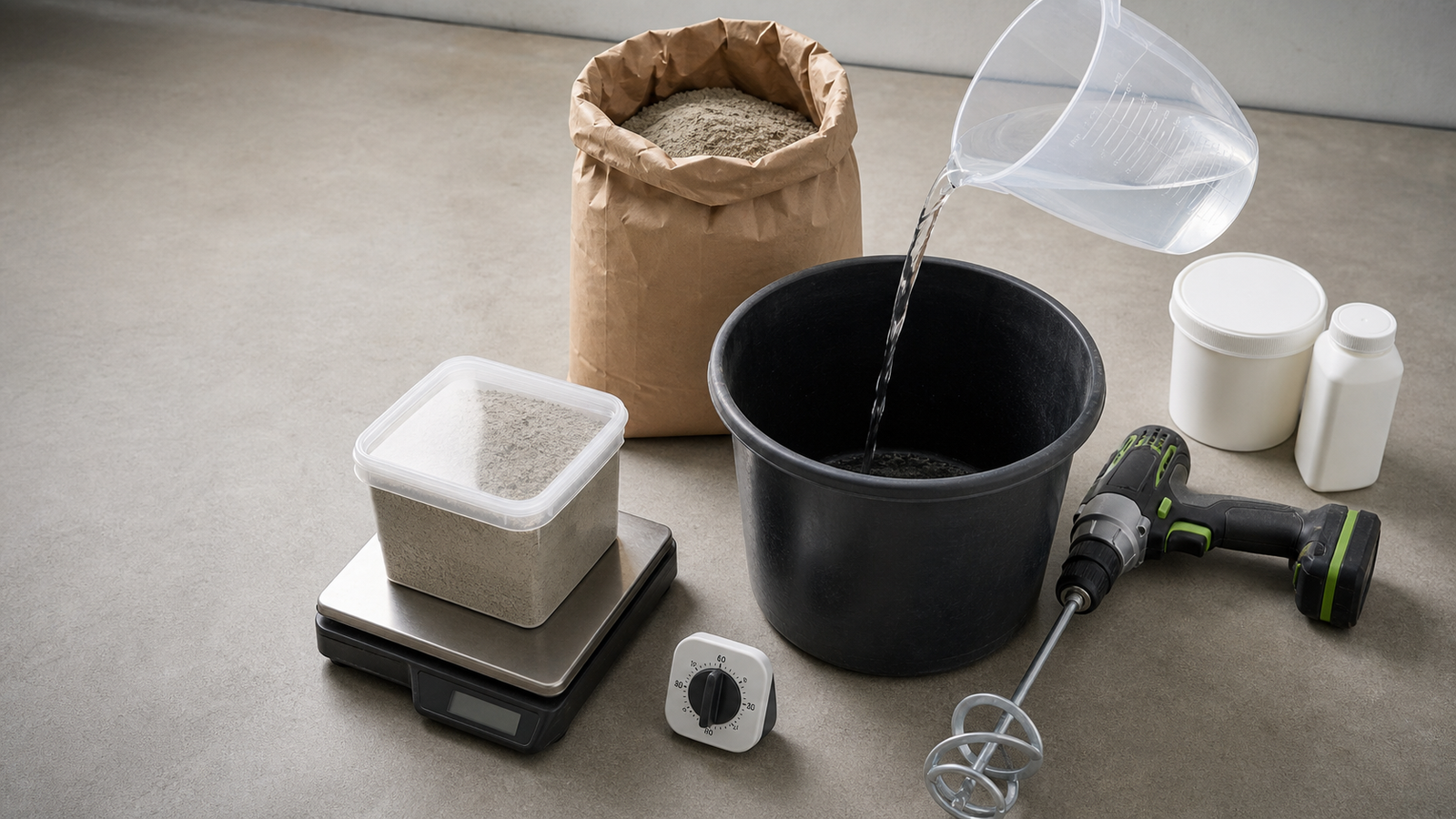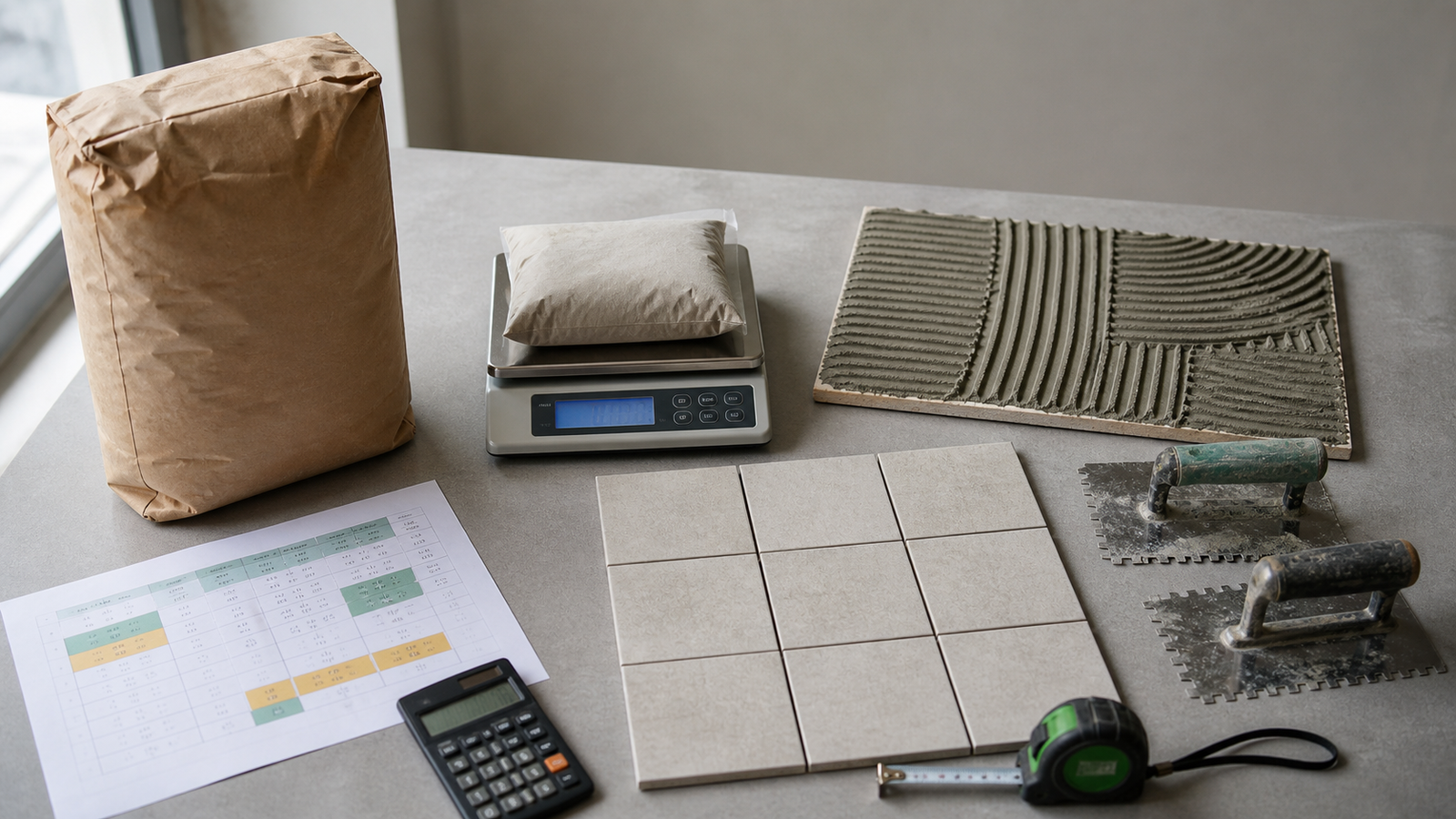
A tile adhesive consumption rate states how much of one named product is used for each unit of tiled area. Record whether that rate refers to dry powder, mixed material or ready-mixed paste before converting it to packages.
Calculate both ends of a published range. Substrate condition, tile, trowel and application method can make the low and high results several packages apart.
How do you calculate tile adhesive from kg/m²?
Multiply compatible planning area by the accepted kg/m² rate. Divide the resulting material mass by the package mass for the same product state, then round upward once when the supplier sells full packages.
Material mass = planning area × consumption rate
Exact packages = material mass ÷ package mass
Whole packages = ceiling(exact packages)
Enter these values in the Tile Adhesive Calculator under the consumption-rate basis. Keep different products, rates and application rows in separate calculations.
Which details belong with a kg/m² rate?
The rate needs a source record. A bare number such as 4 kg/m² cannot identify the product, material state or conditions that produced it.
| Field | Record | Quantity effect |
|---|---|---|
| Product and market | Manufacturer, exact name and sales market | Rates and package sizes stay product-specific |
| Material state | Dry powder, mixed material or ready-mixed paste | Controls which package mass can be divided into the result |
| Rate unit | kg/m², kg/m²/mm or m²/kg | Controls formula direction and any thickness input |
| Application row | Trowel, bed, tile and spreading method | Selects the matching rate or range |
| Substrate | Surface, profile, preparation and zone | Can change installed use |
| Package | Dry bag, pail, tub or full component set | Controls final purchasing increment |
| Revision | Data sheet or product page date and URL | Prevents mixing current and old product records |
Does kg/m² mean dry powder or mixed adhesive?
The product source controls the mass basis. Cementitious powder sheets often state powder consumption, while ready-mixed products state the mass supplied in a pail or tub. Some sheets describe mixed-material consumption.
Match the rate to the package being purchased. Package water belongs to the mixing instruction for a powder product; it does not increase the dry powder quantity ordered.
| Rate basis | Compatible package divisor | Keep separate |
|---|---|---|
| Dry powder kg/m² | Dry powder kg per bag | Added water and mixed mortar mass |
| Ready-mixed paste kg/m² | Paste kg per pail or tub | Powder-bag assumptions |
| Mixed material kg/m² | Verified mixed yield or package record from that product | Dry package mass unless the source supplies the conversion |
| Two-component set kg/m² | Full A+B set mass or approved split rule | Individual component rounding |
How do you calculate a consumption-rate range?
Multiply area by the lower and upper rates. The lower endpoint gives the smaller material estimate; the upper endpoint gives the larger estimate.
SikaCeram 105 lists a 3–6 kg/m² consumption range for one 25 kg cementitious product and ties that range to substrate, tile and gluing method. For a compatible 42 m² area:
- Low material mass: 42 × 3 = 126 kg.
- High material mass: 42 × 6 = 252 kg.
- Low exact bag ratio: 126 ÷ 25 = 5.04 bags, rounded to 6.
- High exact bag ratio: 252 ÷ 25 = 10.08 bags, rounded to 11.
A 6–11 bag span is too wide for a single unsupported purchasing figure. Confirm the matching application condition or retain the range.
How much can a published trowel row change the result?
SikaTile 300 lists about 3.5 kg/m² with a 6 × 6 mm notched trowel and about 5 kg/m² with a 10 × 10 mm notched trowel for its named 25 kg powder product. It also warns that surface irregularities can increase consumption.
| Published row | Rate | Material mass | 25 kg bags |
|---|---|---|---|
| 6 × 6 mm notched trowel | About 3.5 kg/m² | 210 kg | 8.4 exact, 9 whole |
| 10 × 10 mm notched trowel | About 5 kg/m² | 300 kg | 12 exact, 12 whole |
The table checks quantity sensitivity. It does not select a trowel or approve either row for the project.
Is trowel notch height the same as installed bed thickness?
Use the rate row as the manufacturer publishes it. A notch dimension identifies the trowel geometry, while the installed mortar layer also depends on trowel angle, ridge collapse, tile embedment, tile back and substrate.
A generic formula that multiplies notch height by a universal kg/m²/mm factor can count the full notch as a uniform finished layer. Use a per-mm rate only when the same product source and planned application support the thickness input.
How do you use a kg/m²/mm rate?
Multiply area by the product rate and accepted applied thickness. Keep the rate's material state attached to the result.
Material mass = area × kg/m²/mm × accepted thickness in mm
Sika Ready Mix Tile Adhesive is an acrylate dispersion product sold in 5 kg and 18 kg pails. Its product page lists about 1.65 kg/m²/mm. An arithmetic fixture using 18 m² and an accepted 2 mm input gives 18 × 1.65 × 2 = 59.4 kg. Dividing by an 18 kg pail gives 3.3 pails, rounded to 4.
The 2 mm input tests the calculation. The product data and project requirements must approve the applied thickness.
How do you convert m²/kg to kg/m²?
Take the reciprocal. A value of 0.6 m²/kg equals 1 ÷ 0.6 = 1.6667 kg/m². A value of 0.5 m²/kg equals 2 kg/m².
EVERBUILD 701 lists about 0.6 m²/kg with a 6 mm notched trowel and 0.5 m²/kg for a solid bed. For 25 m², those endpoints give 41.6667–50 kg. With its 14 kg tub, the exact ratios are 2.9762–3.5714 tubs, rounded to 3–4.
Keep the source wording with the reciprocal. The conversion changes the unit format, not the product conditions.
How does an allowance change a rate-based order?
Apply a documented project allowance to compatible area before multiplying by the rate. Keep it separate from whole-package surplus.
Nerolac Tile Adhesive Classic lists 4–4.5 kg/m² for its small-tile, 3 mm single-layer guide and sells a 20 kg package. For 35 m², the rate band gives 140–157.5 kg, or 7–7.875 exact bags. The endpoints round to 7–8 bags.
If a separate project decision adds 5%, planning area becomes 36.75 m². The same band gives 147–165.375 kg, or 7.35–8.26875 exact bags. The order range becomes 8–9 bags. This 5% input demonstrates the boundary and does not set a universal allowance.
Can a test area replace a broad planning range?
A test area can produce a project-specific rate when the product manufacturer accepts that workflow and the trial matches the planned substrate, tile and application. SikaCeram 428 tells users to apply the product to a test area to calculate consumption for the specific conditions.
Measure the completed trial area and the material mass installed under the matching product basis.
Observed consumption = installed material mass ÷ completed compatible area
- Record issued material, unused return, discarded material and installed mass separately.
- Use the same trowel, tile, substrate preparation and spreading method planned for production.
- Keep a two-component product in its approved mixing proportion. SikaCeram 428 instructs users to mix full units.
- Do not turn unused mixed material or cleanup loss into installed consumption.
A small trial can miss later surface variation. Retain the tested area, conditions and sample size with the observed rate.
When should several areas stay separate?
Combine unrounded material mass only when one product, material state, rate row, package and allowance basis apply. Round that compatible total once.
- Separate walls and floors when their published rows differ.
- Separate powder adhesive from ready-mixed paste.
- Separate single-spread and double-spread areas when the rate changes.
- Separate substrate repair and levelling materials from tile adhesive.
- Separate full two-component sets from ordinary bag quantities.
Which consumption-rate mistakes change the order?
- Using a generic kg/m² rate after selecting a named product.
- Entering m²/kg as kg/m².
- Multiplying trowel notch height as though it were finished bed thickness.
- Adding mixing water to dry powder purchasing mass.
- Using one endpoint of a wide range without recording the choice.
- Combining powder, paste and mixed-material rates.
- Adding an allowance through both area and an inflated rate.
- Rounding each compatible room before combining material mass.
- Counting unused or discarded trial material as installed consumption.
- Splitting a full component set when the product requires full-unit mixing.
What should the final consumption worksheet contain?
- Area source, exclusions, compatible group and measurement date.
- Product, market, material state and package size.
- Rate or range, units, trowel/application row and source revision.
- Substrate, tile and spreading method behind the chosen value.
- Allowance reason and percentage when used.
- Low and high material mass, exact package ratios and whole packages.
- Separate package surplus and observed site-trial record.
Safety and installation limits
Follow the current product data sheet, safety data and package instructions for product selection, surface preparation, mixing, application, working time and cure. Quantity arithmetic does not approve an adhesive, trowel, bed or tile system.
Cementitious powder can contain Portland cement and crystalline silica. OSHA provides US construction guidance for respirable crystalline silica; the product safety data and rules for the work location still control the task.
Use Tile Adhesive Coverage per Bag when the product gives area per package instead of kg/m². Return to the tile planning tools and guides, review How to Measure for Tile, or check the calculation methodology.
Sources and source scope
- SikaTile 300 Standard Tile Adhesive: named 25 kg powder package, selected trowel-rate rows and surface-irregularity limitation.
- SikaCeram 105: one 25 kg product's 3–6 kg/m² range and listed rate factors.
- Nerolac Tile Adhesive Classic TDS: named dry-powder consumption bands and package record.
- Sika Ready Mix Tile Adhesive: ready-mixed product state, pail sizes and kg/m²/mm rate.
- EVERBUILD 701 Non Slip Tile Adhesive: ready-mixed tub sizes and m²/kg coverage formats.
- SikaCeram 428 Super Bond T: test-area instruction, theoretical-rate limits and full-unit mixing condition.
- OSHA silica construction information: US workplace hazard context.
Source scope: Manufacturer values apply only to the named products, material states, packages, markets and stated conditions. OSHA supports the named US workplace context. The project documents, current product data and responsible project decisions govern the application.
Review responsibility: Saleem Sial owns the research and editorial record. Source verification, independent rate fixtures, internal-link review, build validation, link crawl, schema review and rendered QA form the internal publication gate. Waseem Sial, External Reviewer and Engineer, remains listed for ongoing external review; no completed external-review date is claimed.