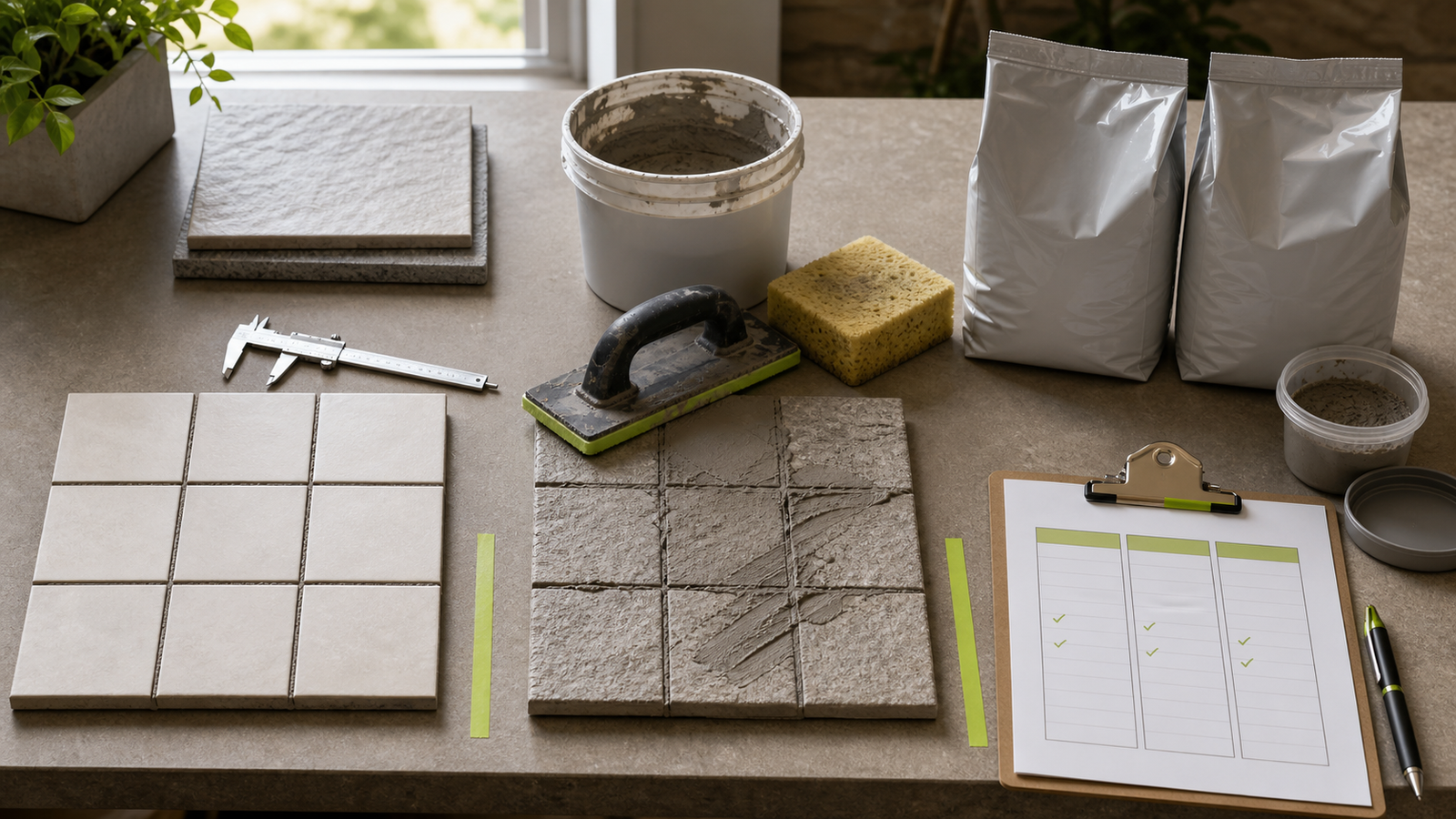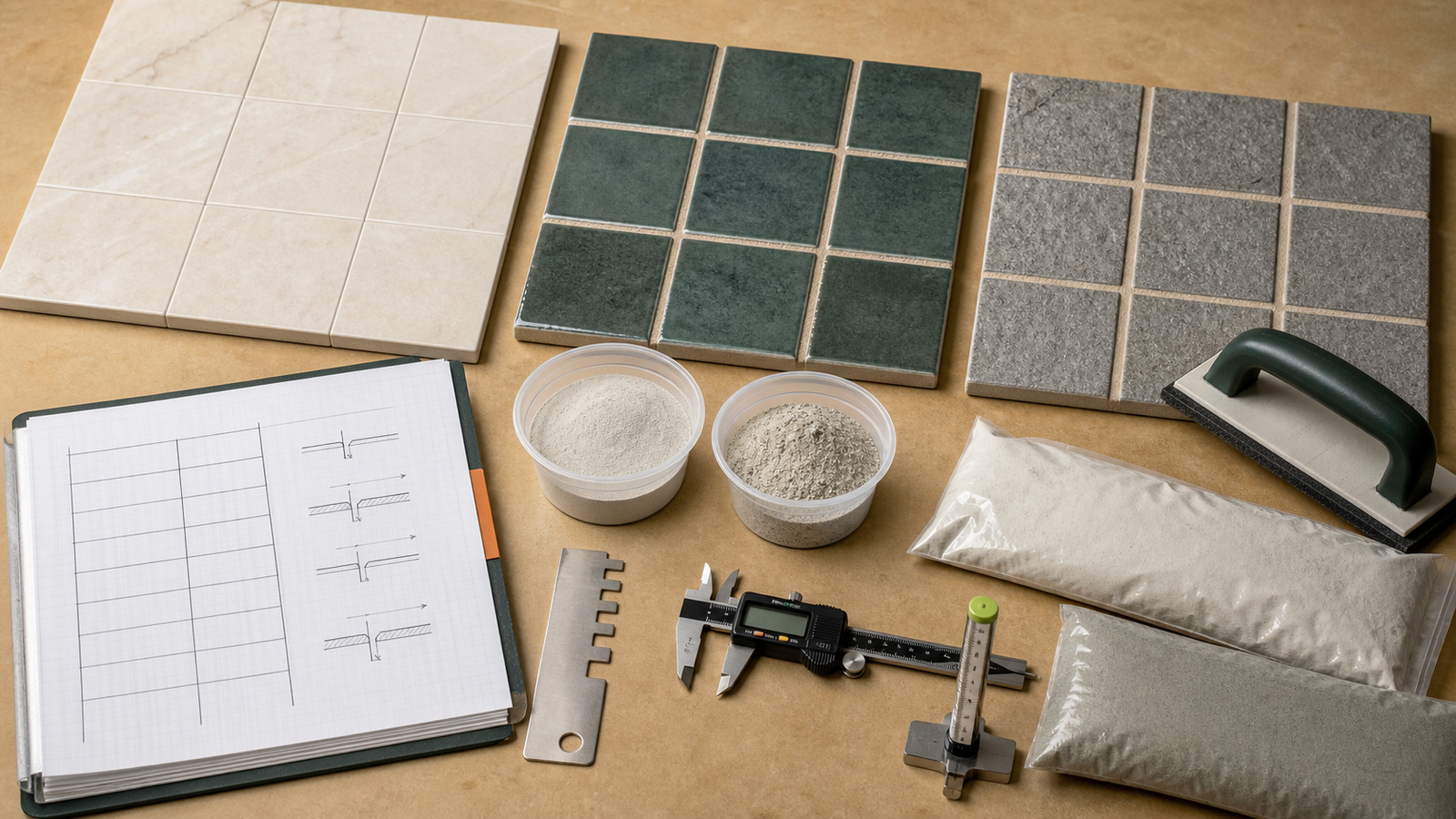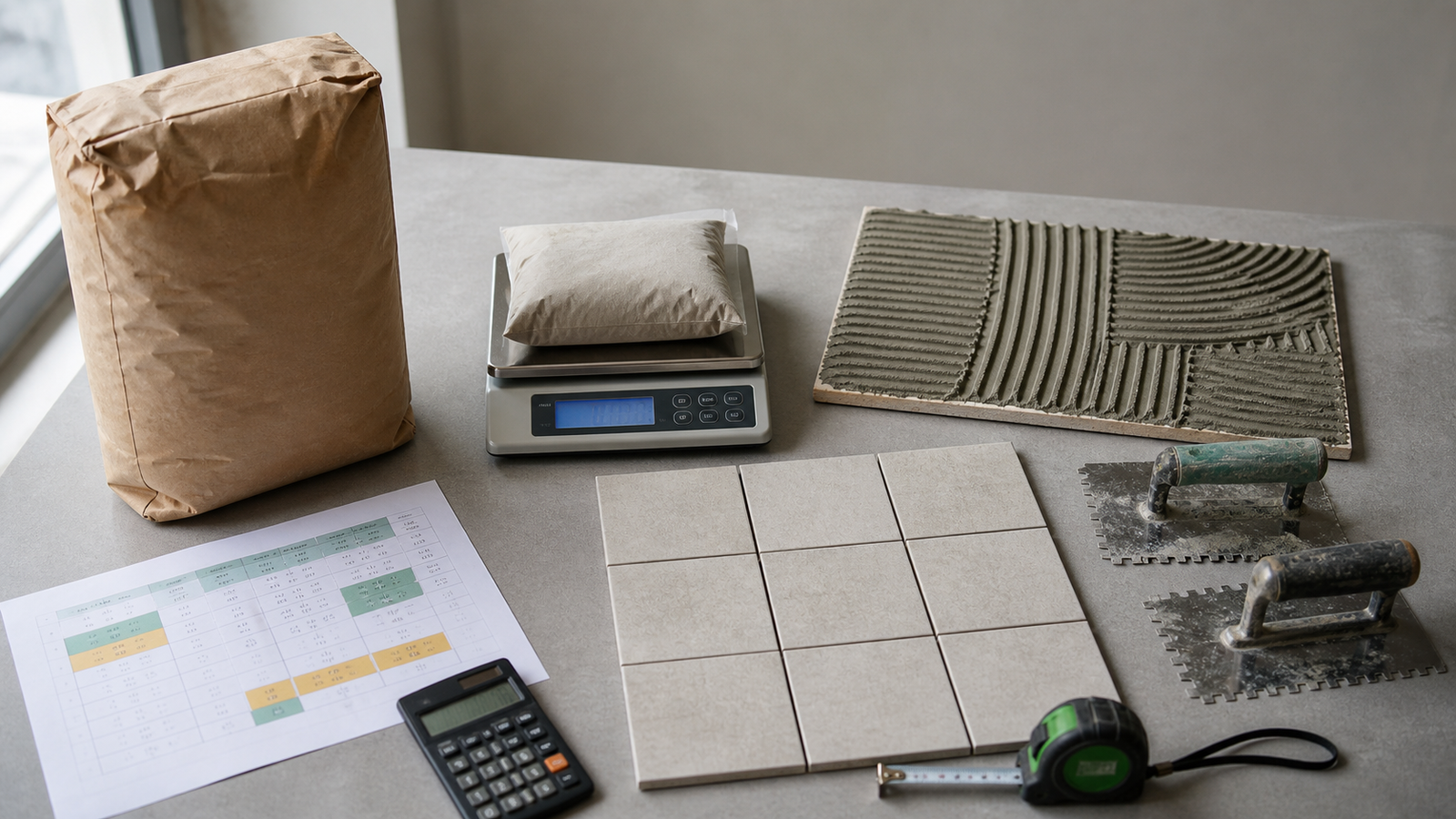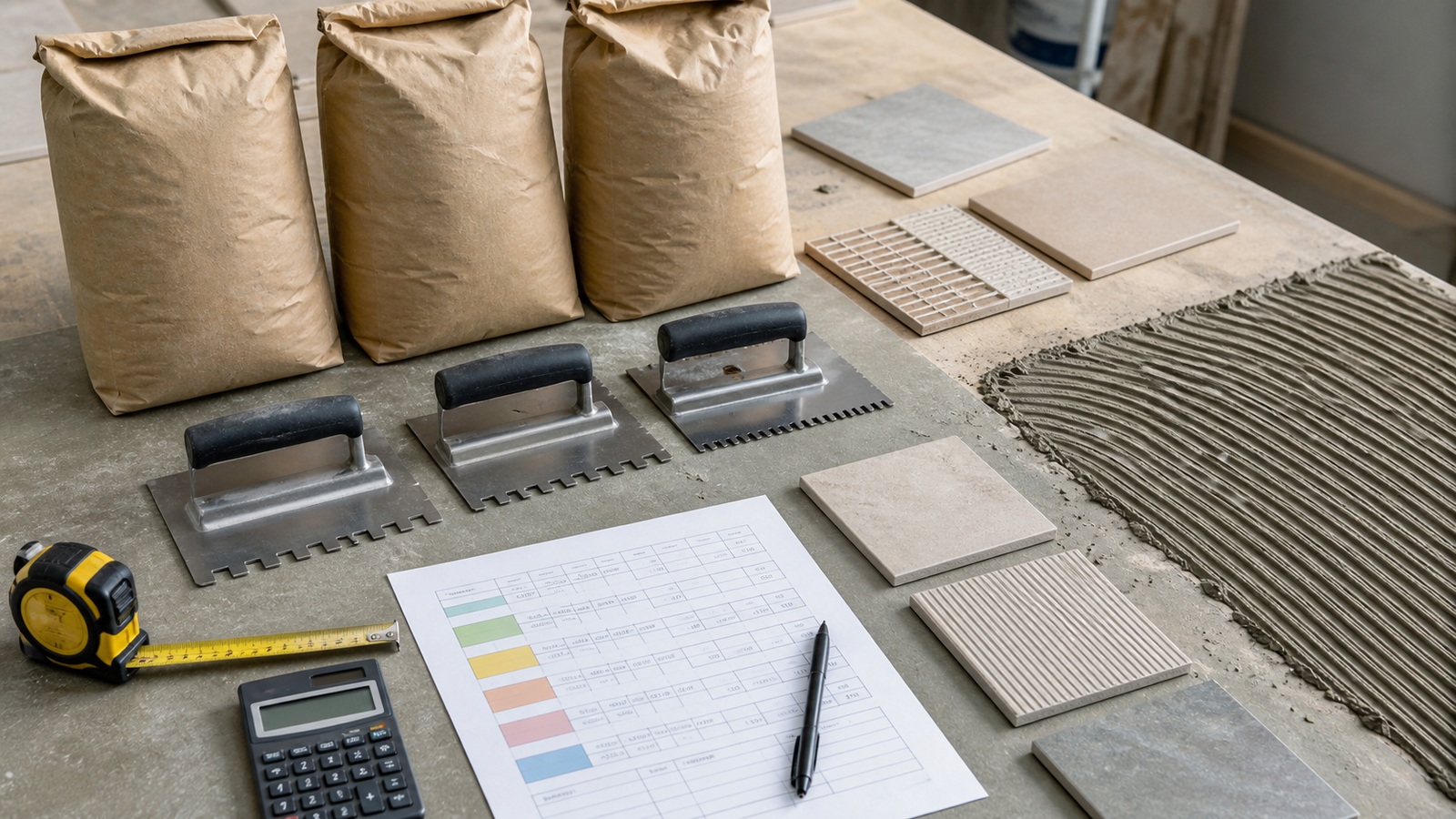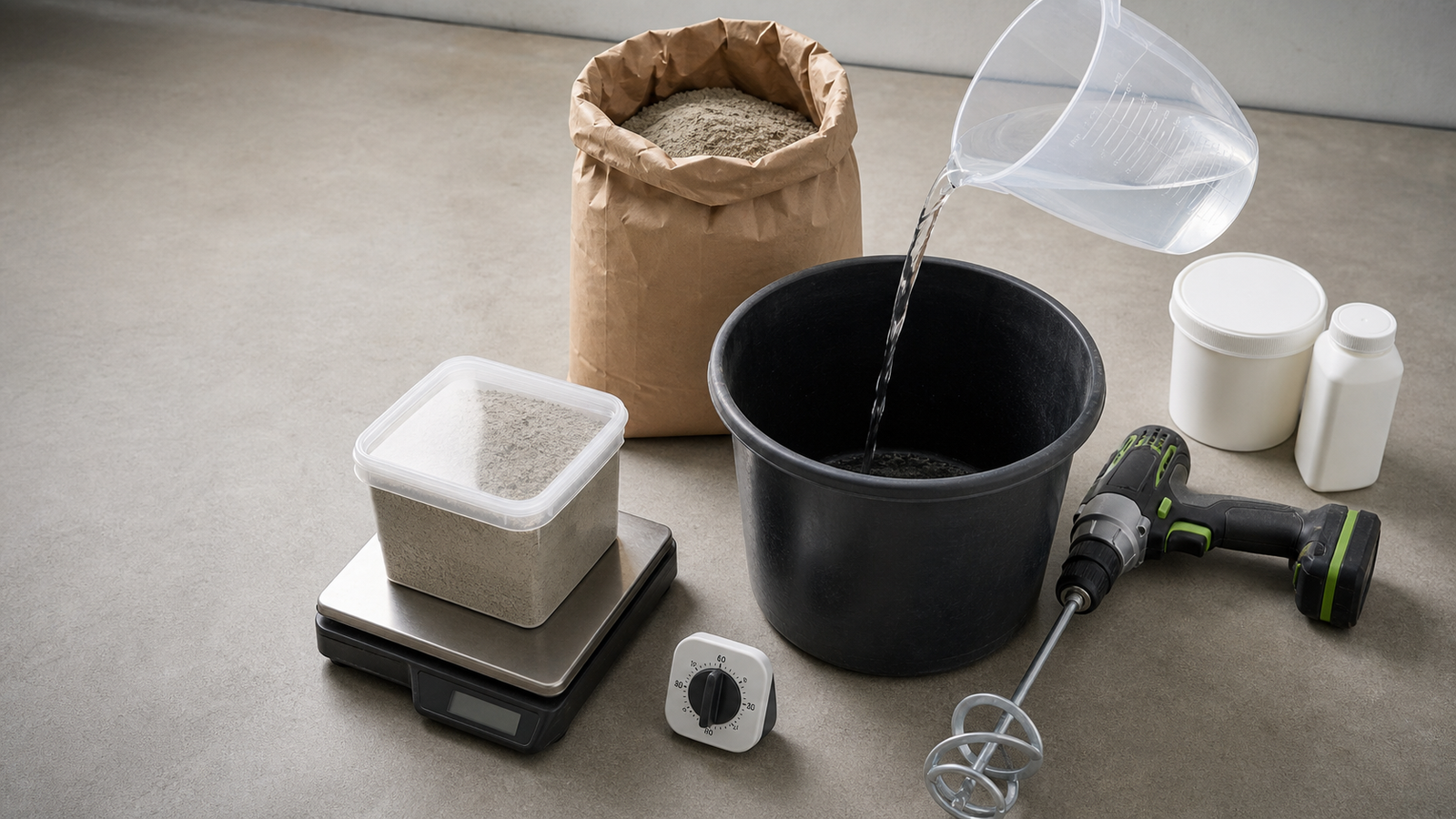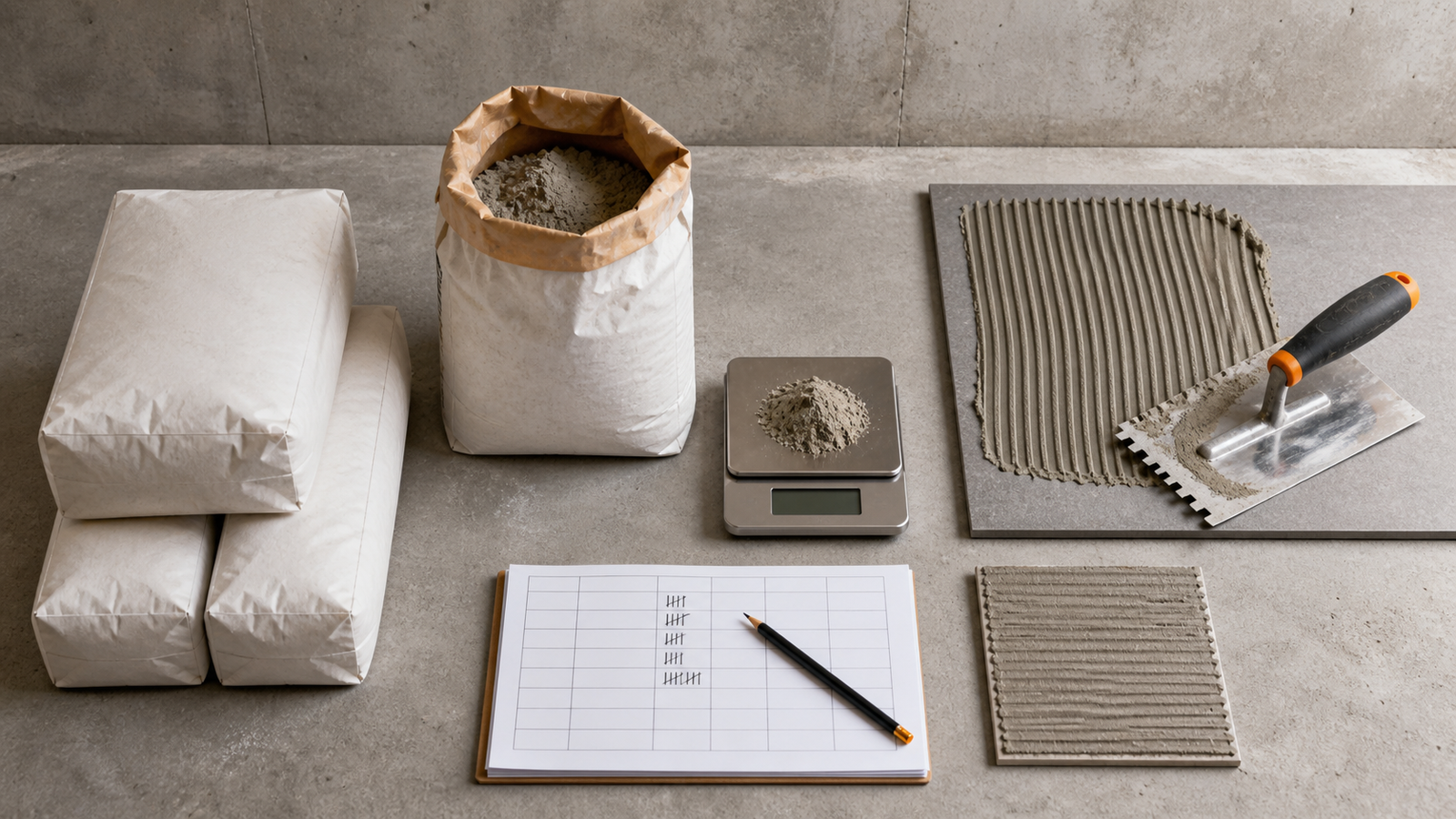
Extra tile adhesive can cover several different things: a separate back-buttering step, measured site variation, material lost during handling or a full package left after rounding. Put each reason on its own line before ordering.
A fixed percentage can hide overlapping assumptions. Start with the selected product's current coverage or consumption record, then add only the adjustment that the record does not already include.
How much extra tile adhesive should you allow?
There is no universal percentage or extra-bag rule. Check what the product's base rate includes, identify the project condition that changes material use, measure or document that adjustment, and round the final compatible quantity to the supplier's package increment.
Use the Tile Adhesive Calculator for the base area, accepted rate and whole-package result. Keep the reason for any entered allowance with the calculation.
| Line | What it represents | Evidence |
|---|---|---|
| Base quantity | Compatible area under the accepted product rate or coverage row | Current product data and project condition |
| Back-buttering addition | Extra material for a separate tile-back application, when excluded from the base | Named product guidance, project requirement or representative trial |
| Site or handling allowance | Documented expected variation or loss | Test area, product note or accepted project record |
| Package surplus | Material above planning demand after upward rounding | Package size and selling increment |
| Retained stock | Usable unopened material intentionally kept after installation | Storage, shelf-life and maintenance decision |
What belongs in the base quantity?
The base quantity uses one named product, material state, package and application record. It includes only areas that share the same substrate condition, tile, trowel or bed basis and spreading method.
CUSTOM's TDS-101 states that its mortar coverage chart does not include back-troweling tiles. The sheet tells estimators to consider tile-underside pattern and depth when estimating the added use. That exclusion makes a separate back-troweling line appropriate for that specific chart.
Another product record may already describe double spreading or buttering. SikaCeram-255 separates its single-layer guide from the statement that consumption depends on single or double spreading. Read the scope before adding anything.
Is back-buttering a fixed percentage of the base adhesive?
No. The additional amount depends on the tile back, the applied coat, the product state and the method used to obtain the required transfer. A tile-size preset alone cannot establish the mass.
SikaCeram-707 states that consumption depends on the substrate profile, tile size and reverse profile, and whether the placing technique is simple or buttering-floating. Its published guide is for simple placing, and it directs users to a test area for specific consumption.
| Source wording | Quantity treatment |
|---|---|
| Coverage excludes back-troweling | Add a separately supported tile-back quantity |
| Rate is for single spreading only | Obtain a double-spreading value or test the planned method |
| Rate already covers the planned buttering method | Do not add a second back-buttering allowance |
| Scope is unclear | Ask the manufacturer or retain a documented range |
How can a test area set the additional quantity?
Use a representative test area when the manufacturer accepts that method and the trial matches the planned product, substrate, tile back, trowel, spreading method and crew workflow. Record the material state before weighing.
- Measure the completed compatible trial area.
- Record dry powder or supplied ready-mix issued to the trial.
- Record usable material returned in the same state.
- Record discarded batches separately from installed material.
- Calculate observed installed use per unit area.
- Compare the result with the base source and identify any added step.
- State the trial area and conditions beside the accepted adjustment.
SikaCeram-707 and SikaCeram-255 both direct users to a test area for the specific substrate and application. A small trial does not capture every later surface or production change, so preserve its scope.
Worked example: record back-buttering as a separate line
A 40 m² compatible field has an accepted base rate of 4 kg/m². Only 24 m² uses the separate back-buttering method. A representative trial has supplied a project-specific additional rate of 0.6 kg/m² in the same dry-powder-equivalent basis. The product is sold in 20 kg bags.
- Base material: 40 × 4 = 160 kg.
- Back-buttering addition: 24 × 0.6 = 14.4 kg.
- Planning material: 160 + 14.4 = 174.4 kg.
- Exact bag ratio: 174.4 ÷ 20 = 8.72 bags.
- Whole-bag order: 9 bags.
- Purchased dry powder: 9 × 20 = 180 kg.
- Package surplus: 180 − 174.4 = 5.6 kg.
The 0.6 kg/m² value is a calculation fixture, not a universal back-buttering rate. The 14.4 kg addition and 5.6 kg package surplus have different causes.
How do you avoid counting the same condition twice?
Give every adjustment one reason code. If 2 entries respond to the same tile back, trowel, surface or handling condition, check whether one already contains the other.
| Combination | Check |
|---|---|
| Lower coverage value plus back-buttering percentage | Was lower coverage selected because of the same back-buttering step? |
| Higher kg/m² rate plus uneven-surface allowance | Does the higher rate already reflect that surface profile? |
| Allowance added to area plus allowance added to mass | Are both entries for one handling condition? |
| Separate room rounding plus combined order rounding | Can compatible unrounded material be combined before one final rounding? |
| Package surplus plus spare bag | Is the retained unit an intentional maintenance decision or simply the rounded remainder? |
Keep a short note beside each accepted entry: condition, source, affected area, rate or percentage, approver and date. An unexplained “waste 10%” line cannot show whether overlap exists.
How can a small allowance change the bag count?
Whole-package thresholds can make a modest planning adjustment add a full bag. Keep the exact material mass visible so the difference is not mislabeled as waste.
A 48 m² field at an accepted 4.5 kg/m² needs 216 kg. With 20 kg bags, 10.8 exact bags round to 11, purchasing 220 kg and leaving 4 kg above the base requirement.
If a separate project record applies a 5% area allowance, planning area becomes 50.4 m² and material becomes 226.8 kg. The exact ratio is 11.34 bags, so the order becomes 12 bags or 240 kg. Package surplus is 13.2 kg above the adjusted requirement.
The 5% input demonstrates the package boundary. It does not recommend 5% for another project.
Should substrate variation be covered by extra adhesive?
Do not use a quantity allowance to approve adhesive as a levelling material. Separate permissible variation within the product's application from substrate repair, patching or levelling that belongs to another material system.
SikaCeram-707 states that its theoretical figures exclude extra material from surface porosity, profile, level variation and waste. That warning signals uncertainty; it does not authorize unlimited thickness or one universal addition.
- Map high and low areas before the takeoff.
- Check the adhesive's permitted thickness and preparation instructions.
- Measure repair or levelling work separately when required.
- Use a test area only within the product and project scope.
- Split zones when their accepted rates differ.
Can one allowance cover every room?
Only combine compatible unrounded material. Start another calculation group when product, material state, package, substrate, tile back, trowel, spreading method or allowance basis changes.
A wall using ready-mixed paste cannot be merged with a floor using dry powder by adding kilograms alone. A shower with a different approved method should also remain separate even if the same package appears on both worksheets.
What is the difference between allowance and package surplus?
Allowance is an adjustment made before purchasing. Package surplus appears after the adjusted requirement is rounded to the seller's increment.
Planning material = base material + documented additions
Exact packages = planning material ÷ package mass
Whole packages = ceiling(exact packages)
Package surplus = whole packages × package mass − planning material
An unopened surplus bag may be returnable or retainable. Open dry material or mixed mortar has separate storage, pot-life, contamination and disposal limits. Purchased surplus does not prove future usability.
Can a partial bag or component set be mixed?
Follow the exact product instructions. Do not assume that a whole purchased package can be divided safely or that each component can be rounded separately.
SikaCeram-428 Super Bond T is a two-component product whose data instructs users to mix full units. That condition affects batching and work sequencing for that product. Other products can have different permitted ratios and partial-batch instructions.
How should adhesive use be reconciled after installation?
Use one material state throughout the ledger. For a powder product, dry-powder equivalent is usually the cleanest purchasing basis. Do not subtract wet mixed-mortar mass directly from dry powder unless a documented conversion supports it.
A checked fixture starts with 240 kg of dry powder issued. The site returns 20 kg unopened and 4 kg usable dry material. Batching records identify 8 kg of dry-powder equivalent in discarded mixes. Installed equivalent is 240 − 20 − 4 − 8 = 208 kg.
If the completed compatible area is 48 m², observed use is 208 ÷ 48 = 4.3333 kg/m². Keep that result with the product, tile, substrate, method, crew and date. It is project evidence, not a universal rate.
Which extra-bag mistakes change the order?
- Adding one bag by habit without checking the package threshold.
- Using a universal back-buttering percentage.
- Applying an adjustment when the product rate already includes the method.
- Using one allowance for different products or application rows.
- Counting levelling material as tile adhesive allowance.
- Adding the same loss to both area and material mass.
- Rounding compatible rooms separately and again after combining them.
- Calling package surplus installed waste.
- Subtracting wet returned mix from a dry-powder order.
- Assuming a partial component set can be mixed.
- Treating an opened remainder as usable spare stock without checking storage instructions.
What should the final allowance record contain?
- Compatible net area and measurement revision.
- Product, market, material state, package and data-sheet revision.
- Base coverage or consumption row and its application scope.
- Back-buttering inclusion or exclusion decision.
- Each additional line, affected area, rate, reason, source and approval.
- Exact package ratio, whole packages and package surplus.
- Unopened return, usable dry return, discarded batches and installed equivalent.
- Separate retained stock and storage decision.
Safety and installation limits
Follow the current product data, safety data, package instructions, project documents and local requirements for product selection, preparation, mixing, application, working time and cure. Quantity arithmetic does not select a mortar, approve back-buttering, set required contact or replace a site inspection.
Cementitious powder can contain Portland cement and crystalline silica. OSHA provides United States construction information for respirable crystalline silica. Product safety data and the rules for the work location still control the task.
Use Tile Adhesive Coverage per Bag when the source gives m² or ft² per package. Use Tile Adhesive Consumption Rate when it gives kg/m². Return to the tile planning tools and guides or check the calculation methodology.
Sources and source scope
- CUSTOM TDS-101: coverage-chart scope, back-troweling exclusion, tile-underside factors and jobsite variation.
- SikaCeram-707 Product Data Sheet: substrate, tile-back and placing-method consumption factors, theoretical-rate limits and test-area instruction.
- SikaCeram-255 Large Tile Product Data Sheet: named dry-powder single-layer rates, single-versus-double spreading boundary and test-area instruction.
- SikaCeram-428 Super Bond T: one two-component product's consumption variables, test-area workflow and full-unit mixing condition.
- OSHA silica construction information: United States workplace hazard context.
Source scope: Manufacturer statements apply only to the named products, packages, markets and conditions. OSHA supports the named United States workplace context. The arithmetic fixtures demonstrate the ledger and do not set product rates or allowance percentages.
Review responsibility: Saleem Sial owns the research and editorial record. Source verification, independent fixtures, internal-link review, build validation, link crawl, schema review and rendered QA form the internal publication gate. Waseem Sial, External Reviewer and Engineer, remains listed for ongoing external review; no completed external-review date is claimed.