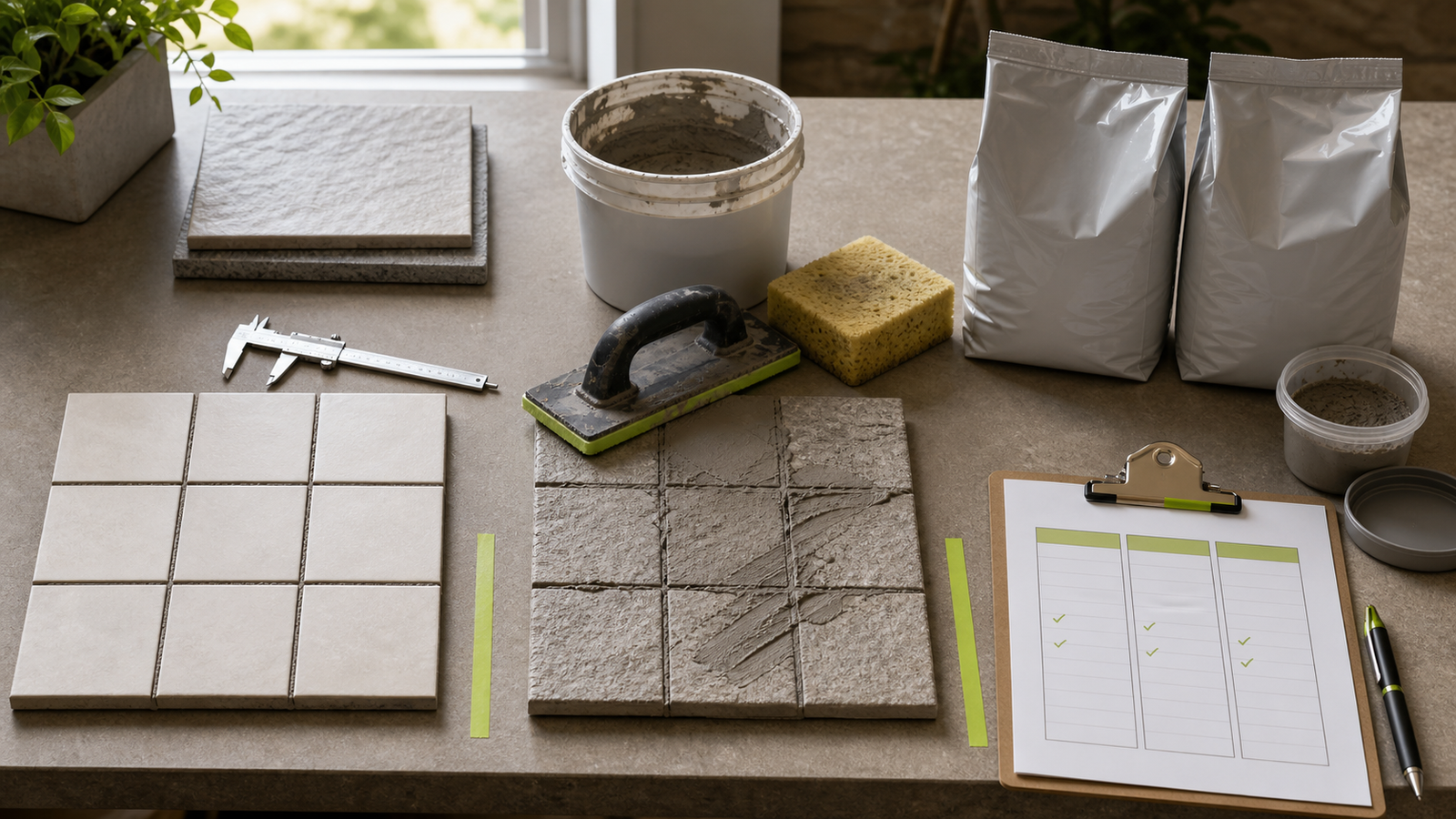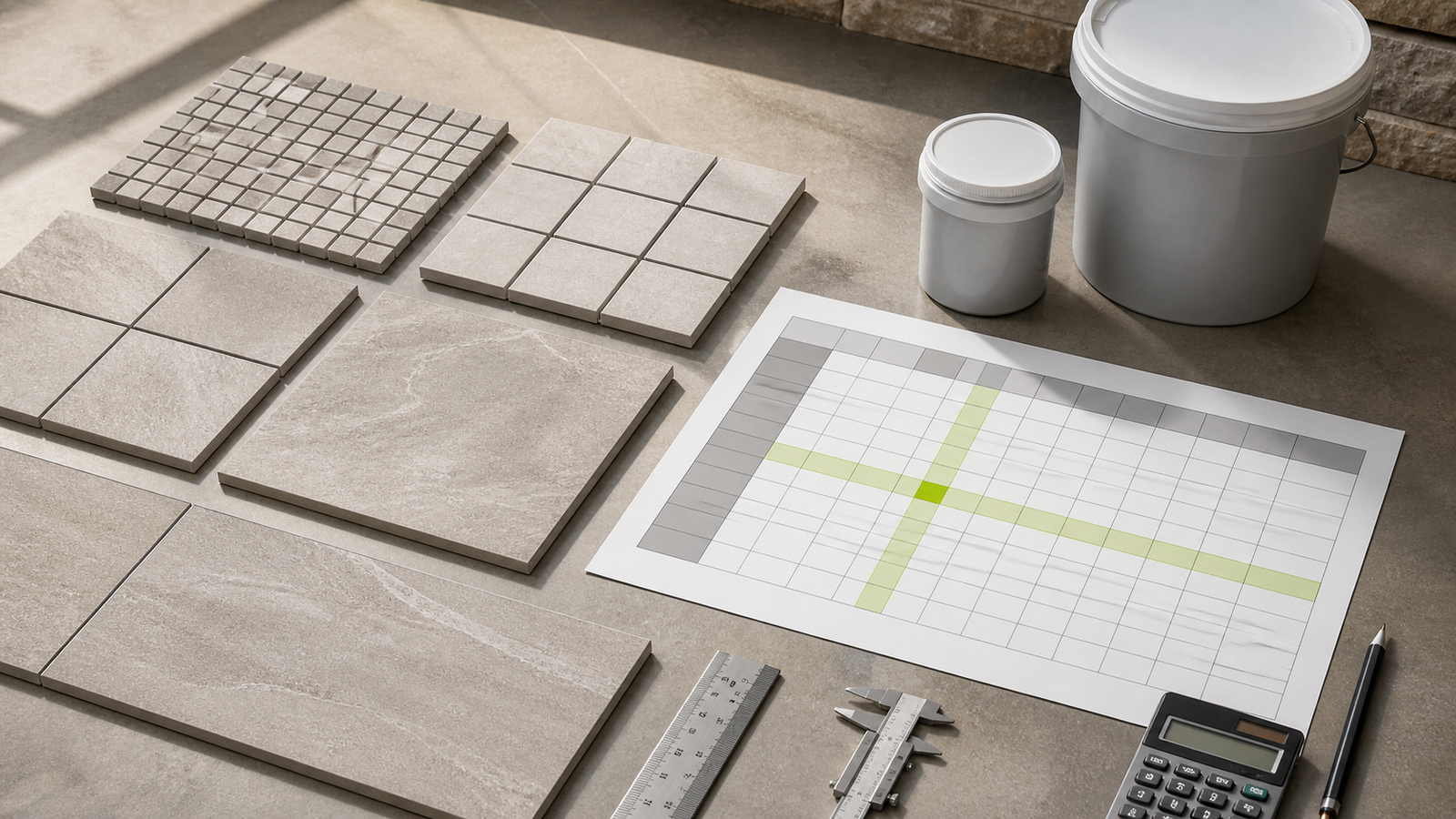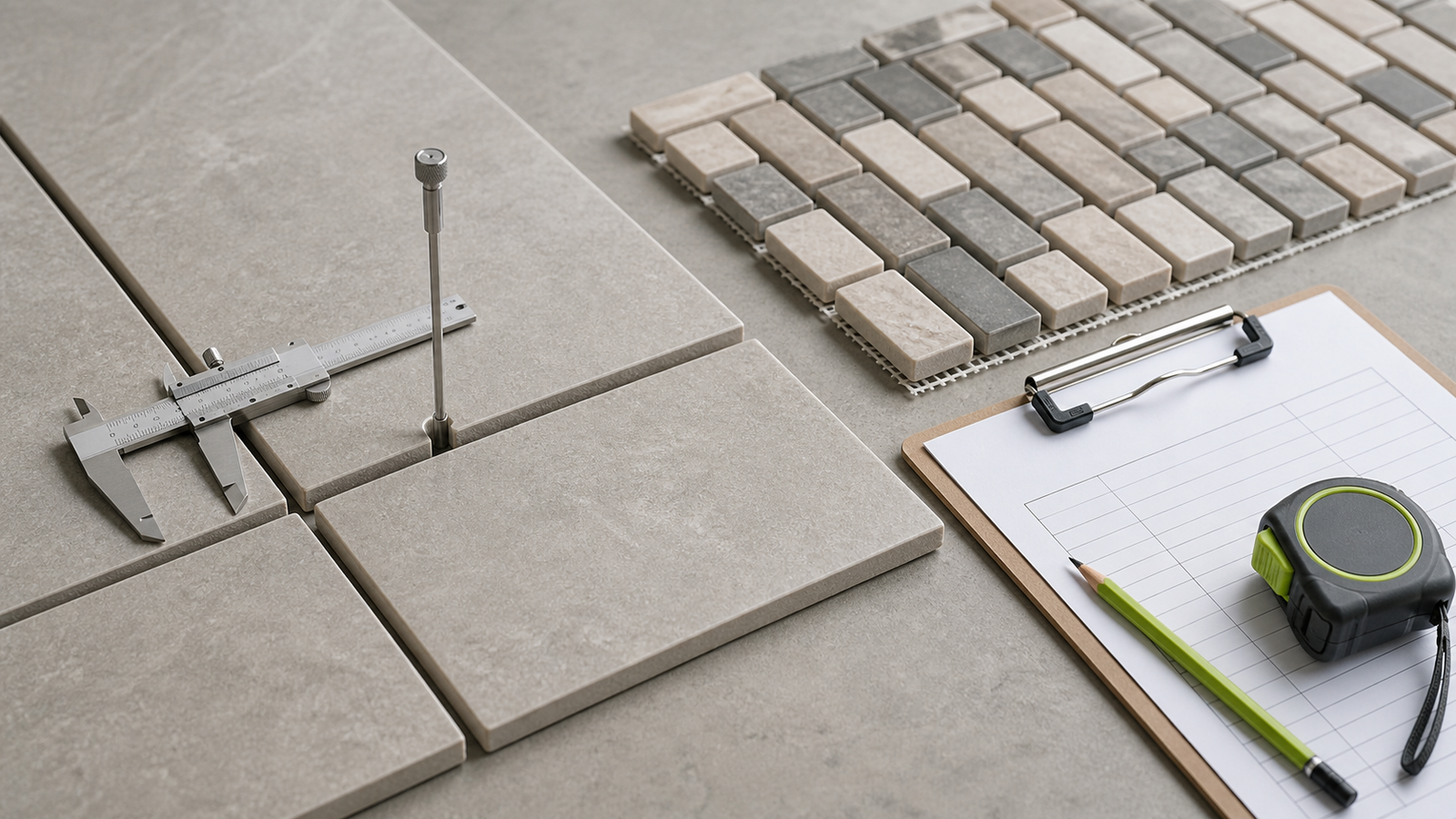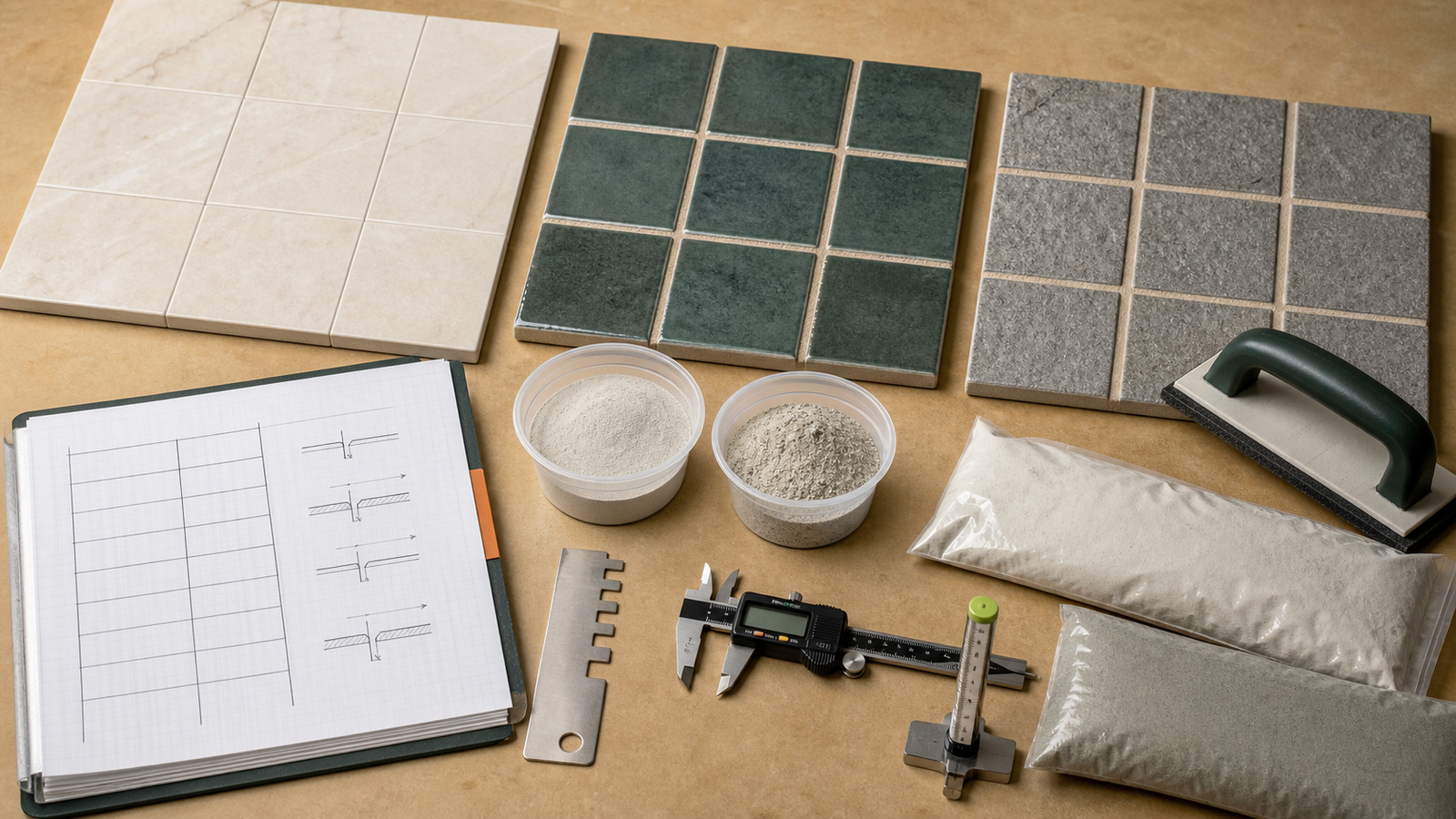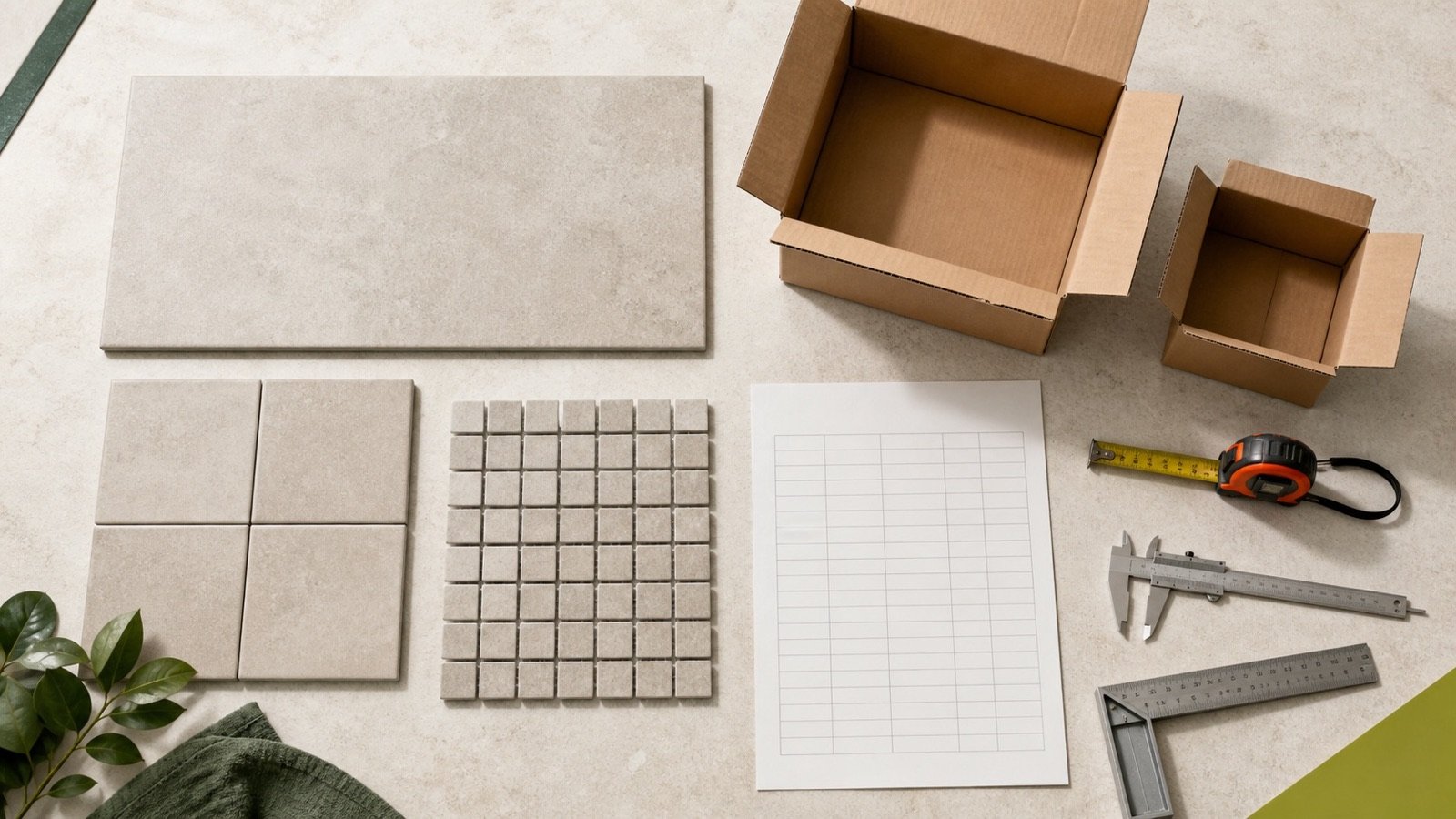
A tile name such as 4 × 4, 12 × 24 or 300 × 600 mm identifies a format. It does not always state the exact physical face or the area that one carton will cover after the product's intended joint and pattern are considered.
Record the current selected product before calculating quantities. Keep its named size, actual dimensions, installed module, pieces per box and stated carton coverage in separate fields.
Which tile size and coverage numbers should you use?
Use the current manufacturer or seller carton coverage to calculate full boxes for the selected SKU. Use actual face dimensions to check individual pieces. Use the named or nominal size to identify the format, and use installed-module or sheet coverage only under its stated joint and pattern basis.
Two products sold under the same named size can have different physical dimensions, pieces per carton or stated coverage. Save the technical sheet or label revision with the quantity record.
| Field | What it tells you | Use it for |
|---|---|---|
| Named or nominal size | The product's format name, often rounded | Identification and comparison |
| Actual or approximate size | The published or measured physical tile face | Piece-area and fit checks |
| Installed module | Tile plus the stated joint or pattern spacing | Course and installed-coverage checks |
| Sheet coverage | The area of one assembled mosaic or pattern sheet | Sheet quantities under the stated pattern |
| Pieces per carton | The current package count | Piece reconciliation and carton conversion |
| Coverage per carton | The supplier's area basis for one current carton | Full-carton ordering |
Why can nominal and actual tile sizes differ?
A nominal size is a product name or module reference. The physical face may be smaller, larger or expressed as an approximate dimension. The intended joint can form part of the installed module.
Fireclay Tile's 2026 Price Guide lists nominal and approximate dimensions separately. It also labels pieces per square foot as calculated with a stated grout spacing. For example, some tables use 3/16 in spacing while another product section uses 1/16 in. The coverage basis belongs to the published product table, not to every tile with the same name.
Do not silently turn a named 12 × 24 tile into exactly 2 ft² per piece. Check the actual dimensions and carton record first.
What should you copy from a tile carton or technical sheet?
Create one product line for each selected SKU. A photograph of the carton label helps, but the working record should put the controlling values into searchable fields.
- Record manufacturer, collection, SKU, color, finish and named size.
- Record actual dimensions and thickness in the published units.
- Record pieces per carton, sheets per carton or both.
- Record square feet or square metres per carton exactly as stated.
- Record the joint, sheet or pattern basis when the source provides one.
- Record the source URL or label photograph, access date and document revision.
- Confirm the seller's current full-carton or loose-piece selling rule.
Match all fields before combining information from a product page, technical PDF and physical carton. A shared collection name does not prove that package counts stayed unchanged.
How do you check rectangular tile face area?
Multiply the actual face length by the actual face width. Convert both dimensions before multiplying, then multiply the face area by the number of pieces.
Tile face area = actual length × actual width
Carton face area = tile face area × pieces per carton
This result is a cross-check. It does not automatically replace the stated carton coverage because that coverage may follow an installed module, joint, sheet or pattern basis.
Worked example: 300 × 600 mm actual tile faces
Assume a rectangular tile has verified actual face dimensions of 300 mm × 600 mm and a carton contains 8 pieces. This is an arithmetic fixture, not a claim about a named product.
- Convert 300 mm to 0.3 m and 600 mm to 0.6 m.
- One face: 0.3 × 0.6 = 0.18 m².
- Eight faces: 0.18 × 8 = 1.44 m².
- Using the NIST area relationship, 1.44 m² is about 15.50 ft².
If the current carton states a different coverage, stop and identify the reason. Check whether the dimensions are nominal, whether the carton count changed, whether a joint or pattern module controls, and whether the label belongs to the same SKU.
Why might the carton coverage exceed the tile-face area?
The stated coverage can represent an installed module rather than the sum of bare tile faces. Joints occupy part of the finished field. Mosaic sheets and repeating patterns can also have open spaces that belong to the installed coverage.
Zia Tile's ceramic specification provides a useful record. Its 4 × 4 product lists an actual face of 9.7 cm × 9.7 cm, 110 pieces per box, 12.22 ft² per box and a suggested 3/16 in grout line.
| Check | Calculation | Result |
|---|---|---|
| Published carton coverage | Current specification value | 12.22 ft² |
| Nominal-size arithmetic | 4 × 4 × 110 ÷ 144 | 12.2222 ft² |
| Actual-face area | 0.097 × 0.097 × 110 | 1.03499 m² |
| Actual-face conversion | 1.03499 × 10.76391 | 11.1404 ft² |
| Difference from stated coverage | 12.22 − 11.1404 | About 1.08 ft² |
The difference is about 8.8% of the stated carton coverage. It does not prove that either field is wrong. It proves that nominal module, physical face and carton coverage answer different questions. Use the stated 12.22 ft² for a current matching-carton order, and retain 9.7 cm × 9.7 cm for physical face and fit checks.
How should mosaic sheets and shaped tiles be handled?
Use the current sheet or pattern coverage. Multiplying each chip's bounding length by width can count open joints as solid tile, while a rectangle around a hexagon, triangle or curved shape can count area outside the piece.
Fireclay's guide says its mosaic sizes are nominal, warns that the sizes are not modular in the cited section and provides pattern-specific pieces per sheet, pieces per square foot and sheets per square foot. It gives this order relationship:
Sheets for order = total area × pieces per area ÷ pieces per sheet
Use that relationship only with the matching product table, spacing and pattern. For a preassembled sheet whose current label states coverage per sheet, the stated sheet value provides a cleaner order input.
Can pieces per box replace square feet per box?
Pieces per box can verify package count, but it cannot replace coverage until the correct piece or module area is known. For non-rectangular pieces, mixed patterns and mesh sheets, the conversion may need manufacturer pattern data.
When both fields appear, retain both. Divide the required pieces by pieces per carton for a piece-driven check, and divide project order area by stated carton coverage for an area-driven check. Reconcile different carton totals before purchase.
How do you reconcile a label, product page and technical PDF?
Build one source-control table. Prefer the current physical carton and current manufacturer or seller record for the exact SKU, then resolve conflicts instead of choosing the larger or more convenient number.
| Check | If values match | If values differ |
|---|---|---|
| SKU, color and finish | Continue | Keep separate product lines |
| Named and actual size | Retain both fields | Confirm revision, caliber or product variant |
| Pieces per carton | Use current count | Ask the seller which package will ship |
| Coverage per carton | Use current stated coverage | Get written confirmation for the order basis |
| Joint or pattern basis | Save it with the calculation | Do not mix coverage tables |
| Selling unit | Round once to that increment | Separate cartons, sheets and loose pieces |
When can several rooms use one carton calculation?
Combine unrounded areas only when every room uses the same selected SKU, carton coverage, layout basis and allowance decision. Keep different sizes, colors, finishes, patterns, mosaics and trims on separate lines.
First complete the surface ledger in How to Measure for Floor and Wall Tile. Then enter the compatible net area, actual tile dimensions, current pieces per box and current box coverage in the Tile Calculator.
The calculator can round a known quantity to whole boxes. It cannot verify that a retailer page, PDF and carton label refer to the same product revision.
Which common tile coverage mistakes should you avoid?
- Treating a named size as an exact physical measurement.
- Using a generic pieces-per-square-foot chart after selecting a different product.
- Multiplying mosaic chip bounding boxes and ignoring sheet geometry.
- Combining a current carton count with an older coverage value.
- Mixing square feet, square metres, inches and millimetres inside one formula.
- Rounding each room to a carton before compatible areas are combined.
- Using carton coverage to approve joints, layout or product suitability.
What does this quantity check not decide?
Size and coverage arithmetic does not approve a tile for a floor, wall, wet area, exterior condition, load, slip requirement or substrate. It also does not set grout joints, movement accommodation, pattern offsets, mortar coverage or layout cuts.
Follow the current product data, project drawings, specifications and applicable installation requirements. Ask the manufacturer, seller or qualified project professional to resolve a product-record conflict before ordering.
Use the Tile planning hub for the calculator and related guides. Our calculation methodology explains precision, units and rounding. Report a factual or calculation issue through the corrections route.
Sources and source scope
- Fireclay Tile 2026 Price Guide: nominal and approximate product sizes, stated grout-spacing bases, pieces per square foot, mosaic pattern and sheet-order context.
- Zia Tile Ceramic Tile Specifications: product-specific nominal dimensions, actual dimensions, quantity per box, square feet per box and suggested grout line.
- NIST Handbook 44, 2026, Appendix C: exact and published length and area unit relationships.
Source scope: Fireclay and Zia support the product-specific distinction between nominal, actual, module, sheet and package fields. Their dimensions, spacing and coverage figures do not apply to other products. NIST supports unit conversion. The 300 × 600 mm fixture and Zia reconciliation arithmetic were independently checked for this page.
Review responsibility: Saleem Sial owns the research and editorial record. Source verification, independent arithmetic, build validation, link crawl, schema review and rendered QA form the internal publication gate. Waseem Sial, External Reviewer and Engineer, remains listed for ongoing external review; no completed external-review date is claimed.