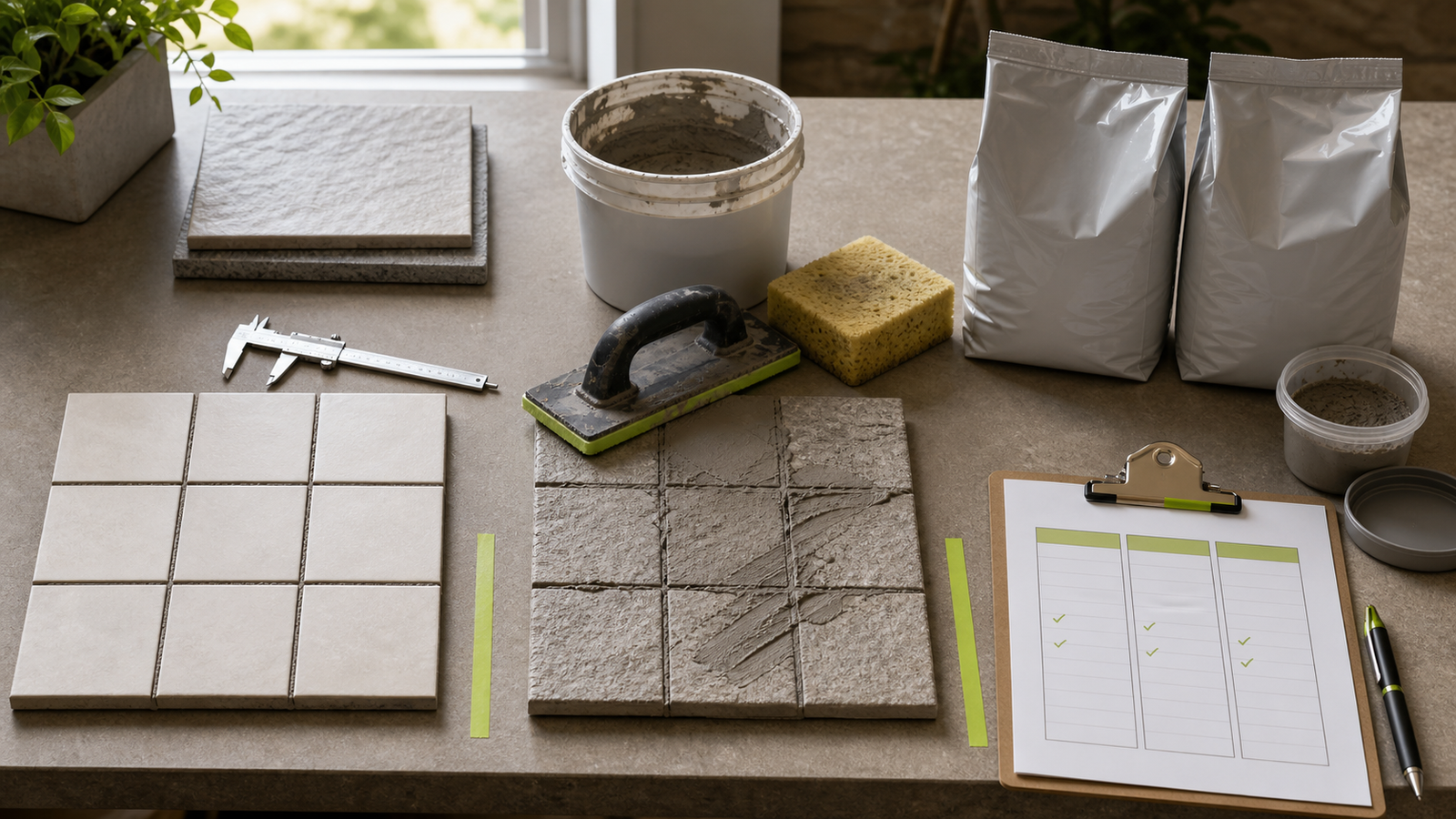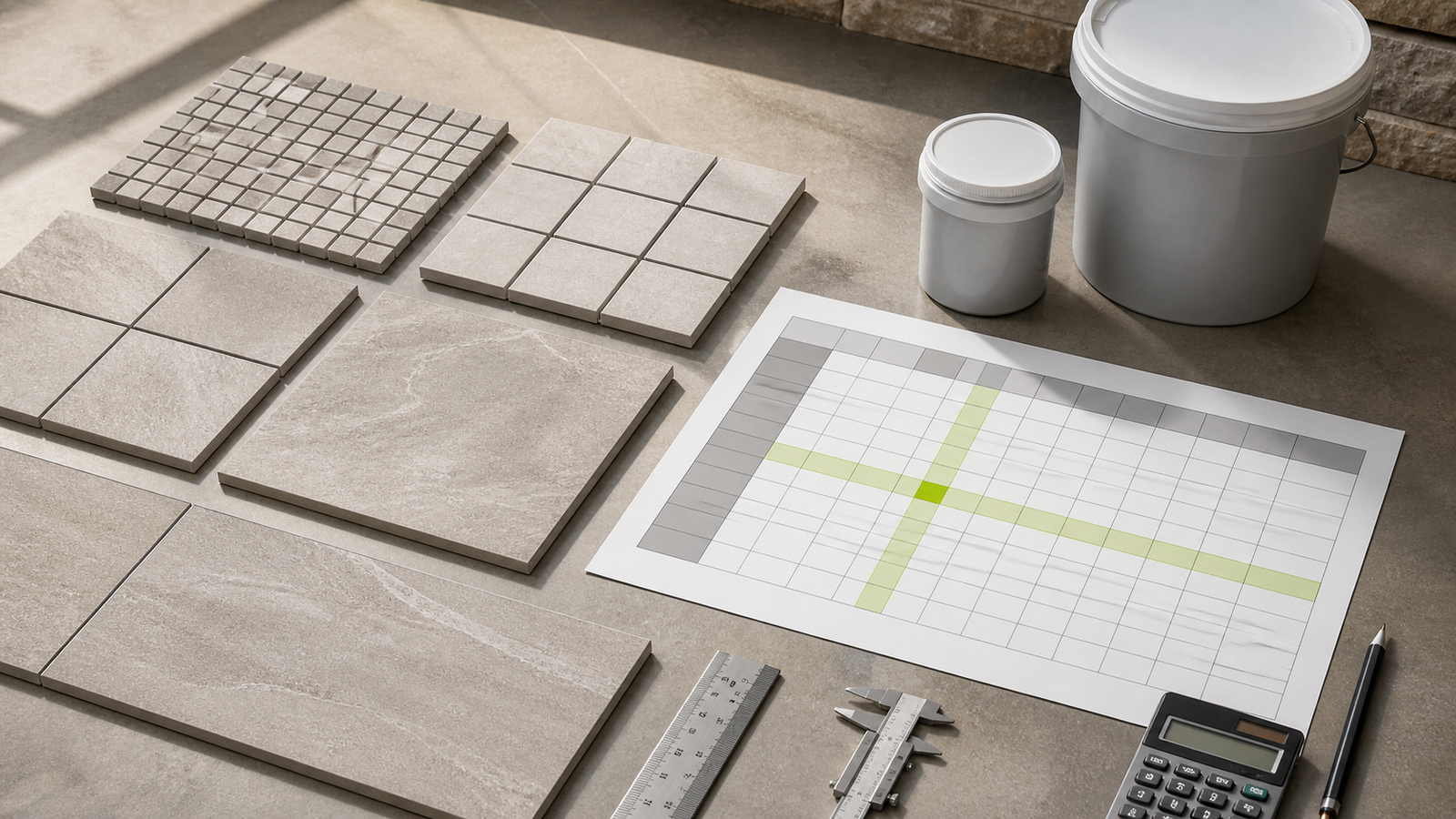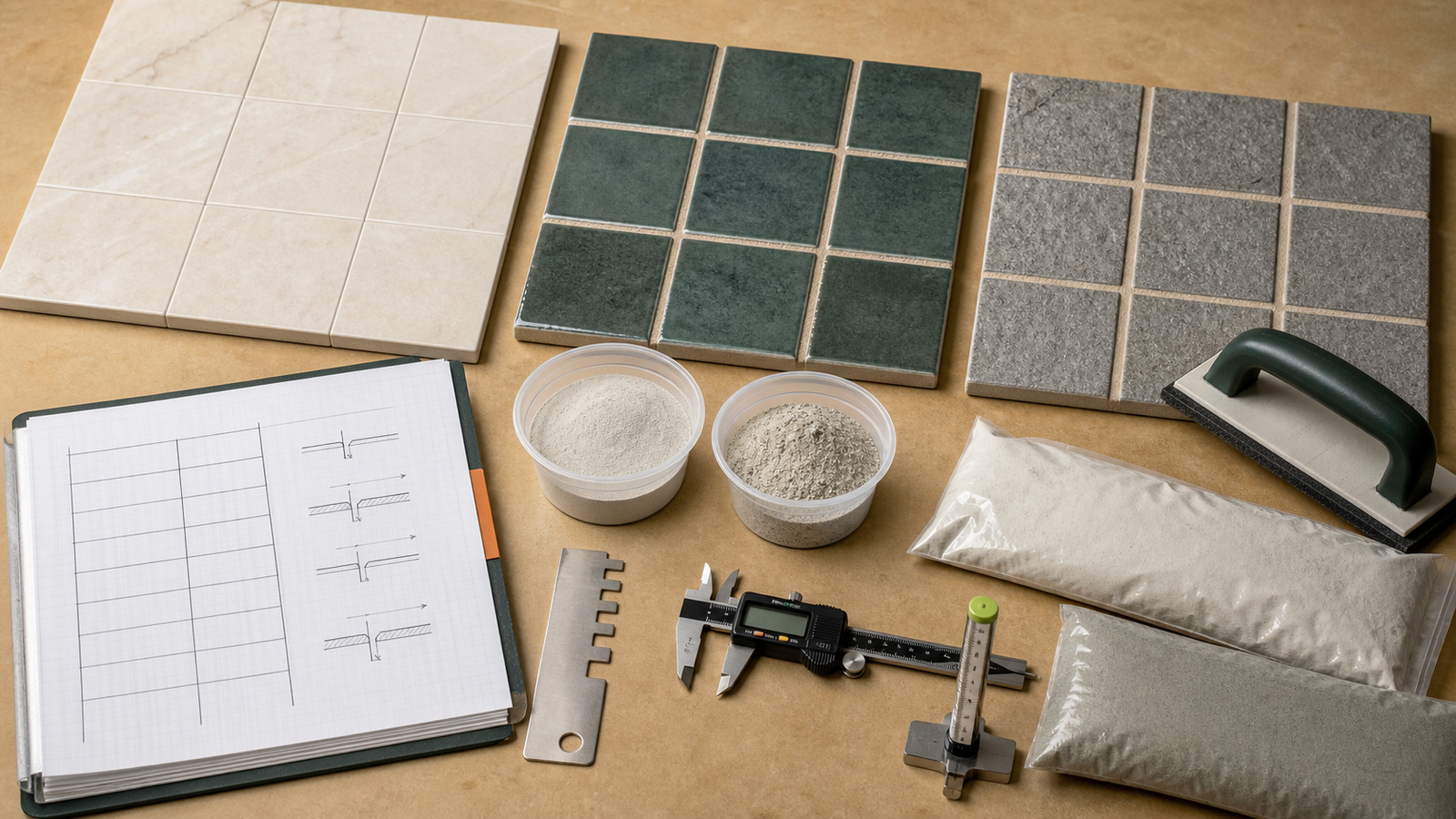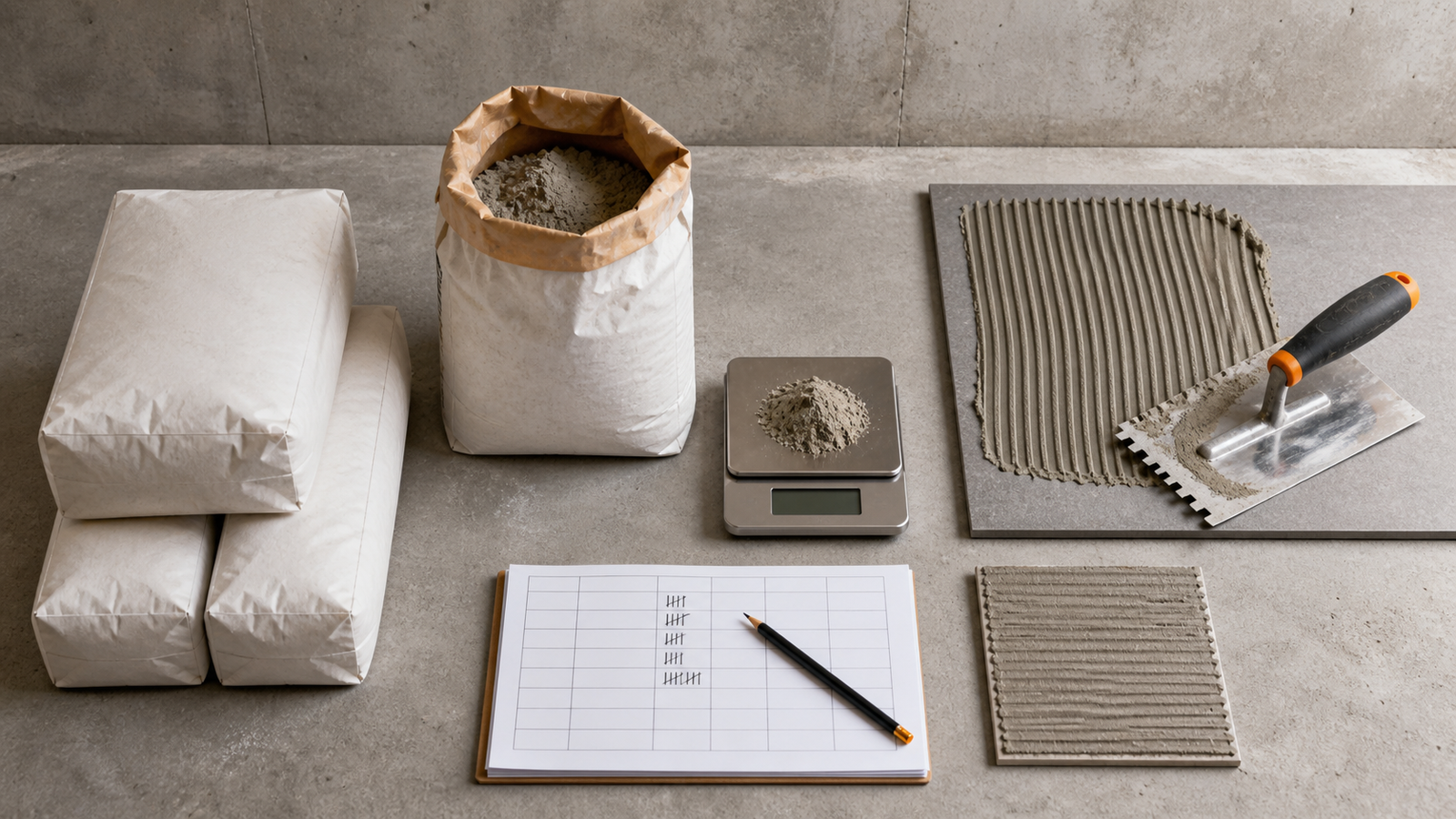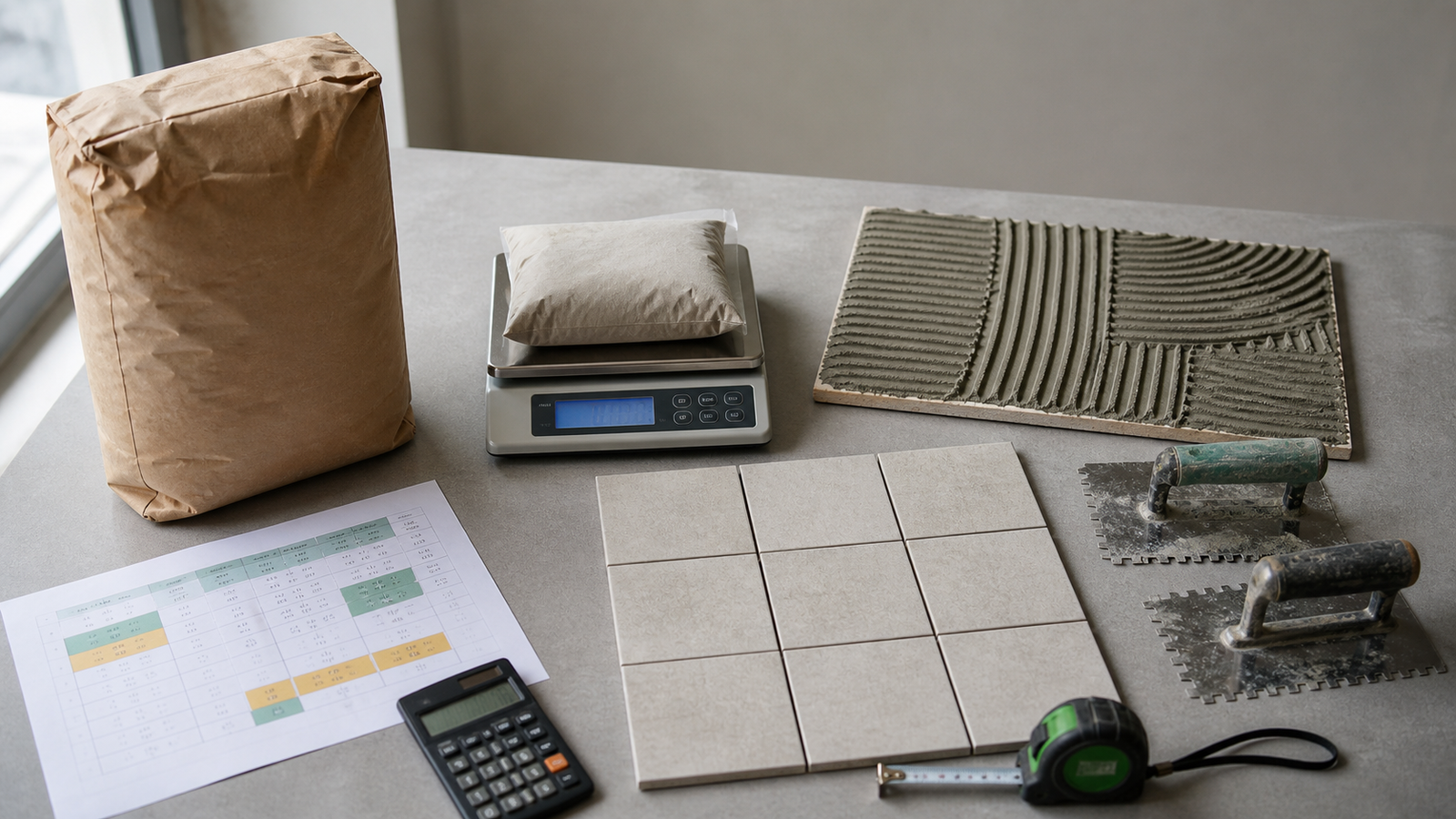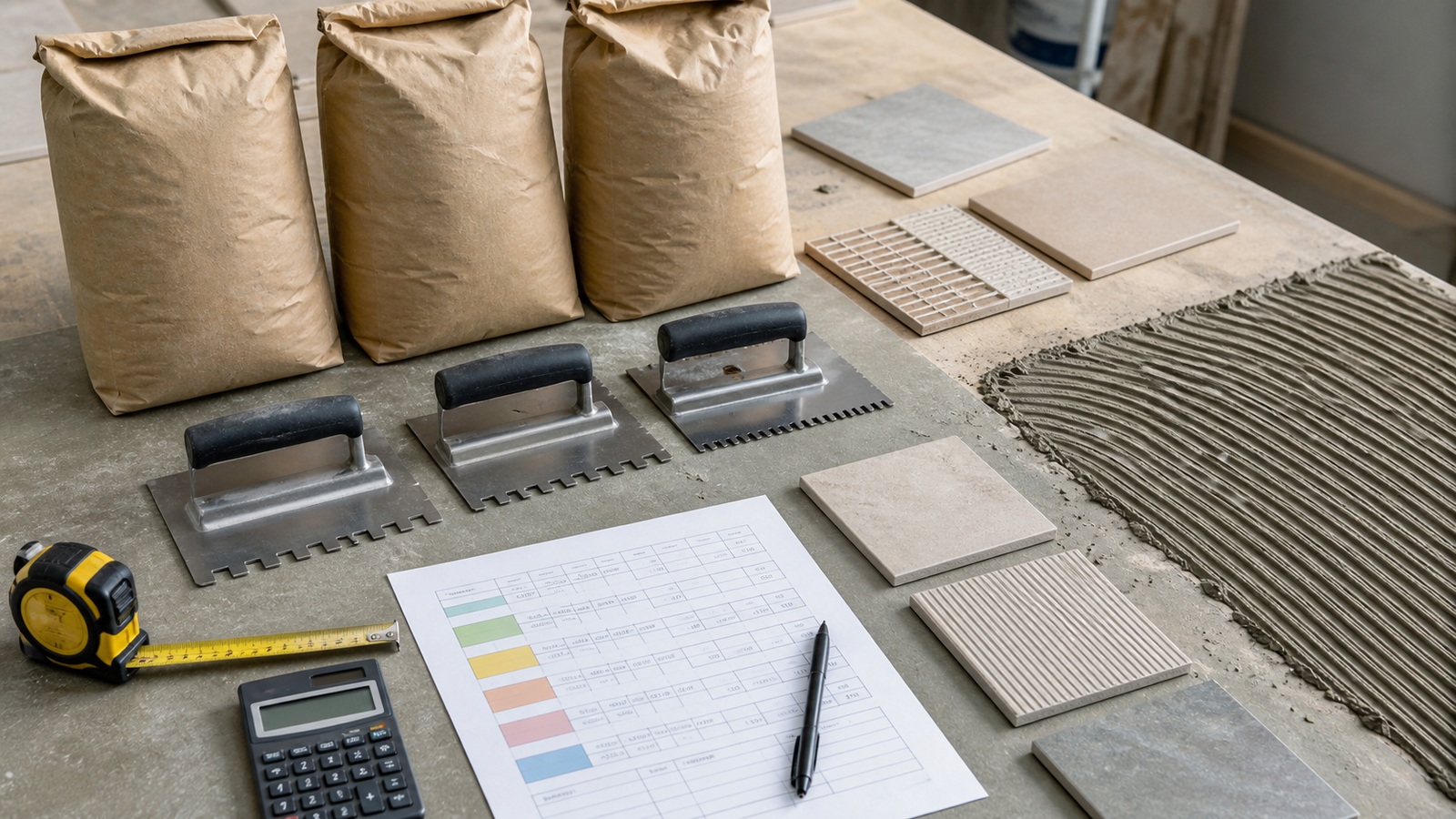
Tile adhesive coverage per bag comes from the selected product's current data, not from bag weight alone. Record the package, coverage or consumption row, trowel, tile, substrate and application before converting area to bags.
A published range also needs 2 calculations. Its lower coverage produces the larger order, and the difference can cross a whole-bag boundary.
How much area does one bag of tile adhesive cover?
One bag covers the area stated for the named product, package and matching application row. Current manufacturer examples range from 6.5–7.5 m² for one named 25 kg mortar with a 6 × 6 mm trowel to 3.9–4.4 m² for one named 50 lb mortar with a 13 mm square-notch trowel.
Those values cannot be merged into a universal answer. Use the Tile Adhesive Calculator with the row that matches the product being purchased and the planned work.
What should you record before using a coverage number?
Save enough context for another person to find the same row. A number copied without its product and application conditions cannot support an order.
| Field | What to record | Why it matters |
|---|---|---|
| Manufacturer and product | Exact name and market | Formulations and published values differ |
| Package | Mass or volume per bag | Coverage is tied to that selling unit |
| Published measure | Coverage per bag or consumption per area | The formulas run in opposite directions |
| Trowel or bed condition | Exact row wording and notch dimensions | One product can have several coverage rows |
| Tile and substrate | Format, back profile, surface and zone | Material transfer and application can change |
| Source revision | Data sheet or page date, URL and access date | Old values can attach to another market or formulation |
| Limitations | Footnotes and jobsite warnings | Published coverage is an estimate |
Is the product value coverage or consumption?
Coverage states how much area one package serves. Consumption states how much material is used per unit area. Identify the unit before entering a value.
| Published unit | Meaning | Exact bag formula |
|---|---|---|
| m²/bag | Area served by one bag | Planning area ÷ m²/bag |
| ft²/bag | Area served by one bag | Planning area ÷ ft²/bag |
| kg/m² | Mass used for each square metre | Planning area × kg/m² ÷ kg/bag |
| lb/100 ft² | Mass used for each 100 square feet | Area × lb rate ÷ 100 ÷ lb/bag |
Do not enter 4.5 kg/m² as 4.5 m² per bag. Do not derive area from a 20 kg or 50 lb package unless the same product record supplies a compatible consumption value.
How do you calculate bags from a coverage range?
Divide the compatible planning area by each end of the published range. Calculate with full precision, then round the final compatible total upward if only whole bags are sold.
Higher bag estimate = planning area ÷ lower published coverage
Lower bag estimate = planning area ÷ higher published coverage
Whole bags = ceiling(accepted exact bag ratio)
Do not select the midpoint automatically. Keep both endpoints visible until product guidance and project conditions support the planning value.
How much can the trowel row change one product's coverage?
CUSTOM lists several estimated coverage ranges for one 50 lb bag of VersaBond Professional Tile Mortar. The values below retain the named package and trowel rows from that manufacturer page.
| Published trowel row | Published coverage | Exact bags for 180 ft² | Whole-bag range |
|---|---|---|---|
| 6 × 6 × 6 mm square notch | 90–100 ft²/bag | 2.0000–1.8000 | 2–2 bags |
| 6 × 9.5 × 6 mm square notch | 60–67 ft²/bag | 3.0000–2.6866 | 3–3 bags |
| 13 mm square notch | 42–47 ft²/bag | 4.2857–3.8298 | 5–4 bags |
This table compares published rows. It does not choose a trowel for the project. CUSTOM also says coverage is for estimating and varies with installation practices and jobsite conditions.
When does the published range change the purchase quantity?
A range matters most near a whole-bag boundary. In the 180 ft² fixture, both ends of the first 2 rows produce the same whole-bag count, while the 42–47 ft² row produces either 5 or 4 bags.
The lower-coverage endpoint is 180 ÷ 42 = 4.2857 bags, rounded to 5. The higher-coverage endpoint is 180 ÷ 47 = 3.8298 bags, rounded to 4. Record the accepted endpoint instead of hiding that 1-bag uncertainty.
How does a project allowance interact with a coverage range?
Apply an allowance only when the project has a documented reason and percentage. Then recalculate both coverage endpoints. An allowance can move only one end of a range across the next bag boundary.
LATICRETE states that one named 25 kg product yields about 6.5–7.5 m² with a 6 × 6 mm square-notch trowel. For 25 m², the range gives 3.8462–3.3333 exact bags, or 4 bags at either endpoint.
If a separate project decision adds 5%, planning area becomes 26.25 m². The same range then gives 4.0385–3.5000 exact bags, or 5–4 whole bags. The 5% is an example project input, not a universal adhesive allowance.
What if coverage and consumption rows do not give the same result?
Keep the rows separate and ask the manufacturer which one controls the planned application. Do not average them or quietly choose the cheaper result.
Nerolac's Tile Adhesive Classic data sheet lists 4–4.5 kg/m² for a small-tile, 3 mm single-layer guide and also lists 5–6 m² coverage for a 20 kg pack at 3 mm. Dividing 20 kg by 4–4.5 kg/m² implies about 5.0000–4.4444 m², which does not reproduce the full 5–6 m² package band.
The rows may reflect different rounding or test contexts not fully captured by a short table. Save the question with the takeoff and obtain product guidance when both appear applicable.
Should you use the lower, upper or middle coverage?
Use the value supported by the selected product's instructions and the planned condition. If that review is incomplete, retain a range instead of presenting one unsupported answer.
| Choice | Quantity effect | Evidence needed |
|---|---|---|
| Lower coverage | Higher bag estimate | Reason the lower-yield condition applies |
| Upper coverage | Lower bag estimate | Evidence that the high-coverage condition applies |
| Midpoint | Intermediate estimate | Documented acceptance; no automatic midpoint |
| Endpoint range | Shows purchasing uncertainty | Use while the application decision remains open |
| Separate groups | Several bag calculations | Use when product, trowel or condition changes |
When should areas stay in separate calculations?
Combine unrounded areas only when one product, package, coverage row and allowance basis apply. Then round the combined bag ratio once.
- Keep a wall and floor separate when their trowel or application record differs.
- Keep large-format tile separate from mosaics when another coverage row applies.
- Keep wet, exterior or heated zones separate when the approved system changes.
- Keep substrate preparation, levelling and patching outside the adhesive coverage total.
- Keep products from different markets or data-sheet revisions separate.
Does back-buttering change coverage per bag?
It can change material use, but the amount depends on the selected product, tile back, substrate, troweling method and required mortar transfer. Do not add a universal back-buttering percentage.
Check whether the published row already reflects the planned method. If a project estimate adds material for a separate step, document it once and avoid reducing coverage and adding the same adjustment again.
Which mistakes make a coverage-per-bag estimate unreliable?
- Using bag weight as the coverage value.
- Copying a rate without its product, package and market.
- Mixing m²/bag with kg/m².
- Choosing the highest coverage because it reduces the order.
- Using a midpoint without reviewing the range conditions.
- Combining different trowel rows into one average.
- Adding an allowance automatically or twice.
- Rounding every compatible room before combining areas.
- Using adhesive quantity to approve substrate levelling.
- Treating purchased surplus as guaranteed usable stock.
What should be saved with the bag estimate?
- Manufacturer, product, package, market and source revision.
- Tile, substrate, zone, trowel and application record.
- Measured net area and any approved allowance.
- Published coverage or consumption range with units.
- Both endpoint calculations and the accepted planning value.
- Exact bag ratio, whole bags and whole-package surplus.
- Open questions sent to the manufacturer or project team.
Safety and installation limits
Follow the current product data sheet, safety data and package instructions for product selection, substrate preparation, mixing, application, working time and cure. Coverage arithmetic does not approve a tile system or trowel.
Cementitious mortar can contain Portland cement and crystalline silica. OSHA provides US construction information for respirable crystalline silica, while the product safety data and rules for the actual jurisdiction control the work.
Return to the tile planning tools and guides, review How to Measure for Tile, or check Tile Sizes and Carton Coverage. The calculation methodology explains unit and rounding controls.
Sources and source scope
- CUSTOM VersaBond Professional Tile Mortar: selected 50 lb package coverage ranges, named trowel rows and estimating limitation.
- LATICRETE 317 Floor & Wall Thin Set Adhesive DS-0317-0224: one named 25 kg product's approximate coverage with a stated trowel.
- Nerolac Tile Adhesive Classic TDS: named-product consumption and package coverage bands and listed coverage factors.
- MAPEI Product Calculators: product-specific estimating and jobsite-variation scope.
- OSHA silica construction information: US workplace hazard context.
Source scope: Manufacturer values apply only to the named products, packages, markets and stated conditions. OSHA supports the named US workplace context. Current product data, project documents, local requirements and responsible project decisions govern the installation.
Review responsibility: Saleem Sial owns the research and editorial record. Source verification, independent range arithmetic, internal-link review, build validation, link crawl, schema review and rendered QA form the internal publication gate. Waseem Sial, External Reviewer and Engineer, remains listed for ongoing external review; no completed external-review date is claimed.