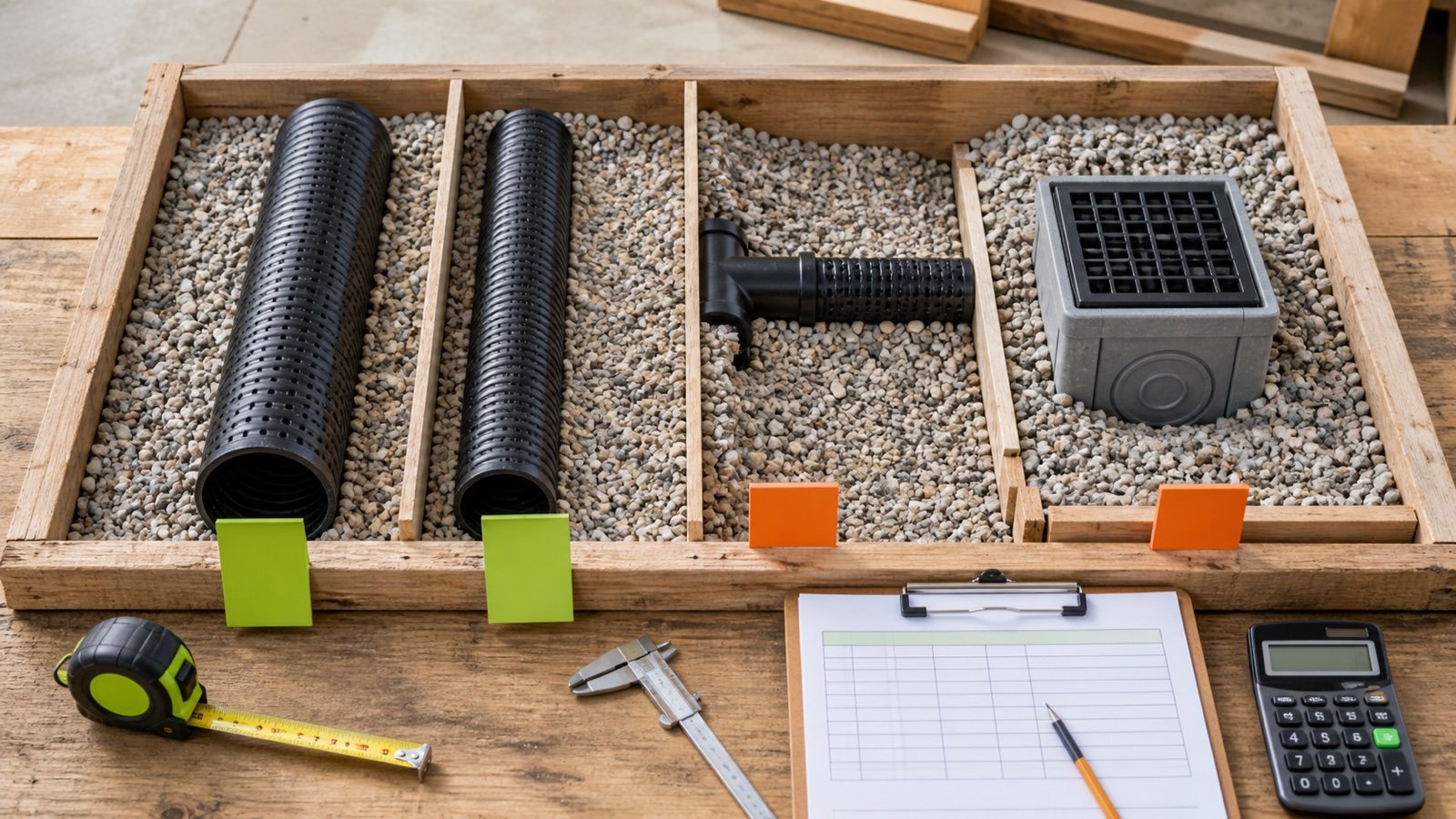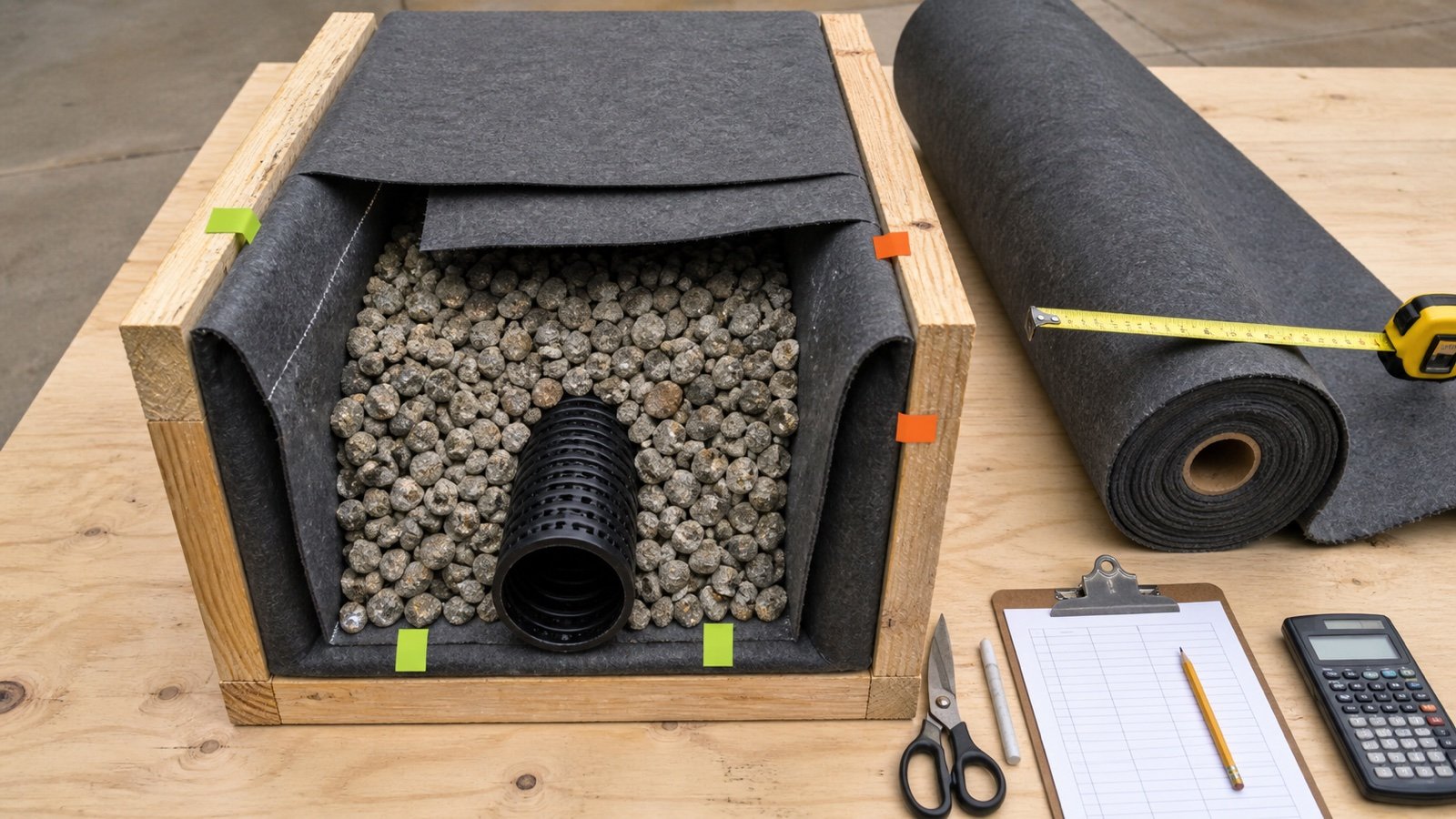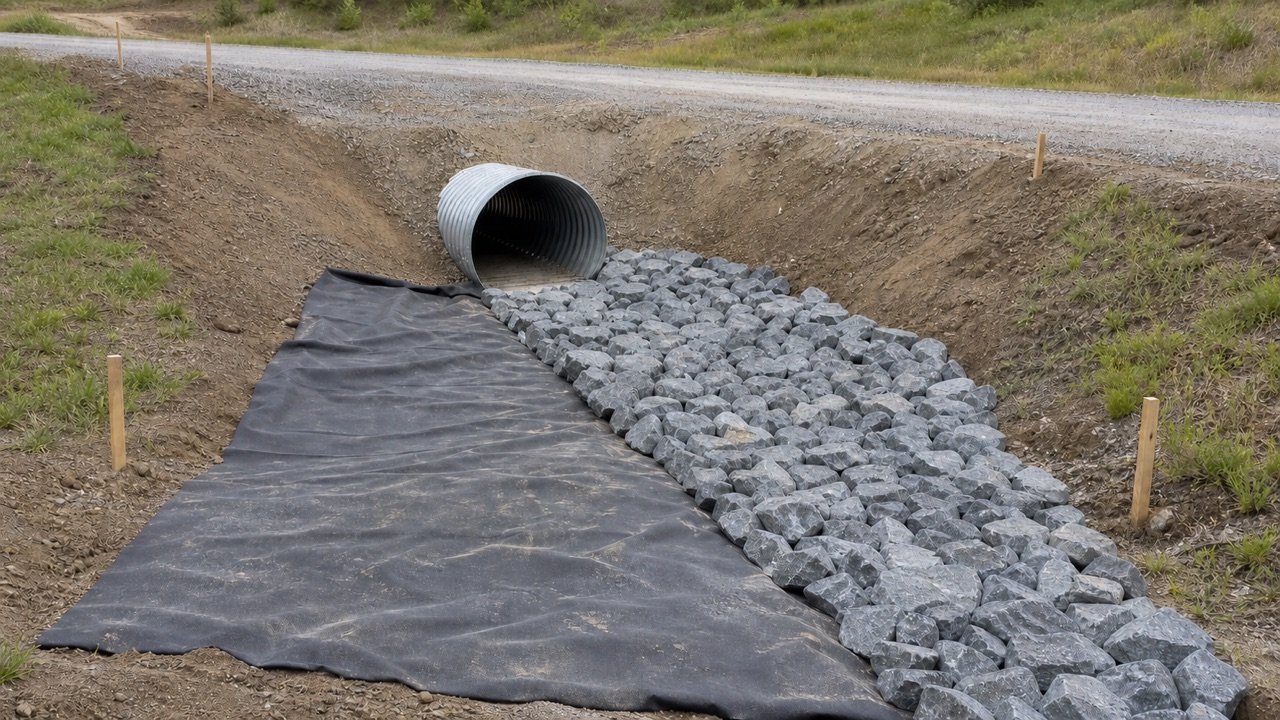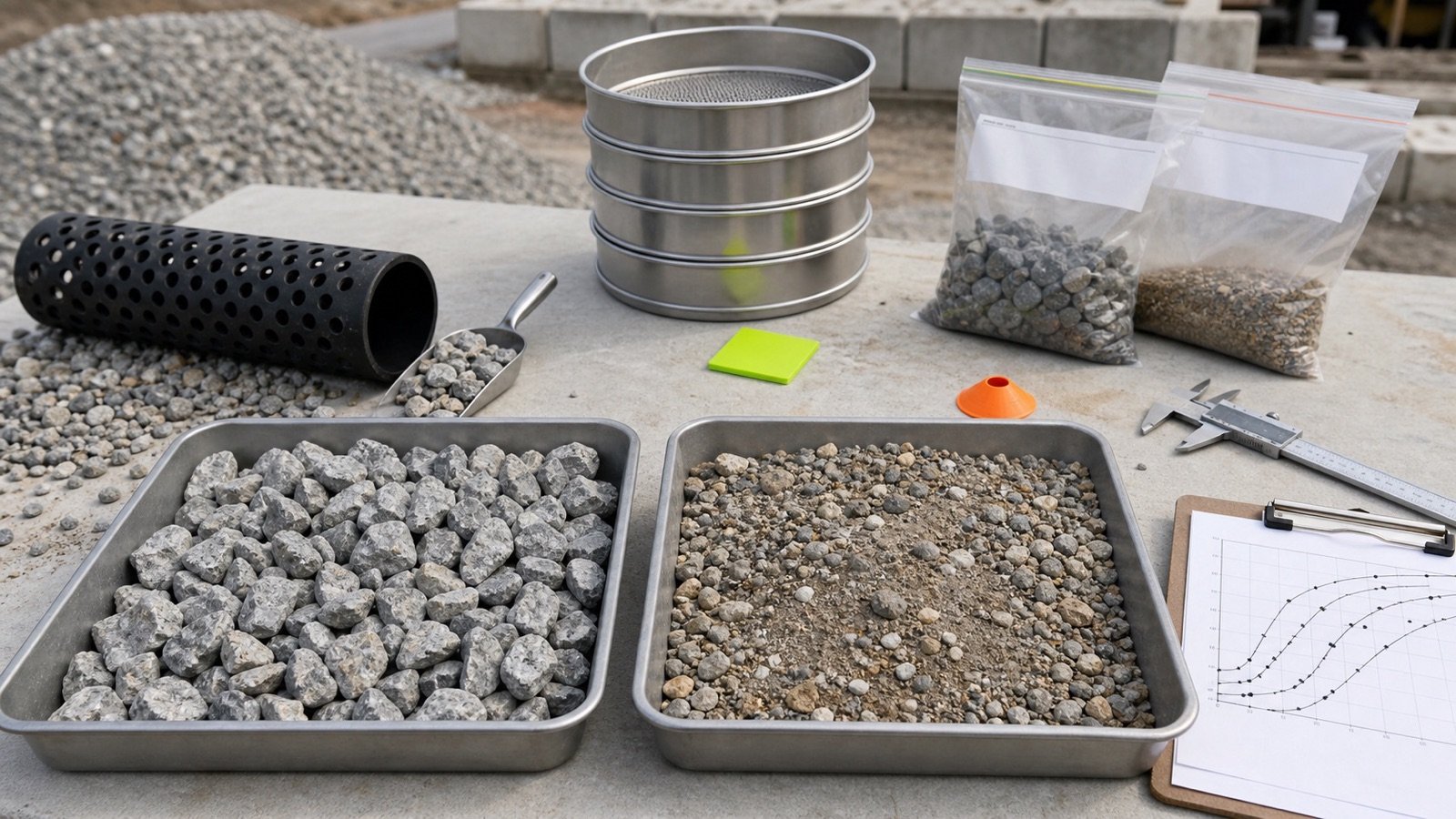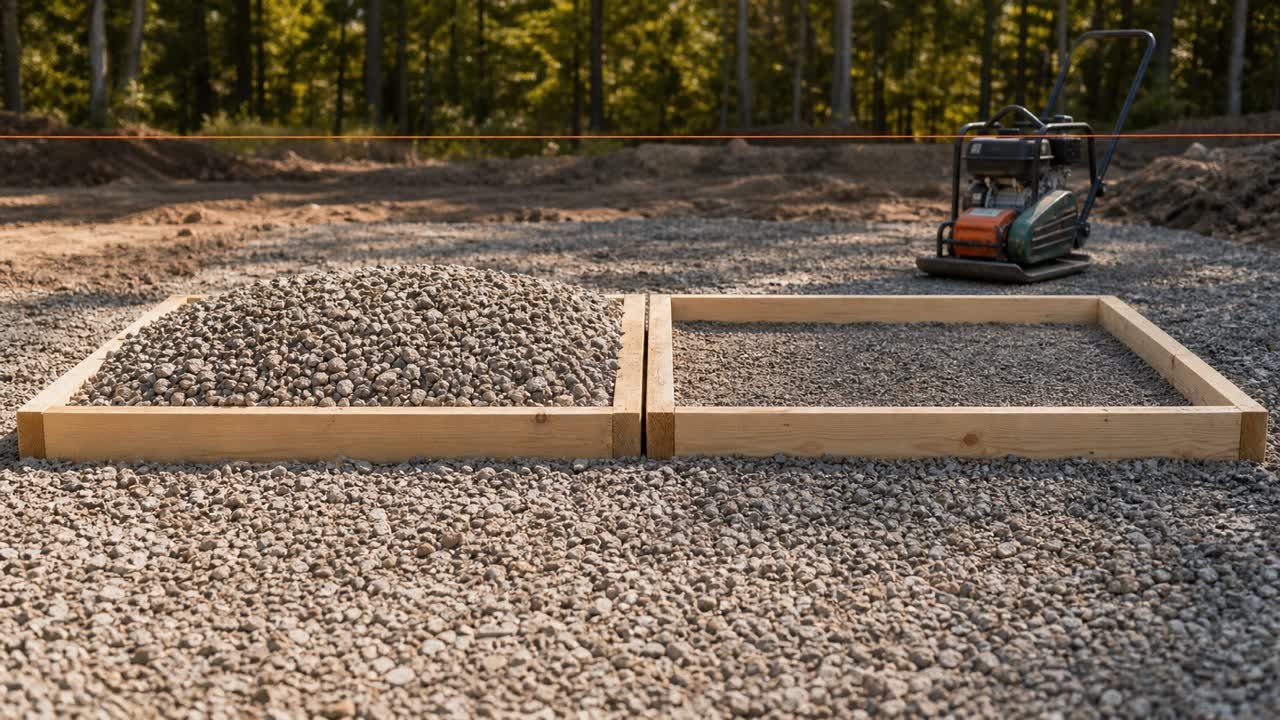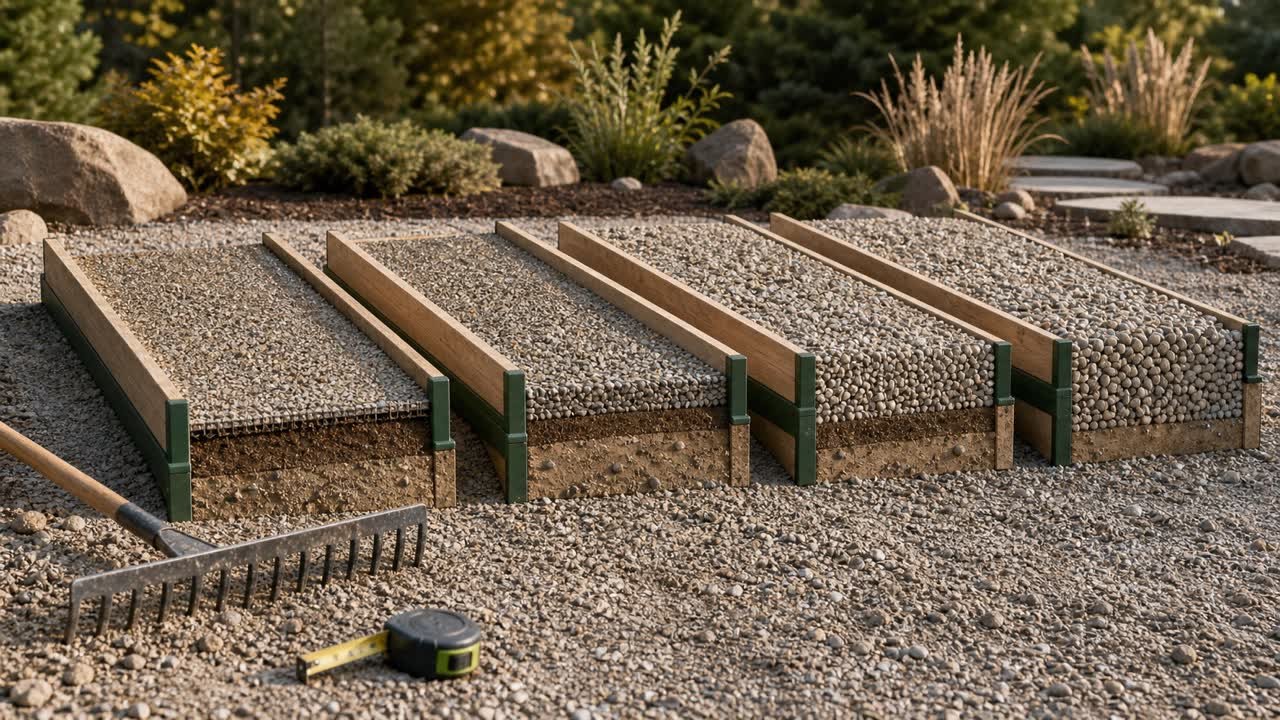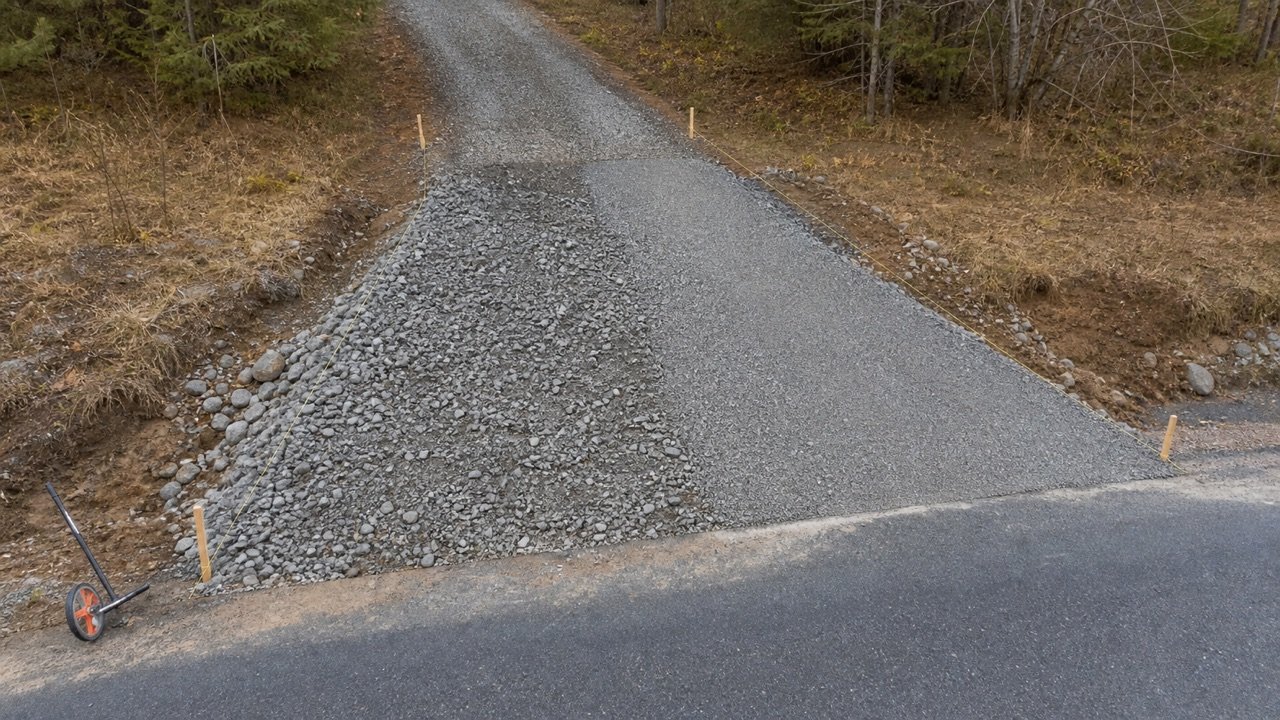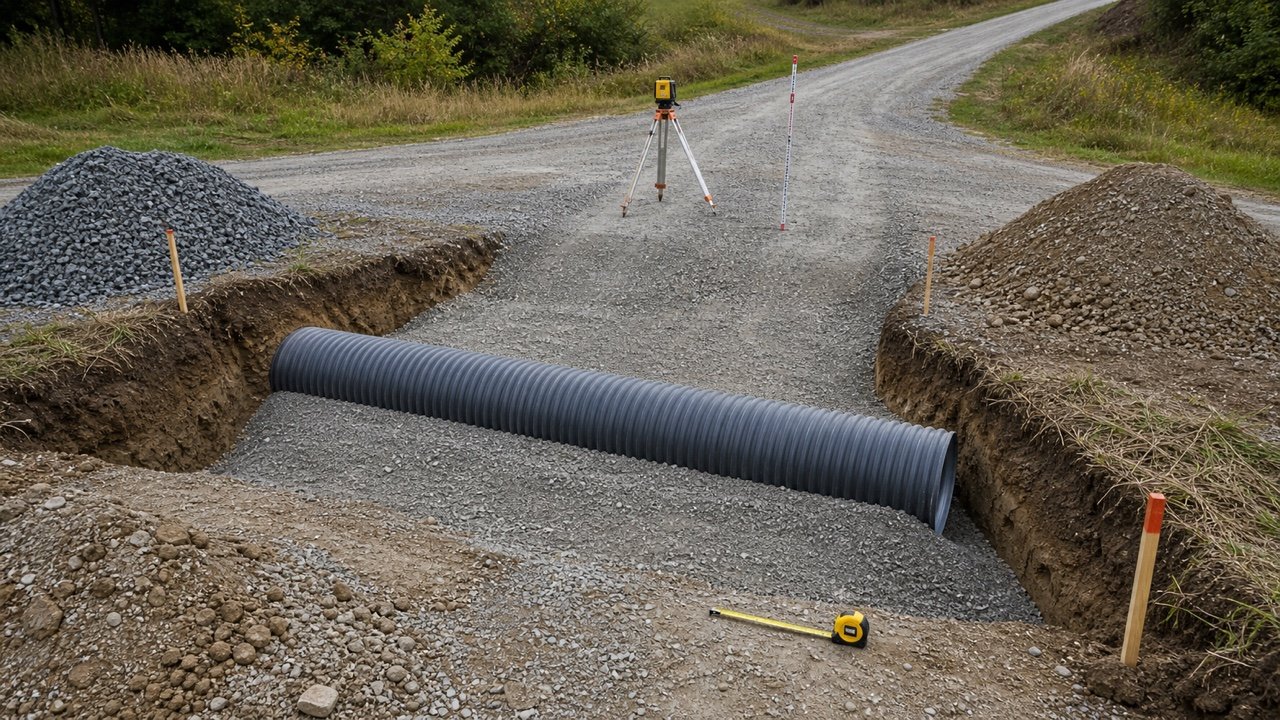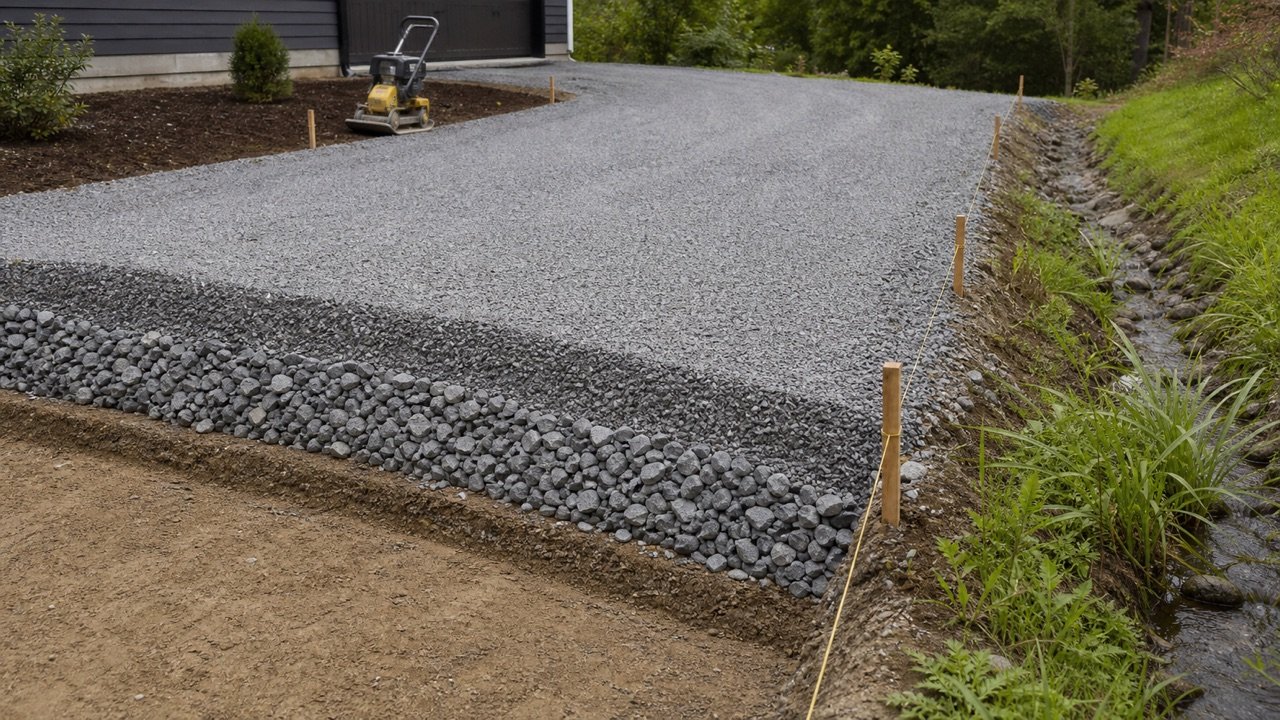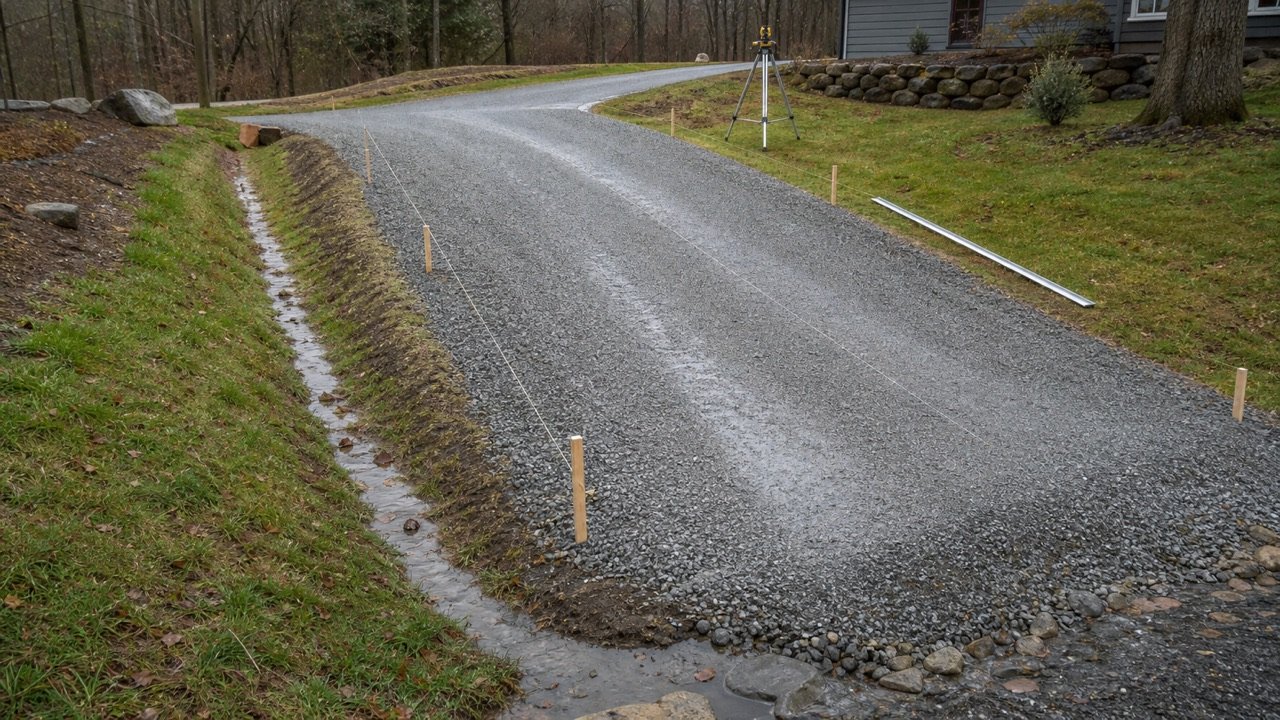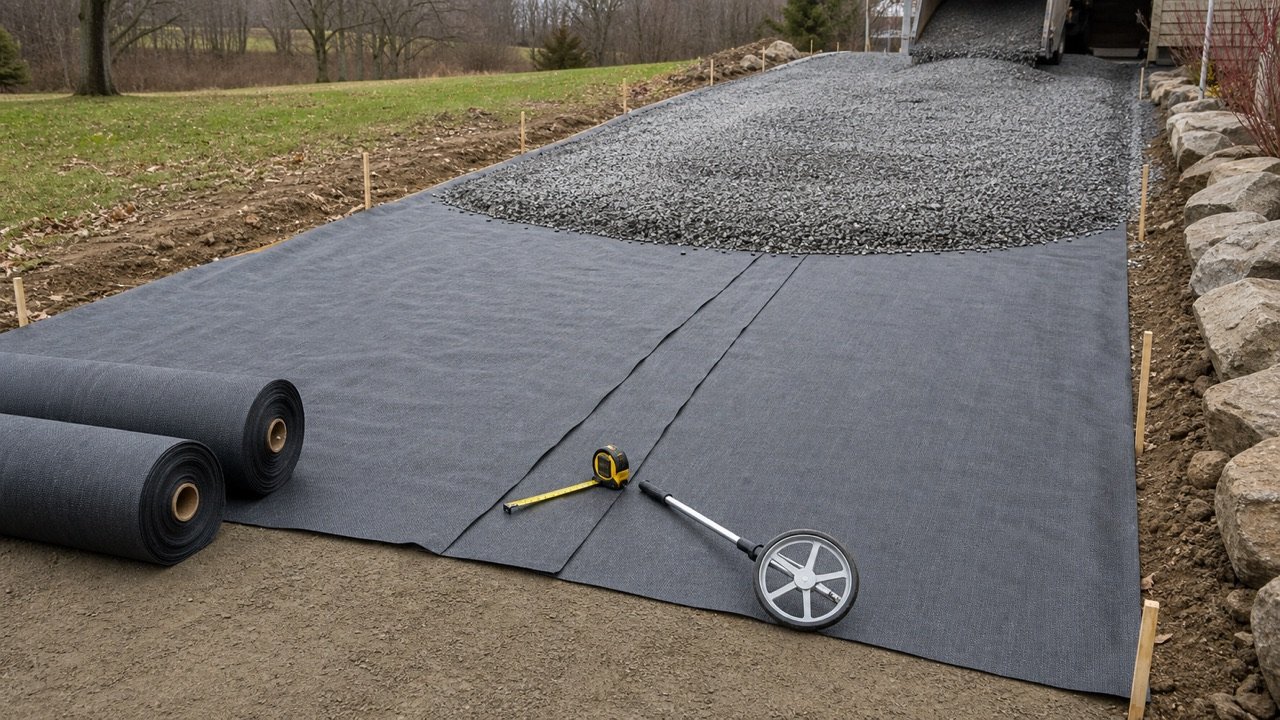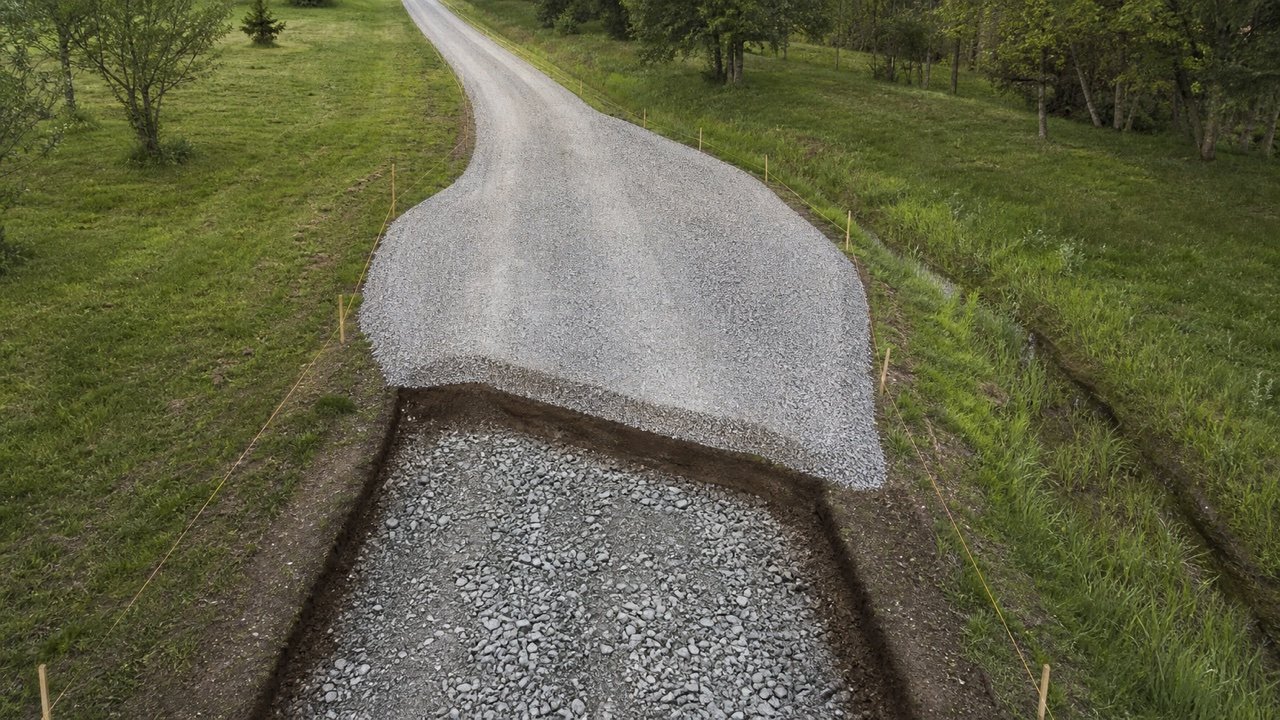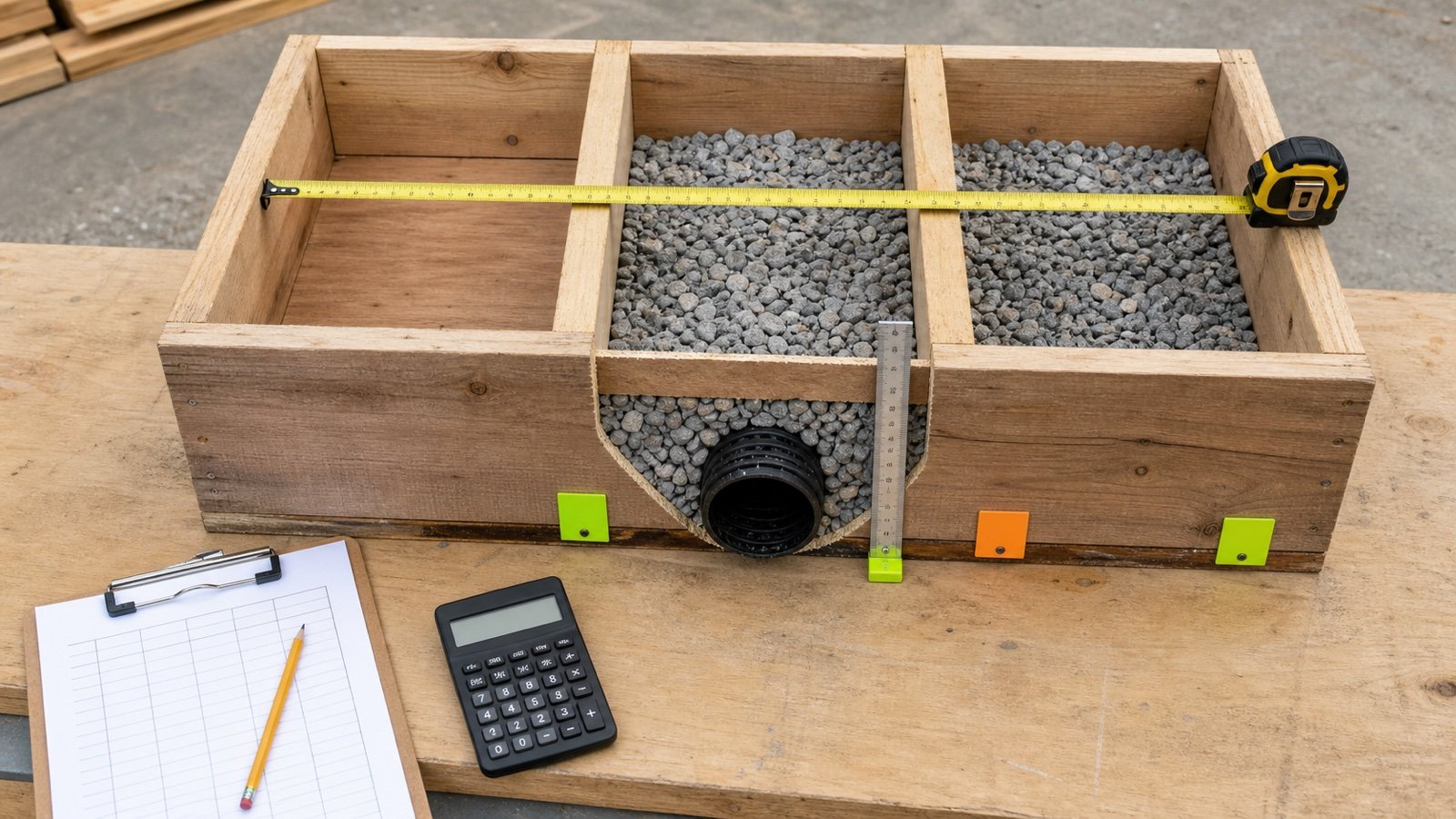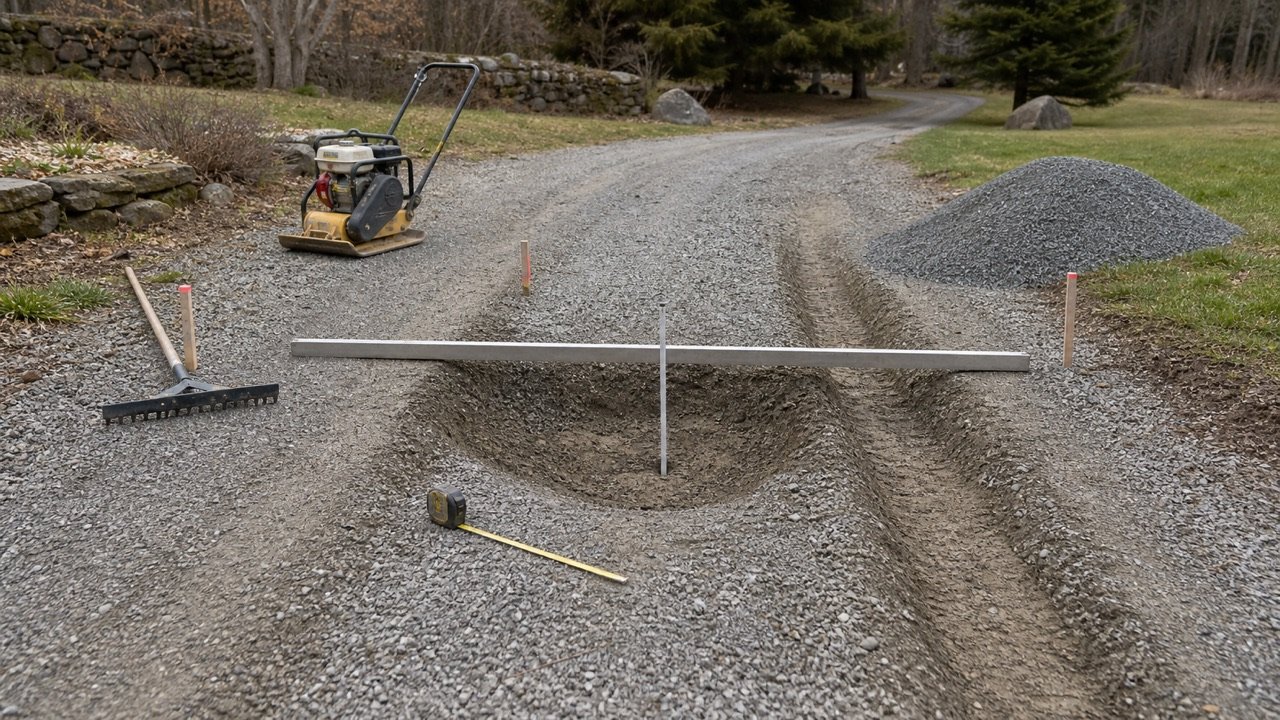
A pothole or wheel rut needs a measured repair boundary, not a guess based on the deepest point. Record the target surface, net plan area, and representative depths before calculating how much compacted material the repair will contain.
Check why the depression formed at the same time. Standing water, a blocked edge, displaced surface gravel, weak base, or pumping subgrade can change both the repair method and the quantity.
How much gravel is needed to repair potholes and ruts?
Multiply each repair zone's net area by its representative average vertical depth, then add the zones. The result is compacted geometric volume. Convert that volume to a loose order quantity or mass only with material-specific supplier or project data.
Repair volume = net plan area × average repair depth
Cubic yards = area in ft² × depth in inches ÷ 324
Cubic metres = area in m² × depth in mm ÷ 1,000
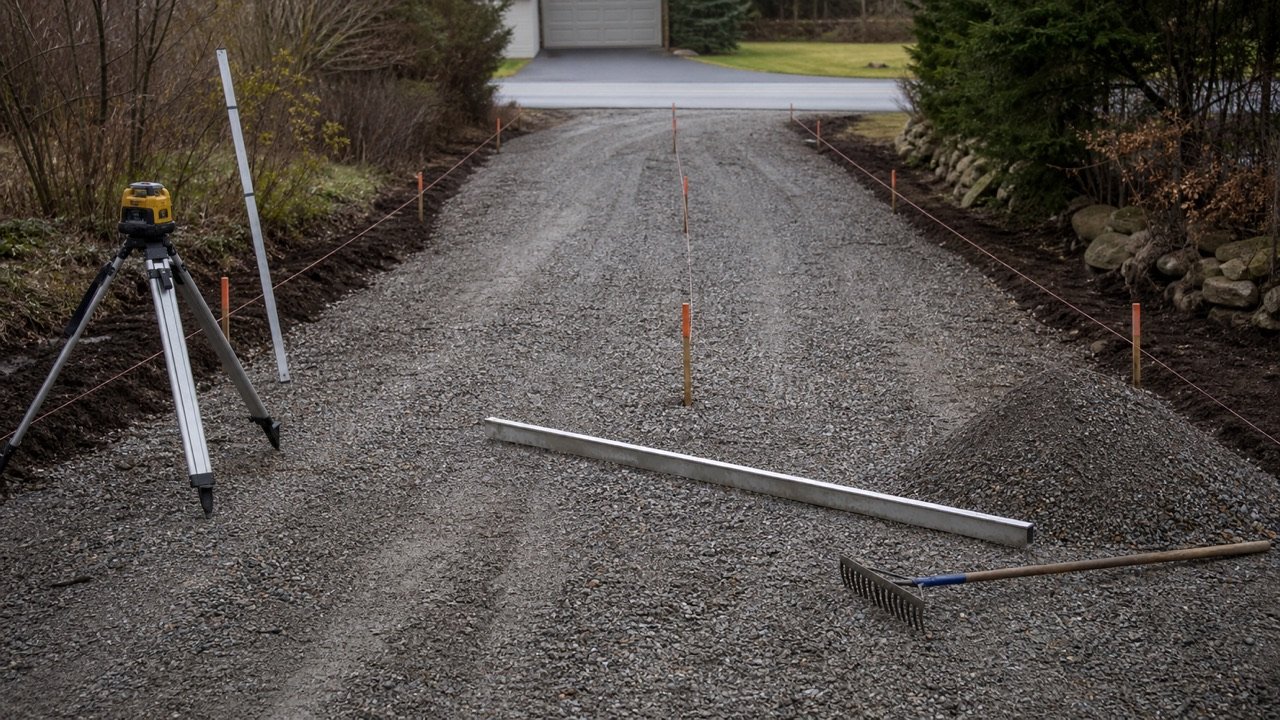
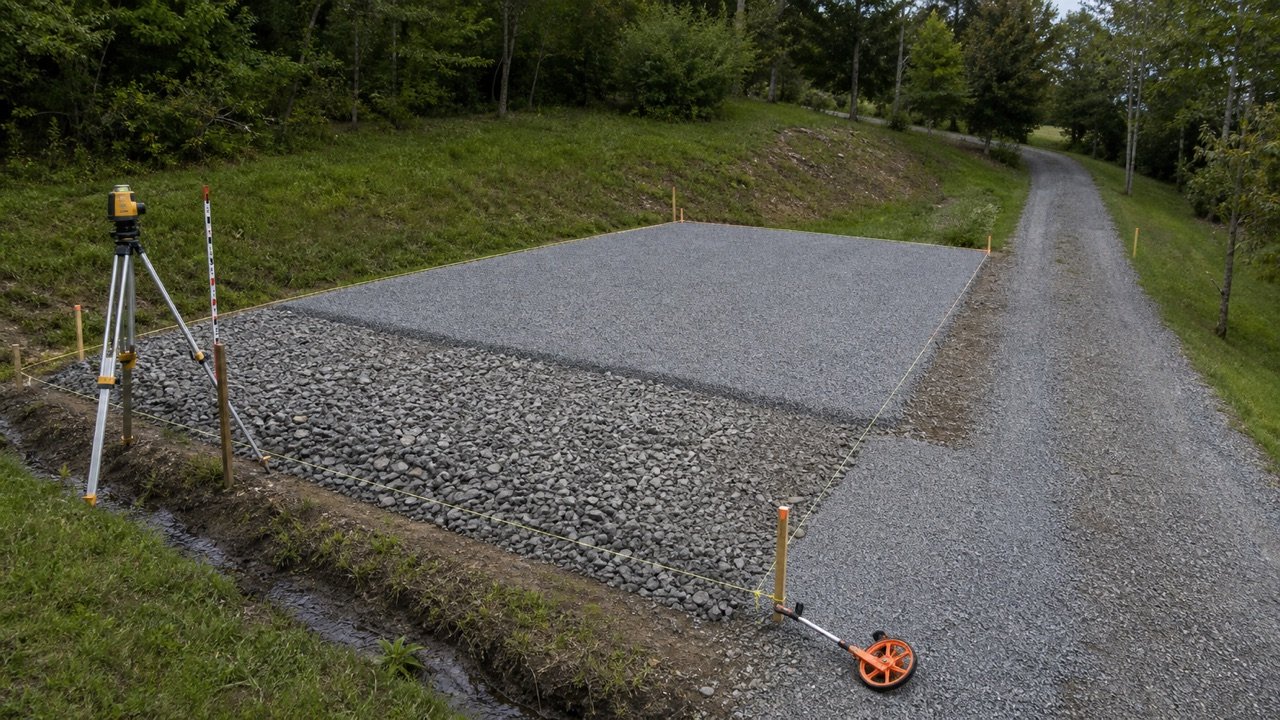
Measure depth vertically from the approved target profile to the prepared repair surface. A straightedge laid across a rut can reproduce an existing damaged profile, so use checked grade stakes, string, level readings, or another project-approved control where reshaping is part of the repair.
This method does not select the aggregate, prove base capacity, or design drainage. It provides the geometric volume after those decisions establish the repair boundary.
Use the Driveway Gravel Calculator for an approved full-width rectangular or uniformly tapered repair section when its base and surface courses share one footprint. Measure isolated potholes, curved excavations, changing ruts, and separate layer boundaries with the methods below.
What should be checked before filling a depression?
Classify the symptom, inspect the material below it, and trace the surface water path. A shallow loss of surface stone has a different scope from a wet excavation that moves under vehicle load.
| Condition | Check | Quantity response |
|---|---|---|
| Loose gravel sits beside a shallow rut | Material cleanliness, grading limits, and target profile | Measure recoverable material before calculating imported fill |
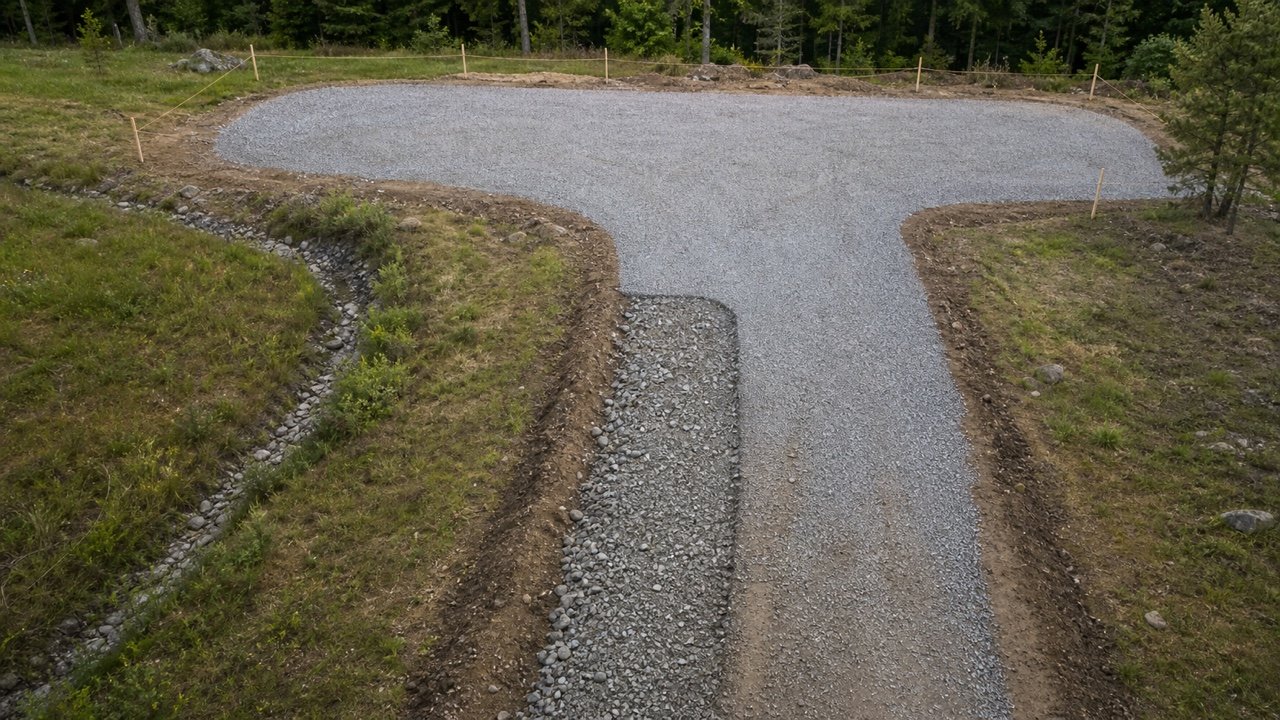
| Water ponds in a pothole | Crossfall, edge blockage, longitudinal low point, and outlet | Include the approved reshaping area; do not price the hole alone |
| Bottom is soft, wet, or pumps under load | Subgrade and base condition, groundwater, drainage, and traffic | Hold the final quantity until the excavation and replacement courses are defined |
| Ruts return in the same wheel paths | Surface thickness, lateral displacement, base deformation, moisture, and loading | Survey cross-sections; repeated filling may not match the required repair |
| Damage follows a washout | Runoff source, flow route, erosion, ditch, culvert, and outlet | Measure eroded and reshaped zones after the drainage repair is defined |
| Only one local surface area is low | Sound surrounding material and continuous drainage | A bounded surface patch may be measured independently |
FHWA gravel-road guidance connects surface shape, drainage, grading, potholes, and rutting. Its public-road practices help explain the maintenance relationship, but they do not create one residential driveway specification.
How do you measure an irregular pothole?
Mark the prepared repair boundary, divide it into small cells or simple shapes, and measure several vertical depths from the target surface. Calculate volume by cell, or multiply the net area by an area-weighted average depth.
- Remove only the loose, contaminated, or unsound material included in the approved repair scope.
- Mark the actual boundary. Do not include sound corners just because a tape measure creates a rectangle.
- Establish the target profile across the opening.
- Divide the plan into equal grid cells or measurable rectangles, triangles, and circles.
- Measure depth at cell centres and at visible changes in the bottom.
- Multiply each cell area by its representative depth.
- Add all cell volumes and record any unmeasured edge or undercut.
- Repeat the survey after further excavation changes the boundary.
A grid reduces the error caused by one deep point. Smaller cells are useful where depth changes quickly. Large uniform cells may be sufficient for a flat-bottomed, squared excavation.
Should a pothole be treated as a box or a bowl?
Use the shape that matches the prepared excavation. A rectangular or cylindrical envelope is a conservative geometric bound for a smooth bowl, but it can overstate the actual void when its maximum depth is applied across the full area.
| Shape | Formula | Use only when |
|---|---|---|
| Rectangular excavation | Length × width × average depth | Sides and bottom are reasonably represented by those dimensions |
| Circular cylinder | π × radius² × average depth | The boundary is circular and the chosen depth represents the full area |
| Paraboloid bowl | 0.5 × π × radius² × central depth | The hole is close to a smooth, circular bowl that reaches zero depth at its edge |
| Grid-depth survey | Sum of cell area × cell depth | The boundary or bottom is irregular |
Do not use the paraboloid formula for a squared repair with vertical sides, a flat bottom, undercut edges, or several separate deep pockets.
Worked pothole example: envelope versus bowl
A circular pothole measures 4 ft across and 0.5 ft at its deepest central point. The radius is 2 ft.
| Method | Calculation | Volume |
|---|---|---|
| Cylindrical envelope | π × 2² × 0.5 | 6.283185 ft³ = 0.232711 yd³ |
| Smooth paraboloid bowl | 0.5 × π × 2² × 0.5 | 3.141593 ft³ = 0.116355 yd³ |
| Independent check | Bowl ÷ cylinder | 0.5 |
The 2 results differ by 100% relative to the bowl estimate. A field grid or the actual squared excavation is better than choosing the more convenient number. Supplier rounding can also make both volumes fall within the same minimum order.
How do you calculate gravel for wheel ruts?
Measure a rut's cross-sectional area at representative stations, then multiply by the length over which that section applies. A trapezoid can represent a rut with measurable top width, bottom width, and average depth.
Trapezoidal rut area = (top width + bottom width) ÷ 2 × depth
Uniform rut volume = rut area × length
Measure both wheel paths. They may have different widths, depths, lengths, and repair causes.
Worked example for 2 uniform wheel ruts
Each rut is 40 ft long, 1.5 ft wide at the top, 0.5 ft wide at the bottom, and 0.25 ft deep. The example assumes that one cross-section represents the complete length.
- Cross-sectional area: (1.5 + 0.5) ÷ 2 × 0.25 = 0.25 ft².
- One rut: 0.25 × 40 = 10 ft³.
- Two ruts: 10 × 2 = 20 ft³.
- Convert: 20 ÷ 27 = 0.740741 yd³.
- Independent SI check: 20 × 0.02831685 = 0.566337 m³.
This is the compacted void represented by the assumed sections. It does not include material needed to reshape the surrounding profile, replace a failed base, or correct drainage.
What if rut width and depth change along the driveway?
Measure sections at stations and calculate each segment between adjacent sections. For a section that changes approximately linearly, multiply segment length by the average of its 2 end areas.
Segment volume = segment length × (start area + end area) ÷ 2
| Station | Top width | Bottom width | Depth | Area |
|---|---|---|---|---|
| 0 ft | 0.8 ft | 0.2 ft | 0.10 ft | 0.050 ft² |
| 10 ft | 1.2 ft | 0.4 ft | 0.20 ft | 0.160 ft² |
| 25 ft | 1.6 ft | 0.6 ft | 0.30 ft | 0.330 ft² |
The first segment is `10 × (0.050 + 0.160) ÷ 2 = 1.05 ft³`. The second is `15 × (0.160 + 0.330) ÷ 2 = 3.675 ft³`. Total measured volume is 4.725 ft³ for that rut before any broader reshaping.
Add stations at abrupt changes, soft spots, driveway entrances, curves, grade breaks, drainage crossings, and the start or end of each repair treatment. One severe section should not be extended over the full rut length without evidence.
How does a metric grid calculation work?
Use metres for area and convert millimetres of average depth to metres. A 2.4 m² prepared repair with an area-weighted average depth of 85 mm has:
2.4 × 85 ÷ 1,000 = 0.204 m³
The independent check is `2.4 × 0.085 = 0.204 m³`. NIST lists 1 yd³ as 0.7645549 m³, so 0.204 m³ is about 0.266824 yd³ before order-state adjustments.
When can existing gravel reduce the order?
Deduct existing gravel only when it is recoverable, suitable for the specified course, and measured after segregation, contamination, and losses are considered. Gravel pushed into ridges or shoulders may be reusable after scarification and grading; material mixed with soil, organics, ice, or unsuitable particles may not be.
- Survey the existing and target cross-sections.
- Calculate cut and fill by station instead of treating every rut as imported fill.
- Keep base material separate from surface material.
- Record stockpile or recovered volume in the same material state as the comparison.
- Confirm gradation, moisture, contamination limits, and reuse approval.
- Subtract only the usable quantity that can reach the repair area.
Use the gravel driveway drainage and grade guide to check the target profile. A grading plan may redistribute enough material that the imported quantity is smaller than the summed rut voids.
How is compacted repair volume converted to an order?
Keep the states separate and convert them in order. The repair geometry describes placed or compacted volume. A quarry may sell a loose volume, mass, partial load, full load, or fixed increment.
- Calculate compacted geometric volume by repair zone and course.
- Add any measured reshaping or transition zones.
- Subtract verified reusable material in a compatible state.
- Apply a documented loose-to-compacted conversion when the supplier sells loose volume.
- Convert volume to mass only with a product, supplier, test, or project bulk density for the stated moisture and material condition.
- Add a separately justified handling allowance where the project needs one.
- Round once to the supplier's selling increment and check delivery access and legal payload.
Do not apply a universal density, compaction factor, waste percentage, or truck capacity. Use the loose versus compacted gravel guide. Run an approved full-width uniform section through the Driveway Gravel Calculator, or use the Gravel Calculator for one prepared repair zone after measuring its net area and representative average depth.
Common repair-quantity mistakes
- Using the maximum depth as the average across the entire pothole.
- Multiplying the longest length and width when much of that rectangle is sound.
- Measuring from a straightedge that follows the damaged profile.
- Mixing inches with feet or millimetres with metres inside one formula.
- Counting overlapping pothole, rut, and reshaping zones twice.
- Assuming both wheel ruts have the same section.
- Extending one test-hole depth to every weak area.
- Ordering surface gravel before defining base or subgrade excavation.
- Adding imported gravel without crediting verified reusable material.
- Converting to tons with a generic internet density.
- Adding settlement, compaction, waste, and contingency as one unexplained percentage.
- Rounding every small patch before summing the project.
- Filling ponded areas without checking the drainage route.
- Treating a calculated quantity as approval of a repair design.
What should the repair record contain?
- Project, location, date, weather, and driveway condition.
- Repair-zone ID, cause classification, and proposed treatment.
- Target surface datum, profile, and measurement method.
- Plan boundary, grid or station spacing, depth readings, and photographs.
- Separate surface, base, and subgrade extents.
- Formula, unrounded geometric volume, and independent check.
- Reusable material quantity and acceptance basis.
- Supplier product, density or conversion evidence, selling unit, and delivery increment.
- Drainage, utility, permit, traffic, and equipment constraints.
- Prepared by, checked by, revision, assumptions, and unresolved conditions.
Safety and scope
Keep people clear of moving vehicles and compaction equipment. Follow equipment instructions, use suitable personal protective equipment, control dust, stabilize open excavations, and locate buried and overhead utilities before digging.
Stop and obtain project-specific advice for deep or spreading soft ground, groundwater, washouts, steep grades, retaining conditions, buried services, public-road connections, heavy or unusual traffic, or repeated failures. Local permits, environmental rules, drainage requirements, drawings, specifications, and a qualified professional can control the work.
This page estimates geometric repair quantities. It does not confirm soil strength, pavement structure, drainage capacity, aggregate specification, compaction procedure, legal disposal, or safe equipment operation.
Sources and source scope
- U.S. EPA, Gravel Roads: Maintenance and Design Manual: current official hub for routine maintenance, drainage, surface gravel, thickness-design, gradation, and quantity-calculation sections.
- FHWA, Maintenance of Drainage Features for Safety: roadway drainage, erosion, subbase saturation, damage, inspection, and corrective-action context. The guide does not design a residential driveway drainage system.
- FHWA and South Dakota LTAP, Gravel Roads Construction & Maintenance Guide: gravel-road cross-section, drainage, pothole, rutting, grading, and maintenance context.
- FHWA Roadway/Roadside Maintenance resources: current official access point for the gravel-road and drainage guides.
- NIST Guide to the SI, Appendix B.8: cubic-foot and cubic-yard conversion factors used in the examples.
Scope: the official road sources support the relationship between surface condition, drainage, grading, and repair in their stated programs. They do not prescribe one residential driveway repair section. The shape formulas and worked examples check quantity arithmetic for the stated measurements.
Review the intended section in the gravel driveway depth guide, compare aggregate options in the gravel size chart, check budget inputs in the gravel cost guide, or return to the Gravel planning hub.