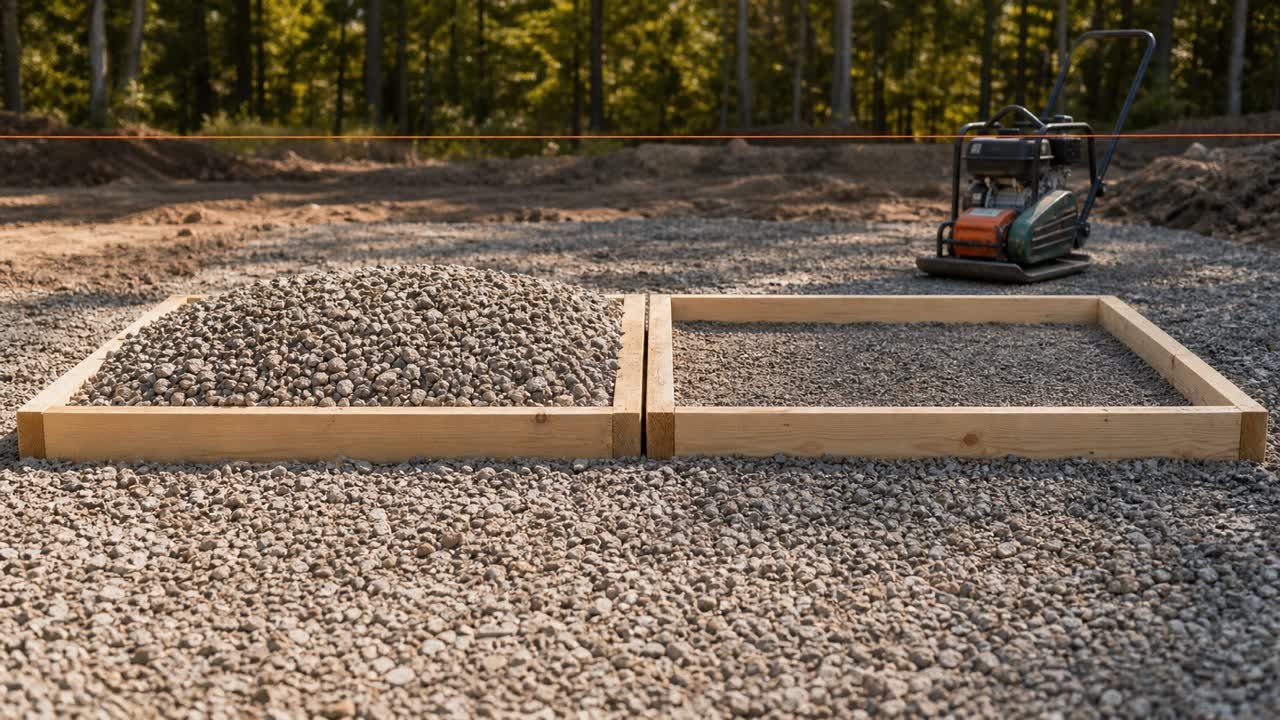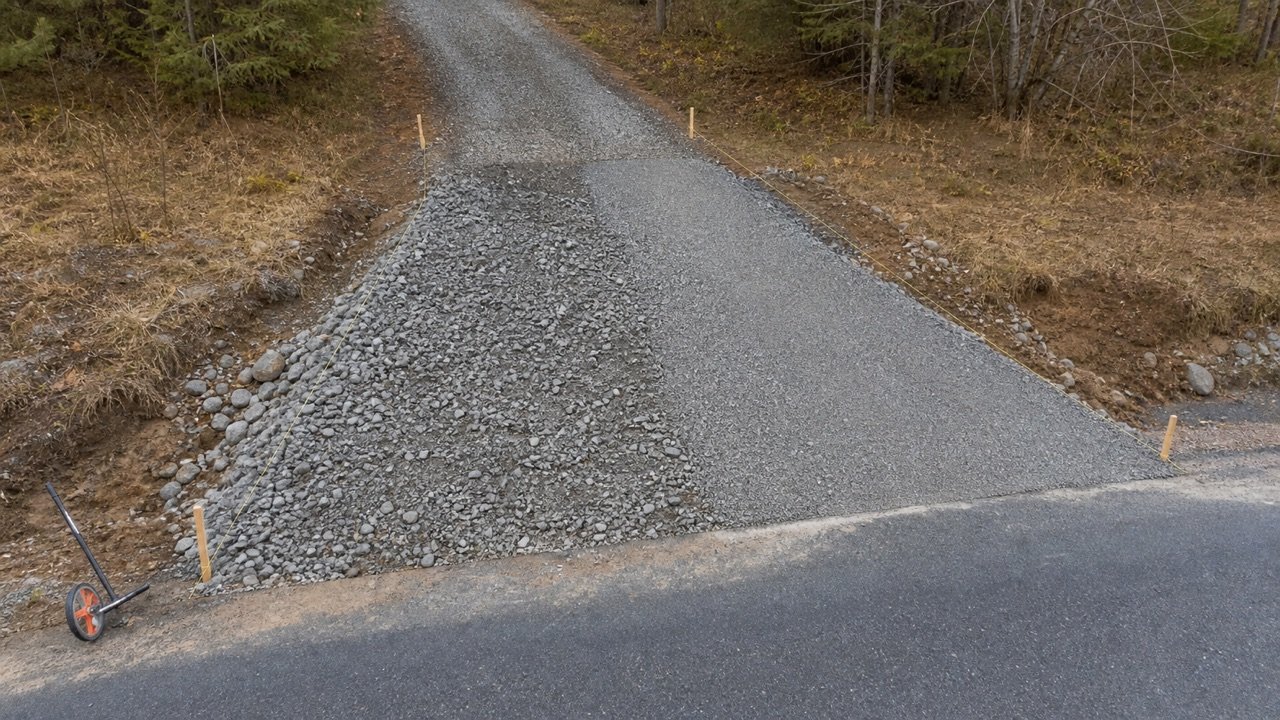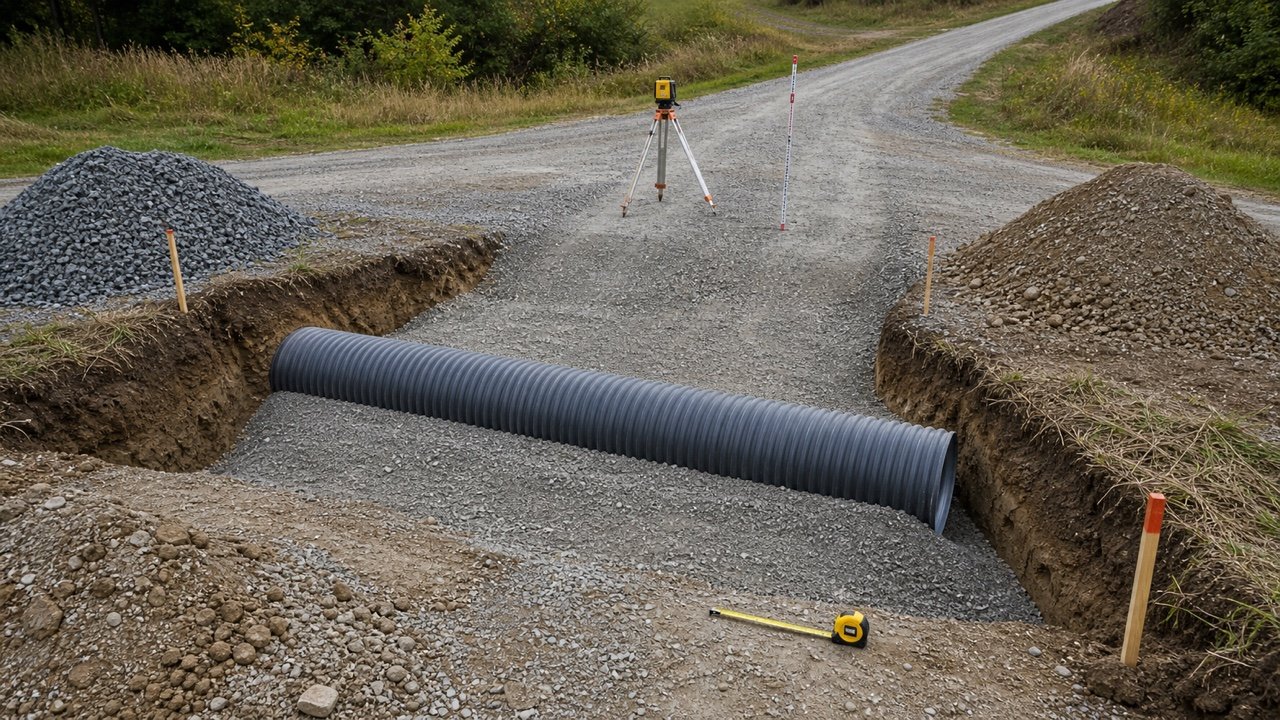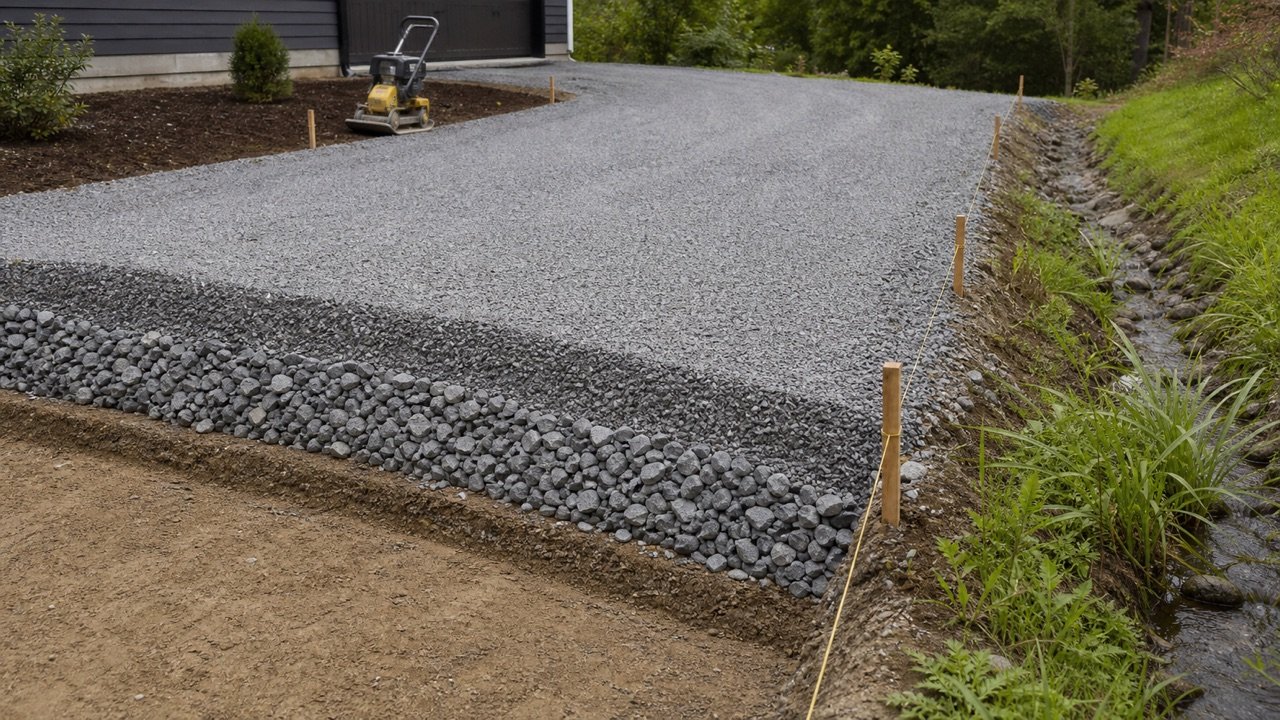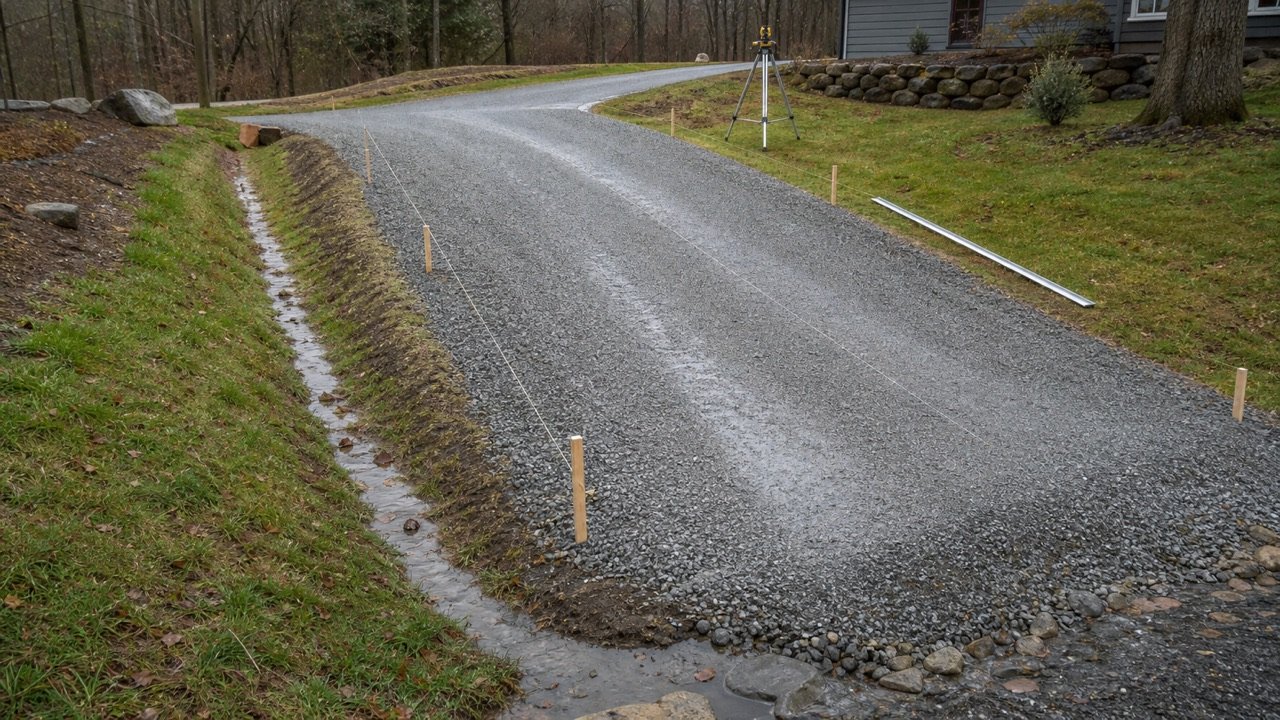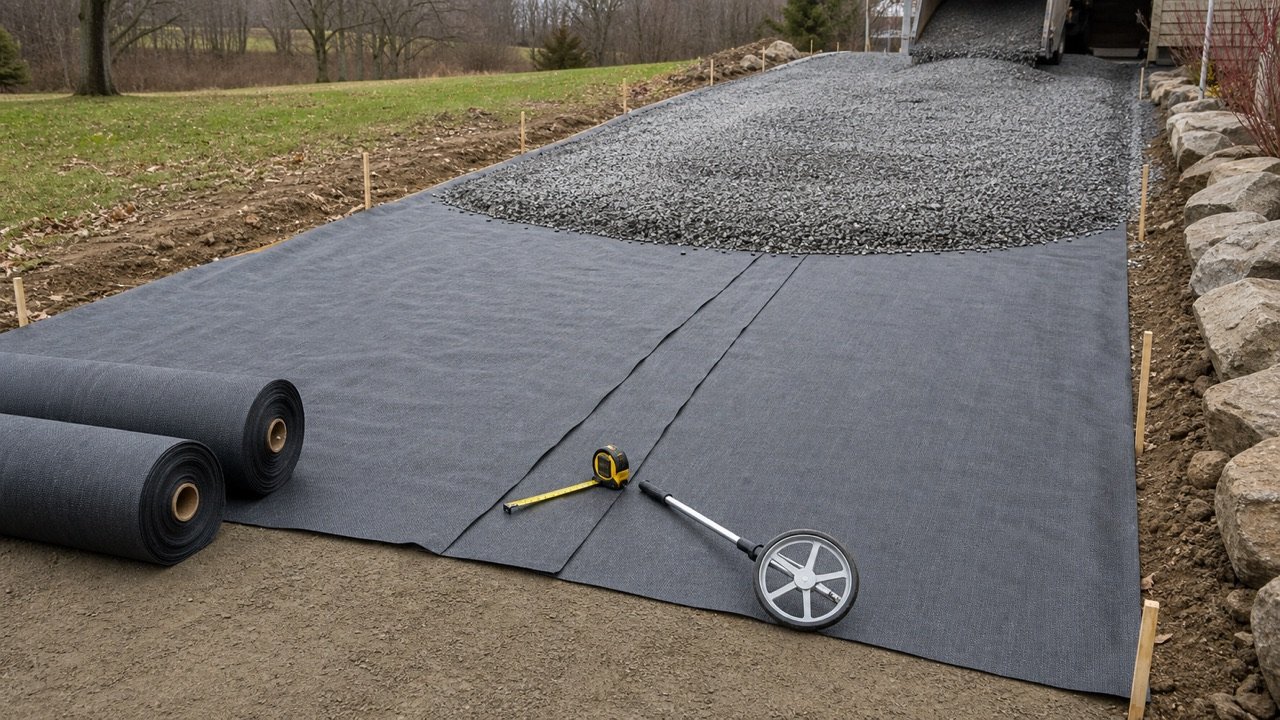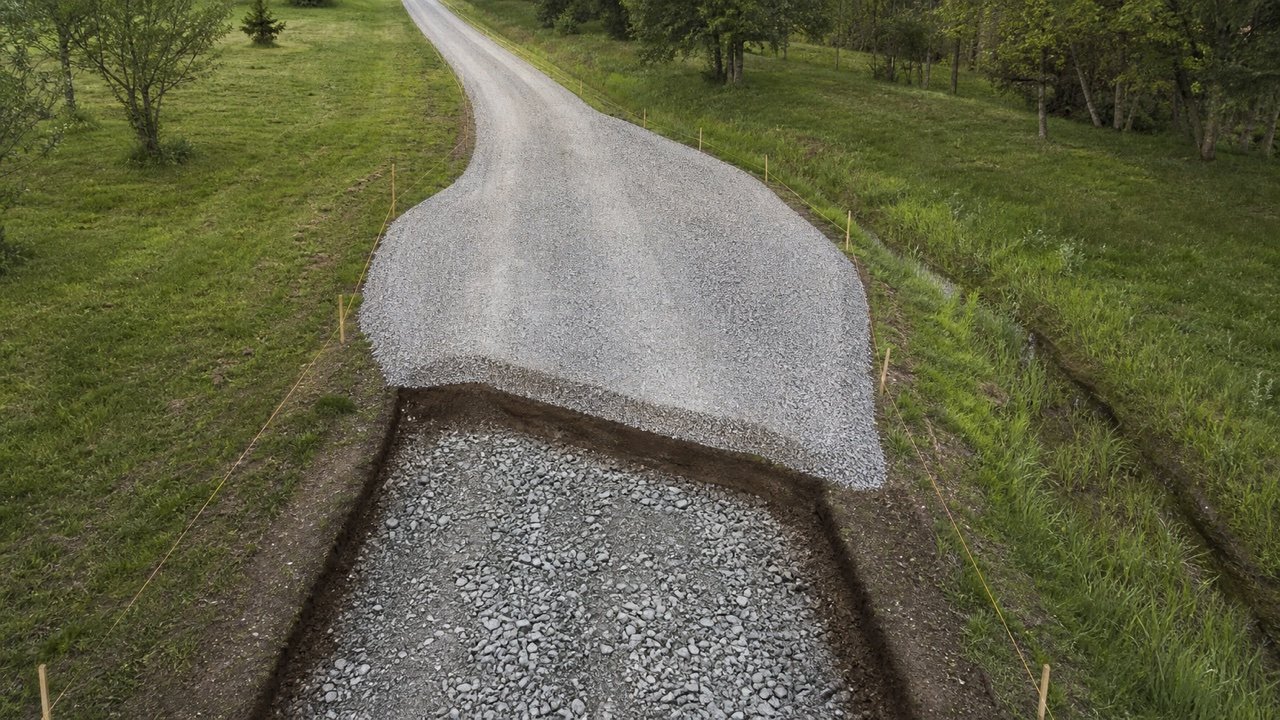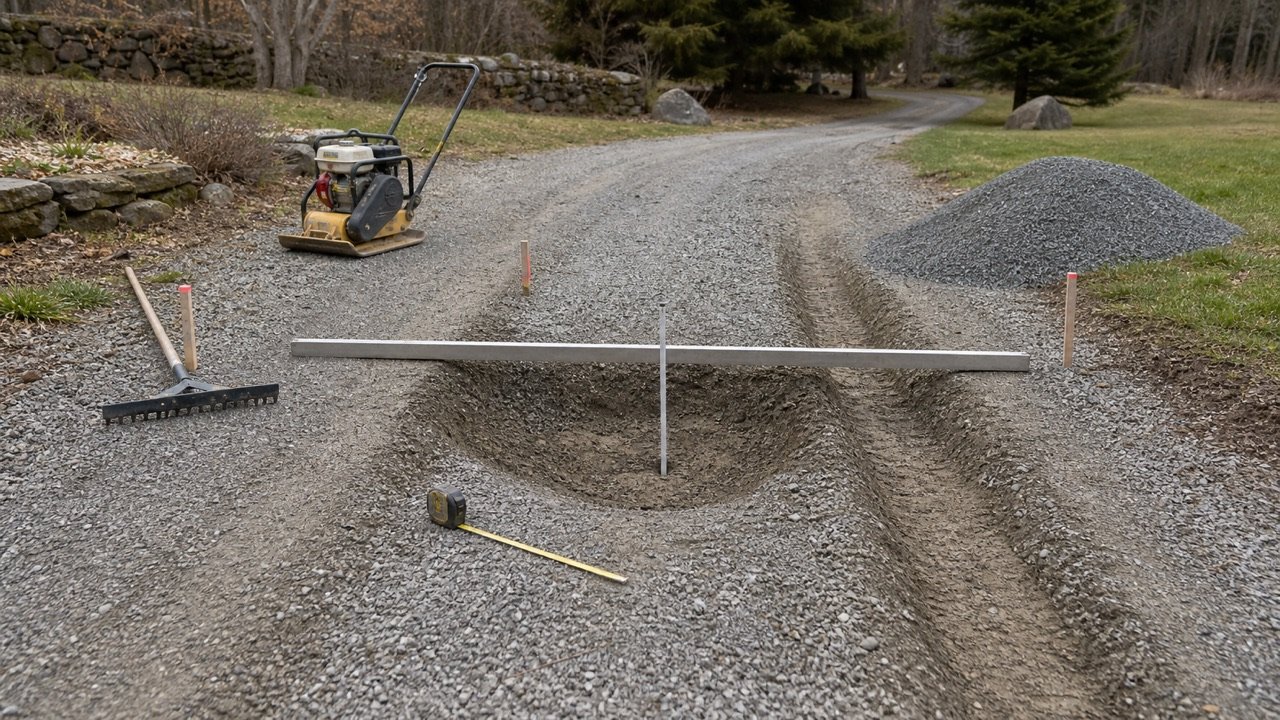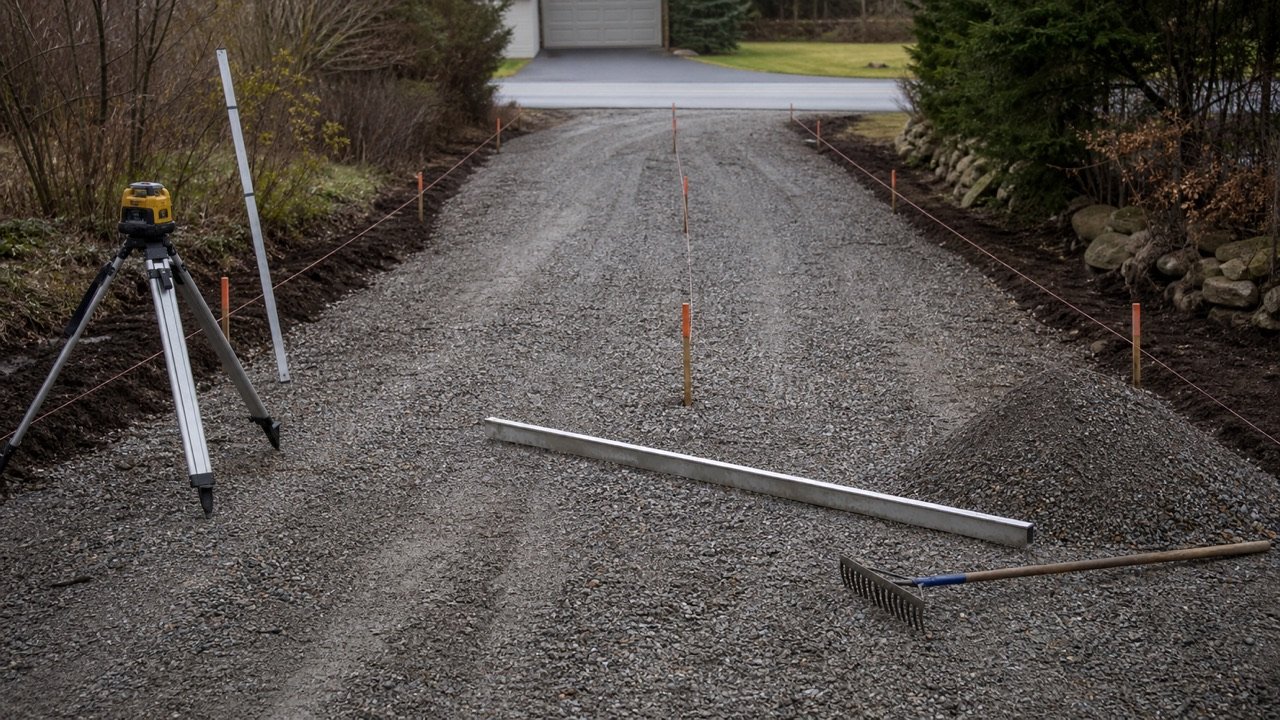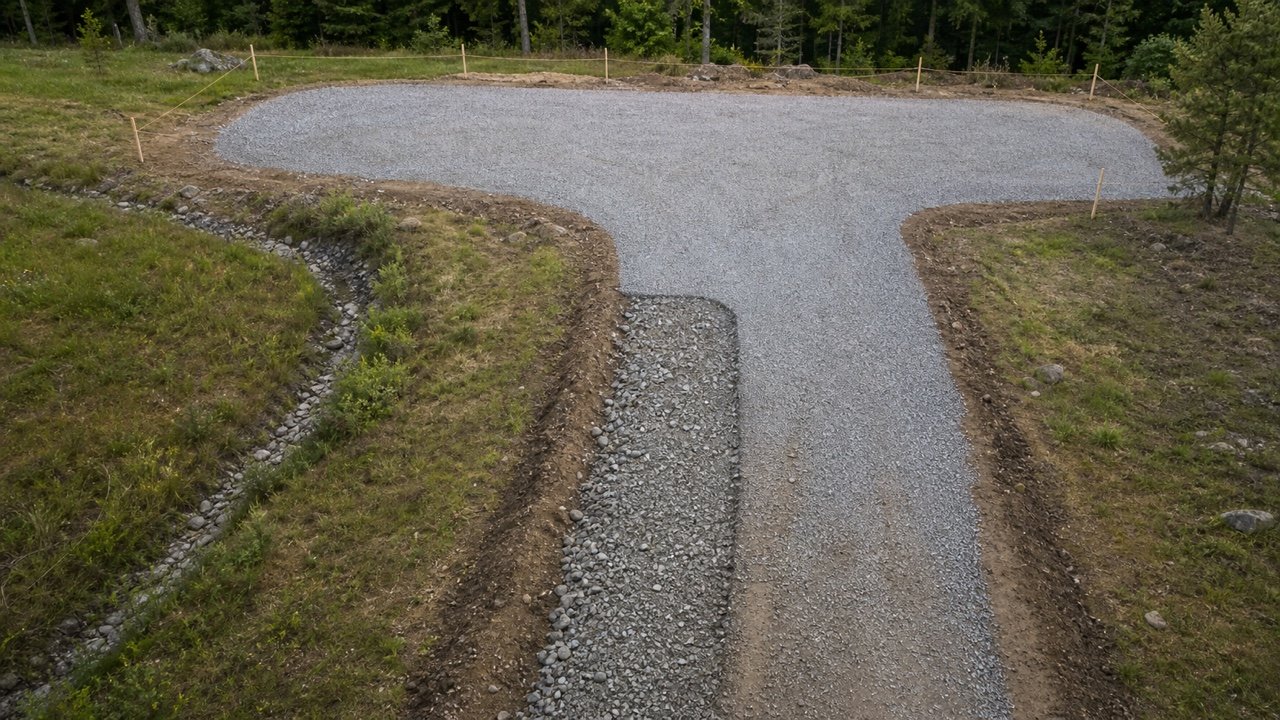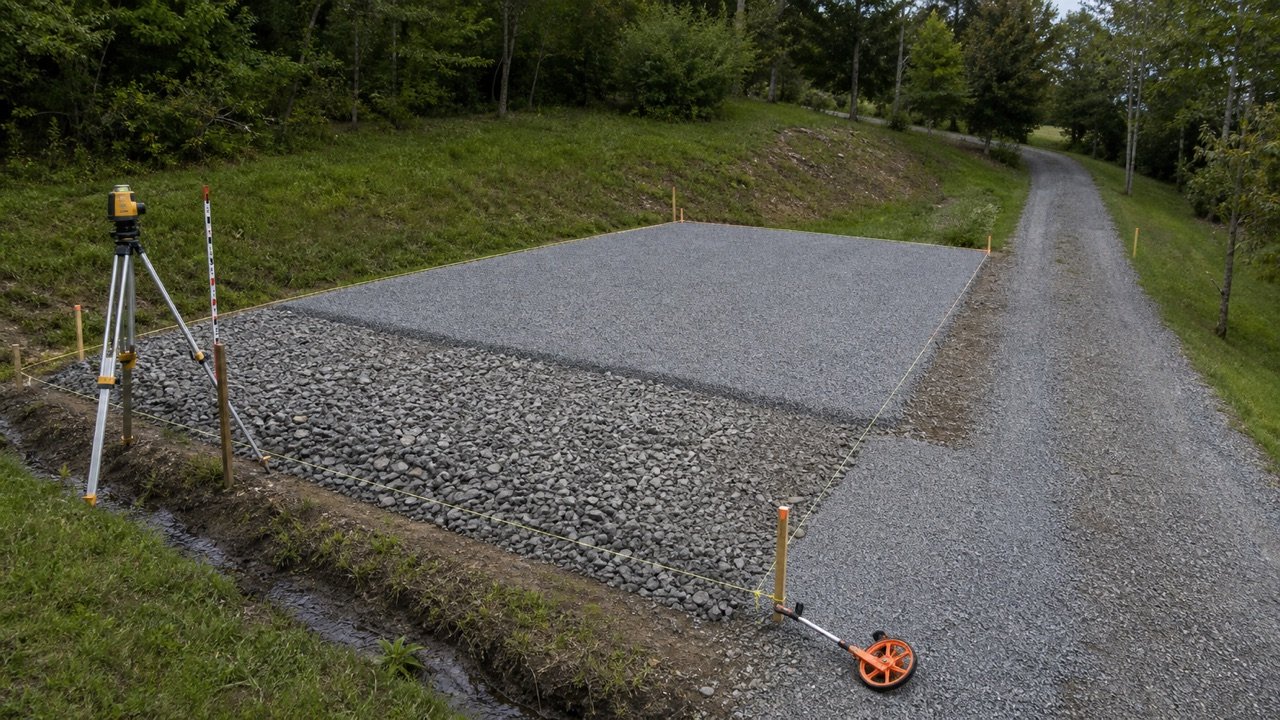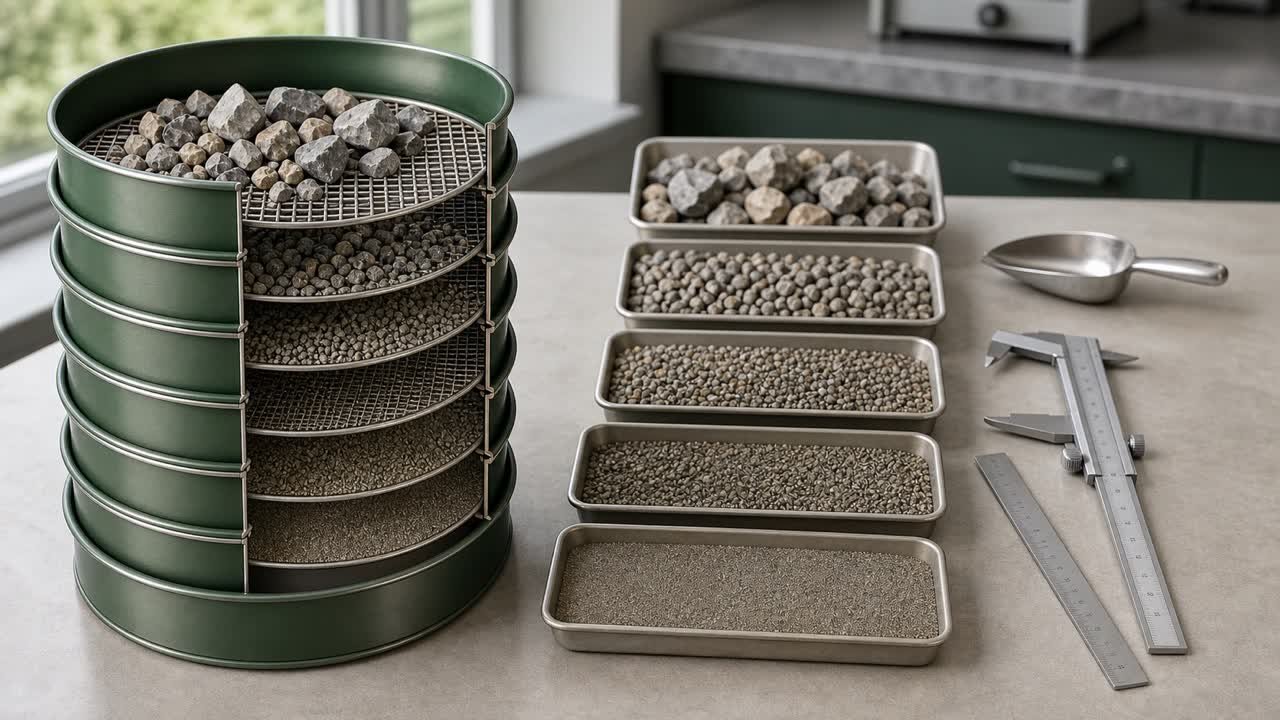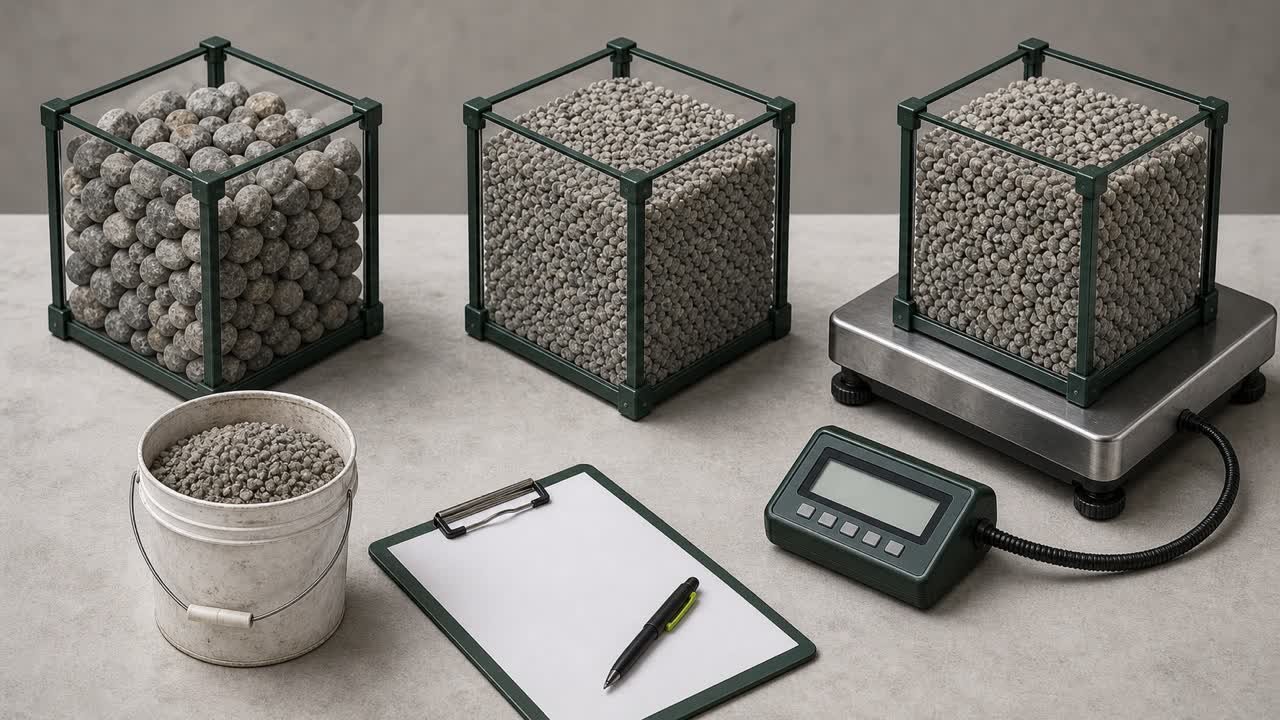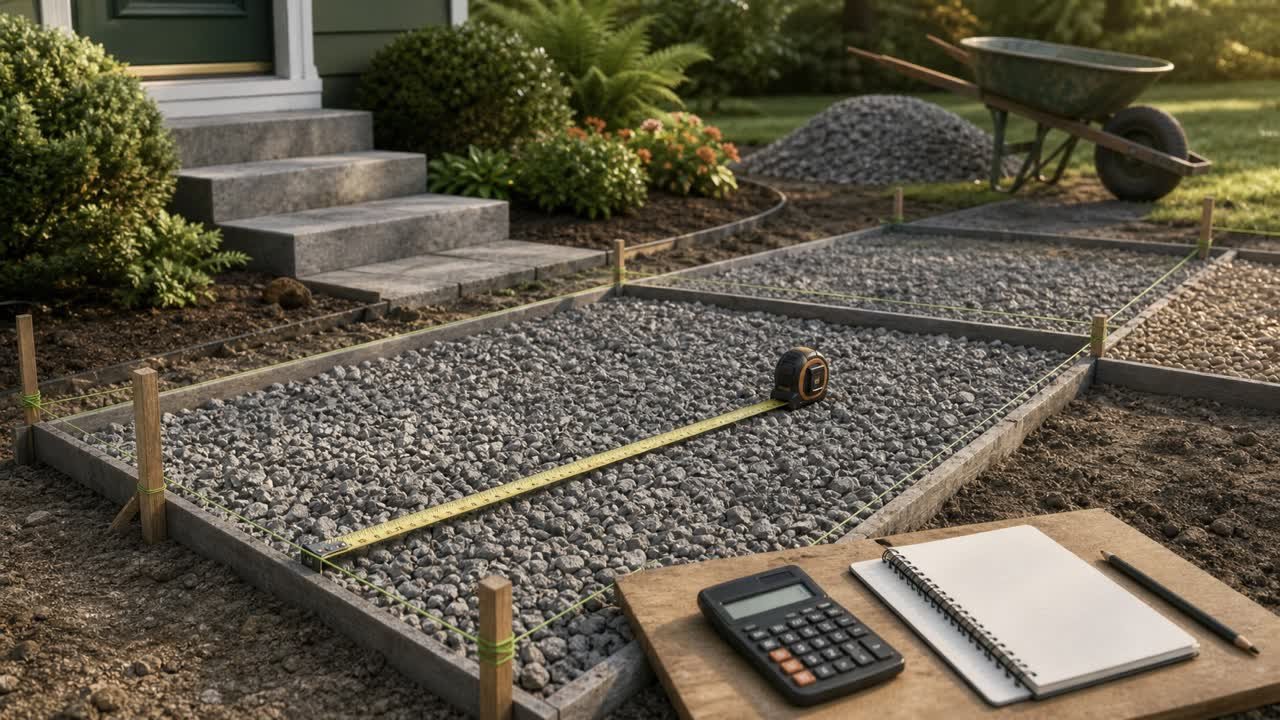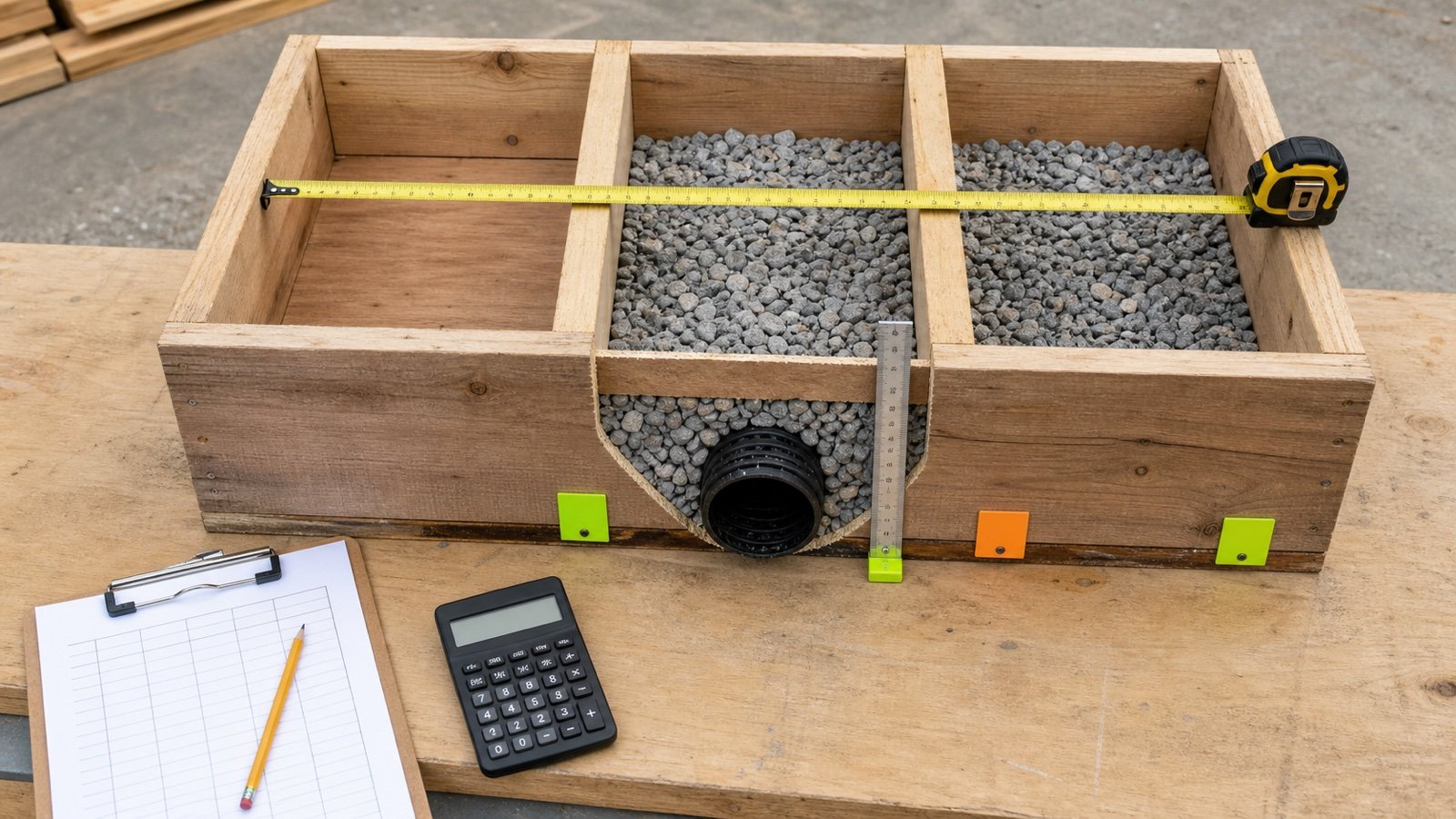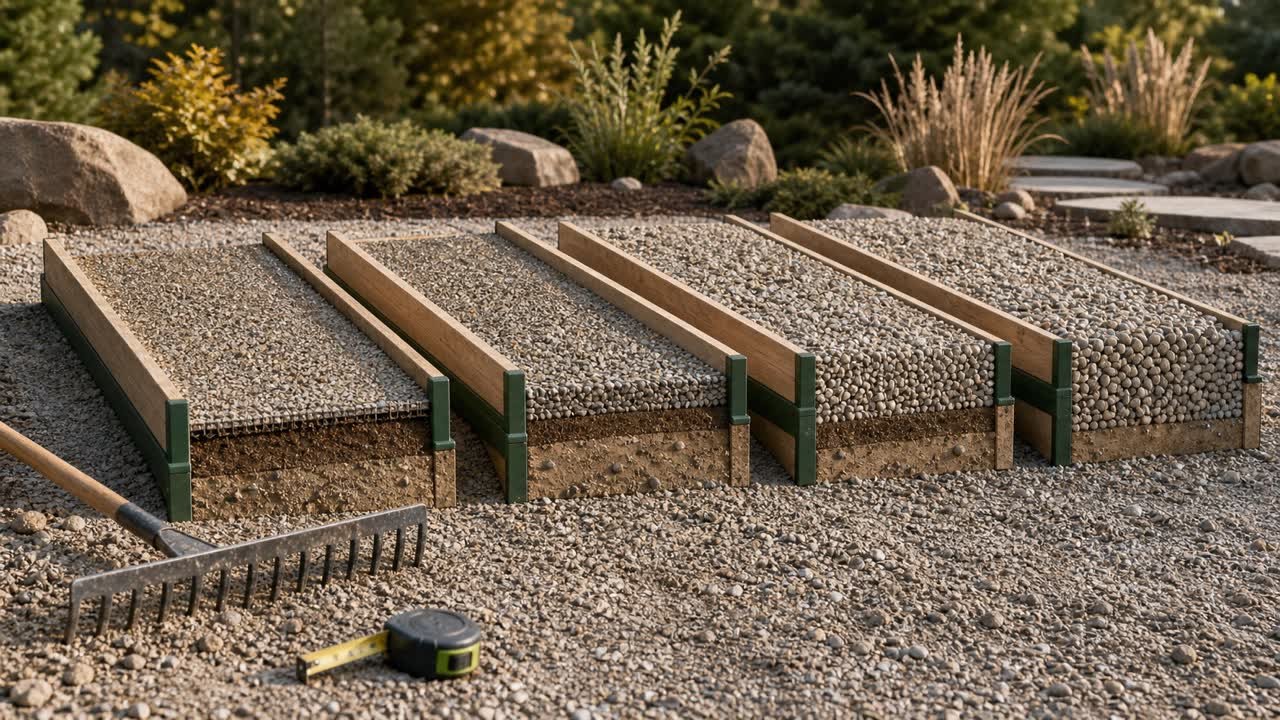
A gravel coverage chart helps you compare an available volume with the area it can cover at a stated depth. Keep the volume and finished depth in the same material state, especially when the delivery is loose but the project requirement describes a compacted layer.
Use the tables for listed depths or apply the formulas to an unlisted depth. For a full project quantity, open the Gravel Calculator and enter each measured section separately.
How much area does gravel cover?
One cubic yard covers 108 ft² at an even 3 in depth. One cubic metre covers 20 m² at an even 50 mm depth. Coverage decreases as the installed depth increases.
Coverage area equals volume divided by depth when the units are compatible. Coverage by weight also needs the selected product's documented bulk density and material condition.
What is the gravel coverage formula?
Coverage area = material volume ÷ installed depth
Convert the depth to feet when the volume is in cubic feet, or to metres when the volume is in cubic metres. The result describes an even geometric layer. Surface variation, placement, settlement, compaction, and handling can change the volume needed in the field.
How much does one cubic yard of gravel cover?
One cubic yard equals exactly 27 cubic feet. Dividing 27 ft³ by the depth in feet gives these mathematical coverage values.
| Installed depth | Calculated coverage |
|---|---|
| 1 in | 324 ft² |
| 2 in | 162 ft² |
| 2.5 in | 129.6 ft² |
| 3 in | 108 ft² |
| 3.5 in | 92.57 ft² |
| 4 in | 81 ft² |
| 6 in | 54 ft² |
At 3 in, the calculation is 27 ft³ ÷ 0.25 ft = 108 ft². The 3 in row is a calculation input, not a recommended construction depth. Confirm the required layer and material with the project documents.
How much does one cubic metre of gravel cover?
One cubic metre covers 40 m² at 25 mm, 20 m² at 50 mm, and 10 m² at 100 mm. Convert millimetres to metres before dividing.
| Installed depth | Calculated coverage |
|---|---|
| 25 mm | 40 m² |
| 50 mm | 20 m² |
| 60 mm | 16.67 m² |
| 75 mm | 13.33 m² |
| 100 mm | 10 m² |
At 50 mm, the calculation is 1 m³ ÷ 0.05 m = 20 m².
How do you calculate a depth missing from the chart?
Use the same coverage formula with the exact required depth. Keep more precision during the calculation and round the displayed result at the end.
Coverage from 1 yd³ = 27 ft³ ÷ depth in feet
At 2.5 in, the depth is 2.5 ÷ 12 = 0.208333 ft. One cubic yard covers 27 ÷ 0.208333 = 129.6 ft².
Coverage from 1 m³ = 1 m³ ÷ depth in metres
At 60 mm, the depth is 0.06 m. One cubic metre covers 1 ÷ 0.06 = 16.67 m², rounded to 2 decimal places.
How do you reverse coverage to calculate volume?
Multiply the net area by the required depth. For U.S. customary measurements, dividing square feet times inches by 324 gives cubic yards.
Cubic yards = area (ft²) × depth (in) ÷ 324
A 450 ft² area at 2 in needs 450 × 2 ÷ 324 = 2.778 yd³ of measured geometric volume. Keep 2.778 for later allowance and supplier rounding; display 2.78 yd³ as the measured result.
Cubic metres = area (m²) × depth (m)
A 32 m² area at 75 mm uses 32 × 0.075 = 2.40 m³.
How do you handle sections with different depths?
Calculate each section with its own area and required depth, then add the volumes. This keeps a deep pad from being hidden inside the average for a shallow path.
A 200 ft² path at 2 in uses 200 × 2 ÷ 324 = 1.235 yd³. An adjoining 100 ft² pad at 4 in also uses 100 × 4 ÷ 324 = 1.235 yd³. Together they require 2.469 yd³ before a documented allowance or supplier rounding.
A steadily changing depth can use an average-depth calculation when the geometry supports that assumption. Ruts, isolated depressions, crowns, and edge tapers need smaller measured sections. The gravel quantity guide explains section-based measurement in more detail.
How do you calculate the gravel still needed after partial placement?
Measure the accepted finished area at the accepted finished depth, then subtract its volume from the planned geometric volume. Keep delivery tickets separate if they describe loose material or a different material state.
| Ledger line | Area and depth | Geometric volume |
|---|---|---|
| Planned section | 600 ft² at 3 in | 5.556 yd³ |
| Accepted finished work | 340 ft² at 3 in | 3.148 yd³ |
| Remaining work | 260 ft² at 3 in | 2.407 yd³ |
| Closure check | 340 ft² + 260 ft² | 3.148 + 2.407 = 5.556 yd³ |
The same method works in metric units. A 55 m² section at 75 mm totals 4.125 m³. If 31 m² has been accepted at that depth, the accepted volume is 2.325 m³ and the remaining 24 m² needs 1.800 m³.
Recalculate when the prepared surface, finished boundary, or required depth changes. Keep the original and revised measurements as separate records so the change remains traceable.
How much can a project-defined depth range change the volume?
Calculate the low and high permitted depths separately when project documents supply a depth range. The difference shows the possible material effect within that stated range.
For 600 ft², a 2.75 in layer equals 600 × 2.75 ÷ 324 = 5.093 yd³. A 3.25 in layer equals 6.019 yd³. The difference is 0.926 yd³.
This example does not set a depth tolerance. The project designer, specification, or other responsible authority controls the permitted depth and how it is checked.
How should coverage become a supplier order?
Keep the geometric volume, documented allowance, and rounded supplier order on separate lines. Each stage answers a different question.
| Quantity stage | What it represents | Controlling information |
|---|---|---|
| Table coverage | An even layer from a stated bulk volume at a stated depth | Compatible units and geometry |
| Measured project volume | Net area multiplied by the required depth for each section | Field measurements and project requirements |
| Planning quantity | Measured volume plus a documented project allowance | Measured uncertainty, placement conditions, or project data |
| Supplier order | Planning quantity adjusted to the quoted selling increment | Product data, minimum order, delivery terms, and supplier rounding |
Use the Gravel Weight Chart only when you have product-specific bulk-density information for the relevant material state. Loose delivered volume, compacted design volume, and legal vehicle payload are separate values.
How should an irregular area be measured?
Divide the shape into rectangles, triangles, or measured strips. Calculate each area and add the results. Use the longest length and widest width only when the full enclosing rectangle will receive gravel.
Deduct slabs, planting beds, structures, and drainage features when they will not receive material. Small deductions may leave the supplier's rounded order unchanged, but keeping them visible makes the calculation easier to audit.
How do you check placed depth in the field?
- Set several checkpoints across each section before spreading.
- Measure from the prepared surface to the finished gravel surface.
- Record low, high, and centre readings with their locations.
- Label the checked state as loose, settled, or compacted.
- Recalculate the remaining volume if the area or accepted depth changes.
The chart cannot account for ruts, crossfall, edge taper, surface depressions, or a loose layer that will later compact. The loose and compacted gravel guide explains why the states should remain separate.
Which coverage assumptions cause ordering errors?
| Assumption | What to check instead |
|---|---|
| The 3 in row recommends a project depth. | Use the project requirement to select the layer and depth. |
| One ton always covers the same area. | Obtain the selected product's bulk density and material condition. |
| Nominal delivered volume proves finished yield. | Track delivery state, placement, settlement, compaction, and accepted geometry. |
| One gross rectangle describes every site. | Separate exclusions, widened areas, slopes, and different depths. |
| One measured depth describes the whole section. | Record several representative checkpoints and their locations. |
Material size and gradation can affect suitability, placement, and compaction. Check the Gravel Size Chart for terminology, then compare the chosen product with the governing project requirement.
Sources and scope
- NIST Handbook 44 (2026), Appendix C: supports the exact 27 ft³ per yd³ relationship and metric volume relationships used in the formulas.
- U.S. EPA Gravel Roads: Maintenance and Design Manual landing page: provides the official manual scope and access to its sections and appendices.
- U.S. EPA Appendix C: Quantity Calculations: shows a road-width, added-depth, volume, truck-capacity, and spreading-distance workflow for gravel-road work.
Source scope: NIST supports the unit relationships. The coverage rows and worked examples are independently checked geometry. The EPA appendix shows a quantity-planning workflow within its gravel-road scope; its road-specific assumptions are not used as universal product or compaction factors here. Product data and project requirements control material suitability, required depth, material state, allowance, and order quantity. Sources and calculations checked 8 August 2026.
Browse all Gravel planning tools and guides for the next calculation or reference.