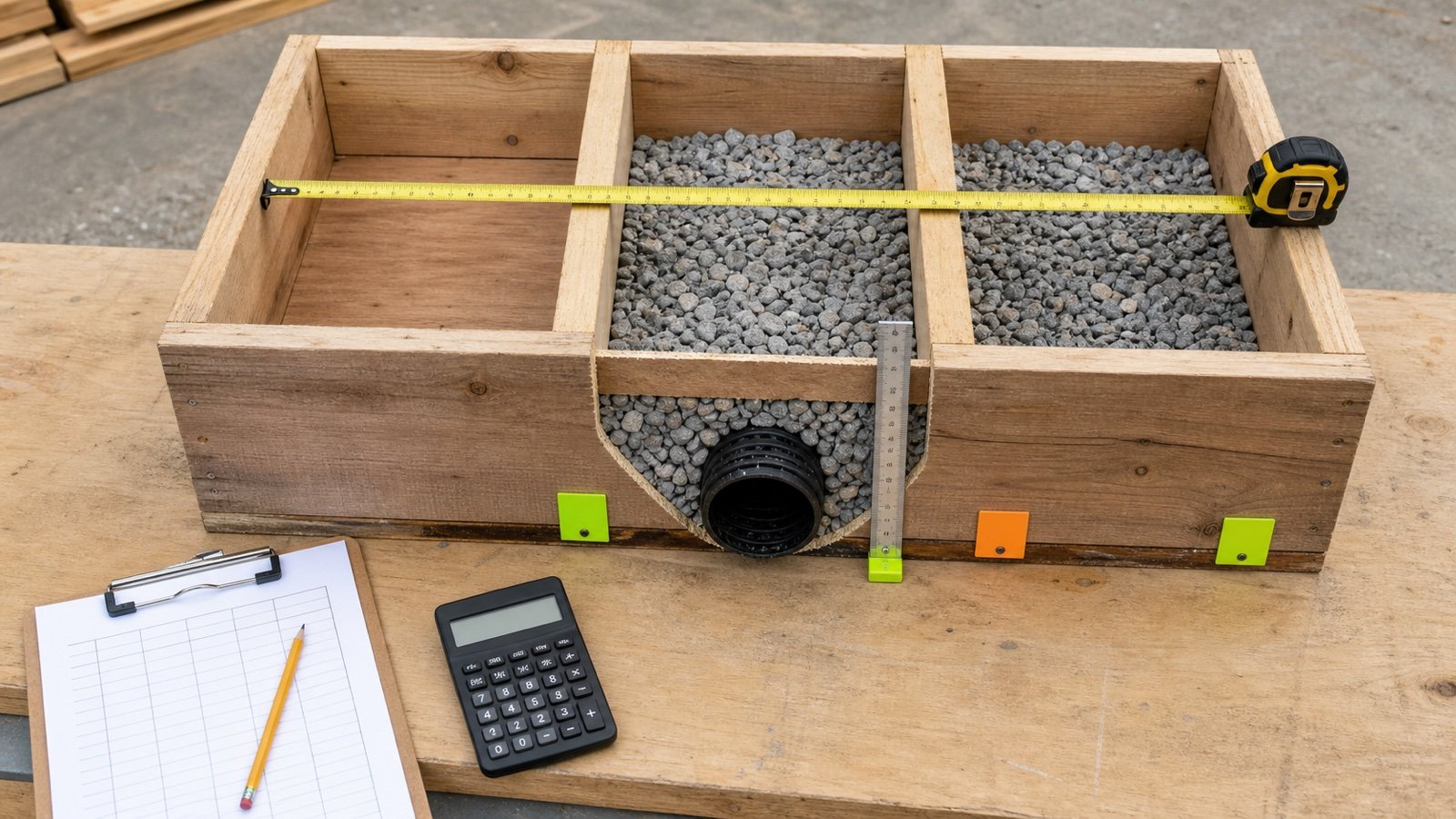
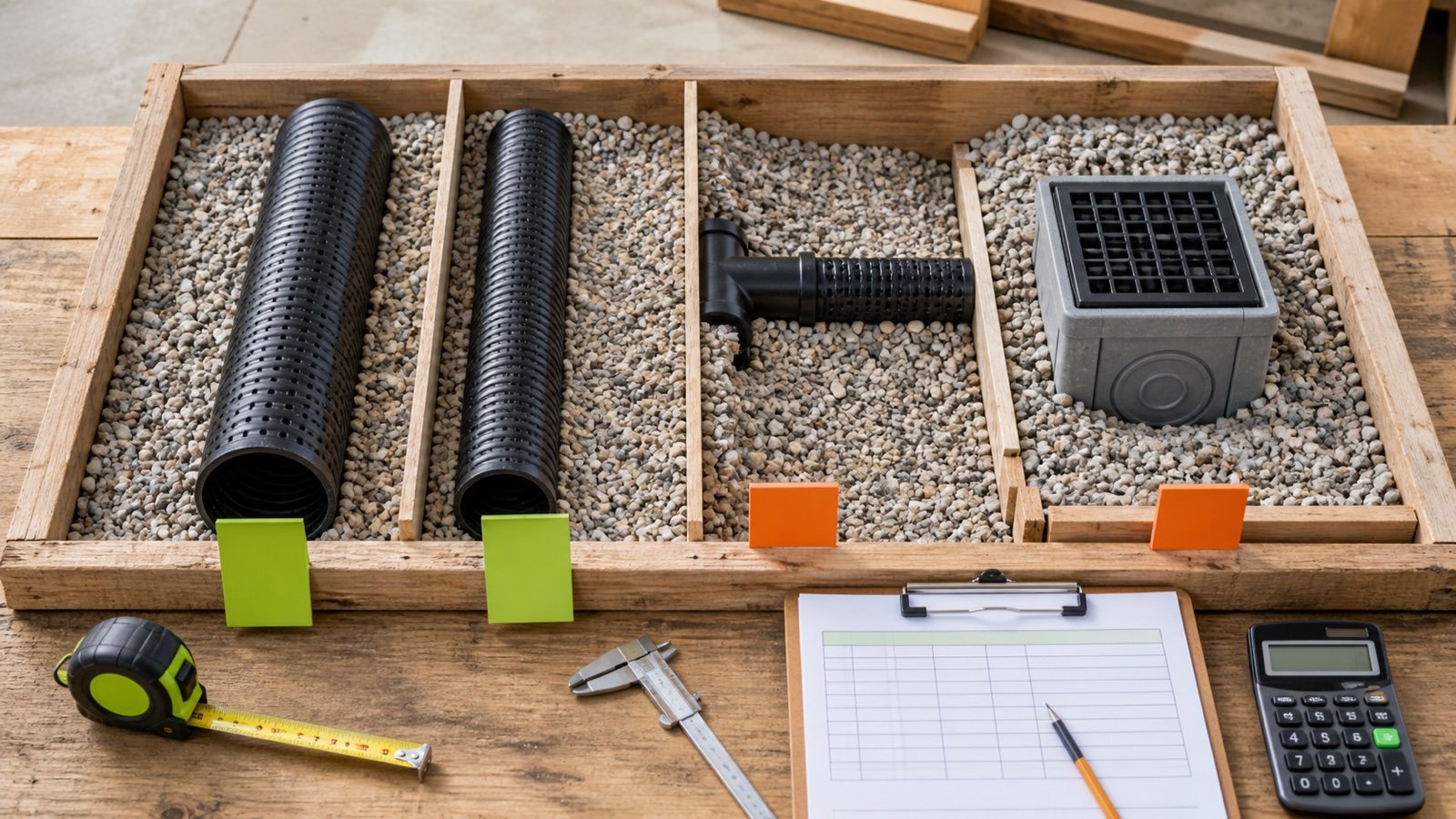
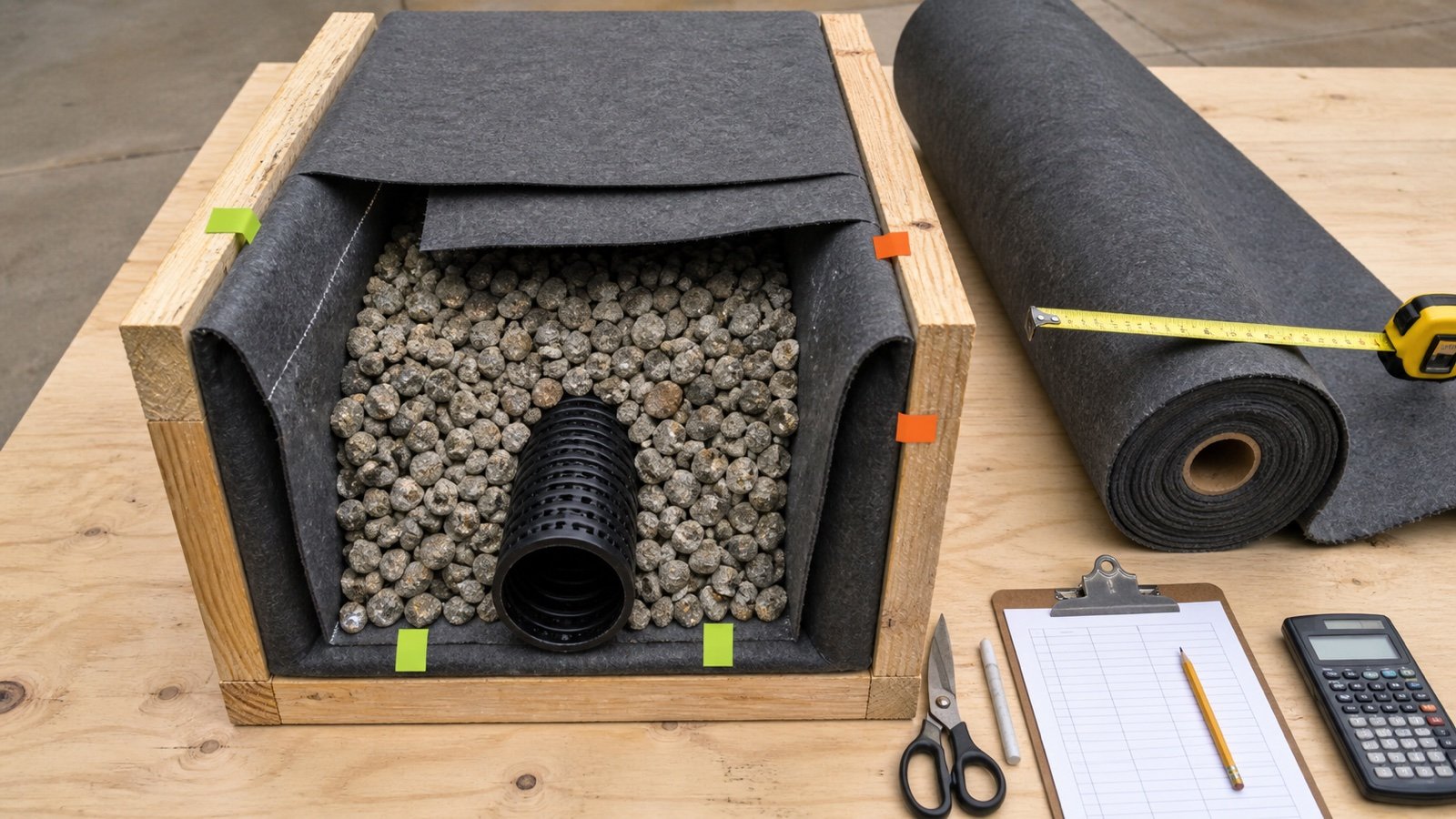
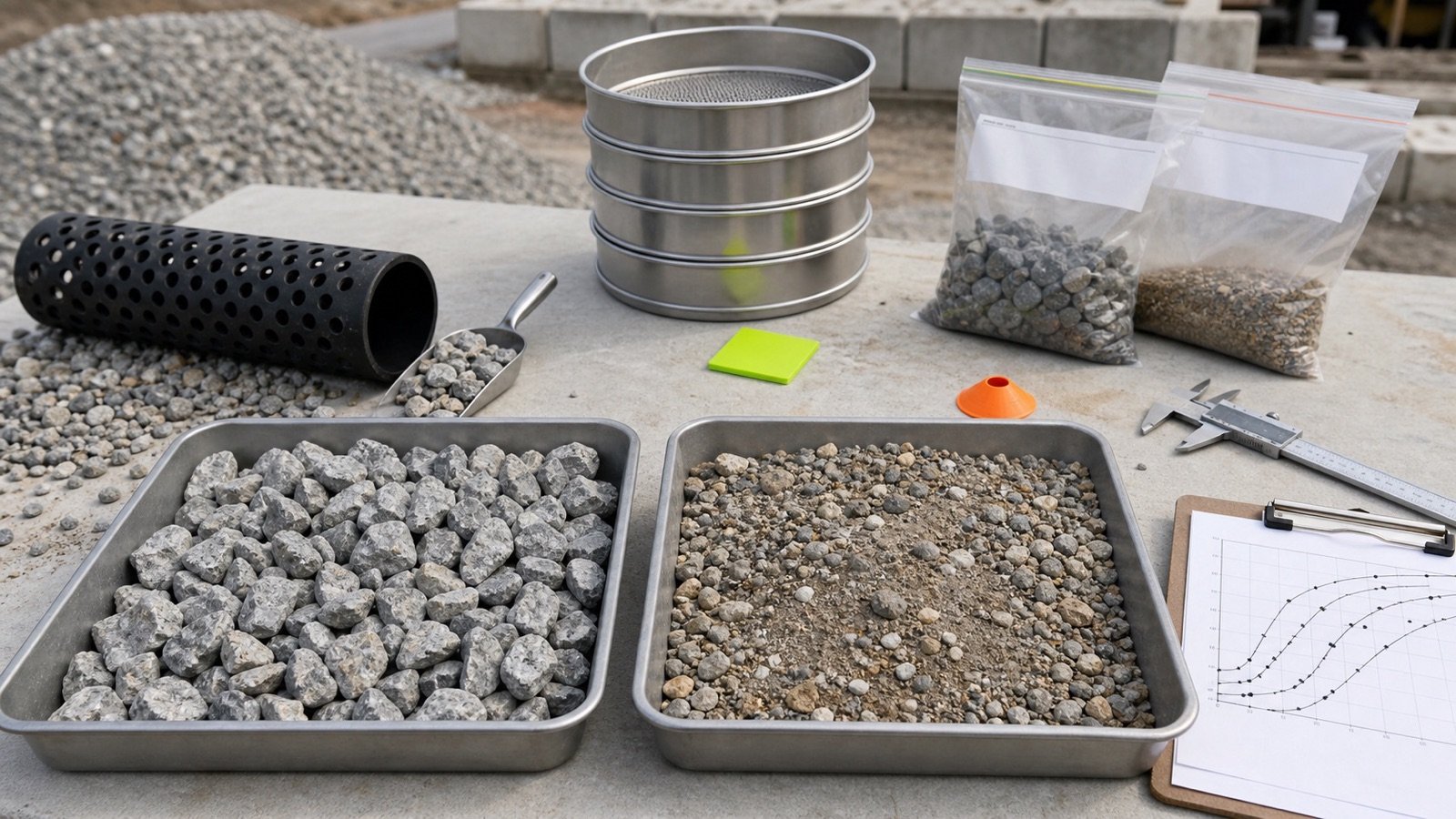
A drainage-gravel order starts with the part of the trench that the selected gravel will occupy. Measure that zone, then subtract the space occupied by a pipe only when the pipe runs through the same full length.
This calculator keeps the gross zone, pipe displacement, net placed gravel, supplier-basis conversion, rounded order, and optional mass on separate lines. Use the drainage-trench measurement guide to record paired widths and depths, the multiple-pipe and structure guide for separate component deductions, the drainage geotextile guide for approved wrap and roll quantities, and the French drain gravel selection guide for product, gradation and filter checks.
How much drainage gravel do you need?
Enter the gravel-zone length, inside width, total placed depth, and the pipe's actual outside diameter. The calculator multiplies the rectangular zone, subtracts the circular pipe volume, and returns cubic metres or cubic yards.
The result measures quantity for a detail you already have. Drawings, local requirements, pipe information, drainage design, soil and water conditions, and the responsible project people determine the trench, pipe, gravel, filter, and outlet.
Which volume does the calculator measure?
The calculator measures the net space available for drainage gravel inside one constant rectangular zone. It does not use the full excavation depth unless gravel fills that full depth.
| Result | Meaning | Record to keep |
|---|---|---|
| Gross gravel zone | Length × inside width × total placed gravel depth | Drawing, detail, field measurement, units, and section limits |
| Pipe displacement | Full-length cylinder calculated from actual outside diameter | Pipe product, OD source, and included run length |
| Placed gravel | Gross zone minus pipe displacement | Unrounded geometric result |
| Supplier basis | Placed gravel after the percentage you enter | Product, material states, factor source, and direction |
| Supplier order | Supplier basis rounded upward to the entered volume increment | Current supplier selling unit and increment |
| Estimated mass | Rounded order × entered supplier bulk density | Density value, state, product, source, unit, and date |
Which dimensions should you enter?
Measure the inside dimensions of the placed gravel zone. Keep its boundaries separate from the excavated opening, soil backfill, surface restoration, and any bedding or surround made from another product.
Drainage run length
Use the length where the same gravel cross-section and pipe condition continue. Split branches, changes in width or depth, pits, chambers, outlets, and pipe-size changes into separate sections.
The pipe deduction assumes the pipe occupies the full entered length. Calculate a partial pipe length as a separate section when part of the gravel trench has no pipe.
Gravel-zone width
Enter the inside width filled by the selected drainage gravel. Excavation width may include working space, side slopes, shoring, overbreak, or other zones that do not receive this product.
Check the width at several points. Divide the run where the planned or measured width changes enough to affect the order.
Total gravel-zone depth
Use the vertical depth from the bottom to the top of the selected gravel zone. If the detail identifies a bed below the pipe and a gravel cover above it, the total zone depth includes the bed, the pipe outside diameter, and the gravel cover.
Separate another bedding, haunch, surround, or final-backfill product. The pipe-zone guide explains how to keep those material zones distinct.
Why does actual pipe outside diameter matter?
The circular space inside the gravel zone depends on outside diameter. A nominal pipe size may describe a product series or internal flow size and may differ from the installed outside diameter.
Read the manufacturer's current product data, approved submittal, pipe marking, or checked project schedule. The nominal size and outside-diameter guide shows why the 2 values belong in separate fields.
Leave the OD field blank when no pipe occupies the measured zone. Do not use zero to hide an unknown pipe size when the pipe displacement belongs in the quantity.
What formulas does the drainage gravel calculator use?
The tool converts every cross-section input to metres or feet before calculating area. Imperial cubic feet are divided by 27 for the cubic-yard results.
Gross zone volume = length × gravel-zone width × gravel-zone depth
Pipe displacement = π × (outside diameter ÷ 2)² × included pipe length
Placed gravel volume = gross zone volume − pipe displacement
Supplier-basis volume = placed gravel × (1 + entered increase % ÷ 100)
Rounded order = ceiling(supplier basis ÷ increment) × increment
Estimated ordered mass = rounded order × supplier bulk density
NIST Handbook 44 Appendix C supports 27 ft³ per yd³ and 1,000 L per m³. The calculator keeps full precision through its formula and displays up to 3 decimal places.
Worked metric drainage-gravel example
A constant gravel zone is 30 m long, 40 cm wide, and 50 cm deep. One pipe with a checked 110 mm outside diameter runs through the full section.
- Gross zone: 30 × 0.40 × 0.50 = 6 m³.
- Pipe displacement: π × 0.055² × 30 = 0.285 m³.
- Placed gravel: 6 − 0.285 = 5.715 m³.
- A user-entered 12% supplier-basis increase gives 5.715 × 1.12 = 6.401 m³.
- A confirmed 0.5 m³ supplier increment rounds the order to 6.5 m³.
- A supplier density of 1,600 kg/m³ gives an estimated ordered mass of 10,400 kg, or 10.4 metric tonnes.
Result: the measured zone contains 5.715 m³ of placed gravel after pipe displacement. The stated supplier inputs produce a 6.5 m³ order.
Worked imperial drainage-gravel example
A gravel zone is 100 ft long, 18 in wide, and 24 in deep. One full-length pipe has a 4 in actual outside diameter.
- Gross zone: 100 × 1.5 × 2 = 300 ft³, or 11.111 yd³.
- Pipe displacement: π × (4 ÷ 12 ÷ 2)² × 100 = 8.727 ft³, or 0.323 yd³.
- Placed gravel: 11.111 − 0.323 = 10.788 yd³.
- A user-entered 5% supplier-basis increase gives 11.327 yd³.
- A confirmed 0.25 yd³ increment rounds the order to 11.5 yd³.
- A supplier density of 1.4 short tons/yd³ gives 16.1 short tons, or 32,200 lb.
The mass is an estimate based on the entered density and rounded volume. A supplier scale ticket records delivered mass.
How should bed, pipe, and cover measurements be combined?
Build the total gravel-zone depth from the approved detail. For one pipe resting within one gravel product, add the gravel bed below the pipe, the actual pipe OD, and the gravel cover above the pipe.
Total gravel-zone depth = bed below pipe + actual pipe OD + gravel cover above pipe
Example: a detail shows 100 mm of gravel below a 160 mm OD pipe and 150 mm of the same gravel above it. Enter 410 mm, or 41 cm, as total metric gravel-zone depth and enter 160 mm as OD.
A shaped bed, cradle, partial surround, multiple pipes, or different materials cannot be represented by that one rectangle-minus-circle method. Use the detailed section geometry and separate quantity lines.
How should placed and supplier-basis volume be separated?
Placed volume describes the completed gravel zone after the pipe deduction. Supplier-basis volume applies the percentage you enter to convert that placed volume to another documented state.
Record both states and the direction of the conversion. A 12% increase from placed to supplier basis means supplier basis = placed × 1.12. A statement that a loose material reduces by 12% during placement uses a different denominator and needs its own calculation.
The field starts at 0%. Obtain the value from project tests, supplier information, specifications, or an accountable project decision for the exact product and states being compared.
How should supplier density and rounding be used?
Enter bulk density only when it describes the selected product in the same volume state as the rounded order. Metric mode expects kg/m³. Imperial mode expects US short tons per cubic yard.
Enter a volume increment only when the supplier confirms that selling increment. A 7.31 yd³ supplier basis rounds to 7.5 yd³ with a 0.25 yd³ increment. An exact 7.5 yd³ result stays at 7.5 yd³.
A supplier minimum, mass increment, whole-bag rule, delivery charge, and truck payload are different commercial controls. Record each term in the unit the supplier uses.
Can this calculator size or design a French drain?
The calculator measures gravel for an entered section. It does not determine whether that section can collect, store, infiltrate, or convey the design water flow.
NRCS Code 606 discusses conduit, bedding, embedment, filter-envelope, hydraulic-envelope, soil, and design considerations for subsurface drains. The national standard directs users to applicable local technical guidance. FHWA drainage review guidance also ties pipe bedding and granular support to pipe and site requirements.
A responsible designer or authority may need rainfall, contributing area, soil infiltration, groundwater, grade, outlet, pipe hydraulics, frost, loading, settlement, maintenance access, filter compatibility, and local approval information.
Which conditions need separate calculations?
| Condition | Why one run does not fit | Quantity action |
|---|---|---|
| Branch or junction | Runs overlap or meet at different angles | Calculate clear section lengths and handle the junction from the drawing |
| Catch basin, pit, or chamber | Shape and exclusions differ from the trench | Use its own solid geometry and component deductions |
| Changing width or depth | Cross-section is not constant | Split the route at each change and add unrounded volumes |
| Pipe changes size | Displacement changes | Use one calculation for each actual OD and length |
| Pipe occupies part of the run | Full-length deduction would overstate pipe volume | Separate pipe and no-pipe sections |
| Multiple pipes | Spacing and overlap with the gravel boundary matter | Calculate the approved cross-section from the drawing |
| Shaped bed or partial haunch | Rectangle-minus-full-circle geometry does not match | Use the specified bed and circular-segment geometry |
How should fittings and pipe ends be handled?
The calculator treats the pipe as one straight cylinder with a constant outside diameter. It does not add or subtract elbows, tees, couplers, bells, end treatments, perforations, chambers, or outlet structures.
Use the approved component dimensions when those features change the gravel space enough to affect the quantity. Keep a section sketch beside the takeoff so reviewers can see where straight-run geometry begins and ends.
What excavation checks remain before work starts?
A gravel result does not make a trench safe. For United States construction workplaces, OSHA identifies cave-ins as the primary excavation hazard and addresses utilities, safe access, water, protective systems, equipment, materials near the edge, and competent-person inspections.
Locate and control underground installations through the applicable process before excavation. Site conditions, trench depth, soil, water, adjacent structures, traffic, and worker exposure determine the required controls. Other countries and US state plans may apply different or stricter rules.
Use the Trench Excavation Calculator for gross excavation volume. Keep excavation, drainage gravel, pipe zone, soil backfill, spoil, and restoration quantities on separate lines.
Common drainage-gravel calculation mistakes
- Entering the full excavation depth when gravel fills a smaller zone.
- Using nominal pipe size instead of actual outside diameter.
- Subtracting a full-length pipe from a section where the pipe occupies only part of the run.
- Using one calculation across branches, pits, or changing cross-sections.
- Combining different gravel, bedding, surround, and backfill products.
- Adding a fixed waste or bulking percentage without defining the material states.
- Using an internet density instead of a product- and state-specific supplier value.
- Rounding each short section before adding the product total.
- Treating estimated mass as a vehicle payload or delivered scale weight.
- Using the quantity result as proof of hydraulic design, filter compatibility, or trench safety.
What should the drainage-gravel record contain?
- Project, route, drawing or detail revision, date, and preparer.
- Section limits, length, inside gravel width, total gravel depth, and units.
- Pipe product, actual OD, included length, and source.
- Gross zone, pipe displacement, and unrounded placed gravel.
- Gravel product or specification and each separate material zone.
- Supplier-basis percentage, states, direction, source, and date.
- Density, volume state, selling unit, increment, quote, and confirmation.
- Separate branch, pit, fitting, backfill, geotextile, outlet, and restoration calculations.
- Design, utility, excavation, delivery, access, and unresolved checks.
Use the Gravel Calculator for a general area-and-depth gravel layer. The trench backfill guide covers the material remaining above separate bedding and pipe zones. The gravel planning hub lists related quantity tools and records.
Sources and scope
- NIST Handbook 44 (2026), Appendix C: cubic-foot, cubic-yard, litre, and cubic-metre relationships.
- NRCS Subsurface Drain, Code 606: pipe support, embedment, filter-envelope, hydraulic-envelope, and project-design context.
- FHWA Drainage Guidelines: pipe bedding and select granular support depend on the pipe and site requirements.
- OSHA Trenching and Excavation eTool: United States excavation hazard and control context.
Source scope: NIST supports the stated unit relationships. NRCS and FHWA support the need for a selected drain, pipe, bedding, and envelope detail. OSHA supports the named United States workplace hazards. Project drawings, local technical criteria, pipe and gravel product data, drainage design, soil and groundwater information, supplier records, site controls, and responsible people govern the work.
Review note: Saleem Sial owns the research and editorial record. Formula fixtures, source checks, build validation, and rendered QA form the internal publication gate. Waseem Sial, External Reviewer and Engineer, is listed for ongoing external review; no completed review date is claimed.