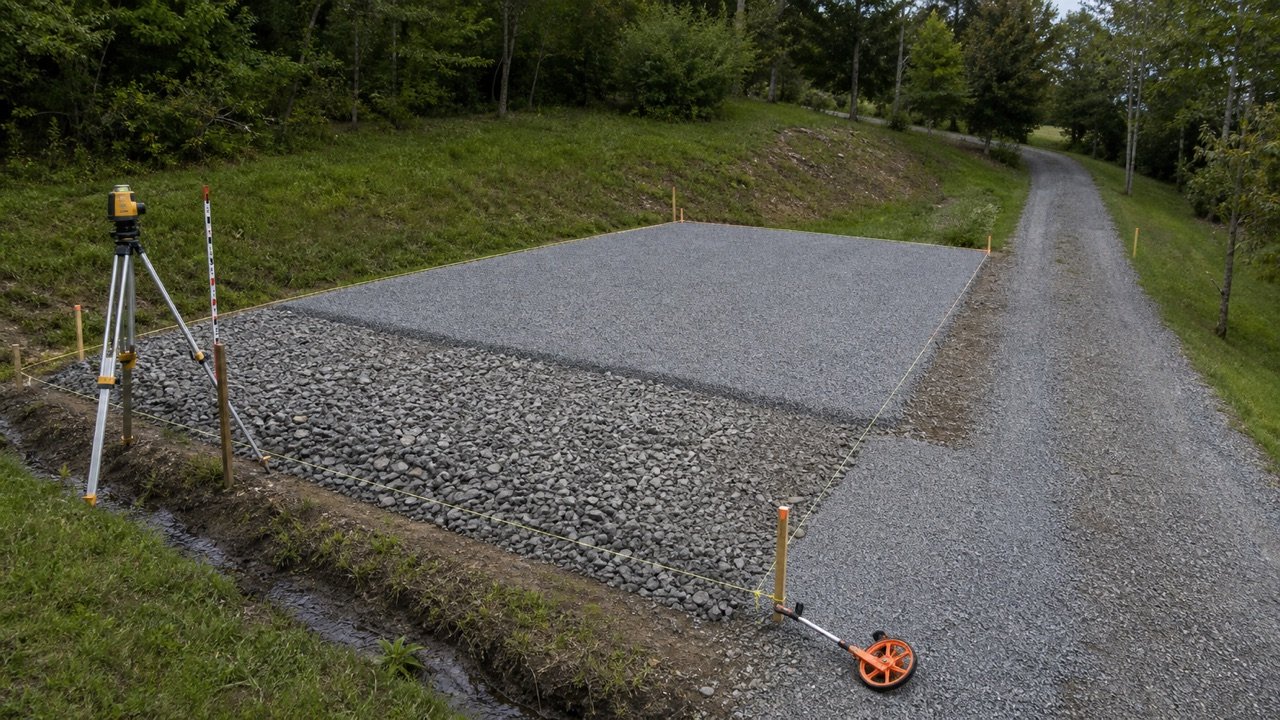
A driveway quantity can include different products at different placed depths. Measure the driveway footprint once when both layers share it, then keep the base and surface calculations on separate lines.
This calculator shows placed volume, a user-entered loose-order conversion, supplier increment rounding, and optional mass for each layer. Every adjustment starts at 0 or blank, so the page does not insert a general depth, density, compaction factor, or truck size.
How much gravel does your driveway need?
Your quantity depends on the measured plan area and the placed depth of each included layer. Enter a base depth, a surface depth, or both. The calculator returns each layer in cubic metres or cubic yards and then builds a separate supplier-order result from the values you enter.
Use the placed result to check geometry. Use the supplier result only after you have evidence for the loose-volume change, product density, selling unit, and order increment.
What does each driveway gravel result mean?
The result schedule keeps 4 quantity stages separate. A change at one stage does not rewrite the measurements behind the earlier stages.
| Result stage | Calculation | Source to record |
|---|---|---|
| Placed volume | Driveway plan area × placed layer depth | Field measurements, drawing, specification, or checked takeoff |
| Supplier-basis volume | Placed volume × (1 + entered loose-volume increase ÷ 100) | Project test, supplier information, specification, or accountable project decision |
| Rounded order | Supplier-basis volume rounded upward to the entered increment | Current supplier quote or order rule |
| Estimated ordered mass | Rounded order × entered supplier bulk density | Exact product, unit, material state, source, and date |
The total placed volume adds active layers. The total order adds each product's rounded quantity. Total mass appears only when every active layer has a density, because a partial mass total could be mistaken for the whole order.
Which driveway footprint should you use?
Choose the mode that matches the measured plan. A rectangle needs one length and width. A uniform taper needs one length plus the width at each end. Known-area mode accepts a checked plan area from a drawing, survey, or separate takeoff.
| Footprint | Use it when | Calculation |
|---|---|---|
| Rectangle | Width stays constant along the measured length | Length × width |
| Uniform taper | Both edges change at a uniform rate between measured end widths | Length × (start width + end width) ÷ 2 |
| Known area | A checked source already gives the plan area | Entered area |
| Separate sections | The driveway has curves, abrupt flares, bays, a turnaround, or changing depths | Calculate each suitable section and add unrounded quantities by product |
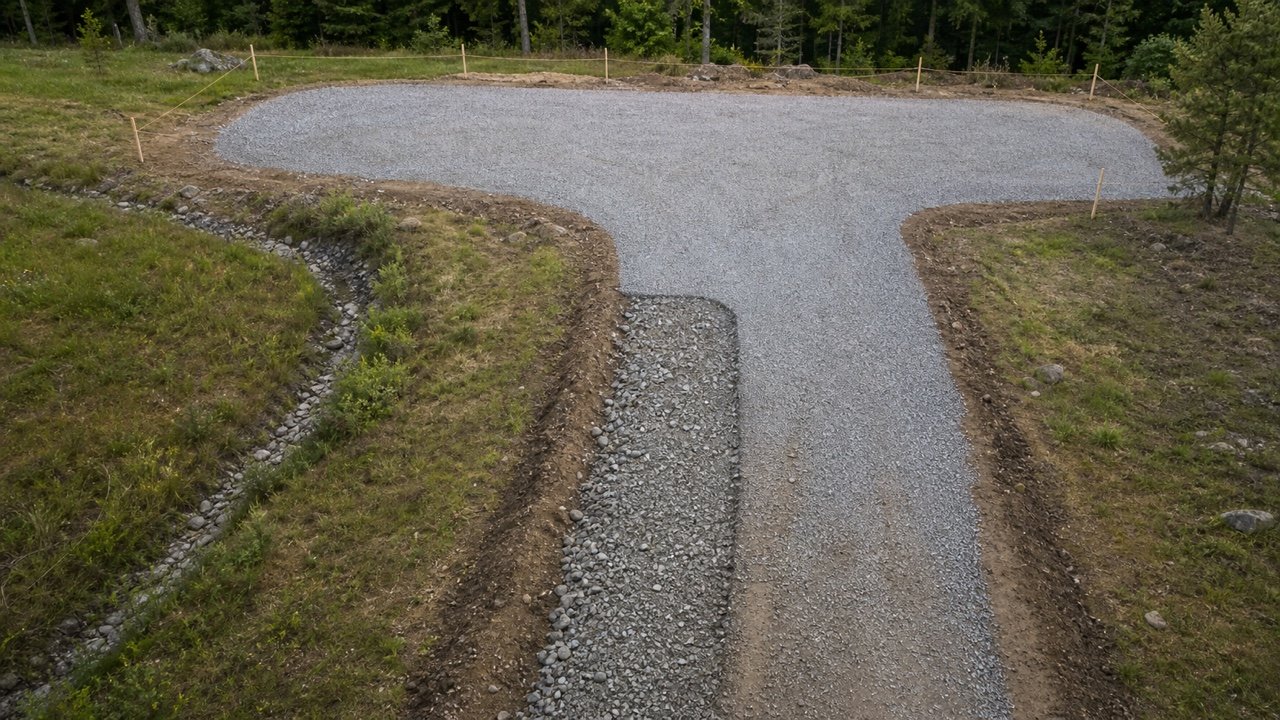
A uniform taper cannot represent a curved drive, sudden widening, circular turnaround, hammerhead, garage apron, parking pad, island, or irregular boundary. Split those features into suitable shapes or use a checked drawing or survey area. The gravel parking pad quantity guide explains composite pad footprints, separate layers, exclusions, and sloped grading fill.
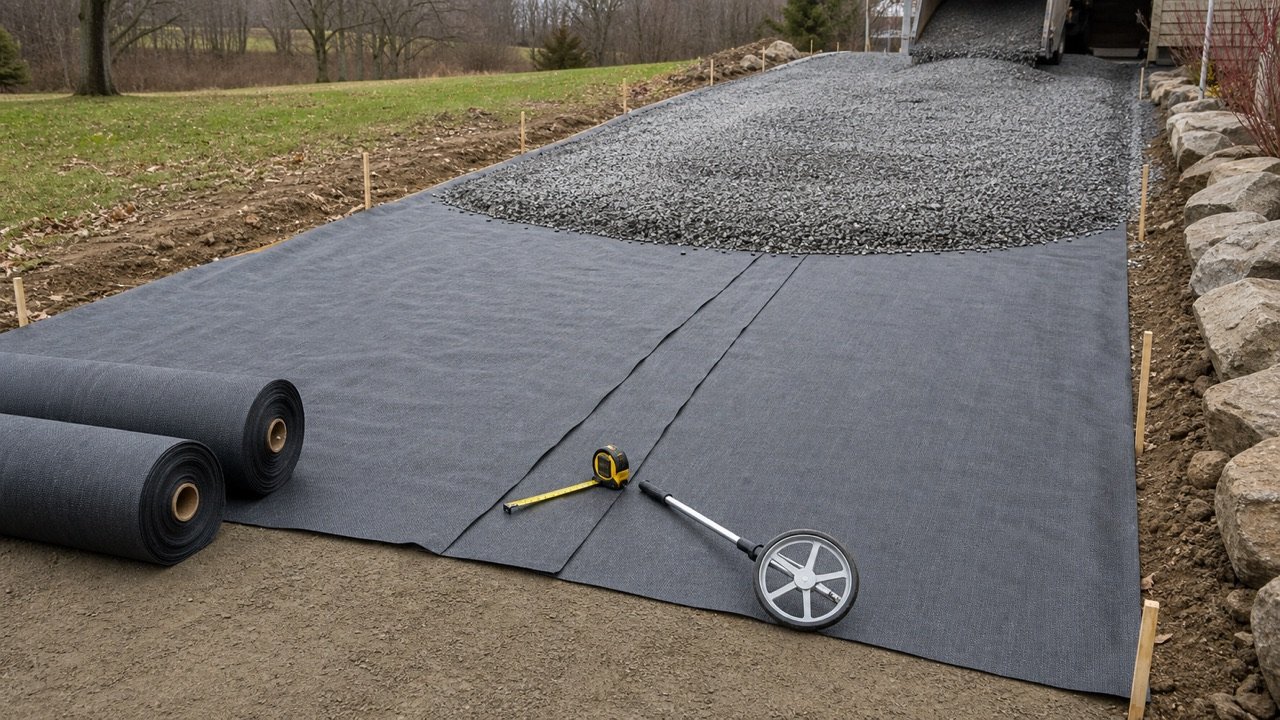
When the accepted footprint will also receive fabric, use the gravel driveway geotextile quantity guide to turn its boundary into panels, overlaps, continuous cut lengths, offcuts, and whole rolls. This calculator does not calculate fabric layout.
Which measurements should you collect?
Record the limits of the material, the width changes, and the placed depth required for each product. Use one unit system through the field record and write down the source of every design depth.
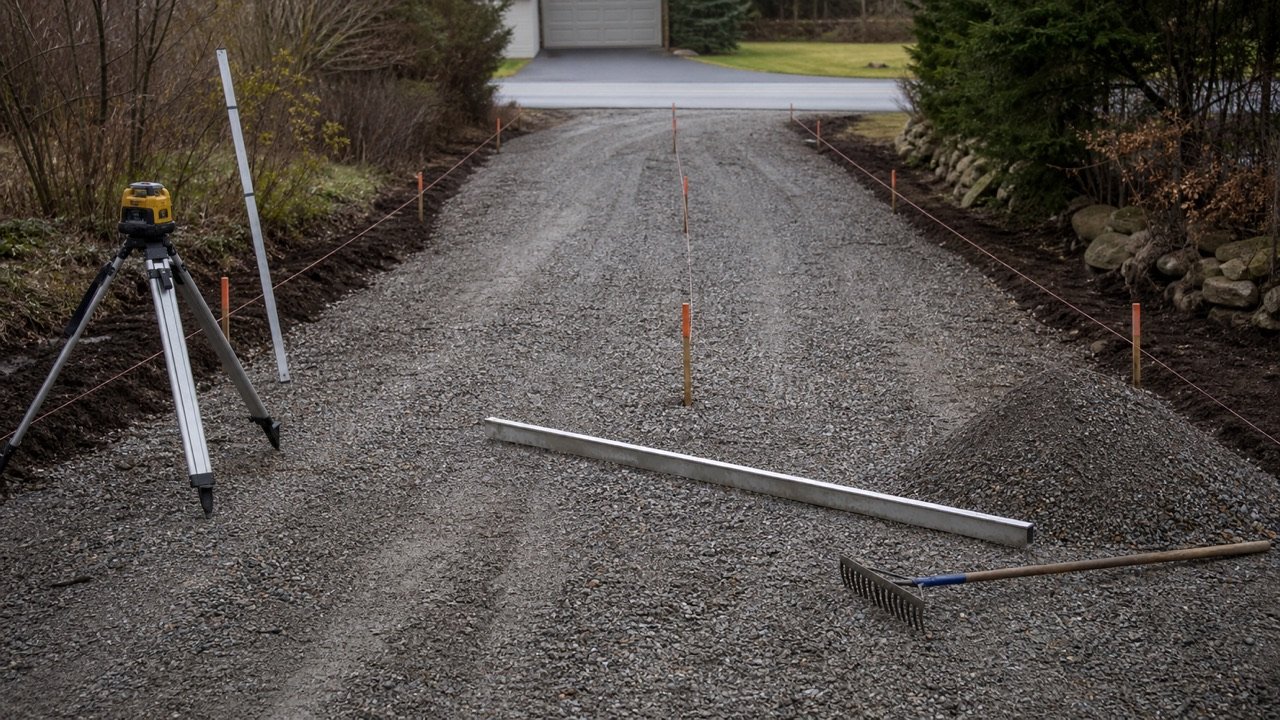
Driveway length and width
Measure the gravel limits. A nearby property line or wheel path may describe a different width. Note gates, kerbs, drains, walls, buildings, shoulders, transitions, and excluded areas that change the footprint.
Take widths at the ends of a uniform taper. Add intermediate width checks. A middle reading that does not follow the end-to-end change means the uniform-taper mode does not describe that section.
Placed layer depth
Enter the depth the completed layer must occupy. The governing drawing, specification, site design, geotechnical advice, local requirement, or responsible project person supplies this depth.
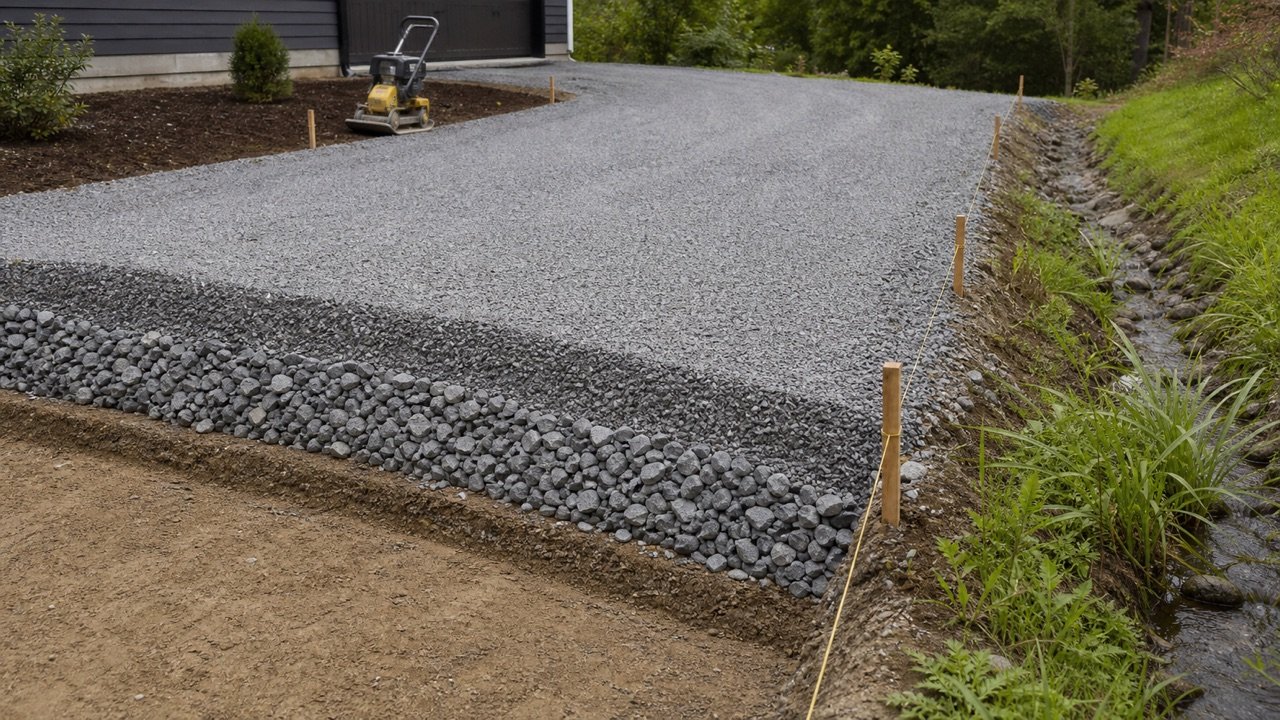
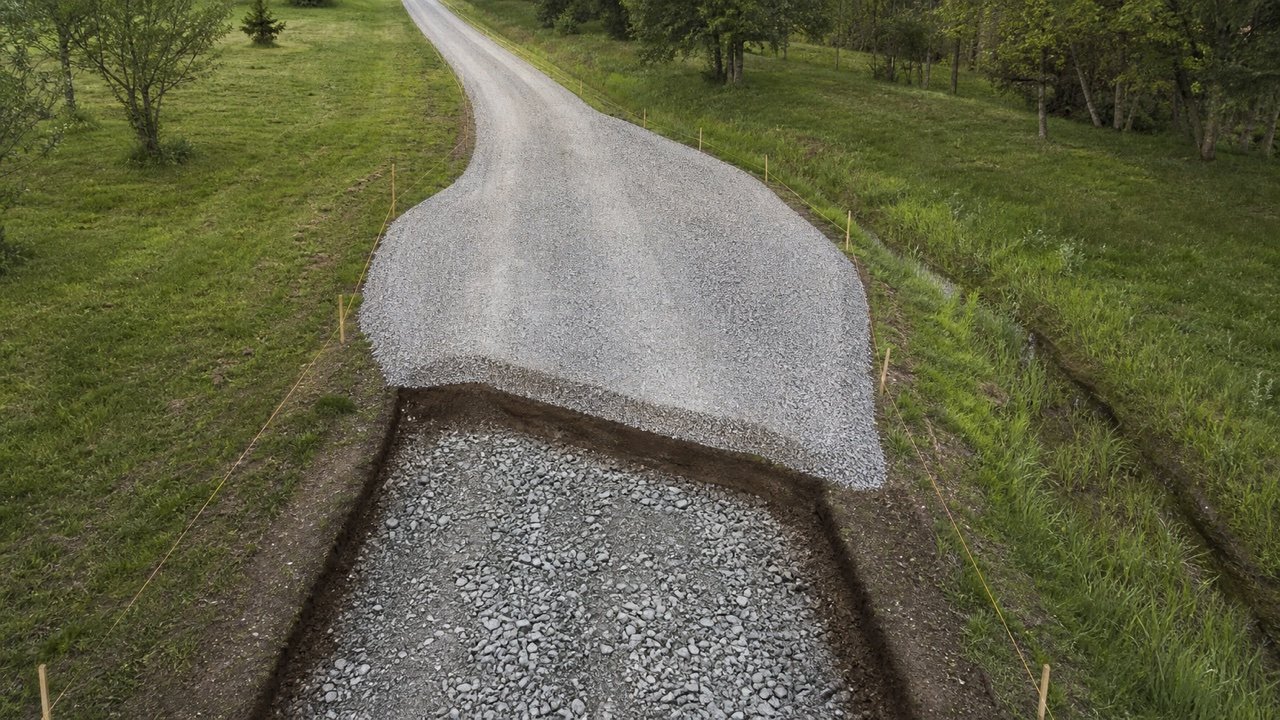
Base and surface depths answer separate material questions. A combined total depth removes the product split needed for ordering, placement checks, and later maintenance.
Known area
Store the drawing, survey, model, or worksheet that supplied the area. Check its revision, units, boundaries, exclusions, and whether it represents the same footprint for both layers.
How does the calculator handle base and surface layers?
Each layer has its own depth, loose-volume increase, density, and supplier increment. Leave one depth blank when the calculation covers a single layer, such as a surface top-up over an accepted existing base.
FHWA terminology treats aggregate base and subbase as compacted mineral-aggregate layers. FHWA also describes granular base and subbase below a driving surface as different parts of a pavement structure. Those sources support keeping layer records separate. They do not prescribe a private driveway section.
| Layer record | Keep with the calculation |
|---|---|
| Base | Product or specification, placed depth, footprint, state conversion, density source, supplier unit, and increment |
| Surface | Product or specification, placed depth, footprint, state conversion, density source, supplier unit, and increment |
| Existing accepted layer | Inspection, level, condition, repair limits, and reason no new quantity is included |
What formulas does the driveway calculator use?
The calculator finds one plan area and applies each active layer depth to that area. It keeps full JavaScript precision during the calculation and displays up to 3 decimal places.
Rectangle area = length × width
Uniform taper area = length × (start width + end width) ÷ 2
Placed layer volume = plan area × placed layer depth
Supplier-basis volume = placed volume × (1 + loose-volume increase % ÷ 100)
Rounded order = ceiling(supplier-basis volume ÷ order increment) × order increment
Estimated ordered mass = rounded order volume × supplier bulk density
When the increment field stays blank, rounded order equals supplier-basis volume. When density stays blank, mass stays unavailable. NIST Handbook 44 Appendix C supports 27 ft³ per yd³ and 1,000 L per m³.
Worked metric driveway example
A rectangular driveway is 30 m long and 3 m wide, giving 90 m². The project record calls for a 15 cm placed base and a 5 cm placed surface.
The base record uses a 12% loose-volume increase, a supplier density of 1,850 kg/m³ for the selected product and order state, and a 0.5 m³ supplier increment. The surface record uses no state increase, no density, and a 0.25 m³ increment.
- Base placed volume: 90 × 0.15 = 13.5 m³.
- Base supplier basis: 13.5 × 1.12 = 15.12 m³.
- Base rounded order: 15.12 rounded upward to 0.5 m³ = 15.5 m³.
- Base ordered mass estimate: 15.5 × 1,850 = 28,675 kg, or 28.675 metric tonnes.
- Surface placed volume: 90 × 0.05 = 4.5 m³.
- Surface rounded order: 4.5 m³, which already fits the 0.25 m³ increment.
Result: total placed volume is 18 m³. The 2 supplier orders total 20 m³. Total mass remains unavailable because the surface density is blank.
Worked imperial tapered-driveway example
A driveway is 120 ft long, 10 ft wide at one end, and 14 ft wide at the other. Its edges change at a uniform rate, so the plan area is 120 × (10 + 14) ÷ 2 = 1,440 ft².
The base is 6 in placed depth with a 10% entered state increase, 1.45 short tons/yd³ supplier density, and 0.5 yd³ increment. The surface is 2 in placed depth with a 5% increase, 1.35 short tons/yd³ density, and 0.25 yd³ increment.
- Base placed volume: 1,440 × 0.5 ÷ 27 = 26.667 yd³.
- Base supplier basis: 26.667 × 1.10 = 29.333 yd³.
- Base rounded order: 29.5 yd³; estimated ordered mass: 29.5 × 1.45 = 42.775 short tons.
- Surface placed volume: 1,440 × (2 ÷ 12) ÷ 27 = 8.889 yd³.
- Surface supplier basis: 8.889 × 1.05 = 9.333 yd³.
- Surface rounded order: 9.5 yd³; estimated ordered mass: 9.5 × 1.35 = 12.825 short tons.
Result: total placed volume is 35.556 yd³, total supplier order is 39 yd³, and the density-based ordered mass is 55.6 short tons.
How should placed and loose volume be separated?
Placed volume describes the space the completed layer occupies. Supplier-order volume may describe loose, stockpiled, loaded, or another documented material state. The percentage field converts placed volume to a larger supplier basis using the value you enter.
The field starts at 0%. Obtain the conversion from a project specification, test, supplier record, or accountable project decision that identifies the product and states being compared. Record the percentage and its direction.
A 15% increase from placed to loose means loose basis = placed × 1.15. A statement that loose material reduces by 15% during placement uses a different mathematical basis and does not produce the same conversion. Ask the source to state both volumes when the wording leaves the basis unclear.
How should supplier density be entered?
Use the bulk density for the exact product and the same state as the rounded supplier order volume. Metric mode expects kg/m³. Imperial mode expects US short tons per cubic yard.
Record the product, gradation or specification, moisture or test condition, density value, unit, supplier or test source, and date. A scale ticket can support a delivered mass record. One delivery does not establish a permanent density for every later load or another product.
The calculator multiplies rounded order volume by density. It does not certify the loaded mass, legal payload, axle loading, or number of trucks.
How does supplier increment rounding work?
Enter an increment only when the supplier confirms a volume selling increment for that product and order. The calculator rounds each layer upward after applying its state conversion.
Example: a supplier basis of 7.31 yd³ with a 0.25 yd³ increment becomes 7.5 yd³. A basis of exactly 7.5 yd³ remains 7.5 yd³. The calculator keeps unrounded supplier basis visible so you can see how much the commercial rule added.
A minimum billed quantity, delivery fee, whole-truck rule, mass increment, and volume increment describe different terms. Enter only a volume increment in this field. Keep price and delivery rules in the supplier comparison record.
How should curves, flares, and turnarounds be measured?
Separate each feature into geometry that matches its boundary, then add unrounded layer volumes. Apply the correct placed depth and product to every section.
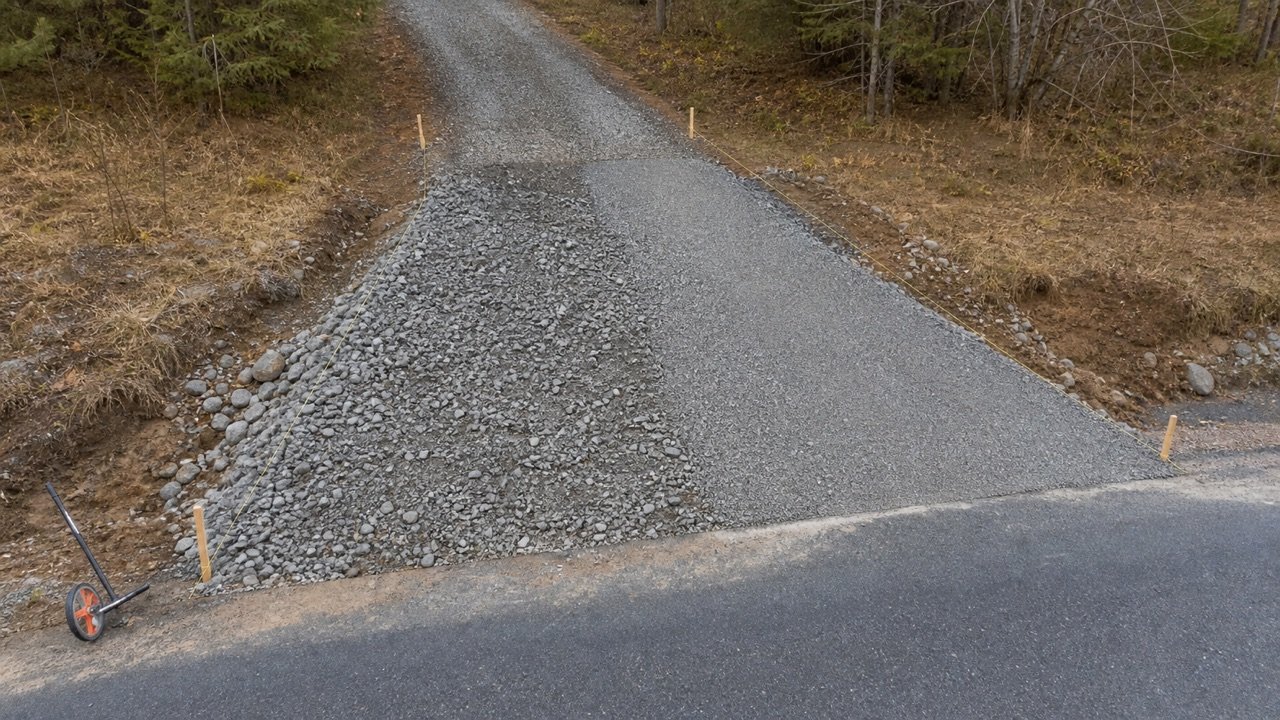
The driveway apron and flare quantity guide, turnaround quantity guide, and passing-bay and taper guide show separate takeoff methods for common widened features.
A crown, crossfall, rut, pothole, or changing formation level changes depth across the footprint. Use measured cross-sections, spot levels, or a checked surface model when a flat uniform layer does not represent the work.
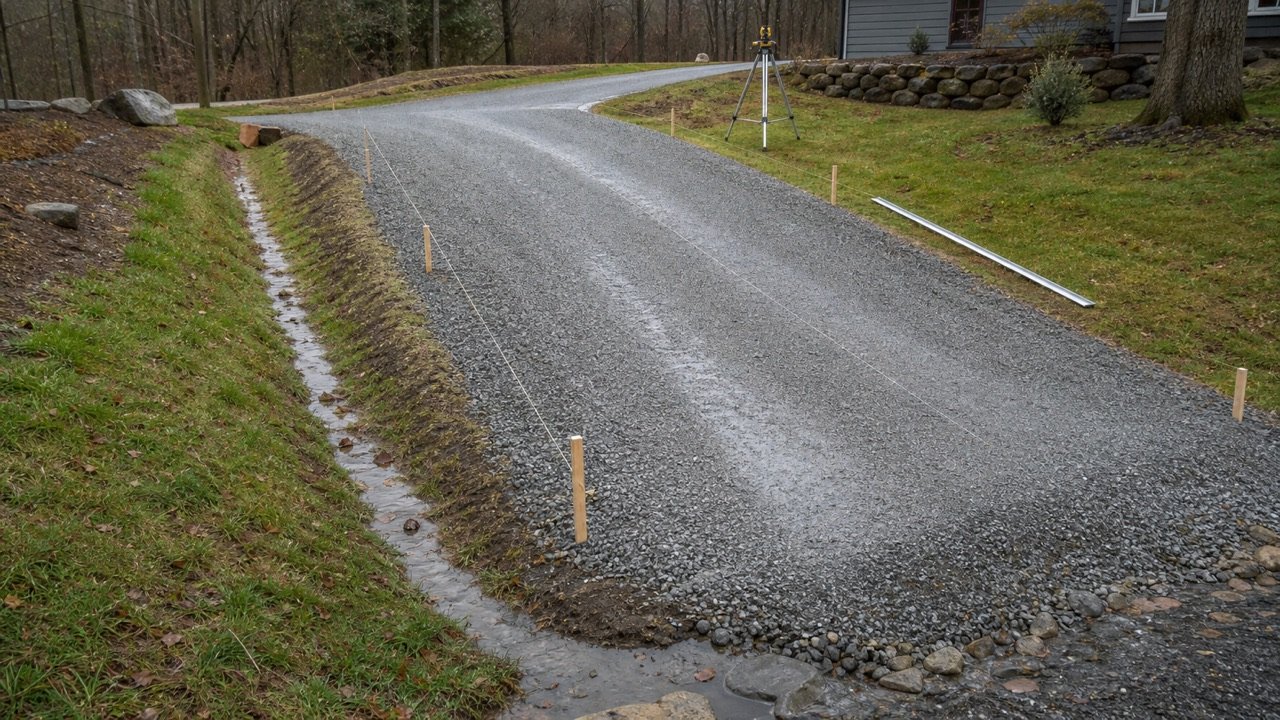
The gravel driveway drainage and grade guide shows how to record center and edge elevations, identify reverse falls, and separate a uniform layer from a changing-depth correction.
Can the calculator choose driveway layer depths?
The calculator uses the depths you enter. Traffic, vehicle loading, subgrade, climate, water, drainage, frost, aggregate, maintenance, and local design requirements can change the section.
FHWA's low-volume-road guidance uses traffic, subgrade quality, climate, compacted thickness, and aggregate loss as design inputs. A single website preset cannot resolve those project conditions. Use the responsible designer, geotechnical information, local requirements, drawings, and specifications.
The gravel driveway depth and layer record explains how to document the selected section without turning a general value into a project requirement.
How should resurfacing and repairs be handled?
For a surface top-up, leave the base depth blank and measure the accepted repair or resurfacing area and placed depth. Split areas when ruts, low spots, shoulders, and intact surfaces need different depths.
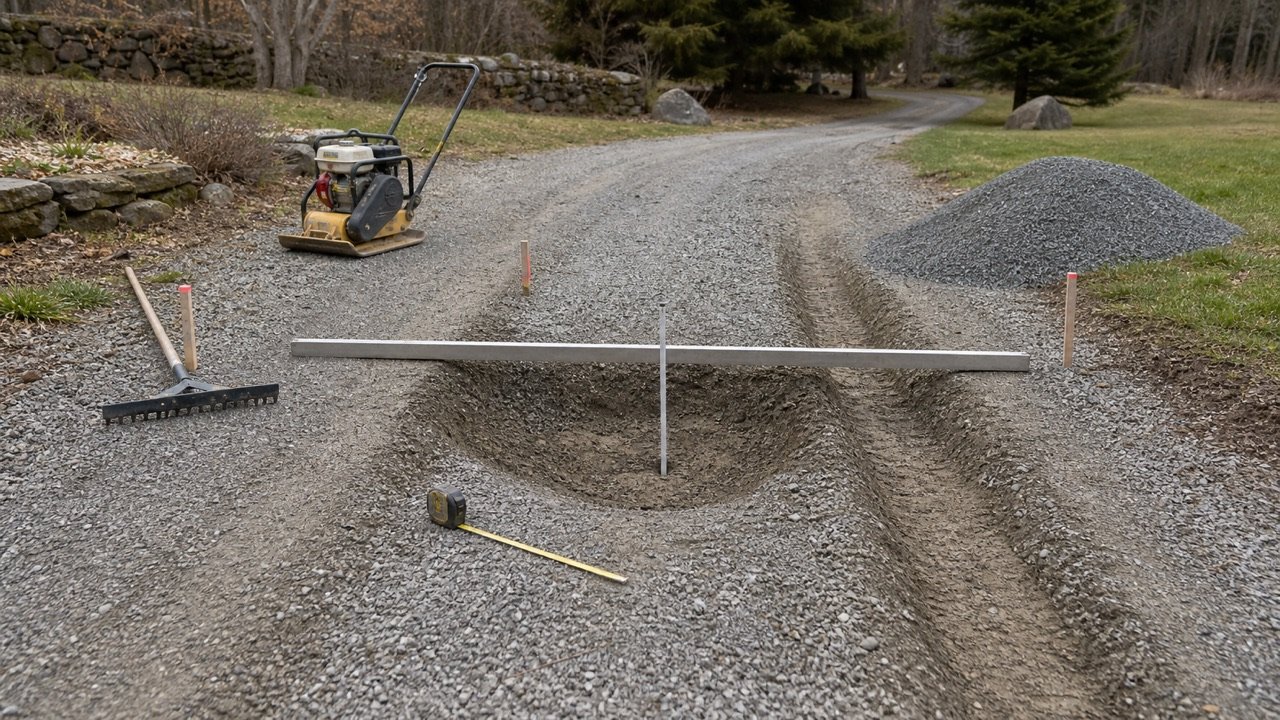
Use the resurfacing and top-up checks for a section schedule. The pothole and rut quantity guide covers local repair geometry.
Existing loose material, contaminated stone, soft subgrade, drainage defects, and unrepaired deformation can change the work. Inspect and define the repair before treating the whole driveway as one thin layer.
How sensitive is the quantity to width and depth?
Width and depth multiply directly into volume. A 5% increase in one dimension creates a 5% volume increase when the other inputs stay unchanged.
Example: a 100 ft × 12 ft layer at 2 in deep is 200 ft³, or 7.407 yd³. Increasing the width to 13 ft gives 216.667 ft³, or 8.025 yd³. Keeping 12 ft width and increasing depth to 2.5 in gives 250 ft³, or 9.259 yd³.
Recalculate the changed geometry. An unexplained extra percentage hides whether the difference came from width, placed depth, material state, handling, or supplier rounding.
What delivery and site checks remain?
Confirm the supplier, product, selling unit, minimum, increment, delivery address, access limits, unloading point, and current quote. NIST Handbook 130 is a model method-of-sale source; local adoption and supplier practice still need a current check.
Inspect gates, slopes, turning space, weak ground, buried services, overhead lines, traffic, pedestrians, buildings, and the intended stockpile area. OSHA lists raised dump truck beds among equipment that can contact overhead power lines. A quantity result cannot approve a route or dump location.
Ask the supplier and site controller to agree on delivery equipment and unloading controls. Keep legal vehicle payload and the supplier's load plan outside the material-density calculation.
What should the driveway quantity record contain?
- Project, driveway section, drawing or survey revision, date, and person who measured it.
- Footprint mode, dimensions, intermediate width checks, area, exclusions, and units.
- Base and surface product identifiers, placed depths, and depth sources.
- Placed volume for every section before an adjustment.
- Loose-volume increase, direction, source, state description, and supplier-basis volume for each layer.
- Density, unit, product, condition, source, date, and estimated mass when used.
- Selling unit, volume increment, unrounded basis, rounded order, quote, and confirmation.
- Drainage, geotextile, repair, delivery, access, and unresolved design checks.
Common driveway gravel calculation mistakes
- Combining base and surface depth into one product quantity.
- Using the uniform-taper mode for a curve, abrupt flare, or irregular width change.
- Entering a design depth without recording its source.
- Treating placed, loose, stockpiled, delivered, and compacted volumes as interchangeable.
- Using a density from another product or material state.
- Applying one state conversion to 2 products without evidence.
- Entering a mass selling increment in the volume-increment field.
- Rounding every small section before adding the layer takeoff.
- Leaving aprons, turnarounds, bays, shoulders, and repair zones out of the measured plan.
- Treating estimated mass as truck payload or a delivery schedule.
Use the Gravel Calculator for a single general gravel layer. Use the gravel planning hub for driveway drainage, geotextile, culvert, parking-pad, repair, and order guides. The calculation methodology explains units, assumptions, and rounding, and the corrections page provides the calculation-issue route.
Sources and scope
- NIST Handbook 44 (2026), Appendix C: cubic-foot, cubic-yard, litre, and cubic-metre relationships.
- FHWA Geotechnical Aspects of Pavements glossary: base, subbase, surface, gravel-base, and compacted unbound-layer terminology.
- FHWA Granular Base Application Description: separate base, subbase, and driving-surface functions and material context.
- FHWA low-volume-road guidance: traffic, subgrade, climate, compacted thickness, and aggregate-loss design context.
- NIST Handbook 130, 2026: model method-of-sale and legal-metrology context with varying adoption.
- OSHA Construction Electrical Incidents: overhead-power-line and raised-dump-body hazard context.
Source scope: NIST supports the stated conversion and method-of-sale context. FHWA supports the layer terminology and the need for project design inputs. OSHA supports the named electrical hazard. Project drawings, specifications, geotechnical information, drainage design, local requirements, supplier records, test data, site controls, and responsible professionals govern the driveway section and delivery.
Review note: Saleem Sial owns the research and editorial record. Formula fixtures, source checks, build validation, and rendered QA form the internal publication gate. Waseem Sial, External Reviewer and Engineer, is listed for ongoing external review; no completed review date is claimed.