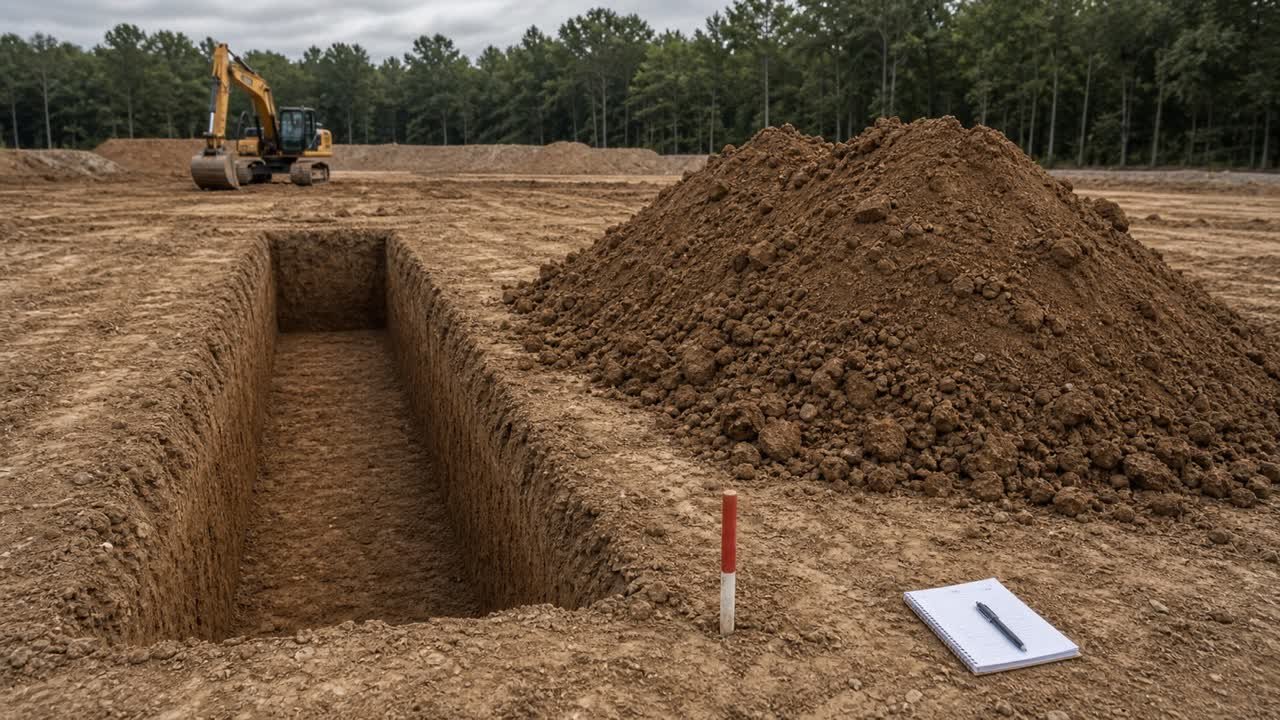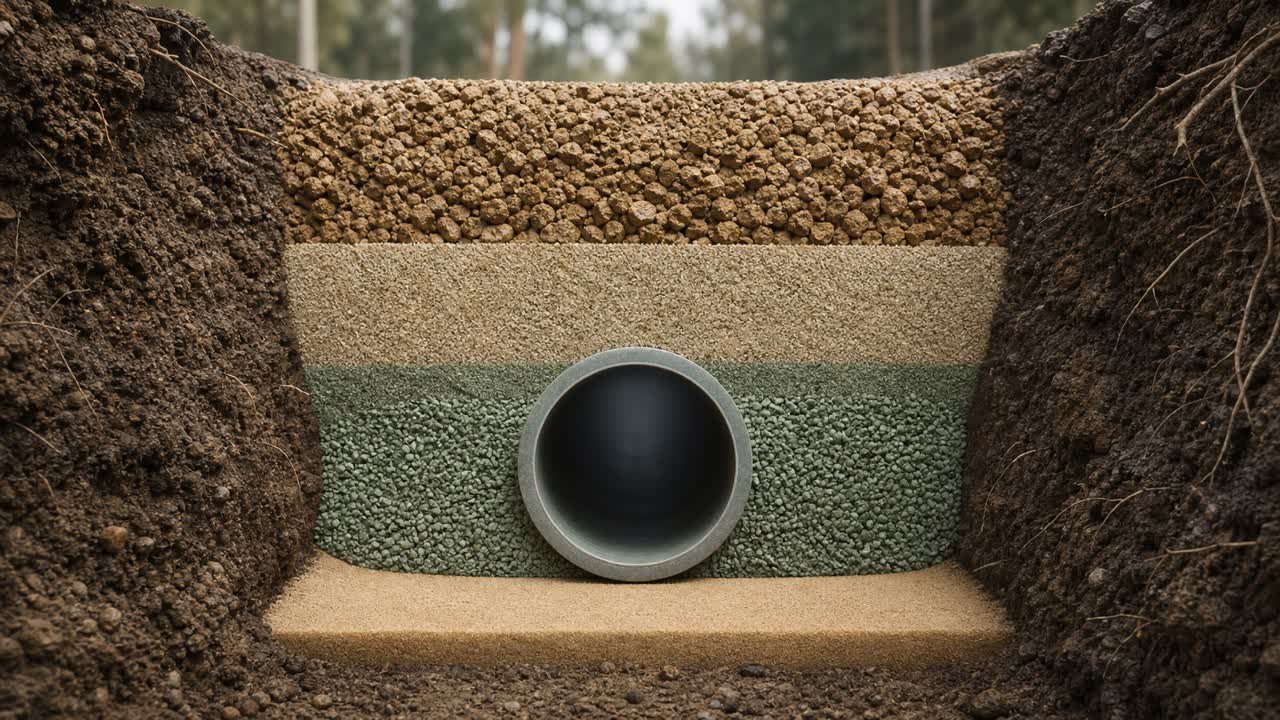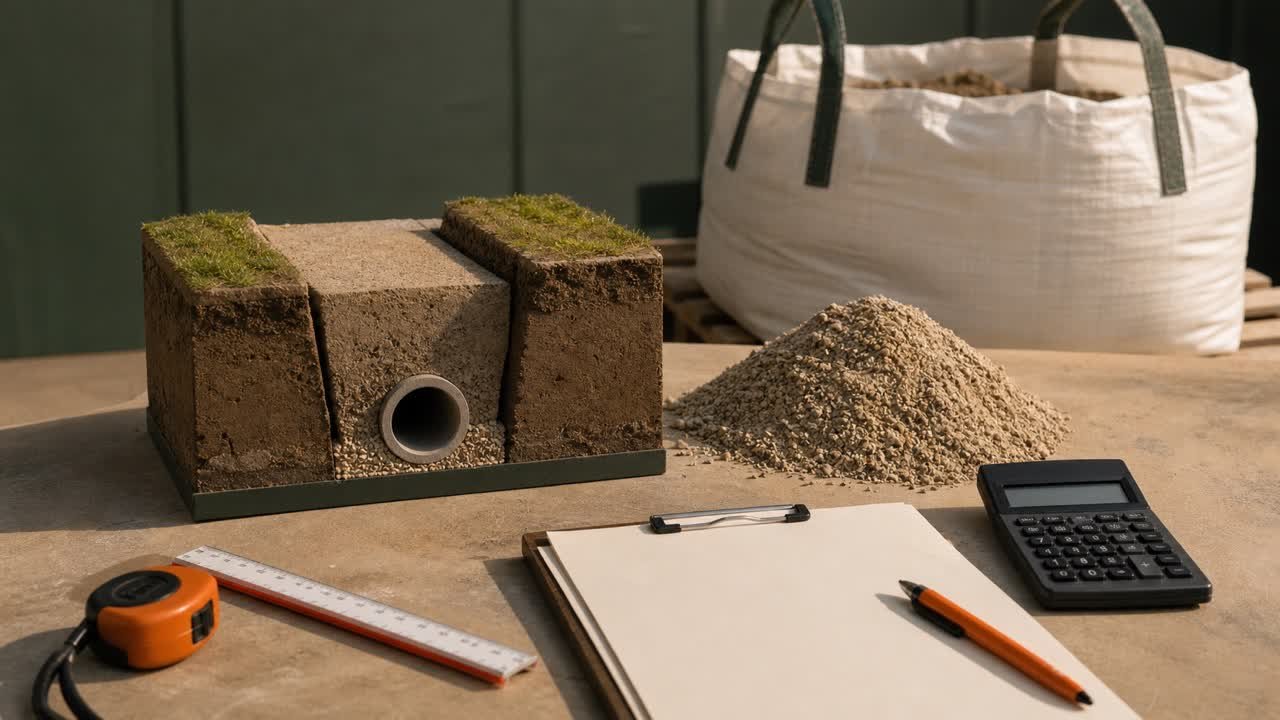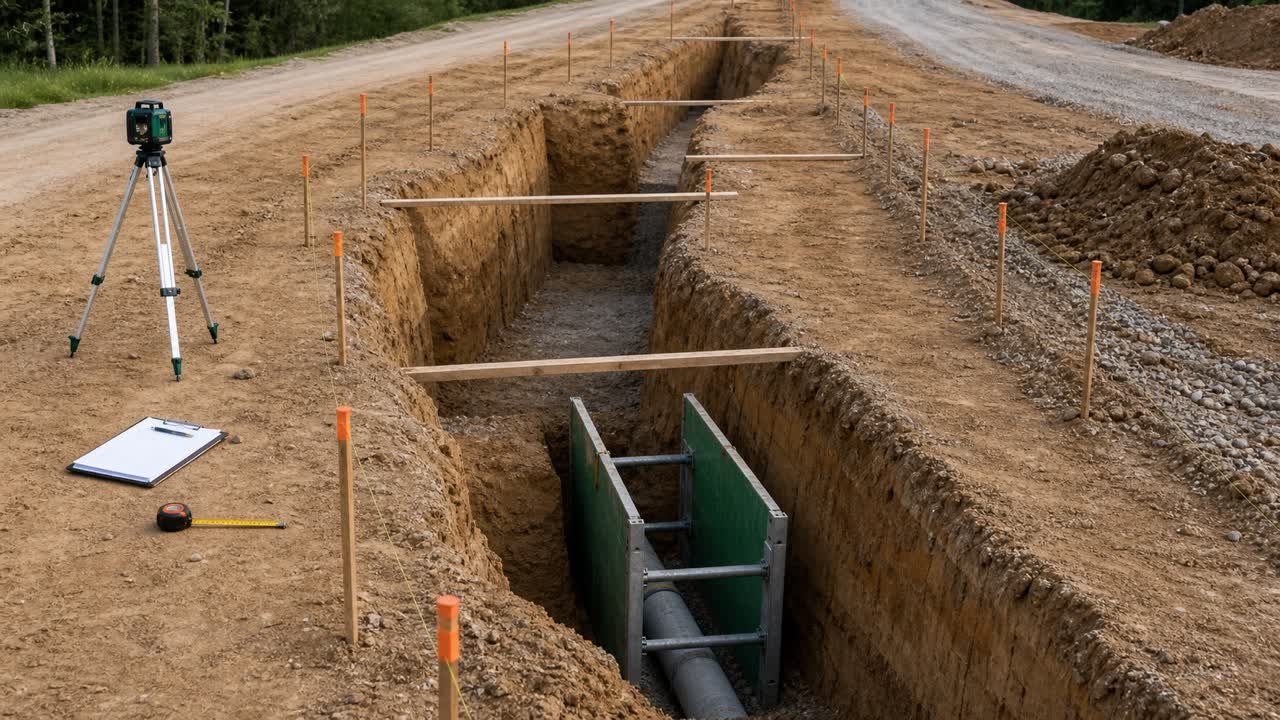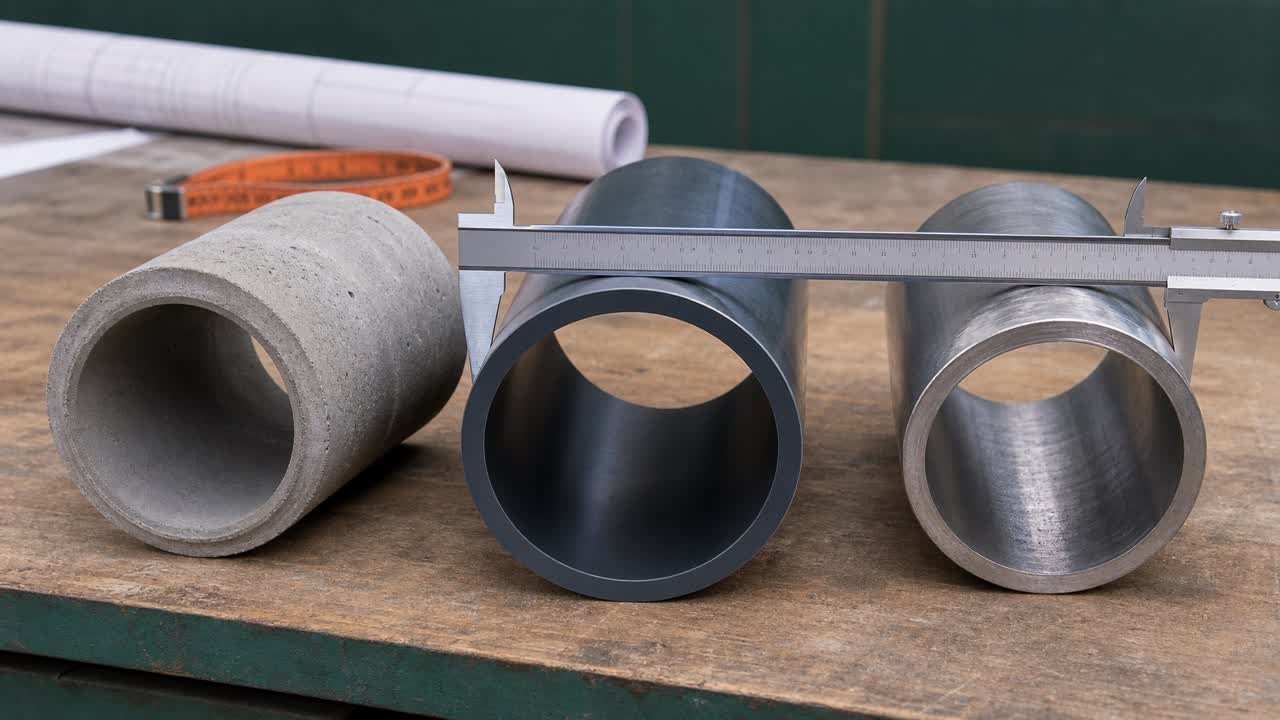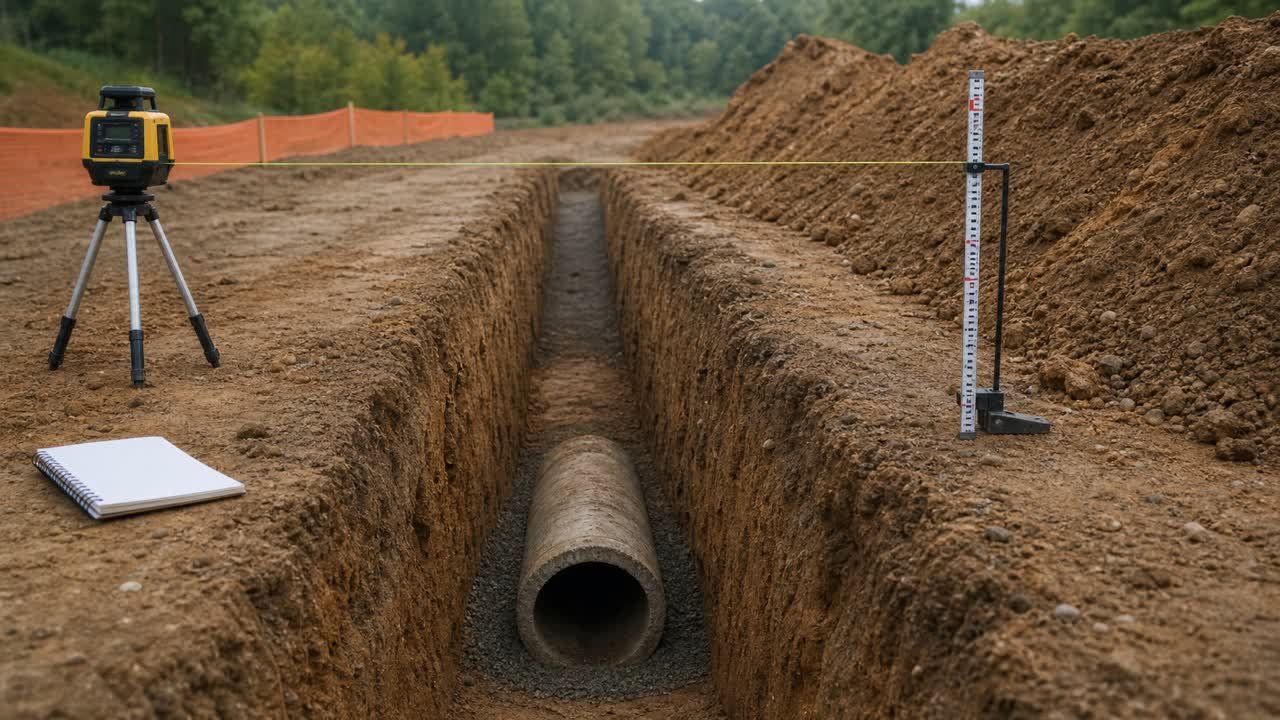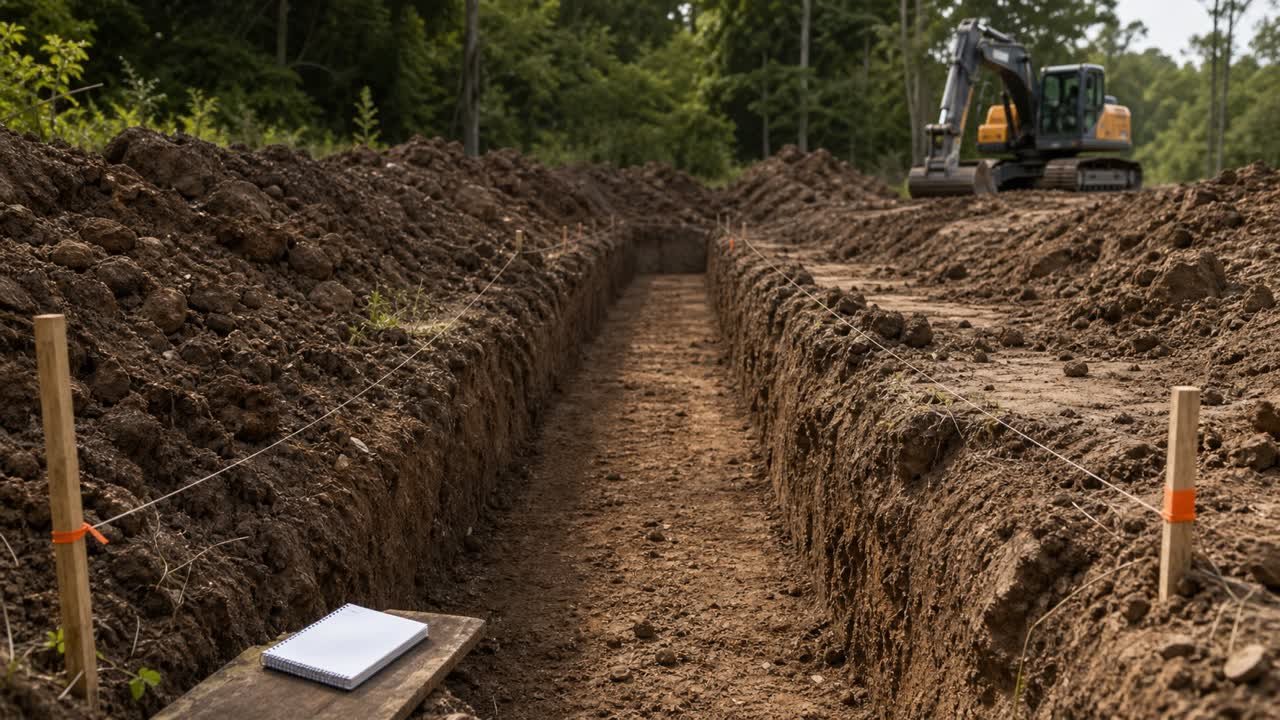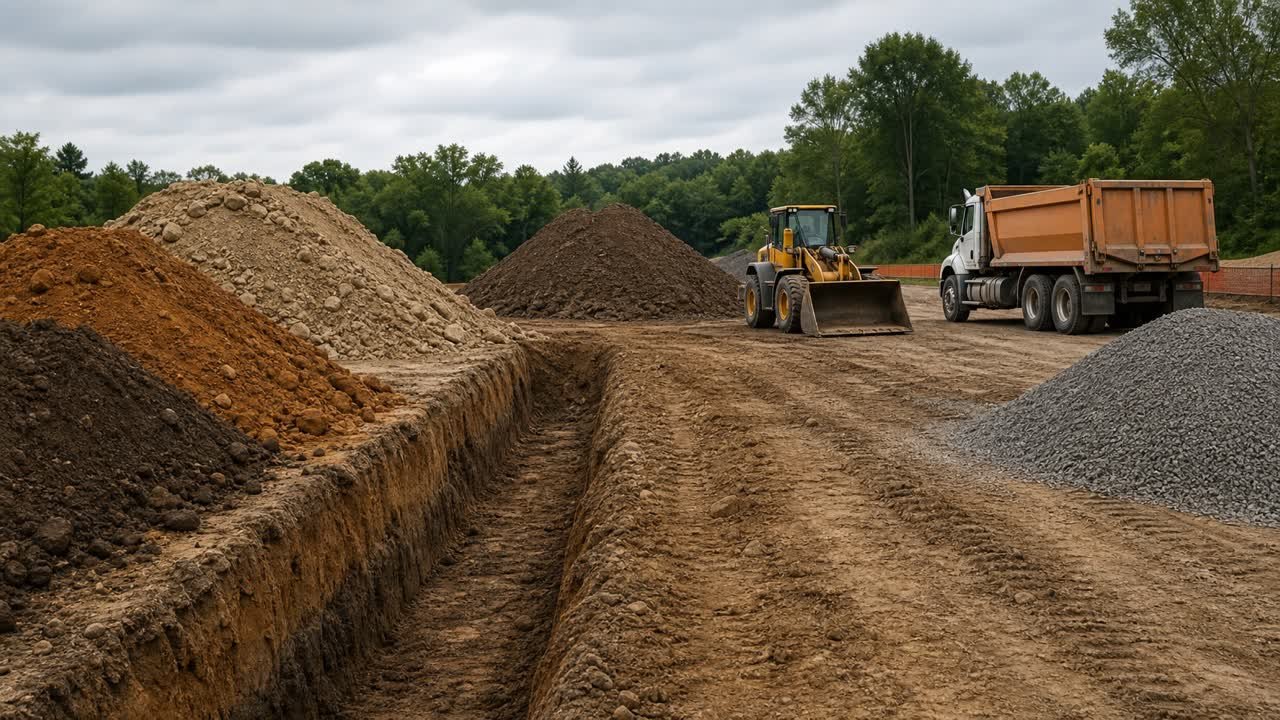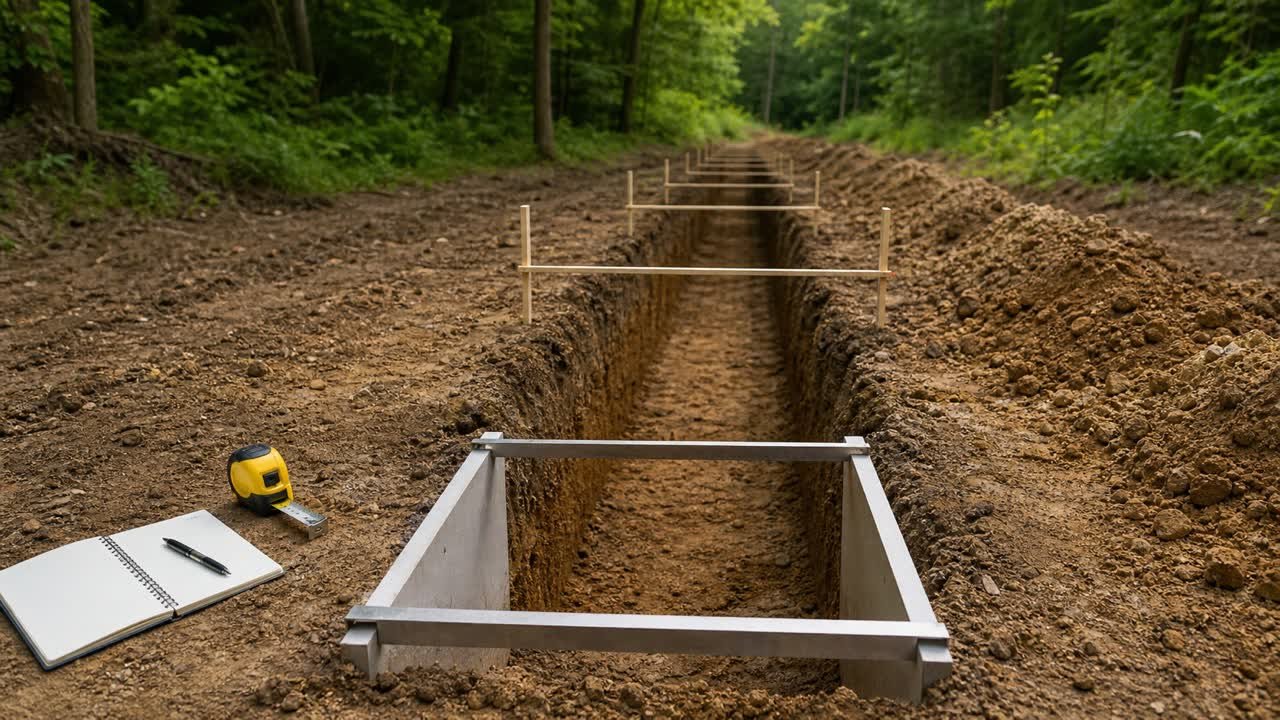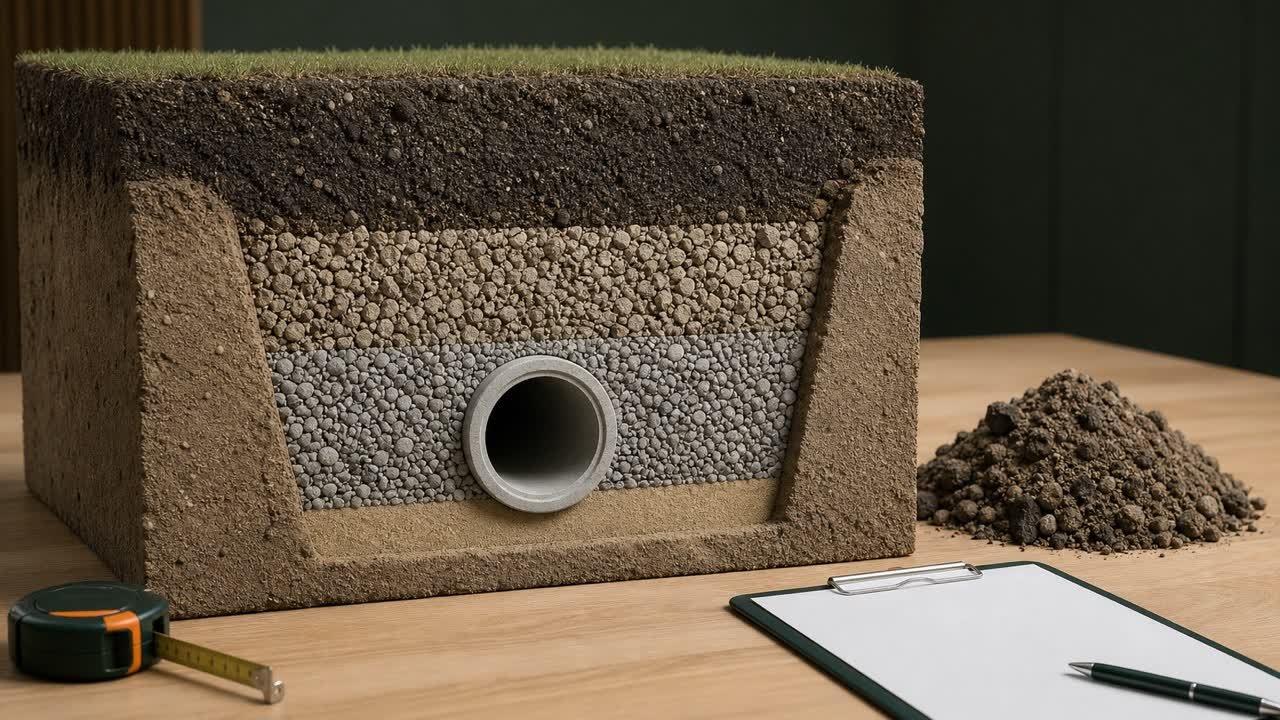
A trench does not return to its gross excavated volume after a pipe and separate embedment materials are installed. The pipe, structures, encasement, and separately filled zones each occupy part of the excavation.
A reliable backfill estimate assigns every cubic unit once. The calculation starts with gross trench volume, deducts permanent displacement, and separates pipe-zone material from the upper backfill that remains.
How do you calculate trench backfill volume?
Calculate the gross trench volume, then subtract the pipe displacement and every separately filled net volume. Keep the result in the in-place or compacted state until the physical space calculation is complete.
Gross trench volume = length × width × depth
Pipe displacement = π × outside diameter² ÷ 4 × pipe length
Remaining backfill = gross trench - pipe displacement - separate net fill zones - other permanent displacement
A gross pipe-zone envelope already contains the pipe space. If that whole envelope is removed from gross trench volume, do not deduct the pipe again when calculating the upper backfill.
Use the Trench Excavation Calculator for the gross volume of a uniform rectangular section. Keep that result separate from the net backfill ledger described below.
Which calculator should you use for this backfill check?
Use the calculator that matches the boundary you are measuring. The Trench Excavation Calculator checks gross rectangular bank excavation, while the Drainage Gravel Calculator checks one uniform rectangular aggregate envelope around a circular pipe.
Use the ledger in this guide when the trench has several separately filled zones, upper backfill, encasement, structures, or a pipe length that differs from the trench length.
| Task | Starting tool or method | Keep separate |
|---|---|---|
| Gross rectangular excavation | Trench Excavation Calculator | Pipe and material-zone ledger |
| One uniform aggregate envelope around a circular pipe | Drainage Gravel Calculator | Upper backfill, supplier units, and material state |
| Several materials or permanent components | This guide's backfill ledger | Gross or net label, overlap check, and each permanent displacement |
| Changing trench section | Separate sections, end-area method, or survey model | Station limits and the approved geometry method |
| Ordering material | Order-quantity conversion after the ledger closes | In-place state, loose state, density, allowance, and supplier increment |
Which measurements are required?
Use dimensions from the same section, station limits, datum, and drawing revision. Record what each vertical boundary represents before entering a number.
| Input | Use | Check |
|---|---|---|
| Trench length | Length of the uniform excavation section | Breaks, structures, bends, width changes, and actual measured limits |
| Trench width and depth | Gross excavation cross-section | Rectangular, sloped, benched, shored, or surveyed shape |
| Pipe length | Length used for pipe displacement | Structures, open gaps, fittings, and ends can make it shorter than trench length |
| Verified pipe OD | Outside cylinder that displaces fill | Product data, barrel, bell, rib, corrugation, and section type |
| Zone boundaries | Separate bedding, embedment, encasement, or upper-backfill volumes | Whether the number describes a gross envelope or net material |
| Other permanent components | Structures or materials that occupy trench space | Concrete, chambers, ducts, foundations, thrust blocks, and permanent shoring |
The trench depth from invert guide explains how surface, pipe invert, outside pipe bottom, bedding, and formation elevations define the vertical stack.
What is the difference between a gross zone and net material?
A gross zone is the full geometric envelope between stated boundaries. Net material is the part of that envelope actually filled after pipe and other permanent displacement are removed.
| Record type | Contains pipe space? | Upper-backfill method |
|---|---|---|
| Gross pipe-zone envelope | Yes | Subtract the gross envelope from the gross trench. Do not subtract the pipe again. |
| Net pipe-zone material | No | Subtract net pipe-zone material and pipe displacement separately. |
Both paths produce the same upper-backfill volume when they use the same boundaries. Problems start when a gross envelope is called “bedding volume” and then pipe displacement is also deducted without checking whether the pipe lies inside that envelope.
How do you calculate net pipe-zone material?
For a full-width rectangular pipe-zone envelope, multiply length, trench width, and zone height. Then subtract the part of the pipe and any other permanent component located inside that zone.
Gross pipe-zone envelope = length × trench width × pipe-zone height
Net pipe-zone material = gross pipe-zone envelope - pipe displacement in the zone - other displacement in the zone
The pipe-zone height can include bedding below the pipe, the full outside pipe height, and the specified height above the crown. These depths come from the approved project requirements. This article supplies no universal bedding or cover value.
The bedding, haunch, pipe-zone, and final-backfill guide explains the zone names and why their project definitions matter.
Worked metric example
A uniform rectangular trench is 24 m long, 0.80 m wide, and 1.50 m deep. It contains 24 m of circular pipe with a verified 0.40 m OD. The project detail places the pipe on 0.10 m of bedding and sets the top of the separate pipe-zone material 0.15 m above the pipe crown.
The gross pipe-zone height is 0.10 + 0.40 + 0.15 = 0.65 m.
| Quantity | Calculation | Result |
|---|---|---|
| Gross trench | 24 × 0.80 × 1.50 | 28.800 m³ |
| Pipe displacement | π × 0.40² ÷ 4 × 24 | 3.015929 m³ |
| Gross pipe-zone envelope | 24 × 0.80 × 0.65 | 12.480 m³ |
| Net pipe-zone material | 12.480 - 3.015929 | 9.464071 m³ |
| Upper backfill | 28.800 - 3.015929 - 9.464071 | 16.320 m³ |
The independent upper-zone check is 24 × 0.80 × (1.50 - 0.65) = 16.320 m³.
The complete ledger also closes: 3.015929 m³ pipe + 9.464071 m³ net pipe-zone material + 16.320 m³ upper backfill = 28.800 m³ gross trench.
Why can upper backfill ignore pipe displacement?
The shortcut works when a gross pipe-zone envelope contains the entire pipe. Subtracting the whole envelope removes both its material space and its pipe space from the upper zone.
Upper backfill = gross trench - gross pipe-zone envelope
In the metric example, 28.800 - 12.480 = 16.320 m³. Subtracting the 3.015929 m³ pipe again would understate upper backfill because the pipe is already below the pipe-zone top.
This shortcut does not calculate net pipe-zone material. The pipe displacement remains necessary when ordering or checking the material placed around the pipe.
Worked imperial example
A rectangular trench is 60 ft long, 3 ft wide, and 5 ft deep. It contains 60 ft of circular pipe with a verified 24 in OD. Bedding extends 6 in below the pipe, and the separate pipe-zone material ends 12 in above the crown.
- Convert OD: 24 in = 2 ft.
- Convert bedding and cover: 6 in = 0.5 ft and 12 in = 1 ft.
- Calculate pipe-zone height: 0.5 + 2 + 1 = 3.5 ft.
- Calculate gross trench: 60 × 3 × 5 = 900 ft³, or 33.333333 yd³.
- Calculate pipe displacement: π × 2² ÷ 4 × 60 = 188.495559 ft³, or 6.981317 yd³.
- Calculate gross pipe-zone envelope: 60 × 3 × 3.5 = 630 ft³, or 23.333333 yd³.
- Calculate net pipe-zone material: 630 - 188.495559 = 441.504441 ft³, or 16.352016 yd³.
- Calculate upper backfill: 900 - 630 = 270 ft³, or 10.000000 yd³.
The ledger check is 188.495559 + 441.504441 + 270 = 900 ft³. Divide by 27 only after the cubic-foot calculations to preserve precision.
What if bedding is only a strip below the pipe?
Treat a full-width bedding strip below the pipe as a separate envelope only when the approved detail uses that shape. The pipe does not occupy a strip that ends at the outside pipe bottom, so the strip and pipe can be deducted separately.
Bedding strip volume = length × width × bedding thickness
Other fill space = gross trench - bedding strip - pipe displacement - other permanent displacement
Shaped bedding, cradles, uncompacted center zones, haunch geometry, foundation layers, and partial-width details need their actual approved profile. A rectangular strip cannot represent them automatically.
Should pipe length equal trench length?
Use the actual pipe length occupying the measured trench section. Chambers, pits, fittings, open gaps, connections, and trench extensions can make the 2 lengths different.
For example, a 10 m × 0.60 m × 1.00 m trench contains only 8 m of 0.20 m OD pipe:
- Gross trench: 10 × 0.60 × 1.00 = 6.000 m³.
- Pipe displacement: π × 0.20² ÷ 4 × 8 = 0.251327 m³.
- Net fill space when one material fills all voids: 6.000 - 0.251327 = 5.748673 m³.
Using 10 m as pipe length would overstate displacement by 0.062832 m³. Record the start and end limits for both excavation and pipe.
Why must pipe outside diameter be verified?
Backfill occupies space around the outside of the pipe, so displacement uses OD rather than inside or nominal diameter. Product geometry can vary by material, wall class, dimension ratio, corrugation, rib, bell, or fitting.
Use the barrel OD only for the matching barrel length. Calculate bells, couplers, fittings, noncircular sections, and structures from verified dimensions or an approved model. See the pipe OD versus nominal size guide before making the deduction.
How do you handle multiple pipes or ducts?
Calculate each permanent displacement and subtract the sum. Confirm that the components do not overlap in the model and that every length belongs inside the same gross trench boundary.
Total pipe displacement = Vp1 + Vp2 + Vp3 + ...
A conduit bank, spacer system, duct package, or concrete encasement may be easier to treat as one verified gross block or irregular solid. If the encasement quantity is a gross envelope containing the ducts, do not subtract the ducts again from upper backfill. Subtract them only when calculating the net encasement material.
How do structures and encasement change the result?
Keep structures, permanent shoring, concrete encasement, foundations, thrust blocks, and other permanent components on separate ledger lines. Use dimensions for the actual portion inside the trench section.
| Item | Possible volume basis | Double-count check |
|---|---|---|
| Concrete encasement | Gross concrete envelope or net concrete material | A gross envelope can contain the pipe or ducts |
| Manhole or chamber | External structure volume inside the excavation | Separate the structure pit from overlapping trench volume |
| Foundation or stabilization | Approved lower-layer envelope | Confirm whether gross trench depth already includes undercut |
| Permanent shoring | Physical volume left in place | Temporary trench boxes are removed and do not remain as displacement |
| Surface restoration | Pavement, base, slab, or topsoil zone | Do not call restoration volume upper backfill if it uses a separate item |
How do changing trench sections affect backfill?
Calculate gross trench and deductions for each uniform segment. Use measured end areas, component solids, or an approved surface model when width, depth, side geometry, or zone boundaries change.
A sloped or benched excavation can have a large upper volume that a bottom-width rectangle misses. A shored trench may follow another payment or construction boundary. The changing trench sections guide covers average end-area and prismoidal checks.
At structures and crossings, calculate the overlap once. Adding a trench volume and a chamber excavation without removing their shared space inflates both excavation and backfill.
Is in-place backfill the same as the order quantity?
The zone ledger calculates physical in-place space. Loose delivery volume, delivered mass, handling allowance, and supplier rounding are later stages with different evidence.
| Stage | Question answered | Evidence |
|---|---|---|
| Gross trench | What excavation volume lies inside the stated boundary? | Survey, drawings, geometry, and section method |
| Net in-place zone | What compacted or placed space remains after displacement? | Zone boundaries and verified component dimensions |
| Loose planning quantity | What loose volume may be needed to produce that in-place space? | Project trial, matched density data, or documented state factor |
| Mass | What does the selected quantity weigh? | Product-specific bulk density and material state |
| Supplier order | What purchasable quantity should be requested? | Selling unit, minimum, increment, handling evidence, and quote terms |
Use the trench order-quantity guide only after the in-place zone ledger closes.
How should excavated spoil and reused backfill be reconciled?
Keep excavated bank volume, loose spoil, reusable material, imported fill, and accepted compacted backfill as separate records. The same soil can occupy different volumes in each state.
Pipe and imported pipe-zone material can create surplus excavated soil because they occupy space that native soil filled before excavation. Suitability, contamination, moisture, oversize material, project requirements, and testing determine whether excavated material can return as final backfill.
The bank versus loose volume guide explains state conversion. Do not subtract an imported compacted volume directly from a loose spoil pile without converting both records to compatible states and boundaries.
Common trench backfill mistakes
- Deducting pipe displacement twice after subtracting a gross pipe-zone envelope.
- Subtracting both a net pipe-zone material total and its gross envelope.
- Using nominal pipe size instead of verified OD.
- Using trench length as pipe length where chambers or gaps interrupt the pipe.
- Applying a full-width bedding strip to shaped or partial-width bedding.
- Ignoring bells, fittings, structures, encasement, or restoration zones.
- Using one rectangular section for a sloped, benched, variable, or irregular trench.
- Adding overlapping trench and structure excavations without removing the overlap.
- Mixing in-place volume with loose spoil, loose order volume, or wet delivered mass.
- Applying a generic compaction, waste, density, or truck factor inside the geometry calculation.
- Rounding pipe area before multiplying by length.
- Using the quantity calculation to select trench width, bedding, cover, material, compaction, or a protective system.
What should a backfill quantity record contain?
- Project, route, section, station limits, drawing, specification, and revision.
- Gross trench boundary, geometry method, dimensions, and calculated volume.
- Pipe product, verified OD, section type, and actual displacement length.
- Every zone top and bottom elevation or thickness.
- Gross-envelope or net-material label for each zone.
- Other permanent displacement and overlap adjustments.
- Unrounded pipe, zone, upper-backfill, and ledger-check volumes.
- Material state for every result.
- Separate state factor, density, allowance, and supplier rounding records.
- Prepared by, checked by, date, unresolved assumptions, and acceptance status.
Safety and scope
Read measurements from approved plans, models, survey records, and safe field methods. Do not enter an unprotected trench to obtain dimensions.
OSHA identifies cave-ins as the main trench hazard in United States construction and addresses protective systems, access, inspections, water, atmosphere, underground installations, and material placement. This calculation does not design or approve sloping, benching, shoring, shielding, dewatering, access, utility support, or adjacent-structure protection.
Project drawings, specifications, product instructions, jurisdictional requirements, and responsible qualified people control the trench, pipe, bedding, embedment, final backfill, compaction, testing, and acceptance.
Sources and source scope
- Indiana DOT, Sample Calculations for Circular Pipe: circular pipe displacement within backfill cross-sections, separate backfill zones, and checked quantity records.
- Plastics Pipe Institute, Chapter 7, Underground Installation of PE Piping: bedding, embedment, initial-backfill, and final-backfill terminology and functions.
- FHWA Drainage Guidelines, Generic Reviews: project-specific excavation, bedding, backfill, placement, and payment-boundary context.
- NIST Guide to the SI, Appendix B.8: exact inch, foot, yard, and metre relationships.
- OSHA Trenching and Excavation: United States excavation hazard and protective-system context.
Scope: these sources support the zone distinctions, pipe-displacement approach, unit conversions, and safety boundary. The approved project documents, component geometry, survey, contract, applicable law, and responsible people control the final measurement, material, construction, payment, and acceptance methods.
Review responsibility: Saleem Sial owns the published calculation, source, and editorial checks. Waseem Sial, External Reviewer and Engineer, remains listed for ongoing external review; no completed external-review date is claimed.
Calculate gross excavation with the Trench Excavation Calculator or return to the Earthwork and Drainage hub.