
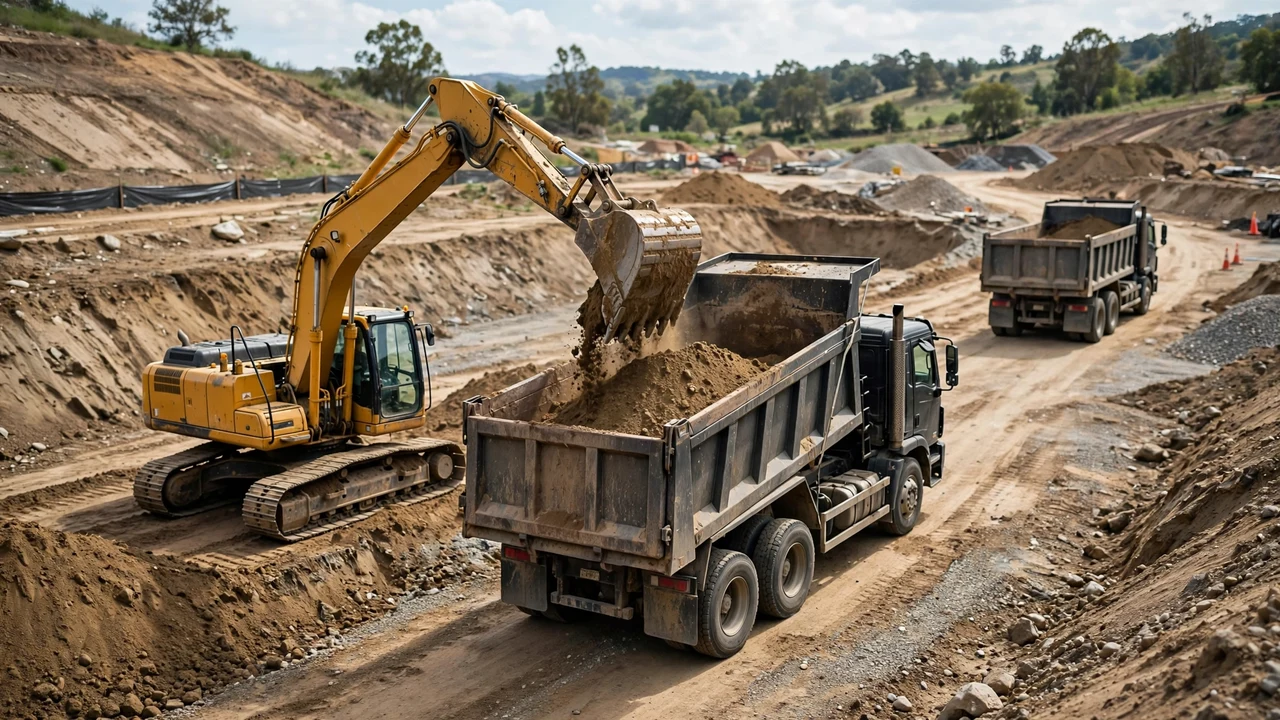
A cut and fill takeoff tells you how much ground moves and how much placed fill the design needs. A delivery plan turns those volumes into trucks booked, loads dispatched, and import or export quantities reconciled against tickets. The conversion fails most often when the plan mixes volume states: bank, loose, and compacted quantities must stay labeled through every step.
How do cut and fill volumes become a delivery plan?
Compare the usable cut against the compacted fill in matching material states. The difference sets the import (borrow) or export (spoil) quantity, swell and shrinkage convert it to loose haul volume, and the usable truck body volume converts that into booked loads.
| Quantity | State | How it is derived |
|---|---|---|
| Total cut | Bank | Approved takeoff or survey |
| Reusable cut | Bank | Layers the geotechnical record or specification approves for fill |
| Cut yield as fill | Compacted | Reusable bank x (1 - shrink %) |
| Fill deficit | Compacted | Design fill minus cut yield; import is needed only when positive |
| Borrow order | Loose | Deficit / (1 - shrink %) x (1 + swell %) |
| Export quantity | Loose | (Total cut - reusable cut) x (1 + swell %) |
Write 240 m3 loose borrow and 180 m3 compacted deficit rather than recording 240 and 180 without labels. The unit alone does not identify the state.
The swell and shrink factors come from the project record, matched measurements, or an approved reference; see the bank and loose volume guide for how to select and check a factor. Caterpillar notes that exact material characteristics require project testing because moisture, particle size, and compaction change material weight and state.
How do you work the balance step by step?
Start from approved volumes and stated factors, and keep each conversion visible. The percentages below are calculation fixtures, not recommended factors.
A project has 1,200 m3 of bank cut and 900 m3 of compacted fill. The geotechnical record approves 800 m3 of bank cut for reuse as fill, with 20% bank-to-loose swell and 10% bank-to-compacted shrink.
- Convert the reusable cut to compacted fill: 800 x (1 - 0.10) = 720 m3.
- Find the fill deficit: 900 - 720 = 180 m3 compacted.
- Convert the deficit to a bank-equivalent borrow: 180 / 0.90 = 200 m3 bank.
- Convert the borrow to delivered loose volume: 200 x 1.20 = 240 m3 loose.
- Convert the non-reusable cut to export: (1,200 - 800) x 1.20 = 480 m3 loose.
Result: the plan orders 240 m3 loose import and schedules 480 m3 loose export. The 180 m3 deficit, 200 m3 bank borrow, and 240 m3 loose delivery are three different quantities describing the same import; record all three.
How does the same check look in cubic yards?
Use the same steps with imperial inputs. Suppose the takeoff shows 1,500 yd3 of bank cut and 1,100 yd3 of compacted fill, with 900 yd3 of bank cut approved for reuse, 20% swell, and 10% shrink.
- Reusable cut as compacted fill: 900 x 0.90 = 810 yd3.
- Fill deficit: 1,100 - 810 = 290 yd3 compacted.
- Borrow: 290 / 0.90 = 322.22 yd3 bank; delivered loose: 322.22 x 1.20 = 386.67 yd3.
- Export: (1,500 - 900) x 1.20 = 720 yd3 loose.
At a stated usable body volume of 12 yd3, the import needs 386.67 / 12 = 32.22, rounded up to 33 loads, and the export needs exactly 720 / 12 = 60 loads. Keep the unrounded ratios beside the rounded bookings.
How do you turn loose quantities into truck loads?
Divide the loose planning volume by the usable loose-volume capacity of the truck, then round a positive remainder up to a whole trip.
Exact volume load ratio = loose volume / usable truck body volume
For the metric example, 240 m3 loose divided by a stated usable body volume of 11.5 m3 gives 20.87, so the import books 21 loads and the export books 480 / 11.5 = 41.74, rounded to 42 loads.
Body volume shows available space. Material mass, moisture, legal payload, axle limits, route restrictions, access, and loading practice can set a smaller usable load. Obtain the vehicle and route limits from the responsible hauler and the applicable authority.
When should material move instead of being stockpiled?
Direct reuse, where cut material moves straight to the fill zone, avoids a second handling step and a stockpile footprint. It works when the excavation sequence, haul route, fill-zone readiness, and testing schedule align. Where timing or space forces storage, the stockpile becomes a loose-volume record of its own and needs its own boundary survey before material leaves it.
Phase import deliveries against fill acceptance rather than ordering the full borrow at once. If compaction testing or suitability results change the reuse yield, an early bulk order becomes stranded material. Match dispatch notes and delivery tickets to the plan daily so the remaining balance stays visible.
How do tickets reconcile against the plan?
Keep every record in its own state and compare plan against actuals without overwriting the original estimate. Trimble's estimating workflow treats bank, loose, and compacted cubic yards as separate quantity states for the same reason.
| Record | State | Reconciles against |
|---|---|---|
| Approved takeoff | Bank cut, compacted fill | Plan inputs and payment boundaries |
| Haul plan | Loose | Truck dispatch sheets and booked loads |
| Delivery and disposal tickets | Stated commercial unit | Loose import and export actuals |
| Accepted fill | Compacted | Final geometry and testing record |
Scale tickets record mass, so converting them to volume needs a density that matches the same material state and moisture condition. Do not add a loose stockpile total to a loose export total when the export quantity already comes from that stockpile; reconcile additions, removals, direct reuse, and the closing inventory first.
Common cut and fill ordering mistakes
- Comparing bank cut directly with compacted fill without swell and shrinkage conversions.
- Applying the borrow factor in the wrong direction when converting deficit to delivered volume.
- Booking trucks on nominal body capacity instead of usable loose volume and legal payload.
- Treating scale-ticket mass as volume without a matching density basis.
- Ordering the full import before compaction or suitability testing confirms the reuse yield.
- Counting reused material as both export and fill, which double-books the quantity.
- Ignoring partial loads, rejected loads, retained soil, and stockpile changes in the reconciliation.
- Replacing the original plan with measured actuals instead of keeping both for variance checks.
Safety and professional scope
A delivery plan does not select excavation geometry, protective systems, equipment, haul routes, loading limits, or compaction requirements. Those decisions follow the project documents, applicable law, site conditions, material testing, vehicle records, and responsible competent or qualified people.
For U.S. construction work, OSHA identifies cave-ins as the main trench hazard. OSHA 29 CFR 1926.651 also covers underground installations, access and egress, hazardous atmospheres, water accumulation, adjacent structures, loose material, and competent-person inspections. Other countries use their own workplace rules.
Collect measurements from a safe location and through the approved survey or quantity-control method. Keep spoil, vehicles, and equipment at the distances and under the controls required by the governing safety plan.
Sources and scope
- U.S. Office of Surface Mining Reclamation and Enforcement, Directive TSR-1 Appendix A: bank, loose, and compacted volume definitions, swell, and load-factor context.
- Caterpillar, Material Density Tables to Help Estimate Earthwork Volumes: material-state definitions, load-factor context, density variation, and the need for project testing.
- Trimble Viewpoint Estimating Help, Enter Swell and Yield Factors: separate BCY, LCY, and CCY states and layer-specific factor workflow.
- OSHA Trenching and Excavation and 29 CFR 1926.651: U.S. occupational excavation-safety context.
Scope: the formulas convert stated material-state quantities into order and haul quantities. The governing drawings, survey and testing methods, geotechnical information, contract measurement provisions, safety plan, vehicle limits, supplier or disposal records, applicable law, and responsible qualified people control the accepted factors and final project quantity.
Review responsibility: Saleem Sial owns the published calculation, source, and editorial checks. Waseem Sial, External Reviewer and Engineer, remains listed for ongoing external review; no completed external-review date is claimed.
Next, use the Cut and Fill Calculator to work out the section volumes, then use the cut and fill volume measurement guide when existing and proposed surfaces both change, the cut and fill material guide for soil considerations, or return to the Earthwork & Drainage Calculators hub.


