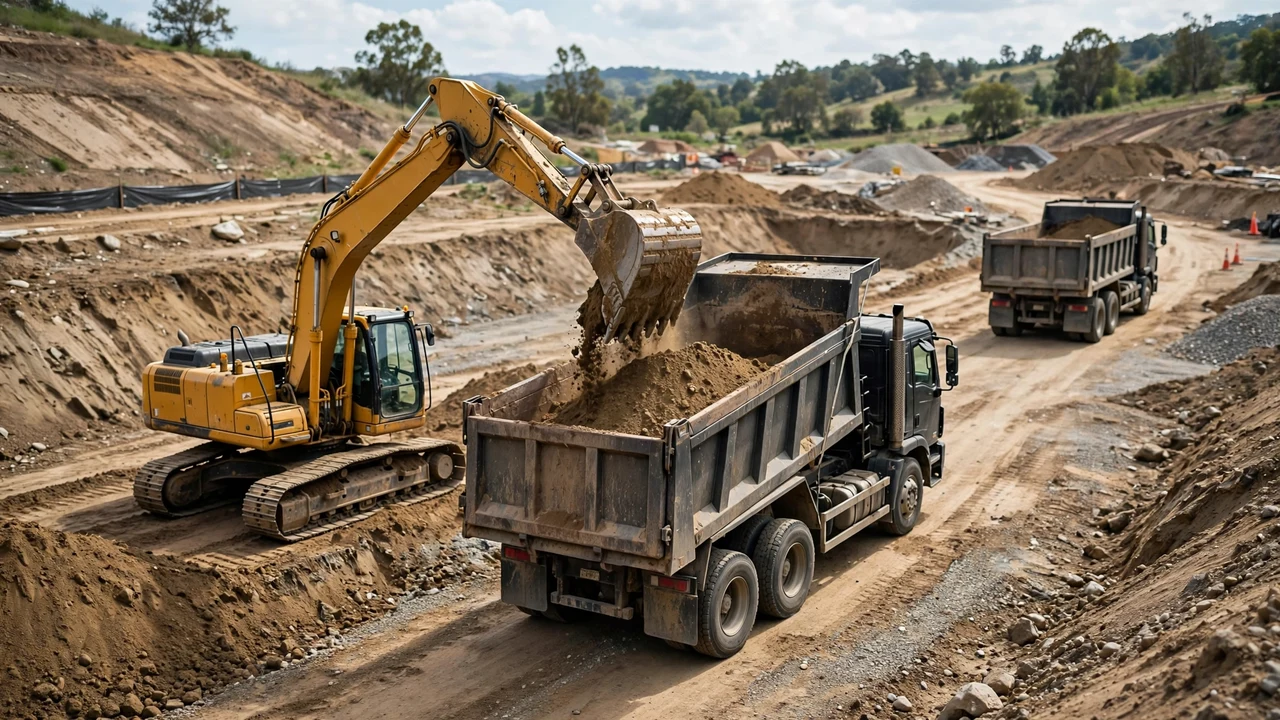
A survey grid or cross-section gives the geometry of a cut or a fill. The soil decides what that geometry means: how much the cut grows in the truck, how much loose volume a compacted fill really needs, and whether the excavated soil can return as fill at all.
What does the material change about a cut-and-fill plan?
The material changes three numbers in the balance. First, how the cut's bank volume converts to loose hauling volume, called swell. Second, how much loose volume the fill's compacted target needs, called shrink. Third, whether the cut soil qualifies as fill material at all.
A granular cut can feed the fill almost directly. A cut in wet clay, organic soil, or blasted rock cannot. The cut-and-fill method guide covers how the volumes are measured; this article covers what the material does to them after measurement.
How do you keep bank, loose, and compacted volume separate?
Keep three volumes on the record. Bank volume is soil in the ground. Loose volume is soil excavated and hauled. Compacted volume is soil placed, watered to its target moisture, and rolled.
Cut is measured in bank cubic yards, hauling is planned in loose cubic yards, and the fill is measured in compacted cubic yards. The most common estimating mistake compares bank cut directly to compacted fill, which skips the swell on the cut side and the shrink on the fill side. Convert both sides to loose volume first, then subtract:
Loose cut = bank volume × swell factor
Loose needed for fill = compacted volume ÷ shrink factor
Only the loose-to-loose subtraction gives the true borrow or export number. The bank-versus-loose guide works the three states through a trench example.
How much do common soils swell and shrink?
Granular soils swell least, clays and organic soils swell more, and blasted rock swells most. The ranges below are generalized planning starts compiled from construction references. They are not project values: the geotech report or the controlling specification sets the factors used for ordering and payment.
| Material | Swell, bank to loose | Shrink, bank to compacted | Field note |
|---|---|---|---|
| Sand and gravel | 5–12% | 5–10% | Swells least; compacts fast and reuses well |
| Common mixed earth | 10–20% | 10–15% | Reasonable start when no geotech data exists |
| Clay | 20–30% | 15–25% | Moisture-sensitive; handled as its own stratum |
| Topsoil | 15–25% | 10–20% | Strip and stockpile; never structural fill |
| Blasted rock | 30–50% | — | Placed rock can occupy more volume than bank; rarely structural fill |
A measured study of 39 earthwork projects found that swell and shrink vary widely even inside one soil group, so the ranges above guide planning without replacing site data. When a site has more than one material layer, weight each stratum separately: multiply each layer's share of the fill by its own factor, then total the results. The weighted total is the combined factor for the site.
Worked example: bank cut, loose haul, compacted fill
Take a site with 1,200 bank yd³ of common earth in cut and a fill that must finish at 900 compacted yd³. Assume a swell factor of 1.25 and a shrink factor of 0.90. Both are stated assumptions for the example, not material properties.
Loose cut = 1,200 × 1.25 = 1,500 yd³ to haul. Loose needed for the fill = 900 ÷ 0.90 = 1,000 yd³ to place and compact. The balance is 1,500 − 1,000 = 500 yd³ of loose surplus, which leaves the site as export.
A metric check with different stated assumptions: 800 m³ of bank cut with a 1.20 swell factor gives 960 m³ loose. A 700 m³ compacted fill with a 0.92 shrink factor needs 700 ÷ 0.92 = 760.9 m³ loose. The surplus is 960 − 760.9 = 199.1 m³ loose.
A balance without its swell and shrink assumptions cannot be checked or adjusted. Future readers need to know whether each factor came from the geotech report, the agency specification, or a planning estimate.
Both examples are arithmetic fixtures verified by independent calculation; they demonstrate the method and describe no real site.
Which cut material can be reused as fill?
Clean sand and gravel make the best reuse material: low swell, fast compaction, and good drainage. Common mixed earth is usually usable under the project specification, with its own swell and shrink factors applied.
Topsoil is handled separately. Strip it first and stockpile it for finish grade, as the topsoil depth guide shows. Organic matter decomposes and settles, so topsoil never goes under a structure or pavement.
Clay is the conditional case. It swells heavily on excavation, compacts slowly, and softens when wet, so many specifications restrict it in structural fills or require placement at a controlled moisture. Expansive clay is treated as its own category; the next section explains why.
Blasted rock swells more than any soil and often needs processing or selective placement before it can serve as fill. Debris, roots, frozen lumps, contaminated soil, and soil too wet to compact are excluded from structural fill under most specifications.
Why does moisture control the fill side?
Fill is placed in lifts and compacted to a target density at a target moisture. Soil placed too wet pumps and ruts under the roller; soil placed too dry never reaches density no matter how many passes it gets.
The target moisture is usually near the laboratory optimum, and the FHWA geotechnical reference notes that optimum compaction moisture is often in the vicinity of the plastic limit. Check moisture during placement, and water or dry the lift before compaction, not after.
What makes a soil expansive, and why does it matter for fills?
Expansive soils change volume as moisture changes, heaving when wet and shrinking when dry. The FHWA geotechnical reference lists the swell-potential factors: the amount and mineralogy of the clay, the soil's density, the compaction moisture and density, permeability, the water table, nearby vegetation and trees, and the overburden stress. Montmorillonite shows a high degree of swell potential, illite negligible to moderate, and kaolinite almost none.
The plasticity index sorts soils quickly:
| Plasticity index | Classification |
|---|---|
| 0–3 | Nonplastic |
| 3–15 | Slightly plastic |
| 15–30 | Medium plastic |
| Over 30 | Highly plastic |
Classes follow Sowers (1979), via FHWA NHI-05-037. A National Research Council digest on swelling subsoils adds that the magnitude of heave or shrinkage also depends on the clay mineral type and amount, the soil's previous stress history, the change in water content, the thickness of the affected strata, and elapsed time.
For fills, the practical result is that many specifications exclude highly plastic soil from structural fills, or require conditioning and testing before it is accepted. A fill that moves with the seasons keeps the quantity ledger honest but fails the grade.
Common mistakes
- Comparing bank cut directly to compacted fill, skipping both conversions.
- Applying one swell and shrink factor across mixed strata instead of weighting each layer.
- Counting the topsoil strip as reusable cut; it leaves the balance before the subtraction.
- Applying the swell factor twice: once to the cut and again to the fill requirement.
- Treating equal cut-and-fill geometry as zero import; the states, not the geometry, decide.
Safety and professional scope
Structural fills follow the geotechnical report and the project specification, including target density, moisture, and testing frequency. Workers in cut areas need protection under the applicable excavation rules: sloping, shoring, or shielding, with spoil kept back from the edge. Cut-slope geometry itself follows the geotech recommendations for the soil at hand; the factors and slopes in this article's examples are stated assumptions, not design values.
Sources and source scope
- FHWA Central Federal Lands, Earthwork Representation: Grading Summaries & Mass Haul Diagrams: earthwork component, adjustment and plan-representation context.
- Caltrans Construction Manual, Section 4-19 Earthwork: verified ground, unsuitable materials handling, compaction and earthwork controls.
- FHWA NHI-05-037, Geotechnical Aspects of Pavements (May 2006): swelling-clay problem identification; swell-potential factors; optimum moisture near the plastic limit; plasticity index classes after Sowers (1979).
- NRC Canadian Building Digest CBD-84, Swelling and Shrinking Subsoils: clay volume-change factors; measured seasonal movement data.
- NIST Guide to the SI, Appendix B: unit relationships used in the examples.
Scope: the swell and shrink ranges are generalized planning starts compiled from construction references; the geotech report or the controlling specification sets project values. Factor tables, pay rules, testing frequencies, and material acceptance remain jurisdiction- and project-specific. Dimensions, factors, and results in the worked examples are stated fixtures verified by independent calculation; they demonstrate the arithmetic and describe no real site.
Review responsibility: Saleem Sial owns the published calculation, source, and editorial checks. Waseem Sial, External Reviewer and Engineer, remains listed for ongoing external review; no completed external-review date is claimed.
Next, use the Cut and Fill Calculator to work out the section volumes, then take the readings with the field measurement guide, or browse the Earthwork & Drainage Calculators hub.