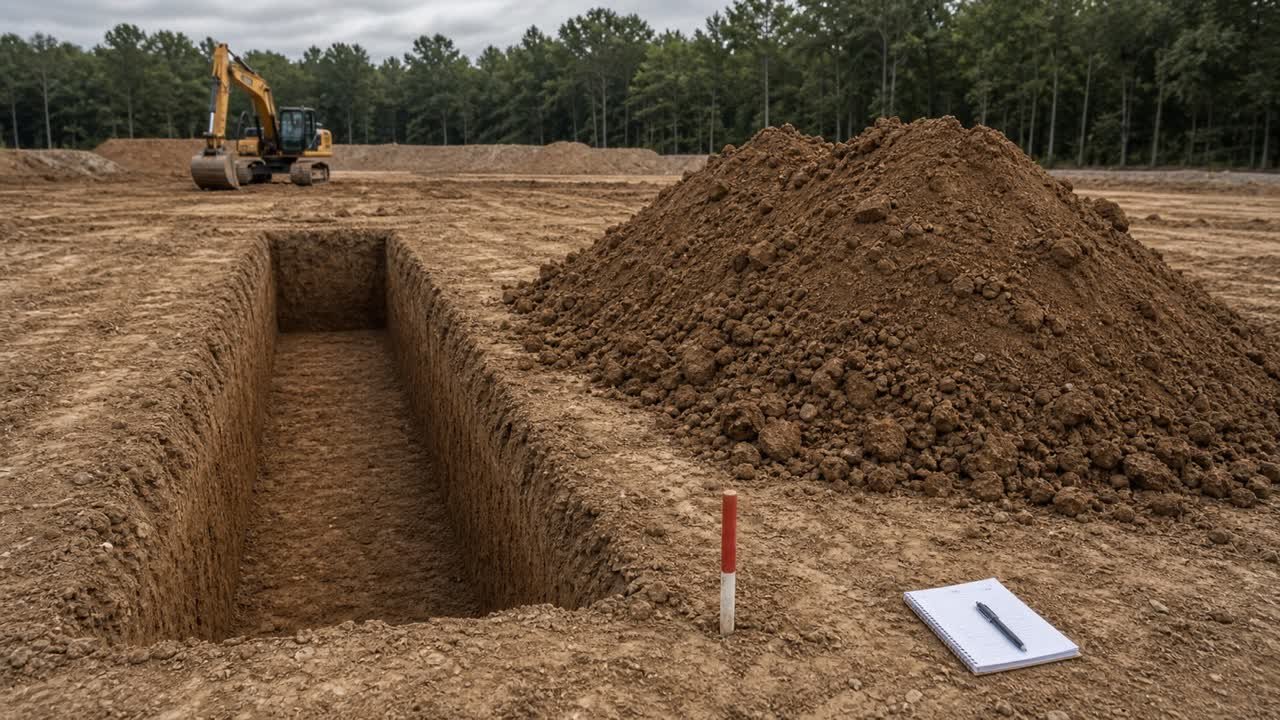
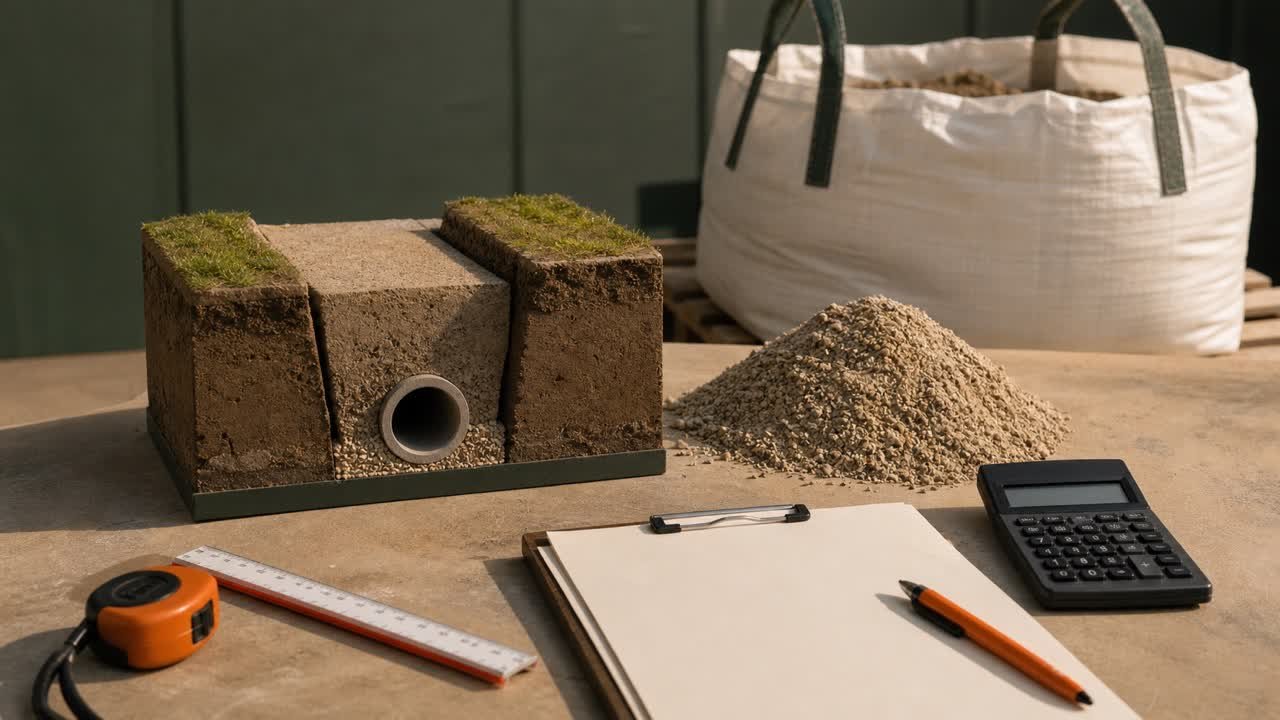
A trench quantity starts with the excavated shape, measured before soil is removed. Enter the full trench length, excavation width, average depth, and number of identical runs. The calculator returns the in-place volume first, then applies only the swell and truck values you enter.
What does the trench volume calculator calculate?
The tool calculates the geometric volume of a rectangular trench with a reasonably uniform width and depth. It can also calculate loose planning volume from a user-entered swell percentage and whole truck trips from a user-entered volume capacity.
Keep the in-place trench volume, loose planning volume, exact load ratio, and rounded trip count as separate records. Each number answers a different project question.
| Result | What it describes | What still needs confirmation |
|---|---|---|
| In-place volume | The rectangular space occupied by the trench before excavation | Measured dimensions, section limits, and whether vertical sides match the plan |
| Loose planning volume | The in-place volume after the selected swell percentage | Project-specific material behavior and the state represented by the factor |
| Estimated loads | Loose volume divided by the entered truck volume, rounded up | Usable body volume, legal payload, material mass, route, access, and disposal controls |
When should you use this rectangular trench calculator?
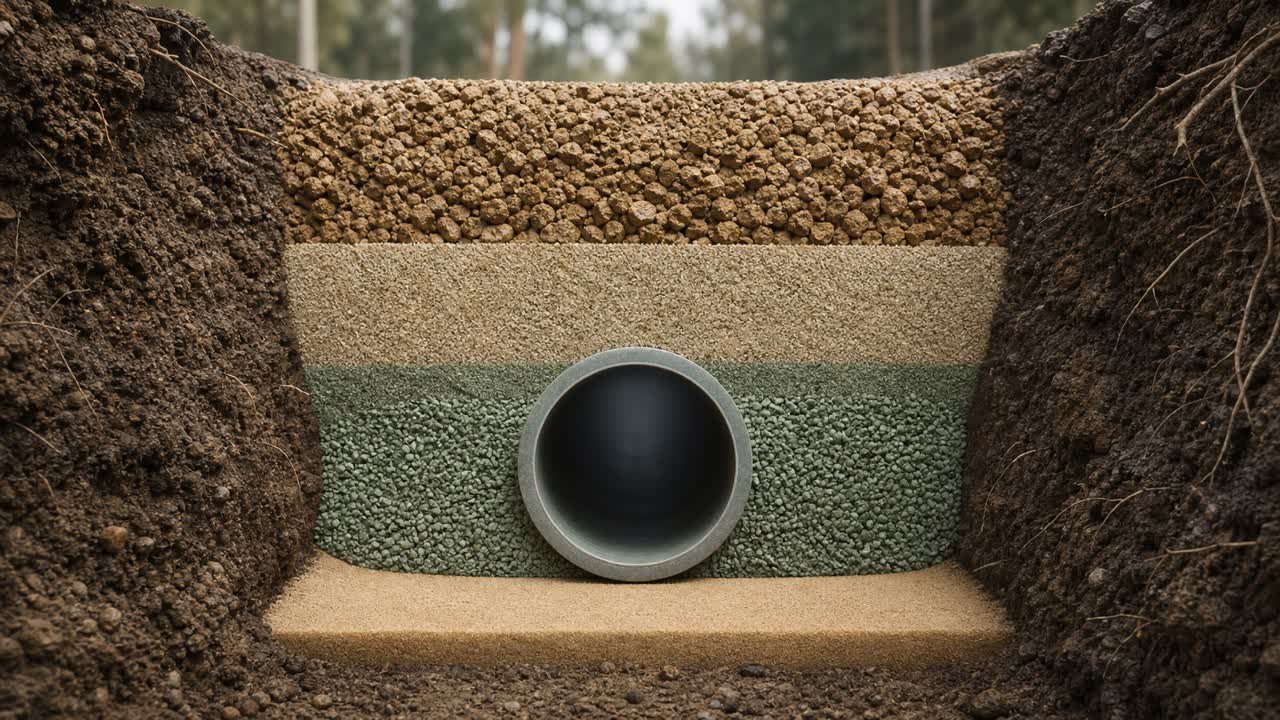
Use it for a long, narrow excavation that can be represented as one or more rectangular prisms. The dimensions must describe the excavated opening, rather than the pipe, cable, bedding layer, or final backfill space.
| Situation | Use this calculator? | Method |
|---|---|---|
| Uniform vertical-sided trench | Yes | Enter length, actual excavation width, and average depth. |
| Several identical trench runs | Yes | Enter the dimensions once and use the identical-runs field. |
| Route changes width or depth | Use separate calculations | Divide the route into uniform sections, calculate each one, and add the section volumes. |
| Top width differs from bottom width | Use a trapezoidal cross-section method | Obtain the required side geometry from the project and calculate the cross-sectional area before multiplying by length. |
| Benched, shored, curved, irregular, or surveyed excavation | Use the governing takeoff method | Follow drawings, survey surfaces, cross-sections, or the responsible professional's method. |
| Pipe bedding, displacement, or backfill | Use a separate zone calculation | Calculate the trench, pipe, bedding, surround, and final backfill as distinct volumes. |
For a driveway crossing, use the gravel driveway culvert quantity guide after calculating gross rectangular excavation. It keeps bedding, pipe displacement, backfill zones, road layers, end treatments, reuse, and supplier quantities separate.
Which measurements do you need?
You need the length of the measured section, the full excavation width, and the vertical depth for the same section. Record where each section begins and ends so the total can be checked against the plan or field notes.
Trench length
Measure along the planned route for the section being calculated. Separate branches, crossings, chambers, widened connections, and repeated runs unless they have the same cross-section.
Excavation width
Use the width of the opening that will be excavated. Pipe outside diameter, nominal pipe size, bucket width, trench-box size, working clearance, and specified trench width describe different things. The project drawings, specification, construction method, and responsible people determine the applicable excavation width.
Average depth
Depth belongs to one reasonably uniform section. Record several readings when the ground or formation level changes. Split abrupt changes into shorter sections rather than hiding them inside one route-wide average.
Identical runs
Use the runs field only when every repeated trench has the same length, width, and average depth. Different dimensions need separate calculations and separate subtotals.
What formula does the calculator use?
The rectangular formula multiplies the cross-sectional area by length. The runs field repeats that same rectangular prism.
In-place volume = length × width × average depth × identical runs
Loose planning volume = in-place volume × (1 + swell % ÷ 100)
Exact load ratio = loose planning volume ÷ truck volume capacity
Estimated trips = exact load ratio rounded up to a whole number
Length, width, and depth must use one length unit. Metric inputs in metres produce cubic metres. Imperial inputs in feet produce cubic feet. Divide cubic feet by 27 when a project record also needs cubic yards.
| Conversion | Relationship | Use |
|---|---|---|
| Feet to metres | 1 ft = 0.3048 m | Convert every length before multiplying when changing unit systems. |
| Cubic feet to cubic metres | 1 ft³ = 0.02831685 m³ | Convert a completed imperial volume. |
| Cubic yards to cubic metres | 1 yd³ = 0.7645549 m³ | Compare supplier or disposal records stated in cubic yards. |
| Cubic feet to cubic yards | 27 ft³ = 1 yd³ | Divide the cubic-foot result by 27. |
The calculator uses unrounded inputs and displays volume with up to 3 decimal places. Unit switching converts populated dimensions and truck capacity, clears the displayed result, and requires a fresh calculation in the selected unit.
Worked metric example
Two identical trenches are each 10 m long, 2 m wide, and 1.5 m deep.
- Calculate one run: 10 × 2 × 1.5 = 30 m³.
- Multiply by 2 identical runs: 30 × 2 = 60 m³ in place.
- Apply a user-entered 20% swell assumption: 60 × 1.20 = 72 m³ loose.
- Divide by a user-entered 12 m³ truck capacity: 72 ÷ 12 = 6 loads.
Result: 60 m³ in place, 72 m³ loose under the stated assumption, and 6 volume-based loads at the entered capacity.
Worked imperial example
A straight trench is 120 ft long, 2.5 ft wide, and 4 ft deep.
- Calculate cubic feet: 120 × 2.5 × 4 = 1,200 ft³.
- Convert to cubic yards: 1,200 ÷ 27 = 44.444 yd³.
- Apply a user-entered 18% swell assumption: 1,200 × 1.18 = 1,416 ft³, or 52.444 yd³.
- Convert a stated 14 yd³ truck volume to the calculator's imperial capacity unit: 14 × 27 = 378 ft³.
- Calculate the exact load ratio: 1,416 ÷ 378 = 3.746 loads.
- Round up for trip planning: 4 estimated trips.
The fourth trip is partial by volume. Vehicle payload, moisture, road limits, loading practice, and disposal rules can reduce the usable quantity carried on each trip.
How do you calculate a trench with changing width or depth?
Divide the route at every meaningful change, calculate each section, and add the unrounded section volumes. Keep a section identifier beside every result.
| Section | Dimensions | In-place volume |
|---|---|---|
| A | 40 ft × 2 ft × 3 ft | 240 ft³ |
| B | 30 ft × 2.5 ft × 4 ft | 300 ft³ |
| C | 20 ft × 3 ft × 5 ft | 300 ft³ |
| Total | 3 separately measured sections | 840 ft³, or 31.111 yd³ |
Run the calculator once for each section and add the in-place results before applying a factor that genuinely applies to the combined material. Separate material types or excavation methods when their swell assumptions differ.
How is a sloped trench different?
A trench with different top and bottom widths has a trapezoidal cross-section. Its volume depends on both widths and the depth.
Trapezoidal area = (top width + bottom width) ÷ 2 × depth
Trapezoidal trench volume = cross-sectional area × length
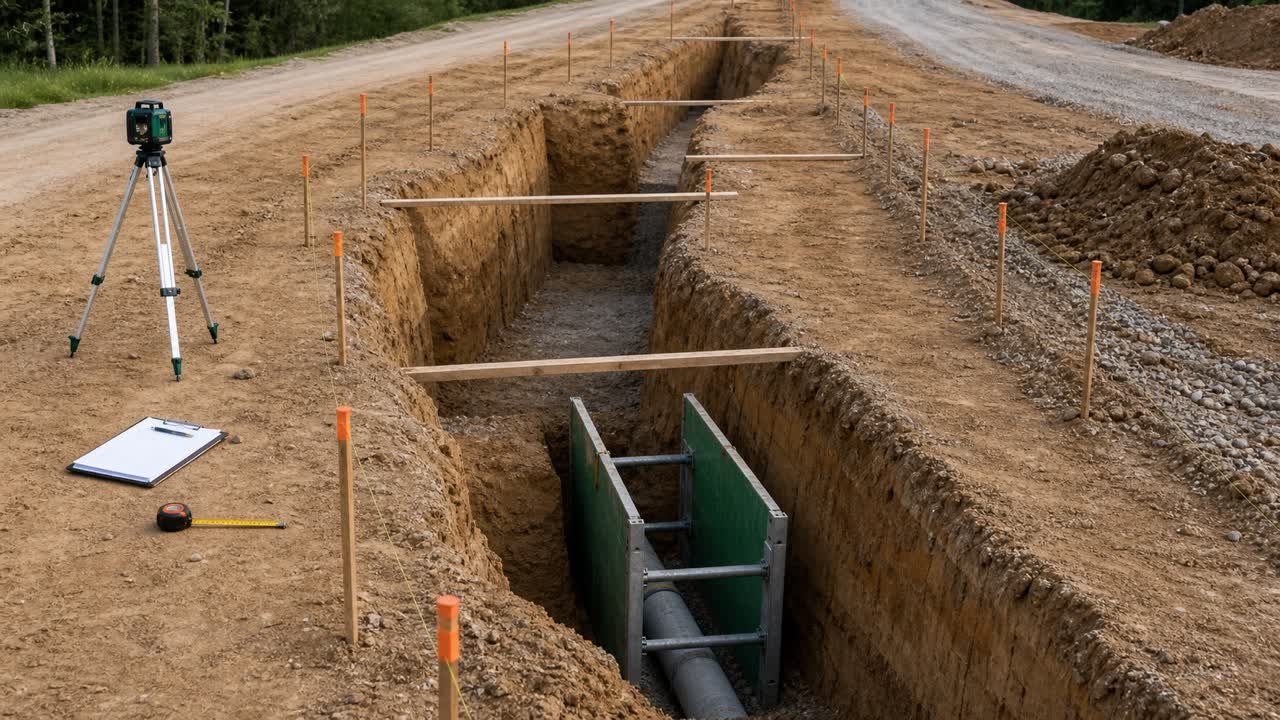
This page's calculator uses one width and therefore represents a rectangle. Side slopes, benches, shields, and shoring follow the project safety and design process. Do not turn a required protective-system decision into a guessed width.
What do bank, loose, and compacted volume mean?
These states describe material at different stages. Keep their factors and quantities separate so a hauling assumption does not change the original excavation geometry.
| Material state | Meaning | Typical project use |
|---|---|---|
| Bank or in place | Material before excavation | Trench geometry, cut quantity, or neat-line record |
| Loose | Material after excavation and disturbance | Stockpile space and volume-based hauling plan |
| Compacted | Placed material after a specified compaction process | Backfill or fill requirement under the governing specification |
The same soil mass can occupy different volumes in these states. Obtain the applicable conversion from project documents, testing, a geotechnical source, or an accountable supplier record. BuildQuantities starts swell at 0% because one default cannot describe every material and condition.
When loose material already sits in a pile, use the stockpile volume guide to select a cone, windrow, frustum, cross-section, or surface-survey method. This calculator's rectangular bank geometry does not measure a loose pile.
Which planning factors must stay separate?
Swell, over-excavation, shrinkage, contingency, and supplier rounding affect different stages. Combining them into one percentage makes later checks difficult.
| Factor | Stage affected | Evidence to record |
|---|---|---|
| Swell or bulking | Bank material converted to a loose state | Material, moisture or test condition, source, and percentage |
| Over-excavation | Excavated geometry beyond the measured or design line | Field measurement, pay rule, drawing, or method allowance |
| Shrinkage or compaction conversion | Loose or bank material converted to a placed state | Specification, test requirement, and reference state |
| Commercial contingency | Cost or schedule plan | Named risk, amount, owner, and approval |
| Truck or supplier rounding | Final booking or order | Usable capacity, selling increment, payload, and quote |
How should truck loads be planned?
The calculator divides loose volume by the truck volume you enter and rounds the ratio up. This is a volume-only planning result. The controlling load may be smaller when material mass reaches the vehicle's legal or operating limit before the body is full.
- Confirm whether the entered capacity is stated in cubic metres, cubic feet, or cubic yards.
- Confirm usable body volume for the chosen vehicle and loading method.
- Obtain the applicable material mass or density record when payload can control.
- Check vehicle payload, axle, road, route, access, loading, unloading, and disposal limits with the responsible parties.
- Record the exact ratio and the rounded trip count separately.
A nominal body volume does not prove the legal load. Wet material, dense soil, rock, restricted routes, or site conditions can control the amount carried.
How sensitive is the result to measurement changes?
Each dimension multiplies directly into the result. A small width or depth difference repeated along a long route can change the total by several cubic metres or yards.
Example: 100 m × 0.6 m × 1.2 m equals 72 m³. Changing the recorded width to 0.65 m gives 78 m³, an increase of 6 m³. Changing both width to 0.65 m and depth to 1.3 m gives 84.5 m³, which is 12.5 m³ above the first measurement.
Record the source of each dimension. Recalculate from the changed field rather than adding an unexplained percentage to the earlier total.
What should a trench quantity record include?
A short measurement and assumption record makes the result reproducible.
- Project, route, drawing, and section identifiers.
- Start and end chainage, station, or field reference for each section.
- Length, excavation width, depth readings, average-depth method, and units.
- Whether the cross-section is rectangular, sloped, benched, shored, or otherwise controlled.
- In-place volume for every section and the unrounded total.
- Material description and the source of any swell or state conversion.
- Truck capacity unit, exact load ratio, rounded trips, and payload check.
- Prepared date, revision, technical-review status, and unresolved assumptions.
What safety checks apply before excavation?
The calculator estimates quantity. Excavation safety follows the applicable workplace rules, project controls, soil and water conditions, utilities, and responsible competent or qualified people.
For United States construction workplaces, OSHA 29 CFR 1926.651 requires the estimated location of underground installations to be determined before opening an excavation. The standard also addresses access and egress, hazardous atmospheres, water accumulation, adjacent structures, loose material, spoil placement, and inspections.
- OSHA requires a safe means of egress in trench excavations 4 ft (1.22 m) or deeper so employees travel no more than 25 ft (7.62 m) laterally.
- Excavated material or equipment that could fall or roll into an excavation must be kept at least 2 ft (0.61 m) from the edge or controlled by a sufficient retaining method.
- When employee exposure can reasonably be anticipated, a competent person performs required inspections before work, as needed during the shift, and after rainstorms or other hazard-increasing events.
- Water accumulation, nearby structures, traffic, lifting operations, and hazardous atmospheres require the controls stated in the applicable rule and project plan.
OSHA's overview identifies cave-ins as the greatest trench risk and describes sloping, shoring, or shielding as protective approaches. The United States rules cited here do not set requirements for another country. Follow the authority and project process that governs the work location.
Common trench-volume mistakes
- Entering pipe diameter or bucket width instead of the approved excavation width.
- Mixing feet, inches, metres, and millimetres inside one multiplication.
- Using one average across abrupt width or depth changes.
- Using the identical-runs field for trenches with different dimensions.
- Applying swell to dimensions before calculating the in-place geometry.
- Combining swell, over-excavation, compaction, contingency, and rounding.
- Dividing cubic feet by a truck capacity stated in cubic yards without converting the unit.
- Rounding section values before adding them.
- Treating a volume-based truck result as proof of payload or legal compliance.
- Using a rectangular formula for sloped, benched, curved, or surveyed geometry.
Questions about trench excavation volume
Should trench width equal the pipe diameter?
Use the approved excavation width. Pipe diameter describes the pipe, while excavation width can include working space, bedding placement, jointing, compaction access, support systems, and project-specific requirements.
Can I use one average depth for the whole route?
One average can represent a reasonably uniform section when the measurement method supports it. Divide a route at abrupt formation, ground, width, slope, crossing, or specification changes.
Why does the load count round up?
A positive remainder still requires another trip in a volume-only plan. Keep the exact ratio beside the rounded result so the partial final load remains visible.
Does this calculate excavation cost?
The tool calculates volume and optional loads. Cost needs current rates and project scope for labor, equipment, support systems, dewatering, haul distance, waiting time, disposal, permits, traffic control, testing, backfill, compaction, and reinstatement.
Can the excavated soil be used as backfill?
Material acceptance, moisture, contamination, particle size, compaction, testing, and zone requirements come from the project specification and responsible parties. Excavated volume alone cannot establish reuse.
Sources and scope
- NIST Guide to the SI, Appendix B.8: foot, cubic-foot, and cubic-yard conversion factors; accessed 28 July 2026.
- OSHA: Trenching and Excavation: United States cave-in prevention and hazard overview; accessed 28 July 2026.
- OSHA 29 CFR 1926.651: United States requirements for utilities, access, atmosphere, water, adjacent structures, spoil placement, and inspections; accessed 28 July 2026.
Source scope: NIST supports unit conversions. OSHA supports the stated United States workplace-safety context. Project drawings, specifications, survey records, geotechnical information, vehicle records, disposal rules, and responsible professionals control the dimensions, material factors, protective systems, and final work plan.
Review note: Saleem Sial owns the research and editorial record. Formula fixtures, source checks, build validation, and rendered QA form the internal publication gate. Waseem Sial, External Reviewer and Engineer, is listed for ongoing external review; no completed review date is claimed. The completed calculator remains indexable.