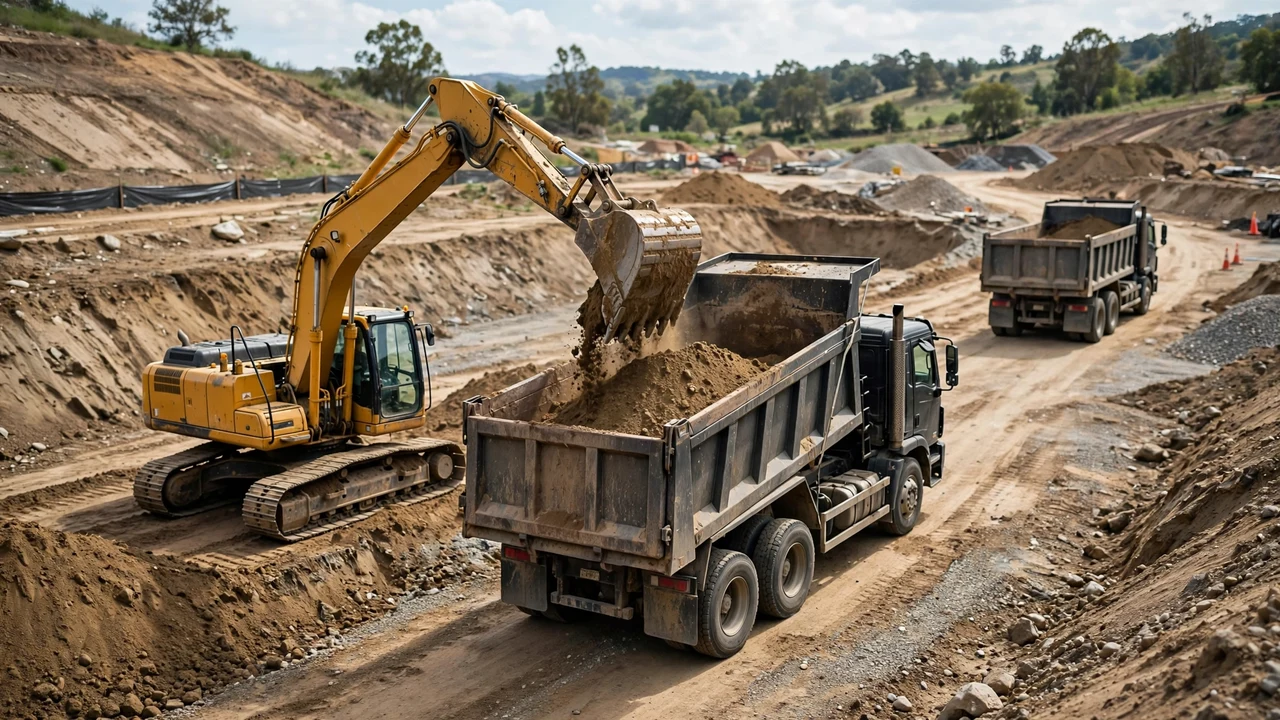
A pond excavation volume comes from the shape of the dig. Pick the formula that matches the shape, and the bank volume holds up when you check it. Pick the wrong one, and the error can reach half the dig.
Which calculation method fits your pond?
Use the method whose geometry matches the pond. Match the outline, the side slope, and any benches to one of the methods below.
| Pond shape | Method | Formula | When it fits |
|---|---|---|---|
| Rectangle with near-vertical walls | Rectangular prism | V = length × width × depth | Small hand-dug ponds, or cohesive soil cut nearly vertical |
| Rectangle with straight side slopes | Pyramid frustum | V = (top area + bottom area + √(top area × bottom area)) ÷ 3 × depth | The most common machine-dug pond |
| Circle or oval with straight slopes | Cone frustum | V = π × depth ÷ 3 × (R² + R × r + r²) | Round ornamental or wildlife ponds |
| Benched or changing slopes | Layer-by-layer frustum | Sum of one frustum volume per bench | Deep ponds dug in safety benches or with different slopes per layer |
| Irregular outline | Grid method | Sum of (cell area × average corner depth) over all cells | Natural-looking ponds with no clean outline |
| Quick field check only | Average end area | V = (top area + bottom area) ÷ 2 × depth | A fast check that reads high on tapered ponds; do not use it as the planning volume |
Record which method produced each number. Two volumes from different methods are not comparable until you know their assumptions.
When do you use the rectangular prism?
Use it when the walls are near-vertical and the bottom matches the top outline. Multiply the top length by the top width by the vertical depth.
Prism volume = length × width × depth
A 25.0 × 15.0 m pond at 3.0 m depth gives 25.0 × 15.0 × 3.0 = 1125 m³. That number is correct only if the sides really stand vertical. Apply it to a sloped dig and it overstates the bank volume by hundreds of cubic metres, as the next fixture shows.
When do you use the pyramid frustum?
Use it for a rectangular pond with straight side slopes, the most common machine-dug shape. You need the top area, the bottom area, and the vertical depth.
Frustum volume = (top area + bottom area + √(top area × bottom area)) ÷ 3 × depth
Take a pond with a 25.0 × 15.0 m top, a 15.0 × 9.0 m bottom, and 3.0 m of vertical depth. The top area is 375.0 m² and the bottom area is 135.0 m².
- Multiply the areas: 375.0 × 135.0 = 50,625.0.
- Take the square root: √50,625.0 = 225.0.
- Add the three terms: 375.0 + 135.0 + 225.0 = 735.0.
- Divide by 3 and multiply by depth: 735.0 ÷ 3 × 3.0 = 735.00 m³.
Result: 735.00 m³ bank. The same dig measured as a top-area prism would give 1125.00 m³, an overstatement of 390.00 m³ (53.1%). The formula is exact when the top and bottom taper in the same proportion, and it is the standard working form for straight slopes.
When do you use the cone frustum?
Use it for a circular or oval pond with straight slopes. You need the top radius, the bottom radius, and the vertical depth.
Cone frustum volume = π × depth ÷ 3 × (top radius² + top radius × bottom radius + bottom radius²)
Take a circular pond with a 12.0 ft top radius, a 6.0 ft bottom radius, and 4.0 ft of depth. The volume is π × 4.0 ÷ 3 × (144 + 72 + 36) = 1055.58 ft³, which is 1055.58 ÷ 27 = 39.10 yd³. For an oval pond, measure the long and short radii and treat them the same way; the formula still applies when both taper in the same proportion.
Use the pond excavation measurement guide when you need to establish the top and bottom dimensions that feed this formula.
How do you handle a benched pond?
Do not run one frustum across the whole depth. Calculate each bench as its own frustum, then add the layer volumes.
Take a pond dug in two 1.5 m benches with a 1.0 m flat ledge between them. The upper bench runs from a 24.0 × 15.0 m top to a 20.0 × 12.5 m mid rectangle: (360.0 + 250.0 + 300.0) ÷ 3 × 1.5 = 455.00 m³. The ledge steps 1.0 m inward on every side, so the lower bench runs from an 18.0 × 10.5 m rectangle to a 14.0 × 7.0 m bottom: (189.0 + 98.0 + 136.10) ÷ 3 × 1.5 = 211.55 m³.
Result: 455.00 + 211.55 = 666.55 m³ bank. A single frustum from the 24.0 × 15.0 m top to the 14.0 × 7.0 m bottom over 3.0 m would give 645.83 m³, which reads 20.72 m³ (3.2%) low because it ignores the ledge. When the slopes run straight through the full depth with no ledge, one frustum and the layer sum agree; split the dig into layers whenever the slope changes.
How do you handle an irregular outline?
Use the grid method. Overlay a grid on the pond plan, record the depth at every grid corner, average the four corner depths of each cell, multiply by the cell area, and sum all cells.
Grid volume = sum over cells of (cell area × average of the 4 corner depths)
Take a 30.0 × 30.0 m pond area divided into nine 10.0 × 10.0 m cells, with corner depths recorded at each grid point. The nine cell averages sum to 2010.0 m³ over 900 m², which is an average depth of 2010.0 ÷ 900 = 2.23 m. Use smaller cells where the depth changes fast; the McGraw-Hill Access Engineering earthwork chapter notes that smaller cells give higher accuracy.
Why does the average end area overstate sloped ponds?
The average end area treats the pond as though the midsection area were the simple average of the top and bottom areas. On a tapered pond the true midsection is smaller than that average, so the method always reads high. It is exact only when the two end areas are equal.
Average end area volume = (top area + bottom area) ÷ 2 × depth
On the rectangular fixture, (375.0 + 135.0) ÷ 2 × 3.0 = 765.00 m³ against the frustum result of 735.00 m³, an overstatement of 30.00 m³ (4.1%). On the circular fixture, (452.39 + 113.10) ÷ 2 × 4.0 = 1130.97 ft³ against the cone result of 1055.58 ft³, an overstatement of 75.39 ft³ (7.1%). The steeper the taper, the larger the bias. Surveying course material describes the method as approximate but generally accepted for quick earthwork estimates; use it as a field check, not as the planning volume.
How do you cross-check a pond volume?
Run the prismoidal formula as the second method. It needs the top area, the bottom area, and the mid-depth area, and it is exact for straight slopes.
Prismoidal volume = depth ÷ 6 × (top area + 4 × mid area + bottom area)
On the rectangular fixture, the mid-depth rectangle is 20.0 × 12.0 m, an area of 240.0 m². The check gives 3.0 ÷ 6 × (375.0 + 4 × 240.0 + 135.0) = 0.5 × 1470.0 = 735.00 m³, matching the frustum exactly. Run one method as the plan and the second as the check; investigate any gap between them before ordering.
Method-selection mistakes to avoid
- Using the top-area prism on a sloped dig. It overstated the rectangular fixture by 390.00 m³ (53.1%).
- Using the average end area as the final volume on a steep taper. It read 7.1% high on the circular fixture.
- Running one frustum across a benched pond instead of summing layers. The bench layers need their own top and bottom areas.
- Applying a pond formula to an irregular outline instead of gridding it. The grid method exists for exactly that shape.
- Mixing bank and loose volumes in one total. Convert the bank result to a loose handling quantity separately; see bank vs loose volume.
- Forgetting the soil type after choosing the method. Swell and reuse depend on what was dug; see soil considerations for pond excavation.
Safety and professional scope
A volume method does not select excavation geometry, protective systems, equipment, or haul routes. Side slopes that stay stable during measurement can still fail during the dig; slope stability follows the geotechnical information and the governing safety plan, not the quantity formula.
For U.S. construction work, OSHA identifies cave-ins as the main trench hazard. OSHA 29 CFR 1926.651 also covers soil classification, protective systems, water accumulation, adjacent structures, and competent-person inspections. Other countries use their own workplace rules.
Sources and scope
- Standard geometry, independently verified by the fixtures in this page: pyramid frustum V = (A1 + A2 + sqrt(A1 x A2)) / 3 x h; cone frustum V = pi x h / 3 x (R^2 + R x r + r^2); prismoidal formula V = h / 6 x (A1 + 4 x Am + A2). Scope: exact when end areas taper in the same proportion for frustums, and for straight slopes for the prismoidal form.
- McGraw-Hill Access Engineering, Earthwork - Borrow Pit Method (Grid Method): grid method description and the smaller-cell accuracy note.
- Surveying course material, Chapter 4 transcript: average end area is approximate and generally accepted as sufficient for earthwork estimates.
- U.S. Office of Surface Mining Reclamation and Enforcement, Directive TSR-1 Appendix A: bank, loose, and compacted volume definitions and swell context.
- NIST Handbook 44, 2026 Appendix C: cubic-foot, cubic-yard, litre, and cubic-metre relationships.
- OSHA Trenching and Excavation and 29 CFR 1926.651: U.S. occupational excavation-safety context.
Scope: the methods on this page calculate bank volume for stated pond geometry. The governing drawings, survey and testing methods, geotechnical information, contract measurement provisions, safety plan, and responsible qualified people control the accepted method and final project quantity.
Review responsibility: Saleem Sial owns the published calculation, source, and editorial checks. Waseem Sial, External Reviewer and Engineer, remains listed for ongoing external review; no completed external-review date is claimed.
Next, use the worked pond excavation example to see a full bank-volume calculation end to end, or the haulage and delivery guide to turn the bank volume into truckloads. Return to the Earthwork & Drainage Calculators hub for the related tools.