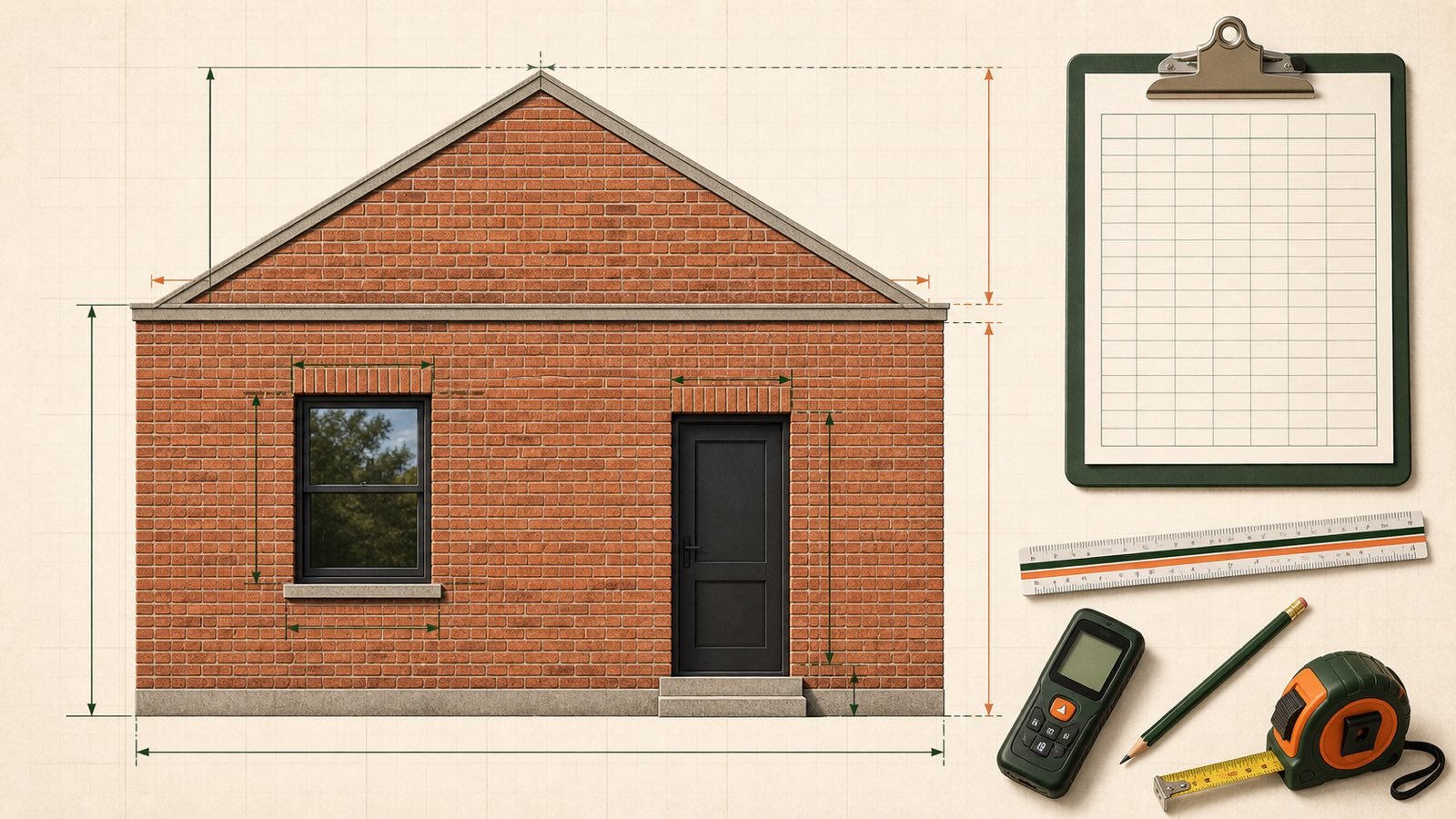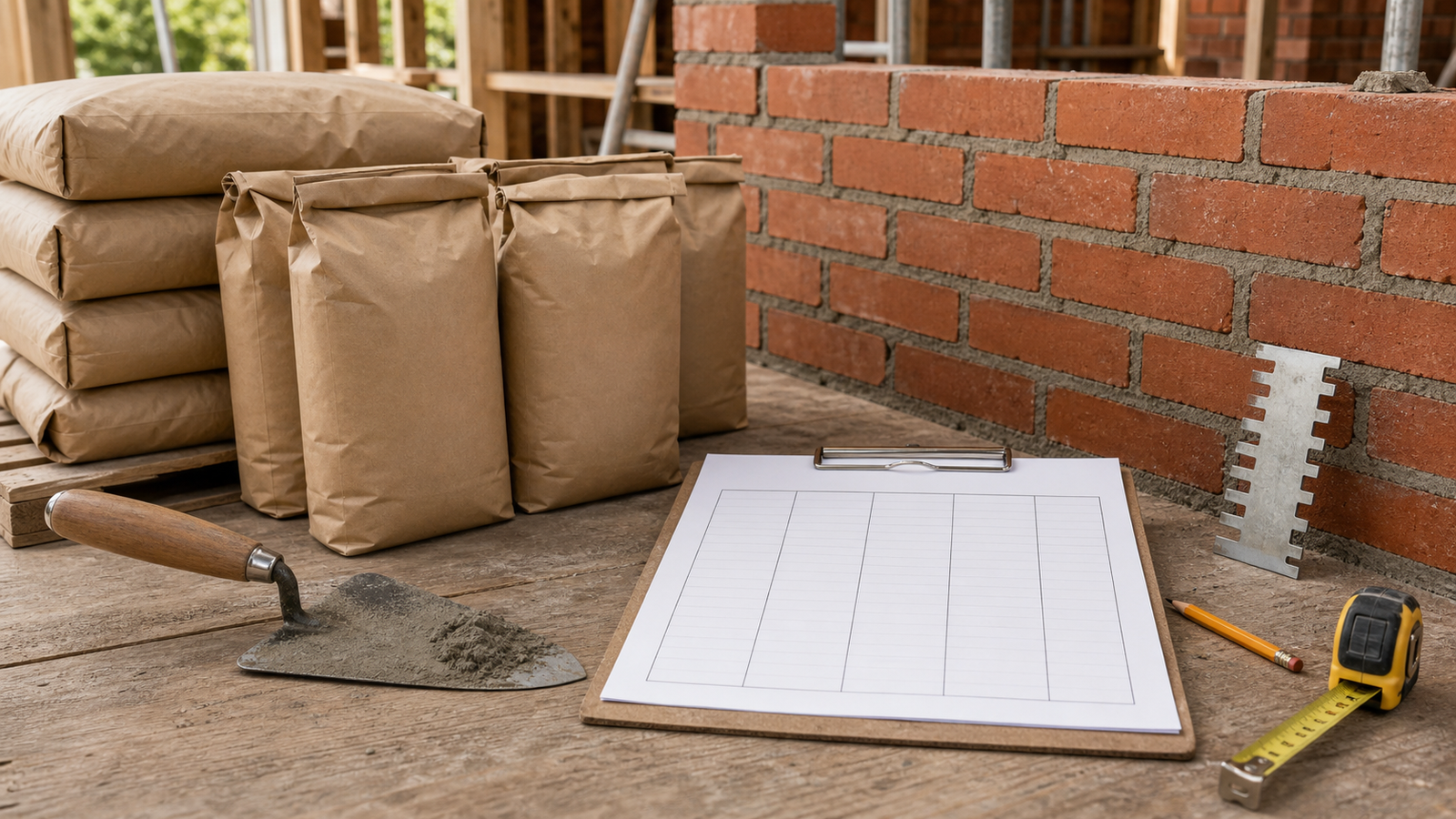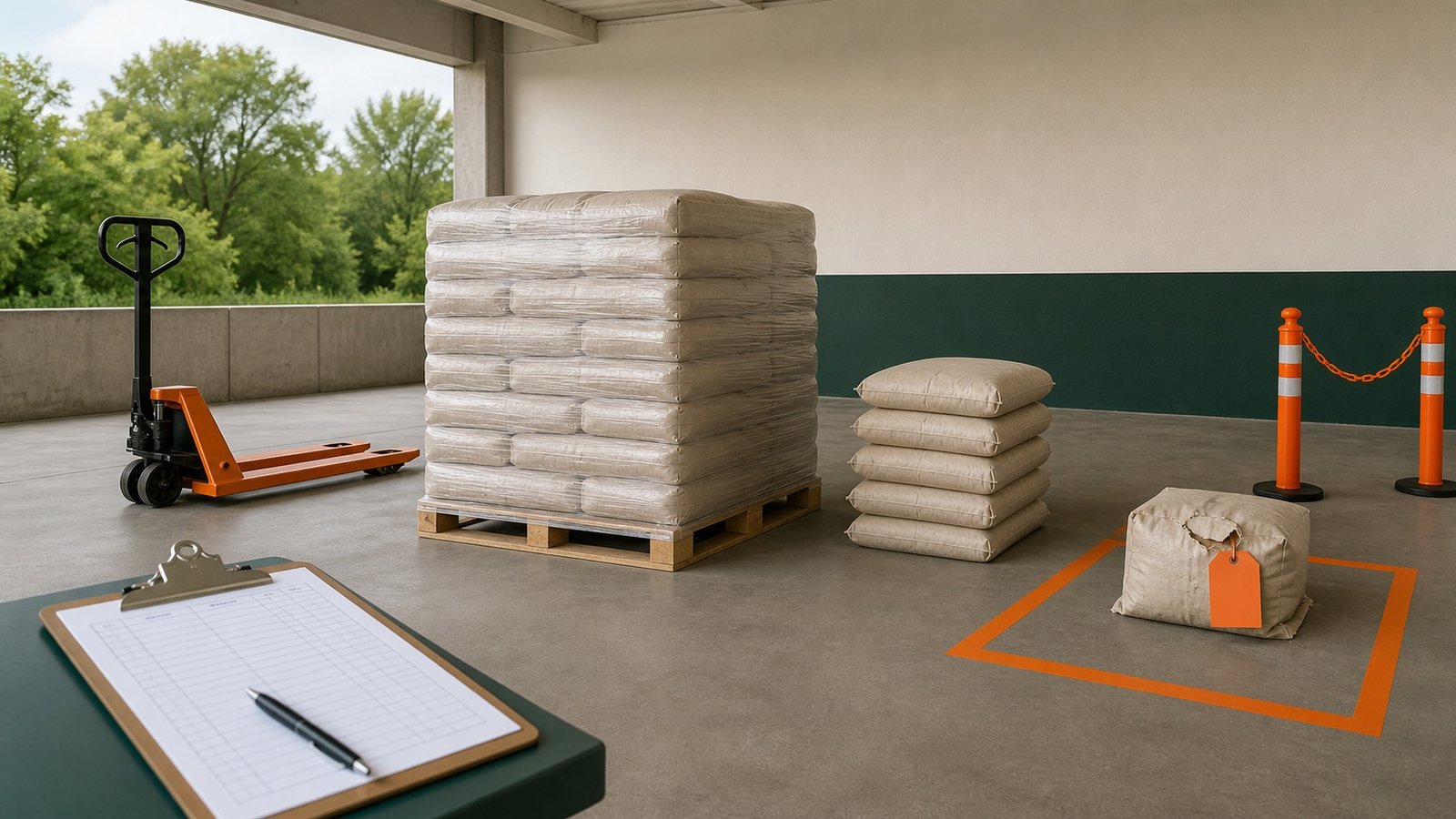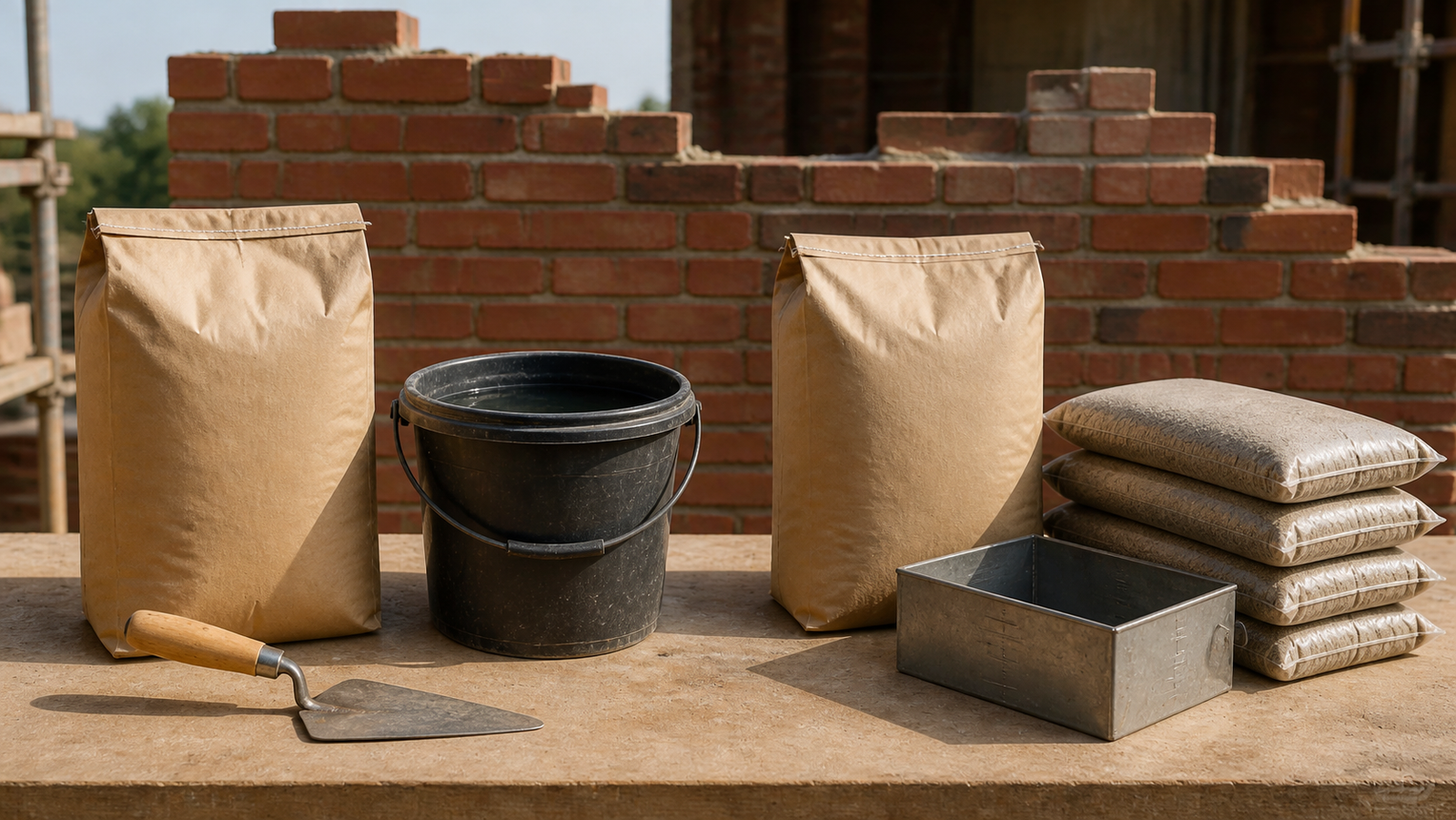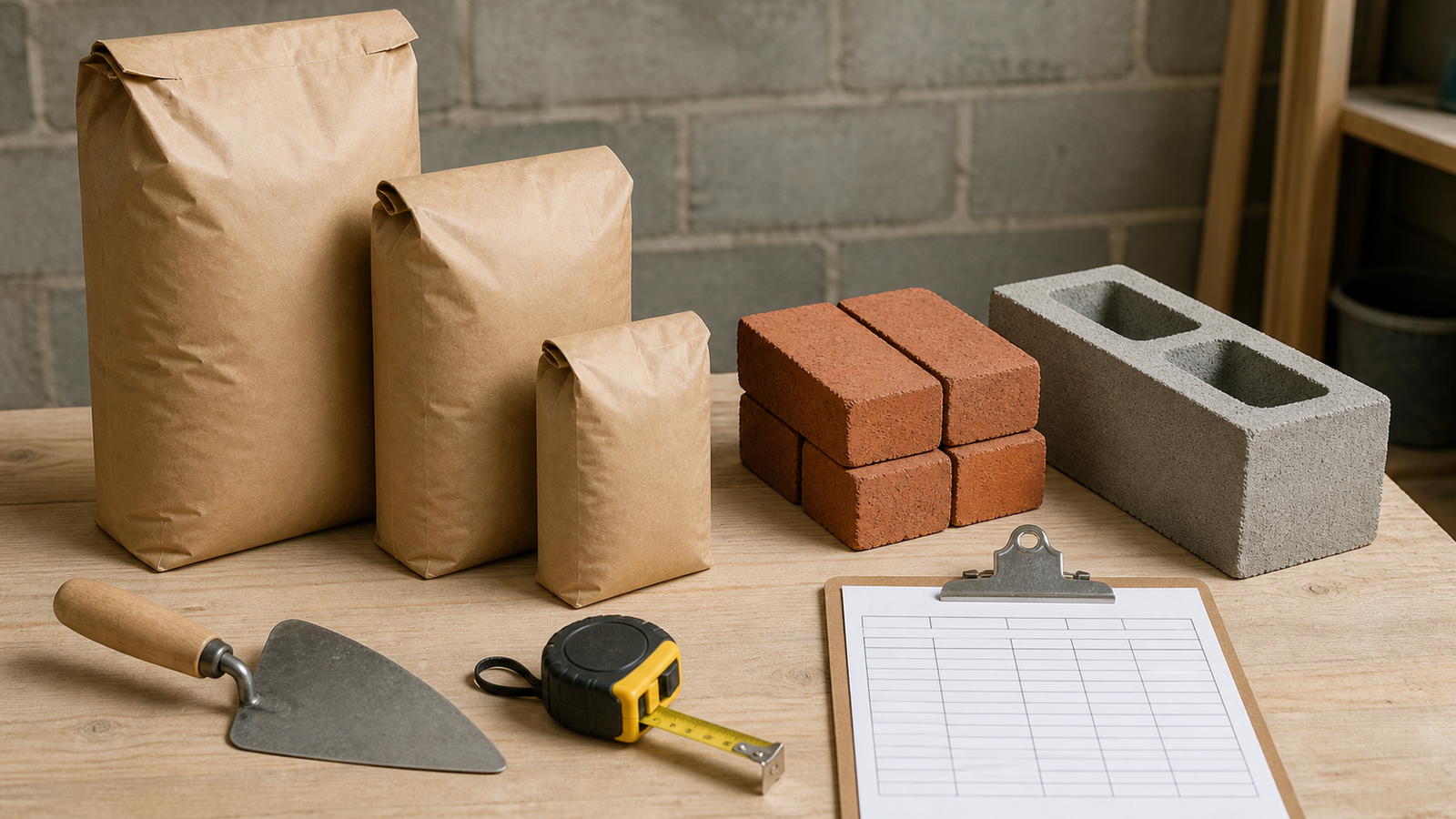
Mortar coverage per bag changes with the product, package and masonry unit. A rate copied as ‘one bag lays 37 bricks’ is incomplete until the record identifies which bag, which bricks and which manufacturer statement supplied the number.
Keep that record attached to the calculation. It lets a supplier, estimator or site team check the same source before the order is placed.
How many bricks or blocks can one bag of mortar lay?
For 2 current US product examples, one 80 lb bag covers 35–37 standard bricks or 12–13 standard blocks. QUIKRETE states up to 37 standard bricks or 13 standard 8 in × 8 in × 16 in blocks for Mortar Mix No. 1102. Sakrete states 35 standard bricks or 12 standard 8 in blocks for its Mortar Mix Type S.
These are named-product records, not a general rate for every 80 lb bag. Enter the value for the product being purchased in the Masonry Mortar Calculator.
What belongs in a mortar coverage record?
Record enough detail for another person to locate the same yield statement. Product name and bag weight alone may still leave the masonry unit, qualifier or source revision unclear.
| Field | What to save | Reason |
|---|---|---|
| Manufacturer | Company named on the package or submittal | Similar product names occur across brands |
| Exact product | Full product name and number | Mortar mix, mason mix and masonry cement can be different purchasing systems |
| Market | Country or regional product page | Formulations, packaging and instructions can differ |
| Package | 80 lb, 60 lb, 40 lb, 30 kg or the actual selling unit | Coverage belongs to the stated package |
| Masonry unit | Brick or block description and dimensions when supplied | A block rate cannot be applied to brick |
| Coverage wording | Exact number or range and units per bag | The calculation needs compatible units |
| Qualifier | Words such as “up to,” “approximately” or stated joint conditions | The qualifier limits how the number should be interpreted |
| Source record | URL, data-sheet revision and access date | Product pages and technical sheets can change |
What do current manufacturer records show?
The current examples disagree by 2 bricks and 1 block per 80 lb bag. That small-looking difference can change the order when the exact ratio crosses a whole-bag boundary.
| Product record | Brick coverage | Block coverage | Source wording or unit |
|---|---|---|---|
| QUIKRETE Mortar Mix No. 1102, data sheet revised November 2020 | Up to 37 standard bricks | Up to 13 standard 8 × 8 × 16 in blocks | 80 lb bag |
| Sakrete Mortar Mix Type S, current US product page | 35 standard bricks | 12 standard 8 in blocks | 80 lb bag mortar yield |
The table supports 2 product-specific inputs. It does not establish a 35–37 brick industry range for an unidentified bag. The selected product record controls the calculation.
How do you convert units per bag into a purchase quantity?
Divide the checked compatible unit count by the current units-per-bag value. Keep the exact ratio, then round upward once if the supplier sells only complete bags.
Exact bags = checked compatible units ÷ current units per bag
Whole bags = ceiling(exact bags)
Purchased capacity = whole bags × current units per bag
Package-rounding capacity = purchased capacity − checked units
Package-rounding capacity describes the mathematical space above the entered count. It does not prove installed surplus, waste or reusable leftover mortar.
How can one block per bag change an order?
A checked wall contains 130 compatible standard blocks. The QUIKRETE record gives 13 blocks per bag, while the Sakrete record gives 12. Each calculation must remain attached to its product.
| Named product input | Exact ratio | Whole bags | Capacity above 130 blocks |
|---|---|---|---|
| QUIKRETE, 13 blocks/bag | 130 ÷ 13 = 10.0000 | 10 | 0 units |
| Sakrete, 12 blocks/bag | 130 ÷ 12 = 10.8333 | 11 | 2 units |
The second result rounds to 11 because 10 bags represent 120 blocks under that product record. The first result stays at 10 because the exact ratio is already a whole number.
Where is the exact whole-bag boundary?
A one-unit change can add a full bag when the takeoff sits beside a package boundary. At 37 standard bricks per bag, 555 bricks equal exactly 15 bags. A count of 556 produces 15.0270 bags and rounds to 16.
| Checked bricks | Exact bags | Whole bags | Purchased capacity |
|---|---|---|---|
| 555 | 15.0000 | 15 | 555 bricks |
| 556 | 15.0270 | 16 | 592 bricks |
Do not add another bag to an exact integer. Do not round the brick count or the units-per-bag value before division.
Can 2 products with the same bag weight give different brick totals?
Yes. Bag mass identifies the dry package quantity. It does not establish the number of joints that package will fill for another formulation and unit.
For 500 compatible standard bricks, 37 bricks per bag gives 13.5135 exact bags and a 14-bag purchase. A 35-brick record gives 14.2857 exact bags and a 15-bag purchase.
The one-bag difference comes from the named coverage records. Choose the product first, then calculate with its current statement.
Can an 80 lb rate be scaled to a 40 lb or 60 lb bag?
Scale by mass only when the current manufacturer documentation supports that relationship for the same product and application. A proportional estimate made from bag weight can hide differences in product listing, package availability, formulation, rounding and stated yield conditions.
QUIKRETE's current product page lists 40, 60 and 80 lb packages for Mortar Mix No. 1102. Its November 2020 data sheet gives the 80 lb masonry-unit yield. The current page does not state a brick or block yield for every listed size, so the 80 lb value should not be divided by 2 or multiplied by 0.75 without a current supporting record.
Ask the supplier or manufacturer for the correct coverage statement when the selected package lacks one. Save that reply or submittal with the takeoff.
Which conditions can reduce units per bag?
Actual use can change when joint volume, bedding and handling differ from the conditions behind the published estimate. Treat the manufacturer value as a product record with limits.
- Brick or block dimensions differ from the named standard unit.
- Joint width or depth changes.
- Concrete block uses full bedding rather than the represented face-shell condition.
- The first course needs a thicker levelling bed.
- Frogs, cores, irregular faces or rough units receive more mortar.
- Details, returns, pilasters and cuts add joints outside the simple count.
- Mortar remains in the mixer or on the board, drops during laying or becomes unusable under the product instructions.
A bag calculator cannot measure those conditions from unit count alone. Use a current product statement, project documents and an accepted project allowance where the estimating method requires one.
How should mortar allowance stay separate from coverage?
Keep the manufacturer coverage value unchanged in the source record. Add a documented project allowance as a separate calculation input, with its reason and approval.
Reducing 37 bricks per bag to 33.3 and adding a separate 10% allowance can count the same concern twice. Record whether the adjustment covers joint variation, handling loss, details or another defined condition. Brick or block breakage belongs in the masonry-unit order, not automatically in the mortar allowance.
The calculator shows base exact bags, allowance quantity and package surplus as separate results so these causes remain visible.
What should you do when sources disagree or an old sheet remains online?
Identify the exact product, market and revision before choosing a value. Keep conflicting records separate and ask the manufacturer or supplier which document controls the product being delivered.
Do not average an old value and a current value. Record the unanswered question beside both calculations. A lower bag count should not be accepted solely because it costs less.
The revision check matters even when the product number appears unchanged. Packaging, formulations, listed applications and public technical sheets can change while older files remain reachable.
What is the practical coverage-to-order workflow?
- Finish the compatible brick or block count. Use the Brick Wall Takeoff guide when the brick schedule still needs openings and wall sections checked.
- Select the mortar product and package from the project specification, approved submittal or supplier record.
- Find the matching manufacturer yield for the named masonry unit.
- Save the product, package, unit, qualifier, revision, URL and access date.
- Run separate calculations for brick and block or for any changed product or package.
- Keep the exact bag ratio through any documented allowance step.
- Round upward once to the supplier's selling increment.
- Compare early job use with the takeoff on larger work and record any forecast change.
Use Concrete Block Mortar Planning when a CMU schedule needs field-use reconciliation by wall zone. That guide handles the site record after the product coverage input has been chosen.
Which mortar coverage mistakes change the result?
- Using “one bag” without recording its mass and product.
- Entering a brick rate for concrete block.
- Combining brick and block counts under one coverage value.
- Using a masonry-cement yield that assumes separately added sand as a complete premix rate.
- Scaling an 80 lb value to another package without manufacturer support.
- Deleting “up to” or “approximately” from the source note.
- Rounding every wall section before compatible exact bag ratios are combined.
- Adding the same adjustment through both reduced coverage and a percentage.
- Treating package-rounding capacity as usable leftover material.
- Using an old sheet without checking the delivered product and market.
Safety, specification and product limits
Coverage arithmetic does not select Type M, S, N or O mortar. ASTM C270-26 covers mortar for unit masonry through its stated proportion and property specifications. Project documents, current standards and responsible design decisions control the mortar selection and wall assembly.
Follow the current package, technical data and safety data for mixing water, sequence, use time, temperature, curing, storage and disposal. Dry mortar can contain Portland cement and crystalline silica.
OSHA's US construction silica FAQ says isolated mixing of small amounts of mortar typically stays below its action level under the stated conditions. It also requires employers to consider foreseeable exposures and other silica-generating work. The applicable safety data, task conditions and local workplace rules control the job.
Return to the brick planning tools and guides. The calculation methodology explains rounding and source controls, and the corrections route accepts a product, source or arithmetic issue.
Sources and source scope
- QUIKRETE Mortar Mix Product No. 1102 data sheet: one named product's 80 lb standard-brick and standard-block yield, package sizes, mixing and revision date.
- QUIKRETE Mortar Mix product page: current US product identity and listed 40, 60 and 80 lb packages.
- Sakrete Mortar Mix Type S: one named 80 lb product's stated standard-brick and standard-block yield and package listing.
- ASTM C270-26: active standard identity and scope for mortar for unit masonry.
- OSHA construction silica FAQ: United States occupational scope and stated small-amount mortar-mixing context.
- NIST SI Units: Mass: kilogram terminology and mass-unit context.
Source scope: Manufacturer records support only their named products, packages, units, markets and stated conditions. ASTM supports the standard's scope, OSHA supports the named United States workplace context, and NIST supports mass terminology. Current product data, project documents, supplier records, local requirements and responsible project decisions govern the order and work.
Review note: Saleem Sial owns the research and editorial record. Source checks, independent arithmetic, originality review, build validation, link crawl, schema review and rendered QA form the internal publication gate. Waseem Sial, External Reviewer and Engineer, is listed for ongoing external review; no completed review date is claimed.