A mortar estimate becomes a purchase only after you match it to the exact bag and the supplier's selling increment. The same order needs a receiving record, because delivered bags can include damaged, wet, unidentified or incompatible material.
This worksheet carries one quantity from the approved gross requirement through pallets, loose bags, accepted delivery and remaining site stock. It keeps supplier rounding and unexplained losses visible instead of hiding them inside a broad waste percentage.
How should you order and track masonry mortar bags?
Start with the approved gross whole-bag requirement. Deduct compatible usable stock once, convert the net requirement through the supplier's current pallet and loose-bag rules, then reconcile accepted receipts against consumption and stock states.
Use one line for each state. Ordered, delivered, accepted, quarantined, consumed, unopened and opened dry material describe different quantities.
| State | Record | Can it reduce a new order? |
|---|---|---|
| Gross requirement | Approved whole bags after yield and project allowance | Starting demand |
| Verified unopened stock | Exact compatible product, dry, identifiable and reserved | Yes |
| Approved opened-dry equivalent | Measured dry quantity accepted under the site procedure | Yes, if the project accepts it |
| Ordered | Quantity on the purchase order | No; it is not yet site stock |
| Physically delivered | All bags that arrive before inspection | No |
| Accepted receipts | Delivered bags accepted for this work | Yes |
| Quarantined or rejected | Wet, torn, hard, contaminated, unidentified or incompatible bags pending disposition | No |
| Consumed | Full-bag equivalents issued to approved work | Reduces the balance |
| Supplier-rounding stock | Usable excess caused by a selling increment | Yes, after receipt and acceptance |
Is there one standard number of mortar bags per pallet?
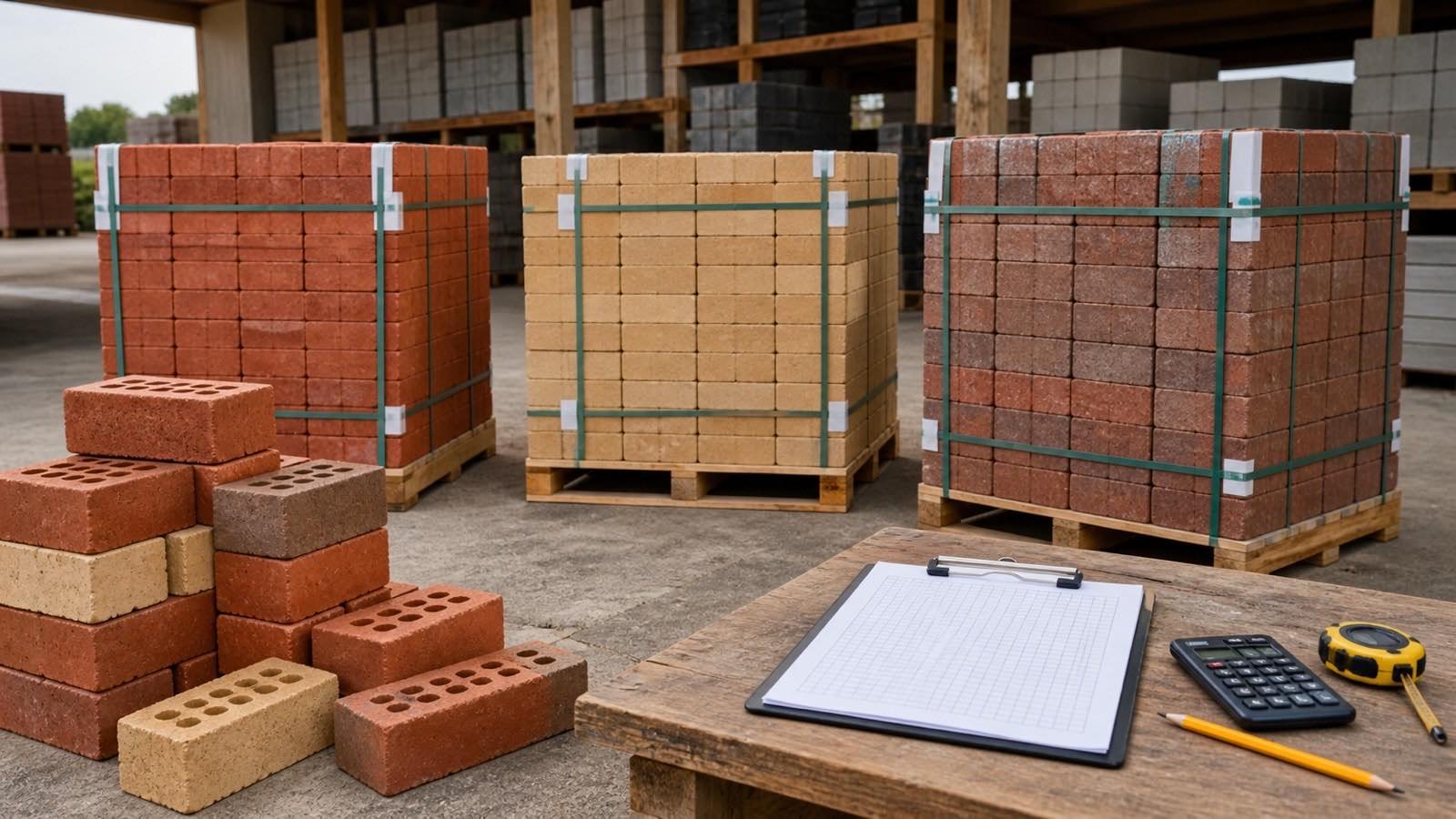
No universal pallet count applies across mortar products. Confirm the manufacturer, product number, package mass, market, supplier and current delivery unit before dividing a bag total.
QUIKRETE's current US page for Mortar Mix No. 1102 lists 40 lb bags at 80 per pallet, 60 lb bags at 56 per pallet and 80 lb bags at 42 per pallet. Those records support this named product example only.
A quote may allow full pallets plus loose bags, full pallets only, or another delivery increment. Save the quote date and selling rule beside the count.
How do 97 bags convert into pallets and loose bags?
Assume the approved net requirement is 97 bags of the named 80 lb QUIKRETE Mortar Mix No. 1102 and the supplier confirms 42 bags per pallet. If the supplier sells loose bags, divide 97 by 42 and keep the whole-pallet and remainder lines separate.
Full pallets = floor(97 ÷ 42) = 2 pallets
Loose bags = 97 − (2 × 42) = 13 bags
The order is 2 full pallets plus 13 loose bags. A full-pallet-only quote changes the purchase:
Pallet-only order = ceiling(97 ÷ 42) = 3 pallets
Purchased bags = 3 × 42 = 126 bags
Supplier-rounding stock = 126 − 97 = 29 bags
Keep the 29 bags in the stock ledger. They came from the supplier's increment, so adding them again as project allowance would count the same excess twice.
What does the bag weight tell the buyer?
Bag mass helps count dry product and plan handling questions. It does not state the freight mass, gross pallet mass or legal vehicle payload.
Dry product mass for 97 bags = 97 × 80 lb = 7,760 lb
Dry product mass on one 42-bag pallet = 42 × 80 lb = 3,360 lb
The pallet, wrapping, loose-bag packaging and other freight add mass. Ask the supplier or carrier for shipping weights and delivery requirements. The responsible logistics team must check vehicle payload, axle limits, unloading equipment, ground conditions and access.
How should existing mortar stock change the order?
Count stock after someone verifies that it matches the approved manufacturer, product, mortar type, color, package and project requirements. Confirm that unopened bags remain dry, identifiable and reserved for the same work.
Suppose the approved gross requirement is 97 bags and the site has 8 compatible unopened bags:
Net new bags = 97 − 8 = 89 bags
89 bags at 42 per pallet = 2 full pallets + 5 loose bags
Do not deduct wet, hard, torn, contaminated, unidentified or quarantined bags. Do not transfer stock between mortar types, colors, product codes or work areas without the approval required by the project.
How do you check a mortar delivery?
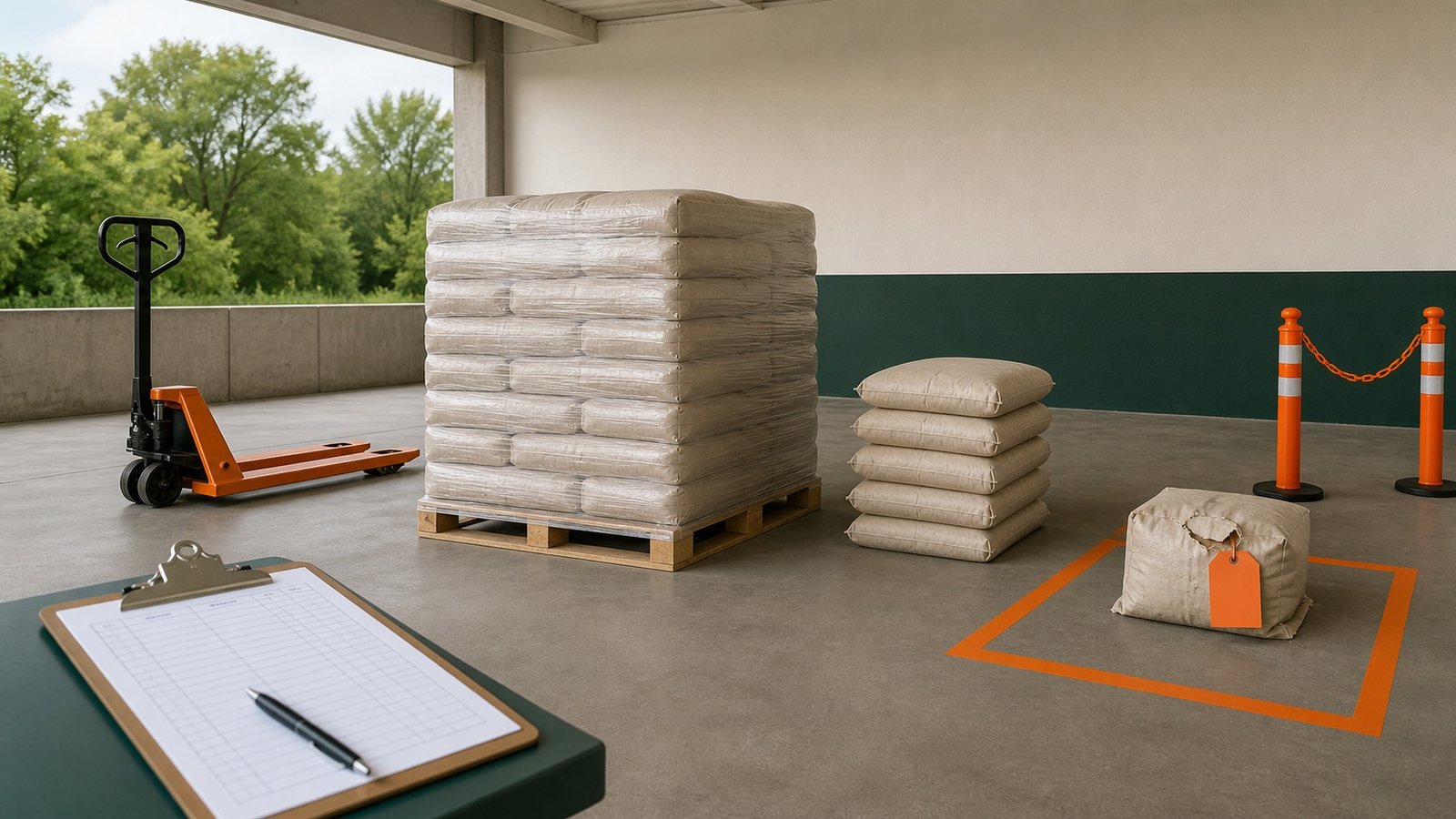
Compare the purchase order, delivery ticket and physical count before the carrier leaves when site procedures allow. Record product identity, package mass, quantity, visible condition and lot or batch information required by the project.
- Count full pallets and loose bags without assuming the ticket is correct.
- Match the manufacturer, product name, product number, type and color.
- Check wrapping, bag tears, moisture signs, hard areas and contamination.
- Separate questionable stock and record photographs, ticket notes and the claim reference.
- Record the accepted quantity after inspection.
- Keep rejected material outside usable stock until the supplier and project team resolve it.
If 89 bags arrive and 3 enter rejection or quarantine, the accepted receipt is 86 bags:
Accepted receipts = 89 delivered − 3 rejected or quarantined = 86 bags
The buyer still has a 3-bag replacement shortfall against the 89-bag order. Treating all 89 delivered bags as usable would hide that shortfall.
How do you reconcile mortar bags on site?
Close the stock period with a quantity equation. Use bag equivalents for every term and keep authorized transfers on their own lines.
Unexplained equivalent bags = accepted receipts + transfers in − equivalent bags consumed − unopened usable stock − approved opened-dry equivalent − quarantined stock − documented damage or disposal − transfers out
| Ledger line | Bag equivalents |
|---|---|
| Accepted receipts | 97 |
| Authorized transfers in | 0 |
| Consumed | 56.5 |
| Unopened usable stock | 35 |
| Approved opened-dry equivalent | 2.5 |
| Quarantined stock | 1 |
| Documented damage or disposal | 1 |
| Authorized transfers out | 0 |
| Unexplained variance | 1 |
The 1-bag variance needs a record review and physical recount. Check issue tickets, returns, partial-bag measurements, transfers and disposal records before changing the estimate.
Can an opened bag count as usable stock?
An opened bag can enter the balance only when the site accepts the exact dry product, its condition and a measured dry equivalent. Record the measurement method and the person or role that accepted it.
Keep an opened bag out of usable stock when moisture, hardening, contamination, product identity or storage history is uncertain. Mixed mortar belongs to the production record, not the dry-stock ledger.
SPEC MIX instructs users to keep its named mortar products dry, covered and protected from weather and other damage. Apply the current instructions for the exact product on site rather than assigning a universal shelf life.
How many new bags are needed after a stock count?
Deduct accepted usable stock from the remaining planned demand, then round through the current supplier increment. Quarantined stock stays outside the deduction.
Suppose the remaining work needs 40 bag equivalents. The site has 35 unopened usable bags and 2.5 approved opened-dry equivalents:
Net remaining requirement = 40 − 35 − 2.5 = 2.5 bag equivalents
A supplier that sells individual bags requires 3 new bags. If the supplier sells another increment, apply that increment and record the resulting supplier-rounding stock.
Which product details should stay separate in the ledger?
Create separate stock lines when product identity or project acceptance can change. Combining the lines can make dry material look interchangeable when it is not.
- Manufacturer, exact product name and product number
- Mortar type, color and approved formulation
- Bag mass and market
- Lot or batch where the project tracks it
- Work area, phase or cost code
- Unopened, opened dry, quarantined and disposed states
A supplier substitution needs approval before you replace the product record or transfer its quantity into usable stock. Similar bag mass or mortar type does not prove equivalence.
What should you ask before issuing the purchase order?
- Is the quoted item the approved manufacturer, product number, mortar type and color?
- How many bags are on the current pallet for this package and market?
- Can the supplier deliver loose bags, or must the order use full pallets?
- What appears on the delivery ticket and lot record?
- Who provides unloading equipment, and what access does the vehicle need?
- What are the shipping weight, lead time, return terms and damage-claim steps?
- Can accepted unopened excess be returned, and under which conditions?
- Does the project require separate lots, mock-up approval or retained samples?
Current local prices, stock and return rules need a dated supplier quote. A generic web price cannot establish the project cost.
Which ordering mistakes create false stock?
- Using 42 bags per pallet for an unidentified product.
- Deducting existing stock before confirming compatibility and condition.
- Counting delivered bags as accepted bags.
- Leaving rejected bags inside usable inventory.
- Counting supplier-rounding stock as a second waste allowance.
- Treating dry product mass as freight or vehicle payload.
- Estimating an opened bag by appearance without a site-approved measurement.
- Combining mortar types, colors or lots that the project keeps separate.
- Hiding transfers, damage and disposal inside consumption.
- Reordering from the original estimate instead of the remaining-demand balance.
Safety, storage and scope limits
Dry mortar handling can expose workers to cementitious material and respirable crystalline silica. OSHA states that extended bag opening and mortar mixing can create foreseeable exposure at or above its action level, depending on the task, duration, location and method. Employers must use the applicable product safety data and workplace controls.
NIOSH's masonry bag-handling research notes that lifting risk changes with load mass, repetitions, duration and bag placement. A quantity worksheet cannot set a safe manual lift, forklift capacity, pallet stack, delivery route or storage design.
Use the Masonry Mortar Calculator to establish the compatible bag requirement. Check Mortar Coverage per Bag for the named yield, Masonry Mortar Allowance for project loss and rounding, and Mortar Mix vs Masonry Cement for product identity. The Concrete Block Mortar Planning guide carries accepted stock into CMU work zones. Return to the brick planning tools and guides, review the calculation methodology, or report an issue through the corrections route.
Sources and source scope
- QUIKRETE Mortar Mix No. 1102 product page: named US bag sizes and pallet quantities.
- QUIKRETE Mortar Mix No. 1102 data sheet: preblended product identity, package sizes and named yield.
- SPEC MIX IWR Mortar: named package formats and dry, covered, protected storage instruction.
- OSHA silica standard interpretation: repeated mortar-bag opening and mixing exposure context.
- OSHA construction silica FAQ: United States workplace scope and task-dependent exposure context.
- NIOSH reduced-weight cement bag study record: manual handling variables in masonry work.
Source scope: Manufacturer pages support their named products, package records and instructions. OSHA and NIOSH support the stated US workplace context. These sources do not establish a universal pallet count, supplier rule, shelf life, return policy, freight mass, vehicle payload or project approval.
Review note: Saleem Sial owns the research and editorial record. The internal publication gate covers source checks, arithmetic fixtures, originality, build validation, link crawl, schema review and rendered QA. Waseem Sial, External Reviewer and Engineer, is listed for ongoing external review; no completed review date is claimed.