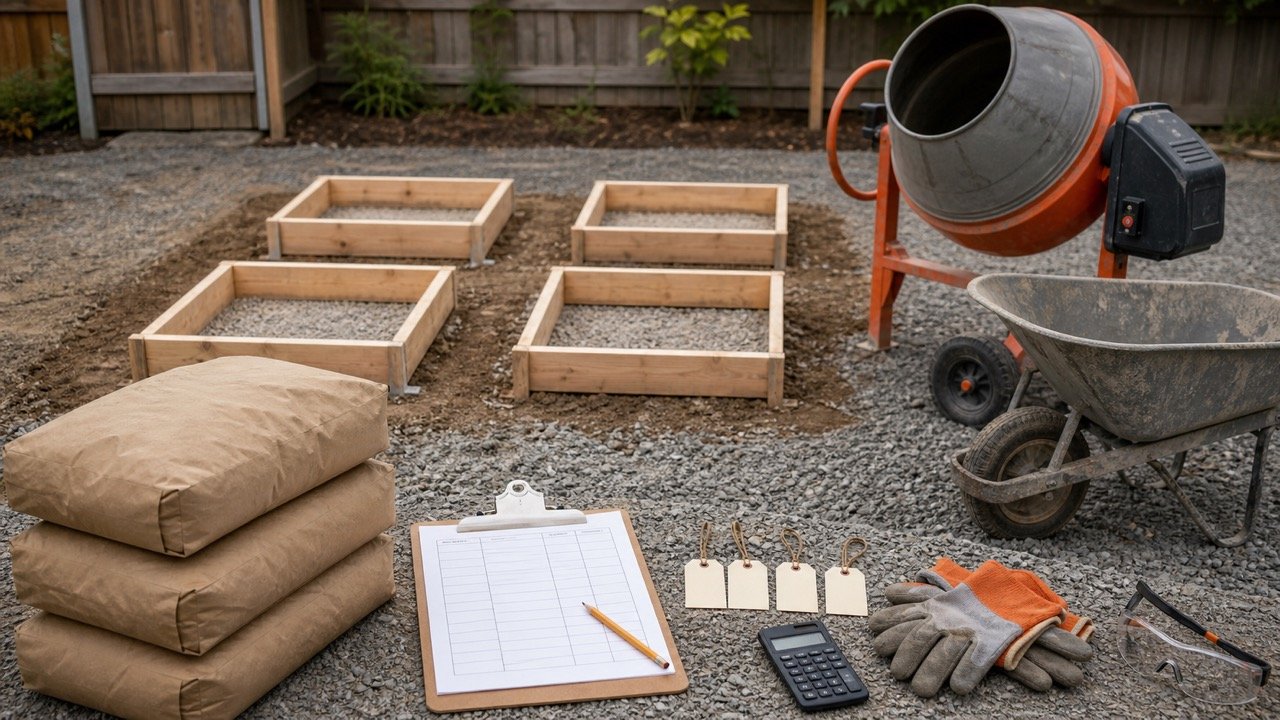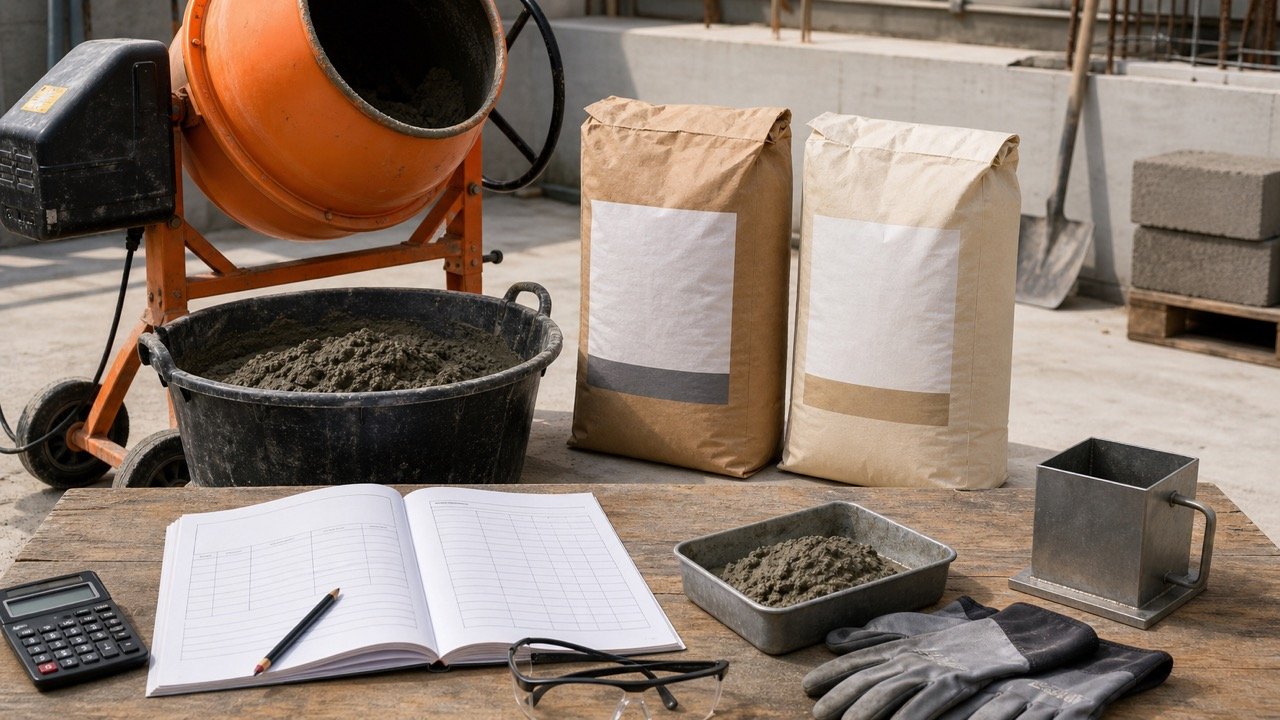
Mortar quantity starts with a checked masonry unit schedule and the selected mortar product. Bag weight alone does not give coverage, and one bags-per-block rate cannot cover every unit shape, joint, bedding pattern, product, or site condition.
Record the product's current coverage for the actual unit and joint scope. Keep the base demand, project allowance, whole-package rounding, delivered stock, and field consumption in separate lines.
How much mortar do you need for concrete blocks?
Divide the compatible unit count by the selected product's published units-per-bag coverage. Apply a documented planning allowance once, then round the final purchase to whole bags.
Base exact bags = compatible masonry units ÷ product coverage
Planning exact bags = compatible units × (1 + allowance) ÷ product coverage
Whole bags to plan = ceiling(planning exact bags)
Record the manufacturer, product, mortar type, bag size, unit description, joint or bedding basis, data-sheet revision, and access date. Treat “up to” coverage as a published planning limit rather than a guaranteed field result.
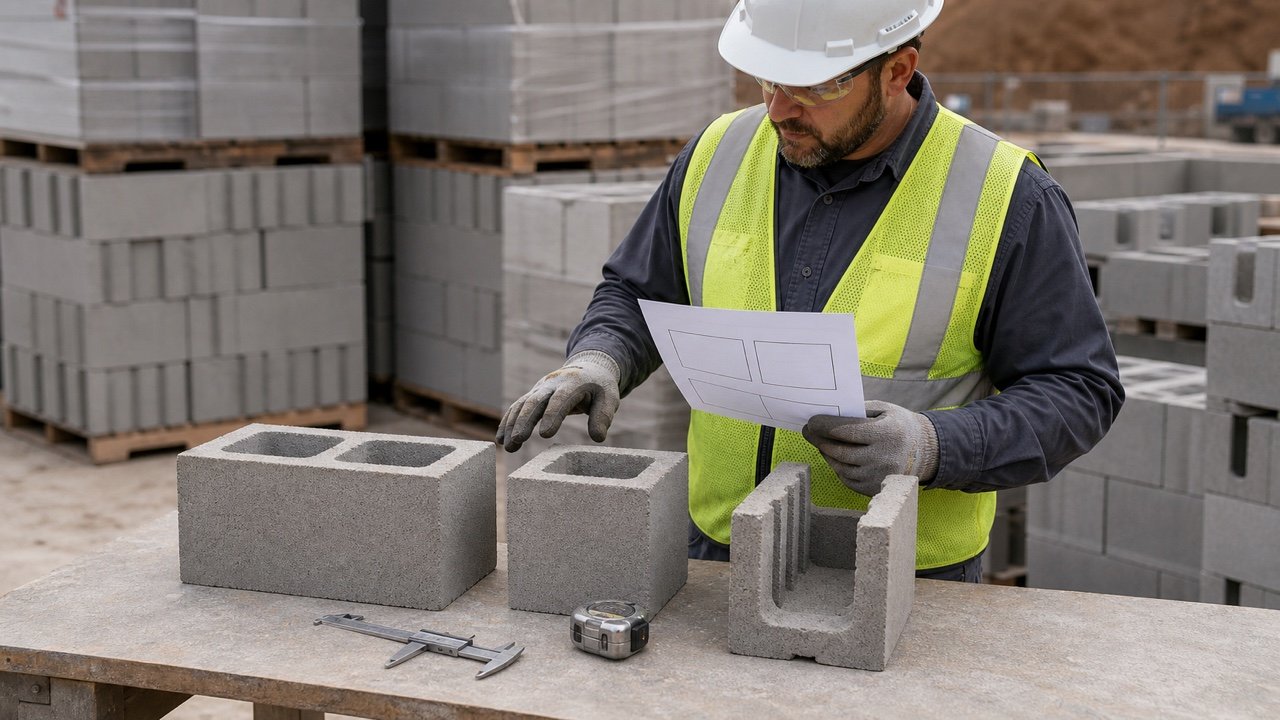
Use the Concrete Block Calculator for the ordinary-unit area estimate. Reconcile that result with the detailed full, half, cut, corner, jamb, sill, lintel, bond-beam, pilaster, cap, and other unit schedule before estimating mortar.
Which quantities belong in the mortar record?
| State | Record | Purpose |
|---|---|---|
| Compatible units | Units covered by one product-yield condition | Base quantity input |
| Published coverage | Units per stated bag and conditions | Conversion basis |
| Base exact bags | Compatible units divided by coverage | Unrounded demand |
| Allowance | Approved percentage or direct quantity and reason | Visible project adjustment |
| Planning exact bags | Demand after the approved adjustment | Rounding input |
| Whole bags | Final ceiling to the sold package | Purchase quantity |
| Delivered stock | Accepted bags, bulk weight, or silo record | Inventory control |
| Consumed | Equivalent full bags used on accepted work | Field reconciliation |
| Unopened usable stock | Dry, in-date, accepted product | Remaining-order check |
Worked example: QUIKRETE Mortar Mix No. 1102
The current QUIKRETE No. 1102 data sheet says an 80 lb bag will lay up to 13 standard 8 × 8 × 16 in. blocks. A checked schedule has 180 compatible units.
- Base exact bags: 180 ÷ 13 = 13.8462.
- Whole bags at 0% allowance: ceiling(13.8462) = 14.
- Published-basis capacity: 14 × 13 = 182 unit equivalents.
- Capacity above base demand from rounding: 182 − 180 = 2 unit equivalents.
The 2-unit figure describes package capacity under the published coverage basis. It does not promise leftover mixed mortar or 2 additional accepted units.
If the project record supports an 8% allowance, planning demand becomes 180 × 1.08 = 194.4 unit equivalents. Exact planning bags are 194.4 ÷ 13 = 14.9538, so the whole-bag plan is 15. Its published-basis capacity is 195 unit equivalents, 0.6 above the adjusted demand.
| Stage | 0% allowance | 8% documented allowance |
|---|---|---|
| Compatible units | 180 | 180 |
| Planning demand | 180 | 194.4 unit equivalents |
| Published coverage | Up to 13 units/80 lb bag | Up to 13 units/80 lb bag |
| Exact bags | 13.8462 | 14.9538 |
| Whole bags | 14 | 15 |
Why can two 80 lb mortar products give different bag counts?
Manufacturers publish coverage for their own products and stated conditions. Sakrete's current Type S product page lists 12 standard 8 in. blocks per 80 lb bag.
For the same 180 compatible units, 180 ÷ 12 = 15 whole bags before a project allowance. The QUIKRETE example gives 14 whole bags at its published up-to-13 rate. This comparison shows why the product record controls quantity. It does not compare mortar type, properties, suitability, or compliance.
| Named source | Published 80 lb coverage | 180-unit base result |
|---|---|---|
| QUIKRETE Mortar Mix No. 1102 | Up to 13 standard 8 × 8 × 16 in. blocks | 14 whole bags |
| Sakrete Mortar Mix Type S | 12 standard 8 in. blocks | 15 whole bags |
Confirm that the required product, mortar type, unit, joint, application, bag size, and current data match before using either rate.
What does a block-mortar estimate include?
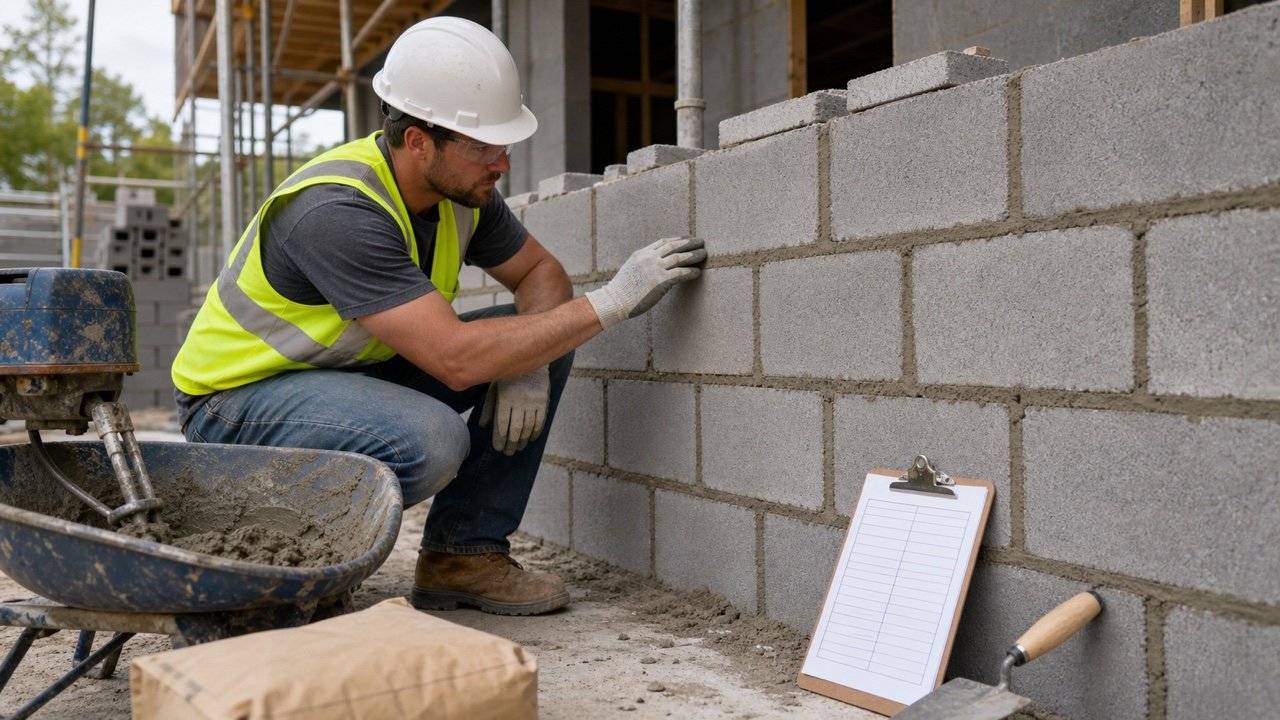
Define the joint and bedding scope before the count. A standard block coverage rate usually addresses mortar used to lay the stated units under the manufacturer's application conditions.
| Material or task | Include in this bag calculation? | Required record |
|---|---|---|
| Bed and head joints for compatible units | Yes, when covered by the product rate | Unit, joint, bedding, product, and coverage |
| First-course levelling bed | Only when the coverage basis includes it | Detail and separate quantity if required |
| Full bedding or web bedding | Only under a matching coverage basis | Specified bedding pattern and unit geometry |
| Grout or concrete in unit cores | No | Grouted-cell schedule and unit void data |
| Parging, stucco, scratch, brown, or finish coat | No | Area, thickness, product yield, and coat system |
| Pointing, repointing, repair, or patching | No | Measured joint or repair geometry and product |
| Thin-joint, adhesive, or dry-stack system | No | System-specific manufacturer and design data |
CMHA's rule-of-thumb estimating discussion explicitly states a face-shell bedding assumption. Unit width may leave the basic face count unchanged while unit geometry and bedding still change mortar use.
How should specialty units and openings affect mortar planning?
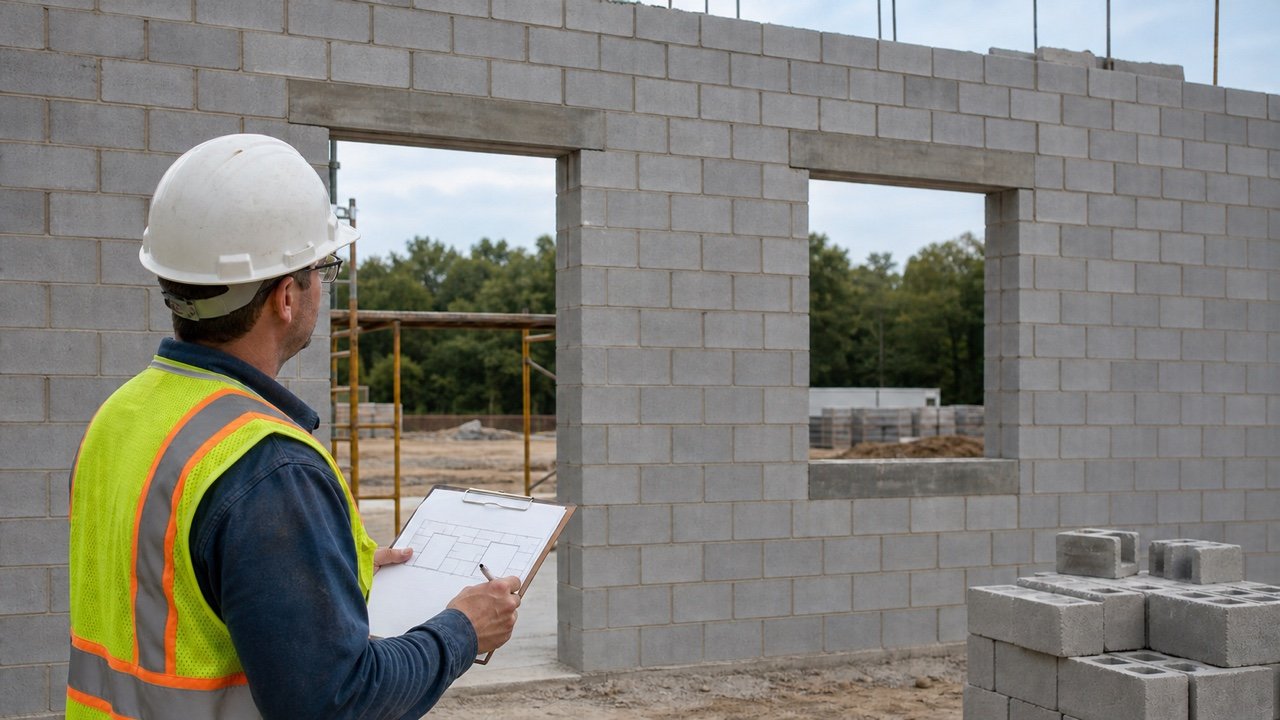
Use the completed unit schedule rather than one gross full-stretcher count. Openings remove ordinary bed and head joints, while jambs, sills, lintels, bond beams, corners, returns, pilasters, cuts, reinforcement, and control joints change the local work.
Group units only when product, geometry, joint, bedding, finish, and coverage basis match. Keep different widths, shapes, architectural faces, and bond conditions in separate coverage groups or obtain a project-specific supplier estimate.
Should you calculate mortar from joint volume?
A geometric calculation needs the full joint network and the mortar-bearing surfaces. Record face-shell lengths, webs included in bedding, bed-joint and head-joint dimensions, tooling profile, unit shapes, partial units, openings, bond, first course, waste, and placement method.
A simple wall-area × joint-thickness formula treats the wall as a continuous mortar sheet and can overstate the mortar volume sharply. Use a verified product coverage, an approved detailed geometry model, or measured project production. Document the method and do not combine them silently.
How are preblended bags and site-batched mortar different?
Preblended dry mortar includes the dry materials defined by that product and converts directly through its published bag or bulk yield. Masonry cement, mortar cement, portland cement, lime, and site sand create a different procurement and batching system.
| System | Quantity evidence | Do not compare by |
|---|---|---|
| Preblended dry bags | Current product coverage or mixed yield, bag size, batch, and accepted use | Bag weight alone |
| Bulk or silo preblend | Delivered dry weight, producer yield, silo readings, batches, and returns | Truck or silo count alone |
| Masonry or mortar cement with site sand | Specified method, approved materials, calibrated batch volumes, sand moisture, batches, and production | Cement-bag count versus preblend-bag count |
CMHA explains that ASTM C270 has proportion and property specification paths and that project documents should call for the applicable path. Do not create a site recipe from a packaged-product coverage table.
How should observed mortar use be checked?
Choose an accepted-work checkpoint with one stable unit and bedding group. Divide accepted compatible units laid by equivalent full bags consumed.
Observed coverage = accepted compatible units ÷ equivalent full bags consumed
A checkpoint records 120 accepted units and 10 equivalent full bags consumed. Observed coverage is 120 ÷ 10 = 12 units/bag. The original planning basis was 13 units/bag, so observed coverage is 1 unit/bag lower.
Review unit mix, bedding, joint size, rejected work, spills, dropped mortar, mixer residue, weather, partial bags, batch records, workmanship, and tally accuracy. The difference identifies a quantity review and does not prove the cause.
If the responsible team approves 12 units/bag as the revised basis and 140 compatible units remain, the unadjusted remaining demand is 140 ÷ 12 = 11.6667, rounded to 12 whole bags. Apply only a still-valid allowance for the remaining scope and subtract confirmed usable unopened stock once.
What belongs in a remaining-order revision?
- Original product, coverage, unit group, allowance, bag plan, and revision.
- Accepted units completed at the checkpoint.
- Equivalent full bags consumed and the treatment of partial bags.
- Observed coverage and investigated difference.
- Remaining compatible unit schedule.
- Confirmed dry, accepted, in-date unopened stock.
- Approved revised coverage and remaining allowance.
- Supplier package, batch, stock, lead time, delivery, return, and acknowledgement.
Preserve the original estimate. Create a dated revision instead of overwriting the product yield or full-project allowance.
Does mortar type determine the bag quantity?
Mortar type and bag quantity answer different questions. Project documents, codes, design, materials, exposure, and the controlled specification select the mortar. Product coverage converts the approved product into quantity.
CMHA identifies Type M, S, N, and O within ASTM C270 and explains proportion and property specification routes. It also warns that field mortar tests and laboratory property compliance have different purposes. A higher type letter or compressive-strength value is not a quantity factor and does not authorise substitution.
Common concrete block mortar planning mistakes
- Using a universal bags-per-block rate.
- Scaling 80 lb coverage to another bag size by weight without manufacturer data.
- Applying a default 10% allowance to every project.
- Estimating from gross wall stretchers after openings and specialty units are scheduled.
- Combining mortar with grout, core fill, parging, pointing, stucco, or repair.
- Using face-shell coverage for full bedding without adjustment.
- Comparing preblend bags with masonry-cement bags by count.
- Selecting mortar type from an online use table.
- Counting opened or damaged product as usable remaining stock.
- Reapplying the original allowance to completed work during a revision.
Verify unit dimensions and shapes in the Concrete Block Sizes reference. Use the Concrete Block Wall Layout guide to reconcile openings and specialty units. Return to the Concrete Planning hub for related tools.
Safety and scope limits
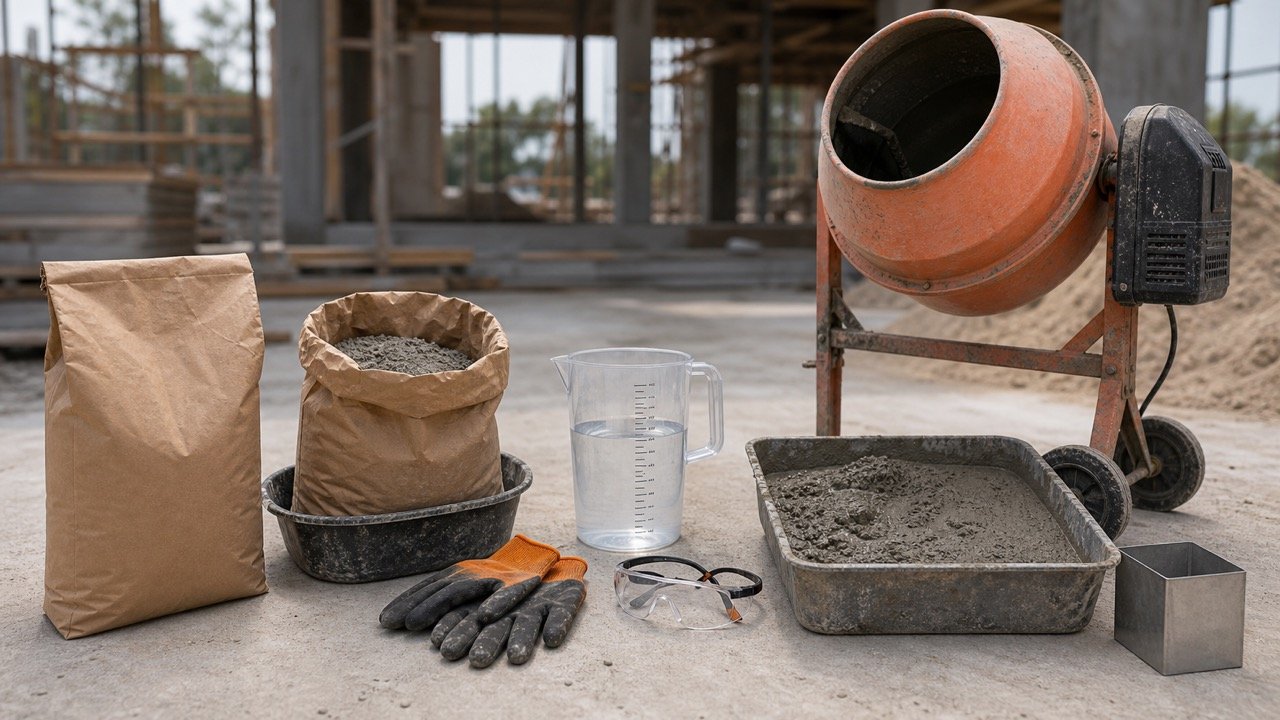
Dry mortar and fresh mortar can expose workers to alkaline cement, dust, silica, lifting, mixers, rotating parts, electrical hazards, spills, and poor access. Follow the current product label and safety data sheet, site plan, PPE requirements, dust controls, mixer instructions, weather procedures, storage limits, and qualified supervision.
Quantity planning does not select mortar type, mix water, admixture, batch time, retempering, curing, testing, joint profile, reinforcement, flashing, structural details, or acceptance. Stop when the product, specification, unit schedule, bedding, or field condition conflicts.
Sources and source scope
- CMHA TEK 04-02A: mortar-estimating uncertainty, project complexity, and face-shell bedding assumption.
- CMHA TEK 09-01A: mortar materials, types, ASTM C270 specification paths, and project-selection context.
- CMHA TEK 18-05B: laboratory and field mortar testing purposes and limits.
- QUIKRETE Mortar Mix No. 1102 data sheet: named product, 80 lb bag coverage, application, standards, mixing, and PPE instructions.
- Sakrete Mortar Mix Type S: named product and published 80 lb coverage.
- NIST Guide to the SI Appendix B: unit conversions.
Source scope: these sources support product-specific coverage, quantity arithmetic, mortar terminology, specification boundaries, testing context, and safety instructions. They do not set a universal yield, allowance, mortar selection, site recipe, field acceptance rule, price, stock, or approved construction method.