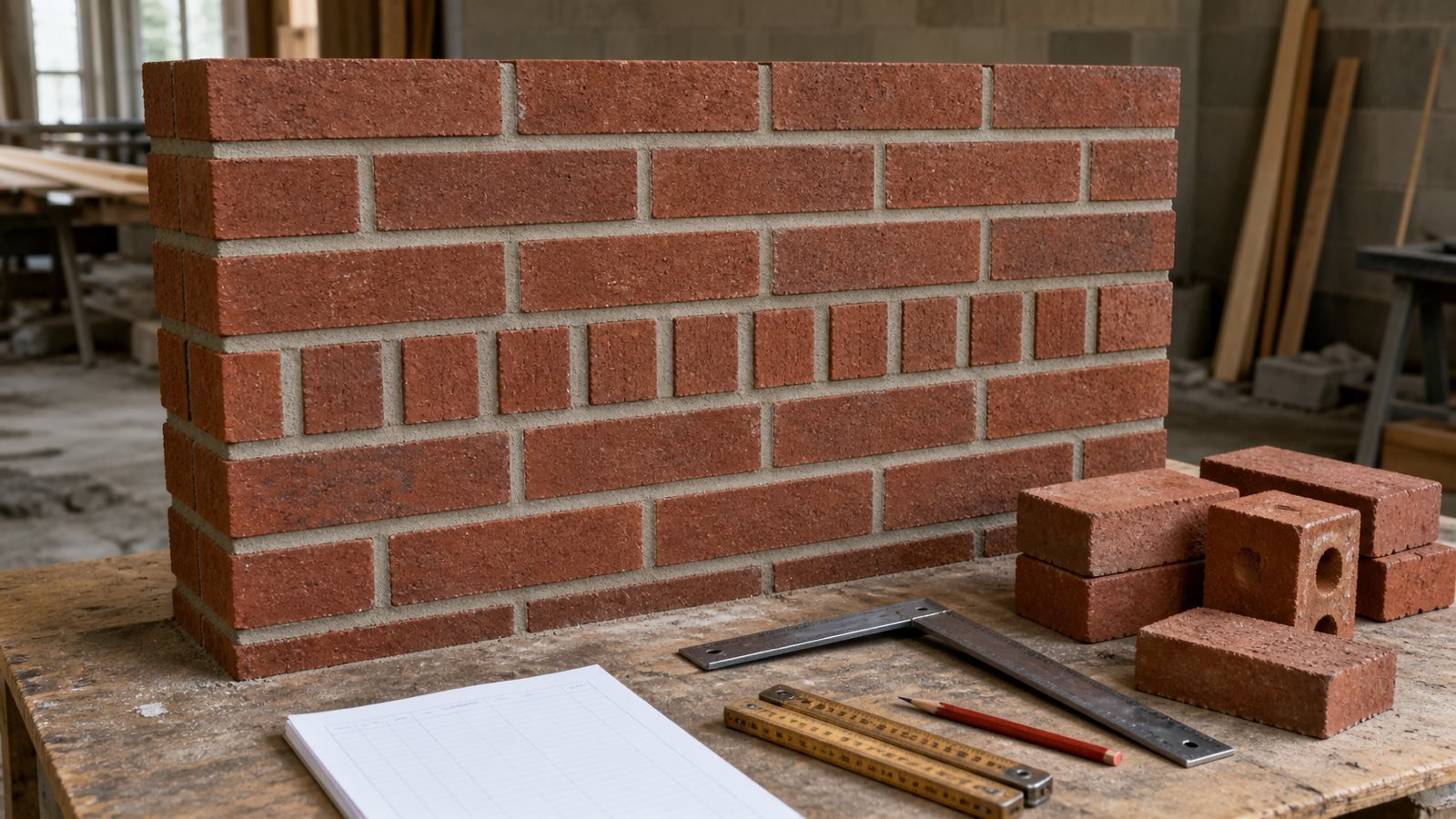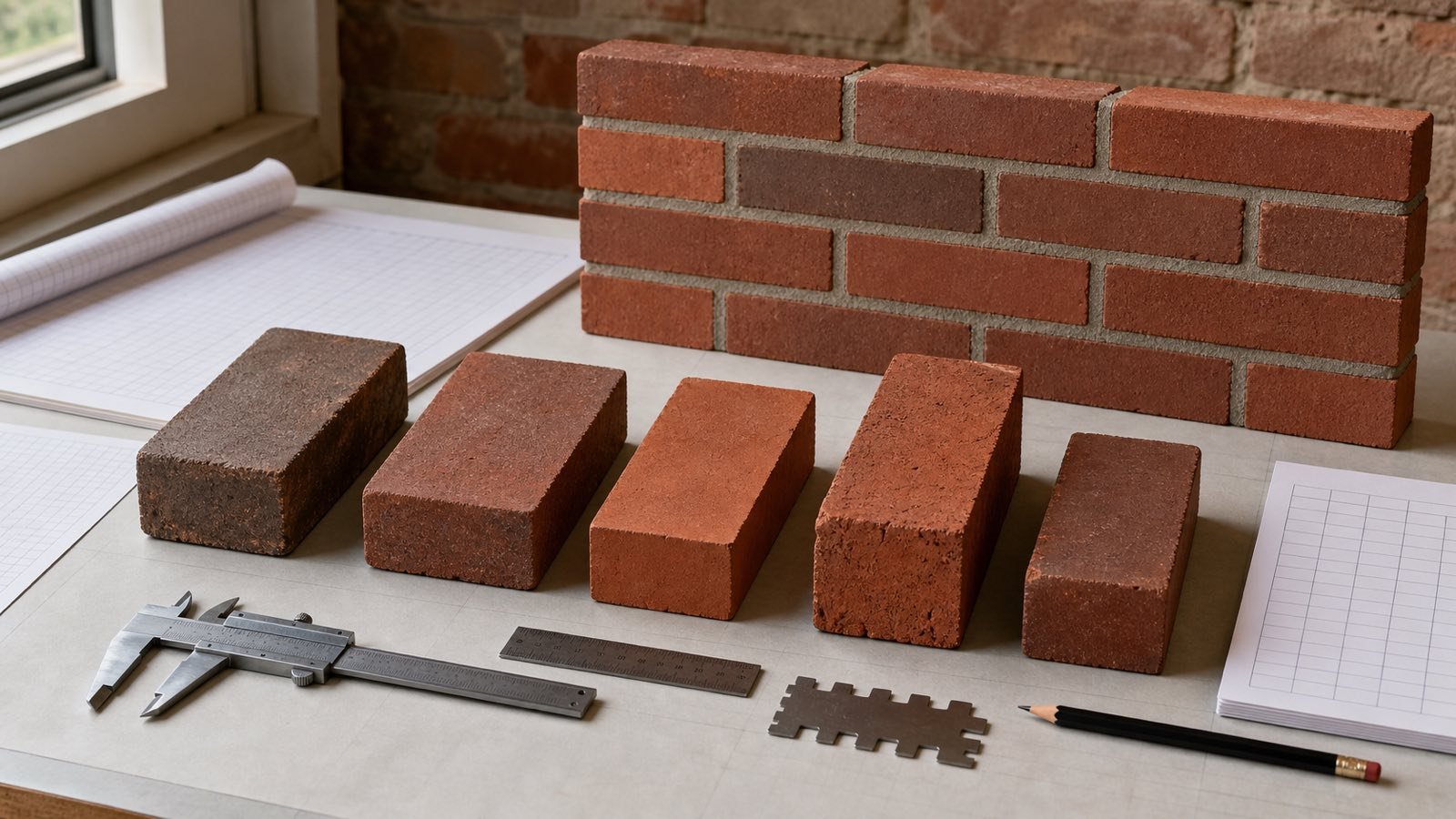
A brick size chart is useful only when its dimensions and coverage describe the same condition. Record the brick designation, full specified size, exposed orientation, mortar joint, bond basis and source before copying a bricks-per-area value into a takeoff.
The tables below use named U.S. brick rows from Brick Industry Association Technical Note 10. A current manufacturer product sheet and the project specification still control the brick ordered for a real job.
How many bricks cover 1 square foot or 1 square metre?
Coverage changes with the brick face, mortar joint and bond. BIA Technical Note 10 lists 675 modular bricks per 100 ft² and 727 per 10 m² for its stated modular condition. Those published values equal 6.75 bricks/ft² and 72.7 bricks/m² before bond corrections, specials, breakage or waste.
That rate belongs to the BIA row, not every product called modular. BIA states that a brick name and its size can vary by manufacturer. Confirm the selected product's specified dimensions and coverage record before calculating an order.
Write the rate as: 6.75 bricks/ft², BIA Modular, nominal face module 8 in × 2⅔ in, running or stack bond table basis, waste excluded, TN 10 Table 4. A bare “6.75” cannot be checked later.
What do nominal, specified and actual brick dimensions mean?
BIA uses 3 separate dimension records. Each answers a different question, and mixing them can change the coverage calculation.
| Dimension | What it describes | Use in a quantity record | Main check |
|---|---|---|---|
| Nominal | A modular brick dimension plus its intended mortar joint | Coordinated wall module and a matching module-based coverage rate | Do not add the joint again |
| Specified | The anticipated manufactured brick size without mortar | Project specifications, purchase orders and face-plus-joint calculations | Add only the intended joint when deriving an exposed module |
| Actual | The measured manufactured brick | Product and field checks against the specified size and allowed tolerance | Measure a suitable sample and follow the project acceptance method |
For BIA's modular example with a ⅜ in joint, the specified size is 3⅝ in wide × 2¼ in high × 7⅝ in long. Its nominal size is 4 in × 2⅔ in × 8 in. The stretcher face uses the height and length, so its coordinated face module is 2⅔ in × 8 in.
BIA lists alternate specified dimensions for some modular rows when a ½ in joint is used. The intended nominal module remains coordinated. BIA’s table note applies the listed common joint sizes to length and width; bed-joint thickness can vary with vertical coursing and actual brick height. This is why the brick-only size, joint, module and course record need separate fields.
Which U.S. modular brick sizes appear in the BIA table?
The following selection comes from BIA Technical Note 10, Tables 1 and 4. Width, height and length follow BIA's stretcher-position order. Coverage is the running or stack bond table estimate and excludes waste.
| BIA designation | Nominal W × H × L | Specified W × H × L at ⅜ in joint | Bricks per 100 ft² | Bricks per 10 m² |
|---|---|---|---|---|
| Modular | 4 × 2⅔ × 8 in | 3⅝ × 2¼ × 7⅝ in | 675 | 727 |
| Engineer Modular | 4 × 3⅕ × 8 in | 3⅝ × 2 13/16 × 7⅝ in | 563 | 605 |
| Closure Modular | 4 × 4 × 8 in | 3⅝ × 3⅝ × 7⅝ in | 450 | 484 |
| Roman | 4 × 2 × 12 in | 3⅝ × 1⅝ × 11⅝ in | 600 | 646 |
| Norman | 4 × 2⅔ × 12 in | 3⅝ × 2¼ × 11⅝ in | 450 | 484 |
| Engineer Norman | 4 × 3⅕ × 12 in | 3⅝ × 2 13/16 × 11⅝ in | 375 | 404 |
| Utility | 4 × 4 × 12 in | 3⅝ × 3⅝ × 11⅝ in | 300 | 323 |
| Meridian | 4 × 4 × 16 in | 3⅝ × 3⅝ × 15⅝ in | 225 | 242 |
Some BIA table rows have no agreed designation. A manufacturer can also use a different name for a listed size. Use the full dimensions in a specification and order record instead of relying on the designation alone.
Which non-modular brick coverage rates does BIA list?
Non-modular bricks have specified and actual dimensions, but no nominal dimension in BIA's terminology. The listed specified size changes with the stated joint in some rows so the intended wall coursing can be maintained.
| BIA designation | Specified W × H × L at ⅜ in joint | Bricks per 100 ft² | Bricks per ft² | Bricks per 10 m² |
|---|---|---|---|---|
| Queen | 2¾ × 2¾ × 7⅝ in | 550 | 5.50 | 592 |
| King | 2¾ × 2⅝ × 9⅝ in | 455 | 4.55 | 490 |
| Standard | 3⅝ × 2¼ × 8 in | 655 | 6.55 | 705 |
| Engineer Standard | 3⅝ × 2 13/16 × 8 in | 539 | 5.39 | 581 |
| Closure Standard | 3⅝ × 3⅝ × 8 in | 430 | 4.30 | 463 |
These are U.S. BIA reference rows. They do not define a global standard brick. A U.K. brick, Canadian metric product, reclaimed unit, paver, thin brick, firebrick or locally made unit needs its own source and installation condition.
How is coverage calculated from a brick module?
For a stretcher face in a simple running or stack bond, divide one unit of wall area by the effective face module. Use the joint-inclusive nominal module when it is verified, or add the intended head and bed joints once to the specified face dimensions.
Bricks per ft² = 144 ÷ (effective module length in inches × effective module height in inches)
Bricks per m² = 1,000,000 ÷ (effective module length in millimetres × effective module height in millimetres)
Example: the BIA modular nominal face is 8 in long × 2⅔ in high. Its module area is 21⅓ in². The rate is 144 ÷ 21⅓ = 6.75 bricks/ft², which agrees with 675 bricks per 100 ft² in Table 4.
A rectangular module calculation does not include headers, special shapes, unusual bonds, wall returns, multiple wythes or cutting. Use a technical table or a separate schedule when those conditions change the unit count.
Why do the imperial and metric BIA rates look slightly different?
BIA prints whole bricks per 100 ft² and per 10 m². Dividing those table entries gives 6.75 bricks/ft² and 72.7 bricks/m². The rates agree at the displayed precision, even though a conversion with more digits produces 72.656395 bricks/m².
- NIST gives 1 ft² = exactly 0.09290304 m².
- Convert the imperial rate: 6.75 ÷ 0.09290304 = 72.656395 bricks/m².
- Round that result to 1 decimal place: 72.7 bricks/m².
- Compare it with BIA's printed metric entry: 727 ÷ 10 = 72.7 bricks/m².
Do not write 72.656395 as though the brick data were measured to 6 decimal places. Preserve precision during arithmetic, then report the result at a level supported by the source and project record.
Worked example: apply a verified coverage rate
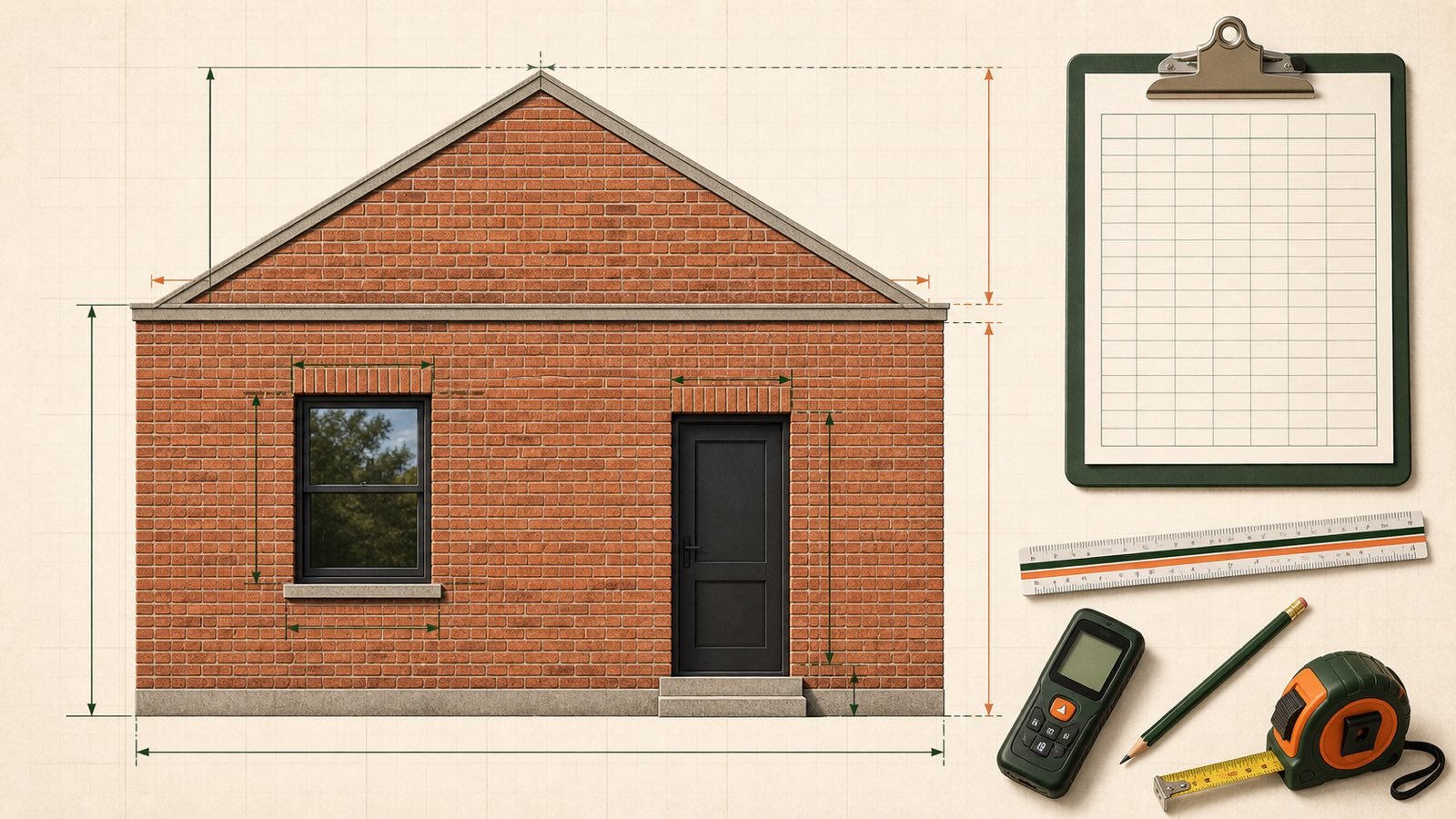
The brick wall takeoff guide calculates 35.91 m² of net brick face for its metric wall, gable and opening example. Assume that every section uses the same BIA modular condition from Table 4.
- Net brick-face area: 35.91 m².
- Verified table rate: 727 ÷ 10 = 72.7 bricks/m².
- Base brick count: 35.91 × 72.7 = 2,610.657 bricks.
- Record the unrounded base quantity before any supported bond correction, special-unit schedule or allowance.
The area and rate produce a base count. The example does not approve 2,611 as an order. Whole-unit rounding, bond corrections, cuts, breakage, supplier packs and project policy come later and need their own records.
Imperial check
A separate takeoff has 367 ft² of compatible net wall area. At 6.75 bricks/ft², the base quantity is 367 × 6.75 = 2,477.25 bricks. Both examples use a verified rate in the same unit system as the wall area.
When does brick orientation change coverage?
The height and length in BIA's tables describe a brick laid as a stretcher. A header, soldier, sailor or rowlock exposes a different pair of dimensions, so its face module and units per area can change.
| Condition | Exposed dimensions to verify | Takeoff action |
|---|---|---|
| Stretcher field | Length × height | Use a matching coverage row or module |
| Header field or header course | Width × height | Use the bond detail and a supported correction or direct count |
| Soldier course | Height × length with the brick standing on end | Count the run and course geometry separately |
| Rowlock or sill | Length × width or the face shown in the detail | Prepare a separate run or unit schedule |
| Mixed decorative pattern | Every exposed face in the repeat | Count a verified repeat module and boundary pieces |
BIA Table 4 uses running or stack bond as its base. Technical Note 10 gives separate bond correction factors for patterns with headers and states limits on those factors. A decorative elevation may need direct counts instead of one percentage.
How should mixed brick products be recorded?
Give each compatible wall zone its own line. Combine quantities only when the product, specified dimensions, exposed orientation, joint, bond basis, source edition and allowance basis match.
| Field | Example record | Why it stays visible |
|---|---|---|
| Wall zone | E1 field brick | Links the rate to a measured area |
| Manufacturer and product | Current approved submittal | Separates same-named bricks from different sources |
| Specified W × H × L | Full 3-dimension record | Prevents nominal and brick-only sizes from being mixed |
| Orientation and joint | Stretcher; stated head and bed joints | Defines the exposed module |
| Bond basis | Running bond table base | Shows whether a correction is still needed |
| Coverage and source | Units per area, document title, table and date | Makes the rate reproducible |
| Net area and base count | Unrounded calculation | Keeps later corrections separate |
For reclaimed or visibly irregular brick, one catalogue dimension may not describe the delivered lot. Follow the project sampling and acceptance method, measure a representative approved set, record the observed range, and test the planned joint and coursing before ordering.
Which size and coverage mistakes change the count?
- Using “standard,” “modular,” “queen” or “king” without recording all 3 dimensions.
- Adding a mortar joint to a nominal module that already includes it.
- Using specified brick dimensions as a face module without the intended joint.
- Copying one manufacturer's coverage rate to another same-named product.
- Using a stretcher-face rate for soldier, header or rowlock work.
- Mixing ft² with bricks/m² or converting a rounded value too early.
- Applying a running-bond table rate to a header pattern without checking the bond correction.
- Multiplying a visible face by wall thickness without identifying the wythes and headers.
- Combining products, joints or wall zones before the base quantity is checked.
- Treating a base count as an approved purchase quantity.
How do you use this rate in the Brick Calculator?
Open the Brick Calculator after the net wall area and coverage record are ready. Choose verified coverage-rate mode and enter the table rate in the same area unit as the wall dimensions.
Use module mode only when the recorded length and height include the intended joints. Use face-plus-joint mode when the record contains specified face dimensions and the intended joint. Keep separate calculator runs for incompatible products, orientations or bonds, then combine their checked unrounded base quantities in the takeoff.
The calculator leaves bond adjustment and allowance visible. Enter those values only when the project record supports them. Confirm the current supplier pack quantity before using pack rounding.
Specification, purchasing and design limits
This guide does not select a brick, approve dimensional tolerances, set mortar joints, choose a bond, design a wall, size lintels, specify movement joints, determine structural capacity or approve an order. Current drawings, specifications, approved product data, field conditions and responsible qualified people control those decisions.
Return to the brick quantity planning tools and guides for the category record. The calculation methodology explains source, unit, precision and rounding checks. Report a source or arithmetic issue through the corrections route.
Sources and source scope
- Brick Industry Association Technical Note 10, Dimensioning and Estimating Brick Masonry, February 2009: U.S. brick dimension terminology, named size rows, coursing, Table 4 coverage estimates, bond basis and estimating limits.
- NIST Handbook 44, 2026, Appendix C: international-foot and SI area conversions and rounding sequence.
- Glen-Gery Brick Dimensions and Sizes: manufacturer-specific dimensions and coverage records used to check that product data should remain tied to its manufacturer.
Source scope: BIA supports the named U.S. reference rows and their stated estimating conditions. NIST supports the unit conversion. Glen-Gery supports its own product records only. The coverage ledger, conversion reconciliation and examples are original checked workflow and arithmetic. These sources do not select the project product, joint, bond, correction, allowance, pack quantity or design.
Review responsibility: Saleem Sial owns the research and editorial record. Source verification, table transcription checks, arithmetic fixtures, build validation, link crawl, schema review and rendered QA form the internal publication gate. Waseem Sial, External Reviewer and Engineer, remains listed for ongoing external review; no completed external-review date is claimed.