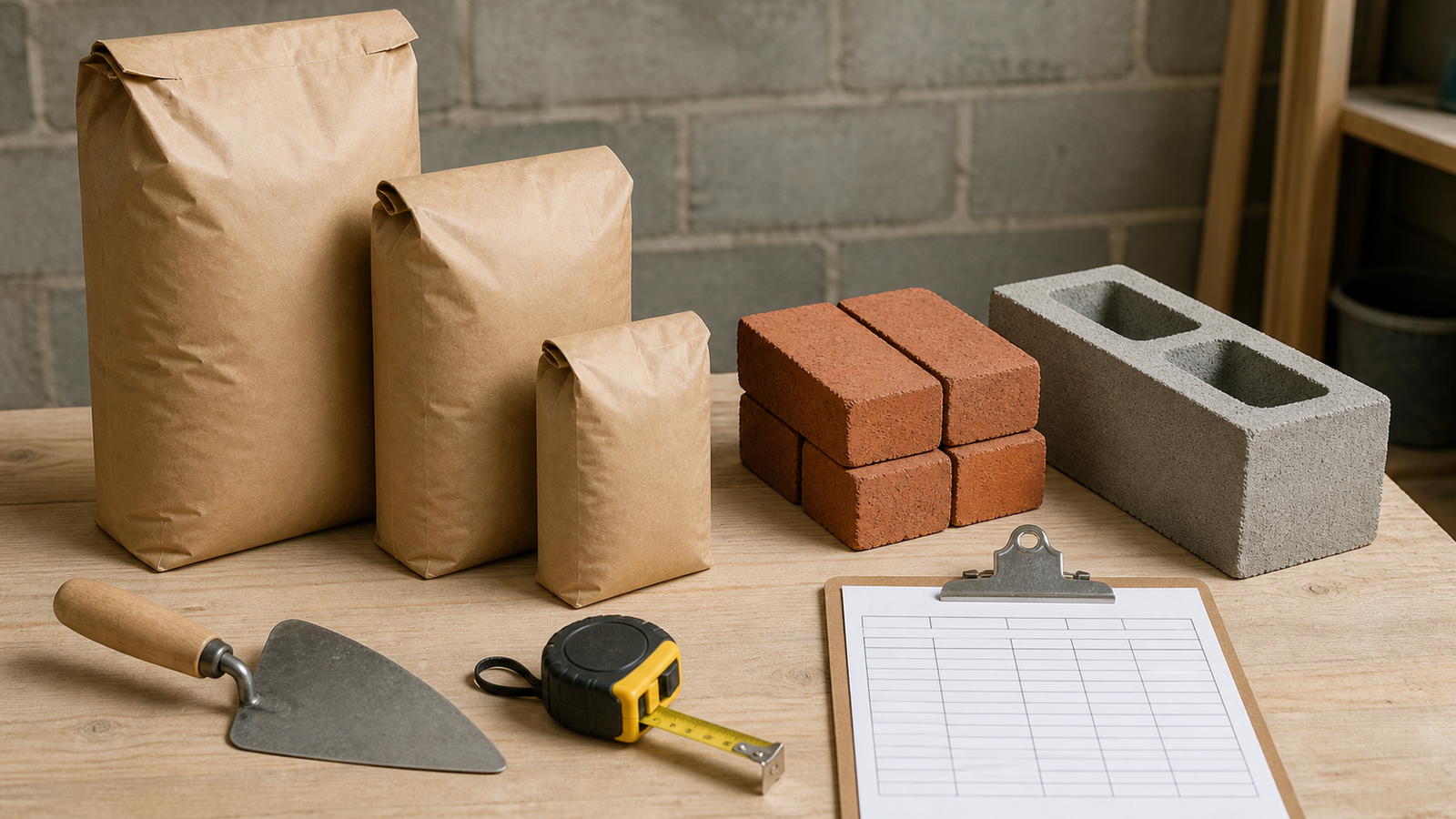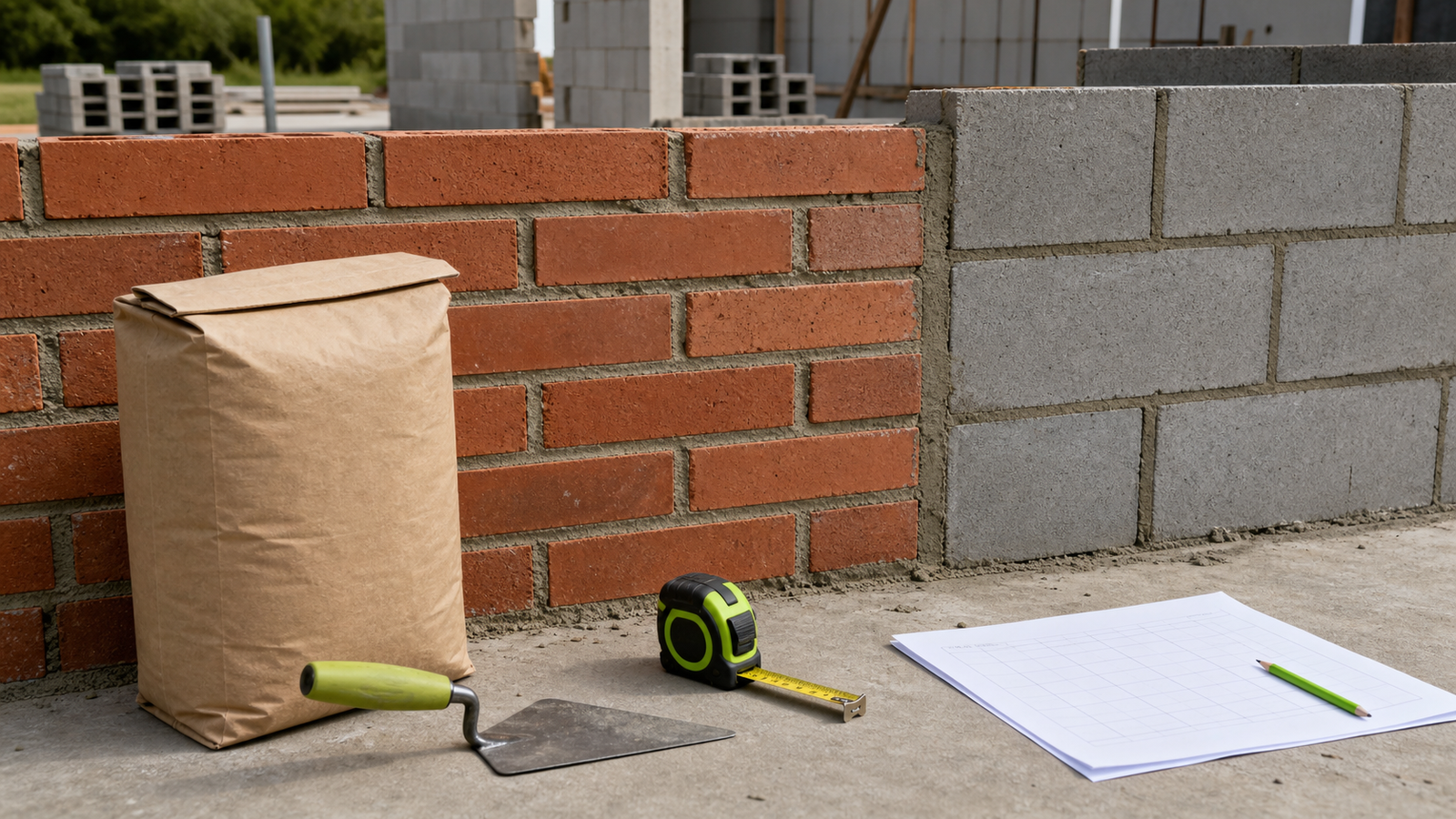
A mortar-bag estimate needs a checked masonry-unit count and a current coverage record for the exact product, package and unit being laid. A bag weight or a label such as standard brick does not establish coverage by itself.
This calculator keeps the product coverage editable. It separates the base bag ratio, documented mortar allowance and whole-package surplus so the order can be checked against the product data and project takeoff.
How many bags of masonry mortar do you need?
Divide the compatible brick or block count by the selected product's stated units per bag. Apply a documented mortar allowance to the unrounded quantity, then round the final bag ratio upward once when the product is sold only in whole bags.
Run separate calculations when the masonry unit, mortar product, package, joint basis or coverage record changes. Do not add brick and concrete-block counts under one coverage value. Use the Brick Wall Takeoff guide when the brick count still needs a measurement record.
What does the Masonry Mortar Calculator calculate?
The tool converts one compatible masonry-unit count into a dry preblended mortar-mix order. It shows the base exact bag ratio, allowance quantity, exact planning ratio, whole bags, purchased unit capacity, capacity above the planning quantity and total dry package mass.
| Result | Meaning | Check against |
|---|---|---|
| Base exact bags | Unit count divided by current units per bag | Masonry takeoff and product data |
| Equivalent units added | Entered mortar allowance expressed against the unit count | Documented estimating basis |
| Exact planning bags | Base requirement plus entered mortar allowance before package rounding | Unrounded calculation |
| Whole bags to purchase | Exact planning bags rounded upward once | Supplier selling increment |
| Purchased capacity | Whole bags multiplied by entered units per bag | Compatible product coverage only |
| Package surplus capacity | Purchased capacity minus planning units | Rounding effect, not installed waste |
Which unit count should you enter?
Enter the checked count of one masonry unit that matches the selected product coverage row. Use the Brick Calculator for a brick wall takeoff or the Concrete Block Calculator for concrete masonry units, openings and face modules.
Decide whether the count already contains a brick or block breakage allowance. Keep that unit-order allowance out of the mortar allowance field. The mortar allowance adjusts product use for the compatible laid quantity; it does not add replacement masonry units to the purchase order.
A product may state one bag yield for a named brick and another for a named block. Calculate each group with its own coverage, then add the unrounded compatible mortar requirements before applying a shared allowance only when the product and allowance basis truly match.
Where should units-per-bag coverage come from?
Use the current product data sheet, package instructions, approved submittal or a current supplier record that identifies the mortar product, package, masonry unit and stated conditions. Record the source date and keep a copy with the takeoff.
QUIKRETE's November 2020 Mortar Mix sheet states that one 80 lb bag of its named product will lay up to 37 standard bricks or 13 standard 8 in × 8 in × 16 in blocks. Its older usage table gives approximate coverage for 40 lb, 60 lb and 80 lb packages. These figures illustrate product-specific inputs. They are not site-wide presets.
| Named source record | Package | Masonry unit | Published coverage |
|---|---|---|---|
| QUIKRETE Mortar Mix No. 1102, 2020 sheet | 80 lb | Standard brick | Up to 37 per bag |
| QUIKRETE Mortar Mix No. 1102, 2020 sheet | 80 lb | Named standard block | Up to 13 per bag |
| QUIKRETE older usage table | 60 lb | Named standard brick | Approximately 28 per bag |
| QUIKRETE older usage table | 60 lb | Named standard block | Approximately 9 per bag |
| SPEC MIX Mortar Cement & Sand | 80 lb | 4 in block | 15–17 per bag |
| SPEC MIX Mortar Cement & Sand | 80 lb | 6 in block | 12–14 per bag |
The table preserves the named source context. Do not transfer a value to another product, unit size, package or application without current documentation. When a source states a range, select and record the project value rather than averaging it automatically.
What formula does the calculator use?
Base exact bags = checked masonry units ÷ current units per bag
Equivalent units added = checked masonry units × entered mortar allowance ÷ 100
Exact planning bags = checked masonry units × (1 + allowance ÷ 100) ÷ units per bag
Whole bags = ceiling(exact planning bags)
Purchased unit capacity = whole bags × units per bag
Package surplus capacity = purchased capacity − planning units
Purchased dry mass = whole bags × dry package mass
The calculator keeps full precision until the whole-bag result. It treats an exact integer as that integer and does not add another bag. The lb/kg switch converts package and purchased dry mass; it does not change bag count or product coverage.
Worked example for standard brick
A checked takeoff contains 500 compatible bricks. The selected preblended product record states 37 bricks per 80 lb bag for the named unit. The estimator has a documented 5% mortar allowance.
- Base exact bags: 500 ÷ 37 = 13.514 bags.
- Equivalent units added: 500 × 5% = 25 units.
- Planning units: 500 + 25 = 525 units.
- Exact planning bags: 525 ÷ 37 = 14.189 bags.
- Whole bags: 15.
- Purchased capacity: 15 × 37 = 555 compatible units.
- Package surplus capacity: 555 − 525 = 30 equivalent units.
- Purchased dry mass: 15 × 80 = 1,200 lb.
The 25-unit allowance and 30-unit package surplus have different causes. The allowance is an entered project adjustment. The surplus comes from purchasing the next whole bag.
Worked example for concrete block
A checked wall takeoff contains 130 compatible blocks. The selected product's current record states 13 blocks per 36.2 kg bag. No separate mortar allowance has been approved.
- Base exact bags: 130 ÷ 13 = 10 bags.
- Exact planning bags: 10.
- Whole bags: 10.
- Purchased capacity: 130 compatible blocks.
- Package surplus capacity: 0.
- Purchased dry mass: 10 × 36.2 = 362 kg.
This fixture lands on a whole package. The calculator does not round it to 11 bags.
Why does bag weight not determine coverage?
Bag mass tells you how much dry product is in the package. Coverage also depends on the product formulation, masonry unit, bedding method, joint dimensions and the conditions represented by the manufacturer's test or estimate.
The published records above show that one 80 lb product can have different yields for different block widths, and one named product gives a much larger brick count than block count. Enter the actual coverage row. Do not scale a units-per-bag figure by package mass unless the same manufacturer explicitly supports that relationship for the same product.
Is a bag of mortar mix the same as masonry cement?
Read the product identity before using the calculator. A preblended mortar mix normally contains the dry constituents required by that product and receives water according to its instructions. Masonry cement is a binder used with separately measured sand and water under a specified batching method.
This calculator counts complete preblended product packages only. It does not calculate sand, cement, lime, water or field-batched proportions. A masonry-cement bag yield that assumes added sand cannot be entered as if the bag itself were a complete premix unless the source and purchasing plan use that same system.
How should a coverage range be handled?
A range such as 15–17 blocks per bag creates 2 valid calculator runs, not one automatic answer. Enter 15 for the lower-coverage case and 17 for the higher-coverage case. Record which value the estimator accepts and why its published conditions match the work.
Use the lower published coverage when the approved planning method calls for that conservative endpoint. Do not select an endpoint merely to reduce or increase the order. Supplier advice, project specifications and the current product record control the choice.
When should mortar allowance stay at 0%?
Leave the field at 0% when the accepted coverage record and project takeoff already represent the planned conditions or when no separate allowance has been approved. The calculator never inserts a default percentage.
Add an allowance only once. If the project has already reduced units-per-bag coverage to account for field use, adding another percentage for the same reason counts the adjustment twice. Document spillage, batching residue, joint variation or another accepted reason separately from brick breakage and whole-package rounding.
Which conditions require separate calculations?
| Condition that changes | Why it matters | Action |
|---|---|---|
| Brick to concrete block | Published units per bag differ | Start a separate group |
| Unit size or wall bedding pattern | Joint mortar demand can change | Use the matching coverage record |
| Product or package | Composition, mass and yield can change | Use current product data |
| New masonry to repointing | Work geometry and application differ | Use a repointing takeoff or product method |
| Preblended product to masonry cement plus sand | Purchased components differ | Use a verified batching takeoff |
| Allowance basis | A combined percentage can hide different assumptions | Calculate and document separately |
What changes actual mortar use?
Joint width and depth, masonry-unit dimensions, face-shell or full bedding, bond and details change mortar demand. Unit absorption, surface condition, workmanship, mixer and board residue, dropped mortar, weather and batch handling can also change field use.
The calculator does not estimate those effects independently. They must be represented in the selected product coverage and any separately approved allowance. Compare early field consumption with the takeoff on larger work, then document any revised forecast rather than changing the source record silently.
What should happen to a partial bag?
The result rounds the purchase to whole bags. It does not instruct the user to split a dry package, change the mixing-water proportion or keep mixed mortar beyond the product's permitted use time.
Follow the current package, technical data and safety data for mixing water, sequence, mixing time, use time, temperature, curing, storage and disposal. Record unopened stock and opened or mixed material separately. Purchased surplus capacity does not prove that leftover material remains usable.
Common masonry mortar quantity mistakes
- Using a generic bags-per-wall figure without a compatible masonry-unit count.
- Combining brick and block counts under one coverage value.
- Scaling coverage from bag mass without manufacturer support.
- Entering a masonry-cement yield as though the bag were complete preblended mortar.
- Using the highest end of a coverage range without checking its conditions.
- Adding brick breakage again as mortar allowance.
- Applying the same allowance through both reduced coverage and a percentage.
- Rounding every wall or elevation before compatible unrounded requirements are combined.
- Treating package surplus as installed mortar, waste or reusable stock.
- Using an old data sheet after the product, package or market record changes.
- Assuming a bag estimate selects the correct mortar type for the wall.
What should the mortar takeoff record contain?
- Project, wall or elevation, drawing revision, date and preparer.
- Masonry manufacturer, product, size, count and whether unit allowance is already included.
- Mortar manufacturer, product, type, package mass, market and data-sheet revision.
- Compatible masonry unit named in the coverage record.
- Published coverage value or range and the selected planning endpoint.
- Mortar allowance percentage, reason and approval.
- Base exact bags, exact planning bags, whole bags, package surplus and dry mass.
- Separate records for sand, water, pigments, admixtures, reinforcement, grout, accessories, pallets, delivery and storage.
Safety, specification and design limits
Mortar selection depends on the masonry assembly, exposure, structural and durability requirements, project specifications, current standards and responsible design decisions. The calculator does not select Type M, S, N or O mortar, approve a mix, set joint dimensions, determine bond, design reinforcement or confirm code compliance.
Dry mortar products can contain Portland cement and crystalline silica. Follow the current safety data, package controls and local workplace rules. OSHA's United States construction silica standard covers occupational exposures under its stated scope. OSHA also explains that mortar-mixing exposure can change with duration, location and mixing method.
Follow project documents and qualified direction for wall stability, temporary bracing, scaffold, lifting, cutting, dust control, weather protection, curing, inspection and cleaning.
Return to the brick planning hub or use the concrete planning hub for concrete masonry and related material tools. Review Concrete Block Mortar Planning when a checked CMU schedule must be matched to mortar coverage. The calculation methodology explains unit and rounding controls, and the corrections route accepts source or formula issues.
Sources and scope
- QUIKRETE Mortar Mix Product No. 1102: one named preblended product's purpose, package sizes, stated standard-brick and standard-block yield, mixing and precautions.
- QUIKRETE Mortar Mix No. 1102 usage table: approximate coverage for the named product and package sizes in the stated masonry units.
- SPEC MIX Mortar Cement and Sand Mortar: named-product package and published yield ranges for several block sizes.
- NIST Handbook 44 current edition: official access to mass unit relationships.
- OSHA 29 CFR 1926.1153 and the 2019 mortar-mixing interpretation: United States occupational silica scope and exposure context.
Source scope: Manufacturer records support only their named products, packages, units, markets and stated conditions. NIST supports mass conversion. OSHA supports the named United States workplace context. Current product data, project documents, supplier records, local requirements and responsible project decisions govern the order and work.
Review note: Saleem Sial owns the research and editorial record. Formula fixtures, source checks, build validation, link crawl, schema review and rendered QA form the internal publication gate. Waseem Sial, External Reviewer and Engineer, is listed for ongoing external review; no completed review date is claimed.