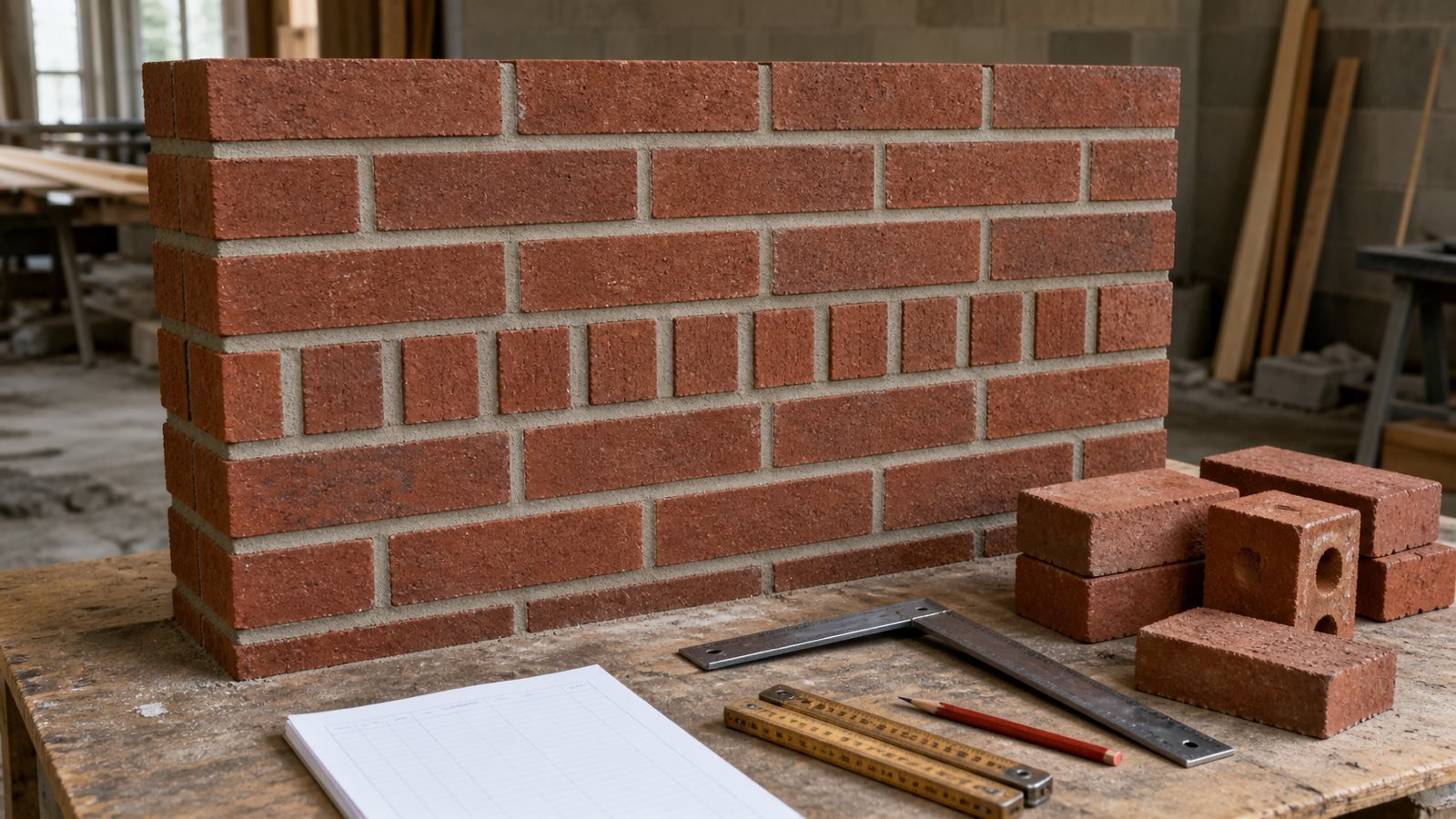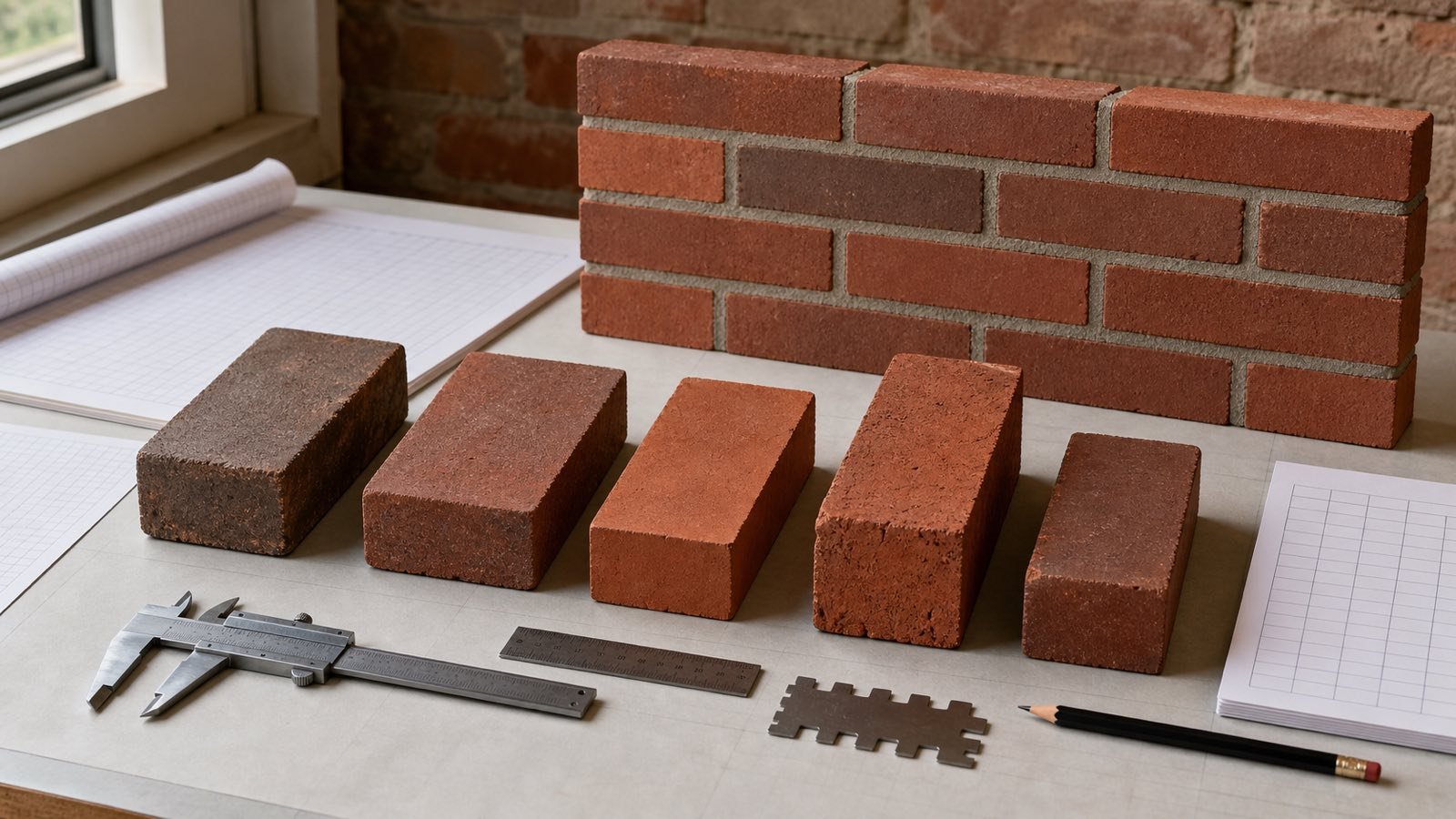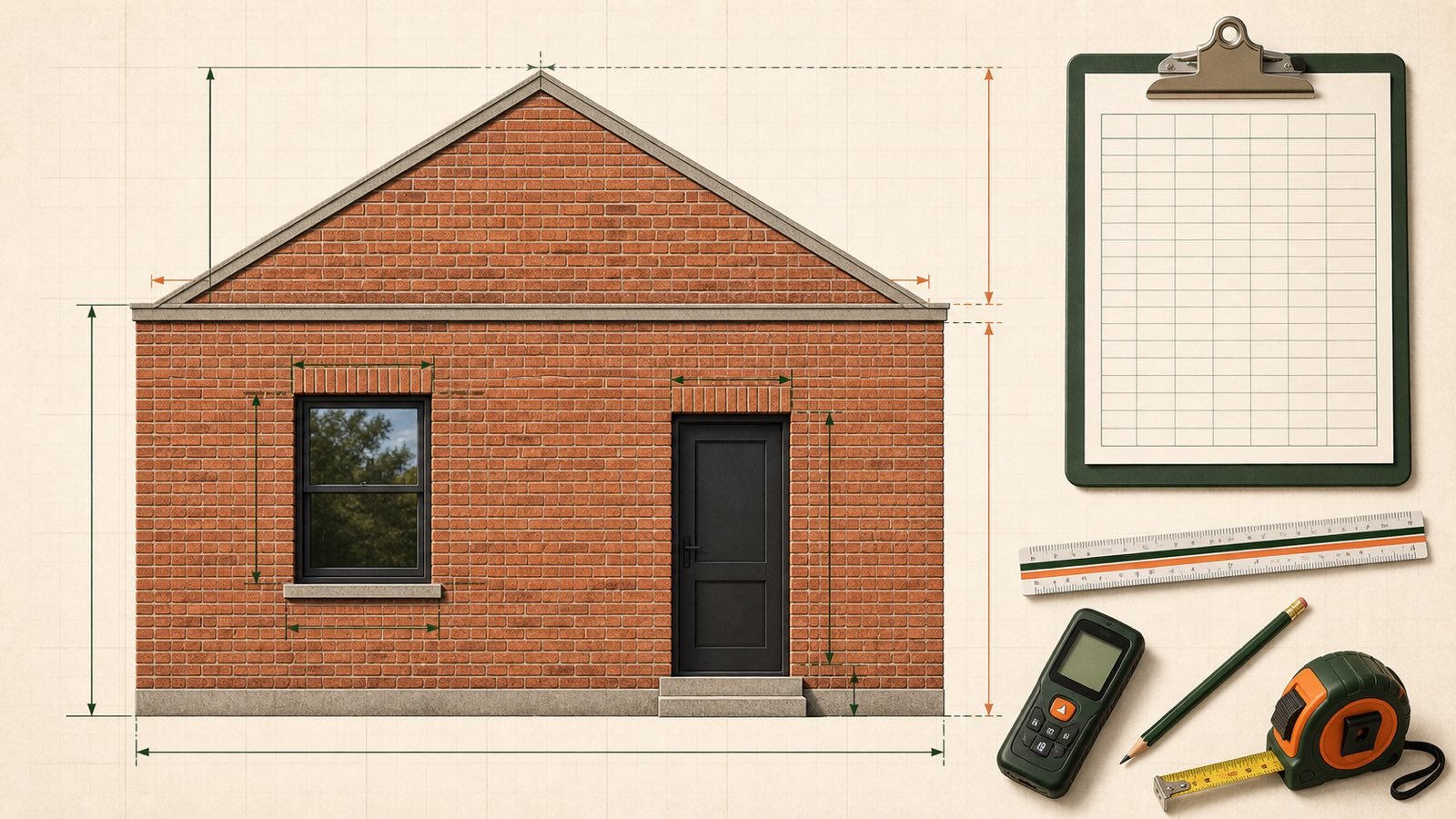
A brick takeoff can be accurate at the wall and still produce the wrong purchase order. Waste allowance, whole-brick rounding and supplier packaging change the quantity at different stages.
Keep those stages visible. Record the corrected net bricks, the allowance basis, the exact planning result, the seller's current increment and the surplus created by pack rounding.
How should brick waste and pack rounding be calculated?
Apply the supported waste or breakage allowance to the corrected net brick quantity. Round that result up to whole bricks, then round to full packs, cubes or pallets only when the current seller requires that increment.
Exact planning bricks = corrected net bricks × (1 + allowance % ÷ 100)
Whole planning bricks = ceiling(exact planning bricks)
Supplier increments = ceiling(whole planning bricks ÷ bricks per increment)
Ordered bricks = supplier increments × bricks per increment
Pack surplus = ordered bricks − whole planning bricks
The allowance covers the recorded waste and breakage basis. Pack surplus comes from the seller's increment. Special shapes, blend colors and approved spare stock need their own order lines.
What does BIA's at least 5% rule cover?
Brick Industry Association Technical Note 10 gives at least 5% as a general rule for brick waste and breakage after net quantities and correction factors have been calculated. It also says job conditions or experience can warrant a higher percentage.
The note is dated February 2009 and addresses estimating for U.S. brick masonry. Its 5% statement supplies a sourced starting rule for the stated scope. Project details, approved estimating policy and relevant records still control the percentage used for an order.
Record the reason beside the number. A percentage entered as 5 has little audit value without the brick product, wall zones, bond basis, cuts, handling conditions, site plan and person who approved the allowance.
Which quantity stages belong in the order ledger?
The ledger should retain each quantity stage from measured wall area through the supplier order. A checker can then find whether extra bricks came from geometry, a correction, an allowance or packaging.
| Stage | Quantity basis | Required record |
|---|---|---|
| Base bricks | Net wall area and verified coverage or module | Wall zone, openings, brick, face, joint and source |
| Corrected net bricks | Base count plus a supported bond correction or direct pattern count | Bond detail, fraction or counted repeat |
| Special units | Direct schedule for shapes, orientations and boundary pieces | Product code, finished faces, quantity and drawing detail |
| Planning allowance | Corrected net quantity multiplied by the approved percentage | Percentage, reason, scope and approval |
| Whole planning bricks | Exact planning quantity rounded up once | Unrounded result and rounding rule |
| Supplier order | Whole planning bricks rounded to the verified selling increment | Seller, product, pack count, split-pack rule and quote date |
| Pack surplus | Ordered bricks minus whole planning bricks | Quantity and intended disposition |
The brick bond correction guide closes the bond stage before this ordering workflow begins. Use a direct unit schedule when one percentage cannot describe the pattern or special work.
Which conditions can change the allowance?
The selected allowance should follow the documented project conditions and accepted estimating method. Known quantities belong in direct count lines; uncertain losses belong in the allowance record.
| Condition | Preferred treatment | Evidence to retain |
|---|---|---|
| Handling and ordinary breakage risk | Include under the approved allowance basis | Project policy, delivery plan and relevant prior record |
| Repeated cuts with a known yield | Count full-brick equivalents and discarded pieces | Cut schedule, saw kerf and accepted reuse |
| Soldiers, rowlocks, sills, arches or closures | Prepare a separate unit schedule | Elevation, detail, orientation and product code |
| Bond with full headers | Apply the supported net correction before allowance | Bond schedule and factor source |
| Supplier pack surplus | Calculate after the allowance | Current selling increment and split-pack terms |
| Future maintenance stock | Add a named spare-stock line approved by the owner | Quantity, storage plan and acceptance |
A list of possible risks cannot prove one percentage. Record the chosen basis and its scope. Revise the net takeoff when a drawing change adds known brickwork.
Worked example: allowance followed by full-pack rounding
A BIA example produces 786 corrected net bricks for 100 ft² of Standard brick in its stated common-bond condition. Assume the project record supports a 5% allowance and the current seller confirms 500 bricks per full selling increment.
| Step | Calculation | Result |
|---|---|---|
| Corrected net quantity | BIA example result | 786 bricks |
| Exact allowance quantity | 786 × 1.05 | 825.3 bricks |
| Whole planning quantity | ceiling(825.3) | 826 bricks |
| Full increments | ceiling(826 ÷ 500) | 2 increments |
| Ordered quantity | 2 × 500 | 1,000 bricks |
| Pack surplus | 1,000 − 826 | 174 bricks |
The allowance adds 39.3 exact bricks before whole-brick rounding. The selling increment adds another 174 bricks after that rounding. Labeling all 214 bricks above the 786 net count as waste would hide the supplier effect.
The seller may offer loose bricks, a split pack or another increment. Use the current confirmed number in the order calculation.
Why can pack surplus exceed the waste allowance?
A large selling increment can cross the next pack boundary by a few bricks and add the rest of that pack. The amount depends on the whole planning quantity's position within the verified increment.
| Example increment | Whole increments | Ordered bricks | Pack surplus |
|---|---|---|---|
| 50 bricks | 17 | 850 | 24 |
| 100 bricks | 9 | 900 | 74 |
| 250 bricks | 4 | 1,000 | 174 |
| 500 bricks | 2 | 1,000 | 174 |
This table checks the rounding formula. It does not claim that one brick product is available in all 4 increments. Compare options only when the seller confirms the same acceptable product, production context, price basis and sales terms.
How should the supplier increment be checked?
Confirm the exact number of bricks in the seller's pack, cube, pallet or other sales unit for the quoted product. Record whether loose units or partial packs can be purchased.
Terminology alone cannot supply the number. A pallet may carry a different count by brick size, plant, packaging method or product. Enter the unit count from the current quote, order acknowledgement or seller record.
Glen-Gery's December 2023 terms give one useful example: that seller states that order and shipment quantities should use even cube counts and that partial cubes or pallets are not sold. Those terms apply to that seller under their stated conditions. Another seller may use a different increment or policy.
Match product name, specified dimensions, color, texture, plant or run information where supplied, quantity per increment, number of increments, freight basis and requested release schedule.
How should special shapes and custom products be ordered?
List special shapes and custom products apart from field brick. Give each line a product reference, finished-face requirement, drawing detail, direct quantity, cutting plan and allowance basis.
BIA Technical Note 9B recommends that written orders identify standard and non-standard quantities and describe brick by specified width, height and length. It also calls for detailed drawings for special shapes and for shipment quantities and schedules to be identified.
Custom-product terms can commit the buyer to the full ordered quantity and restrict cancellation or return. Obtain the current quote and written terms before adding a broad field-brick percentage to an expensive special unit.
How can pack rounding change a color blend?
Round each color or product line under its own supplier increment. The combined pack order can move away from the specified blend ratio, so the final SKU quantities need supplier and project review.
Example: a corrected total of 2,000 bricks receives a supported 5% allowance, giving 2,100 planning bricks. A specified 60/40 split produces 1,260 bricks of color A and 840 of color B.
| Line | Planning bricks | Verified increment | Ordered bricks | Ordered share |
|---|---|---|---|---|
| Color A, target 60% | 1,260 | 500 | 1,500 | 55.56% |
| Color B, target 40% | 840 | 400 | 1,200 | 44.44% |
| Total | 2,100 | Separate SKU increments | 2,700 | 100% |
Pack rounding changes this hypothetical order from 60/40 to about 55.56/44.44. The estimator can ask the seller about approved pre-blending, alternative releases, split units or another documented solution.
Glen-Gery's guide specification calls for exposed units to be mixed from several pallets or cubes as they are placed. The project specification and manufacturer instructions control the specified blending method. Pack arithmetic cannot replace that installation requirement.
How should existing stock, spare bricks and returns be recorded?
Use separate reconciliation lines for usable existing stock, owner-approved spare stock and authorized returns. Each line needs a product match, quantity, condition, custody and written acceptance.
- Existing stock: verify product, specified dimensions, color or run context, damage, contamination and approved use before subtracting it from procurement.
- Spare stock: state the owner-approved quantity and storage responsibility after the installation order is closed.
- Returns: obtain written seller approval, restocking terms, condition requirements and transport responsibility before assigning credit.
- Damaged delivery: isolate the reported quantity and follow the seller's inspection and claim procedure.
Glen-Gery's current published terms require written pre-approval for returns and leave acceptance to the seller's site manager. That example supports checking written terms; it supplies no general right to return surplus brick.
What should a written brick order contain?
A written order should let the seller and project team identify the exact material, quantity, commercial basis and delivery sequence. Match the order to the approved takeoff revision.
| Order field | Entry | Check |
|---|---|---|
| Project control | Job, location, purchaser, drawing and revision | The takeoff and order use the same issue |
| Brick identity | Manufacturer, product, specified width × height × length, color and texture | Trade names do not replace dimensions |
| Standard quantity | Corrected net, allowance, whole planning bricks and supplier increments | Every rounding step can be reproduced |
| Special products | Code, detail, finished faces, direct quantity and terms | Specials are separate from field-brick allowance |
| Commercial basis | Unit price, freight, handling, taxes, quote date and expiry | Included and excluded charges are stated |
| Delivery plan | Shipment quantities, dates, release notice and unloading basis | Site storage and access fit the sequence |
| Acceptance | Order acknowledgement, substitutions, run information and unresolved exceptions | Responsible people review changes before release |
BIA Technical Note 9B recommends a written order with accurately determined quantities, special items, specified dimensions, prices, freight terms and delivery schedules. The current purchase contract and seller acknowledgement control the transaction.
How do you enter allowance and packs in the Brick Calculator?
Use the Brick Calculator after the wall area, openings, brick quantity basis and any bond correction have been checked. The allowance field starts at 0%, so the estimator must enter the supported project value.
- Record the calculator's unrounded base and bond-adjusted quantity.
- Enter the approved allowance percentage.
- Check the exact planning result and whole-brick result.
- Enter the current positive whole-number brick count per supplier increment.
- Confirm the calculated increment count, ordered bricks and pack surplus.
- Run separate records for different products, colors, shapes or selling increments.
The brick wall takeoff guide supplies the wall-zone and opening ledger used before ordering. Keep both records under the same drawing revision.
Which ordering mistakes change the result?
- Applying allowance before a required bond correction.
- Rounding each wall section before compatible quantities are combined.
- Using one percentage for known special shapes and uncertain breakage.
- Calling the full difference between net and ordered bricks waste.
- Copying a pack count from another brick size or seller.
- Forcing full-pack rounding when the seller permits loose units.
- Rounding a multi-color total before splitting it into product lines.
- Assuming surplus brick can be returned for credit.
- Subtracting unverified old stock through a negative allowance.
- Ignoring quote expiry, freight basis, delivery sequence or special-order commitments.
- Changing the takeoff after an order without issuing a reconciliation record.
Purchasing and project limits
This guide checks brick quantity arithmetic and an order handoff. It does not set a required waste percentage, approve a product, promise product availability, interpret a contract, price freight, grant return rights or design masonry.
Use current drawings, specifications, approved submittals, manufacturer data, seller quotes, purchase terms, delivery constraints and responsible project decisions. Record local units and commercial terms exactly as supplied.
Return to the brick quantity planning tools and guides for the category record. The calculation methodology explains source, precision and rounding checks. Report a factual or calculation issue through the corrections route.
Sources and source scope
- Brick Industry Association Technical Note 10, Dimensioning and Estimating Brick Masonry, February 2009: net quantity, correction, waste sequence and the at-least-5% general brick rule.
- Brick Industry Association Technical Note 9B, Manufacturing, Classification, and Selection of Brick, Selection, Part 3, December 2017: written ordering, specified dimensions, special products, shipment quantities, schedules and production-run context.
- Glen-Gery / Brickworks Supply Terms and Conditions of Sale, revised December 2023: seller-specific full-cube or pallet, returns, custom-order, delivery and inspection terms.
- Glen-Gery Single Wythe Loadbearing Hollow Clay Brick Guide Specification, revised January 2019: mixing exposed units from several pallets or cubes for color and texture distribution.
Source scope: BIA supports the estimating order, general waste rule and written-order fields. Glen-Gery documents one manufacturer's blending instruction and one seller's commercial terms. The pack-surplus, increment-sensitivity and blend-ratio tables are original checked arithmetic. Current project records and seller terms control the project order.
Review responsibility: Saleem Sial owns the research and editorial record. Source verification, independent arithmetic, build validation, link crawl, schema review and rendered QA form the internal publication gate. Waseem Sial, External Reviewer and Engineer, remains listed for ongoing external review; no completed external-review date is claimed.